Pharmaceutical Technology
Presentation
On
ABSORBENTS
Amity University, Noida
Amity Institute of Pharmacy
BY: UNNATI GARG
ABSORBENT COTTON
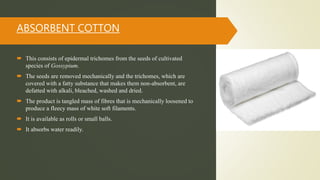
 This consists of epidermal trichomes from the seeds of cultivated
species of Gossypium.
 The seeds are removed mechanically and the trichomes, which are
covered with a fatty substance that makes them non-absorbent, are
defatted with alkali, bleached, washed and dried.
 The product is tangled mass of fibres that is mechanically loosened to
produce a fleecy mass of white soft filaments.
 It is available as rolls or small balls.
 It absorbs water readily.
Uses Of Absorbent Cotton
 The high absorbency of cotton wool makes it an excellent material for:
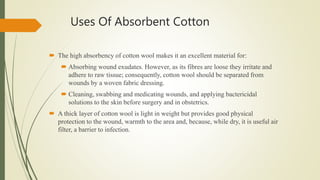
 Absorbing wound exudates. However, as its fibres are loose they irritate and
adhere to raw tissue; consequently, cotton wool should be separated from
wounds by a woven fabric dressing.
 Cleaning, swabbing and medicating wounds, and applying bactericidal
solutions to the skin before surgery and in obstetrics.
 A thick layer of cotton wool is light in weight but provides good physical
protection to the wound, warmth to the area and, because, while dry, it is useful air
filter, a barrier to infection.
ABSORBENT GAUZE
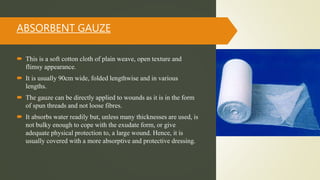
 This is a soft cotton cloth of plain weave, open texture and
flimsy appearance.
 It is usually 90cm wide, folded lengthwise and in various
lengths.
 The gauze can be directly applied to wounds as it is in the form
of spun threads and not loose fibres.
 It absorbs water readily but, unless many thicknesses are used, is
not bulky enough to cope with the exudate form, or give
adequate physical protection to, a large wound. Hence, it is
usually covered with a more absorptive and protective dressing.
ABSORBENT LINT
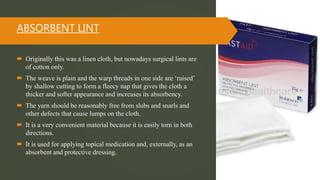
 Originally this was a linen cloth, but nowadays surgical lints are
of cotton only.
 The weave is plain and the warp threads in one side are ‘raised’
by shallow cutting to form a fleecy nap that gives the cloth a
thicker and softer appearance and increases its absorbency.
 The yarn should be reasonably free from slubs and snarls and
other defects that cause lumps on the cloth.
 It is a very convenient material because it is easily torn in both
directions.
 It is used for applying topical medication and, externally, as an
absorbent and protective dressing.
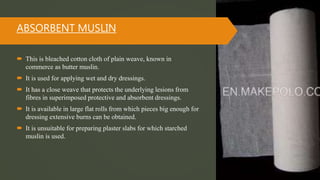
ABSORBENT MUSLIN
 This is bleached cotton cloth of plain weave, known in
commerce as butter muslin.
 It is used for applying wet and dry dressings.
 It has a close weave that protects the underlying lesions from
fibres in superimposed protective and absorbent dressings.
 It is available in large flat rolls from which pieces big enough for
dressing extensive burns can be obtained.
 It is unsuitable for preparing plaster slabs for which starched
muslin is used.
REFERENCE
 Cooper and Gunn, Dispensing for Pharmaceutical Students, 12th edition, 2008, CBS
Publishers and Distributors Pvt. Ltd., Page no. 271, 273, 274.
Absorbents

Absorbents

  • 1.
    Pharmaceutical Technology Presentation On ABSORBENTS Amity University,Noida Amity Institute of Pharmacy BY: UNNATI GARG
  • 2.
    ABSORBENT COTTON  Thisconsists of epidermal trichomes from the seeds of cultivated species of Gossypium.  The seeds are removed mechanically and the trichomes, which are covered with a fatty substance that makes them non-absorbent, are defatted with alkali, bleached, washed and dried.  The product is tangled mass of fibres that is mechanically loosened to produce a fleecy mass of white soft filaments.  It is available as rolls or small balls.  It absorbs water readily.
  • 3.
    Uses Of AbsorbentCotton  The high absorbency of cotton wool makes it an excellent material for:  Absorbing wound exudates. However, as its fibres are loose they irritate and adhere to raw tissue; consequently, cotton wool should be separated from wounds by a woven fabric dressing.  Cleaning, swabbing and medicating wounds, and applying bactericidal solutions to the skin before surgery and in obstetrics.  A thick layer of cotton wool is light in weight but provides good physical protection to the wound, warmth to the area and, because, while dry, it is useful air filter, a barrier to infection.
  • 4.
    ABSORBENT GAUZE  Thisis a soft cotton cloth of plain weave, open texture and flimsy appearance.  It is usually 90cm wide, folded lengthwise and in various lengths.  The gauze can be directly applied to wounds as it is in the form of spun threads and not loose fibres.  It absorbs water readily but, unless many thicknesses are used, is not bulky enough to cope with the exudate form, or give adequate physical protection to, a large wound. Hence, it is usually covered with a more absorptive and protective dressing.
  • 5.
    ABSORBENT LINT  Originallythis was a linen cloth, but nowadays surgical lints are of cotton only.  The weave is plain and the warp threads in one side are ‘raised’ by shallow cutting to form a fleecy nap that gives the cloth a thicker and softer appearance and increases its absorbency.  The yarn should be reasonably free from slubs and snarls and other defects that cause lumps on the cloth.  It is a very convenient material because it is easily torn in both directions.  It is used for applying topical medication and, externally, as an absorbent and protective dressing.
  • 6.
    ABSORBENT MUSLIN  Thisis bleached cotton cloth of plain weave, known in commerce as butter muslin.  It is used for applying wet and dry dressings.  It has a close weave that protects the underlying lesions from fibres in superimposed protective and absorbent dressings.  It is available in large flat rolls from which pieces big enough for dressing extensive burns can be obtained.  It is unsuitable for preparing plaster slabs for which starched muslin is used.
  • 7.
    REFERENCE  Cooper andGunn, Dispensing for Pharmaceutical Students, 12th edition, 2008, CBS Publishers and Distributors Pvt. Ltd., Page no. 271, 273, 274.