forms of topical medicines
by
Belton Winford
topical medication
• is a medication that is applied to body surfaces
such as the skin or mucous membranes
• Many topical medications are epicutaneous,
meaning that they are applied directly to the skin
• Topical medications may also be inhalational,
such as asthma medications, or applied to the
surface of tissues other than the skin, such as
eye drops applied to the conjunctiva, or ear
drops placed in the ear, or medications applied
to the surface of a tooth
• As a route of administration, topical
medications are contrasted with enteral (in
the digestive tract) and
intravascular/intravenous (injected into the
circulatory system).
• they are intended for local effect but they
may also cause systemic effects.
Advantages of Topical Drug Delivery
Systems:
• Avoidance of first pass metabolism.
• Convenient and easy to apply.
• Avoidance of the risks and inconveniences of
intravenous therapy and of the varied conditions
of absorption, like pH changes, presence of
enzymes, gastric emptying time etc.
• Achievement of efficacy with lower total daily
dosage of drug by continuous drug input.
• Avoids fluctuation in drug levels, inter- and
intrapatient variations.
• Ability to easily terminate the medications, when
needed.
• A relatively large area of application in
comparison with buccal or nasal cavity
• Ability to deliver drug more selectively to a
specific site.
• Avoidance of gastro-intestinal incompatibility.
• Providing utilization of drugs with short biological
half-life, narrow therapeutic window.
• Improving physiological and
pharmacological response.
• Improve patient compliance.
• Provide suitability for self-medication.
Disadvantages of Topical Drug Delivery
Systems:
• Skin irritation of contact dermatitis may occur
due to the drug and/or excipients.
• Poor permeability of some drugs through the
skin.
• Possibility of allergenic reactions.
• Can be used only for drugs which require very
small plasma concentration for action
• Enzyme in epidermis may denature the drugs
• Drugs of larger particle size not easy to absorb
through the skin
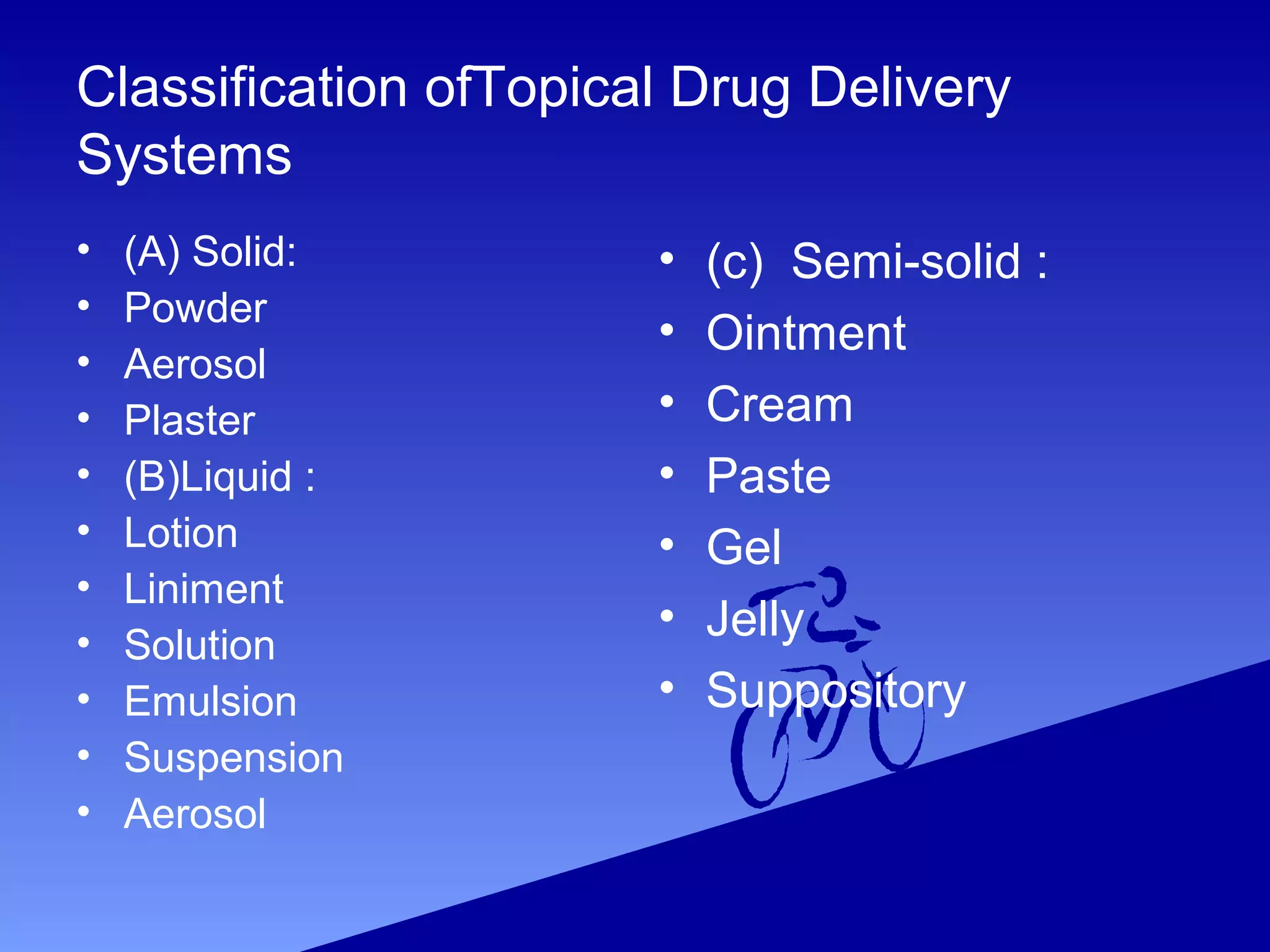
Classification ofTopical Drug Delivery
Systems
•
•
•
•
•
•
•
•
•
•
•

(A) Solid:
Powder
Aerosol
Plaster
(B)Liquid :
Lotion
Liniment
Solution
Emulsion
Suspension
Aerosol

•
•
•
•
•
•
•

(c) Semi-solid :
Ointment
Cream
Paste
Gel
Jelly
Suppository
creams
• emulsion of water and oil
• classified as oil in water (o/w) or water in oil
(w/o) emulsions
• o/w creams (e.g. vanishing creams) spread
easily and do not leave the skin greasy and
sticky
• w/o creams (e.g. cold cream) are more greasy
and more emollient
• creams contain emulsifiers and preservatives
which may cause contact allergy
ointment
• semi-solid preparations of hydrocarbons (petrolatum,
mineral oil, paraffins, synthetic hydrocarbons)
• strong emollient effect makes it useful in dry skin
conditions
• occlusive effect enhances penetration of active drug and
improves efficacy (especially in thickened, lichenified
skin)
• provides a protective film on the skin (e.g., useful in
housewife’s hands, irritant dermatitis)
• greasy, sticky, retains sweat (therefore, not suitable in
wet weepy dermatitis, hairy areas, skin prone to
folliculitis, or hot weather conditions)
• contains no water and does not require a preservative
paste
• mixture of powder and ointment (e.g., zinc oxide 20%
paste)
• addition of powder improves porosity (breathability). For
example, when treating diaper rash, a protective
ointment base which also allows breathability of the skin
is desired.
• addition of powder to change an ointment into a paste
also increases the consistency of the preparation so that
it is more difficult to rub off. This property is useful when
one does not want an irritating preparation to get onto
the normal skin (e.g., anthralin paste for treating
psoriasis).
gel
• transparent preparations containing
cellulose ethers or carbromer in water or a
water-alcohol mixture
• gels liquify on contact with the skin, dry
and leave a thin film of active medication
• gels tend to be drying
• they are useful in hairy areas
• they are cosmetically acceptable
lotion
• a loosely used term that nowadays includes any
liquid preparation in which inert or active
medications are suspended or dissolved
• an o/w emulsion with a high water content to
give the preparation a liquid consistency can be
considered a lotion
• most lotions are aqueous or hydroalcoholic
systems; small amounts of alcohol are added to
aid solubilization of the active ingredient(s) and
to hasten evaporation of the solvent from the
skin surface
• most acne lotions are hydroalcoholic which
evaporate fast; they are non-sticky and drying
• emulsion type lotions are usually not drying,
depending on the water content (higher water
and/or less oil is more drying)
• lotions are easy to apply to large areas
• lotions are suitable for hairy areas, skin prone to
folliculitis/acne, intertriginous areas
powder
• s either the pure drug by itself (talcum
powder), or is made of the drug mixed in a
carrier such as corn starch or corn cob
powder (Zeosorb AF - miconazole
powder). Can be used as an inhaled
topical (cocaine powder used in nasal
surgery).
tape
• Cordran tape is an example of a topical
steroid applied under occlusion by tape.
This greatly increases the potency and
absorption of the topical steroid and is
used to treat inflammatory skin diseases.
Factors to consider when choosing a topical
preparation:
• Always consider the effect of the vehicle.
An occlusive vehicle enhances penetration
of the active ingredient and improves
efficacy. The vehicle itself may have a
cooling, drying, emollient, or protective
action. It can also cause side effects by
being excessively drying or occlusive.
• Match the type of preparation with the type
of lesions. For example, avoid greasy
ointments for acute weepy dermatitis.
• Match the type of preparation with the site
(e.g., gel or lotion for hairy areas).
• Consider irritation or sensitization
potential. Generally, ointments and w/o
creams are less irritating, while gels are
irritating. Ointments do not contain
preservatives or emulsifiers if allergy to
these agents is a concern.

Forms of topical medicines

  • 1.
    forms of topicalmedicines by Belton Winford
  • 2.
    topical medication • isa medication that is applied to body surfaces such as the skin or mucous membranes • Many topical medications are epicutaneous, meaning that they are applied directly to the skin • Topical medications may also be inhalational, such as asthma medications, or applied to the surface of tissues other than the skin, such as eye drops applied to the conjunctiva, or ear drops placed in the ear, or medications applied to the surface of a tooth
  • 3.
    • As aroute of administration, topical medications are contrasted with enteral (in the digestive tract) and intravascular/intravenous (injected into the circulatory system). • they are intended for local effect but they may also cause systemic effects.
  • 4.
    Advantages of TopicalDrug Delivery Systems: • Avoidance of first pass metabolism. • Convenient and easy to apply. • Avoidance of the risks and inconveniences of intravenous therapy and of the varied conditions of absorption, like pH changes, presence of enzymes, gastric emptying time etc. • Achievement of efficacy with lower total daily dosage of drug by continuous drug input. • Avoids fluctuation in drug levels, inter- and intrapatient variations.
  • 5.
    • Ability toeasily terminate the medications, when needed. • A relatively large area of application in comparison with buccal or nasal cavity • Ability to deliver drug more selectively to a specific site. • Avoidance of gastro-intestinal incompatibility. • Providing utilization of drugs with short biological half-life, narrow therapeutic window.
  • 6.
    • Improving physiologicaland pharmacological response. • Improve patient compliance. • Provide suitability for self-medication.
  • 7.
    Disadvantages of TopicalDrug Delivery Systems: • Skin irritation of contact dermatitis may occur due to the drug and/or excipients. • Poor permeability of some drugs through the skin. • Possibility of allergenic reactions. • Can be used only for drugs which require very small plasma concentration for action • Enzyme in epidermis may denature the drugs • Drugs of larger particle size not easy to absorb through the skin
  • 8.
    Classification ofTopical DrugDelivery Systems • • • • • • • • • • • (A) Solid: Powder Aerosol Plaster (B)Liquid : Lotion Liniment Solution Emulsion Suspension Aerosol • • • • • • • (c) Semi-solid : Ointment Cream Paste Gel Jelly Suppository
  • 9.
    creams • emulsion ofwater and oil • classified as oil in water (o/w) or water in oil (w/o) emulsions • o/w creams (e.g. vanishing creams) spread easily and do not leave the skin greasy and sticky • w/o creams (e.g. cold cream) are more greasy and more emollient • creams contain emulsifiers and preservatives which may cause contact allergy
  • 10.
    ointment • semi-solid preparationsof hydrocarbons (petrolatum, mineral oil, paraffins, synthetic hydrocarbons) • strong emollient effect makes it useful in dry skin conditions • occlusive effect enhances penetration of active drug and improves efficacy (especially in thickened, lichenified skin) • provides a protective film on the skin (e.g., useful in housewife’s hands, irritant dermatitis) • greasy, sticky, retains sweat (therefore, not suitable in wet weepy dermatitis, hairy areas, skin prone to folliculitis, or hot weather conditions) • contains no water and does not require a preservative
  • 11.
    paste • mixture ofpowder and ointment (e.g., zinc oxide 20% paste) • addition of powder improves porosity (breathability). For example, when treating diaper rash, a protective ointment base which also allows breathability of the skin is desired. • addition of powder to change an ointment into a paste also increases the consistency of the preparation so that it is more difficult to rub off. This property is useful when one does not want an irritating preparation to get onto the normal skin (e.g., anthralin paste for treating psoriasis).
  • 12.
    gel • transparent preparationscontaining cellulose ethers or carbromer in water or a water-alcohol mixture • gels liquify on contact with the skin, dry and leave a thin film of active medication • gels tend to be drying • they are useful in hairy areas • they are cosmetically acceptable
  • 13.
    lotion • a looselyused term that nowadays includes any liquid preparation in which inert or active medications are suspended or dissolved • an o/w emulsion with a high water content to give the preparation a liquid consistency can be considered a lotion • most lotions are aqueous or hydroalcoholic systems; small amounts of alcohol are added to aid solubilization of the active ingredient(s) and to hasten evaporation of the solvent from the skin surface
  • 14.
    • most acnelotions are hydroalcoholic which evaporate fast; they are non-sticky and drying • emulsion type lotions are usually not drying, depending on the water content (higher water and/or less oil is more drying) • lotions are easy to apply to large areas • lotions are suitable for hairy areas, skin prone to folliculitis/acne, intertriginous areas
  • 15.
    powder • s eitherthe pure drug by itself (talcum powder), or is made of the drug mixed in a carrier such as corn starch or corn cob powder (Zeosorb AF - miconazole powder). Can be used as an inhaled topical (cocaine powder used in nasal surgery).
  • 16.
    tape • Cordran tapeis an example of a topical steroid applied under occlusion by tape. This greatly increases the potency and absorption of the topical steroid and is used to treat inflammatory skin diseases.
  • 17.
    Factors to considerwhen choosing a topical preparation: • Always consider the effect of the vehicle. An occlusive vehicle enhances penetration of the active ingredient and improves efficacy. The vehicle itself may have a cooling, drying, emollient, or protective action. It can also cause side effects by being excessively drying or occlusive. • Match the type of preparation with the type of lesions. For example, avoid greasy ointments for acute weepy dermatitis.
  • 18.
    • Match thetype of preparation with the site (e.g., gel or lotion for hairy areas). • Consider irritation or sensitization potential. Generally, ointments and w/o creams are less irritating, while gels are irritating. Ointments do not contain preservatives or emulsifiers if allergy to these agents is a concern.