DIFFERENT TYPES OF TOPICAL
FORMULATIONS
DR. ANISA KHAN
PGR DERMATOLOGY,LRH
1.Ointment 2.Cream
3.Lotion 4.Shake Lotion
5.Gel 6.Mousse
7.Paste 8.Emollient
9.Oil 10.Tincture
11.Powder 12.Spray
13.Patches 14.Paints
15.Collodions 16.Microsponges
17.Liposomes
CHOICE OF VEHICLE FOR TOPICAL MEDICATION
• The choice of vehicle for topical medication depends on the anatomical
site to be treated and the condition of the skin.
• Acutely inflamed skin ---- fairly bland preparation with least irritation
• Moist and exudative lesion ----- wet medication like creams and lotions
• Dry skin ---- ointments ( as they have occlusive action)
• Hair bearing skin esp. scalp ---- shampoo,lotion,gel,mousse
• Oily skin affected by acne ---- lotion and gel
• Sensitive skin affected by Rosecea ---- emollient effect of cream
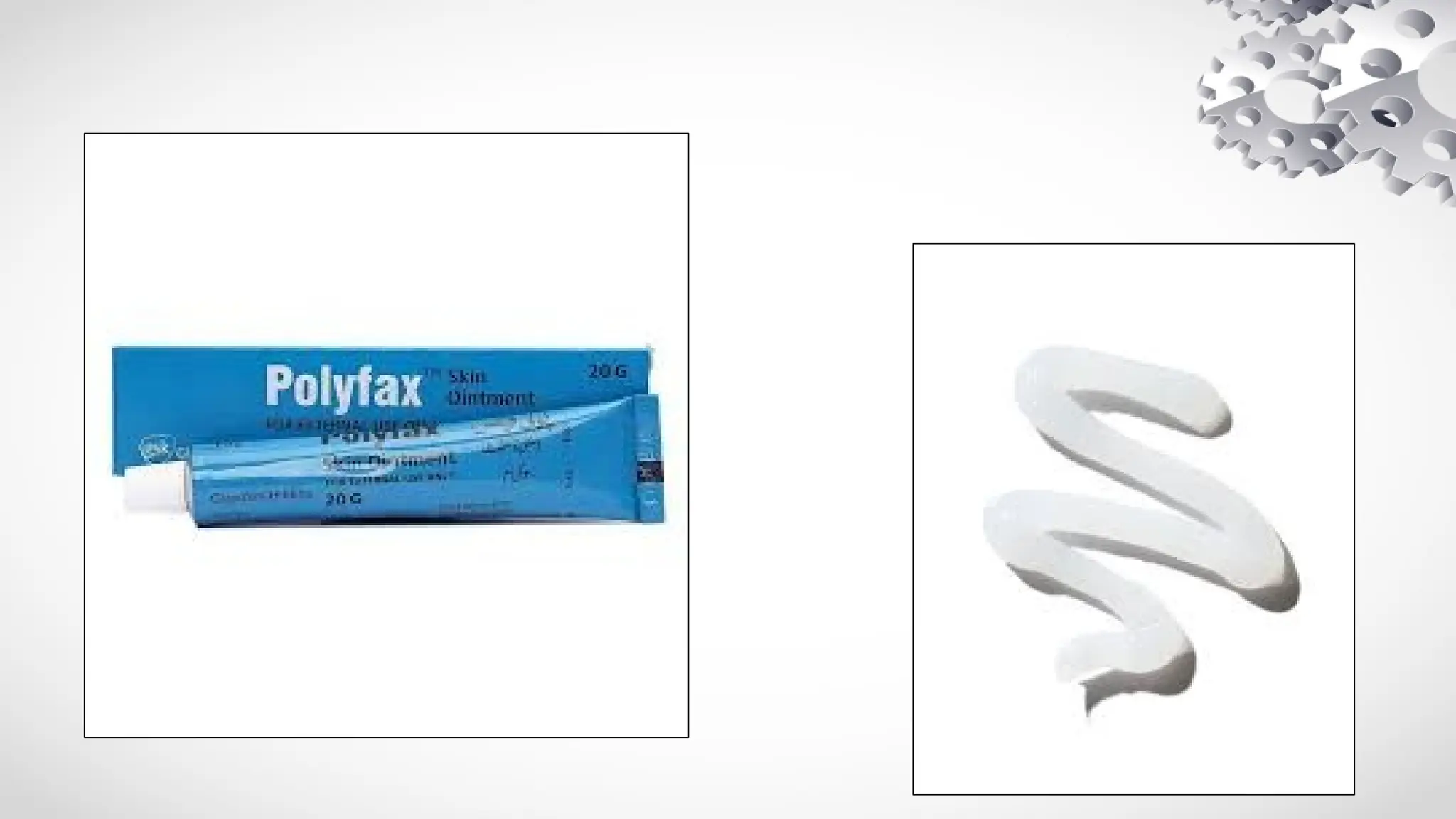
Ointment:
• Semi solid vehicle
• composed of lipids such as white soft paraffin (petrolatum) ----
which has both occlusive and emollient properties
• some ointments have emulsifying agents like polyhyric alcohol
(macrogols , polyethylene glycols) OR cetostearyl (ceteryl) alcohol
(emulsifying ointment BP)
• These humectants(polyhydric alcohol) help retain water to prevent
dehydration.
• Latter one is less greasy and have good solvent properties
CREAMS:
• semi solid emulsions containing both lipid and water
‐
• Emulsions are suspensions, either of lipid droplets in water or water droplets in
lipid
• Emulsifier is an agent which reduces the tension between water and oil to
stablize the emulsion.
 In the former category are aqueous or vanishing creams
• These are water miscible, cooling and soothing, and are well absorbed into the
skin and have oil as a disperse phase and water as continuous phase
 In the latter category are water in oil creams, for example oily cream
‐ ‐
• These are immiscible with water and more difficult to wash off. And have water
as disperse phase and water as continuous phase.
• They are emollient, lubricant and mildly occlusive (but less so than ointments).
PASTES:
• semi solid preparations containing a high proportion of finely powdered
‐
material such as zinc oxide or starch.
• Protective (fatty) pastes are greasy and therefore messy and water insoluble.
• They are difficult to apply and remove
• They are occlusive, protective and hydrating.
• Drying pastes, also called cooling pastes, are mixtures of powder with liquid.
• These are non-greasy, water miscible and easy to apply and remove.
• They are drying and soothing, and can be used in conjunction with dressings
as paste bandages or as vehicles for active medication
LOTIONS AND SHAKE LOTIONS :
• liquid formulations that are usually simple suspensions or solutions of
medication in water, alcohol or other liquids. e.g: permethrin lotions
• Those containing alcohol often sting, especially when applied to broken
skin and When left on the skin, the liquid will evaporate, leaving a film
of medication on the surface.
• Aqueous suspensions of powders such as calamine, which require
shaking prior to each application, are known as shake lotions.
GELS:
• Gels might be regarded as thickened lotions.
• They are semi-solid preparations containing high-molecular-
weight polymers, such as carboxypolymethylene (carbomer BP)
or methylcellulose.
• Lotions and gels are especially suitable for treating the scalp and
other hairy areas of skin.
• Like lotions, gels tend to dry when left on the skin.
• Gels can provide cosmetically acceptable formulations for use on
the face. e.g: Tretinoin gels for acne
EMULGELS:
• These are hybrid formulation combining the properties of
emulsions ( water in oil or oil in water ) and gels
• They offer speadability of an emulsion and cooling , non
greasy texture of a gel
• Emulgel on consistency basis lies b/w lotions and creams
• e.g:
• voltral emulgel
POWDERS:
• Those applied directly to the skin are also known as
dusting powders .
• They can reduce friction (talc) or excessive moisture
(starch).
• They are occasionally used to deliver drugs such as
antifungal agents applied to the feet
PAINTS:
• Paints are liquid preparations, either aqueous, hydro‐
• alcoholic or alcoholic (tinctures ) having thicker
consistency than collodions, which are usually applied
with a brush to the skin or mucous membranes and then
they evaporate ,leaving behind a layer of medicine.
• e.g: duofilm (salicylic acid) for warts, iodine antiseptic
paint, antifungal paint
• TINCTURE:
• A plant extract in an alcoholic ,vinegar or glycerine base
COLLODIONS:
• Collodions are liquid preparations consisting of cellulose
nitrate in organic solvent.
• They evaporate rapidly as they have thin consistency to
leave a flexible or brittle film that can hold medication in
contact with the skin.
• They are most frequently used to apply salicylic and lactic
acids to warts.
• They may also be used as protectives to seal minor cuts
and abrasions
• Collodions are also sometimes called paints
MICROSPONGES:
• These use porous beads, typically 10–25 μm in diameter,
to form a reservoir loaded with the drug.
• This approach has been used for cosmetics and
sunscreens as well as medications such as benzoyl
peroxide and retinoids.
• The aim is to provide sustained release of the drug whilst
reducing irritation.
LIPOSOMES:
• Liposomes are structures comprising an aqueous phase
surrounded by a lipid capsule, ranging widely in diameter from
several nanometers to several microns.
• They may contain several lipid layers
• Liposomes may be regarded as ‘penetration enhancing agents’
‐
• This technology is mainly used in cosmetics
• However, it can be useful for reducing irritation from topical use of
agents such as tretinoin, benzoyl peroxide and dithranol and
reducing the staining of skin and clothes from the latter
OIL AND SERUMS:
• SERUMS are water based ,thin,light consistency which
absorb quickly and have small molecules so penetrate
into the deep skin layers.
• They are applied before moisturizer
• OILS are oil based ,thick, emollient consistency which
absorb slowly and have larger molecules so penetrate
only into the superficial layers of skin.
• They are applied after moisturizer or instead of it.
EMOLLIENTS:
• It is a chemical formulation which softens and sooths the
skin
• Emollient is one of the ingredients of moisturizer
• E.g: creams,lotions,ointments, oils
• EXCIPIENT:
• An inactive ingredient in a formulation which acts only as
a vehicle or base to deliver the active ingredient
• INCIPIENT:
• A pro-form of a formulation which has to be improved
before use e. g: mixture of raw ingredients of lotion or
cream in a factory
MOUSSE:
• A light weight airy product with a foam like texture
• Used for hair and skin care
• e.g;
1. mousse hair removal spray
2. mousse anti-dandruff shampoo
3. mousse foundation
SKIN PATCHES:
• Adhesive treatments applied directly to the skin, targeting
specific concerns
• they contain hyaluronic acid, collagens, salicylic acid.
niacinamide etc
• e.g;
1. pimple patches
2. under eye patches
SPRAYS:
• These are liquid formulas in spray bottles which deliver
the product evenly to the skin
• e.g;
1. minoxidil hair spray
2. facial mists containing rose water
DIFFERENT TYPES OF TOPICAL FORMULATIONS.pptx

DIFFERENT TYPES OF TOPICAL FORMULATIONS.pptx

  • 1.
    DIFFERENT TYPES OFTOPICAL FORMULATIONS DR. ANISA KHAN PGR DERMATOLOGY,LRH
  • 2.
    1.Ointment 2.Cream 3.Lotion 4.ShakeLotion 5.Gel 6.Mousse 7.Paste 8.Emollient 9.Oil 10.Tincture 11.Powder 12.Spray 13.Patches 14.Paints 15.Collodions 16.Microsponges 17.Liposomes
  • 3.
    CHOICE OF VEHICLEFOR TOPICAL MEDICATION • The choice of vehicle for topical medication depends on the anatomical site to be treated and the condition of the skin. • Acutely inflamed skin ---- fairly bland preparation with least irritation • Moist and exudative lesion ----- wet medication like creams and lotions • Dry skin ---- ointments ( as they have occlusive action) • Hair bearing skin esp. scalp ---- shampoo,lotion,gel,mousse • Oily skin affected by acne ---- lotion and gel • Sensitive skin affected by Rosecea ---- emollient effect of cream
  • 4.
    Ointment: • Semi solidvehicle • composed of lipids such as white soft paraffin (petrolatum) ---- which has both occlusive and emollient properties • some ointments have emulsifying agents like polyhyric alcohol (macrogols , polyethylene glycols) OR cetostearyl (ceteryl) alcohol (emulsifying ointment BP) • These humectants(polyhydric alcohol) help retain water to prevent dehydration. • Latter one is less greasy and have good solvent properties
  • 6.
    CREAMS: • semi solidemulsions containing both lipid and water ‐ • Emulsions are suspensions, either of lipid droplets in water or water droplets in lipid • Emulsifier is an agent which reduces the tension between water and oil to stablize the emulsion.  In the former category are aqueous or vanishing creams • These are water miscible, cooling and soothing, and are well absorbed into the skin and have oil as a disperse phase and water as continuous phase  In the latter category are water in oil creams, for example oily cream ‐ ‐ • These are immiscible with water and more difficult to wash off. And have water as disperse phase and water as continuous phase. • They are emollient, lubricant and mildly occlusive (but less so than ointments).
  • 8.
    PASTES: • semi solidpreparations containing a high proportion of finely powdered ‐ material such as zinc oxide or starch. • Protective (fatty) pastes are greasy and therefore messy and water insoluble. • They are difficult to apply and remove • They are occlusive, protective and hydrating. • Drying pastes, also called cooling pastes, are mixtures of powder with liquid. • These are non-greasy, water miscible and easy to apply and remove. • They are drying and soothing, and can be used in conjunction with dressings as paste bandages or as vehicles for active medication
  • 10.
    LOTIONS AND SHAKELOTIONS : • liquid formulations that are usually simple suspensions or solutions of medication in water, alcohol or other liquids. e.g: permethrin lotions • Those containing alcohol often sting, especially when applied to broken skin and When left on the skin, the liquid will evaporate, leaving a film of medication on the surface. • Aqueous suspensions of powders such as calamine, which require shaking prior to each application, are known as shake lotions.
  • 12.
    GELS: • Gels mightbe regarded as thickened lotions. • They are semi-solid preparations containing high-molecular- weight polymers, such as carboxypolymethylene (carbomer BP) or methylcellulose. • Lotions and gels are especially suitable for treating the scalp and other hairy areas of skin. • Like lotions, gels tend to dry when left on the skin. • Gels can provide cosmetically acceptable formulations for use on the face. e.g: Tretinoin gels for acne
  • 15.
    EMULGELS: • These arehybrid formulation combining the properties of emulsions ( water in oil or oil in water ) and gels • They offer speadability of an emulsion and cooling , non greasy texture of a gel • Emulgel on consistency basis lies b/w lotions and creams • e.g: • voltral emulgel
  • 17.
    POWDERS: • Those applieddirectly to the skin are also known as dusting powders . • They can reduce friction (talc) or excessive moisture (starch). • They are occasionally used to deliver drugs such as antifungal agents applied to the feet
  • 19.
    PAINTS: • Paints areliquid preparations, either aqueous, hydro‐ • alcoholic or alcoholic (tinctures ) having thicker consistency than collodions, which are usually applied with a brush to the skin or mucous membranes and then they evaporate ,leaving behind a layer of medicine. • e.g: duofilm (salicylic acid) for warts, iodine antiseptic paint, antifungal paint • TINCTURE: • A plant extract in an alcoholic ,vinegar or glycerine base
  • 21.
    COLLODIONS: • Collodions areliquid preparations consisting of cellulose nitrate in organic solvent. • They evaporate rapidly as they have thin consistency to leave a flexible or brittle film that can hold medication in contact with the skin. • They are most frequently used to apply salicylic and lactic acids to warts. • They may also be used as protectives to seal minor cuts and abrasions • Collodions are also sometimes called paints
  • 23.
    MICROSPONGES: • These useporous beads, typically 10–25 μm in diameter, to form a reservoir loaded with the drug. • This approach has been used for cosmetics and sunscreens as well as medications such as benzoyl peroxide and retinoids. • The aim is to provide sustained release of the drug whilst reducing irritation.
  • 25.
    LIPOSOMES: • Liposomes arestructures comprising an aqueous phase surrounded by a lipid capsule, ranging widely in diameter from several nanometers to several microns. • They may contain several lipid layers • Liposomes may be regarded as ‘penetration enhancing agents’ ‐ • This technology is mainly used in cosmetics • However, it can be useful for reducing irritation from topical use of agents such as tretinoin, benzoyl peroxide and dithranol and reducing the staining of skin and clothes from the latter
  • 27.
    OIL AND SERUMS: •SERUMS are water based ,thin,light consistency which absorb quickly and have small molecules so penetrate into the deep skin layers. • They are applied before moisturizer • OILS are oil based ,thick, emollient consistency which absorb slowly and have larger molecules so penetrate only into the superficial layers of skin. • They are applied after moisturizer or instead of it.
  • 29.
    EMOLLIENTS: • It isa chemical formulation which softens and sooths the skin • Emollient is one of the ingredients of moisturizer • E.g: creams,lotions,ointments, oils • EXCIPIENT: • An inactive ingredient in a formulation which acts only as a vehicle or base to deliver the active ingredient • INCIPIENT: • A pro-form of a formulation which has to be improved before use e. g: mixture of raw ingredients of lotion or cream in a factory
  • 31.
    MOUSSE: • A lightweight airy product with a foam like texture • Used for hair and skin care • e.g; 1. mousse hair removal spray 2. mousse anti-dandruff shampoo 3. mousse foundation
  • 33.
    SKIN PATCHES: • Adhesivetreatments applied directly to the skin, targeting specific concerns • they contain hyaluronic acid, collagens, salicylic acid. niacinamide etc • e.g; 1. pimple patches 2. under eye patches
  • 35.
    SPRAYS: • These areliquid formulas in spray bottles which deliver the product evenly to the skin • e.g; 1. minoxidil hair spray 2. facial mists containing rose water