/]
T O P I C A L
P R E P A R A T I O N S
7/16/2022 1
DVM COLLEGE OF PHARMACY : Made by Jasbir
Ph no-7056360303 : Gmail-gouravkhatana303@gmail.com
CONTENTS
7/16/2022 2
including
7/16/2022 3
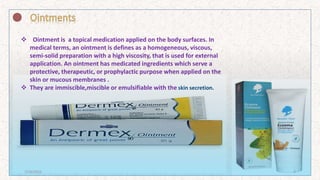
 Ointment is a topical medication applied on the body surfaces. In
medical terms, an ointment is defines as a homogeneous, viscous,
semi-solid preparation with a high viscosity, that is used for external
application. An ointment has medicated ingredients which serve a
protective, therapeutic, or prophylactic purpose when applied on the
skin or mucous membranes .
 They are immiscible,miscible or emulsifiable with the
7/16/2022 4
शामिल
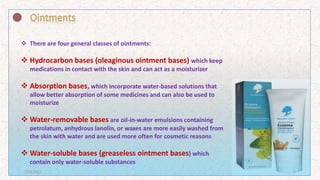
 There are four general classes of ointments:
 Hydrocarbon bases (oleaginous ointment bases) which keep
medications in contact with the skin and can act as a moisturizer
 Absorption bases, which incorporate water-based solutions that
allow better absorption of some medicines and can also be used to
moisturize
 Water-removable bases are oil-in-water emulsions containing
petrolatum, anhydrous lanolin, or waxes are more easily washed from
the skin with water and are used more often for cosmetic reasons
 Water-soluble bases (greaseless ointment bases) which
contain only water-soluble substances
7/16/2022 5
 Preparation of ointments
Ointments are prepared by two general methods
Procedure :
7/16/2022 6
7/16/2022 7
z
2) fusion Method :
* This method is suitable when base is solid.
Small Scale → porcelain dish is placed on water bath.
Large Scale → Carried out in large steam-jacke kettles.
Procedure: The ingredients and base are melted and properly mixed to obtain a uniform
product
Initially the ingredient of highest melting point is melted then remaining are added in
decreasing order M.P.
mixture is removed from water bath and stirr to cool it.
⇒ Insoluble drugs in base → added in powdered form.
⇒ Liquids or semisolids → added at a temp. of 40°C
⇒ Volatile or heat-labile ingredients. → added at last
Ointment: store in a tight container below
40° C (104° F), preferably at room
temperature. Avoid freezing.
7/16/2022 8
z
Advantages of ointments :
A- They stay longer on the surface of your skin,
trap moisture in to prevent wounds
B-The used bases can impart an additional emollient or lubricant effect.
• Disadvantages of ointments:
A- They are greasy in nature state.
B- They are not easy to remove.
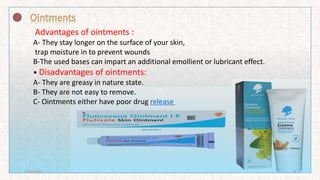
C- Ointments either have poor drug release
7/16/2022 9
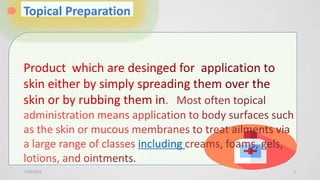
 Pharmaceutical Creams (topical preparation) are homogeneous, semi-solid or viscous preparations that
possess a relatively fluid consistency and are intended for external application to the skin or certain mucous
membranes for protective, therapeutic or prophylactic purposes especially where an occlusive effect is not
necessary.
 classification of Creams
1. o/w emulsion type cream. Vanishing creams. Foundation creams.(spread easily and do not leave the skin
greasy and sticky .
Contains: emulsifying agents of natural origins (bees wax, wool alcohols, and wool fat).
Properties: Emollient, Creamy, white or translucent and stiff.
.
7/16/2022 10
2.w/o emulsion type creams. Cleansing cream, Cold cream or moisturizing creams/Winter cream are more
greasy and more emollient.
Contains: synthetic waxes e.g., cetomacrogols & macrogols.
Properties: Causes rapid absorption & penetration; Thin, white & smooth in consistency.
Method of Preparation:
1. Trituration: It is used for finely divided insoluble powder
particles or liquids. *Insoluble powders are added by geometric
dilution. Liquids are added by making well in the center. Air pocket
formation avoided. Use glass slab when small quantities are
mixed. Mortar and pestle used when large quantities are to be
mixed.
2 Levigation: Incorporation of insoluble coarse particles. Also
known as "Wet grinding". Insoluble coarse powder is rubbed with
molten base or liquid or a semi solid base. A considerable shearing
force is applied to avoid grittiness.
7/16/2022 11
3.Fusion Method
The fusion method boldly relies on the application of a certain amount
of heat. It is the process of melting or liquefying through high
temperature or fire. It can be pretty much compared to cooking. You
mix all the ingredients and the meat in a casserole, as they boil within
due to the fire underneath. As for the making of creams, the base, and
all other components are combined and mixed inside the heated
machine.
7/16/2022 12
ADVANTAGES: They gives prolong contact in their site of
application than any other pharmaceutical semisolid dosage forms.
 Injured area can be dried quickly by creams than other semi-solid
preparations.
 Non-irritating when applied to the skin.
 Easily water washable. Easy to wipe away.
 Less greasy compared to ointment.
 Easy to spread on the skin's surface (i.e. easy to apply).
DISADVANTAGES:
 Stability is not as good as ointment.
 They are less hydrophobic than other semisolid preparation, so risk
of contamination is high than the others.
7/16/2022 13
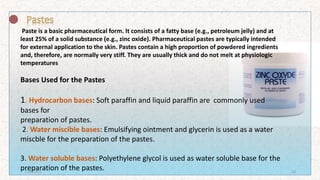
Paste is a basic pharmaceutical form. It consists of a fatty base (e.g., petroleum jelly) and at
least 25% of a solid substance (e.g., zinc oxide). Pharmaceutical pastes are typically intended
for external application to the skin. Pastes contain a high proportion of powdered ingredients
and, therefore, are normally very stiff. They are usually thick and do not melt at physiologic
temperatures
Bases Used for the Pastes
1. Hydrocarbon bases: Soft paraffin and liquid paraffin are commonly used
bases for
preparation of pastes.
2. Water miscible bases: Emulsifying ointment and glycerin is used as a water
miscble for the preparation of the pastes.
3. Water soluble bases: Polyethylene glycol is used as water soluble base for the
preparation of the pastes.
7/16/2022 14
Method of Preparation of Pastes:-Pastes can be prepared in the
same manner as ointments. The trituration method is only used in case
of base is liquid or semi-solid while the fusion method used in case of
base is semi-solid or solid in nature.
Storage of Pastes:-Pastes should be stored in well closed container and
placed in a cool and dry place so as to prevent
evaporation of moisture present in the pastes.
7/16/2022 15
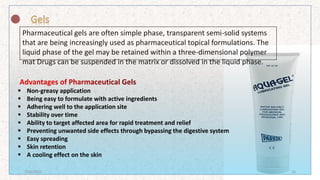
Pharmaceutical gels are often simple phase, transparent semi-solid systems
that are being increasingly used as pharmaceutical topical formulations. The
liquid phase of the gel may be retained within a three-dimensional polymer
mat Drugs can be suspended in the matrix or dissolved in the liquid phase.
 Non-greasy application
 Being easy to formulate with active ingredients
 Adhering well to the application site
 Stability over time
 Ability to target affected area for rapid treatment and relief
 Preventing unwanted side effects through bypassing the digestive system
 Easy spreading
 Skin retention
 A cooling effect on the skin
7/16/2022 16
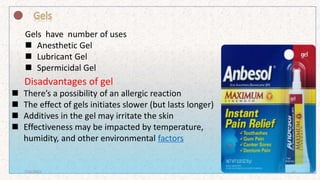
Gels have number of uses
 Anesthetic Gel
 Lubricant Gel
 Spermicidal Gel
Disadvantages of gel
 There’s a possibility of an allergic reaction
 The effect of gels initiates slower (but lasts longer)
 Additives in the gel may irritate the skin
 Effectiveness may be impacted by temperature,
humidity, and other environmental factors
7/16/2022 17
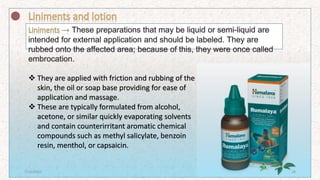
 They are applied with friction and rubbing of the
skin, the oil or soap base providing for ease of
application and massage.
 These are typically formulated from alcohol,
acetone, or similar quickly evaporating solvents
and contain counterirritant aromatic chemical
compounds such as methyl salicylate, benzoin
resin, menthol, or capsaicin.
7/16/2022 18
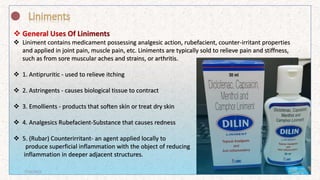
 Liniment contains medicament possessing analgesic action, rubefacient, counter-irritant properties
and applied in joint pain, muscle pain, etc. Liniments are typically sold to relieve pain and stiffness,
such as from sore muscular aches and strains, or arthritis.
 1. Antipruritic - used to relieve itching
 2. Astringents - causes biological tissue to contract
 3. Emollients - products that soften skin or treat dry skin
 4. Analgesics Rubefacient-Substance that causes redness
 5. (Rubar) Counterirritant- an agent applied locally to
produce superficial inflammation with the object of reducing
inflammation in deeper adjacent structures.
7/16/2022 19
 Containers: The liniment should be dispensed in coloured fluted bottles
in order to distinguish them from preparations meant for internal use.
 Labeling:-The label must state "For external used only" and "Shake well
before use". The label should carry the warning, "Not to be applied to
open wound or broken skin".
 Storage: Liniment should be stored in tightly closed airtight container in
cool and dry place.
7/16/2022 20
 Introduction:- Lotions are less viscose liquid dosage form mainly meant for
external or topical application without friction. . Lotions may be used for local
action as cooling, Alcohol sometimes mixed in aqueous lotions for its cooling
and soothing effect. soothing or protective purposes. They are generally
applied for antiseptic action.
Examples of lotions:
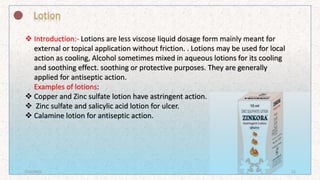
 Copper and Zinc sulfate lotion have astringent action.
 Zinc sulfate and salicylic acid lotion for ulcer.
 Calamine lotion for antiseptic action.
7/16/2022 21
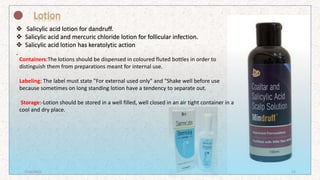
 Salicylic acid lotion for dandruff.
 Salicylic acid and mercuric chloride lotion for follicular infection.
 Salicylic acid lotion has keratolytic action
.
Containers:The lotions should be dispensed in coloured fluted bottles in order to
distinguish them from preparations meant for internal use.
Labeling: The label must state "For external used only" and "Shake well before use
because sometimes on long standing lotion have a tendency to separate out.
Storage:-Lotion should be stored in a well filled, well closed in an air tight container in a
cool and dry place.
7/16/2022 22
▸ Difference between liniments and lotions:
1. Liniments are liquid or semi-liquid preparations that are generally applied to the skin by rubbing
and friction on the skin, whereas lotions are liquids that are intended for external application
without friction
2. • The liniment has a higher viscosity than the lotion, while the lotion has a lower viscosity than
liniment this is why they need to be rubbed.
3. The liniment is applied to relieve pain, and swelling of joints, whereas lotion is used to moisturize
the skin and is used as a treatment for superficial injuries.
4. Liniment is applied after taking a bath as pain relief, whereas lotion is ideal for use during the day
and during summer.
5. Liniments are suitable for unbroken skin, whereas lotions are suitable for mild to slightly dry skin.
6. Liniments are alcoholic or oleaginous solutions are emulsions, while, lotions are aqueous or
sometimes alcoholic preparation.
7/16/2022 23
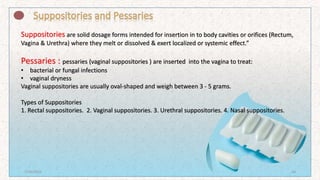
Suppositories are solid dosage forms intended for insertion in to body cavities or orifices (Rectum,
Vagina & Urethra) where they melt or dissolved & exert localized or systemic effect.”
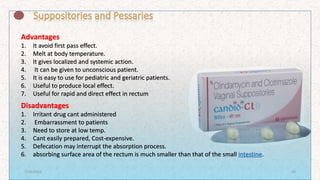
Pessaries : pessaries (vaginal suppositories ) are inserted into the vagina to treat:
• bacterial or fungal infections
• vaginal dryness
Vaginal suppositories are usually oval-shaped and weigh between 3 - 5 grams.
Types of Suppositories
1. Rectal suppositories. 2. Vaginal suppositories. 3. Urethral suppositories. 4. Nasal suppositories.
7/16/2022 24
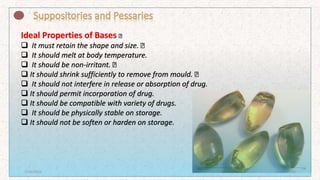
Ideal Properties of Bases
 It must retain the shape and size.
 It should melt at body temperature.
 It should be non-irritant.
 It should shrink sufficiently to remove from mould.
 It should not interfere in release or absorption of drug.
 It should permit incorporation of drug.
 It should be compatible with variety of drugs.
 It should be physically stable on storage.
 It should not be soften or harden on storage.
7/16/2022 25
Suppository Bases
Suppository bases should be non-toxic, non-irritating, inert, compatible with the active ingredients,
and easily formed by compression or molding. Suppository bases can be classified as according to
their composition and physical properties.
 Oleaginous (fatty or hydrophobic) bases
Oleaginous bases include theobroma oil (also called cocoa butter) and synthetic
triglyceride mixtures. At ordinary room temperatures of 15°C-25°C (59°F-77°F),
theobroma oil is a hard amorphous solid, while at 30°C-35°C (86°F-95°F)/ body
temperature, it melts readily to a bland, non-irritating oil. However as it is a
polymorphic compound and if overheated, theobroma oil will convert to a
metastable structure that melts in the 25°C-30°C (77°-86°F) range. Thus, the
finished suppositories would melt at room temperature and not be usable. Synthetic
triglycerides consist of hydrogenated vegetable oils such as palm kernel oil and
cottonseed oil, and have the advantage of not exhibiting polymorphism.
7/16/2022 26
 Water soluble (water miscible) bases
Water soluble bases are those containing glycerinated gelatin or polyethylene glycol
(PEG) polymers. They release the drug by dissolving in the aqueous body fluids. The
formulation do not need to melt at body temperature, so water soluble suppositories
can be formulated with much higher melting points and thus may be safely stored at
room temperature.
 Glycerinated Gelatin is particularly used for vaginal suppositories.
Glycerinated gelatin suppositories tend to disperse slowly in mucous secretions
thus to provide prolonged release of active ingredients. However, as the
glycerinated base tend to absorb moisture due to its hygroscopic nature, these
suppositories must be kept in well-closed containers.
7/16/2022 27
 Methods of Preparation
 Suppositories can be extemporaneously prepared by different methods:
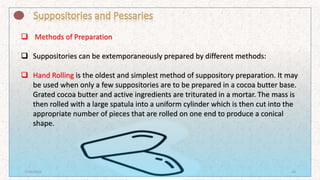
 Hand Rolling is the oldest and simplest method of suppository preparation. It may
be used when only a few suppositories are to be prepared in a cocoa butter base.
Grated cocoa butter and active ingredients are triturated in a mortar. The mass is
then rolled with a large spatula into a uniform cylinder which is then cut into the
appropriate number of pieces that are rolled on one end to produce a conical
shape.
7/16/2022 28
 Compression Molding is a method of preparing suppositories from a mixed mass
of grated suppository base and medicaments which is forced into a special
compression mold. The method requires that the capacity of the molds first be
determined by compressing a small amount of the base into the dies and
weighing the finished suppositories. When active ingredients are added, it is
necessary to omit a portion of the suppository base, based on the density factors
of the active ingredients.
 Fusion Molding involves first melting the suppository base, and then dispersing
or dissolving the drug in the melted base. The mixture is removed from the heat
and poured into a suppository mold. When the mixture has congealed, the
suppositories are removed from the mold. The fusion method can be used with
all types of suppositories and must be used with most of them.
7/16/2022 29
Advantages
1. It avoid first pass effect.
2. Melt at body temperature.
3. It gives localized and systemic action.
4. It can be given to unconscious patient.
5. It is easy to use for pediatric and geriatric patients.
6. Useful to produce local effect.
7. Useful for rapid and direct effect in rectum
Disadvantages
1. Irritant drug cant administered
2. Embarrassment to patients
3. Need to store at low temp.
4. Cant easily prepared, Cost-expensive.
5. Defecation may interrupt the absorption process.
6. absorbing surface area of the rectum is much smaller than that of the small intestine.
7/16/2022 30

Topicalpreparation.pptx

  • 1.
    /] T O PI C A L P R E P A R A T I O N S 7/16/2022 1 DVM COLLEGE OF PHARMACY : Made by Jasbir Ph no-7056360303 : Gmail-gouravkhatana303@gmail.com
  • 2.
  • 3.
  • 4.
     Ointment isa topical medication applied on the body surfaces. In medical terms, an ointment is defines as a homogeneous, viscous, semi-solid preparation with a high viscosity, that is used for external application. An ointment has medicated ingredients which serve a protective, therapeutic, or prophylactic purpose when applied on the skin or mucous membranes .  They are immiscible,miscible or emulsifiable with the 7/16/2022 4
  • 5.
    शामिल  There arefour general classes of ointments:  Hydrocarbon bases (oleaginous ointment bases) which keep medications in contact with the skin and can act as a moisturizer  Absorption bases, which incorporate water-based solutions that allow better absorption of some medicines and can also be used to moisturize  Water-removable bases are oil-in-water emulsions containing petrolatum, anhydrous lanolin, or waxes are more easily washed from the skin with water and are used more often for cosmetic reasons  Water-soluble bases (greaseless ointment bases) which contain only water-soluble substances 7/16/2022 5
  • 6.
     Preparation ofointments Ointments are prepared by two general methods Procedure : 7/16/2022 6
  • 7.
  • 8.
    z 2) fusion Method: * This method is suitable when base is solid. Small Scale → porcelain dish is placed on water bath. Large Scale → Carried out in large steam-jacke kettles. Procedure: The ingredients and base are melted and properly mixed to obtain a uniform product Initially the ingredient of highest melting point is melted then remaining are added in decreasing order M.P. mixture is removed from water bath and stirr to cool it. ⇒ Insoluble drugs in base → added in powdered form. ⇒ Liquids or semisolids → added at a temp. of 40°C ⇒ Volatile or heat-labile ingredients. → added at last Ointment: store in a tight container below 40° C (104° F), preferably at room temperature. Avoid freezing. 7/16/2022 8
  • 9.
    z Advantages of ointments: A- They stay longer on the surface of your skin, trap moisture in to prevent wounds B-The used bases can impart an additional emollient or lubricant effect. • Disadvantages of ointments: A- They are greasy in nature state. B- They are not easy to remove. C- Ointments either have poor drug release 7/16/2022 9
  • 10.
     Pharmaceutical Creams(topical preparation) are homogeneous, semi-solid or viscous preparations that possess a relatively fluid consistency and are intended for external application to the skin or certain mucous membranes for protective, therapeutic or prophylactic purposes especially where an occlusive effect is not necessary.  classification of Creams 1. o/w emulsion type cream. Vanishing creams. Foundation creams.(spread easily and do not leave the skin greasy and sticky . Contains: emulsifying agents of natural origins (bees wax, wool alcohols, and wool fat). Properties: Emollient, Creamy, white or translucent and stiff. . 7/16/2022 10
  • 11.
    2.w/o emulsion typecreams. Cleansing cream, Cold cream or moisturizing creams/Winter cream are more greasy and more emollient. Contains: synthetic waxes e.g., cetomacrogols & macrogols. Properties: Causes rapid absorption & penetration; Thin, white & smooth in consistency. Method of Preparation: 1. Trituration: It is used for finely divided insoluble powder particles or liquids. *Insoluble powders are added by geometric dilution. Liquids are added by making well in the center. Air pocket formation avoided. Use glass slab when small quantities are mixed. Mortar and pestle used when large quantities are to be mixed. 2 Levigation: Incorporation of insoluble coarse particles. Also known as "Wet grinding". Insoluble coarse powder is rubbed with molten base or liquid or a semi solid base. A considerable shearing force is applied to avoid grittiness. 7/16/2022 11
  • 12.
    3.Fusion Method The fusionmethod boldly relies on the application of a certain amount of heat. It is the process of melting or liquefying through high temperature or fire. It can be pretty much compared to cooking. You mix all the ingredients and the meat in a casserole, as they boil within due to the fire underneath. As for the making of creams, the base, and all other components are combined and mixed inside the heated machine. 7/16/2022 12
  • 13.
    ADVANTAGES: They givesprolong contact in their site of application than any other pharmaceutical semisolid dosage forms.  Injured area can be dried quickly by creams than other semi-solid preparations.  Non-irritating when applied to the skin.  Easily water washable. Easy to wipe away.  Less greasy compared to ointment.  Easy to spread on the skin's surface (i.e. easy to apply). DISADVANTAGES:  Stability is not as good as ointment.  They are less hydrophobic than other semisolid preparation, so risk of contamination is high than the others. 7/16/2022 13
  • 14.
    Paste is abasic pharmaceutical form. It consists of a fatty base (e.g., petroleum jelly) and at least 25% of a solid substance (e.g., zinc oxide). Pharmaceutical pastes are typically intended for external application to the skin. Pastes contain a high proportion of powdered ingredients and, therefore, are normally very stiff. They are usually thick and do not melt at physiologic temperatures Bases Used for the Pastes 1. Hydrocarbon bases: Soft paraffin and liquid paraffin are commonly used bases for preparation of pastes. 2. Water miscible bases: Emulsifying ointment and glycerin is used as a water miscble for the preparation of the pastes. 3. Water soluble bases: Polyethylene glycol is used as water soluble base for the preparation of the pastes. 7/16/2022 14
  • 15.
    Method of Preparationof Pastes:-Pastes can be prepared in the same manner as ointments. The trituration method is only used in case of base is liquid or semi-solid while the fusion method used in case of base is semi-solid or solid in nature. Storage of Pastes:-Pastes should be stored in well closed container and placed in a cool and dry place so as to prevent evaporation of moisture present in the pastes. 7/16/2022 15
  • 16.
    Pharmaceutical gels areoften simple phase, transparent semi-solid systems that are being increasingly used as pharmaceutical topical formulations. The liquid phase of the gel may be retained within a three-dimensional polymer mat Drugs can be suspended in the matrix or dissolved in the liquid phase.  Non-greasy application  Being easy to formulate with active ingredients  Adhering well to the application site  Stability over time  Ability to target affected area for rapid treatment and relief  Preventing unwanted side effects through bypassing the digestive system  Easy spreading  Skin retention  A cooling effect on the skin 7/16/2022 16
  • 17.
    Gels have numberof uses  Anesthetic Gel  Lubricant Gel  Spermicidal Gel Disadvantages of gel  There’s a possibility of an allergic reaction  The effect of gels initiates slower (but lasts longer)  Additives in the gel may irritate the skin  Effectiveness may be impacted by temperature, humidity, and other environmental factors 7/16/2022 17
  • 18.
     They areapplied with friction and rubbing of the skin, the oil or soap base providing for ease of application and massage.  These are typically formulated from alcohol, acetone, or similar quickly evaporating solvents and contain counterirritant aromatic chemical compounds such as methyl salicylate, benzoin resin, menthol, or capsaicin. 7/16/2022 18
  • 19.
     Liniment containsmedicament possessing analgesic action, rubefacient, counter-irritant properties and applied in joint pain, muscle pain, etc. Liniments are typically sold to relieve pain and stiffness, such as from sore muscular aches and strains, or arthritis.  1. Antipruritic - used to relieve itching  2. Astringents - causes biological tissue to contract  3. Emollients - products that soften skin or treat dry skin  4. Analgesics Rubefacient-Substance that causes redness  5. (Rubar) Counterirritant- an agent applied locally to produce superficial inflammation with the object of reducing inflammation in deeper adjacent structures. 7/16/2022 19
  • 20.
     Containers: Theliniment should be dispensed in coloured fluted bottles in order to distinguish them from preparations meant for internal use.  Labeling:-The label must state "For external used only" and "Shake well before use". The label should carry the warning, "Not to be applied to open wound or broken skin".  Storage: Liniment should be stored in tightly closed airtight container in cool and dry place. 7/16/2022 20
  • 21.
     Introduction:- Lotionsare less viscose liquid dosage form mainly meant for external or topical application without friction. . Lotions may be used for local action as cooling, Alcohol sometimes mixed in aqueous lotions for its cooling and soothing effect. soothing or protective purposes. They are generally applied for antiseptic action. Examples of lotions:  Copper and Zinc sulfate lotion have astringent action.  Zinc sulfate and salicylic acid lotion for ulcer.  Calamine lotion for antiseptic action. 7/16/2022 21
  • 22.
     Salicylic acidlotion for dandruff.  Salicylic acid and mercuric chloride lotion for follicular infection.  Salicylic acid lotion has keratolytic action . Containers:The lotions should be dispensed in coloured fluted bottles in order to distinguish them from preparations meant for internal use. Labeling: The label must state "For external used only" and "Shake well before use because sometimes on long standing lotion have a tendency to separate out. Storage:-Lotion should be stored in a well filled, well closed in an air tight container in a cool and dry place. 7/16/2022 22
  • 23.
    ▸ Difference betweenliniments and lotions: 1. Liniments are liquid or semi-liquid preparations that are generally applied to the skin by rubbing and friction on the skin, whereas lotions are liquids that are intended for external application without friction 2. • The liniment has a higher viscosity than the lotion, while the lotion has a lower viscosity than liniment this is why they need to be rubbed. 3. The liniment is applied to relieve pain, and swelling of joints, whereas lotion is used to moisturize the skin and is used as a treatment for superficial injuries. 4. Liniment is applied after taking a bath as pain relief, whereas lotion is ideal for use during the day and during summer. 5. Liniments are suitable for unbroken skin, whereas lotions are suitable for mild to slightly dry skin. 6. Liniments are alcoholic or oleaginous solutions are emulsions, while, lotions are aqueous or sometimes alcoholic preparation. 7/16/2022 23
  • 24.
    Suppositories are soliddosage forms intended for insertion in to body cavities or orifices (Rectum, Vagina & Urethra) where they melt or dissolved & exert localized or systemic effect.” Pessaries : pessaries (vaginal suppositories ) are inserted into the vagina to treat: • bacterial or fungal infections • vaginal dryness Vaginal suppositories are usually oval-shaped and weigh between 3 - 5 grams. Types of Suppositories 1. Rectal suppositories. 2. Vaginal suppositories. 3. Urethral suppositories. 4. Nasal suppositories. 7/16/2022 24
  • 25.
    Ideal Properties ofBases  It must retain the shape and size.  It should melt at body temperature.  It should be non-irritant.  It should shrink sufficiently to remove from mould.  It should not interfere in release or absorption of drug.  It should permit incorporation of drug.  It should be compatible with variety of drugs.  It should be physically stable on storage.  It should not be soften or harden on storage. 7/16/2022 25
  • 26.
    Suppository Bases Suppository basesshould be non-toxic, non-irritating, inert, compatible with the active ingredients, and easily formed by compression or molding. Suppository bases can be classified as according to their composition and physical properties.  Oleaginous (fatty or hydrophobic) bases Oleaginous bases include theobroma oil (also called cocoa butter) and synthetic triglyceride mixtures. At ordinary room temperatures of 15°C-25°C (59°F-77°F), theobroma oil is a hard amorphous solid, while at 30°C-35°C (86°F-95°F)/ body temperature, it melts readily to a bland, non-irritating oil. However as it is a polymorphic compound and if overheated, theobroma oil will convert to a metastable structure that melts in the 25°C-30°C (77°-86°F) range. Thus, the finished suppositories would melt at room temperature and not be usable. Synthetic triglycerides consist of hydrogenated vegetable oils such as palm kernel oil and cottonseed oil, and have the advantage of not exhibiting polymorphism. 7/16/2022 26
  • 27.
     Water soluble(water miscible) bases Water soluble bases are those containing glycerinated gelatin or polyethylene glycol (PEG) polymers. They release the drug by dissolving in the aqueous body fluids. The formulation do not need to melt at body temperature, so water soluble suppositories can be formulated with much higher melting points and thus may be safely stored at room temperature.  Glycerinated Gelatin is particularly used for vaginal suppositories. Glycerinated gelatin suppositories tend to disperse slowly in mucous secretions thus to provide prolonged release of active ingredients. However, as the glycerinated base tend to absorb moisture due to its hygroscopic nature, these suppositories must be kept in well-closed containers. 7/16/2022 27
  • 28.
     Methods ofPreparation  Suppositories can be extemporaneously prepared by different methods:  Hand Rolling is the oldest and simplest method of suppository preparation. It may be used when only a few suppositories are to be prepared in a cocoa butter base. Grated cocoa butter and active ingredients are triturated in a mortar. The mass is then rolled with a large spatula into a uniform cylinder which is then cut into the appropriate number of pieces that are rolled on one end to produce a conical shape. 7/16/2022 28
  • 29.
     Compression Moldingis a method of preparing suppositories from a mixed mass of grated suppository base and medicaments which is forced into a special compression mold. The method requires that the capacity of the molds first be determined by compressing a small amount of the base into the dies and weighing the finished suppositories. When active ingredients are added, it is necessary to omit a portion of the suppository base, based on the density factors of the active ingredients.  Fusion Molding involves first melting the suppository base, and then dispersing or dissolving the drug in the melted base. The mixture is removed from the heat and poured into a suppository mold. When the mixture has congealed, the suppositories are removed from the mold. The fusion method can be used with all types of suppositories and must be used with most of them. 7/16/2022 29
  • 30.
    Advantages 1. It avoidfirst pass effect. 2. Melt at body temperature. 3. It gives localized and systemic action. 4. It can be given to unconscious patient. 5. It is easy to use for pediatric and geriatric patients. 6. Useful to produce local effect. 7. Useful for rapid and direct effect in rectum Disadvantages 1. Irritant drug cant administered 2. Embarrassment to patients 3. Need to store at low temp. 4. Cant easily prepared, Cost-expensive. 5. Defecation may interrupt the absorption process. 6. absorbing surface area of the rectum is much smaller than that of the small intestine. 7/16/2022 30

Editor's Notes

  • #4 ailments: common illness