TOPICAL MEANING :
Designed for or involving local application and action
topical
ˈtɒpɪk(ə)l/
• Skin-the largest organ of body and most accessible organ
• Surface area 1.5 – 2m2
• Drug penetration is inversely proportional
to thickness of stratum corneum
PENETRATION PATHWAY- MECANISM OF
PERCUTANEOUS ABSORPTION
• Transcellular
• Intercellular
• Eccrine
• Follicular
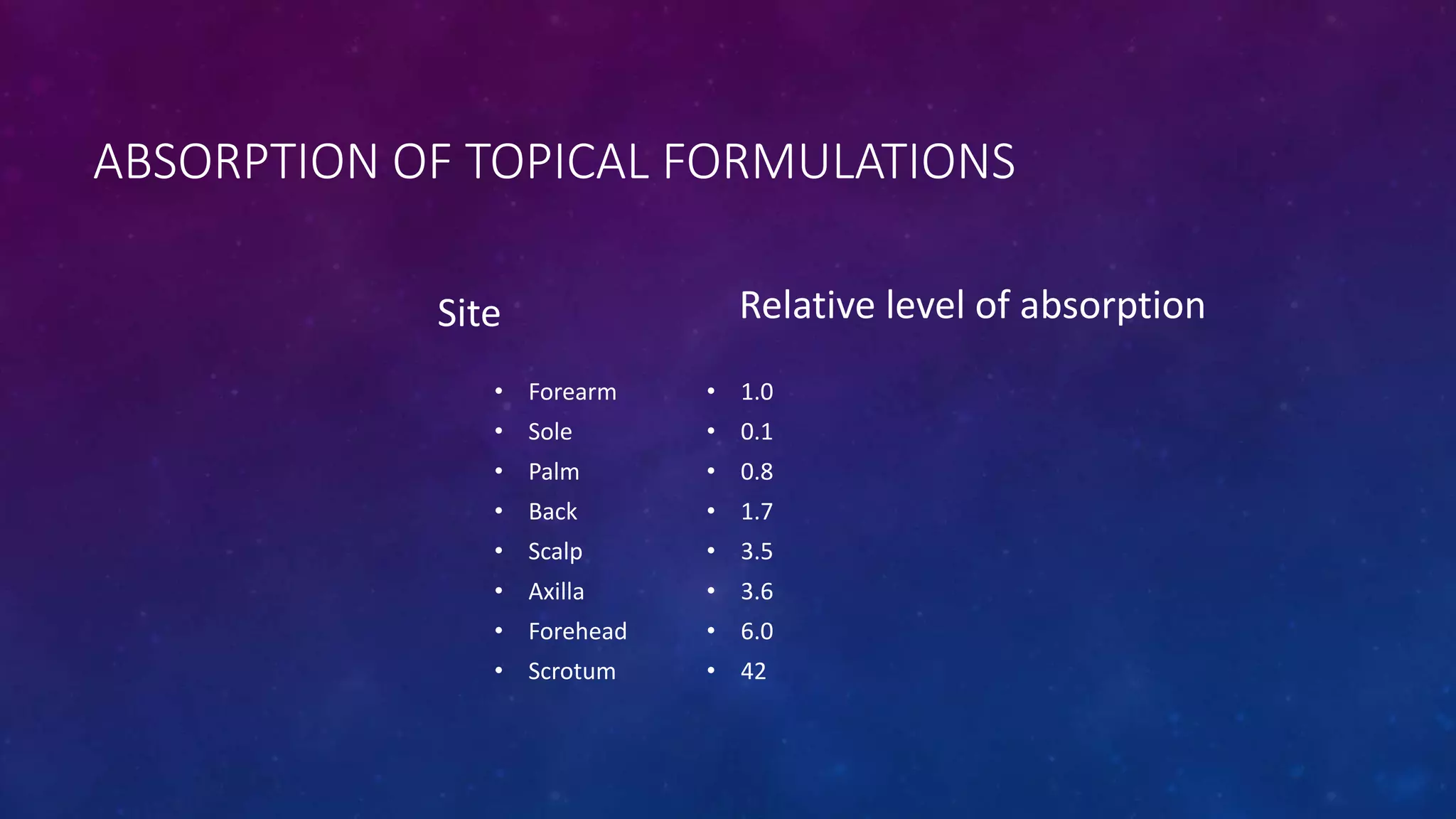
ABSORPTION OF TOPICAL FORMULATIONS
Site
• Forearm
• Sole
• Palm
• Back
• Scalp
• Axilla
• Forehead
• Scrotum
Relative level of absorption
• 1.0
• 0.1
• 0.8
• 1.7
• 3.5
• 3.6
• 6.0
• 42
FACTORS AFFECTING TOPICAL ABSORPTION
• Drug concentration
• Site of application
• Age of patient
• Surface area applied
• Friction and heat
• Occlusion
• Hair follicles
• Cutaneous circulation
ADVANTAGES OF TOPICAL APPLICATIONS
• Achieve high concentration for drug in skin
• Minimal exposure to other organs
• Increase efficacy
DISADVANTAGES
• Time consuming
• Complicated instructions
• Messy
• Local side effects
HOW TO PRESCRIBE
A. Specify concentration of drug
B. Vehicle
C. Frequency
D. Quantity
A.CONCENTRATION OF DRUG:
Percentage representing the proportion of the formulation by weight or volume
• Weight– 1% W/W –1 gram of drug in 100 gram of formulation
• Volume- 1% W/V– solution contain 1 gram drug in 100 ml of formulation
• Parts- 1 part in 1000 solution - means 1 gram in 1000 solution
B.VEHICLE :
DEFINATION: Substance which is incorporated into a topical preparation in
order to facilitate the drug delivery by bringing the drug in contact with the
skin
AN IDEAL VEHICLE……….
• Elicits no pharmacological effect
• Solubilize the drug
• Releases the drug with appropriate kinetics
• Is chemically and physically stable
• Cosmetically appealing
• Non allergic and non irritating
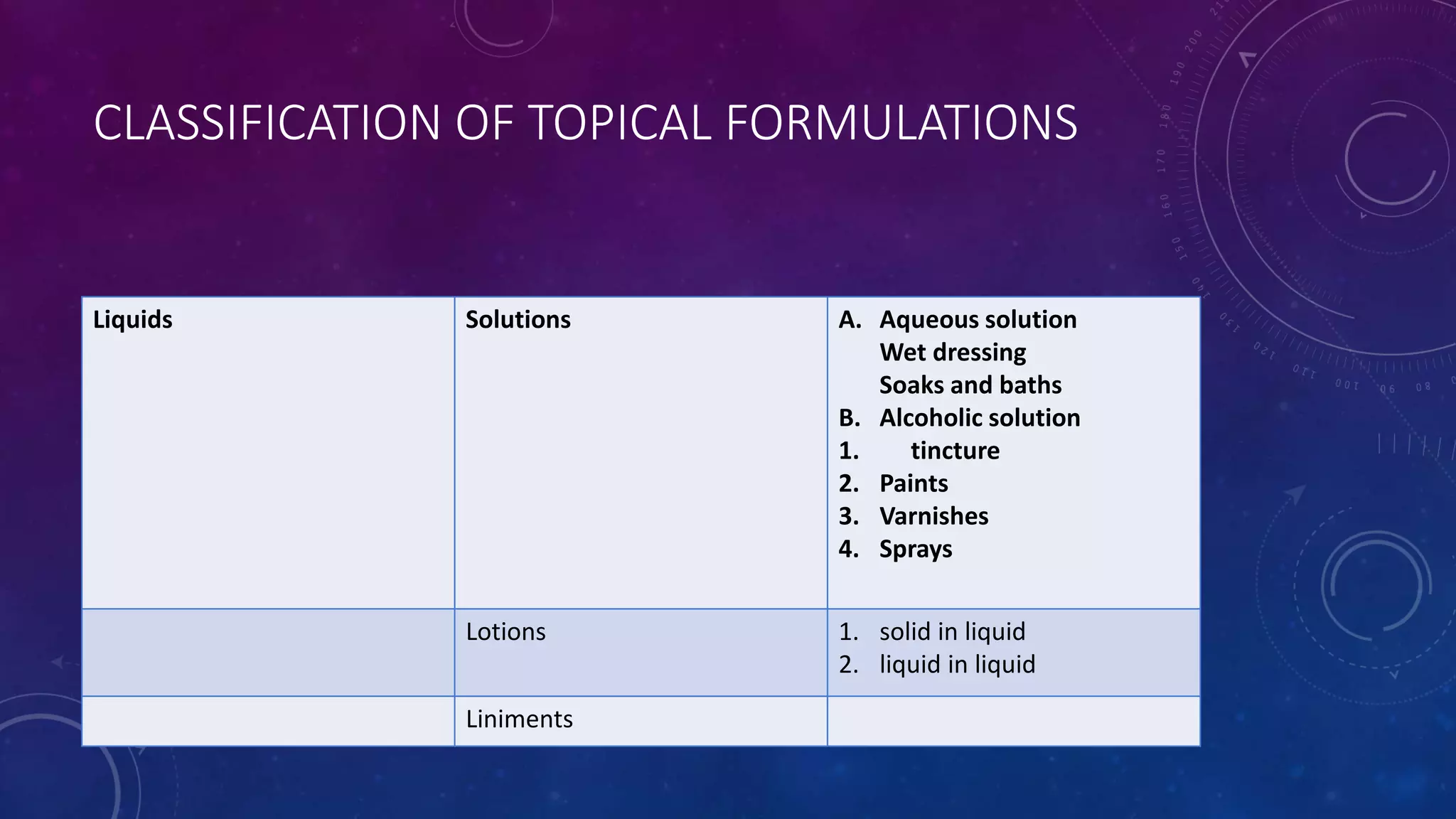
CLASSIFICATION OF TOPICAL FORMULATIONS
Liquids Solutions A. Aqueous solution
Wet dressing
Soaks and baths
B. Alcoholic solution
1. tincture
2. Paints
3. Varnishes
4. Sprays
Lotions 1. solid in liquid
2. liquid in liquid
Liniments
Semisolid Creams 1. Lipophilic
2. Hydrophilic
3. Amphibilic
4. Barrier
Ointments 1. Hydrophobic
2. Waterabsorbing
3. Hydrophilic
Gels 1. Lipophilic
2. Hydrophilic
Pastes 1. Hard pastes
2. Soft pastes
3. Drying pastes
Solid Powders
Poultice
Tapes
Plasters
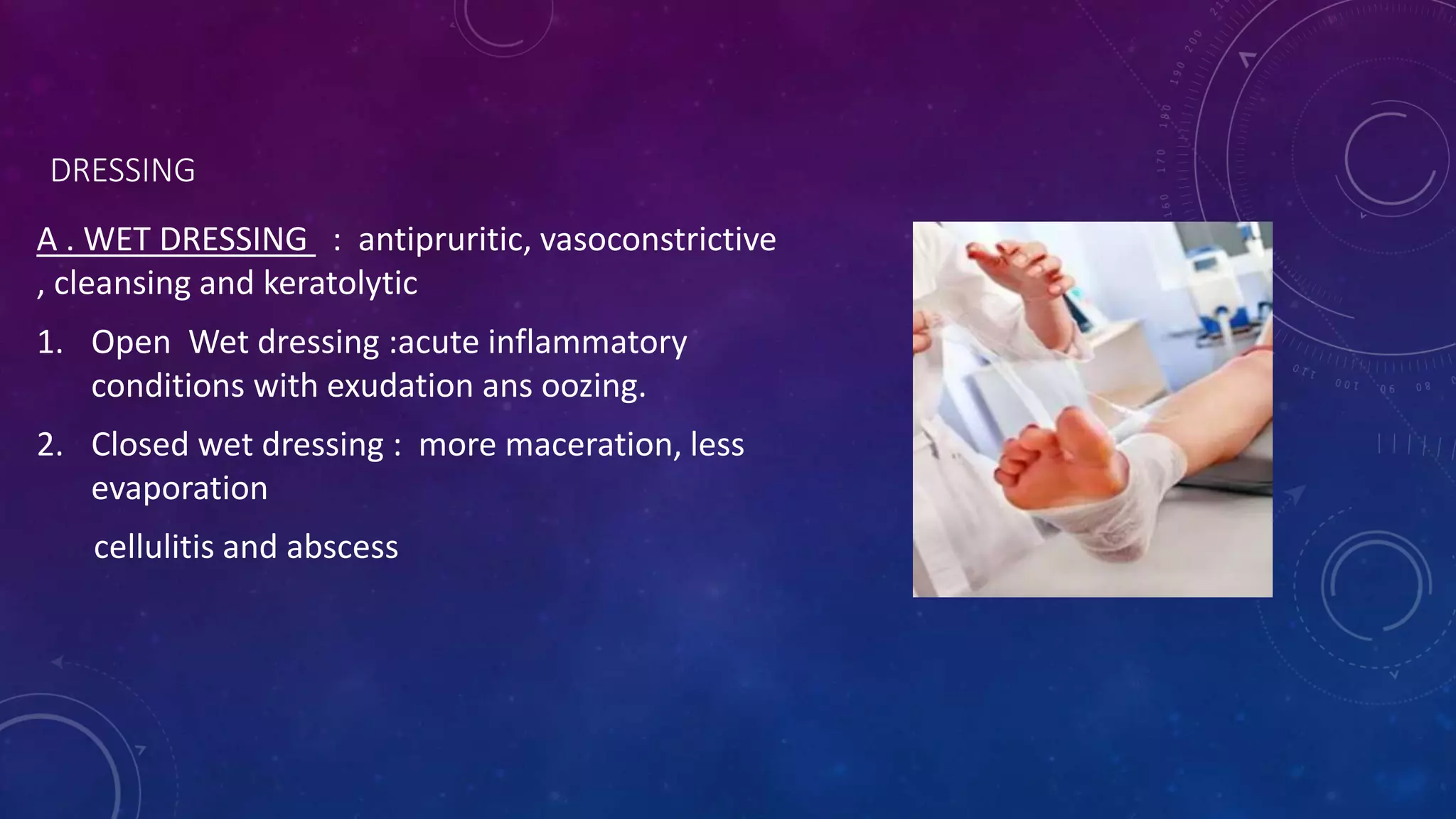
DRESSING
A . WET DRESSING : antipruritic, vasoconstrictive
, cleansing and keratolytic
1. Open Wet dressing :acute inflammatory
conditions with exudation ans oozing.
2. Closed wet dressing : more maceration, less
evaporation
cellulitis and abscess
BATHS
• Cleansing
• Soothing
• Antipruritic
• Antiinflammatory
• Eg. Sitz bath,medicated baths,Psoralen
bath, tar bath
SOAKS
Preferred for extremities.
Convenient for patient.
PAINTS:
• Liquid preparations,either aqueous, hydroalcoholic or alcoholic
• usually applied with a brush.
• Eg- gentian violet: antibiotic, anti candidial
- brilliant green: antibacterial
- castellani paint: intertrigo, paronychia,tinea
LOTIONS:
• Liquid formulations, suspension or solution of medication in water, alcohol or
other liquid.
• Advantages-convenient
- ratio of inert and active ingredients can be altered.
• Disadvantages- drying effect
- irritating
TINCTURES
• Alcoholic solutions designed to deliver large amount of active ingredients at a
site without any undesirable cosmetic effect.
• Used in areas which are not usually easily irritated such as scalp.
OINTMENTS:
• Semisolid vehicles composed of lipid such as White soft paraffin (BP
• Occlusive & emolient property
• Good hydration
• Used in chronic,dry,brittle,lichenified dermatoses
• Contain no water
• Do not sustain the growth of microorganisms
• Difficult to spread
• Decrease evaporation
• Can not be used in acute discharging lesions
LINIMENTS
• Nonalcoholic solutions of drugs in oil or alcoholic solutions of soap.
• Rubbed into the skin with friction
• Analgesics, counter irritants, astringent, emollient and antipruritic
CREAM:
Semisolid emulsions composed of both lipid and water
• Lipid in water-aqeous or vanishing cream
Water miscible cooling and soothing
• Water in oil- immiscible with water, more difficult to wash off,
Emollient lubricant and mildly occlusive
PASTES:
Semisolid preparations containing high proportion of finely powdered material
such as zinc oxide or starch
Protective paste: -Greasy ,water insoluble ,difficult to apply and remove.
-accurate localisation occlusive protective and hydrating
Drying paste: cooling paste
- mixture of powdered with liquid
- non greasy water miscible.
In comparison with ointments pastes are thicker, drier and more solid.
GELS:
Thickened lotions, semisolid preparations, containing HMW polymer.
Suitable for treating the scalp & hairy areas of skin
POWDERS
• Applied directly to skin
• Also known as dusting powders
• Reduce friction
• Absorb excessive moisture
POULTICES
• Wet solid masses of particles applied to
exudative lesions
• Bed sores,leg ulcers.
• May be heated before application
• Acts as cleansers and absorptive agents.
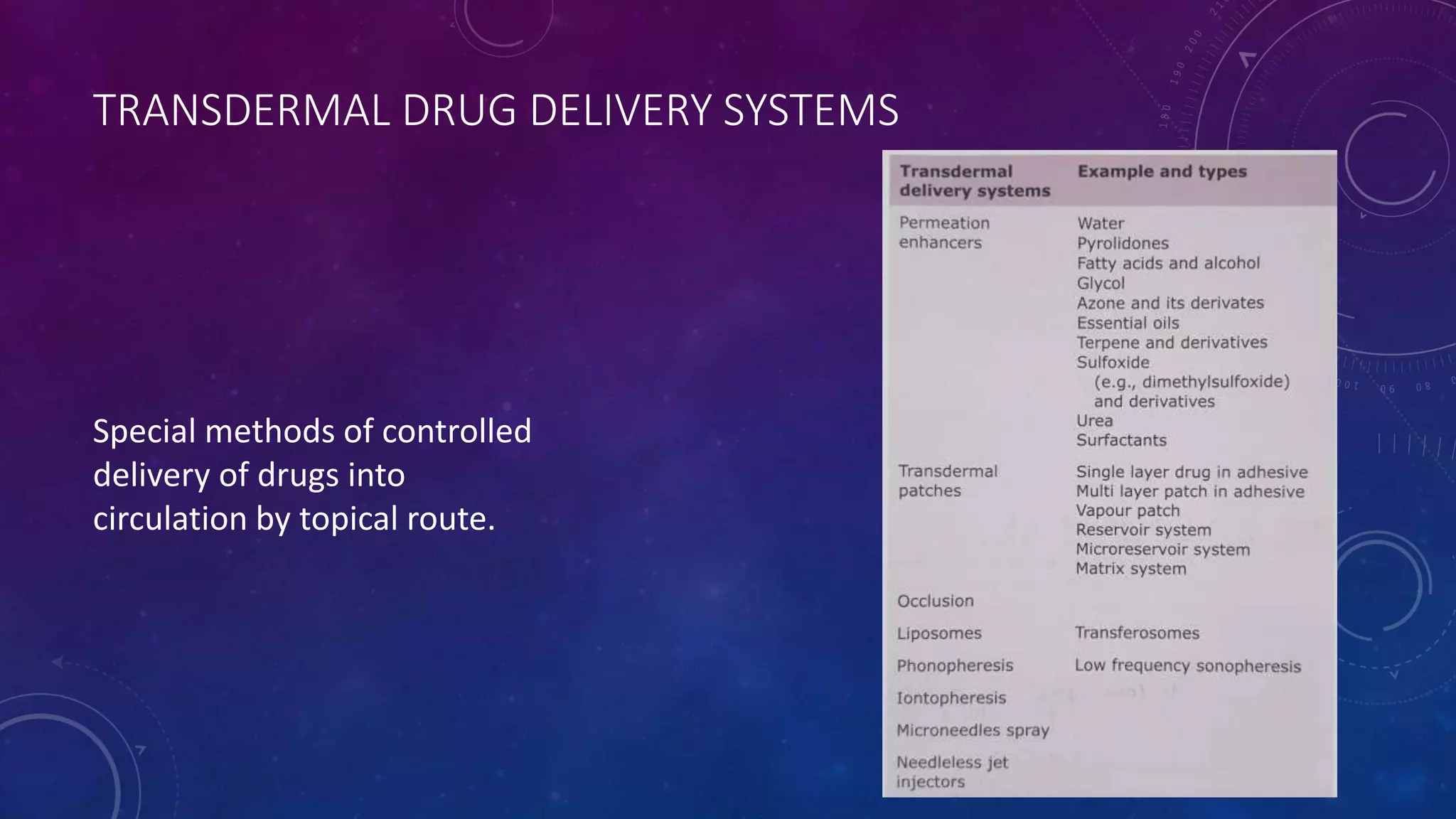
TRANSDERMAL DRUG DELIVERY SYSTEMS
Special methods of controlled
delivery of drugs into
circulation by topical route.
COLLODIONS:
Liquid preparation Consisting of cellulose nitrate in organic solvent.
• Evaporate easily to leave a flexible film.
• Most frequently used to apply salicylic and lactic acids to warts.
• May also be used as protectives ro seal minor cuts and abrasions.
• Easy to apply and water repellent.
• Inflammable.
MICROSPONGES:
Used as porous beads 10-25ùm in diameter to form a reservoir loaded with
drug
• Used for cosmetics and sunscreens
• Provide sustain release of drug while reducing irritation.
LIPOSOMES:
Aqueous phase surrounded by a lipid capsule
• Used as Penetration enhancing agents.
• Useful for reducing irritation from topical use of agents such as
tretinoin,benzoyl peroxide
• Reduces staining of skin and clothes from latter.
POTENCY OF VEHICLES
From high to low
Ointments
Cream
Lotion
Gel
Spray
Foam
C. FREQUENCY:
• Maximize response while avoiding side effects.
• Excessive applications can lead to systemic effects
• Emollients-frequently
• Active preparations-OD / BID
• Pharmacological actions persists even after Drug has been wiped out
• Increasing interval between application is a effective way of tapering intensity
of treatment
• Rebound and tachyphylaxis
D. QUANTITY:
How much to apply
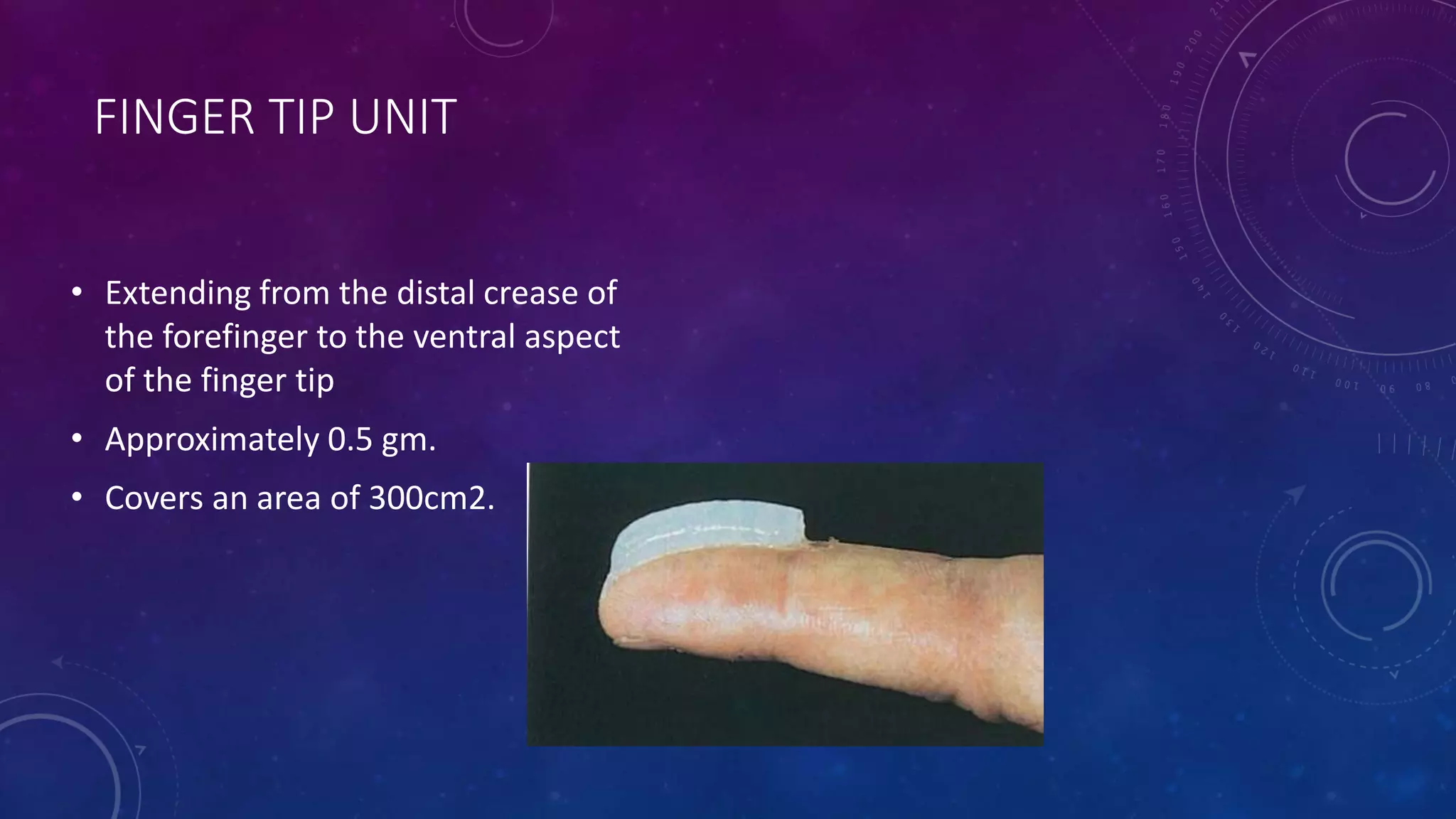
FINGER TIP UNIT
• Extending from the distal crease of
the forefinger to the ventral aspect
of the finger tip
• Approximately 0.5 gm.
• Covers an area of 300cm2.
HAZARDS OF TOPICAL TREATMENT:
• Local
• Sysyemic
TOPICAL TREATMENT USED IN MANAGEMENT OF
SKIN DISEASE
• Emollients
• Astringent
• Antiinfective agents : -Antiseptics.
- chlorine releasing agents
-antibiotics
• Antifungals
• Antivirals
• Topical glucocorticoids
• Calcineurin inhibitors
• Retinoids
• Vitamin D analogues
• Cytotoxic and antineoplastic agents
• Depilatories
• Sensitizing agents
• Sunscreens
• Tars
• Antihistamines
• Antiperspirants
• Traditional remedies
• Miscellaneous agents
Antiseptics :
• Alcohols
• Aldehydes
• Cetrimide and benzalkolium chloride
• chlorhexidine
• Chlorxylenal
• hydrogen peroxide
• Iodine
Chlorine releasing agents:
• Tri closan
• Triclocarbon
• Hexachlorphane
ANTIBIOTICS:
• Bacitracin
• Clindamycin
• Dapsone
• Erythromycin
• Fusidic acid
• Gentamycin
• Metronidazole
• Mupirocin
• Neomycin & framycetin
• Polymyxin B
• Retapamulin
• Silver sulfadiazine
• Tetracyclines
ANTIFUNGAL AGENTS :
• Allylamine- Terbinafine, Naftifine, Butenafine
• Imidazole- Bifonazole,clotrimazole, Econazole, Fenticonazole, ketoconazole, Isoconazole, Miconazole, OnIconazole,
Terconazole, Tioconazole,Serteconazole,Sillconazole, Lulliconazole, & others.
• Morpholines- Amorolfine
• Polyenes- Nystatin
• Ciclopirox olamine
• Tolnaftate
• Undecylenic acid
• Others:- whitfield’s ointment - 6% benzoic acid + 3% salycylic acid in petrolatum base
-Zinc pyrithione
- Selenium sulphide
- Resorcinol
- Azelaic acid
ANTIVIRAL AGENTS :
• Aciclovir & penciclovir
• Idoxuridine
• Podophyllin & podophyllotoxin
• Others: - fluorouracil
- bleomycin
- imiquimod
- cidofovir
ANTIPARASITIC AGENTS:
• Pyrethroids
• Malathion
• Dimethicone
• Ivermectin
• Others: - Benzyl benzoate
- Carbaryl
- GBHC
- Crotamiton
RETINOIDS:
• Retinol
• retinoic acid
• isotretinoin
• Alitretinoin
• Adapelene
• Benaroline
• Tazorolene
VITAMIN D ANALOGUES:
• Talcalcitol
• Calcitriol
• Calcipotrial
• Moxacalcitol
CYTOTOXIC AND NEOPLASTIC DRUGS :
• 5-Fluorouracil
• Bleomycin
• Diclofenac
• Imiquimod.
• Ingenol mebrale
• Mechlorethamine
• Methotrexate
• T4 endonuclease
DEPIGMENTING AGENTS:
• Hydroquinone
• Monobenzyl ether of hydroquinone
• Retinoic acid
• Kligman cream
• Kojic acid
• Liquiritin
Sunscreen =dose of UVB radiation producing minimal erythema with sunscreen
dose of UVB radiation producing minimal erythema without sunscreen
Humectants-
Compounds with high affinity for water.
Draw water into stratum corneum
Have emollient effect on dry skin
Eg: gelatin
glycerin
urea
Lacquer – liquid dissolved in alcohol that dries to form a hard protective
covering.
Emollients- derived from Latin word mollire which means to soften the skin.
CHOICE OF PREPARATION
Condition of skin Preparation of choice
Acute, inflamed,red,swollen, lesions with dischrge Lotions
Subacut, chronic, less inflamed Lotion, paste, cream.
Dry, scaly, thickened, lichenified Ointments, pastes
Generalized, widespread Eruptions Lotions
Soles Ointments
Hairy area Lotions
ADVICE TO PATIENT
• Where to use and where not to use
• How much to use
• When to use (timing)
• How to use
• Warning
THANK
YOU

Topical Prepartions in dermatology

  • 2.
    TOPICAL MEANING : Designedfor or involving local application and action topical ˈtɒpɪk(ə)l/
  • 3.
    • Skin-the largestorgan of body and most accessible organ • Surface area 1.5 – 2m2 • Drug penetration is inversely proportional to thickness of stratum corneum
  • 4.
    PENETRATION PATHWAY- MECANISMOF PERCUTANEOUS ABSORPTION • Transcellular • Intercellular • Eccrine • Follicular
  • 5.
    ABSORPTION OF TOPICALFORMULATIONS Site • Forearm • Sole • Palm • Back • Scalp • Axilla • Forehead • Scrotum Relative level of absorption • 1.0 • 0.1 • 0.8 • 1.7 • 3.5 • 3.6 • 6.0 • 42
  • 6.
    FACTORS AFFECTING TOPICALABSORPTION • Drug concentration • Site of application • Age of patient • Surface area applied • Friction and heat • Occlusion • Hair follicles • Cutaneous circulation
  • 7.
    ADVANTAGES OF TOPICALAPPLICATIONS • Achieve high concentration for drug in skin • Minimal exposure to other organs • Increase efficacy
  • 8.
    DISADVANTAGES • Time consuming •Complicated instructions • Messy • Local side effects
  • 9.
    HOW TO PRESCRIBE A.Specify concentration of drug B. Vehicle C. Frequency D. Quantity
  • 10.
    A.CONCENTRATION OF DRUG: Percentagerepresenting the proportion of the formulation by weight or volume • Weight– 1% W/W –1 gram of drug in 100 gram of formulation • Volume- 1% W/V– solution contain 1 gram drug in 100 ml of formulation • Parts- 1 part in 1000 solution - means 1 gram in 1000 solution
  • 11.
    B.VEHICLE : DEFINATION: Substancewhich is incorporated into a topical preparation in order to facilitate the drug delivery by bringing the drug in contact with the skin AN IDEAL VEHICLE………. • Elicits no pharmacological effect • Solubilize the drug • Releases the drug with appropriate kinetics • Is chemically and physically stable • Cosmetically appealing • Non allergic and non irritating
  • 12.
    CLASSIFICATION OF TOPICALFORMULATIONS Liquids Solutions A. Aqueous solution Wet dressing Soaks and baths B. Alcoholic solution 1. tincture 2. Paints 3. Varnishes 4. Sprays Lotions 1. solid in liquid 2. liquid in liquid Liniments
  • 13.
    Semisolid Creams 1.Lipophilic 2. Hydrophilic 3. Amphibilic 4. Barrier Ointments 1. Hydrophobic 2. Waterabsorbing 3. Hydrophilic Gels 1. Lipophilic 2. Hydrophilic Pastes 1. Hard pastes 2. Soft pastes 3. Drying pastes Solid Powders Poultice Tapes Plasters
  • 14.
    DRESSING A . WETDRESSING : antipruritic, vasoconstrictive , cleansing and keratolytic 1. Open Wet dressing :acute inflammatory conditions with exudation ans oozing. 2. Closed wet dressing : more maceration, less evaporation cellulitis and abscess
  • 15.
    BATHS • Cleansing • Soothing •Antipruritic • Antiinflammatory • Eg. Sitz bath,medicated baths,Psoralen bath, tar bath
  • 16.
  • 17.
    PAINTS: • Liquid preparations,eitheraqueous, hydroalcoholic or alcoholic • usually applied with a brush. • Eg- gentian violet: antibiotic, anti candidial - brilliant green: antibacterial - castellani paint: intertrigo, paronychia,tinea
  • 18.
    LOTIONS: • Liquid formulations,suspension or solution of medication in water, alcohol or other liquid. • Advantages-convenient - ratio of inert and active ingredients can be altered. • Disadvantages- drying effect - irritating
  • 19.
    TINCTURES • Alcoholic solutionsdesigned to deliver large amount of active ingredients at a site without any undesirable cosmetic effect. • Used in areas which are not usually easily irritated such as scalp.
  • 20.
    OINTMENTS: • Semisolid vehiclescomposed of lipid such as White soft paraffin (BP • Occlusive & emolient property • Good hydration • Used in chronic,dry,brittle,lichenified dermatoses • Contain no water • Do not sustain the growth of microorganisms • Difficult to spread • Decrease evaporation • Can not be used in acute discharging lesions
  • 21.
    LINIMENTS • Nonalcoholic solutionsof drugs in oil or alcoholic solutions of soap. • Rubbed into the skin with friction • Analgesics, counter irritants, astringent, emollient and antipruritic
  • 22.
    CREAM: Semisolid emulsions composedof both lipid and water • Lipid in water-aqeous or vanishing cream Water miscible cooling and soothing • Water in oil- immiscible with water, more difficult to wash off, Emollient lubricant and mildly occlusive
  • 23.
    PASTES: Semisolid preparations containinghigh proportion of finely powdered material such as zinc oxide or starch Protective paste: -Greasy ,water insoluble ,difficult to apply and remove. -accurate localisation occlusive protective and hydrating Drying paste: cooling paste - mixture of powdered with liquid - non greasy water miscible. In comparison with ointments pastes are thicker, drier and more solid.
  • 24.
    GELS: Thickened lotions, semisolidpreparations, containing HMW polymer. Suitable for treating the scalp & hairy areas of skin
  • 25.
    POWDERS • Applied directlyto skin • Also known as dusting powders • Reduce friction • Absorb excessive moisture
  • 26.
    POULTICES • Wet solidmasses of particles applied to exudative lesions • Bed sores,leg ulcers. • May be heated before application • Acts as cleansers and absorptive agents.
  • 27.
    TRANSDERMAL DRUG DELIVERYSYSTEMS Special methods of controlled delivery of drugs into circulation by topical route.
  • 28.
    COLLODIONS: Liquid preparation Consistingof cellulose nitrate in organic solvent. • Evaporate easily to leave a flexible film. • Most frequently used to apply salicylic and lactic acids to warts. • May also be used as protectives ro seal minor cuts and abrasions. • Easy to apply and water repellent. • Inflammable.
  • 29.
    MICROSPONGES: Used as porousbeads 10-25ùm in diameter to form a reservoir loaded with drug • Used for cosmetics and sunscreens • Provide sustain release of drug while reducing irritation.
  • 30.
    LIPOSOMES: Aqueous phase surroundedby a lipid capsule • Used as Penetration enhancing agents. • Useful for reducing irritation from topical use of agents such as tretinoin,benzoyl peroxide • Reduces staining of skin and clothes from latter.
  • 31.
    POTENCY OF VEHICLES Fromhigh to low Ointments Cream Lotion Gel Spray Foam
  • 32.
    C. FREQUENCY: • Maximizeresponse while avoiding side effects. • Excessive applications can lead to systemic effects • Emollients-frequently • Active preparations-OD / BID • Pharmacological actions persists even after Drug has been wiped out • Increasing interval between application is a effective way of tapering intensity of treatment • Rebound and tachyphylaxis
  • 33.
  • 34.
    FINGER TIP UNIT •Extending from the distal crease of the forefinger to the ventral aspect of the finger tip • Approximately 0.5 gm. • Covers an area of 300cm2.
  • 37.
    HAZARDS OF TOPICALTREATMENT: • Local • Sysyemic
  • 38.
    TOPICAL TREATMENT USEDIN MANAGEMENT OF SKIN DISEASE • Emollients • Astringent • Antiinfective agents : -Antiseptics. - chlorine releasing agents -antibiotics • Antifungals • Antivirals • Topical glucocorticoids • Calcineurin inhibitors
  • 39.
    • Retinoids • VitaminD analogues • Cytotoxic and antineoplastic agents • Depilatories • Sensitizing agents • Sunscreens • Tars • Antihistamines • Antiperspirants • Traditional remedies • Miscellaneous agents
  • 40.
    Antiseptics : • Alcohols •Aldehydes • Cetrimide and benzalkolium chloride • chlorhexidine • Chlorxylenal • hydrogen peroxide • Iodine Chlorine releasing agents: • Tri closan • Triclocarbon • Hexachlorphane
  • 41.
    ANTIBIOTICS: • Bacitracin • Clindamycin •Dapsone • Erythromycin • Fusidic acid • Gentamycin • Metronidazole • Mupirocin • Neomycin & framycetin • Polymyxin B • Retapamulin • Silver sulfadiazine • Tetracyclines
  • 42.
    ANTIFUNGAL AGENTS : •Allylamine- Terbinafine, Naftifine, Butenafine • Imidazole- Bifonazole,clotrimazole, Econazole, Fenticonazole, ketoconazole, Isoconazole, Miconazole, OnIconazole, Terconazole, Tioconazole,Serteconazole,Sillconazole, Lulliconazole, & others. • Morpholines- Amorolfine • Polyenes- Nystatin • Ciclopirox olamine • Tolnaftate • Undecylenic acid • Others:- whitfield’s ointment - 6% benzoic acid + 3% salycylic acid in petrolatum base -Zinc pyrithione - Selenium sulphide - Resorcinol - Azelaic acid
  • 43.
    ANTIVIRAL AGENTS : •Aciclovir & penciclovir • Idoxuridine • Podophyllin & podophyllotoxin • Others: - fluorouracil - bleomycin - imiquimod - cidofovir
  • 44.
    ANTIPARASITIC AGENTS: • Pyrethroids •Malathion • Dimethicone • Ivermectin • Others: - Benzyl benzoate - Carbaryl - GBHC - Crotamiton
  • 45.
    RETINOIDS: • Retinol • retinoicacid • isotretinoin • Alitretinoin • Adapelene • Benaroline • Tazorolene
  • 46.
    VITAMIN D ANALOGUES: •Talcalcitol • Calcitriol • Calcipotrial • Moxacalcitol
  • 47.
    CYTOTOXIC AND NEOPLASTICDRUGS : • 5-Fluorouracil • Bleomycin • Diclofenac • Imiquimod. • Ingenol mebrale • Mechlorethamine • Methotrexate • T4 endonuclease
  • 48.
    DEPIGMENTING AGENTS: • Hydroquinone •Monobenzyl ether of hydroquinone • Retinoic acid • Kligman cream • Kojic acid • Liquiritin
  • 49.
    Sunscreen =dose ofUVB radiation producing minimal erythema with sunscreen dose of UVB radiation producing minimal erythema without sunscreen
  • 50.
    Humectants- Compounds with highaffinity for water. Draw water into stratum corneum Have emollient effect on dry skin Eg: gelatin glycerin urea Lacquer – liquid dissolved in alcohol that dries to form a hard protective covering. Emollients- derived from Latin word mollire which means to soften the skin.
  • 51.
    CHOICE OF PREPARATION Conditionof skin Preparation of choice Acute, inflamed,red,swollen, lesions with dischrge Lotions Subacut, chronic, less inflamed Lotion, paste, cream. Dry, scaly, thickened, lichenified Ointments, pastes Generalized, widespread Eruptions Lotions Soles Ointments Hairy area Lotions
  • 52.
    ADVICE TO PATIENT •Where to use and where not to use • How much to use • When to use (timing) • How to use • Warning
  • 53.