DISPERSED SYSTEMS 15/03/2013
Transdermal Drug Delivery Systems:
Ointments, Creams, and other
preparations.
Reference: Pharmaceutics: the science
of dosage form design by Aulton M.E.
DISPERSED SYSTEMS
Objectives:
 To define all types of semi-solid
dispersed systems
 To apply the various methods of
formulation,
 To identify properties and uses of
the systems
Dispersed systems cont.
Generally,, transdermal drug delivery
systems, ointments, creams, Lotions
and topical solutions represent the
major frequently used dermatological
dosage forms. Other include pastes,
liniments, powders, gels, tinctures and
aerosols are also commonly used
Dispersed systems cont.
 Preparations are applied to the skin either for
their physical effect like acting as skin
protectants, lubricants, and emollients, drying
effect or for the specific effect of the medicinal
agent(s) present.
 Preparations are sold over the counter, contain
mixtures of medicinal substances used in the
treatment of such conditions as minor skin
infections, itching, burns, diaper rash, insect
stings and bites, athletes foot corns, calluses,
warts, dandruff, acne, psoriasis and eczema.
Dispersed systems cont.
 Skin preparations that require prescription
generally contain a single medicinal agent
intended to counter a specific diagnosis
condition.
 Generally drugs used in the treatment of skin do
not penetrate the skin into blood circulation.
This only happed when the drug penetrate the
epidermis. This can be evidenced by detection
in blood and in urinary excretion or metabolites
Dispersed systems cont.
PERCUTANOUS ABSORPTION
 Absorption of substance from outside
the skin to positions beneath the skin,
including entrance into the blood stream
is referred to as percutaneous
absorption.
Dispersed systems cont.
 The percutaneous absorption of a
medicinal substance present in a
transdermal therapeutic system or in a
dermatological preparations depends
not only upon the physical and chemical
properties of the medicinal substance,
but also upon its behavior when placed
in the pharmaceutical vehicle and the
condition of the skin.
Dispersed systems cont.
 It is known that although a
pharmaceutical vehicle may not penetrate
the skin to any great extent nor actually
carry the medicine through the skin, the
vehicle does influence the rate and degree
of penetration of the drug and the degree
and rate vary with different drugs and with
different vehicles
Dispersed systems cont.
 Therefore each drug – vehicle
combination must be
examined/studied/researched
individually for percutaneous
absorption and therapeutic efficacy.
Dispersed systems cont.
THE SKIN
The structure of the skin is made of:
 1. Horny layer – dead epidermal cells or
stratum corneum, covered by an emulsion
firm.
 2. Beneath – this layer is living epidermis
or the stratum germinativum
 3. Dermis or true skin.
4. Subcutaneous fat tissue
Dispersed systems cont.
5.Sweat glands are in the subcutaneous
tissue. The glands yield their products
through the sweat duct which finds their
way to the surface of the skin.
6. Sebaceous gland and hair follicles
originating in the dermis and
subcutaneous layers and also find their
way to the surface.
Dispersed systems cont.
PENETRATION OF THE SKIN BY DRUGS
After topical application, drugs may penetrate
intact skin through the walls of the hair
follicles, and sweat glands, or sebaceous
glands or between the cells of the horny
layer. Broken or abraded skin, allow drug
penetration easily but such penetration does
not really show true percutaneous
absorption.
Dispersed systems cont.
The film on top of this layer does not
affect penetration of drug through
the epidermal layer because the film
is not a true barrier as it has no
definite composition, thickness, or
continuity.
Dispersed systems cont.
Stratum corneum – 1.0 – 1.5 mm, composed of
40% protein,(keratin) and 40% water with the
balance being lipids. The lipids content is
concentrated in the extra cellular phase of
subcutaneous and the lipids play a role in the
first step of the absorption process.
Drugs pass through deeper epidermal layer
tissues and into the dermis. Then it reaches
the vascularized dermal layer and become
available for absorption into general
circulation.
Dispersed systems cont.
Sc behaves as a semi permeable artificial
membrane and drug molecules penetrate by
passive diffusion.
The rate of drug movement across this skin
layer is dependent on:
 The drug concentration in the vehicle
 Drug aqueous solubility
 Its oil/water partition coefficient between the
sc and the vehicle
Dispersed systems cont.
Substances that possess both aqueous and lipid
solubility characteristics are good candidates for
diffusion through the stratum corneum as well as
through the epidermal and dermal layers.
Permeation of the skin or laminate barriers
occurs by diffusion via:
 Transcellular penetration (across the cells)
 Intercellular penetration (between cells)
 Trans-appendage penetration (via hair follicles
sweat and sebum glands and pilosebaceous
apparatus).
Dispersed systems cont.
FACTORS AFFECTING PERCUTANEOUS
ABSORPTION
The factors include:
 Nature of the drug itself
 Nature of the vehicle
 Condition of the skin
 Presence of moisture (hydration)
Dispersed systems cont.
Through research a consensus on the
combination of drug, vehicle and skin
condition are summarized as follow:
1. Drug concentration in the vehicle.
Percutanous absorption increase with increase
concentration of drug in the vehicle.
2. Large surface area of application and Drug
affinity.
Drug should have more affinity to the skin than
to the vehicle for the drug to leave the vehicle
for absorption in favor of the skin.
Dispersed systems cont.
3. Degree of solubility of the drug. Solubility of
the drug in both lipid and water is essential
for effective percutaneous absorption.
Agueous solubility determine the
concentration presented to the absorption
site and partition coefficient strongly
influences the rate of transport across the
absorption site. Solute with mw below 800 to
100 with adequate solubility in mineral oil and
water (>1mg/ml) can permeate skin.
Dispersed systems cont.
4. Drug absorption appears to be enhanced from
vehicles that easily cover the skin surface, mix
readily with the sebum, and bring the drug into
contact with the tissue cells for absorption.
5. Vehicles that increase hydration of the skin
generally increase percutanous absorption of
drugs. Oleaginous vehicles and/or occlusive
bandages act as moisture barriers therefore
hydrate the skin.
Dispersed systems cont.
6. Generally, the amount of rubbing in or
inunctions of the topical application will
have a bearing on amount of drug
absorbed and this is increase with
prolonged time of inunctions.
7. The percutaneous absorption increase
with thin horny layer, thus the site of
application play a role in drug
absorption.
Dispersed systems cont.
Beside the thickness of horny layer in
different site of the body, the properties
of the sc vary from different sites of
body including:
 Differences in number of cell layers
 Stacking of cells
 Size of cells
 Amount of surface lipids
Dispersed systems cont.
8. Time of contact of the application and
the skin absorption is increased. The
longer the time the more the absorption.
9. Multiple-application dosing rather than
single bolus application can increase
drug absorption and bioavailability.
Dispersed systems cont.
 Age: A newborn skin and very old
skin has very little difference. An
infant and adult skins are
indistinguishable. The blood levels
of drugs following topical application
may be higher in infants than in
adults due to a greater body surface
to volume ratio.
Dispersed systems cont.
OINTMENT
Ointments are semisolid preparations intended
for external application. Those intended for
application to the eye are specifically prepared
and are termed ophthalmic ointments.
Ointments can be medicated or non-medicated,
the later being referred to as ointment bases
and used as such as:
 For their emollient or lubricating effect
 Used as vehicle in the preparation of medicated
ointment
Dispersed systems cont.
OINTMENT BASES
They are classified into four general groups:
1. Hydrocarbon bases
2. Absorption bases
3. Water-removable bases
4. Water soluble bases
Dispersed systems cont.
HYDROCARBON BASES (Oleaginous
bases)
These are water-free and aqueous
preparations may be incorporated
into them only in small amounts and
then with difficulty. Are used for
their emollient effect.
Dispersed systems cont
Properties:
Are retained on the skin for long period
Do not permit escape of moisture from
skin to the atmosphere occlusive
dressings
Are difficult to wash off
Do not dry out or change noticeably
upon aging
Dispersed systems cont
1. Petrolatum USP
A mixture of semisolid hc obtained from
petrolatum. It is unctuous mass, varying in
color from yellowish to light amber. Melting
temperature between 380 and 600C. Can be
used at lone or in combination with other agents
as an ointment base.
Synonyms: Yellow petrolatum: Petrollatum jelly
commercial product. Vaseline (Chesebrorough-
Pond’s)
Dispersed systems cont
1. White Petrolatum USP:
Is a petrolatum that has been decolorized, it
differs only in this respect to petrolatum and is
used for the same purpose. It is more
esthetically acceptable to patients. Because of
its occlusive, no water-washable
characteristics, it is particularly useful to treat
diaper rash (impervious to mine and protect the
baby’s skin) and dry skin (helps the skin retain
moisture).
Synonyms: White Petrolatum jelly
Commercial product: White Vaseline
Dispersed systems cont
2. Yellow Ointment: USP:
Content: Yellow wax: 5%
Petrolatum 95%
Yellow wax is the purified wax obtained from
the honey comb of the bee (Apis mellifera)
Synonyms: Simple ointment.
Dispersed systems cont
3. Mineral Oil:
Is a mixture of liquid hydrocarbons
obtained from petrolatum. It is useful as
a levigating substance to wet and to
incorporate solid substance e.g. Salicylic
acid, zinc oxide, into the preparation of
ointments that consists of oleaginous
bases as their vehicle. Synonym liquid
Petrolatum.
Dispersed systems cont
ABSORPTION BASES
They are of two types:
Those that permit the incorporation of aqueous
solutions, resulting in the formation of water in
oil emulsions (e.g. Hydrophilic Petrolatum and
Anhydrous Lanolin).
Those that are already water-in-oil emulsion
(emulsion bases) that permit the incorporation
of small additional quantities of aqueous
solutions (e.g. Lanolin and Cold Cream)
Dispersed systems cont
ABSORPTION BASES cont.
These bases are useful as emollients but as
occlusive as the oleaginous base. They are not
easily removed from the skin with water
washing.
 It is pharmaceutically useful in incorporating
aqueous solutions of drugs into oleaginous
bases. Incorporate the aqueous 50% in the
absorption base, and then this mixture is added
into the oleaginous base. Example is
gentamycin sulfate for ophthalmic therapy.
Dispersed systems cont
1. Anhydrous Lanoline
Contain 0.25% water. Anhydrous lanolin is
insoluble in water but mixes without
separation with about twice its weight of water.
The resultant mixture with water is water-in-oil
emulsion. It is useful as vehicle for application
of comp. Tincture of benzoic and sucrose is
used to treat decubitus ulcers, i.e. bedsores. It
is rolled onto the skin lesion with a colon
swab.
Synonym: Hydrous wool fat.
Dispersed systems cont
2. Hydrophilic Petrolatum:
It is composed of cholesterol, stearyl alcohol,
white wax and white petrolatum. It has the
ability to absorb water with the formation of a
water-in-oil emulsion. Aquaphor is a highly
refined variation of hydrophilic petrolatum and
because it can absorb up to 3 times its weight
in water. It is useful to pharmacists who have
to incorporate extemporaneously a water-
soluble drug into an oleaginous base.
Dispersed systems cont
3. Lanolin
A semisolid fat like substance obtained
from the wool of sheep (Ovis Aries). It is a
water-in-oil-emulsion containing between 25
and 30% water. Additional water can be
incorporated into lanolin by mixing.
Synonym: Hydrous wool fat.
Dispersed systems cont
Cold Cream:
Is a semisolid, white water-in-oil emulsion
prepared with cetyl esters wax, white wax,
mineral oil, and sodium borate and purified
water. The sodium borate combine freely with
the free fatty acids present in the waxes to
form sodium soap that acts as the emulsifiers.
Cold cream is used as an emollient and
ointment base. The presence of water in the
base is useful onto the skin and enhances
moisturization of the skin.
Dispersed systems cont
WATER REMOVABLE BASES
These are oil-in-water emulsions that are capable
of being washed from skin or clothing with
water. Thus referred to as “water-washable”
ointment bases. These bases can be diluted
with water or aqueous solutions.
Therapeutically they have the ability to absorb
serous discharges in dermatological conditions.
The skin better absorbs drugs incorporated in
these bases than the other types.
Dispersed systems cont
1. Hydrophilic ointment
It is water-loving base. It contains sodium
lauryl sulphate as an emulsifying agent, with
stearyl alcohol and white petrolatum
representing the oleaginous phase of the
emulsion and propylene glycol and water
representing the aqueous phase. Methyl
paraffin and propylparaffin are used to
preserve the ointment microbial growth. The
ointment is used a water removable vehicle for
drugs
Dispersed systems cont
WATER SOLUBLE BASES
It contains only water-soluble components. They
are water washable, referred as “greaseless”.
They good for incorporation of non aqueous or
solid substances.
1. Polyethylene Glycol ointment
It is formulated by combining:
Polyethylene glycol 3350 – 400g
Polyethylene (liquid) 400 – 600g
Total 1000g
Dispersed systems cont
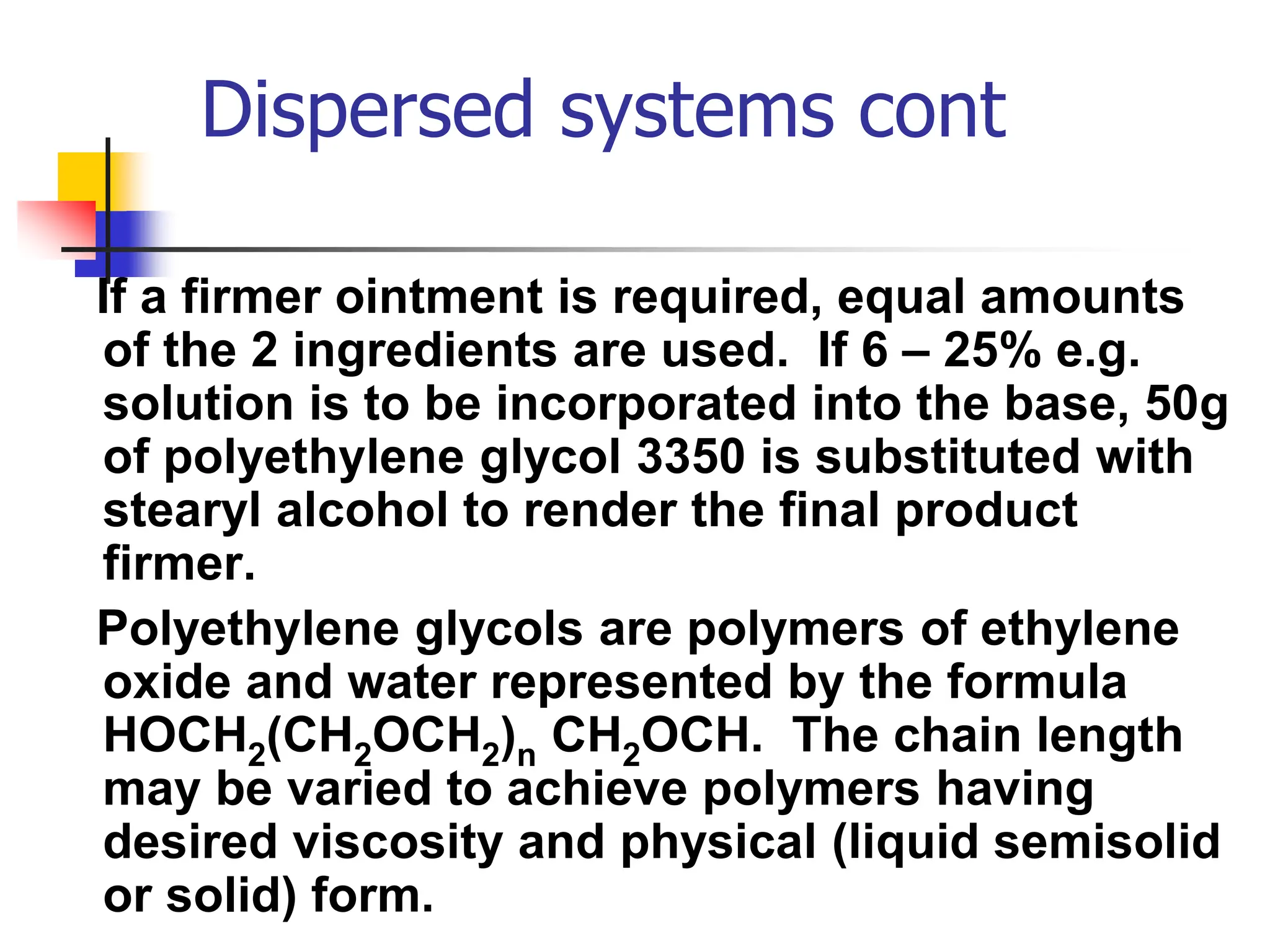
If a firmer ointment is required, equal amounts
of the 2 ingredients are used. If 6 – 25% e.g.
solution is to be incorporated into the base, 50g
of polyethylene glycol 3350 is substituted with
stearyl alcohol to render the final product
firmer.
Polyethylene glycols are polymers of ethylene
oxide and water represented by the formula
HOCH2(CH2OCH2)n CH2OCH. The chain length
may be varied to achieve polymers having
desired viscosity and physical (liquid semisolid
or solid) form.
Dispersed systems cont
SELECTION OF THE APPROPRIATE BASE
The selection of the base for use in a formulation
depends on careful assessment of a number of
factors, which include:
The advisability of occlusion of moisture from
the skin by the base.
The desirability for enhancement by the base of
the percutaneous absorption of the drug.
Dispersed systems cont
 The influence if any of the drug on the consistency or
other features of the ointment base.
 Natures of the patients skin – dry or wet.
 The long term and short-term stability of the drug in the
ointment base.
PREPARATION OF OINTMENTS
Both on a large or small scale, ointments are prepared
by two general methods.
1. Incorporation or mechanical
2. Fusion
Dispersed systems cont
 Incorporation:
In this method, the components are
mixed together by various means until a
uniform mixture has been attained. In a
small scale, as in extemporaneous
compounding of prescriptions, the
components are mixed in a mortar using
a pestle or on a slab-using spatula
Dispersed systems cont
(a) Incorporation of solids:
When preparing ointment by spatulation a
pharmacist use large long broad spatula stainless
steel and a small spatula use to remove the
accumulation of ointment on the large spatula
periodically.
If the components of the ointment are reactive with
the metal spatula then a plastic one is used. The
solids are first reduced to fine particles in a motor.
Then the base is put on one side of the slab and
the powders on the other side.
Dispersed systems cont
Then mixing is done geometrically until you
obtain a uniform mixture of ointment.
Sometimes the powder particles are reduced
then navigated using vehicle which will be
compatible with both the drug and the base
like mineral oil, glycerin, then is mixed with a
portion of the base on equal bases. After
lavigation the dispersion is incorporated with
the remaining base by spatulation or mortar
and pestel.
Dispersed systems cont
Solid materials soluble in a common
solvent that will affect neither the
stability of the drug nor the efficacy of
the product may first be dissolved in that
solvent, then the solution added to the
ointment base by spatulation or by
mortar and pestle. Mortar and pestle is
preferred if the liquids are more.

dispersed system (ointment and bases).ppt

  • 1.
    DISPERSED SYSTEMS 15/03/2013 TransdermalDrug Delivery Systems: Ointments, Creams, and other preparations. Reference: Pharmaceutics: the science of dosage form design by Aulton M.E.
  • 2.
    DISPERSED SYSTEMS Objectives:  Todefine all types of semi-solid dispersed systems  To apply the various methods of formulation,  To identify properties and uses of the systems
  • 3.
    Dispersed systems cont. Generally,,transdermal drug delivery systems, ointments, creams, Lotions and topical solutions represent the major frequently used dermatological dosage forms. Other include pastes, liniments, powders, gels, tinctures and aerosols are also commonly used
  • 4.
    Dispersed systems cont. Preparations are applied to the skin either for their physical effect like acting as skin protectants, lubricants, and emollients, drying effect or for the specific effect of the medicinal agent(s) present.  Preparations are sold over the counter, contain mixtures of medicinal substances used in the treatment of such conditions as minor skin infections, itching, burns, diaper rash, insect stings and bites, athletes foot corns, calluses, warts, dandruff, acne, psoriasis and eczema.
  • 5.
    Dispersed systems cont. Skin preparations that require prescription generally contain a single medicinal agent intended to counter a specific diagnosis condition.  Generally drugs used in the treatment of skin do not penetrate the skin into blood circulation. This only happed when the drug penetrate the epidermis. This can be evidenced by detection in blood and in urinary excretion or metabolites
  • 6.
    Dispersed systems cont. PERCUTANOUSABSORPTION  Absorption of substance from outside the skin to positions beneath the skin, including entrance into the blood stream is referred to as percutaneous absorption.
  • 7.
    Dispersed systems cont. The percutaneous absorption of a medicinal substance present in a transdermal therapeutic system or in a dermatological preparations depends not only upon the physical and chemical properties of the medicinal substance, but also upon its behavior when placed in the pharmaceutical vehicle and the condition of the skin.
  • 8.
    Dispersed systems cont. It is known that although a pharmaceutical vehicle may not penetrate the skin to any great extent nor actually carry the medicine through the skin, the vehicle does influence the rate and degree of penetration of the drug and the degree and rate vary with different drugs and with different vehicles
  • 9.
    Dispersed systems cont. Therefore each drug – vehicle combination must be examined/studied/researched individually for percutaneous absorption and therapeutic efficacy.
  • 10.
    Dispersed systems cont. THESKIN The structure of the skin is made of:  1. Horny layer – dead epidermal cells or stratum corneum, covered by an emulsion firm.  2. Beneath – this layer is living epidermis or the stratum germinativum  3. Dermis or true skin. 4. Subcutaneous fat tissue
  • 11.
    Dispersed systems cont. 5.Sweatglands are in the subcutaneous tissue. The glands yield their products through the sweat duct which finds their way to the surface of the skin. 6. Sebaceous gland and hair follicles originating in the dermis and subcutaneous layers and also find their way to the surface.
  • 12.
    Dispersed systems cont. PENETRATIONOF THE SKIN BY DRUGS After topical application, drugs may penetrate intact skin through the walls of the hair follicles, and sweat glands, or sebaceous glands or between the cells of the horny layer. Broken or abraded skin, allow drug penetration easily but such penetration does not really show true percutaneous absorption.
  • 13.
    Dispersed systems cont. Thefilm on top of this layer does not affect penetration of drug through the epidermal layer because the film is not a true barrier as it has no definite composition, thickness, or continuity.
  • 14.
    Dispersed systems cont. Stratumcorneum – 1.0 – 1.5 mm, composed of 40% protein,(keratin) and 40% water with the balance being lipids. The lipids content is concentrated in the extra cellular phase of subcutaneous and the lipids play a role in the first step of the absorption process. Drugs pass through deeper epidermal layer tissues and into the dermis. Then it reaches the vascularized dermal layer and become available for absorption into general circulation.
  • 15.
    Dispersed systems cont. Scbehaves as a semi permeable artificial membrane and drug molecules penetrate by passive diffusion. The rate of drug movement across this skin layer is dependent on:  The drug concentration in the vehicle  Drug aqueous solubility  Its oil/water partition coefficient between the sc and the vehicle
  • 16.
    Dispersed systems cont. Substancesthat possess both aqueous and lipid solubility characteristics are good candidates for diffusion through the stratum corneum as well as through the epidermal and dermal layers. Permeation of the skin or laminate barriers occurs by diffusion via:  Transcellular penetration (across the cells)  Intercellular penetration (between cells)  Trans-appendage penetration (via hair follicles sweat and sebum glands and pilosebaceous apparatus).
  • 17.
    Dispersed systems cont. FACTORSAFFECTING PERCUTANEOUS ABSORPTION The factors include:  Nature of the drug itself  Nature of the vehicle  Condition of the skin  Presence of moisture (hydration)
  • 18.
    Dispersed systems cont. Throughresearch a consensus on the combination of drug, vehicle and skin condition are summarized as follow: 1. Drug concentration in the vehicle. Percutanous absorption increase with increase concentration of drug in the vehicle. 2. Large surface area of application and Drug affinity. Drug should have more affinity to the skin than to the vehicle for the drug to leave the vehicle for absorption in favor of the skin.
  • 19.
    Dispersed systems cont. 3.Degree of solubility of the drug. Solubility of the drug in both lipid and water is essential for effective percutaneous absorption. Agueous solubility determine the concentration presented to the absorption site and partition coefficient strongly influences the rate of transport across the absorption site. Solute with mw below 800 to 100 with adequate solubility in mineral oil and water (>1mg/ml) can permeate skin.
  • 20.
    Dispersed systems cont. 4.Drug absorption appears to be enhanced from vehicles that easily cover the skin surface, mix readily with the sebum, and bring the drug into contact with the tissue cells for absorption. 5. Vehicles that increase hydration of the skin generally increase percutanous absorption of drugs. Oleaginous vehicles and/or occlusive bandages act as moisture barriers therefore hydrate the skin.
  • 21.
    Dispersed systems cont. 6.Generally, the amount of rubbing in or inunctions of the topical application will have a bearing on amount of drug absorbed and this is increase with prolonged time of inunctions. 7. The percutaneous absorption increase with thin horny layer, thus the site of application play a role in drug absorption.
  • 22.
    Dispersed systems cont. Besidethe thickness of horny layer in different site of the body, the properties of the sc vary from different sites of body including:  Differences in number of cell layers  Stacking of cells  Size of cells  Amount of surface lipids
  • 23.
    Dispersed systems cont. 8.Time of contact of the application and the skin absorption is increased. The longer the time the more the absorption. 9. Multiple-application dosing rather than single bolus application can increase drug absorption and bioavailability.
  • 24.
    Dispersed systems cont. Age: A newborn skin and very old skin has very little difference. An infant and adult skins are indistinguishable. The blood levels of drugs following topical application may be higher in infants than in adults due to a greater body surface to volume ratio.
  • 25.
    Dispersed systems cont. OINTMENT Ointmentsare semisolid preparations intended for external application. Those intended for application to the eye are specifically prepared and are termed ophthalmic ointments. Ointments can be medicated or non-medicated, the later being referred to as ointment bases and used as such as:  For their emollient or lubricating effect  Used as vehicle in the preparation of medicated ointment
  • 26.
    Dispersed systems cont. OINTMENTBASES They are classified into four general groups: 1. Hydrocarbon bases 2. Absorption bases 3. Water-removable bases 4. Water soluble bases
  • 27.
    Dispersed systems cont. HYDROCARBONBASES (Oleaginous bases) These are water-free and aqueous preparations may be incorporated into them only in small amounts and then with difficulty. Are used for their emollient effect.
  • 28.
    Dispersed systems cont Properties: Areretained on the skin for long period Do not permit escape of moisture from skin to the atmosphere occlusive dressings Are difficult to wash off Do not dry out or change noticeably upon aging
  • 29.
    Dispersed systems cont 1.Petrolatum USP A mixture of semisolid hc obtained from petrolatum. It is unctuous mass, varying in color from yellowish to light amber. Melting temperature between 380 and 600C. Can be used at lone or in combination with other agents as an ointment base. Synonyms: Yellow petrolatum: Petrollatum jelly commercial product. Vaseline (Chesebrorough- Pond’s)
  • 30.
    Dispersed systems cont 1.White Petrolatum USP: Is a petrolatum that has been decolorized, it differs only in this respect to petrolatum and is used for the same purpose. It is more esthetically acceptable to patients. Because of its occlusive, no water-washable characteristics, it is particularly useful to treat diaper rash (impervious to mine and protect the baby’s skin) and dry skin (helps the skin retain moisture). Synonyms: White Petrolatum jelly Commercial product: White Vaseline
  • 31.
    Dispersed systems cont 2.Yellow Ointment: USP: Content: Yellow wax: 5% Petrolatum 95% Yellow wax is the purified wax obtained from the honey comb of the bee (Apis mellifera) Synonyms: Simple ointment.
  • 32.
    Dispersed systems cont 3.Mineral Oil: Is a mixture of liquid hydrocarbons obtained from petrolatum. It is useful as a levigating substance to wet and to incorporate solid substance e.g. Salicylic acid, zinc oxide, into the preparation of ointments that consists of oleaginous bases as their vehicle. Synonym liquid Petrolatum.
  • 33.
    Dispersed systems cont ABSORPTIONBASES They are of two types: Those that permit the incorporation of aqueous solutions, resulting in the formation of water in oil emulsions (e.g. Hydrophilic Petrolatum and Anhydrous Lanolin). Those that are already water-in-oil emulsion (emulsion bases) that permit the incorporation of small additional quantities of aqueous solutions (e.g. Lanolin and Cold Cream)
  • 34.
    Dispersed systems cont ABSORPTIONBASES cont. These bases are useful as emollients but as occlusive as the oleaginous base. They are not easily removed from the skin with water washing.  It is pharmaceutically useful in incorporating aqueous solutions of drugs into oleaginous bases. Incorporate the aqueous 50% in the absorption base, and then this mixture is added into the oleaginous base. Example is gentamycin sulfate for ophthalmic therapy.
  • 35.
    Dispersed systems cont 1.Anhydrous Lanoline Contain 0.25% water. Anhydrous lanolin is insoluble in water but mixes without separation with about twice its weight of water. The resultant mixture with water is water-in-oil emulsion. It is useful as vehicle for application of comp. Tincture of benzoic and sucrose is used to treat decubitus ulcers, i.e. bedsores. It is rolled onto the skin lesion with a colon swab. Synonym: Hydrous wool fat.
  • 36.
    Dispersed systems cont 2.Hydrophilic Petrolatum: It is composed of cholesterol, stearyl alcohol, white wax and white petrolatum. It has the ability to absorb water with the formation of a water-in-oil emulsion. Aquaphor is a highly refined variation of hydrophilic petrolatum and because it can absorb up to 3 times its weight in water. It is useful to pharmacists who have to incorporate extemporaneously a water- soluble drug into an oleaginous base.
  • 37.
    Dispersed systems cont 3.Lanolin A semisolid fat like substance obtained from the wool of sheep (Ovis Aries). It is a water-in-oil-emulsion containing between 25 and 30% water. Additional water can be incorporated into lanolin by mixing. Synonym: Hydrous wool fat.
  • 38.
    Dispersed systems cont ColdCream: Is a semisolid, white water-in-oil emulsion prepared with cetyl esters wax, white wax, mineral oil, and sodium borate and purified water. The sodium borate combine freely with the free fatty acids present in the waxes to form sodium soap that acts as the emulsifiers. Cold cream is used as an emollient and ointment base. The presence of water in the base is useful onto the skin and enhances moisturization of the skin.
  • 39.
    Dispersed systems cont WATERREMOVABLE BASES These are oil-in-water emulsions that are capable of being washed from skin or clothing with water. Thus referred to as “water-washable” ointment bases. These bases can be diluted with water or aqueous solutions. Therapeutically they have the ability to absorb serous discharges in dermatological conditions. The skin better absorbs drugs incorporated in these bases than the other types.
  • 40.
    Dispersed systems cont 1.Hydrophilic ointment It is water-loving base. It contains sodium lauryl sulphate as an emulsifying agent, with stearyl alcohol and white petrolatum representing the oleaginous phase of the emulsion and propylene glycol and water representing the aqueous phase. Methyl paraffin and propylparaffin are used to preserve the ointment microbial growth. The ointment is used a water removable vehicle for drugs
  • 41.
    Dispersed systems cont WATERSOLUBLE BASES It contains only water-soluble components. They are water washable, referred as “greaseless”. They good for incorporation of non aqueous or solid substances. 1. Polyethylene Glycol ointment It is formulated by combining: Polyethylene glycol 3350 – 400g Polyethylene (liquid) 400 – 600g Total 1000g
  • 42.
    Dispersed systems cont Ifa firmer ointment is required, equal amounts of the 2 ingredients are used. If 6 – 25% e.g. solution is to be incorporated into the base, 50g of polyethylene glycol 3350 is substituted with stearyl alcohol to render the final product firmer. Polyethylene glycols are polymers of ethylene oxide and water represented by the formula HOCH2(CH2OCH2)n CH2OCH. The chain length may be varied to achieve polymers having desired viscosity and physical (liquid semisolid or solid) form.
  • 43.
    Dispersed systems cont SELECTIONOF THE APPROPRIATE BASE The selection of the base for use in a formulation depends on careful assessment of a number of factors, which include: The advisability of occlusion of moisture from the skin by the base. The desirability for enhancement by the base of the percutaneous absorption of the drug.
  • 44.
    Dispersed systems cont The influence if any of the drug on the consistency or other features of the ointment base.  Natures of the patients skin – dry or wet.  The long term and short-term stability of the drug in the ointment base. PREPARATION OF OINTMENTS Both on a large or small scale, ointments are prepared by two general methods. 1. Incorporation or mechanical 2. Fusion
  • 45.
    Dispersed systems cont Incorporation: In this method, the components are mixed together by various means until a uniform mixture has been attained. In a small scale, as in extemporaneous compounding of prescriptions, the components are mixed in a mortar using a pestle or on a slab-using spatula
  • 46.
    Dispersed systems cont (a)Incorporation of solids: When preparing ointment by spatulation a pharmacist use large long broad spatula stainless steel and a small spatula use to remove the accumulation of ointment on the large spatula periodically. If the components of the ointment are reactive with the metal spatula then a plastic one is used. The solids are first reduced to fine particles in a motor. Then the base is put on one side of the slab and the powders on the other side.
  • 47.
    Dispersed systems cont Thenmixing is done geometrically until you obtain a uniform mixture of ointment. Sometimes the powder particles are reduced then navigated using vehicle which will be compatible with both the drug and the base like mineral oil, glycerin, then is mixed with a portion of the base on equal bases. After lavigation the dispersion is incorporated with the remaining base by spatulation or mortar and pestel.
  • 48.
    Dispersed systems cont Solidmaterials soluble in a common solvent that will affect neither the stability of the drug nor the efficacy of the product may first be dissolved in that solvent, then the solution added to the ointment base by spatulation or by mortar and pestle. Mortar and pestle is preferred if the liquids are more.