Course: Applied Grammar & Syntax
By Muhammad Ibrahim Khalil
GRAMMATICAL RELATIONS/FUNCTIONS
Syntactic categories: NP, VP, PP, AP, N, V, Adv, ……
Grammatical Functions: Subject, Predicate, Object, Modifier, ……
a. [S[NPThe student][VPbought[NPa book][PPon Monday]]]
b. [S[SUBJThe Student][PREDbought[OBJa book][MODon Monday]]]
DIFFERENCE BETWEEN SYNTACTIC CATEGORIES AND GRAMMATICAL FUNCTIONS
Subjects
a. [The dog] [chased [the cat]].
b. [The cat] [chased [the dog]].
Tests for subjecthood
a. Agreement
b. Tag questions
c. Subject-auxiliary inversion
GRAMMATICAL FUNCTIONS
Direct Objects (DO)
Traditionally speaking, a direct object is an NP undergoing the action denoted by the verb, e.g.,
a. The naughty boy broke the window with a stone.
b. The student borrowed a book from the library.
Test for objecthood: passivization
On passivization, the direct objects are ‘promoted’ to subjects in the passive sentences, e.g.,
a. The window was broken by the naughty boy with a stone.
b. A book was borrowed by the student from the library.
GRAMMATICAL FUNCTIONS
However, non-object NPs cannot be promoted to the subject position in the passive sentences, e.g.,
a. This student belongs to Chakwal.
b. *Chakwal is belonged to by this student.
a. He lives in a large house.
b. *A large house is lived in by him.
DIRECT OBJECT
(CONTINUED)
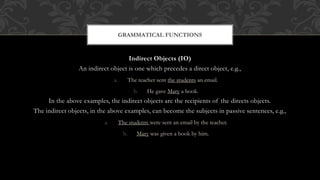
Indirect Objects (IO)
An indirect object is one which precedes a direct object, e.g.,
a. The teacher sent the students an email.
b. He gave Mary a book.
In the above examples, the indirect objects are the recipients of the directs objects.
The indirect objects, in the above examples, can become the subjects in passive sentences, e.g.,
a. The students were sent an email by the teacher.
b. Mary was given a book by him.
GRAMMATICAL FUNCTIONS
Indirect object can also be expressed as Oblique PP following the direct object, e.g.,
a. The teacher sent an email to the students.
b. He gave a book to Mary.
This process is known as dative alteration (change of indirect object to oblique PP). After applying
dative alteration, it is again the direct object which can be passivized, e.g.,
a. An email was sent to the students by the teacher.
b. A book was given to Mary by him.
INDIRECT OBJECT
(CONTINUED)
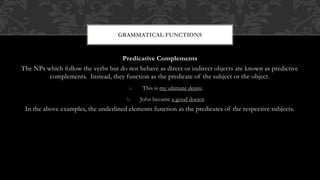
Predicative Complements
The NPs which follow the verbs but do not behave as direct or indirect objects are known as predictive
complements. Instead, they function as the predicate of the subject or the object.
a. This is my ultimate desire.
b. John became a good doctor.
In the above examples, the underlined elements function as the predicates of the respective subjects.
GRAMMATICAL FUNCTIONS
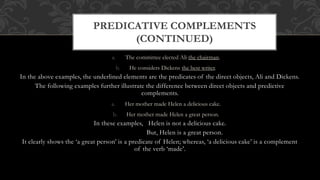
a. The committee elected Ali the chairman.
b. He considers Dickens the best writer.
In the above examples, the underlined elements are the predicates of the direct objects, Ali and Dickens.
The following examples further illustrate the difference between direct objects and predictive
complements.
a. Her mother made Helen a delicious cake.
b. Her mother made Helen a great person.
In these examples, Helen is not a delicious cake.
But, Helen is a great person.
It clearly shows the ‘a great person’ is a predicate of Helen; whereas, ‘a delicious cake’ is a complement
of the verb ‘made’.
PREDICATIVE COMPLEMENTS
(CONTINUED)
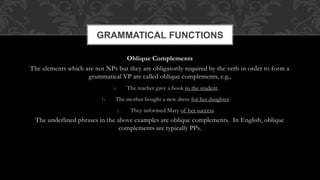
Oblique Complements
The elements which are not NPs but they are obligatorily required by the verb in order to form a
grammatical VP are called oblique complements, e.g.,
a. The teacher gave a book to the student.
b. The mother bought a new dress for her daughter.
c. They informed Mary of her success.
The underlined phrases in the above examples are oblique complements. In English, oblique
complements are typically PPs.
GRAMMATICAL FUNCTIONS
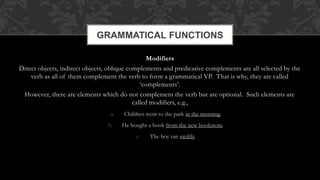
Modifiers
Direct objects, indirect objects, oblique complements and predicative complements are all selected by the
verb as all of them complement the verb to form a grammatical VP. That is why, they are called
‘complements’.
However, there are elements which do not complement the verb but are optional. Such elements are
called modifiers, e.g.,
a. Children went to the park in the morning.
b. He bought a book from the new bookstore.
c. The boy ran swiftly.
GRAMMATICAL FUNCTIONS
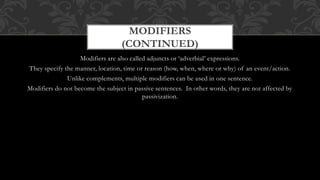
Modifiers are also called adjuncts or ‘adverbial’ expressions.
They specify the manner, location, time or reason (how, when, where or why) of an event/action.
Unlike complements, multiple modifiers can be used in one sentence.
Modifiers do not become the subject in passive sentences. In other words, they are not affected by
passivization.
MODIFIERS
(CONTINUED)
Carnie, A. (2012). Syntax: A generative introduction (Vol. 18). John Wiley & Sons.
Kim, J. B., & Sells, P. (2008). English syntax: An introduction. CSLI publications.
BIBLIOGRAPHY

Grammatical functions

  • 1.
    Course: Applied Grammar& Syntax By Muhammad Ibrahim Khalil GRAMMATICAL RELATIONS/FUNCTIONS
  • 2.
    Syntactic categories: NP,VP, PP, AP, N, V, Adv, …… Grammatical Functions: Subject, Predicate, Object, Modifier, …… a. [S[NPThe student][VPbought[NPa book][PPon Monday]]] b. [S[SUBJThe Student][PREDbought[OBJa book][MODon Monday]]] DIFFERENCE BETWEEN SYNTACTIC CATEGORIES AND GRAMMATICAL FUNCTIONS
  • 3.
    Subjects a. [The dog][chased [the cat]]. b. [The cat] [chased [the dog]]. Tests for subjecthood a. Agreement b. Tag questions c. Subject-auxiliary inversion GRAMMATICAL FUNCTIONS
  • 4.
    Direct Objects (DO) Traditionallyspeaking, a direct object is an NP undergoing the action denoted by the verb, e.g., a. The naughty boy broke the window with a stone. b. The student borrowed a book from the library. Test for objecthood: passivization On passivization, the direct objects are ‘promoted’ to subjects in the passive sentences, e.g., a. The window was broken by the naughty boy with a stone. b. A book was borrowed by the student from the library. GRAMMATICAL FUNCTIONS
  • 5.
    However, non-object NPscannot be promoted to the subject position in the passive sentences, e.g., a. This student belongs to Chakwal. b. *Chakwal is belonged to by this student. a. He lives in a large house. b. *A large house is lived in by him. DIRECT OBJECT (CONTINUED)
  • 6.
    Indirect Objects (IO) Anindirect object is one which precedes a direct object, e.g., a. The teacher sent the students an email. b. He gave Mary a book. In the above examples, the indirect objects are the recipients of the directs objects. The indirect objects, in the above examples, can become the subjects in passive sentences, e.g., a. The students were sent an email by the teacher. b. Mary was given a book by him. GRAMMATICAL FUNCTIONS
  • 7.
    Indirect object canalso be expressed as Oblique PP following the direct object, e.g., a. The teacher sent an email to the students. b. He gave a book to Mary. This process is known as dative alteration (change of indirect object to oblique PP). After applying dative alteration, it is again the direct object which can be passivized, e.g., a. An email was sent to the students by the teacher. b. A book was given to Mary by him. INDIRECT OBJECT (CONTINUED)
  • 8.
    Predicative Complements The NPswhich follow the verbs but do not behave as direct or indirect objects are known as predictive complements. Instead, they function as the predicate of the subject or the object. a. This is my ultimate desire. b. John became a good doctor. In the above examples, the underlined elements function as the predicates of the respective subjects. GRAMMATICAL FUNCTIONS
  • 9.
    a. The committeeelected Ali the chairman. b. He considers Dickens the best writer. In the above examples, the underlined elements are the predicates of the direct objects, Ali and Dickens. The following examples further illustrate the difference between direct objects and predictive complements. a. Her mother made Helen a delicious cake. b. Her mother made Helen a great person. In these examples, Helen is not a delicious cake. But, Helen is a great person. It clearly shows the ‘a great person’ is a predicate of Helen; whereas, ‘a delicious cake’ is a complement of the verb ‘made’. PREDICATIVE COMPLEMENTS (CONTINUED)
  • 10.
    Oblique Complements The elementswhich are not NPs but they are obligatorily required by the verb in order to form a grammatical VP are called oblique complements, e.g., a. The teacher gave a book to the student. b. The mother bought a new dress for her daughter. c. They informed Mary of her success. The underlined phrases in the above examples are oblique complements. In English, oblique complements are typically PPs. GRAMMATICAL FUNCTIONS
  • 11.
    Modifiers Direct objects, indirectobjects, oblique complements and predicative complements are all selected by the verb as all of them complement the verb to form a grammatical VP. That is why, they are called ‘complements’. However, there are elements which do not complement the verb but are optional. Such elements are called modifiers, e.g., a. Children went to the park in the morning. b. He bought a book from the new bookstore. c. The boy ran swiftly. GRAMMATICAL FUNCTIONS
  • 12.
    Modifiers are alsocalled adjuncts or ‘adverbial’ expressions. They specify the manner, location, time or reason (how, when, where or why) of an event/action. Unlike complements, multiple modifiers can be used in one sentence. Modifiers do not become the subject in passive sentences. In other words, they are not affected by passivization. MODIFIERS (CONTINUED)
  • 13.
    Carnie, A. (2012).Syntax: A generative introduction (Vol. 18). John Wiley & Sons. Kim, J. B., & Sells, P. (2008). English syntax: An introduction. CSLI publications. BIBLIOGRAPHY