SQUEEZE YOUR BRAINS!!
 List the periods/ages in English Literature.
 Medieval literature (1066-1510) Geoffrey Chaucer
 Renaissance and Reformation (1510-1620) Univ Wits, Shakes.,
 Revolution and Restoration (1620-1690) Metaphysical poets
 Neo-classicism (1690-1780) Defoe, Addison, Steele, etc
 Romantic period (1780-1830) Shelley, Keats, Byron, etc
 Late Victorian & Edwardian lit., (1830-1880) Dickens, Carlyle.,
 Modernism (1920-1945) Woolf, Richardson, Lawrence, etc…
 Post-war & Post-modernism (1950’s – present)
 What do you know about William Wordsworth? (Slide 5)
 How does Romanticism emerge? (Slide 3,4)
 Neo-Classicism insisted:
“Poetry imitated nature to delight and to
instruct and the poet must follow the rules
of the ancients”
 Dryden, Addison & Dr.Johnson– questioned all the
rules  did not stand for the ‘Test of Time’
 “Changes are always developments, they are never
complete severances”
 ROMANTICISM – the name to the new change
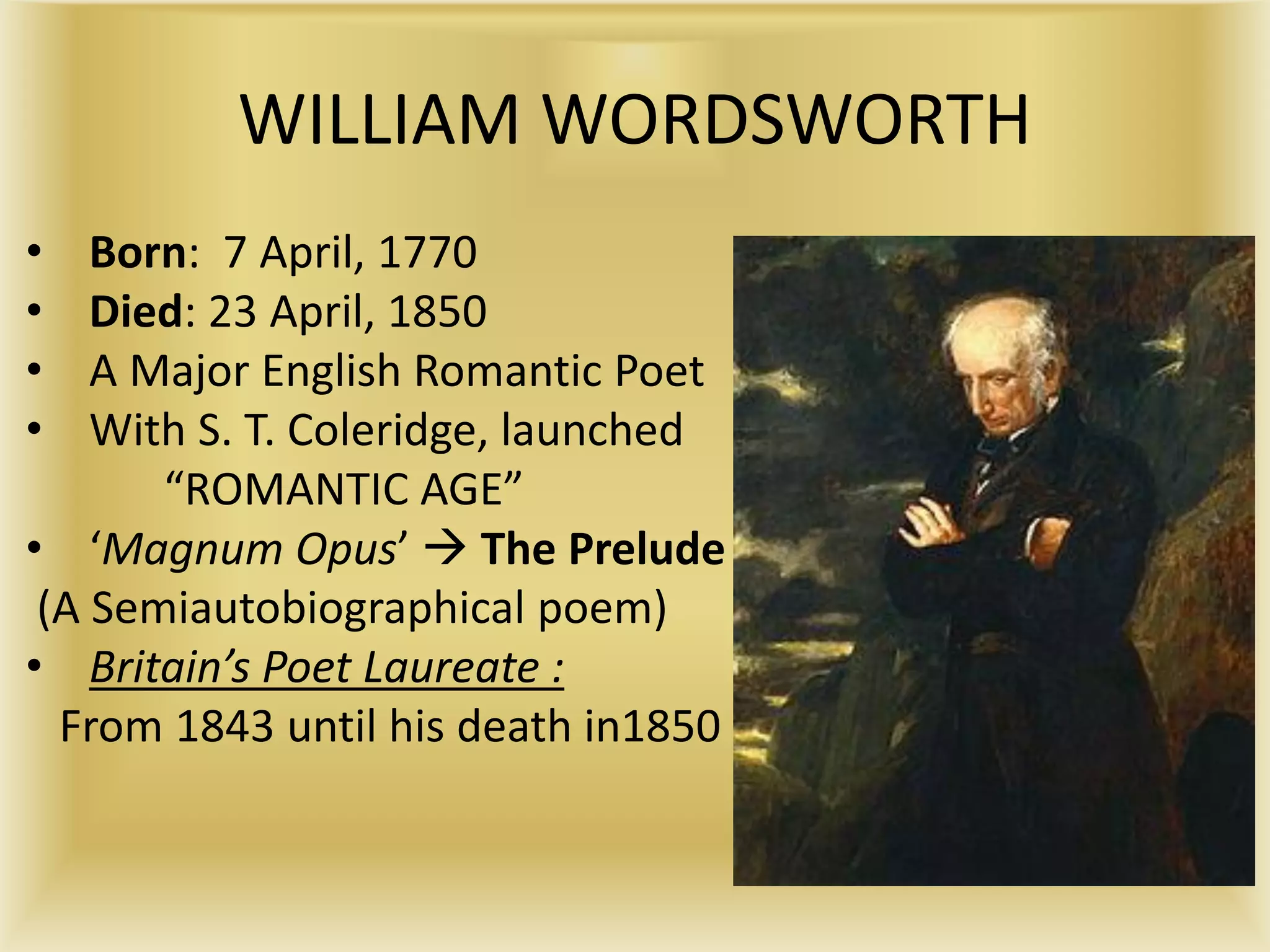
WILLIAM WORDSWORTH
• Born: 7 April, 1770
• Died: 23 April, 1850
• A Major English Romantic Poet
• With S. T. Coleridge, launched
“ROMANTIC AGE”
• ‘Magnum Opus’  The Prelude
(A Semiautobiographical poem)
• Britain’s Poet Laureate :
From 1843 until his death in1850
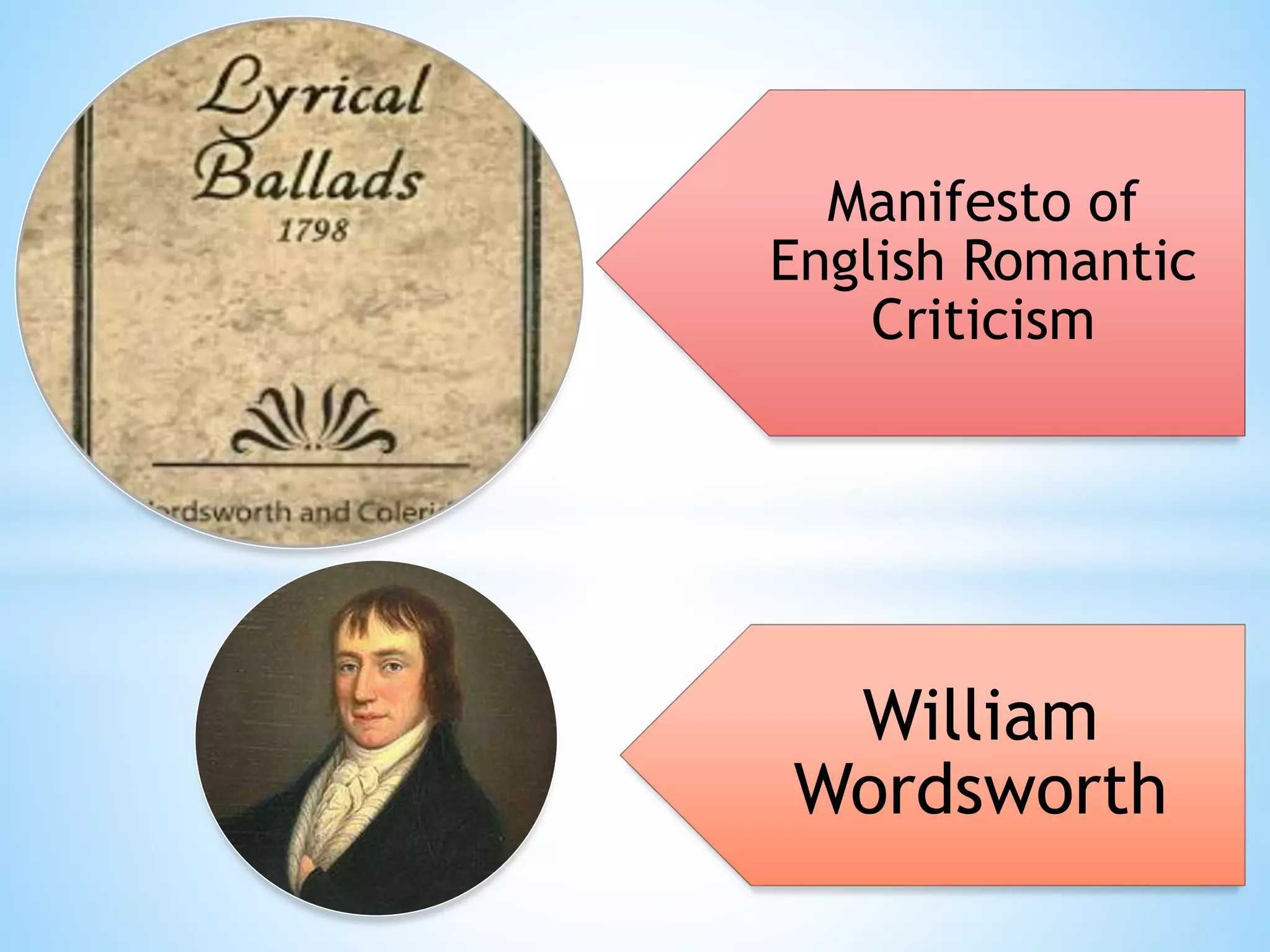
William
Wordsworth
Manifesto of
English Romantic
Criticism
WORDSWORTH
AS A CRITIC
 Not by temperament & training
 ‘The Lyrical Ballads’ – 1798
 The preface (2nd edition) – 1800
 An Appendix – 1802
 An Essay Supplementary – 1815
 Literary criticism – demolishes old & faulty

 “…more permanent and a far more
philosophical language”

 Difference: not only in metre, but also in
the choice of words and phrases
 Disgusted by the “gaudiness and inane
phraseology” of many modern writers,
he castigates poets who,
“ separate themselves from the sympathies of
men,… to furnish food for fickle tastes and fickle
appetites of their own creation”
 Simple in language:
“ language of common men…”
• Poetry is to give pleasure…
 Situations from everyday life:
– “The principal object: to choose incidents and situations from
common life,…”
 Selection of language:
– “In a selection of language really used by men…”
 Transformed by the poet’s imagination:
Ordinary events  VIVID & ATTRACTIVE
– “to throw over them a certain colouring of imagination…”
“ordinary things should be presented to the mind in an
unusual aspect”
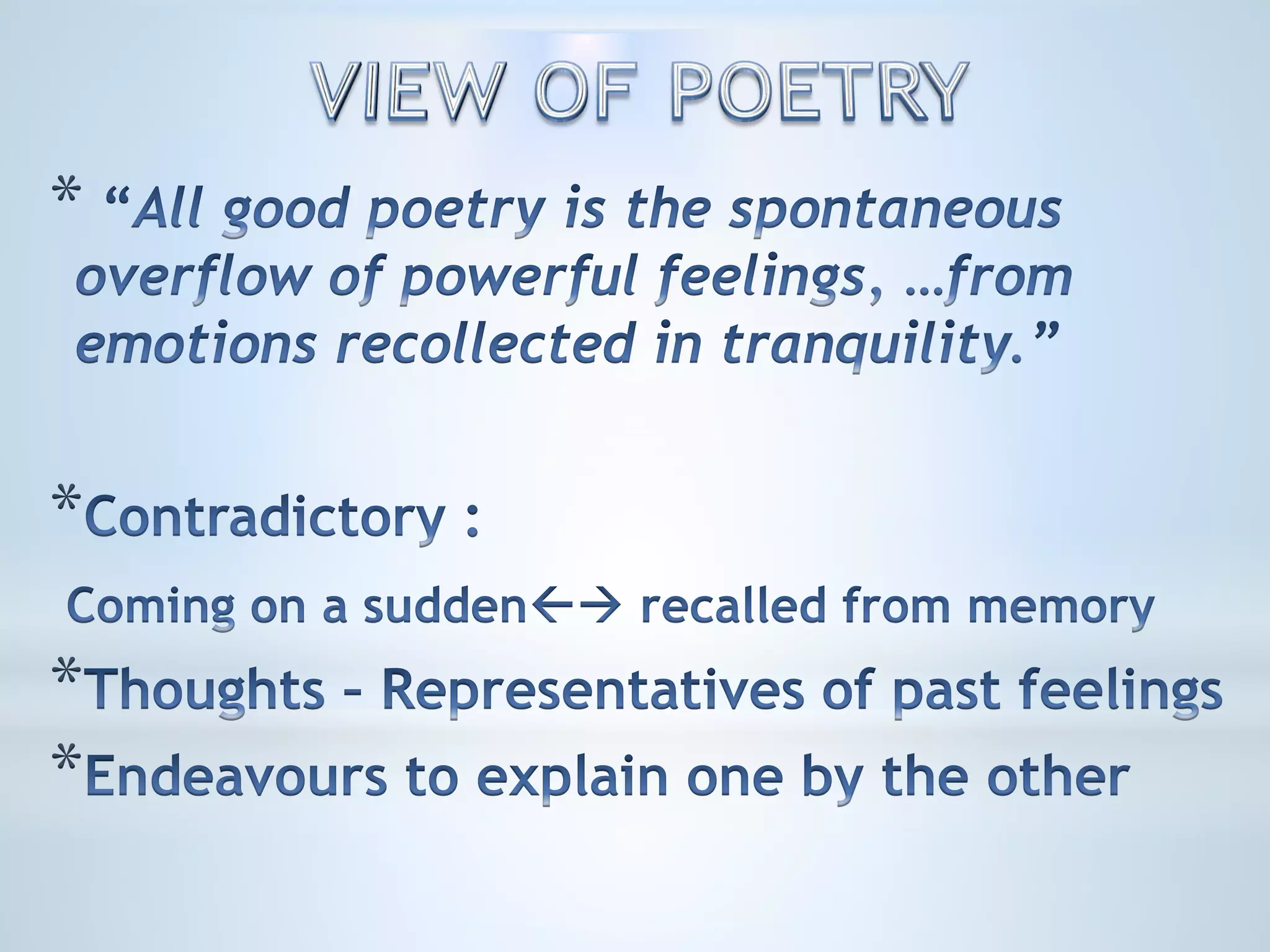
*
*
*
*




* ‘man speaking to men’
* ‘a man,… endowed with more lively sensibility,
more enthusiasm and tenderness, who has a
greater knowledge of human nature, and a more
comprehensive soul’
*‘every great poet is a teacher; I wish either to be
considered as a teacher or as nothing…’
[Plato and Wordsworth has much in common]
* The idea of poetry  form of communication
Rene Wellek
“Wordsworth….in the history of criticism which must
be called ambiguous or transitional,…. he adopts a
theory of poetry, in which imagination holds the
central place”
“…Wordsworth left only a small body of criticism, it is
rich in survivals, suggestions, anticipations and
personal insights…”
“Wordsworth actually ends in good neo-classicism,
doth the same tale repeat,… in a selection of
language really used by men…”
says….

William wordsworth as a critic

  • 2.
    SQUEEZE YOUR BRAINS!! List the periods/ages in English Literature.  Medieval literature (1066-1510) Geoffrey Chaucer  Renaissance and Reformation (1510-1620) Univ Wits, Shakes.,  Revolution and Restoration (1620-1690) Metaphysical poets  Neo-classicism (1690-1780) Defoe, Addison, Steele, etc  Romantic period (1780-1830) Shelley, Keats, Byron, etc  Late Victorian & Edwardian lit., (1830-1880) Dickens, Carlyle.,  Modernism (1920-1945) Woolf, Richardson, Lawrence, etc…  Post-war & Post-modernism (1950’s – present)  What do you know about William Wordsworth? (Slide 5)  How does Romanticism emerge? (Slide 3,4)
  • 3.
     Neo-Classicism insisted: “Poetryimitated nature to delight and to instruct and the poet must follow the rules of the ancients”  Dryden, Addison & Dr.Johnson– questioned all the rules  did not stand for the ‘Test of Time’  “Changes are always developments, they are never complete severances”  ROMANTICISM – the name to the new change
  • 5.
    WILLIAM WORDSWORTH • Born:7 April, 1770 • Died: 23 April, 1850 • A Major English Romantic Poet • With S. T. Coleridge, launched “ROMANTIC AGE” • ‘Magnum Opus’  The Prelude (A Semiautobiographical poem) • Britain’s Poet Laureate : From 1843 until his death in1850
  • 6.
  • 7.
    WORDSWORTH AS A CRITIC Not by temperament & training  ‘The Lyrical Ballads’ – 1798  The preface (2nd edition) – 1800  An Appendix – 1802  An Essay Supplementary – 1815  Literary criticism – demolishes old & faulty
  • 8.
      “…more permanentand a far more philosophical language”   Difference: not only in metre, but also in the choice of words and phrases
  • 9.
     Disgusted bythe “gaudiness and inane phraseology” of many modern writers, he castigates poets who, “ separate themselves from the sympathies of men,… to furnish food for fickle tastes and fickle appetites of their own creation”  Simple in language: “ language of common men…”
  • 10.
    • Poetry isto give pleasure…  Situations from everyday life: – “The principal object: to choose incidents and situations from common life,…”  Selection of language: – “In a selection of language really used by men…”  Transformed by the poet’s imagination: Ordinary events  VIVID & ATTRACTIVE – “to throw over them a certain colouring of imagination…” “ordinary things should be presented to the mind in an unusual aspect”
  • 11.
  • 12.
  • 13.
    * ‘man speakingto men’ * ‘a man,… endowed with more lively sensibility, more enthusiasm and tenderness, who has a greater knowledge of human nature, and a more comprehensive soul’ *‘every great poet is a teacher; I wish either to be considered as a teacher or as nothing…’ [Plato and Wordsworth has much in common] * The idea of poetry  form of communication
  • 14.
    Rene Wellek “Wordsworth….in thehistory of criticism which must be called ambiguous or transitional,…. he adopts a theory of poetry, in which imagination holds the central place” “…Wordsworth left only a small body of criticism, it is rich in survivals, suggestions, anticipations and personal insights…” “Wordsworth actually ends in good neo-classicism, doth the same tale repeat,… in a selection of language really used by men…” says….