Chapter 12
Informal
and
Formal Groups
GROUP DYNAMICS
GROUP DYNAMICS:
•The social process by which people interact face-to-face in
small groups is called group dynamics.
•Group dynamics refers to the study of forces why people
within a group interact with each other?
• Types of Groups
Formal groups
are established by the organization, have a public identity and a
goal to achieve.
- Organization establishes this group
- It has a public identity
- It has some goals to achieve
GROUP DYNAMICS
Informal groups,
which emerge on the basis of common interests,proximity and
friendships.
- It serves some common interests of members
- This group forms based on member’s Proximity
- Friendship exists within this group.
Types of formal groups
1. Temporary work group: Created to accomplish a short-term
task and then disband.
For example: Meeting - The event at which group members
discuss ideas or solves problems is generally called a
meeting.
2. Enduring work group: It is more natural and comparatively
permanent group formed by the organization itself.
For example: Team - This type of group is formed when people
perform task together as part of their job assignments.
THE NATURE OF INFORMAL ORGANIZATIONS
Comparison of Informal and Formal Organization
1. The emphasis within informal organization is on people and
their relationships, while formal organization emphasizes
official positions in terms of authority and responsibility.
2. Informal power is attached to a person, while formal
authority attaches to a position and a person has it only when
occupying that position.
3. Informal power is personal, but formal authority is
institutional.
4. Power in informal organization is given by group members,
while formal power is delegated by managers
Comparison of Informal and Formal Organization
5. Informal power does not follow the official chain of command, but
formal power follows the official chain of command
6. Informal power is more unstable than formal authority, since it is subject
to the sentiments of people.
7. Informal power is subjective in nature, and hence, informal organization
cannot be controlled by management, but the formal organization can be.
8. Informal organizations tend to remain smaller in order to keep within the
limits of personal relationships, but, formal organizations may grow to
immense size.
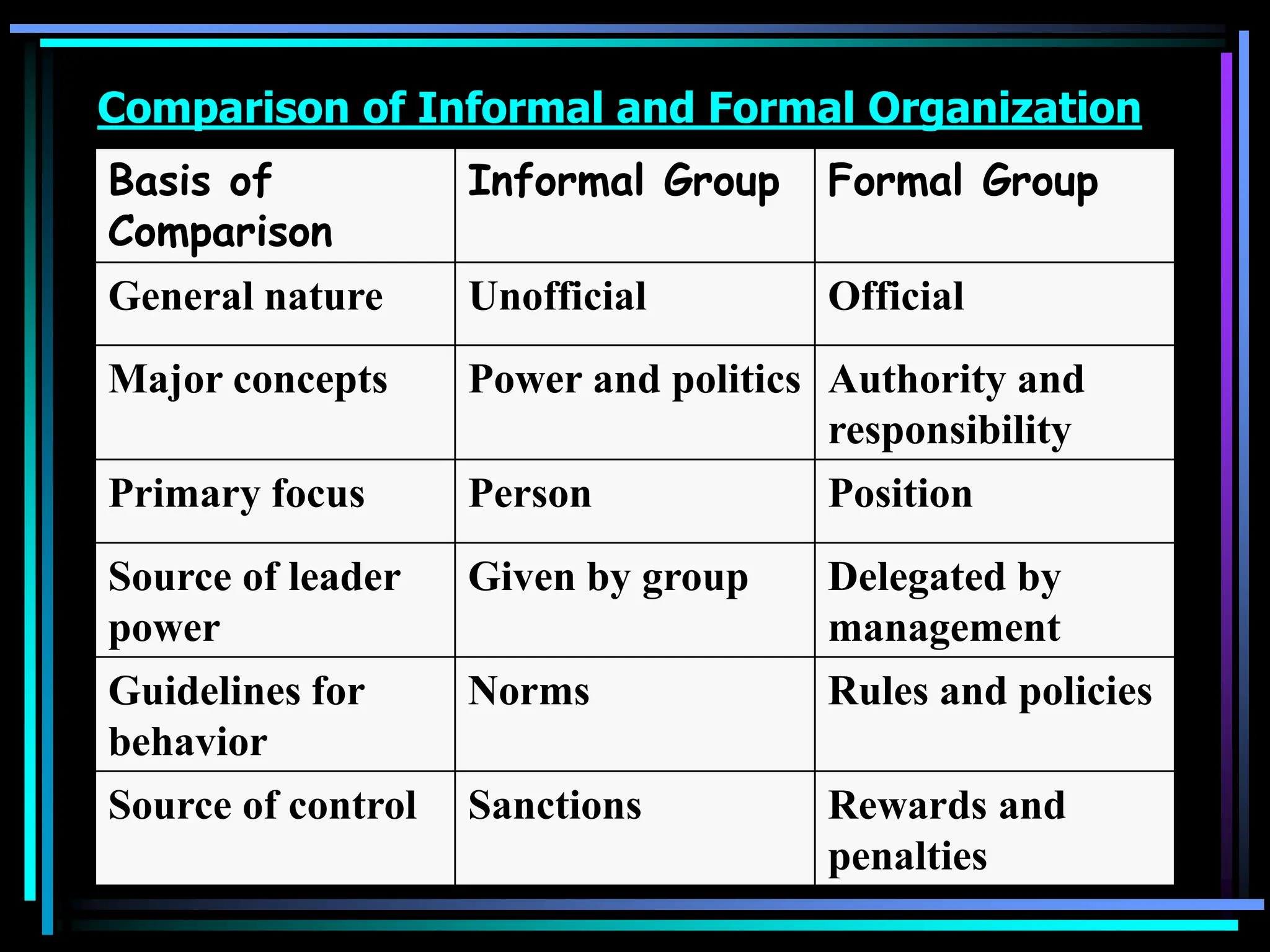
Comparison of Informal and Formal Organization
Basis of
Comparison
Informal Group Formal Group
General nature Unofficial Official
Major concepts Power and politics Authority and
responsibility
Primary focus Person Position
Source of leader
power
Given by group Delegated by
management
Guidelines for
behavior
Norms Rules and policies
Source of control Sanctions Rewards and
penalties
THE NATURE OF INFORMAL ORGANIZATIONS
Figure: Formal and informal organizations and their effects
THE NATURE OF INFORMAL ORGANIZATIONS
Member Status and Informal Leaders
Members of work group like to distinguish them from one another on
the basis of: age, seniority, earnings, birthplace, nature of
workplace, technical skill, freedom, personality etc.
•Informal leader: The employee with the largest amount of status
who is usually emerge from within the group.
•Identifying and Rewarding Informal Leaders: Informal
leaders often exhibit some distinct behavior like
- Acting as a spokesperson on behalf of management
- Being the center of social attention
- Providing guidance to new employees
Benefits and problems Associated with Informal
Organizations:
Benefits Problems
•Makes a more effective total system •Creates undesirable rumor
•Lighten workload of management •Encourage negative attitudes
•Helps get the works done •Resists change
•Encourage cooperation •Leads to interpersonal conflicts
•Fill in gaps in manager’s ability •Rejects and harasses some
employees
•Gives satisfaction and stability to
workgroup
•Weakens motivation and satisfaction
•Improve communication •Operates outside of management’s
control
•Provides a safety value for employee
emotions
•Support conformity
•Contribute to higher cohesiveness •Develops role conflicts
Monitoring Informal Organizations
Network charts:
A visual portrait of
interactions among
people within an
informal group.
It’s a communication
pattern which is
drown by asking:
-Who trust whom?
-Whom do you seek
advice most
frequently?
FORMAL GROUPS
Committee: A specific type of group meeting in which members in their
group role have been delegated the authority to handle the problem at hand.
System factors to be considered to make an effective
committee:
Size: Membership should be limited within 7 due to proper communication.
Composition: It should include leader, problem solving group and task force.
Agendas:
Surface agenda – the official task of the group.
Hidden agenda – member’s private motives that they keep hidden.
Leadership roles:
Task role – to help the group achieving its objectives and stay on target.
Social role – to maintain group relationships by recognizing contributions and
reducing disagreements.
Structured Approaches: Four structured approaches
commonly used in group problem solving are brainstorming,
nominal groups, the Delphi technique, and dialectic inquiry.
• Brainstorming: A method for encouraging creative
thinking in groups of about eight (8) people.
Basic guidelines:
1) Generate as many ideas as possible.
2) Be creative and imaginative.
3) Build upon, extend or combine earlier ideas.
4) Withhold criticism of others’ ideas.
• Nominal Group Technique: A nominal group exists in
name only, with members having minimal interaction prior to
producing decision.
Steps of nominal group technique:
1. Individuals are brought together and presented with a problem.
2. They develop solutions independently in a written form.
3. Their ideas are shared with others.
4. Time is allocated to ask questions.
5. Group members select the best alternative to their solutions.
6. At last the group decision is announced.
Delphi Decision Making
 A panel of relevant people is chosen to address an issue.
 Such members are selected who are experts and have relevant
information to share.
 A series of questions are presented to the respondents who do not meet
face to face.
 All express their opinions in written and have to explain their
conclusions.
• Dialectic Decision Method (DDM)
 Begins with a clear statement of problem to be solved.
 Two or more competing proposals are generated.
 Identify the explicit and implicit assumptions underlying
each proposal.
 Examine all relative merits and demerits of each
proposal.
 Finally make a decision based on the competing
presentations.
Figure
Steps
in
dialectic
decision
making
Weaknesses of Committees
• Slowness and Expensiveness
• Group think
• Polarization
• Escalating Commitment
• Divided Responsibility
End of the
Chapter

Informal and Formal Groups Ch 12_naz.ppt

  • 1.
  • 2.
    GROUP DYNAMICS GROUP DYNAMICS: •Thesocial process by which people interact face-to-face in small groups is called group dynamics. •Group dynamics refers to the study of forces why people within a group interact with each other? • Types of Groups Formal groups are established by the organization, have a public identity and a goal to achieve. - Organization establishes this group - It has a public identity - It has some goals to achieve
  • 3.
    GROUP DYNAMICS Informal groups, whichemerge on the basis of common interests,proximity and friendships. - It serves some common interests of members - This group forms based on member’s Proximity - Friendship exists within this group. Types of formal groups 1. Temporary work group: Created to accomplish a short-term task and then disband. For example: Meeting - The event at which group members discuss ideas or solves problems is generally called a meeting.
  • 4.
    2. Enduring workgroup: It is more natural and comparatively permanent group formed by the organization itself. For example: Team - This type of group is formed when people perform task together as part of their job assignments.
  • 5.
    THE NATURE OFINFORMAL ORGANIZATIONS Comparison of Informal and Formal Organization 1. The emphasis within informal organization is on people and their relationships, while formal organization emphasizes official positions in terms of authority and responsibility. 2. Informal power is attached to a person, while formal authority attaches to a position and a person has it only when occupying that position. 3. Informal power is personal, but formal authority is institutional. 4. Power in informal organization is given by group members, while formal power is delegated by managers
  • 6.
    Comparison of Informaland Formal Organization 5. Informal power does not follow the official chain of command, but formal power follows the official chain of command 6. Informal power is more unstable than formal authority, since it is subject to the sentiments of people. 7. Informal power is subjective in nature, and hence, informal organization cannot be controlled by management, but the formal organization can be. 8. Informal organizations tend to remain smaller in order to keep within the limits of personal relationships, but, formal organizations may grow to immense size.
  • 7.
    Comparison of Informaland Formal Organization Basis of Comparison Informal Group Formal Group General nature Unofficial Official Major concepts Power and politics Authority and responsibility Primary focus Person Position Source of leader power Given by group Delegated by management Guidelines for behavior Norms Rules and policies Source of control Sanctions Rewards and penalties
  • 8.
    THE NATURE OFINFORMAL ORGANIZATIONS Figure: Formal and informal organizations and their effects
  • 9.
    THE NATURE OFINFORMAL ORGANIZATIONS Member Status and Informal Leaders Members of work group like to distinguish them from one another on the basis of: age, seniority, earnings, birthplace, nature of workplace, technical skill, freedom, personality etc. •Informal leader: The employee with the largest amount of status who is usually emerge from within the group. •Identifying and Rewarding Informal Leaders: Informal leaders often exhibit some distinct behavior like - Acting as a spokesperson on behalf of management - Being the center of social attention - Providing guidance to new employees
  • 10.
    Benefits and problemsAssociated with Informal Organizations: Benefits Problems •Makes a more effective total system •Creates undesirable rumor •Lighten workload of management •Encourage negative attitudes •Helps get the works done •Resists change •Encourage cooperation •Leads to interpersonal conflicts •Fill in gaps in manager’s ability •Rejects and harasses some employees •Gives satisfaction and stability to workgroup •Weakens motivation and satisfaction •Improve communication •Operates outside of management’s control •Provides a safety value for employee emotions •Support conformity •Contribute to higher cohesiveness •Develops role conflicts
  • 11.
    Monitoring Informal Organizations Networkcharts: A visual portrait of interactions among people within an informal group. It’s a communication pattern which is drown by asking: -Who trust whom? -Whom do you seek advice most frequently?
  • 12.
    FORMAL GROUPS Committee: Aspecific type of group meeting in which members in their group role have been delegated the authority to handle the problem at hand. System factors to be considered to make an effective committee: Size: Membership should be limited within 7 due to proper communication. Composition: It should include leader, problem solving group and task force. Agendas: Surface agenda – the official task of the group. Hidden agenda – member’s private motives that they keep hidden. Leadership roles: Task role – to help the group achieving its objectives and stay on target. Social role – to maintain group relationships by recognizing contributions and reducing disagreements.
  • 13.
    Structured Approaches: Fourstructured approaches commonly used in group problem solving are brainstorming, nominal groups, the Delphi technique, and dialectic inquiry. • Brainstorming: A method for encouraging creative thinking in groups of about eight (8) people. Basic guidelines: 1) Generate as many ideas as possible. 2) Be creative and imaginative. 3) Build upon, extend or combine earlier ideas. 4) Withhold criticism of others’ ideas. • Nominal Group Technique: A nominal group exists in name only, with members having minimal interaction prior to producing decision.
  • 14.
    Steps of nominalgroup technique: 1. Individuals are brought together and presented with a problem. 2. They develop solutions independently in a written form. 3. Their ideas are shared with others. 4. Time is allocated to ask questions. 5. Group members select the best alternative to their solutions. 6. At last the group decision is announced. Delphi Decision Making  A panel of relevant people is chosen to address an issue.  Such members are selected who are experts and have relevant information to share.  A series of questions are presented to the respondents who do not meet face to face.  All express their opinions in written and have to explain their conclusions.
  • 15.
    • Dialectic DecisionMethod (DDM)  Begins with a clear statement of problem to be solved.  Two or more competing proposals are generated.  Identify the explicit and implicit assumptions underlying each proposal.  Examine all relative merits and demerits of each proposal.  Finally make a decision based on the competing presentations.
  • 16.
  • 17.
    Weaknesses of Committees •Slowness and Expensiveness • Group think • Polarization • Escalating Commitment • Divided Responsibility
  • 18.