Prepared by
Prof. Ashish Makwana
Civil Engineering Dept. - MEFGI
1Prof. Ashish Makwana
2Prof. Ashish Makwana
PRESENTATION
OUTLINE…
• Form work for R.C.C. wall, slab, beam &
column
• Centering for arches of large spans and dams
• Design features for temporary works
• Slip formwork
• False work for Bridges
3Prof. Ashish Makwana
FORM WORK
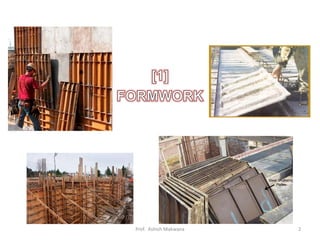
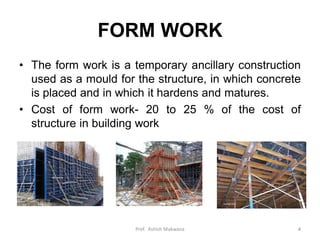
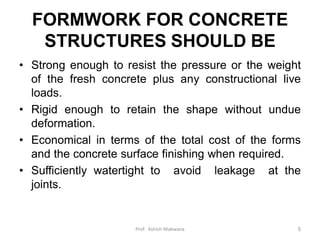
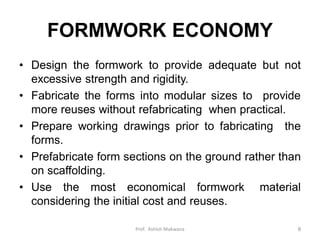
• The form work is a temporary ancillary construction
used as a mould for the structure, in which concrete
is placed and in which it hardens and matures.
• Cost of form work- 20 to 25 % of the cost of
structure in building work
4Prof. Ashish Makwana
FORMWORK FOR CONCRETE
STRUCTURES SHOULD BE
• Strong enough to resist the pressure or the weight
of the fresh concrete plus any constructional live
loads.
• Rigid enough to retain the shape without undue
deformation.
• Economical in terms of the total cost of the forms
and the concrete surface finishing when required.
• Sufficiently watertight to avoid leakage at the
joints.
5Prof. Ashish Makwana
6Prof. Ashish Makwana
7Prof. Ashish Makwana
FORMWORK ECONOMY
• Design the formwork to provide adequate but not
excessive strength and rigidity.
• Fabricate the forms into modular sizes to provide
more reuses without refabricating when practical.
• Prepare working drawings prior to fabricating the
forms.
• Prefabricate form sections on the ground rather than
on scaffolding.
• Use the most economical formwork material
considering the initial cost and reuses.
8Prof. Ashish Makwana
FORMWORK ECONOMY (continued..)
• Use no more nails than are needed to join the forms
together safely.
• Remove the formwork as soon as it is permissible.
• Clean and oil forms by using releasing agent after
each use.
• When it is permissible install construction joins to
reduce the total quantity of form material required
and permit the carpenters to work more
continuously.
9Prof. Ashish Makwana
FORMWORK MATERIALS
1. Timber 2. Metals 3. Plastics
10Prof. Ashish Makwana
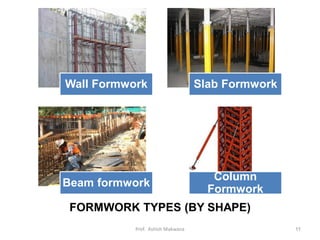
FORMWORK TYPES (BY SHAPE)
11
Wall Formwork Slab Formwork
Beam formwork
Column
Formwork
Prof. Ashish Makwana
12
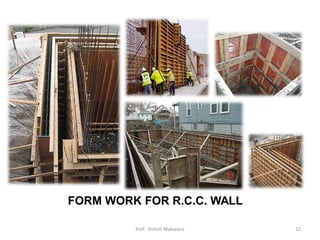
FORM WORK FOR R.C.C. WALL
Prof. Ashish Makwana
FORM WORK FOR
R.C.C. WALL
13Prof. Ashish Makwana
FORM WORK FOR R.C.C. WALL
• Wall formwork is a simpler than for other concrete
units as the actual forces against it are less, most of
the load being carried vertically downwards.
• The panels at both sides are held in position by
ties.
• Ties are also used as spacer, arranging wall
thickness.
• WaII support systems are usually sloping props
at satisfactory intervals.
14Prof. Ashish Makwana
15
FORM WORK FOR COLUMN
Prof. Ashish Makwana
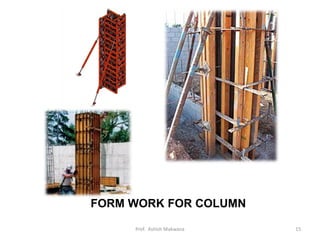
FORM WORK FOR COLUMN
• Column formwork is made usually with either timber
or metal panels.
• The principle is to create an enclosed box with
frames at the exact size of the column and fix it
tightly on the kicker left from base or at the last
stage of column concreting.
• The box is held in position by steel column clamps
or bolted yokes and supported by timber studs or
props.
16Prof. Ashish Makwana
17
FORM WORK FOR R.C.C. SLAB
Prof. Ashish Makwana
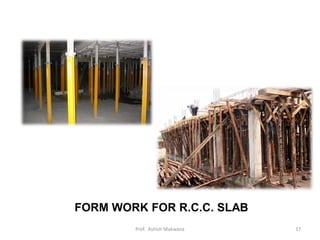
FORM WORK FOR
R.C.C. SLAB
• Floors require a large area of formwork to be
provided usually from beam to beam.
• Timber floor formwork consists of timber boards or
plywood sheets supported on a framework and
resting on a series of timber joists.
• Again timber and metal props can be used for
vertical supports.
• Metal panels can be used and bolted or clipped
together and held in place by a system of metal
beams or a tabular scaffold system.
• Adjustable props need for levelling purposes.
18Prof. Ashish Makwana
19
FORMWORK FOR R.C.C. BEAM
Prof. Ashish Makwana
FORM WORK FOR
R.C.C. BEAM
• Beam formwork consists of open through section
and because it is not closed at the top requires
more supporting framework to restrain the sides.
• The supports need to be maintained to the soffit and
also provide lateral support to the sides.
• In timber this is done by the use of a headtree
across the top of a vertical member.
• Metal panels are used with corner pieces, but
timber headtrees are needed for vertical support.
20Prof. Ashish Makwana
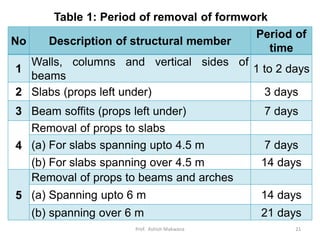
No Description of structural member
Period of
time
1
Walls, columns and vertical sides of
beams
1 to 2 days
2 Slabs (props left under) 3 days
3 Beam soffits (props left under) 7 days
4
Removal of props to slabs
(a) For slabs spanning upto 4.5 m 7 days
(b) For slabs spanning over 4.5 m 14 days
5
Removal of props to beams and arches
(a) Spanning upto 6 m 14 days
(b) spanning over 6 m 21 days
21
Table 1: Period of removal of formwork
Prof. Ashish Makwana
CENTERING FOR ARCHES OF
LARGE SPANS AND DAMS
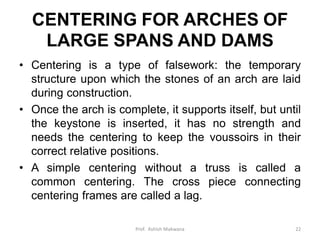
• Centering is a type of falsework: the temporary
structure upon which the stones of an arch are laid
during construction.
• Once the arch is complete, it supports itself, but until
the keystone is inserted, it has no strength and
needs the centering to keep the voussoirs in their
correct relative positions.
• A simple centering without a truss is called a
common centering. The cross piece connecting
centering frames are called a lag.
22Prof. Ashish Makwana
23
The original Blackfriars Bridge, London,
under construction in 1764
Prof. Ashish Makwana
DESIGN FEATURES FOR
TEMPORARY WORKS
• Strength: Forms and shutters have to be designed
to support dead weight, live load and hydrostatic
pressure. Sheathing must be rigid enough to resist
bulging.
• Speedy erection and dismantling: The formwork sho
uld be simple to remove without causing damage to
the concrete.
• Tightness of joints: The liquid retaining properties
the formwork must be adequate to prevent leakage
of cement and fine aggregate from the concrete.
24Prof. Ashish Makwana
DESIGN FEATURES FOR TEMPORARY WORKS (continued..)
• Rigidity: Brace formwork and support to ensure
no movement may take place under wind pressure,
or when the concrete is being placed and vibrated.
• Ease of handling: Forms and shutters must be of a
size and weight that can be handled by the labour
and plant available on site.
• Removal of debris: Provide all formwork with special
cleanout holes to allow for the removal of sawdust, s
havings, and other debris from the bottom of the for
mwork before the pour begins.
25Prof. Ashish Makwana
DESIGN FEATURES FOR TEMPORARY WORKS (continued..)
• Reuse:
– Design for unit construction, if possible, so that
at you can strike and reuse as soon as possible.
– Use clamps, wedges, and similar devices to hold
sections of formwork in place.
– Avoid nailing as much as possible, nail holes and
bruising of the timber will spoil
formwork for further use.
– The formwork material must be durable and capa
ble of producing a good surface finish.
26Prof. Ashish Makwana
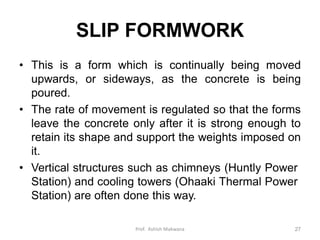
SLIP FORMWORK
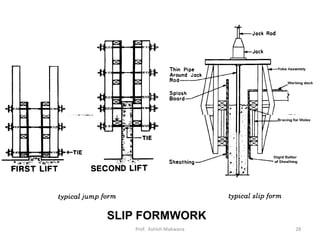
• This is a form which is continually being moved
upwards, or sideways, as the concrete is being
poured.
• The rate of movement is regulated so that the forms
leave the concrete only after it is strong enough to
retain its shape and support the weights imposed on
it.
• Vertical structures such as chimneys (Huntly Power
Station) and cooling towers (Ohaaki Thermal Power
Station) are often done this way.
27Prof. Ashish Makwana
28
SLIP FORMWORK
Prof. Ashish Makwana
29
SLIP FORMWORK
Prof. Ashish Makwana
FALSEWORK FOR BRIDGES
• Falsework is temporary structure or framework used
in construction to support materials, equipment, or
formwork.
• Most falsework is vertical, supporting beams and
slabs. Falsework must be engineer designed.
• As well as supporting the weight, allowance must
made for sideway pressures such as wind, stacks
materials causing eccentric loading, props out of
plumb, formwork being struck by machinery or crane
loads.
30Prof. Ashish Makwana
FALSE WORK FOR BRIDGES (continued..)
• Falsework can be:
– timber;
– scaffold tube with adjustable screw jacks, top or
bottom, or both;
– proprietary prop such as Acrow prop;
– proprietary braced frame such as Acrow shore;
– proprietary floor centre (a telescopic beam);
– proprietary beam clamps such as Acrow beam
clamp which combines formwork and falsework.
31Prof. Ashish Makwana
FALSE WORK FOR BRIDGES (continued..)
SETTING UP FALSEWORK
• Base must be level and firm. A sole plate is
preferable.
• Props and frames must be placed as per design.
• Place props centrally under members
• Brace falsework in two directions
• Floor centres must have full bearing for the end
tongues.
• Beams must be centred over props to prevent
eccentric (out of line) loading.
32Prof. Ashish Makwana
33
FALSEWORK
Prof. Ashish Makwana
THANK YOU
34Prof. Ashish Makwana

Form work_Advanced Construction Technology (Semester-6), Civil Engineering

  • 1.
    Prepared by Prof. AshishMakwana Civil Engineering Dept. - MEFGI 1Prof. Ashish Makwana
  • 2.
  • 3.
    PRESENTATION OUTLINE… • Form workfor R.C.C. wall, slab, beam & column • Centering for arches of large spans and dams • Design features for temporary works • Slip formwork • False work for Bridges 3Prof. Ashish Makwana
  • 4.
    FORM WORK • Theform work is a temporary ancillary construction used as a mould for the structure, in which concrete is placed and in which it hardens and matures. • Cost of form work- 20 to 25 % of the cost of structure in building work 4Prof. Ashish Makwana
  • 5.
    FORMWORK FOR CONCRETE STRUCTURESSHOULD BE • Strong enough to resist the pressure or the weight of the fresh concrete plus any constructional live loads. • Rigid enough to retain the shape without undue deformation. • Economical in terms of the total cost of the forms and the concrete surface finishing when required. • Sufficiently watertight to avoid leakage at the joints. 5Prof. Ashish Makwana
  • 6.
  • 7.
  • 8.
    FORMWORK ECONOMY • Designthe formwork to provide adequate but not excessive strength and rigidity. • Fabricate the forms into modular sizes to provide more reuses without refabricating when practical. • Prepare working drawings prior to fabricating the forms. • Prefabricate form sections on the ground rather than on scaffolding. • Use the most economical formwork material considering the initial cost and reuses. 8Prof. Ashish Makwana
  • 9.
    FORMWORK ECONOMY (continued..) •Use no more nails than are needed to join the forms together safely. • Remove the formwork as soon as it is permissible. • Clean and oil forms by using releasing agent after each use. • When it is permissible install construction joins to reduce the total quantity of form material required and permit the carpenters to work more continuously. 9Prof. Ashish Makwana
  • 10.
    FORMWORK MATERIALS 1. Timber2. Metals 3. Plastics 10Prof. Ashish Makwana
  • 11.
    FORMWORK TYPES (BYSHAPE) 11 Wall Formwork Slab Formwork Beam formwork Column Formwork Prof. Ashish Makwana
  • 12.
    12 FORM WORK FORR.C.C. WALL Prof. Ashish Makwana
  • 13.
    FORM WORK FOR R.C.C.WALL 13Prof. Ashish Makwana
  • 14.
    FORM WORK FORR.C.C. WALL • Wall formwork is a simpler than for other concrete units as the actual forces against it are less, most of the load being carried vertically downwards. • The panels at both sides are held in position by ties. • Ties are also used as spacer, arranging wall thickness. • WaII support systems are usually sloping props at satisfactory intervals. 14Prof. Ashish Makwana
  • 15.
    15 FORM WORK FORCOLUMN Prof. Ashish Makwana
  • 16.
    FORM WORK FORCOLUMN • Column formwork is made usually with either timber or metal panels. • The principle is to create an enclosed box with frames at the exact size of the column and fix it tightly on the kicker left from base or at the last stage of column concreting. • The box is held in position by steel column clamps or bolted yokes and supported by timber studs or props. 16Prof. Ashish Makwana
  • 17.
    17 FORM WORK FORR.C.C. SLAB Prof. Ashish Makwana
  • 18.
    FORM WORK FOR R.C.C.SLAB • Floors require a large area of formwork to be provided usually from beam to beam. • Timber floor formwork consists of timber boards or plywood sheets supported on a framework and resting on a series of timber joists. • Again timber and metal props can be used for vertical supports. • Metal panels can be used and bolted or clipped together and held in place by a system of metal beams or a tabular scaffold system. • Adjustable props need for levelling purposes. 18Prof. Ashish Makwana
  • 19.
    19 FORMWORK FOR R.C.C.BEAM Prof. Ashish Makwana
  • 20.
    FORM WORK FOR R.C.C.BEAM • Beam formwork consists of open through section and because it is not closed at the top requires more supporting framework to restrain the sides. • The supports need to be maintained to the soffit and also provide lateral support to the sides. • In timber this is done by the use of a headtree across the top of a vertical member. • Metal panels are used with corner pieces, but timber headtrees are needed for vertical support. 20Prof. Ashish Makwana
  • 21.
    No Description ofstructural member Period of time 1 Walls, columns and vertical sides of beams 1 to 2 days 2 Slabs (props left under) 3 days 3 Beam soffits (props left under) 7 days 4 Removal of props to slabs (a) For slabs spanning upto 4.5 m 7 days (b) For slabs spanning over 4.5 m 14 days 5 Removal of props to beams and arches (a) Spanning upto 6 m 14 days (b) spanning over 6 m 21 days 21 Table 1: Period of removal of formwork Prof. Ashish Makwana
  • 22.
    CENTERING FOR ARCHESOF LARGE SPANS AND DAMS • Centering is a type of falsework: the temporary structure upon which the stones of an arch are laid during construction. • Once the arch is complete, it supports itself, but until the keystone is inserted, it has no strength and needs the centering to keep the voussoirs in their correct relative positions. • A simple centering without a truss is called a common centering. The cross piece connecting centering frames are called a lag. 22Prof. Ashish Makwana
  • 23.
    23 The original BlackfriarsBridge, London, under construction in 1764 Prof. Ashish Makwana
  • 24.
    DESIGN FEATURES FOR TEMPORARYWORKS • Strength: Forms and shutters have to be designed to support dead weight, live load and hydrostatic pressure. Sheathing must be rigid enough to resist bulging. • Speedy erection and dismantling: The formwork sho uld be simple to remove without causing damage to the concrete. • Tightness of joints: The liquid retaining properties the formwork must be adequate to prevent leakage of cement and fine aggregate from the concrete. 24Prof. Ashish Makwana
  • 25.
    DESIGN FEATURES FORTEMPORARY WORKS (continued..) • Rigidity: Brace formwork and support to ensure no movement may take place under wind pressure, or when the concrete is being placed and vibrated. • Ease of handling: Forms and shutters must be of a size and weight that can be handled by the labour and plant available on site. • Removal of debris: Provide all formwork with special cleanout holes to allow for the removal of sawdust, s havings, and other debris from the bottom of the for mwork before the pour begins. 25Prof. Ashish Makwana
  • 26.
    DESIGN FEATURES FORTEMPORARY WORKS (continued..) • Reuse: – Design for unit construction, if possible, so that at you can strike and reuse as soon as possible. – Use clamps, wedges, and similar devices to hold sections of formwork in place. – Avoid nailing as much as possible, nail holes and bruising of the timber will spoil formwork for further use. – The formwork material must be durable and capa ble of producing a good surface finish. 26Prof. Ashish Makwana
  • 27.
    SLIP FORMWORK • Thisis a form which is continually being moved upwards, or sideways, as the concrete is being poured. • The rate of movement is regulated so that the forms leave the concrete only after it is strong enough to retain its shape and support the weights imposed on it. • Vertical structures such as chimneys (Huntly Power Station) and cooling towers (Ohaaki Thermal Power Station) are often done this way. 27Prof. Ashish Makwana
  • 28.
  • 29.
  • 30.
    FALSEWORK FOR BRIDGES •Falsework is temporary structure or framework used in construction to support materials, equipment, or formwork. • Most falsework is vertical, supporting beams and slabs. Falsework must be engineer designed. • As well as supporting the weight, allowance must made for sideway pressures such as wind, stacks materials causing eccentric loading, props out of plumb, formwork being struck by machinery or crane loads. 30Prof. Ashish Makwana
  • 31.
    FALSE WORK FORBRIDGES (continued..) • Falsework can be: – timber; – scaffold tube with adjustable screw jacks, top or bottom, or both; – proprietary prop such as Acrow prop; – proprietary braced frame such as Acrow shore; – proprietary floor centre (a telescopic beam); – proprietary beam clamps such as Acrow beam clamp which combines formwork and falsework. 31Prof. Ashish Makwana
  • 32.
    FALSE WORK FORBRIDGES (continued..) SETTING UP FALSEWORK • Base must be level and firm. A sole plate is preferable. • Props and frames must be placed as per design. • Place props centrally under members • Brace falsework in two directions • Floor centres must have full bearing for the end tongues. • Beams must be centred over props to prevent eccentric (out of line) loading. 32Prof. Ashish Makwana
  • 33.
  • 34.