PRESENTATION
ON“FORMWORK”
CON S TRUCTION
TECHNIQUES
BY
Nishant Singh
Kushwah
G E C , Aj m e
r
17-Apr-19 N S Kushwah
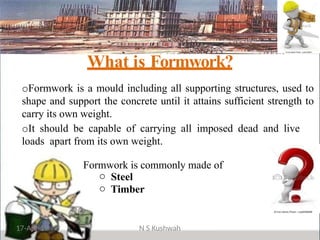
What is Formwork?
oFormwork is a mould including all supporting structures, used to
shape and support the concrete until it attains sufficient strength to
carry its own weight.
oIt should be capable of carrying all imposed dead and live
loads apart from its own weight.
Formwork is commonly made of
o Steel
o Timber
17-Apr-19 N S Kushwah
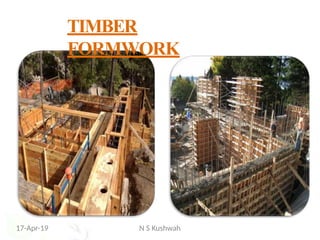
TIMBER
FORMWORK
17-Apr-19 N S Kushwah
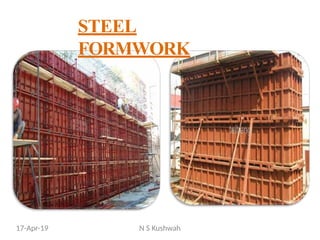
STEEL
FORMWORK
17-Apr-19 N S Kushwah
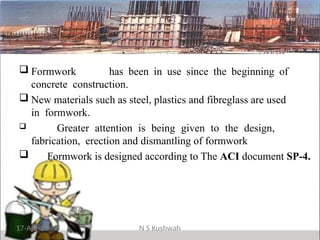
 Formwork has been in use since the beginning of
concrete construction.
 New materials such as steel, plastics and fibreglass are used
in formwork.
 Greater attention is being given to the design,
fabrication, erection and dismantling of formwork
 Formwork is designed according to The ACI document SP-4.
17-Apr-19 N S Kushwah
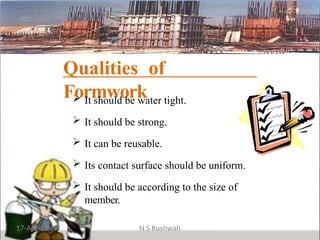
Qualities of
Formwork
 It should be water tight.
 It should be strong.
 It can be reusable.
 Its contact surface should be uniform.
 It should be according to the size of
member.
17-Apr-19 N S Kushwah
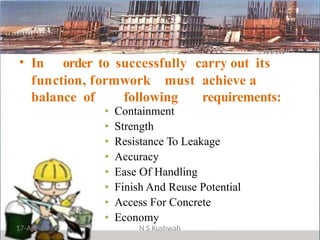
• In order to successfully carry out its
function, formwork must achieve a
balance of following requirements:
• Containment
• Strength
• Resistance To Leakage
• Accuracy
• Ease Of Handling
• Finish And Reuse Potential
• Access For Concrete
• Economy
17-Apr-19 N S Kushwah
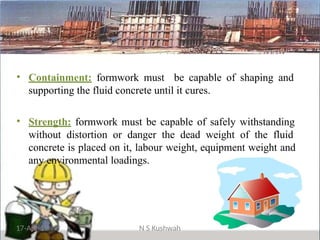
• Containment: formwork must be capable of shaping and
supporting the fluid concrete until it cures.
• Strength: formwork must be capable of safely withstanding
without distortion or danger the dead weight of the fluid
concrete is placed on it, labour weight, equipment weight and
any environmental loadings.
17-Apr-19 N S Kushwah
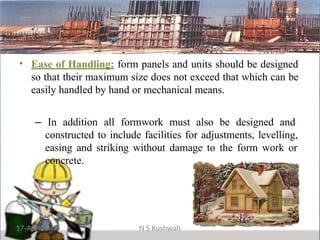
• Ease of Handling: form panels and units should be designed
so that their maximum size does not exceed that which can be
easily handled by hand or mechanical means.
– In addition all formwork must also be designed and
constructed to include facilities for adjustments, levelling,
easing and striking without damage to the form work or
concrete.
17-Apr-19 N S Kushwah
• Economy: all the formwork is very expensive. On average about 35% of
the total cost of any finished concrete unit or element can be attributed to
its formwork; of this just over 40% can be taken for material for
formwork and 60% for labour.
– The formwork designer must therefore not only consider the
maximum number of times that any form can be reused, but also
produce a design that will minimize the time taken for erection and
striking.
17-Apr-19 N S Kushwah
Major objectives
considered in
formwork:
 Quality
 Safety
 Economy
17-Apr-19 N S Kushwah
so that they have
17-Apr-19 N S Kushwah
 Quality:
Forms must be designed and built with sufficient stiffness and accuracy so that the
size, shape, position, and finish of the cast concrete are maintained.
Safety:
Forms must be built sufficient strengthand factor of safety
the capable of all supporting loads.

Economy:
Forms must be built efficiently, minimizing time and cost.
Requirements of
formwork:
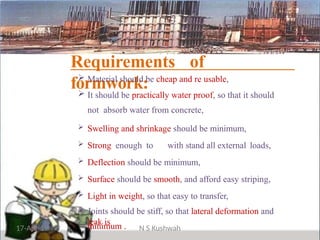
 Material should be cheap and re usable,
 It should be practically water proof, so that it should
not absorb water from concrete,
 Swelling and shrinkage should be minimum,
 Strong enough to with stand all external loads,
 Deflection should be minimum,
 Surface should be smooth, and afford easy striping,
 Light in weight, so that easy to transfer,
 Joints should be stiff, so that lateral deformation and
leak is
minimum .
17-Apr-19 N S Kushwah
Three stages in the
process :
a) Assembly and erection .
b) Concrete placement.
c) Stripping and dismantling.
17-Apr-19 N S Kushwah
• Formwork detail for
different structural
members
In concrete construction formwork is
17-Apr-19
commonly provided for the following
structural members.
o Wall
o Column
o Slabs & Beams
o Stairs
o Chimneys
o Water tanks
o Cooling TNoSwK
uesrhsw
a
h
• Formwork for Wall
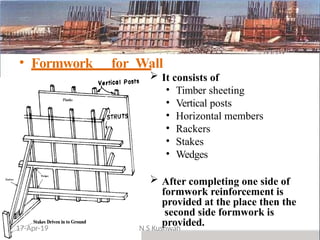
 It consists of
• Timber sheeting
• Vertical posts
• Horizontal members
• Rackers
• Stakes
• Wedges
 After completing one side of
formwork reinforcement is
provided at the place then the
second side formwork is
provided.
17-Apr-19 N S Kushwah
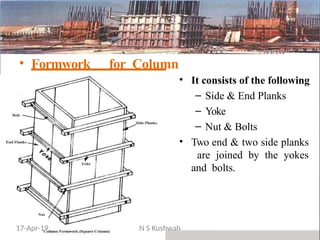
• Formwork for Column
• It consists of the following
– Side & End Planks
– Yoke
– Nut & Bolts
• Two end & two side planks
are joined by the yokes
and bolts.
17-Apr-19 N S Kushwah
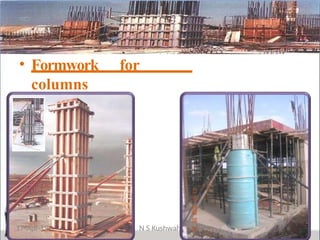
• Formwork for
columns
17-Apr-19 N S Kushwah
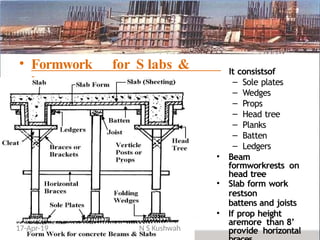
• Formwork for S labs &
beams•:
It consistsof
– Sole plates
– Wedges
– Props
– Head tree
– Planks
– Batten
– Ledgers
• Beam
formworkrests on
head tree
• Slab form work
restson
battens and joists
• If prop height
aremore than 8’
provide horizontal
17-Apr-19 N S Kushwah
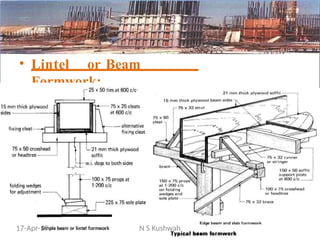
• Lintel or Beam
Formwork:
17-Apr-19 N S Kushwah
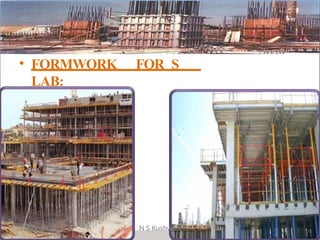
• FORMWORK FOR S
LAB:
17-Apr-19 N S Kushwah
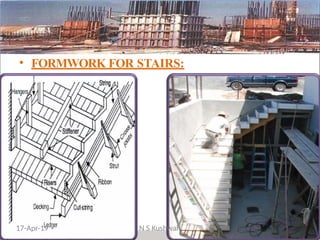
• FORMWORK FOR STAIRS:
• It consists of
– Vertical & inclined
posts
– Inclined members
-- Wooden Planks or
sheeting
– Stringer
– Riser Planks
17-Apr-19 N S Kushwah
• FORMWORK FOR STAIRS:
17-Apr-19 N S Kushwah
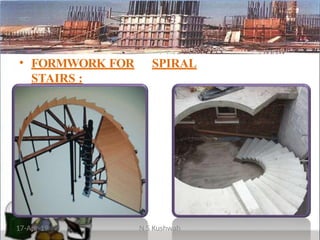
• FORMWORK FOR SPIRAL
STAIRS :
17-Apr-19 N S Kushwah
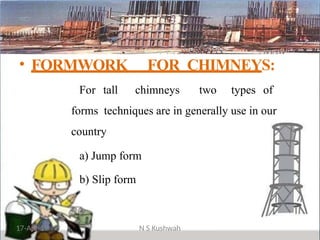
• FORMWORK FOR CHIMNEYS:
For tall chimneys two types of
forms techniques are in generally use in our
country
a) Jump form
b) Slip form
17-Apr-19 N S Kushwah
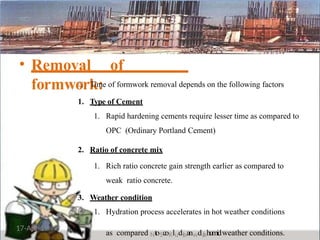
• Removal of
formwork:
Time of formwork removal depends on the following factors
1. Type of Cement
1. Rapid hardening cements require lesser time as compared to
OPC (Ordinary Portland Cement)
2. Ratio of concrete mix
1. Rich ratio concrete gain strength earlier as compared to
weak ratio concrete.
3. Weather condition
17-Apr-19
1. Hydration process accelerates in hot weather conditions
as compared NtoScoKluds
hanwda
hhumidweather conditions.
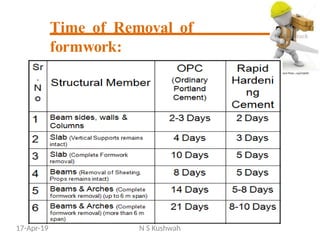
Time of Removal of
formwork:
17-Apr-19 N S Kushwah
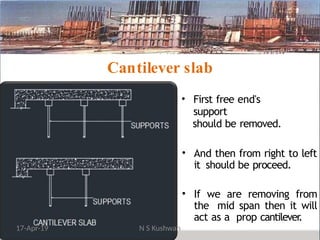
• First free end's
support
should be removed.
• And then from right to left
it should be proceed.
• If we are removing from
the mid span then it will
act as a prop cantilever
.
Cantilever slab
17-Apr-19 N S Kushwah
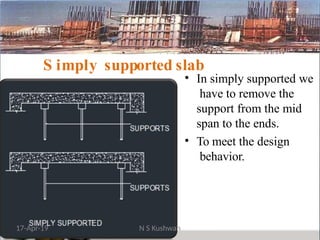
• In simply supported we
have to remove the
support from the mid
span to the ends.
• To meet the design
behavior.
S imply supported slab
17-Apr-19 N S Kushwah
• Maintenance of formwork:
• Due to continuous use wooden planks &
steel plates surfaces become uneven and require
maintenance.
• For wooden formwork use cardboard or
plastic fiber board. Bolt hole places must also be
repaired.
• For steelformwork plates must be leveled
17-Apr-19 N S Kushwah
• Cost of formwork
 For normal works cost of formwork is about 30%-40% of the concrete cost.
 For special works cost of formwork is about 50%-60% of the concrete cost.
 Formwork cost is controlled by the following factors
• Formwork Material cost
• Formwork erecting cost
• Formwork removal cost
• Formwork jointing cost (Nails and Cables)
• Labor charges.
17-Apr-19 N S Kushwah
• Advantages of steel form work:
 It can be used for a no. of
times.
 It is non absorbent.
 Smooth finish surfaceobtained.
 No shrinkage of formwork
occurs.
 Easy to use.
 Its volume is less
17-Apr-19 N S Kushwah
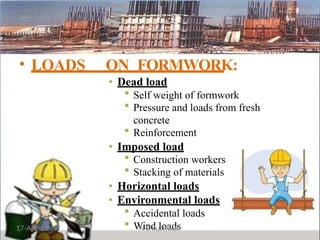
• LOADS ON FORMWORK:
• Dead load
 Self weight of formwork
 Pressure and loads from fresh
concrete
 Reinforcement
• Imposed load
 Construction workers
 Stacking of materials
• Horizontal loads
• Environmental loads
 Accidental loads
 Wind loads
17-Apr-19 N S Kushwah
• References
• R.C.C Design by B.C.Punmia
• R.C.C Design by H.J.Shah
• Formwork Design Section 1500
• Doka Formwork Design
• Design of safe timber structures by Eva
and Tomi Torrati
17-Apr-19 N S Kushwah
17-Apr-19

Form Work in civil engineering field.pptx

  • 1.
    PRESENTATION ON“FORMWORK” CON S TRUCTION TECHNIQUES BY NishantSingh Kushwah G E C , Aj m e r 17-Apr-19 N S Kushwah
  • 2.
    What is Formwork? oFormworkis a mould including all supporting structures, used to shape and support the concrete until it attains sufficient strength to carry its own weight. oIt should be capable of carrying all imposed dead and live loads apart from its own weight. Formwork is commonly made of o Steel o Timber 17-Apr-19 N S Kushwah
  • 3.
  • 4.
  • 5.
     Formwork hasbeen in use since the beginning of concrete construction.  New materials such as steel, plastics and fibreglass are used in formwork.  Greater attention is being given to the design, fabrication, erection and dismantling of formwork  Formwork is designed according to The ACI document SP-4. 17-Apr-19 N S Kushwah
  • 6.
    Qualities of Formwork  Itshould be water tight.  It should be strong.  It can be reusable.  Its contact surface should be uniform.  It should be according to the size of member. 17-Apr-19 N S Kushwah
  • 7.
    • In orderto successfully carry out its function, formwork must achieve a balance of following requirements: • Containment • Strength • Resistance To Leakage • Accuracy • Ease Of Handling • Finish And Reuse Potential • Access For Concrete • Economy 17-Apr-19 N S Kushwah
  • 8.
    • Containment: formworkmust be capable of shaping and supporting the fluid concrete until it cures. • Strength: formwork must be capable of safely withstanding without distortion or danger the dead weight of the fluid concrete is placed on it, labour weight, equipment weight and any environmental loadings. 17-Apr-19 N S Kushwah
  • 9.
    • Ease ofHandling: form panels and units should be designed so that their maximum size does not exceed that which can be easily handled by hand or mechanical means. – In addition all formwork must also be designed and constructed to include facilities for adjustments, levelling, easing and striking without damage to the form work or concrete. 17-Apr-19 N S Kushwah
  • 10.
    • Economy: allthe formwork is very expensive. On average about 35% of the total cost of any finished concrete unit or element can be attributed to its formwork; of this just over 40% can be taken for material for formwork and 60% for labour. – The formwork designer must therefore not only consider the maximum number of times that any form can be reused, but also produce a design that will minimize the time taken for erection and striking. 17-Apr-19 N S Kushwah
  • 11.
    Major objectives considered in formwork: Quality  Safety  Economy 17-Apr-19 N S Kushwah
  • 12.
    so that theyhave 17-Apr-19 N S Kushwah  Quality: Forms must be designed and built with sufficient stiffness and accuracy so that the size, shape, position, and finish of the cast concrete are maintained. Safety: Forms must be built sufficient strengthand factor of safety the capable of all supporting loads.  Economy: Forms must be built efficiently, minimizing time and cost.
  • 13.
    Requirements of formwork:  Materialshould be cheap and re usable,  It should be practically water proof, so that it should not absorb water from concrete,  Swelling and shrinkage should be minimum,  Strong enough to with stand all external loads,  Deflection should be minimum,  Surface should be smooth, and afford easy striping,  Light in weight, so that easy to transfer,  Joints should be stiff, so that lateral deformation and leak is minimum . 17-Apr-19 N S Kushwah
  • 14.
    Three stages inthe process : a) Assembly and erection . b) Concrete placement. c) Stripping and dismantling. 17-Apr-19 N S Kushwah
  • 15.
    • Formwork detailfor different structural members In concrete construction formwork is 17-Apr-19 commonly provided for the following structural members. o Wall o Column o Slabs & Beams o Stairs o Chimneys o Water tanks o Cooling TNoSwK uesrhsw a h
  • 16.
    • Formwork forWall  It consists of • Timber sheeting • Vertical posts • Horizontal members • Rackers • Stakes • Wedges  After completing one side of formwork reinforcement is provided at the place then the second side formwork is provided. 17-Apr-19 N S Kushwah
  • 17.
    • Formwork forColumn • It consists of the following – Side & End Planks – Yoke – Nut & Bolts • Two end & two side planks are joined by the yokes and bolts. 17-Apr-19 N S Kushwah
  • 18.
  • 19.
    • Formwork forS labs & beams•: It consistsof – Sole plates – Wedges – Props – Head tree – Planks – Batten – Ledgers • Beam formworkrests on head tree • Slab form work restson battens and joists • If prop height aremore than 8’ provide horizontal 17-Apr-19 N S Kushwah
  • 20.
    • Lintel orBeam Formwork: 17-Apr-19 N S Kushwah
  • 21.
    • FORMWORK FORS LAB: 17-Apr-19 N S Kushwah
  • 22.
    • FORMWORK FORSTAIRS: • It consists of – Vertical & inclined posts – Inclined members -- Wooden Planks or sheeting – Stringer – Riser Planks 17-Apr-19 N S Kushwah
  • 23.
    • FORMWORK FORSTAIRS: 17-Apr-19 N S Kushwah
  • 24.
    • FORMWORK FORSPIRAL STAIRS : 17-Apr-19 N S Kushwah
  • 25.
    • FORMWORK FORCHIMNEYS: For tall chimneys two types of forms techniques are in generally use in our country a) Jump form b) Slip form 17-Apr-19 N S Kushwah
  • 26.
  • 27.
    • Removal of formwork: Timeof formwork removal depends on the following factors 1. Type of Cement 1. Rapid hardening cements require lesser time as compared to OPC (Ordinary Portland Cement) 2. Ratio of concrete mix 1. Rich ratio concrete gain strength earlier as compared to weak ratio concrete. 3. Weather condition 17-Apr-19 1. Hydration process accelerates in hot weather conditions as compared NtoScoKluds hanwda hhumidweather conditions.
  • 28.
    Time of Removalof formwork: 17-Apr-19 N S Kushwah
  • 29.
    • First freeend's support should be removed. • And then from right to left it should be proceed. • If we are removing from the mid span then it will act as a prop cantilever . Cantilever slab 17-Apr-19 N S Kushwah
  • 30.
    • In simplysupported we have to remove the support from the mid span to the ends. • To meet the design behavior. S imply supported slab 17-Apr-19 N S Kushwah
  • 31.
    • Maintenance offormwork: • Due to continuous use wooden planks & steel plates surfaces become uneven and require maintenance. • For wooden formwork use cardboard or plastic fiber board. Bolt hole places must also be repaired. • For steelformwork plates must be leveled 17-Apr-19 N S Kushwah
  • 32.
    • Cost offormwork  For normal works cost of formwork is about 30%-40% of the concrete cost.  For special works cost of formwork is about 50%-60% of the concrete cost.  Formwork cost is controlled by the following factors • Formwork Material cost • Formwork erecting cost • Formwork removal cost • Formwork jointing cost (Nails and Cables) • Labor charges. 17-Apr-19 N S Kushwah
  • 33.
    • Advantages ofsteel form work:  It can be used for a no. of times.  It is non absorbent.  Smooth finish surfaceobtained.  No shrinkage of formwork occurs.  Easy to use.  Its volume is less 17-Apr-19 N S Kushwah
  • 34.
    • LOADS ONFORMWORK: • Dead load  Self weight of formwork  Pressure and loads from fresh concrete  Reinforcement • Imposed load  Construction workers  Stacking of materials • Horizontal loads • Environmental loads  Accidental loads  Wind loads 17-Apr-19 N S Kushwah
  • 35.
    • References • R.C.CDesign by B.C.Punmia • R.C.C Design by H.J.Shah • Formwork Design Section 1500 • Doka Formwork Design • Design of safe timber structures by Eva and Tomi Torrati 17-Apr-19 N S Kushwah
  • 36.