EXPANSION &
CONSTRUCTION JOINTS
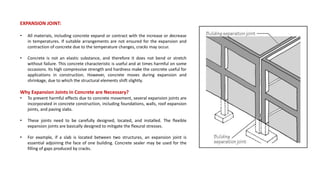
EXPANSION JOINT:
• All materials, including concrete expand or contract with the increase or decrease
in temperatures. If suitable arrangements are not ensured for the expansion and
contraction of concrete due to the temperature changes, cracks may occur.
• Concrete is not an elastic substance, and therefore it does not bend or stretch
without failure. This concrete characteristic is useful and at times harmful on some
occasions. Its high compressive strength and hardness make the concrete useful for
applications in construction. However, concrete moves during expansion and
shrinkage, due to which the structural elements shift slightly.
Why Expansion Joints in Concrete are Necessary?
• To prevent harmful effects due to concrete movement, several expansion joints are
incorporated in concrete construction, including foundations, walls, roof expansion
joints, and paving slabs.
• These joints need to be carefully designed, located, and installed. The flexible
expansion joints are basically designed to mitigate the flexural stresses.
• For example, if a slab is located between two structures, an expansion joint is
essential adjoining the face of one building. Concrete sealer may be used for the
filling of gaps produced by cracks.
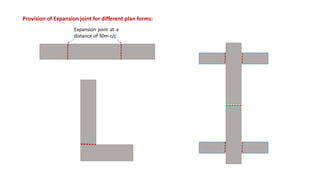
Provision of Expansion joint for different plan forms:
Expansion joint at a
distance of 30m c/c
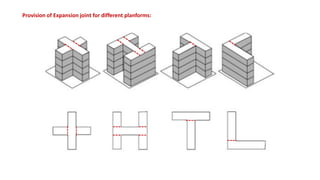
Provision of Expansion joint for different planforms:
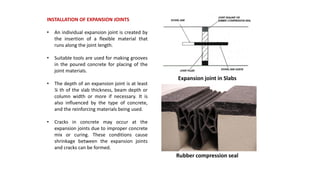
INSTALLATION OF EXPANSION JOINTS
• An individual expansion joint is created by
the insertion of a flexible material that
runs along the joint length.
• Suitable tools are used for making grooves
in the poured concrete for placing of the
joint materials.
• The depth of an expansion joint is at least
¼ th of the slab thickness, beam depth or
column width or more if necessary. It is
also influenced by the type of concrete,
and the reinforcing materials being used.
• Cracks in concrete may occur at the
expansion joints due to improper concrete
mix or curing. These conditions cause
shrinkage between the expansion joints
and cracks can be formed.
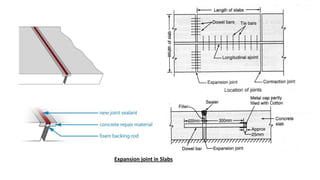
Expansion joint in Slabs
Rubber compression seal
Expansion joint in Slabs
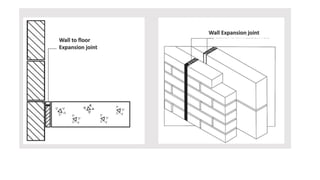
Wall to floor
Expansion joint
Wall Expansion joint
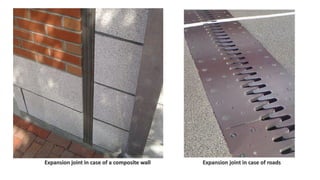
Expansion joint in case of roadsExpansion joint in case of a composite wall
CONSTRUCTION JOINT:
On many jobs there will be starting and stopping points-we won't pour the entire slab or column all at once. That's where we
will place a construction joint. Here are a few tips:
• A construction joint should also be used in cases of equipment breakdown, an unexpected shortage of materials, or bad
weather, although the joint should still be worked into the jointing pattern—placed where a contraction joint was planned.
If that's not possible, the odd section may later have to be removed.
• Use internal vibration during concrete placement at the construction joint to assure proper consolidation along the edge
and around any dowels, load transfer devices, or armored joint assemblies--especially if the concrete has larger top-size
aggregate.
• Be sure to cure the vertical face after removal of the bulkhead by applying a liquid curing compound.
• Construction joints should be worked into the overall joints plan, where they can also function as expansion joints.
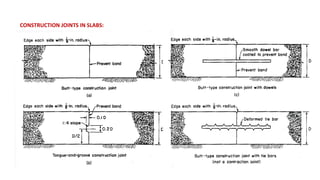
CONSTRUCTION JOINTS IN SLABS:
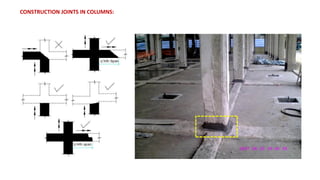
CONSTRUCTION JOINTS IN COLUMNS:
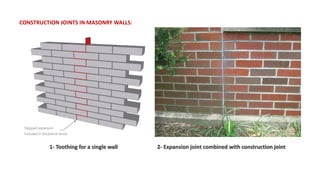
CONSTRUCTION JOINTS IN MASONRY WALLS:
1- Toothing for a single wall 2- Expansion joint combined with construction joint
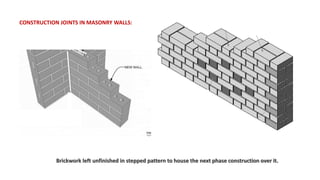
CONSTRUCTION JOINTS IN MASONRY WALLS:
Brickwork left unfinished in stepped pattern to house the next phase construction over it.
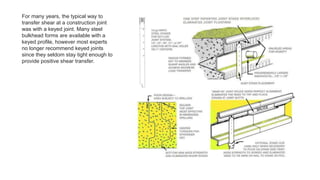
For many years, the typical way to
transfer shear at a construction joint
was with a keyed joint. Many steel
bulkhead forms are available with a
keyed profile, however most experts
no longer recommend keyed joints
since they seldom stay tight enough to
provide positive shear transfer.
MILD STEEL & STAINLESS STEEL
What Is Stainless Steel?
What is stainless steel?
• 'Stainless' is a term coined early in the development of these steels for cutlery applications. It was adopted as a generic
name for these steels and now covers a wide range of steel types and grades for corrosion or oxidation resistant
applications.
• Stainless steels are iron alloys with a minimum of 10.5% chromium. Other alloying elements are added to enhance
their structure and properties such as formability, strength and cryogenic toughness. These include metals such as:
• Nickel
• Molybdenum
• Titanium
• Copper
• Non-metal additions are also made, the main ones being:
• Carbon
• Nitrogen
• The main requirement for stainless steels is that they should be corrosion resistant for a specified application or
environment. The selection of a particular "type" and "grade" of stainless steel must initially meet the corrosion
resistance requirements. Additional mechanical or physical properties may also need to be considered to achieve the
overall service performance requirements.
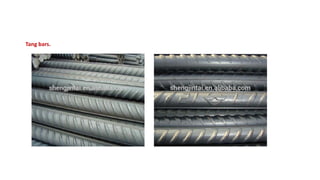
Tang bars.
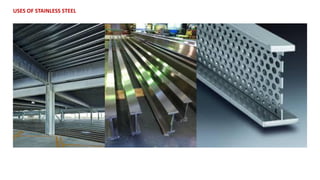
USES OF STAINLESS STEEL
• Carbon steel is sometimes referred to as ‘mild steel’ or ‘plain
carbon steel’.
• The American Iron and Steel Institute defines a carbon steel
as having no more than 2 % carbon and no other
appreciable alloying element. Carbon steel makes up the
largest part of steel production and is used in a vast range of
applications.
• Typically carbon steels are stiff and strong.
• They also exhibit ferromagnetism (i.e. they are magnetic).
This means they are extensively used in motors and
electrical appliances.
• Welding carbon steels with a carbon content greater than
0.3 % requires that special precautions be taken. However,
welding carbon steel presents far fewer problems than
welding stainless steels.
• The corrosion resistance of carbon steels is poor (i.e. they
rust) and so they should not be used in a corrosive
environment unless some form of protective coating is used.
What Is Mild Steel?
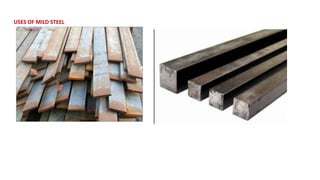
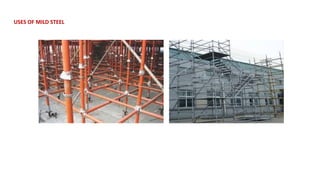
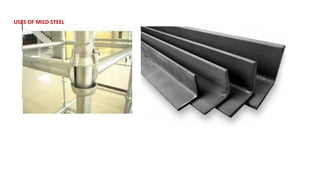
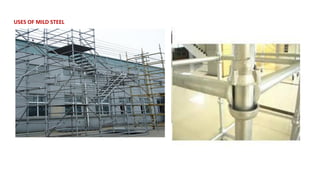
USES OF MILD STEEL
USES OF MILD STEEL
USES OF MILD STEEL
USES OF MILD STEEL

Joints

  • 1.
  • 2.
    EXPANSION JOINT: • Allmaterials, including concrete expand or contract with the increase or decrease in temperatures. If suitable arrangements are not ensured for the expansion and contraction of concrete due to the temperature changes, cracks may occur. • Concrete is not an elastic substance, and therefore it does not bend or stretch without failure. This concrete characteristic is useful and at times harmful on some occasions. Its high compressive strength and hardness make the concrete useful for applications in construction. However, concrete moves during expansion and shrinkage, due to which the structural elements shift slightly. Why Expansion Joints in Concrete are Necessary? • To prevent harmful effects due to concrete movement, several expansion joints are incorporated in concrete construction, including foundations, walls, roof expansion joints, and paving slabs. • These joints need to be carefully designed, located, and installed. The flexible expansion joints are basically designed to mitigate the flexural stresses. • For example, if a slab is located between two structures, an expansion joint is essential adjoining the face of one building. Concrete sealer may be used for the filling of gaps produced by cracks.
  • 3.
    Provision of Expansionjoint for different plan forms: Expansion joint at a distance of 30m c/c
  • 4.
    Provision of Expansionjoint for different planforms:
  • 5.
    INSTALLATION OF EXPANSIONJOINTS • An individual expansion joint is created by the insertion of a flexible material that runs along the joint length. • Suitable tools are used for making grooves in the poured concrete for placing of the joint materials. • The depth of an expansion joint is at least ¼ th of the slab thickness, beam depth or column width or more if necessary. It is also influenced by the type of concrete, and the reinforcing materials being used. • Cracks in concrete may occur at the expansion joints due to improper concrete mix or curing. These conditions cause shrinkage between the expansion joints and cracks can be formed. Expansion joint in Slabs Rubber compression seal
  • 6.
  • 7.
    Wall to floor Expansionjoint Wall Expansion joint
  • 8.
    Expansion joint incase of roadsExpansion joint in case of a composite wall
  • 9.
    CONSTRUCTION JOINT: On manyjobs there will be starting and stopping points-we won't pour the entire slab or column all at once. That's where we will place a construction joint. Here are a few tips: • A construction joint should also be used in cases of equipment breakdown, an unexpected shortage of materials, or bad weather, although the joint should still be worked into the jointing pattern—placed where a contraction joint was planned. If that's not possible, the odd section may later have to be removed. • Use internal vibration during concrete placement at the construction joint to assure proper consolidation along the edge and around any dowels, load transfer devices, or armored joint assemblies--especially if the concrete has larger top-size aggregate. • Be sure to cure the vertical face after removal of the bulkhead by applying a liquid curing compound. • Construction joints should be worked into the overall joints plan, where they can also function as expansion joints.
  • 10.
  • 11.
  • 12.
    CONSTRUCTION JOINTS INMASONRY WALLS: 1- Toothing for a single wall 2- Expansion joint combined with construction joint
  • 13.
    CONSTRUCTION JOINTS INMASONRY WALLS: Brickwork left unfinished in stepped pattern to house the next phase construction over it.
  • 14.
    For many years,the typical way to transfer shear at a construction joint was with a keyed joint. Many steel bulkhead forms are available with a keyed profile, however most experts no longer recommend keyed joints since they seldom stay tight enough to provide positive shear transfer.
  • 15.
    MILD STEEL &STAINLESS STEEL
  • 16.
    What Is StainlessSteel? What is stainless steel? • 'Stainless' is a term coined early in the development of these steels for cutlery applications. It was adopted as a generic name for these steels and now covers a wide range of steel types and grades for corrosion or oxidation resistant applications. • Stainless steels are iron alloys with a minimum of 10.5% chromium. Other alloying elements are added to enhance their structure and properties such as formability, strength and cryogenic toughness. These include metals such as: • Nickel • Molybdenum • Titanium • Copper • Non-metal additions are also made, the main ones being: • Carbon • Nitrogen • The main requirement for stainless steels is that they should be corrosion resistant for a specified application or environment. The selection of a particular "type" and "grade" of stainless steel must initially meet the corrosion resistance requirements. Additional mechanical or physical properties may also need to be considered to achieve the overall service performance requirements.
  • 17.
  • 18.
  • 19.
  • 20.
  • 21.
  • 22.
  • 23.
  • 24.
  • 25.
  • 26.
    • Carbon steelis sometimes referred to as ‘mild steel’ or ‘plain carbon steel’. • The American Iron and Steel Institute defines a carbon steel as having no more than 2 % carbon and no other appreciable alloying element. Carbon steel makes up the largest part of steel production and is used in a vast range of applications. • Typically carbon steels are stiff and strong. • They also exhibit ferromagnetism (i.e. they are magnetic). This means they are extensively used in motors and electrical appliances. • Welding carbon steels with a carbon content greater than 0.3 % requires that special precautions be taken. However, welding carbon steel presents far fewer problems than welding stainless steels. • The corrosion resistance of carbon steels is poor (i.e. they rust) and so they should not be used in a corrosive environment unless some form of protective coating is used. What Is Mild Steel?
  • 27.
  • 28.
  • 29.
  • 30.