
FORMWORK
Slipform
1April 19, 2020 VISHNU VIJAYAN- BMCE
INTRODUCTION
• Concrete Formwork is the temporary structure that
supports the fresh concrete and steel during the
construction process within required Strength and
Tolerance
• Formwork for concrete structures has a significant
impact on the cost, time, and quality of a completed
construction project.
• The cost of the formwork may exceed the cost of the
concrete and reinforcing steel.
2April 19, 2020 VISHNU VIJAYAN- BMCE
Contd..
• The structural safety and reliability of formwork is
just as important as that of the building itself.
• Failure of the formwork during construction could
pose obvious safety concerns, not to mention the cost
of ripping out incorrectly placed concrete
• Design values for wall forms, column forms, beam
forms, and footing forms are all different from each
other.
• The form material must also be considered. The type
of wood and the percent moisture are both factored
into the design process.
3April 19, 2020 VISHNU VIJAYAN- BMCE
DEFINITION:
 Its is an artificial support provided below and around the precast or
cast insitu concrete work.
 Formwork is commonly made of
 Steel
 wood
 Formwork construction & casting is of prime importance in
concrete industry. It share a significant amount of concrete cost.
 Formwork is designed according to The ACI document SP-4.
4
April 19, 2020 VISHNU VIJAYAN- BMCE
Qualities of formwork:
 It should be water tight
 It should be strong
 It can be reusable
 Its contact surface should be uniform
 It should be according to the size of member.
5
April 19, 2020 VISHNU VIJAYAN- BMCE
Uses
 Formwork molds the concrete to the desired shape
and size, and controls its position and alignment.
 Using formwork, concrete structures can be
constructed quickly and in the most affordable way.
Formwork substantially lowers the timeline and costs of
the project
 It is used to transfer the temporary external loads.
6
April 19, 2020 VISHNU VIJAYAN- BMCE
Major objectives considered in formwork:
 Quality
 Safety
 Economy
7
April 19, 2020 VISHNU VIJAYAN- BMCE
 Quality:
Forms must be designed and built with sufficient
stiffness and accuracy so that the size, shape, position, and
finish of the cast concrete are maintained.
Safety:
Forms must be built sufficient strength and factor of
safety so that they have the capable of all supporting loads.
Economy:
Forms must be built efficiently, minimizing time and
cost..
8
April 19, 2020 VISHNU VIJAYAN- BMCE
Requirements of formwork:
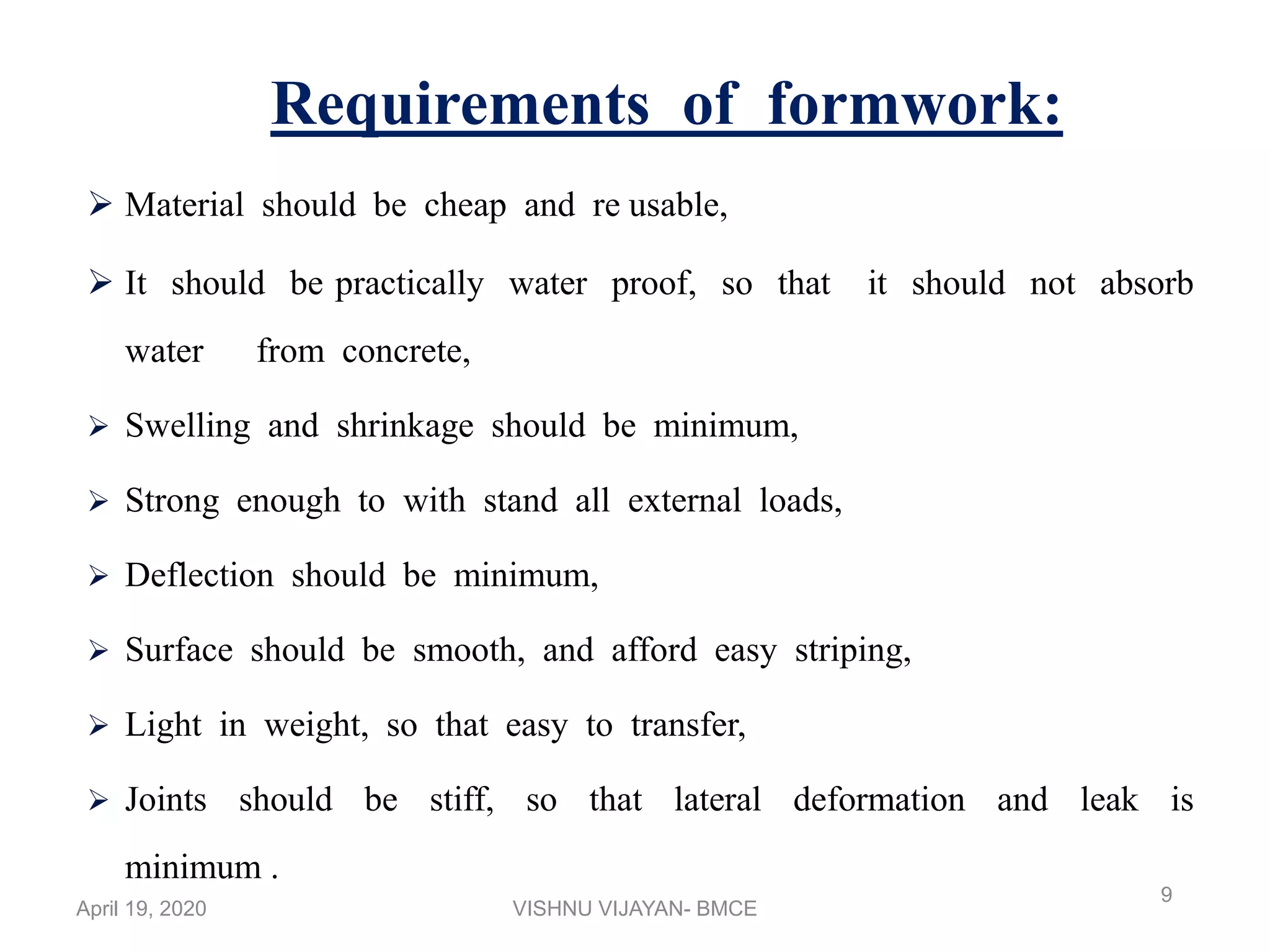
 Material should be cheap and re usable,
 It should be practically water proof, so that it should not absorb
water from concrete,
 Swelling and shrinkage should be minimum,
 Strong enough to with stand all external loads,
 Deflection should be minimum,
 Surface should be smooth, and afford easy striping,
 Light in weight, so that easy to transfer,
 Joints should be stiff, so that lateral deformation and leak is
minimum .
9
April 19, 2020 VISHNU VIJAYAN- BMCE
THREE STAGES:
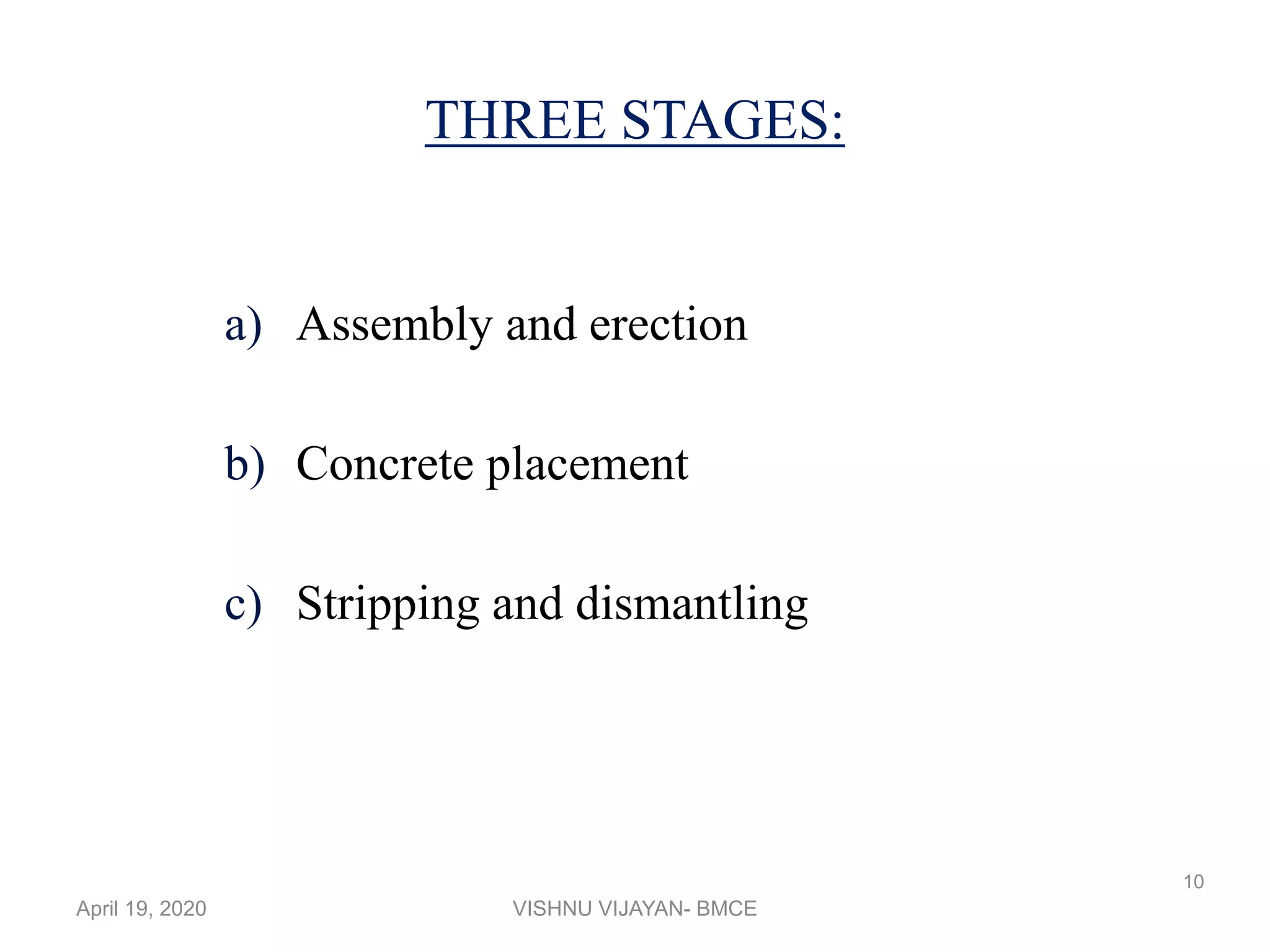
a) Assembly and erection
b) Concrete placement
c) Stripping and dismantling
10
April 19, 2020 VISHNU VIJAYAN- BMCE
Formwork detail for different structural
members
In concrete construction formwork is
commonly provided for the following structural
members.
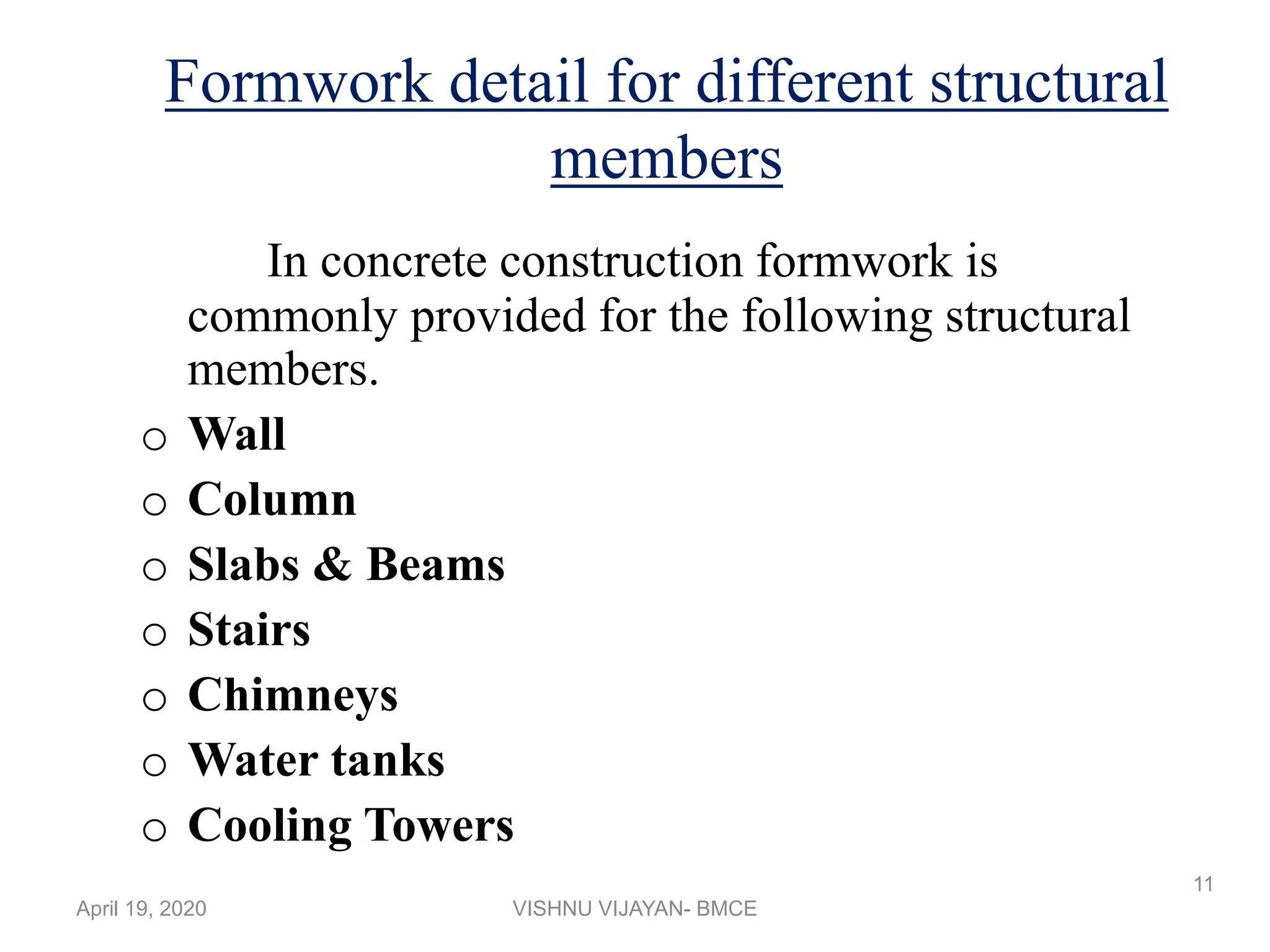
o Wall
o Column
o Slabs & Beams
o Stairs
o Chimneys
o Water tanks
o Cooling Towers
11
April 19, 2020 VISHNU VIJAYAN- BMCE
Formwork for Wall
 It consists of
• Timber sheeting
• Vertical posts
• Horizontal members
• Rackers
• Stakes
• Wedges
 After completing one
side of formwork
reinforcement is
provided at the place
then the second side
formwork is
provided.
12
April 19, 2020 VISHNU VIJAYAN- BMCE
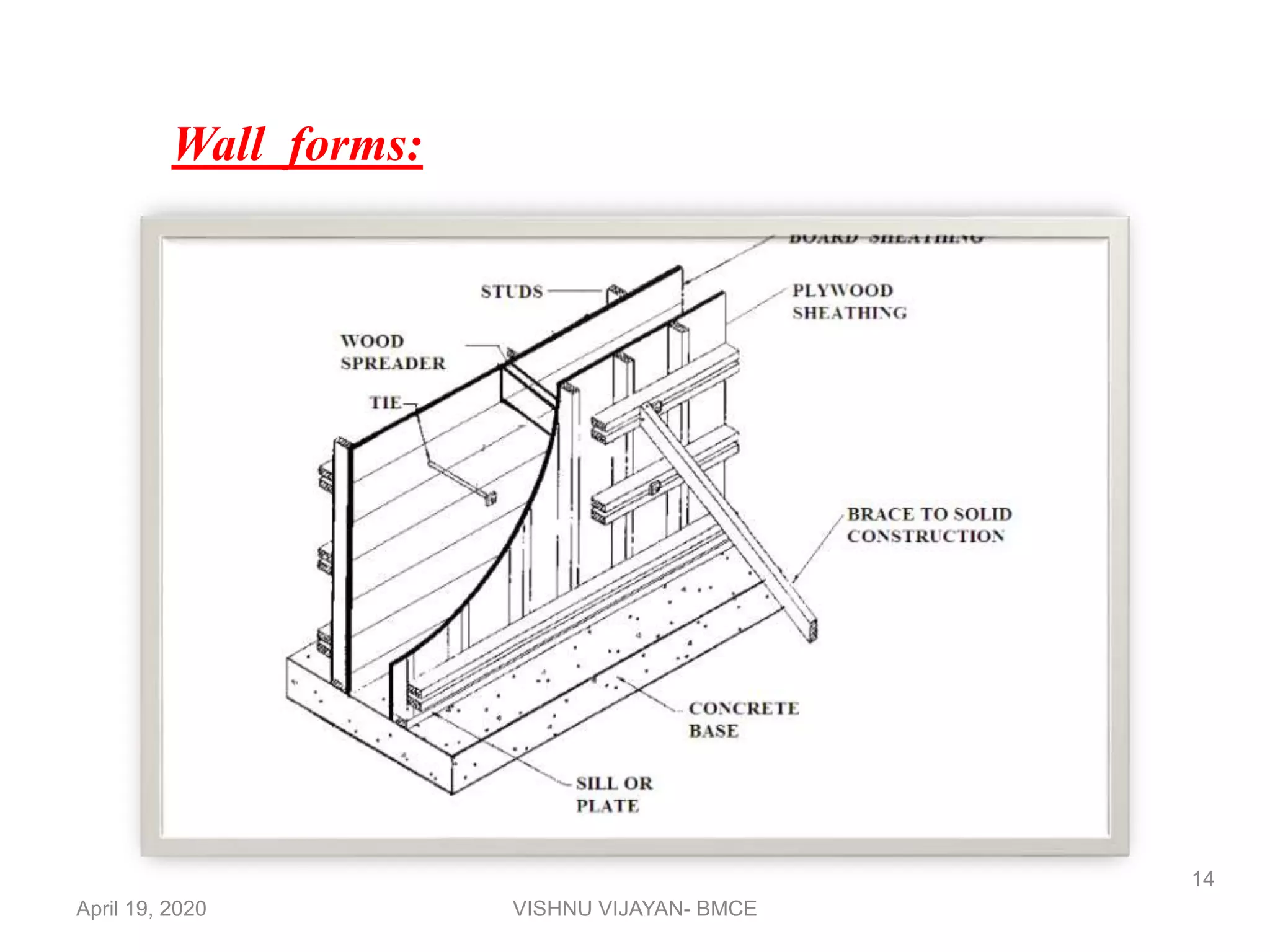
Wall forms:
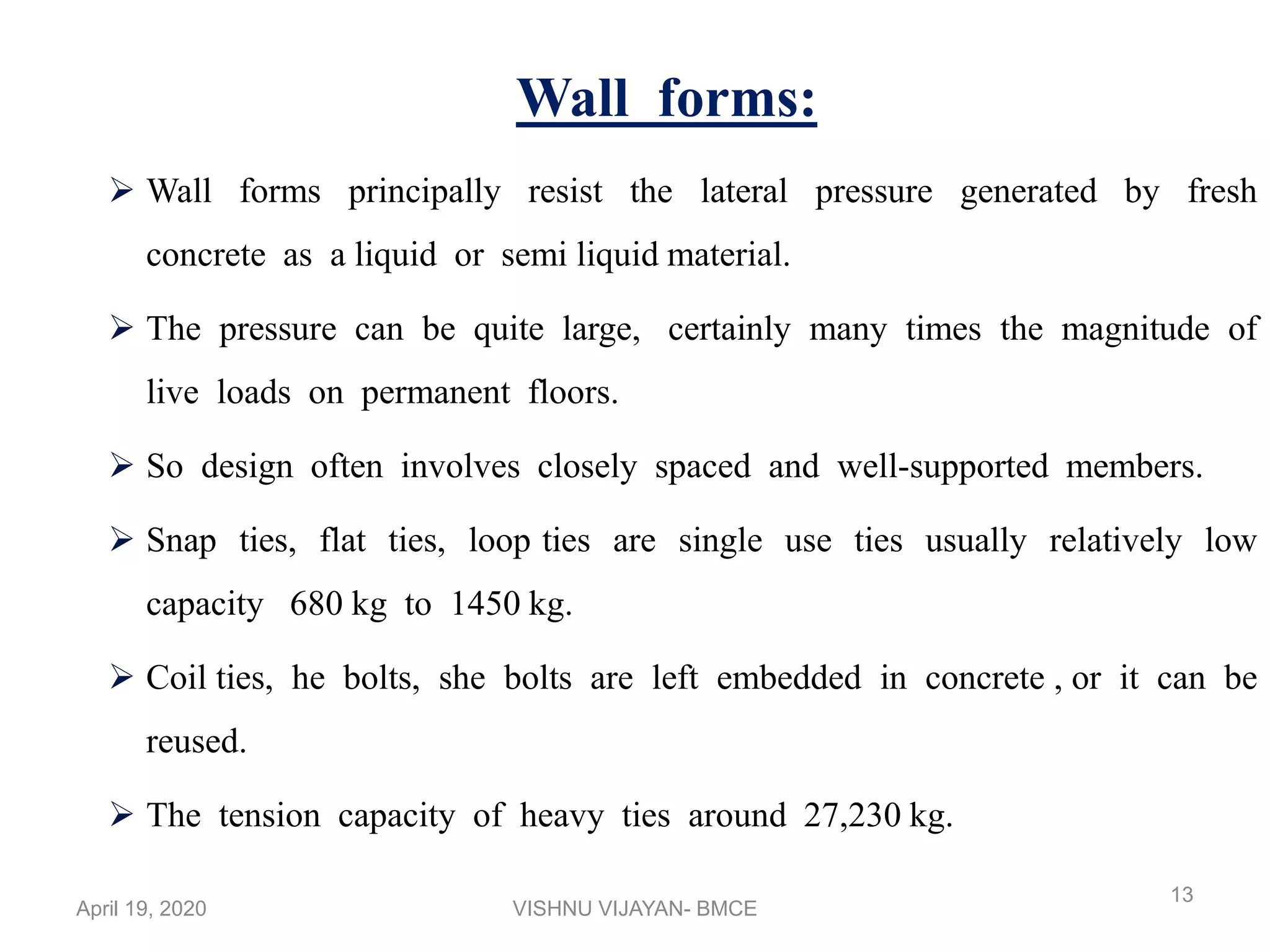
 Wall forms principally resist the lateral pressure generated by fresh
concrete as a liquid or semi liquid material.
 The pressure can be quite large, certainly many times the magnitude of
live loads on permanent floors.
 So design often involves closely spaced and well-supported members.
 Snap ties, flat ties, loop ties are single use ties usually relatively low
capacity 680 kg to 1450 kg.
 Coil ties, he bolts, she bolts are left embedded in concrete , or it can be
reused.
 The tension capacity of heavy ties around 27,230 kg.
13
April 19, 2020 VISHNU VIJAYAN- BMCE
14
Wall forms:
April 19, 2020 VISHNU VIJAYAN- BMCE
Formwork for Column
• It consists of
the following
– Side & End
Planks
– Yoke
– Nut & Bolts
• Two end & two
side planks are
joined by the
yokes and bolts.
15
April 19, 2020 VISHNU VIJAYAN- BMCE
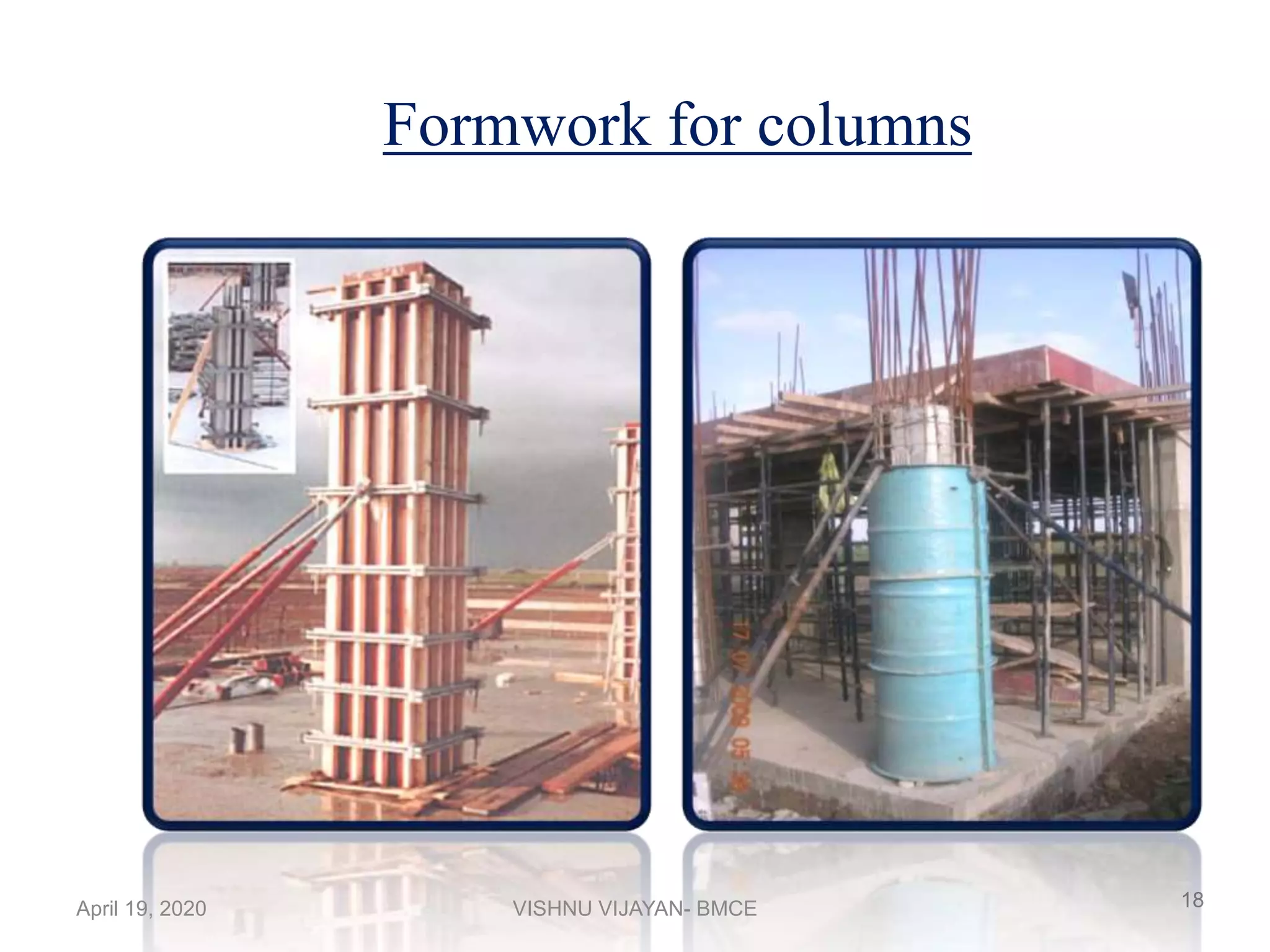
Column forms:
 Column-forms materials tend to vary with the column shape.
 Wood or steel is often used with square or rectangular
column.
 Round column forms more typically pre manufactured in a
range of standard diameters, are available in steel, paper
board, and fiber reinforced plastic.
 Round column are more structural efficient compared to square,
since the internal pressures can be resisted by the hoop
membrane.
 Round steel forms are generally used for larger columns and
bridge piers and come in diameters about 0.36m to 3mts.. 16
April 19, 2020 VISHNU VIJAYAN- BMCE
17April 19, 2020 VISHNU VIJAYAN- BMCE
Formwork for columns
18April 19, 2020 VISHNU VIJAYAN- BMCE
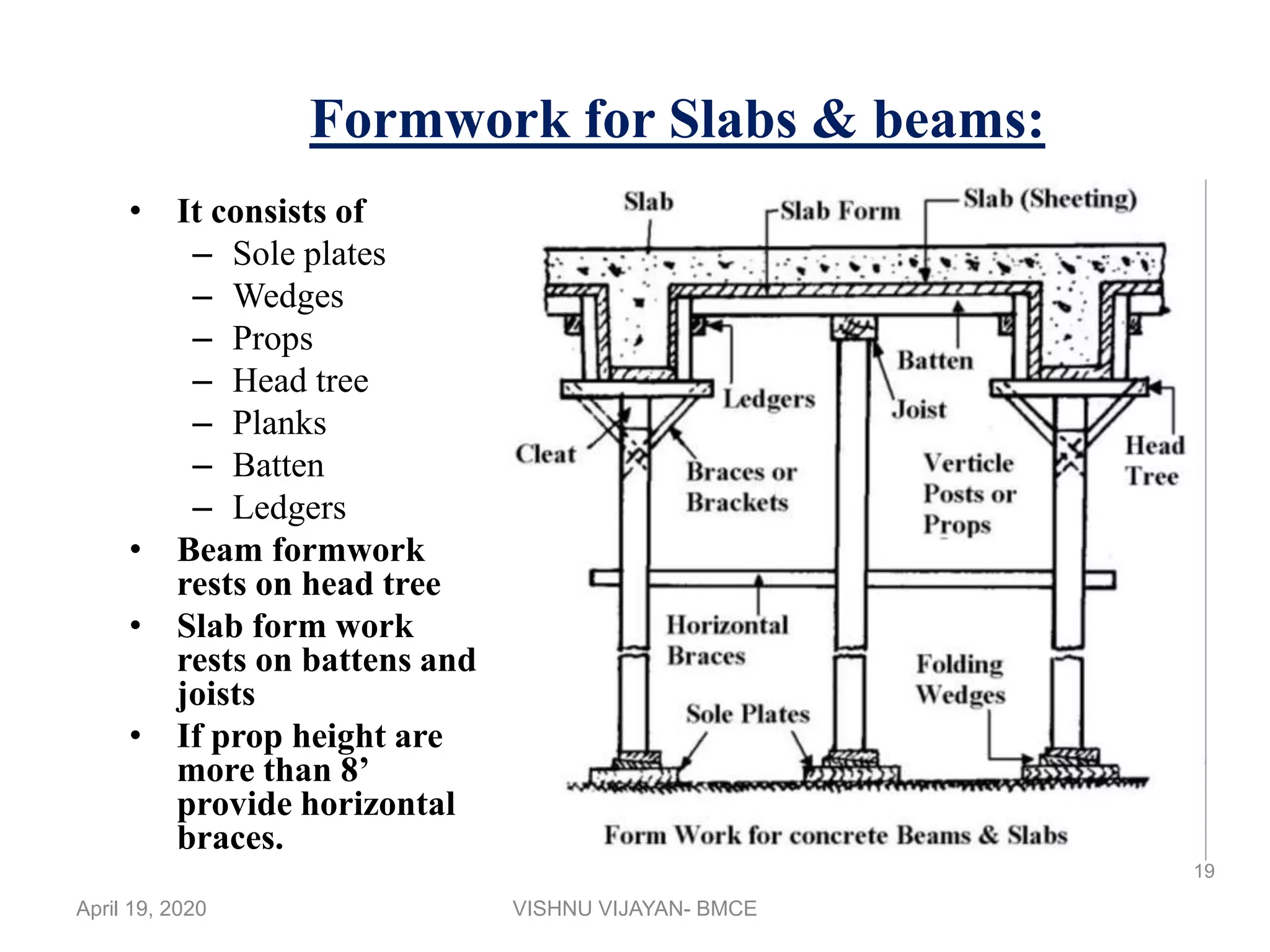
Formwork for Slabs & beams:
• It consists of
– Sole plates
– Wedges
– Props
– Head tree
– Planks
– Batten
– Ledgers
• Beam formwork
rests on head tree
• Slab form work
rests on battens and
joists
• If prop height are
more than 8’
provide horizontal
braces.
19
April 19, 2020 VISHNU VIJAYAN- BMCE
Lintel or Beam Formwork:
20
April 19, 2020 VISHNU VIJAYAN- BMCE
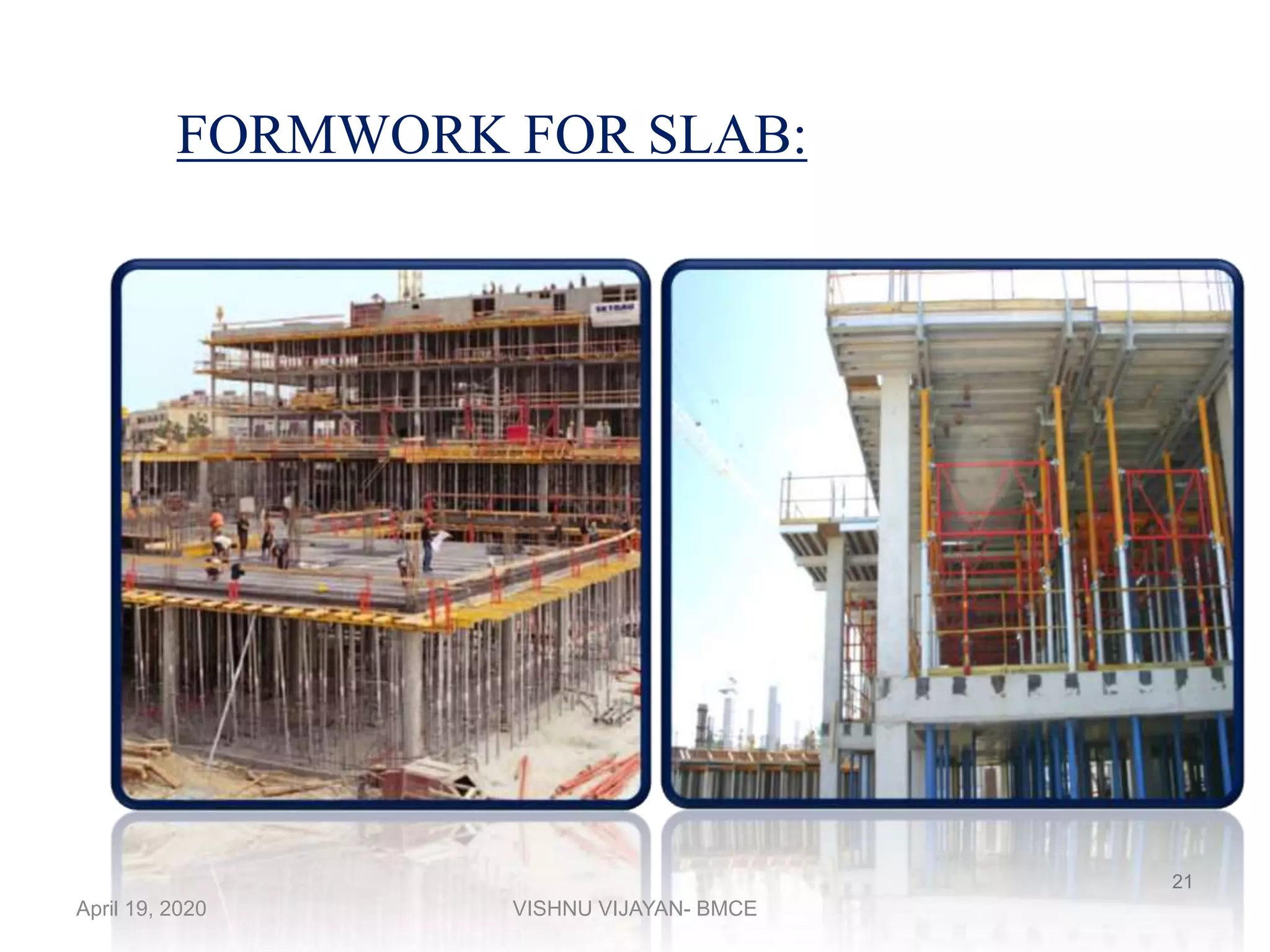
FORMWORK FOR SLAB:
21
April 19, 2020 VISHNU VIJAYAN- BMCE
FORMWORK FOR STAIRS:
• It consists of
– Vertical &
inclined posts
– Inclined members
– Wooden Planks or
sheeting
– Stringer
– Riser Planks
22
April 19, 2020 VISHNU VIJAYAN- BMCE
FORMWORK FOR STAIRS:
 The sheathing or decking for deck slabs is carried on
cross-joists which are in turn supported on raking
ledgers
 The ledgers are generally of 7.5cm x 10cm size .
 The cross- joists may be 5cm x 10cm size
 The riser planks are 4-5 cm thick and equal to the
height of riser
 The riser planks are placed after the reinforcement is
placed in position
23
April 19, 2020 VISHNU VIJAYAN- BMCE
FORMWORK FOR STAIRS:
24
April 19, 2020 VISHNU VIJAYAN- BMCE
FORMWORK FOR STAIRS:
25
April 19, 2020 VISHNU VIJAYAN- BMCE
FORMWORK FOR CHIMNEYS:
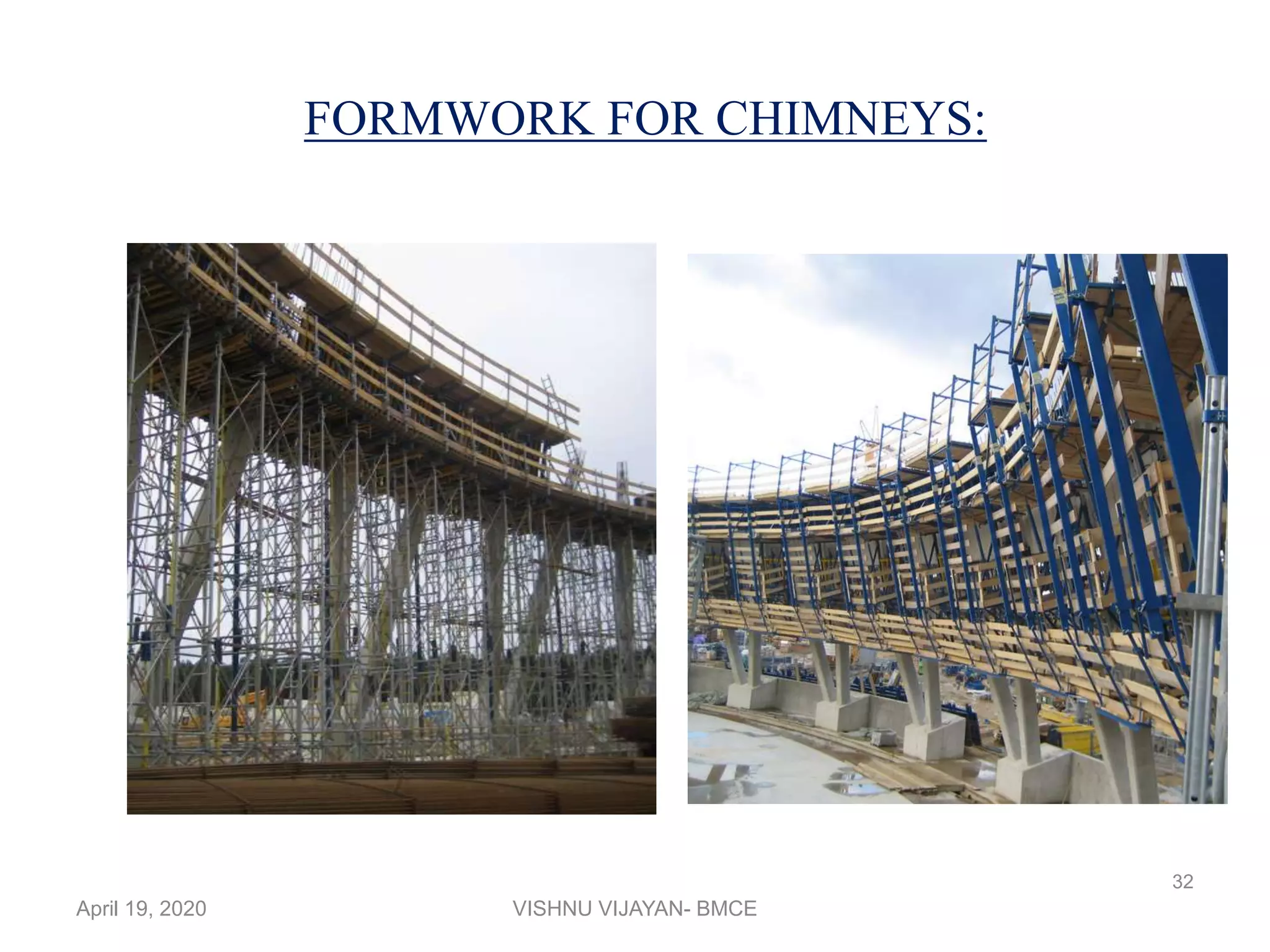
For tall chimneys two types of forms
techniques are in generally use in our
country
a) Jump form
b) Slip form
26April 19, 2020 VISHNU VIJAYAN- BMCE
Jump Form:
 In this type jacking bars are either cast in concrete
or else are carried in tubes which are cast in
concrete.
 After casting a lift, concrete is allowed to set and
then the forms are raised by jacks and the next lift
is cast.
 Jacks are usually placed about 2m apart and are
designed.
27April 19, 2020 VISHNU VIJAYAN- BMCE
28
Jump Form:
April 19, 2020 VISHNU VIJAYAN- BMCE
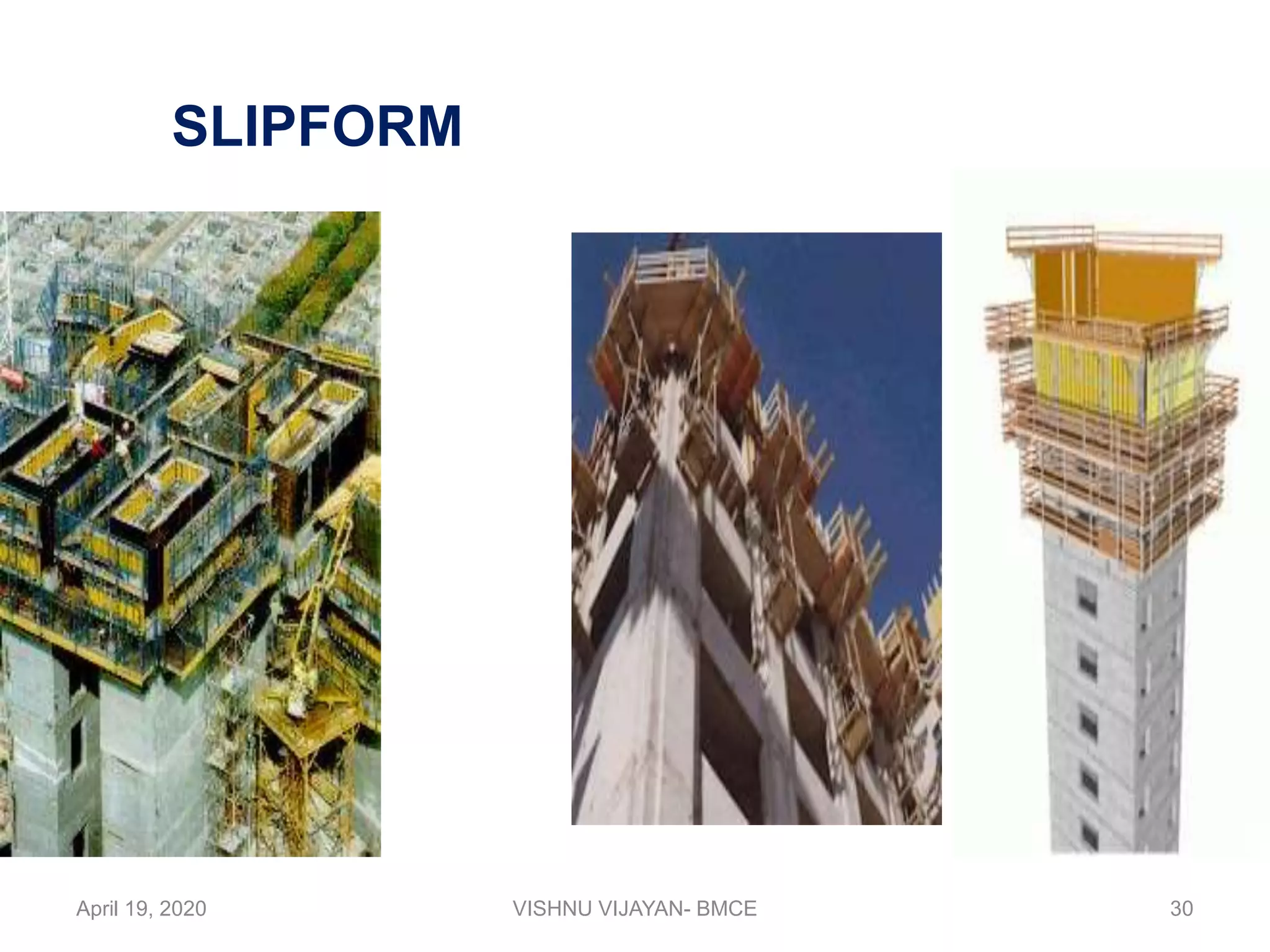
SLIP FORM:
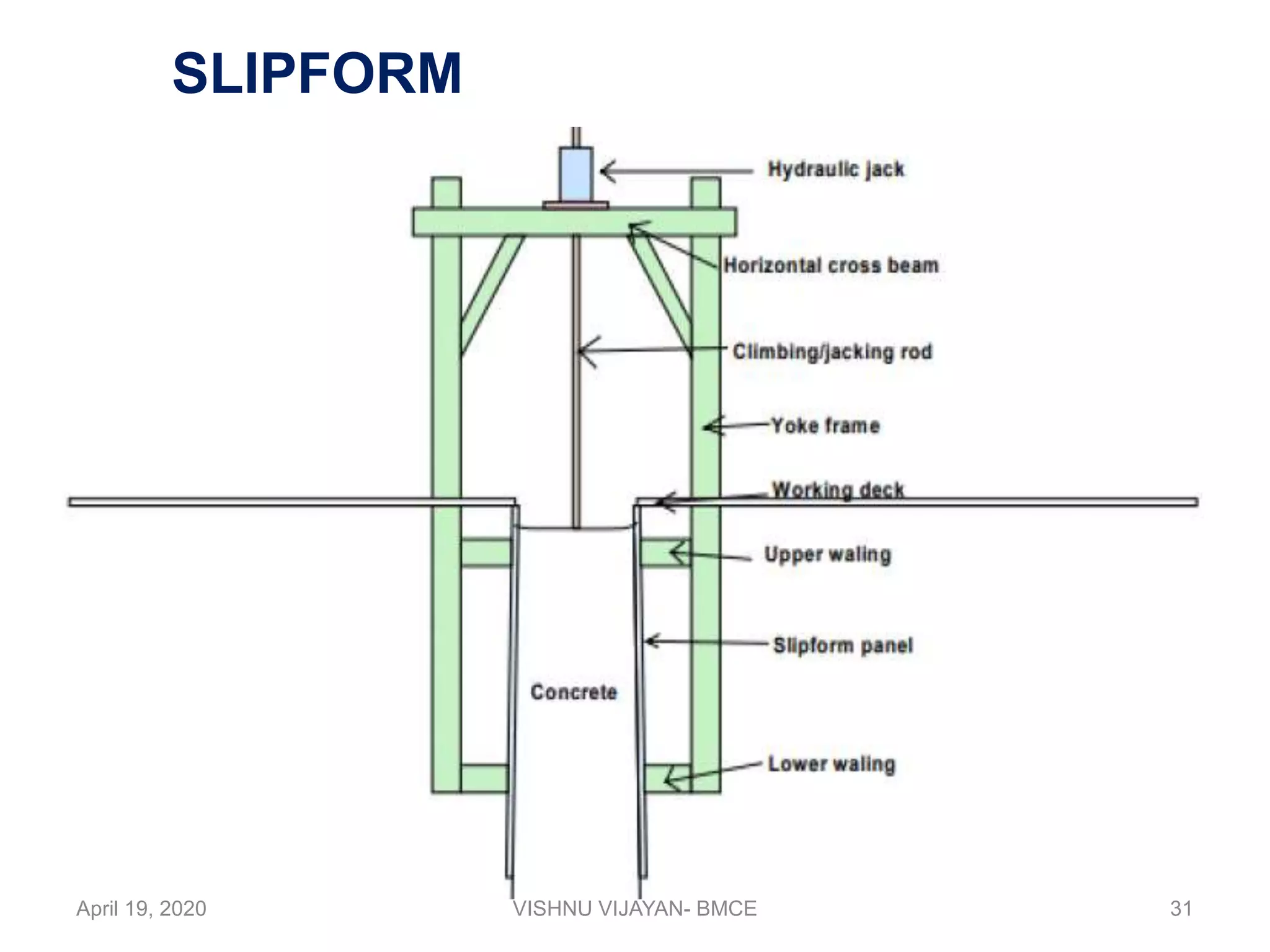
 The slip form method of concrete construction is
used for forming both horizontal and vertical
concrete structures.
 It often used for forming highway pavements as
continuous operation.
 Slip form methods is also been used for forming
various types of vertical concrete structures.
29
April 19, 2020 VISHNU VIJAYAN- BMCE
30
SLIPFORM
April 19, 2020 VISHNU VIJAYAN- BMCE
31
SLIPFORM
April 19, 2020 VISHNU VIJAYAN- BMCE
FORMWORK FOR CHIMNEYS:
32
April 19, 2020 VISHNU VIJAYAN- BMCE
FORMWORK FOR CHIMNEYS:
33
April 19, 2020 VISHNU VIJAYAN- BMCE
Removal of formwork:
 Time of formwork removal depends on the following factors
1. Type of Cement
1. Rapid hardening cements require lesser time as compared to OPC
(Ordinary Portland Cement)
2. Ratio of concrete mix
1. Rich ratio concrete gain strength earlier as compared to weak ratio
concrete.
3. Weather condition
1. Hydration process accelerates in hot weather conditions as
compared to cold and humid weather conditions.
34April 19, 2020 VISHNU VIJAYAN- BMCE
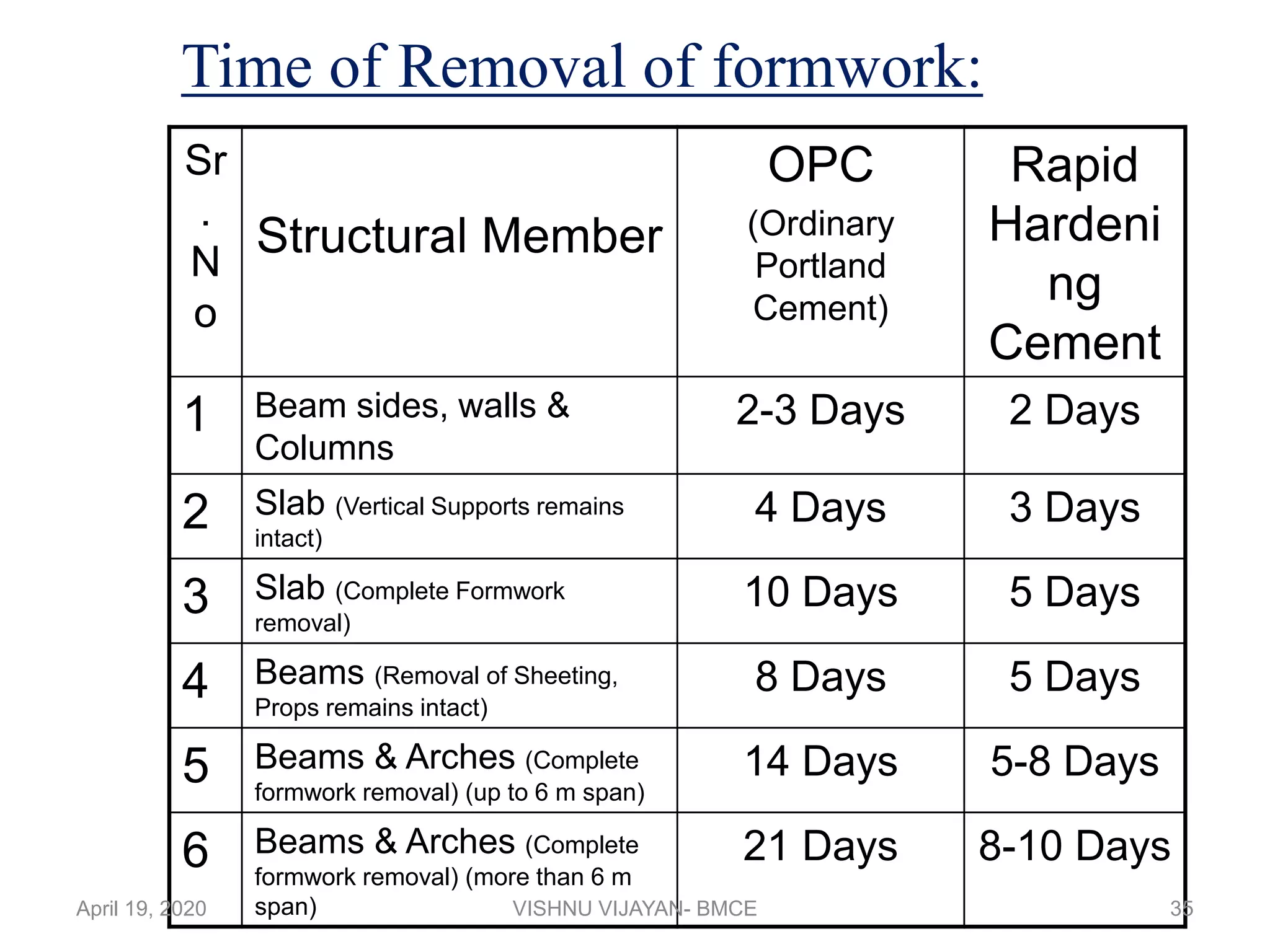
Time of Removal of formwork:
Sr
.
N
o
Structural Member
OPC
(Ordinary
Portland
Cement)
Rapid
Hardeni
ng
Cement
1 Beam sides, walls &
Columns
2-3 Days 2 Days
2 Slab (Vertical Supports remains
intact)
4 Days 3 Days
3 Slab (Complete Formwork
removal)
10 Days 5 Days
4 Beams (Removal of Sheeting,
Props remains intact)
8 Days 5 Days
5 Beams & Arches (Complete
formwork removal) (up to 6 m span)
14 Days 5-8 Days
6 Beams & Arches (Complete
formwork removal) (more than 6 m
span)
21 Days 8-10 Days
35April 19, 2020 VISHNU VIJAYAN- BMCE
Maintenance of formwork:
• Due to continuous use wooden planks & steel plates
surfaces become uneven and require maintenance.
• For wooden formwork use cardboard or plastic fiber
board. Bolt hole places must also be repaired.
• For steel formwork plates must be leveled by mallet
and loose corners must be welded.
36
April 19, 2020 VISHNU VIJAYAN- BMCE
Cost of formwork
 For normal works cost of formwork is about 30%-40% of the
concrete cost.
 For special works cost of formwork is about 50%-60% of the
concrete cost.
 Formwork cost is controlled by the following factors
• Formwork Material cost
• Formwork erecting cost
• Formwork removal cost
• Formwork jointing cost (Nails and Cables)
• Labor charges.
37
April 19, 2020 VISHNU VIJAYAN- BMCE
Advantages of steel form work:
 It can be used for a no. of times.
 It is non absorbent.
 Smooth finish surface obtained.
 No shrinkage of formwork occurs.
 Easy to use.
 Its volume is less
 Its strength is more.
38
April 19, 2020 VISHNU VIJAYAN- BMCE
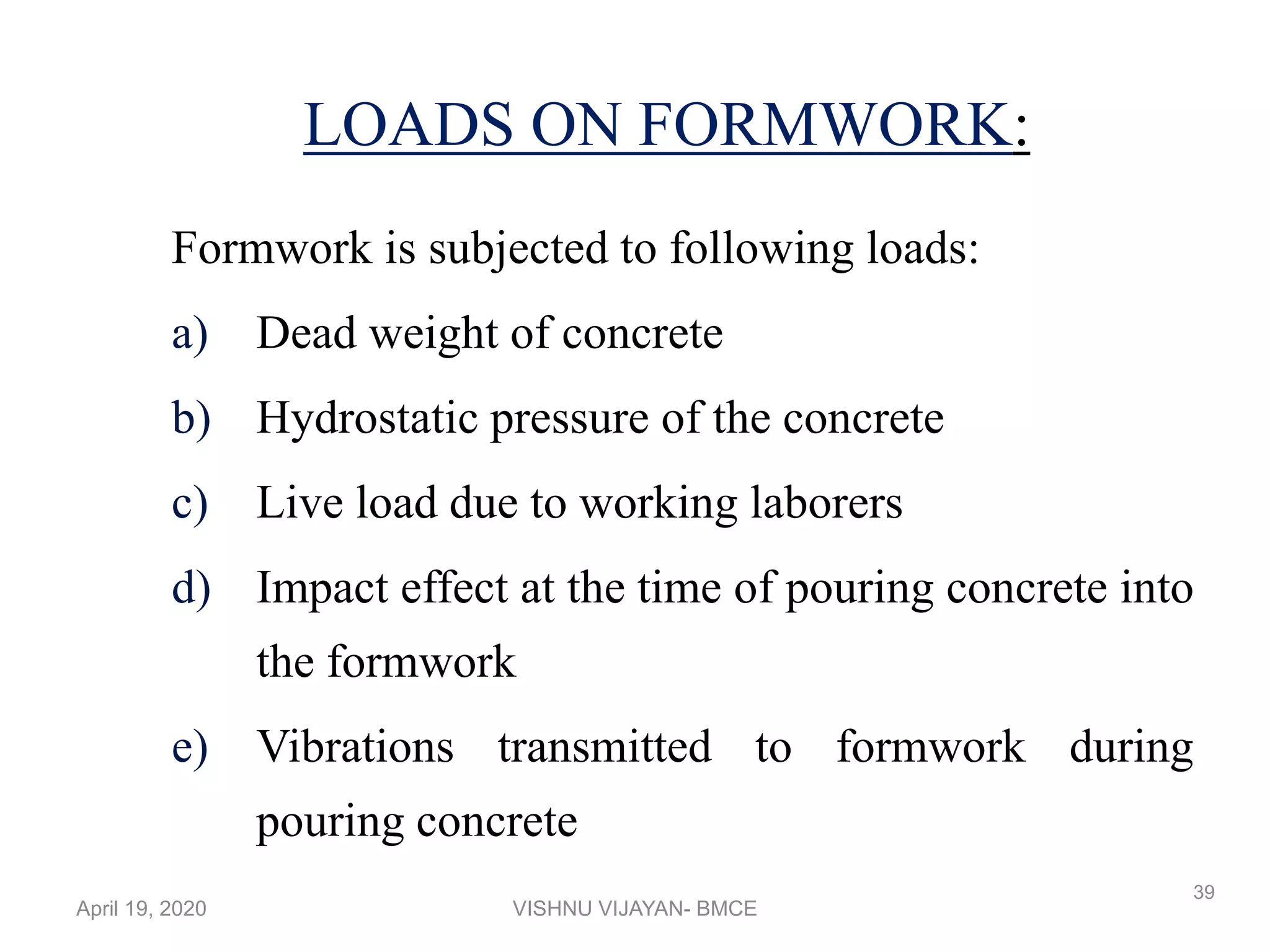
LOADS ON FORMWORK:
Formwork is subjected to following loads:
a) Dead weight of concrete
b) Hydrostatic pressure of the concrete
c) Live load due to working laborers
d) Impact effect at the time of pouring concrete into
the formwork
e) Vibrations transmitted to formwork during
pouring concrete
39
April 19, 2020 VISHNU VIJAYAN- BMCE
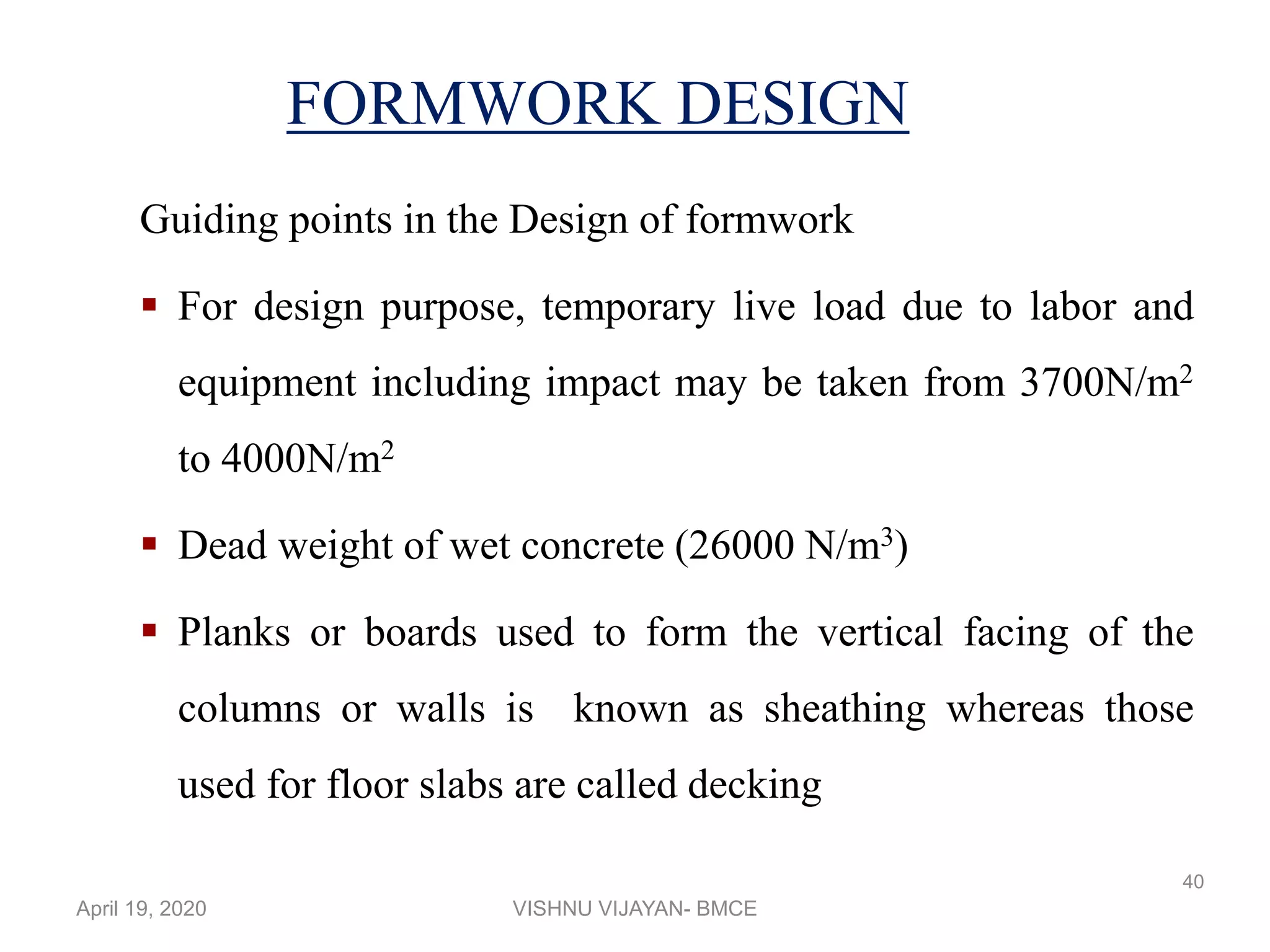
FORMWORK DESIGN
Guiding points in the Design of formwork
 For design purpose, temporary live load due to labor and
equipment including impact may be taken from 3700N/m2
to 4000N/m2
 Dead weight of wet concrete (26000 N/m3)
 Planks or boards used to form the vertical facing of the
columns or walls is known as sheathing whereas those
used for floor slabs are called decking
40
April 19, 2020 VISHNU VIJAYAN- BMCE
 The hydrostatic pressure due to fluidity of concrete in the initial
stages of pouring depends upon several factors such as amount
of water, size of aggregates, rate of pouring etc.,
 The hydrostatic pressure is maximum at the time of pouring, but
after some time it starts decreasing, as concrete starts setting and
hardening. This pressure is mainly dependent on the depth of
concrete poured before it starts setting
 Deflection of the sheathing and joists should be limited to a
maximum value of 2.5mm
41
April 19, 2020 VISHNU VIJAYAN- BMCE
Contd...
 The minimum wind design pressure q not less than 15
psf and bracing should be designed for at least
w =46 kg/ft- length applied to the top
 The minimum lateral load w, for design of bracing
system would be greater than,
q .(h/2) or 46 kg/ft
42
April 19, 2020 VISHNU VIJAYAN- BMCE
Contd...
For design practice the maximum pressure is given
by:
p = wh
Where,
p => lateral pressure of concrete,
w => unit weight of concrete,
h => depth of fluid or plastic concrete.
43
April 19, 2020 VISHNU VIJAYAN- BMCE
Contd...
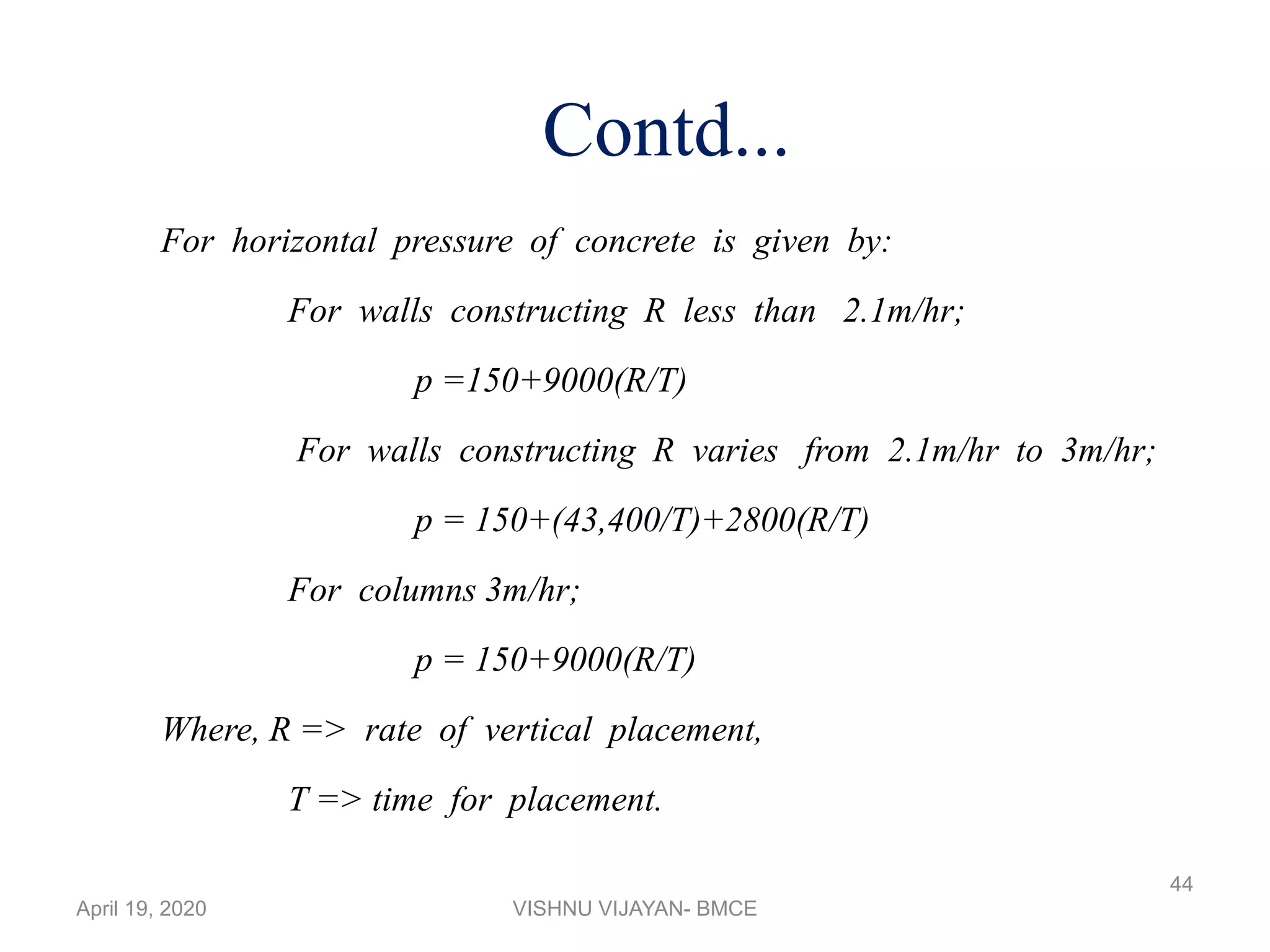
For horizontal pressure of concrete is given by:
For walls constructing R less than 2.1m/hr;
p =150+9000(R/T)
For walls constructing R varies from 2.1m/hr to 3m/hr;
p = 150+(43,400/T)+2800(R/T)
For columns 3m/hr;
p = 150+9000(R/T)
Where, R => rate of vertical placement,
T => time for placement.
44
April 19, 2020 VISHNU VIJAYAN- BMCE
DESIGN OF SLAB FORMWORK:
Design of slab forms can be summarized in the following design steps:
 Step 1: Estimate design loads
 Step 2: Determine sheathing thickness and spacing of its supports (joist
spacing)
 Step 3: Determine joist size and spacing of supports (stringer spacing)
 Step 4: Determine stringer size and span (shore spacing)
 Step 5: Perform shore design to support stringers
 Step 6: Check bearing stresses
 Step 7: Design lateral bracing
45
April 19, 2020 VISHNU VIJAYAN- BMCE
REFERENCES
• "Emerging Trends in Formwork and Scaffolding", CE & CR, September 92,
Pg.46-49 2. David W. Johnston, P.E., Ph.D. Chapter no.7-Design and
Construction of Concrete Formwork,
• 3. Detroit, Mich. AC1 Committee 347R-94 (1994), "Recommended practice
for concrete formwork." Amer. Concrete. Inst.,
• 4. Basher Aiami -1999, “Analysis of Construction Loads on Concrete
Formwork”.
• 5. Sonjoy Deb, B. Tech, Civil Associate Editor; “Advanced Formwork and its
Management Systems for Speedy Construction of Buildings”.
• 6. Gardner, NJ. (1980),"Pressures of concrete on formwork" ACIJ. 77(4),
279-286.
• 7. Gardner, NJ. (1985), “Shoring reshoring and safety." Concrete
International: Design & Construction, 7(4),28-34,
• 8. “Building Formwork". Building construction By B.C. Punmia (2008
edition).
• 9. "Formwork & Scaffolding, Steel Scaffolding, Centering, Formwork", CE
& CR, July 1998, Vol. 11, No. 7, Pg. 57-60.
• 10. "Emerging Trends In Formwork And Scaffolding", CE & CR, Sep 92,
Pg.46-49. 11. "Construction Equipment "CE&CR, Mayl992, Pg.50 -52. 46April 19, 2020 VISHNU VIJAYAN- BMCE
Thank you ..
47April 19, 2020 VISHNU VIJAYAN- BMCE

FORM WORK & SLIPFORM

  • 1.
  • 2.
    INTRODUCTION • Concrete Formworkis the temporary structure that supports the fresh concrete and steel during the construction process within required Strength and Tolerance • Formwork for concrete structures has a significant impact on the cost, time, and quality of a completed construction project. • The cost of the formwork may exceed the cost of the concrete and reinforcing steel. 2April 19, 2020 VISHNU VIJAYAN- BMCE
  • 3.
    Contd.. • The structuralsafety and reliability of formwork is just as important as that of the building itself. • Failure of the formwork during construction could pose obvious safety concerns, not to mention the cost of ripping out incorrectly placed concrete • Design values for wall forms, column forms, beam forms, and footing forms are all different from each other. • The form material must also be considered. The type of wood and the percent moisture are both factored into the design process. 3April 19, 2020 VISHNU VIJAYAN- BMCE
  • 4.
    DEFINITION:  Its isan artificial support provided below and around the precast or cast insitu concrete work.  Formwork is commonly made of  Steel  wood  Formwork construction & casting is of prime importance in concrete industry. It share a significant amount of concrete cost.  Formwork is designed according to The ACI document SP-4. 4 April 19, 2020 VISHNU VIJAYAN- BMCE
  • 5.
    Qualities of formwork: It should be water tight  It should be strong  It can be reusable  Its contact surface should be uniform  It should be according to the size of member. 5 April 19, 2020 VISHNU VIJAYAN- BMCE
  • 6.
    Uses  Formwork moldsthe concrete to the desired shape and size, and controls its position and alignment.  Using formwork, concrete structures can be constructed quickly and in the most affordable way. Formwork substantially lowers the timeline and costs of the project  It is used to transfer the temporary external loads. 6 April 19, 2020 VISHNU VIJAYAN- BMCE
  • 7.
    Major objectives consideredin formwork:  Quality  Safety  Economy 7 April 19, 2020 VISHNU VIJAYAN- BMCE
  • 8.
     Quality: Forms mustbe designed and built with sufficient stiffness and accuracy so that the size, shape, position, and finish of the cast concrete are maintained. Safety: Forms must be built sufficient strength and factor of safety so that they have the capable of all supporting loads. Economy: Forms must be built efficiently, minimizing time and cost.. 8 April 19, 2020 VISHNU VIJAYAN- BMCE
  • 9.
    Requirements of formwork: Material should be cheap and re usable,  It should be practically water proof, so that it should not absorb water from concrete,  Swelling and shrinkage should be minimum,  Strong enough to with stand all external loads,  Deflection should be minimum,  Surface should be smooth, and afford easy striping,  Light in weight, so that easy to transfer,  Joints should be stiff, so that lateral deformation and leak is minimum . 9 April 19, 2020 VISHNU VIJAYAN- BMCE
  • 10.
    THREE STAGES: a) Assemblyand erection b) Concrete placement c) Stripping and dismantling 10 April 19, 2020 VISHNU VIJAYAN- BMCE
  • 11.
    Formwork detail fordifferent structural members In concrete construction formwork is commonly provided for the following structural members. o Wall o Column o Slabs & Beams o Stairs o Chimneys o Water tanks o Cooling Towers 11 April 19, 2020 VISHNU VIJAYAN- BMCE
  • 12.
    Formwork for Wall It consists of • Timber sheeting • Vertical posts • Horizontal members • Rackers • Stakes • Wedges  After completing one side of formwork reinforcement is provided at the place then the second side formwork is provided. 12 April 19, 2020 VISHNU VIJAYAN- BMCE
  • 13.
    Wall forms:  Wallforms principally resist the lateral pressure generated by fresh concrete as a liquid or semi liquid material.  The pressure can be quite large, certainly many times the magnitude of live loads on permanent floors.  So design often involves closely spaced and well-supported members.  Snap ties, flat ties, loop ties are single use ties usually relatively low capacity 680 kg to 1450 kg.  Coil ties, he bolts, she bolts are left embedded in concrete , or it can be reused.  The tension capacity of heavy ties around 27,230 kg. 13 April 19, 2020 VISHNU VIJAYAN- BMCE
  • 14.
    14 Wall forms: April 19,2020 VISHNU VIJAYAN- BMCE
  • 15.
    Formwork for Column •It consists of the following – Side & End Planks – Yoke – Nut & Bolts • Two end & two side planks are joined by the yokes and bolts. 15 April 19, 2020 VISHNU VIJAYAN- BMCE
  • 16.
    Column forms:  Column-formsmaterials tend to vary with the column shape.  Wood or steel is often used with square or rectangular column.  Round column forms more typically pre manufactured in a range of standard diameters, are available in steel, paper board, and fiber reinforced plastic.  Round column are more structural efficient compared to square, since the internal pressures can be resisted by the hoop membrane.  Round steel forms are generally used for larger columns and bridge piers and come in diameters about 0.36m to 3mts.. 16 April 19, 2020 VISHNU VIJAYAN- BMCE
  • 17.
    17April 19, 2020VISHNU VIJAYAN- BMCE
  • 18.
    Formwork for columns 18April19, 2020 VISHNU VIJAYAN- BMCE
  • 19.
    Formwork for Slabs& beams: • It consists of – Sole plates – Wedges – Props – Head tree – Planks – Batten – Ledgers • Beam formwork rests on head tree • Slab form work rests on battens and joists • If prop height are more than 8’ provide horizontal braces. 19 April 19, 2020 VISHNU VIJAYAN- BMCE
  • 20.
    Lintel or BeamFormwork: 20 April 19, 2020 VISHNU VIJAYAN- BMCE
  • 21.
    FORMWORK FOR SLAB: 21 April19, 2020 VISHNU VIJAYAN- BMCE
  • 22.
    FORMWORK FOR STAIRS: •It consists of – Vertical & inclined posts – Inclined members – Wooden Planks or sheeting – Stringer – Riser Planks 22 April 19, 2020 VISHNU VIJAYAN- BMCE
  • 23.
    FORMWORK FOR STAIRS: The sheathing or decking for deck slabs is carried on cross-joists which are in turn supported on raking ledgers  The ledgers are generally of 7.5cm x 10cm size .  The cross- joists may be 5cm x 10cm size  The riser planks are 4-5 cm thick and equal to the height of riser  The riser planks are placed after the reinforcement is placed in position 23 April 19, 2020 VISHNU VIJAYAN- BMCE
  • 24.
    FORMWORK FOR STAIRS: 24 April19, 2020 VISHNU VIJAYAN- BMCE
  • 25.
    FORMWORK FOR STAIRS: 25 April19, 2020 VISHNU VIJAYAN- BMCE
  • 26.
    FORMWORK FOR CHIMNEYS: Fortall chimneys two types of forms techniques are in generally use in our country a) Jump form b) Slip form 26April 19, 2020 VISHNU VIJAYAN- BMCE
  • 27.
    Jump Form:  Inthis type jacking bars are either cast in concrete or else are carried in tubes which are cast in concrete.  After casting a lift, concrete is allowed to set and then the forms are raised by jacks and the next lift is cast.  Jacks are usually placed about 2m apart and are designed. 27April 19, 2020 VISHNU VIJAYAN- BMCE
  • 28.
    28 Jump Form: April 19,2020 VISHNU VIJAYAN- BMCE
  • 29.
    SLIP FORM:  Theslip form method of concrete construction is used for forming both horizontal and vertical concrete structures.  It often used for forming highway pavements as continuous operation.  Slip form methods is also been used for forming various types of vertical concrete structures. 29 April 19, 2020 VISHNU VIJAYAN- BMCE
  • 30.
    30 SLIPFORM April 19, 2020VISHNU VIJAYAN- BMCE
  • 31.
    31 SLIPFORM April 19, 2020VISHNU VIJAYAN- BMCE
  • 32.
    FORMWORK FOR CHIMNEYS: 32 April19, 2020 VISHNU VIJAYAN- BMCE
  • 33.
    FORMWORK FOR CHIMNEYS: 33 April19, 2020 VISHNU VIJAYAN- BMCE
  • 34.
    Removal of formwork: Time of formwork removal depends on the following factors 1. Type of Cement 1. Rapid hardening cements require lesser time as compared to OPC (Ordinary Portland Cement) 2. Ratio of concrete mix 1. Rich ratio concrete gain strength earlier as compared to weak ratio concrete. 3. Weather condition 1. Hydration process accelerates in hot weather conditions as compared to cold and humid weather conditions. 34April 19, 2020 VISHNU VIJAYAN- BMCE
  • 35.
    Time of Removalof formwork: Sr . N o Structural Member OPC (Ordinary Portland Cement) Rapid Hardeni ng Cement 1 Beam sides, walls & Columns 2-3 Days 2 Days 2 Slab (Vertical Supports remains intact) 4 Days 3 Days 3 Slab (Complete Formwork removal) 10 Days 5 Days 4 Beams (Removal of Sheeting, Props remains intact) 8 Days 5 Days 5 Beams & Arches (Complete formwork removal) (up to 6 m span) 14 Days 5-8 Days 6 Beams & Arches (Complete formwork removal) (more than 6 m span) 21 Days 8-10 Days 35April 19, 2020 VISHNU VIJAYAN- BMCE
  • 36.
    Maintenance of formwork: •Due to continuous use wooden planks & steel plates surfaces become uneven and require maintenance. • For wooden formwork use cardboard or plastic fiber board. Bolt hole places must also be repaired. • For steel formwork plates must be leveled by mallet and loose corners must be welded. 36 April 19, 2020 VISHNU VIJAYAN- BMCE
  • 37.
    Cost of formwork For normal works cost of formwork is about 30%-40% of the concrete cost.  For special works cost of formwork is about 50%-60% of the concrete cost.  Formwork cost is controlled by the following factors • Formwork Material cost • Formwork erecting cost • Formwork removal cost • Formwork jointing cost (Nails and Cables) • Labor charges. 37 April 19, 2020 VISHNU VIJAYAN- BMCE
  • 38.
    Advantages of steelform work:  It can be used for a no. of times.  It is non absorbent.  Smooth finish surface obtained.  No shrinkage of formwork occurs.  Easy to use.  Its volume is less  Its strength is more. 38 April 19, 2020 VISHNU VIJAYAN- BMCE
  • 39.
    LOADS ON FORMWORK: Formworkis subjected to following loads: a) Dead weight of concrete b) Hydrostatic pressure of the concrete c) Live load due to working laborers d) Impact effect at the time of pouring concrete into the formwork e) Vibrations transmitted to formwork during pouring concrete 39 April 19, 2020 VISHNU VIJAYAN- BMCE
  • 40.
    FORMWORK DESIGN Guiding pointsin the Design of formwork  For design purpose, temporary live load due to labor and equipment including impact may be taken from 3700N/m2 to 4000N/m2  Dead weight of wet concrete (26000 N/m3)  Planks or boards used to form the vertical facing of the columns or walls is known as sheathing whereas those used for floor slabs are called decking 40 April 19, 2020 VISHNU VIJAYAN- BMCE
  • 41.
     The hydrostaticpressure due to fluidity of concrete in the initial stages of pouring depends upon several factors such as amount of water, size of aggregates, rate of pouring etc.,  The hydrostatic pressure is maximum at the time of pouring, but after some time it starts decreasing, as concrete starts setting and hardening. This pressure is mainly dependent on the depth of concrete poured before it starts setting  Deflection of the sheathing and joists should be limited to a maximum value of 2.5mm 41 April 19, 2020 VISHNU VIJAYAN- BMCE
  • 42.
    Contd...  The minimumwind design pressure q not less than 15 psf and bracing should be designed for at least w =46 kg/ft- length applied to the top  The minimum lateral load w, for design of bracing system would be greater than, q .(h/2) or 46 kg/ft 42 April 19, 2020 VISHNU VIJAYAN- BMCE
  • 43.
    Contd... For design practicethe maximum pressure is given by: p = wh Where, p => lateral pressure of concrete, w => unit weight of concrete, h => depth of fluid or plastic concrete. 43 April 19, 2020 VISHNU VIJAYAN- BMCE
  • 44.
    Contd... For horizontal pressureof concrete is given by: For walls constructing R less than 2.1m/hr; p =150+9000(R/T) For walls constructing R varies from 2.1m/hr to 3m/hr; p = 150+(43,400/T)+2800(R/T) For columns 3m/hr; p = 150+9000(R/T) Where, R => rate of vertical placement, T => time for placement. 44 April 19, 2020 VISHNU VIJAYAN- BMCE
  • 45.
    DESIGN OF SLABFORMWORK: Design of slab forms can be summarized in the following design steps:  Step 1: Estimate design loads  Step 2: Determine sheathing thickness and spacing of its supports (joist spacing)  Step 3: Determine joist size and spacing of supports (stringer spacing)  Step 4: Determine stringer size and span (shore spacing)  Step 5: Perform shore design to support stringers  Step 6: Check bearing stresses  Step 7: Design lateral bracing 45 April 19, 2020 VISHNU VIJAYAN- BMCE
  • 46.
    REFERENCES • "Emerging Trendsin Formwork and Scaffolding", CE & CR, September 92, Pg.46-49 2. David W. Johnston, P.E., Ph.D. Chapter no.7-Design and Construction of Concrete Formwork, • 3. Detroit, Mich. AC1 Committee 347R-94 (1994), "Recommended practice for concrete formwork." Amer. Concrete. Inst., • 4. Basher Aiami -1999, “Analysis of Construction Loads on Concrete Formwork”. • 5. Sonjoy Deb, B. Tech, Civil Associate Editor; “Advanced Formwork and its Management Systems for Speedy Construction of Buildings”. • 6. Gardner, NJ. (1980),"Pressures of concrete on formwork" ACIJ. 77(4), 279-286. • 7. Gardner, NJ. (1985), “Shoring reshoring and safety." Concrete International: Design & Construction, 7(4),28-34, • 8. “Building Formwork". Building construction By B.C. Punmia (2008 edition). • 9. "Formwork & Scaffolding, Steel Scaffolding, Centering, Formwork", CE & CR, July 1998, Vol. 11, No. 7, Pg. 57-60. • 10. "Emerging Trends In Formwork And Scaffolding", CE & CR, Sep 92, Pg.46-49. 11. "Construction Equipment "CE&CR, Mayl992, Pg.50 -52. 46April 19, 2020 VISHNU VIJAYAN- BMCE
  • 47.
    Thank you .. 47April19, 2020 VISHNU VIJAYAN- BMCE