Presentation
on
Grouting and Guniting
Prepared by :
Vipul kerni
Sharandeep
1
Grouting
Grouting is the process of placing a material into cavities in
concrete or masonry structure for the purpose of increasing
the load bearing capacity of a structure, restoring the
monolithic nature of a structural member, filling voids
around pre cast connections steel base plates, providing fire
stops, stopping leakages, placing adhesives and soil
stabilization.
GROUT is a mixture of water, cement and optional material
like sand, water reducing admixtures, expansion agents and
pozzolans. The water to cement ratio is around 0.5. Fine
sand is used to avoid segregation.
Categories of grout
Suspension Grout
Liquid Grout or Solution Grout.
Suspension grout is a mixture of one or several inert
materials like cement, clays etc suspended in a fluid
i.e water. Suspension grout is a mixture of pure
cement with water.
Liquid grout or solution grout consists of chemical
products in a solution or an emulsion form and their
reagents. The most frequently used products are
sodium silicate and certain resins.
4
Properties of grout
Fluidity
Minimum bleeding and segregation
Low shrinkage
Adequate strength after hardening
No detrimental compounds
Durable
5
Specification for grout
The sand should pass 150 µm IS sieve
The compressive strength of 100 mm cubes of the
grout shall not be less than 17 N/mm² at 7 days
6
Types of grouting materials and
their use
Chemical grouting
- control seepage
- shut- off seepage
- soil stabilization
Cementitious grouting
- mass placement
- structural(high strength)
- caustic environments
Types of grouting materials and
their use
- high temperatures
Epoxy grouting
- seal cracks
- bolt anchoring
- base plate levelling
- acidic environment
Polyesters
- bolt anchoring
Silicones
- smoke seals
- fire stops
Applications of grouting
Repairing of cracks
The wide cracks may be repaired by filling them
with portland cement grout.
The grout mixture may contain cement and water
or cement, sand and water, depending upon the
width of crack.
The water cement ratio should be kept as low as
practicable to maximize strength and minimize
shrinkage.
Applications of grouting
Strengthening existing walls
The lateral strength of buildings can be improved
by increasing the strength and stiffness of the
existing individual walls, whether they are cracked
or uncracked.
Applications of grouting
For soil stabilization
Common methods are
- chemical grouting
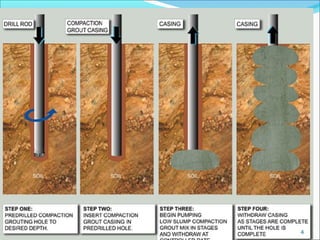
- compaction grouting
- jet grouting
Types of Grouts
Cement-based Grouts:
Cement-based grouts are the most frequently used in both
water stopping and strengthening treatment. They are
characterized by their water cement ratio and their Total
Dry Matter / Water weight ratio. The properties and
characteristics of these grouts vary according to the mix
proportions used. However, they have the following
properties and characteristics in common.
Stability and fluidity according to the dosage of
the various components and their quality
Unconfined compressive strength linked to water
cement ratio
Types of grout
Durability depending on the quantity and
quality of the components
Easy preparation and availability
Ease of use
 Relatively low cost mixes
13
Pure cement grout
 It is an unstable grout. However, bleeding can
be avoided with water cement ratio less than
0.67.
Usual mix proportions are from water cement
ratio 0.4 to 1 for grouting. Very high mechanical
strength can be attained with this type of grout.
During grouting, cement grains deposit in
inter-granular voids or fissures is analogous to a
kind of hydraulic filling.
The grout usually undergoes a significant
filtration effect. The grain fineness is an
important factor for fine fissures.
Bentonite cement grout
It is a stable grout. When bentonite is added to a
cement suspension, the effects are: -
 Obtain a homogeneous colloidal mix with a wide
range of viscosity.
Avoid cement sedimentation during grouting.
 Decrease the setting time index and separation
filtering processes.
Cont.…
 Increase the cement binding time.
Improve the penetration in compact type soils
Obtain a wide range of mechanical strength values.
In water stopping, grout will include a lot of bentonite
and little cement. In consolidation works, grout will
contain a lot of cement and little bentonite. Ideal mixes
should be both stable and easy to pump.
16
Grouts with fillers
 Fillers are added in order to modify the viscosity of a given
grout so as to obtain a low cost product to substitute the
cement. The most commonly used fillers are the natural
sands and fly ash from thermal power stations.
The term “mortar” is commonly used to specify grouts with
fillers that have a high sand content. Adding fillers reduces
the grout penetrability, as the fillers are of larger grain sizes.
 Grouts with fillers are used when water absorption and/or
the size of voids are such that filling becomes essential and
when the leaking of grout into adjoining areas should be
limited.
 In addition, fillers in grout will produce low slump grout
with high viscosity for certain grouting purposes.
Silicate based grouts
Slicates based grouts are sodium silicate in liquid form

diluted and containing a reagent.
Their viscosity changes with time to reach a solid state that
is called the “gel”.
They are used in soils with low permeability values such
that all suspension grouts cannot penetrate. According to
the type of grout used, the gel obtained will be water-
Tightness and/or with strength that are temporary or
permanent.
 When the temperature of a silicate decreases, its viscosity
increases very rapidly. This temperature should not fall
below 0 degree C in order to eliminate any risks of
modification of its properties.
Soft gels
 It is mainly for water stopping purpose. They
are gels with a very low dosage in silicate in
which the gelling process is most generally
obtained by adding a mineral reagent
Their very low degree of viscosity (close to
water) ensures the injection of very fine sand to
achieve the water stopping purpose.
Reduction in permeability can be up to 1 x 10⁻⁶
m/s and, in some case even up to 1 x 10⁻⁷ m/s
when more lines of grout holes are added. There
is also a slight improvement in strength, about
0.2 MPa.
Procedure of grouting
A 1:2 cement-sand grout with a water-cement ratio
between 0.6 and 0.8 is prepared using a mechanical
mixer.
The mixture is then sent down under pressure (of
about 120kg/cm²) through a 30-50 mm diameter pipe
terminating into steel cages.
20
Procedure of grouting
As the grouting proceeds the pipe is raised
gradually upto a height of not more than 60 cm
above its starting level after which it is withdrawn
and placed into the next cage for furthure grouting
by the same procedure.
After grouting the whole area for a height of about
60 cm , the same operation is repeated, if
necessary , for the next layer of 60cm and so on.
21
Grout Mixer
Grout Mixers. Many types of grout mixers have
been used, including hand-turned dough mixers,
concrete mixers of various sizes, and especially
designed grout mixers. Any machine is suitable that
has the desired capacity and that mixes the grout
mechanically to a uniform consistency.
Two mixers can be arranged to discharge into the
same sump to satisfy high capacity requirements.
Manual stirring of cement and clay grouts in a tub is
not satisfactory except in emergencies. Hand-
powered dough mixers are not recommended
because of their limited capacity.
High-speed colloidal-type mixers.
High-speed colloidal-type grout mixers are commercially available in both
the single - and double –drum types. These mixers are equipped with small
centrifugal pumps, which cause the grout to circulate at high speed while
being mixed. Particles of cement may be broken and rounded to a
significant degree in high-speed mixers. This results in an increase in
pumpability and penetrability for Portland-cement grout. In an
emergency, grout can be pumped at low pressures into the foundation or
other places with the centrifugal pumps of these mixers.
Water meters.
A satisfactory water meter is the single-disk type, size 1-1/2 in., and
threaded for pipe connection. This type has a 6 -in. vertical register with a
long hand that makes one revolution per cubic foot of water and a short
hand that indicates 10 cu ft per revolution. For use in grouting, the meter
should have a reset knob to set the hands to zero and a direct-reading
totalizer. A screen should be provided if sand or rock particles are present
in the water supply
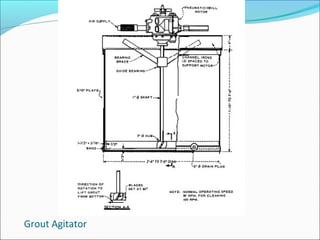
Agitator sumps.
After mixing, grout should be agitated to prevent settlement while it is
being pumped. This can be done by pumping the grout into a sump
equipped with a stirring blade.
Agitator should have the same capacity as the mixer so that one batch of
grout can be pumped while the next batch is being mixed. When
emptying the grout from the mixer into the agitator, the grout should
pass through a 1/8-in. -mesh screen to remove pieces of sacks, strings,
wire, ties, or other foreign matter that may be dropped into the mixer.
PUMPS.
Pumps for cement grouting should be sufficiently flexible to permit close
control of pressure and to provide for a variable rate of injection without
clogging of valves and feed lines. With constant speed pumps, special
arrangements of the supply piping systems and valves are needed to
provide close control of the grouting operation. Constant speed pumps
are powered by electric motors or internal-combustion engines. Variable
speed pumps are hand operated, steam driven, or air driven.
Grout Agitator
GROUT LINES.
a. General. There are two primary arrangements of piping used to
supply grout from the pump to the hole. The simpler of the two is the
single-line system. It consists of a pipe or a hose or a combination of
both, extending from the pump to the header at the hole.
The pump speed controls the rate of injection. The second
arrangement is the double -line or circulating system. This system
has a return line from the header to the grout sump in addition to the
pump line of the single -line system. Thus, if the header connection
to the hole is closed, grout can be continuously circulated from the
grout sump to the pump, through the pump line, through the header,
and back to the sump through the return line. While grouting, the
amount of grout entering the hole through the header can be varied
by opening or closing a valve on the return line without changing
pump speed. The double-line system is generally preferred because it
permits better control of grouting pressures and allows less material
to settle out of the mix to plug the lines
 Hose.
 Flexible hose is most commonly used for suction and discharge lines. If
the length of the discharge line is such that pipe is necessary, a short
length of hose should be provided at the pump discharge and at the
connection to the grout header.
 Piping.
 Black steel pipe and fittings 1-1/2 in. in diameter are normally suitable for
pressure lines ; but where large quantities of grout are to be injected and
the supply line is long, it may be desirable to provide a larger size pipe and
connection hoses.
 Grout Header.
 The grout header is usually assembled as a unit in order—that it may be
moved from one grout hole to another. The assembly consists of the
operating valves, a pressure gage, pipe, and the necessary fittings to attach
the header to the hole and to attach the grout supply and return lines.
 Pressure Gages.
 Reliable pressure gages are essential in pressure grouting. They constitute
the principal index to the behavior of the hole and the stresses that are
being produced in treated material.
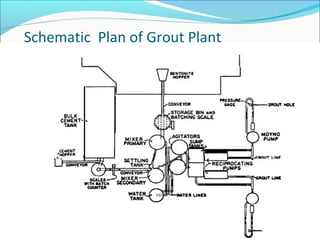
Schematic Plan of Grout Plant
29
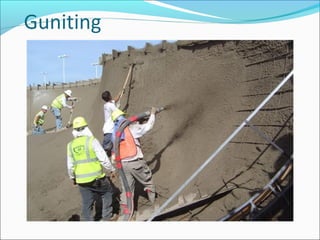
Guniting
Guniting is an effective technique, which has been
extensively used in the rehabilitation of
structurally distressed R.C members. There has
been case of heavy rusting of the mesh in the form
of powder or in the form of a sheet coming out.
Distressing before restoration is possible only in
case of overheads tanks which can be restored
when the tanks are empty.
Guniting
 Gunite is also known as shotcrete or pneumatically
applied mortar
 It can be used on vertical and overhead, as well as
on horizontal surfaces and is particularly useful for
restoring surfaces spalled due to corrosion of
reinforcement
 Gunite is a mixture of Portland cement, sand and
water, shot into the place by compressed air
Guniting
 Sand and cement are mixed dry in a mixing
chamber, and the dry mixture is then
transferred by air pressure along a pipe or
hose to a nozzle, where it is forcibly
projected on to the surface to be coated
 Water is added to the mixture by passing it
through a spray injected at the nozzle
 The flow of water at the nozzle can be
controlled to give a mix of desired stiffness,
which will adhere to the surface against
which it is projected
Guniting
A cement-sand mix, in the ratio 1:2 or 1:3
depending upon the requirement, is applied at
high pressure over the surface with the help of
specialized equipment.
Guniting is extensively used to rehabilitate
concrete bridges, dams, spillways, buildings,
marine structures, etc.
Spraying of concrete
There are two different methods of spraying:
– Dry process spraying
– Wet process spraying
Dry process spraying is the process in which the
mixture of damp sand and cement is passed through
the delivery hose to the nozzle and the water is mixed
at that time.
Water cement ratio should be between 0.33 and 0.50
This process is often used for repair work.
It is because of its fast application process and
restoration of structural strength at an early stage.
Spraying of concrete
The performance characteristics of dry sprayed
concrete are they have good density and high
strength.
It has very good bond to a suitable substrate.
These advantages make it more variable than
conventional concrete and wet process sprayed
concrete.
grouting and guniting

grouting and guniting

  • 1.
    Presentation on Grouting and Guniting Preparedby : Vipul kerni Sharandeep 1
  • 2.
    Grouting Grouting is theprocess of placing a material into cavities in concrete or masonry structure for the purpose of increasing the load bearing capacity of a structure, restoring the monolithic nature of a structural member, filling voids around pre cast connections steel base plates, providing fire stops, stopping leakages, placing adhesives and soil stabilization. GROUT is a mixture of water, cement and optional material like sand, water reducing admixtures, expansion agents and pozzolans. The water to cement ratio is around 0.5. Fine sand is used to avoid segregation.
  • 3.
    Categories of grout SuspensionGrout Liquid Grout or Solution Grout. Suspension grout is a mixture of one or several inert materials like cement, clays etc suspended in a fluid i.e water. Suspension grout is a mixture of pure cement with water. Liquid grout or solution grout consists of chemical products in a solution or an emulsion form and their reagents. The most frequently used products are sodium silicate and certain resins.
  • 4.
  • 5.
    Properties of grout Fluidity Minimumbleeding and segregation Low shrinkage Adequate strength after hardening No detrimental compounds Durable 5
  • 6.
    Specification for grout Thesand should pass 150 µm IS sieve The compressive strength of 100 mm cubes of the grout shall not be less than 17 N/mm² at 7 days 6
  • 7.
    Types of groutingmaterials and their use Chemical grouting - control seepage - shut- off seepage - soil stabilization Cementitious grouting - mass placement - structural(high strength) - caustic environments
  • 8.
    Types of groutingmaterials and their use - high temperatures Epoxy grouting - seal cracks - bolt anchoring - base plate levelling - acidic environment Polyesters - bolt anchoring Silicones - smoke seals - fire stops
  • 9.
    Applications of grouting Repairingof cracks The wide cracks may be repaired by filling them with portland cement grout. The grout mixture may contain cement and water or cement, sand and water, depending upon the width of crack. The water cement ratio should be kept as low as practicable to maximize strength and minimize shrinkage.
  • 10.
    Applications of grouting Strengtheningexisting walls The lateral strength of buildings can be improved by increasing the strength and stiffness of the existing individual walls, whether they are cracked or uncracked.
  • 11.
    Applications of grouting Forsoil stabilization Common methods are - chemical grouting - compaction grouting - jet grouting
  • 12.
    Types of Grouts Cement-basedGrouts: Cement-based grouts are the most frequently used in both water stopping and strengthening treatment. They are characterized by their water cement ratio and their Total Dry Matter / Water weight ratio. The properties and characteristics of these grouts vary according to the mix proportions used. However, they have the following properties and characteristics in common. Stability and fluidity according to the dosage of the various components and their quality Unconfined compressive strength linked to water cement ratio
  • 13.
    Types of grout Durabilitydepending on the quantity and quality of the components Easy preparation and availability Ease of use  Relatively low cost mixes 13
  • 14.
    Pure cement grout It is an unstable grout. However, bleeding can be avoided with water cement ratio less than 0.67. Usual mix proportions are from water cement ratio 0.4 to 1 for grouting. Very high mechanical strength can be attained with this type of grout. During grouting, cement grains deposit in inter-granular voids or fissures is analogous to a kind of hydraulic filling. The grout usually undergoes a significant filtration effect. The grain fineness is an important factor for fine fissures.
  • 15.
    Bentonite cement grout Itis a stable grout. When bentonite is added to a cement suspension, the effects are: -  Obtain a homogeneous colloidal mix with a wide range of viscosity. Avoid cement sedimentation during grouting.  Decrease the setting time index and separation filtering processes.
  • 16.
    Cont.…  Increase thecement binding time. Improve the penetration in compact type soils Obtain a wide range of mechanical strength values. In water stopping, grout will include a lot of bentonite and little cement. In consolidation works, grout will contain a lot of cement and little bentonite. Ideal mixes should be both stable and easy to pump. 16
  • 17.
    Grouts with fillers Fillers are added in order to modify the viscosity of a given grout so as to obtain a low cost product to substitute the cement. The most commonly used fillers are the natural sands and fly ash from thermal power stations. The term “mortar” is commonly used to specify grouts with fillers that have a high sand content. Adding fillers reduces the grout penetrability, as the fillers are of larger grain sizes.  Grouts with fillers are used when water absorption and/or the size of voids are such that filling becomes essential and when the leaking of grout into adjoining areas should be limited.  In addition, fillers in grout will produce low slump grout with high viscosity for certain grouting purposes.
  • 18.
    Silicate based grouts Slicatesbased grouts are sodium silicate in liquid form diluted and containing a reagent. Their viscosity changes with time to reach a solid state that is called the “gel”. They are used in soils with low permeability values such that all suspension grouts cannot penetrate. According to the type of grout used, the gel obtained will be water- Tightness and/or with strength that are temporary or permanent.  When the temperature of a silicate decreases, its viscosity increases very rapidly. This temperature should not fall below 0 degree C in order to eliminate any risks of modification of its properties.
  • 19.
    Soft gels  Itis mainly for water stopping purpose. They are gels with a very low dosage in silicate in which the gelling process is most generally obtained by adding a mineral reagent Their very low degree of viscosity (close to water) ensures the injection of very fine sand to achieve the water stopping purpose. Reduction in permeability can be up to 1 x 10⁻⁶ m/s and, in some case even up to 1 x 10⁻⁷ m/s when more lines of grout holes are added. There is also a slight improvement in strength, about 0.2 MPa.
  • 20.
    Procedure of grouting A1:2 cement-sand grout with a water-cement ratio between 0.6 and 0.8 is prepared using a mechanical mixer. The mixture is then sent down under pressure (of about 120kg/cm²) through a 30-50 mm diameter pipe terminating into steel cages. 20
  • 21.
    Procedure of grouting Asthe grouting proceeds the pipe is raised gradually upto a height of not more than 60 cm above its starting level after which it is withdrawn and placed into the next cage for furthure grouting by the same procedure. After grouting the whole area for a height of about 60 cm , the same operation is repeated, if necessary , for the next layer of 60cm and so on. 21
  • 23.
    Grout Mixer Grout Mixers.Many types of grout mixers have been used, including hand-turned dough mixers, concrete mixers of various sizes, and especially designed grout mixers. Any machine is suitable that has the desired capacity and that mixes the grout mechanically to a uniform consistency. Two mixers can be arranged to discharge into the same sump to satisfy high capacity requirements. Manual stirring of cement and clay grouts in a tub is not satisfactory except in emergencies. Hand- powered dough mixers are not recommended because of their limited capacity.
  • 24.
    High-speed colloidal-type mixers. High-speedcolloidal-type grout mixers are commercially available in both the single - and double –drum types. These mixers are equipped with small centrifugal pumps, which cause the grout to circulate at high speed while being mixed. Particles of cement may be broken and rounded to a significant degree in high-speed mixers. This results in an increase in pumpability and penetrability for Portland-cement grout. In an emergency, grout can be pumped at low pressures into the foundation or other places with the centrifugal pumps of these mixers. Water meters. A satisfactory water meter is the single-disk type, size 1-1/2 in., and threaded for pipe connection. This type has a 6 -in. vertical register with a long hand that makes one revolution per cubic foot of water and a short hand that indicates 10 cu ft per revolution. For use in grouting, the meter should have a reset knob to set the hands to zero and a direct-reading totalizer. A screen should be provided if sand or rock particles are present in the water supply
  • 25.
    Agitator sumps. After mixing,grout should be agitated to prevent settlement while it is being pumped. This can be done by pumping the grout into a sump equipped with a stirring blade. Agitator should have the same capacity as the mixer so that one batch of grout can be pumped while the next batch is being mixed. When emptying the grout from the mixer into the agitator, the grout should pass through a 1/8-in. -mesh screen to remove pieces of sacks, strings, wire, ties, or other foreign matter that may be dropped into the mixer. PUMPS. Pumps for cement grouting should be sufficiently flexible to permit close control of pressure and to provide for a variable rate of injection without clogging of valves and feed lines. With constant speed pumps, special arrangements of the supply piping systems and valves are needed to provide close control of the grouting operation. Constant speed pumps are powered by electric motors or internal-combustion engines. Variable speed pumps are hand operated, steam driven, or air driven.
  • 26.
  • 27.
    GROUT LINES. a. General.There are two primary arrangements of piping used to supply grout from the pump to the hole. The simpler of the two is the single-line system. It consists of a pipe or a hose or a combination of both, extending from the pump to the header at the hole. The pump speed controls the rate of injection. The second arrangement is the double -line or circulating system. This system has a return line from the header to the grout sump in addition to the pump line of the single -line system. Thus, if the header connection to the hole is closed, grout can be continuously circulated from the grout sump to the pump, through the pump line, through the header, and back to the sump through the return line. While grouting, the amount of grout entering the hole through the header can be varied by opening or closing a valve on the return line without changing pump speed. The double-line system is generally preferred because it permits better control of grouting pressures and allows less material to settle out of the mix to plug the lines
  • 28.
     Hose.  Flexiblehose is most commonly used for suction and discharge lines. If the length of the discharge line is such that pipe is necessary, a short length of hose should be provided at the pump discharge and at the connection to the grout header.  Piping.  Black steel pipe and fittings 1-1/2 in. in diameter are normally suitable for pressure lines ; but where large quantities of grout are to be injected and the supply line is long, it may be desirable to provide a larger size pipe and connection hoses.  Grout Header.  The grout header is usually assembled as a unit in order—that it may be moved from one grout hole to another. The assembly consists of the operating valves, a pressure gage, pipe, and the necessary fittings to attach the header to the hole and to attach the grout supply and return lines.  Pressure Gages.  Reliable pressure gages are essential in pressure grouting. They constitute the principal index to the behavior of the hole and the stresses that are being produced in treated material.
  • 29.
    Schematic Plan ofGrout Plant 29
  • 30.
    Guniting Guniting is aneffective technique, which has been extensively used in the rehabilitation of structurally distressed R.C members. There has been case of heavy rusting of the mesh in the form of powder or in the form of a sheet coming out. Distressing before restoration is possible only in case of overheads tanks which can be restored when the tanks are empty.
  • 31.
    Guniting  Gunite isalso known as shotcrete or pneumatically applied mortar  It can be used on vertical and overhead, as well as on horizontal surfaces and is particularly useful for restoring surfaces spalled due to corrosion of reinforcement  Gunite is a mixture of Portland cement, sand and water, shot into the place by compressed air
  • 32.
    Guniting  Sand andcement are mixed dry in a mixing chamber, and the dry mixture is then transferred by air pressure along a pipe or hose to a nozzle, where it is forcibly projected on to the surface to be coated  Water is added to the mixture by passing it through a spray injected at the nozzle  The flow of water at the nozzle can be controlled to give a mix of desired stiffness, which will adhere to the surface against which it is projected
  • 33.
    Guniting A cement-sand mix,in the ratio 1:2 or 1:3 depending upon the requirement, is applied at high pressure over the surface with the help of specialized equipment. Guniting is extensively used to rehabilitate concrete bridges, dams, spillways, buildings, marine structures, etc.
  • 34.
    Spraying of concrete Thereare two different methods of spraying: – Dry process spraying – Wet process spraying Dry process spraying is the process in which the mixture of damp sand and cement is passed through the delivery hose to the nozzle and the water is mixed at that time. Water cement ratio should be between 0.33 and 0.50 This process is often used for repair work. It is because of its fast application process and restoration of structural strength at an early stage.
  • 35.
    Spraying of concrete Theperformance characteristics of dry sprayed concrete are they have good density and high strength. It has very good bond to a suitable substrate. These advantages make it more variable than conventional concrete and wet process sprayed concrete.