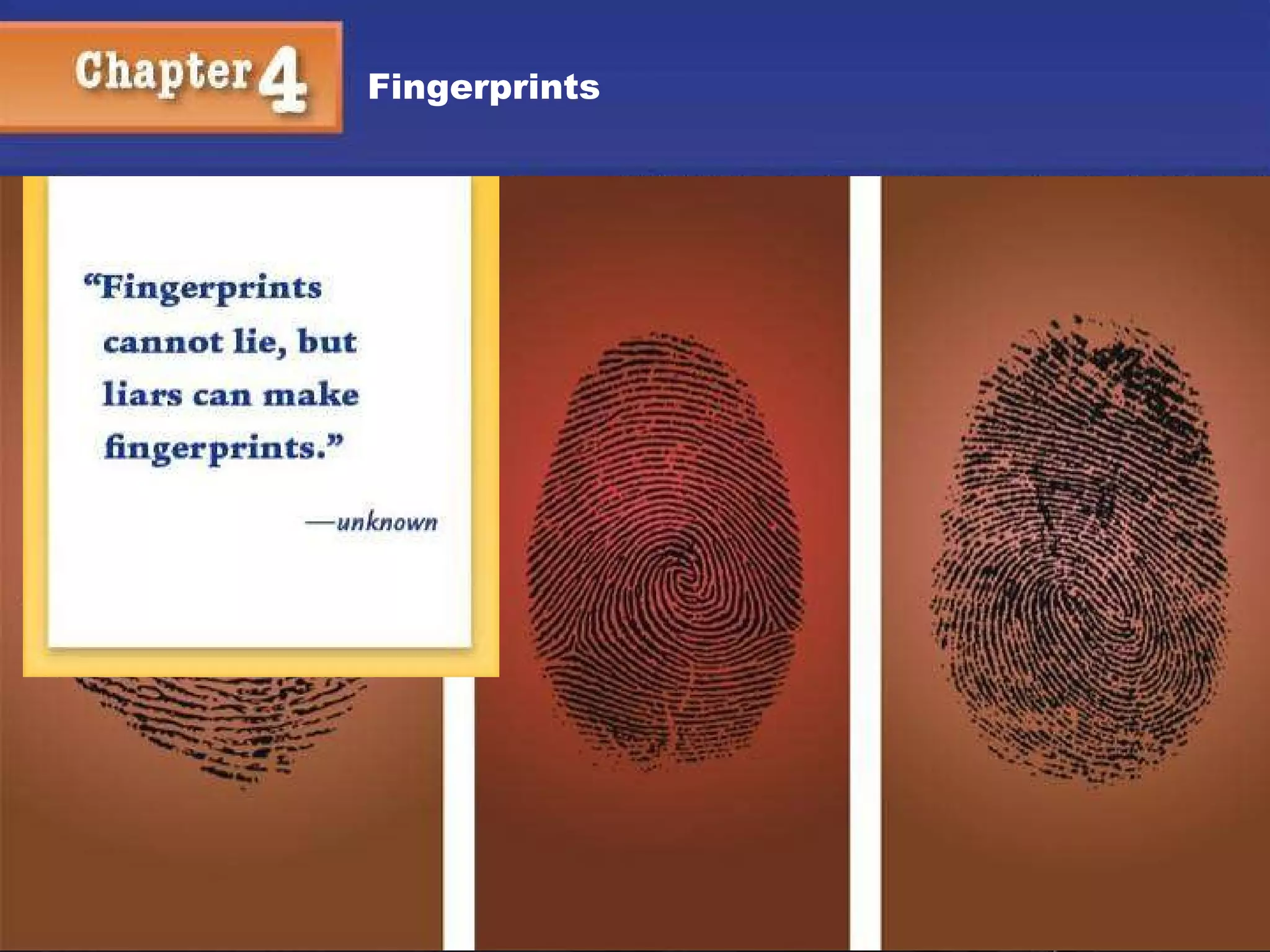
Fingerprints
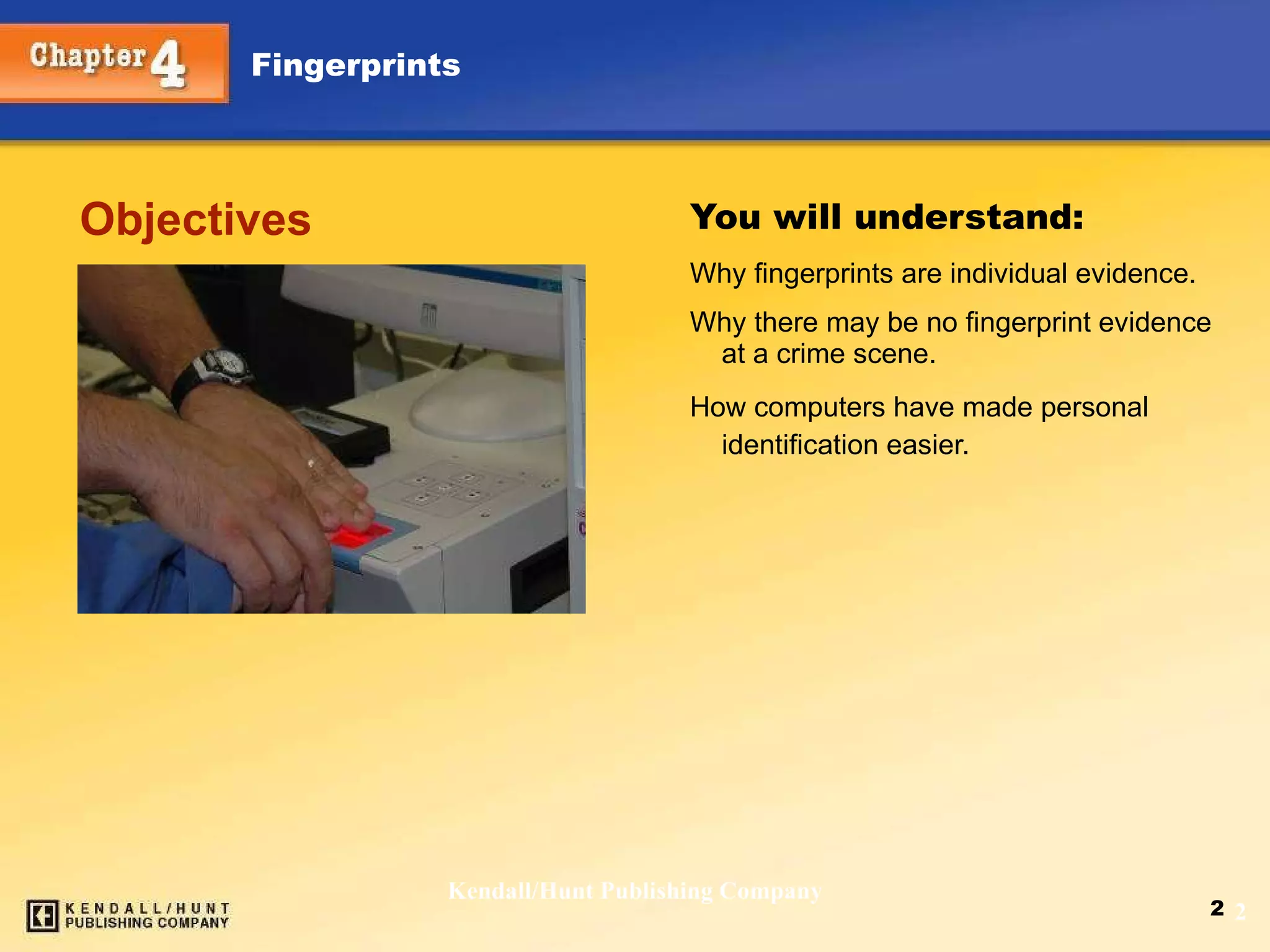
You will understand: Why fingerprints are individual evidence. Why there may be no fingerprint evidence at a crime scene.  How computers have made personal identification easier.   Objectives Kendall/Hunt Publishing Company
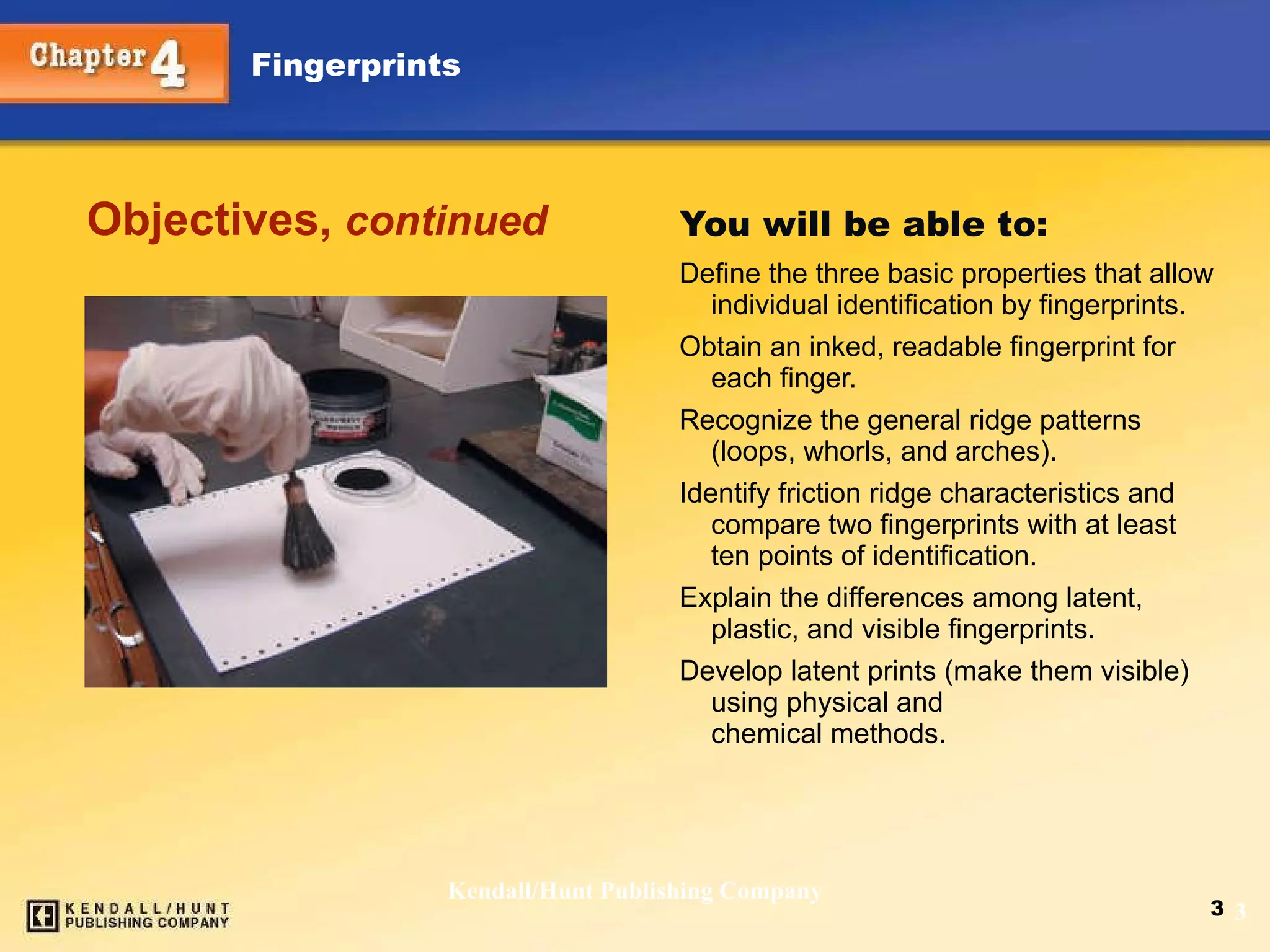
You will be able to: Define the three basic properties that allow individual identification by fingerprints.  Obtain an inked, readable fingerprint for each finger.  Recognize the general ridge patterns (loops, whorls, and arches).  Identify friction ridge characteristics and compare two fingerprints with at least ten points of identification.  Explain the differences among latent, plastic, and visible fingerprints.  Develop latent prints (make them visible) using physical and  chemical methods. Objectives,  continued Kendall/Hunt Publishing Company
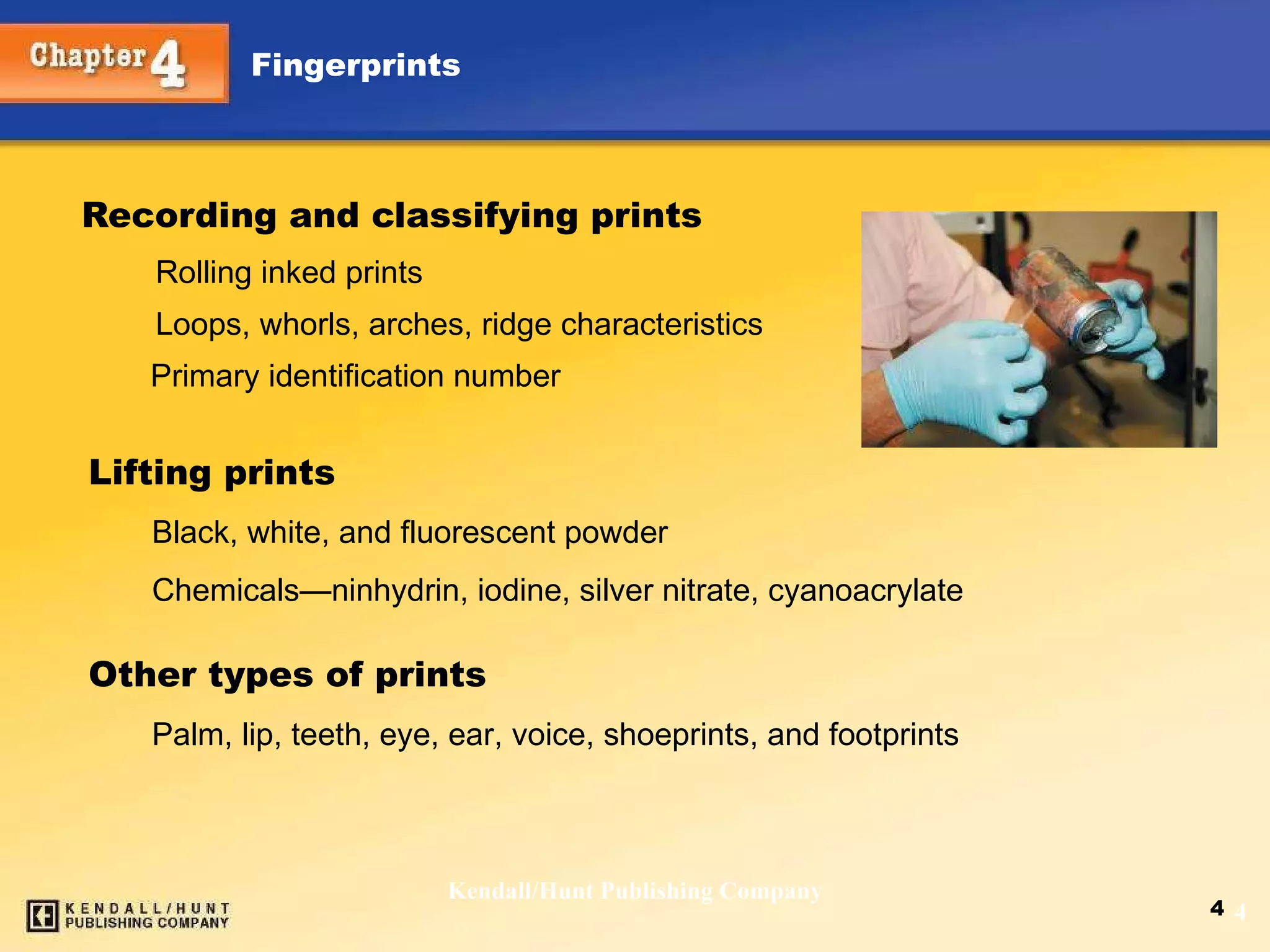
Recording and classifying prints   Rolling inked prints   Loops, whorls, arches, ridge characteristics Primary identification number Kendall/Hunt Publishing Company Lifting prints Black, white, and fluorescent powder Chemicals — ninhydrin, iodine, silver nitrate, cyanoacrylate Other types of prints Palm, lip, teeth, eye, ear, voice, shoeprints, and footprints
Kendall/Hunt Publishing Company
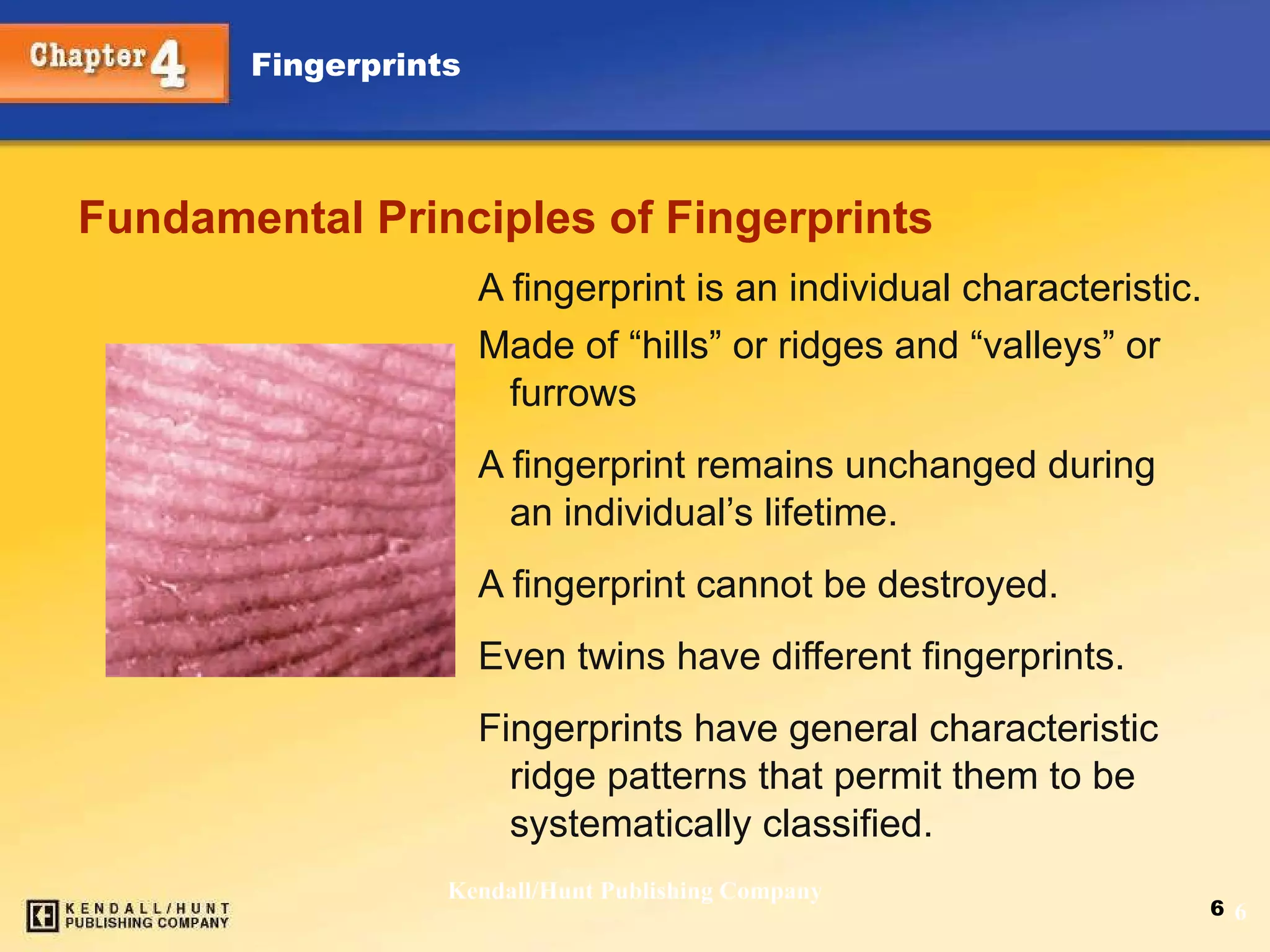
Fundamental Principles of Fingerprints A fingerprint is an individual characteristic. Made of “hills” or ridges and “valleys” or furrows A fingerprint remains unchanged during an individual’s lifetime. A fingerprint cannot be destroyed. Even twins have different fingerprints. Fingerprints have general characteristic ridge patterns that permit them to be systematically classified. Kendall/Hunt Publishing Company
Patterns form on fingers during early embryo development (10 th  week of gestation/pregnancy)  Person’s genetic make up plays a role in finger print ridge patterns but it is not the only factor The 2 features of fingerprints most important to their use as a means of personal identification: Every print is unique to an individual Fingerprints do not change during a life time (unless there is extensive damage to the dermal layer) Kendall/Hunt Publishing Company
Kendall/Hunt Publishing Company
History of Fingerprinting Presentations Biographical information Date of Birth Place of Birth Residence (if different than birthplace) Education Job/Career Contributions to field of forensic science/study of fingerprints 2 cases they worked on (brief description and relevance)  Picture 3 important facts
Kendall/Hunt Publishing Company 1. Nehemiah Grew and Johannes Evangelista Purkinje 2. William Herschel 3. Henry Faulds 4. Alphonse Bertillon 5. Francis Galton 6. Edward Richard Henry 7. Juan Vucetich
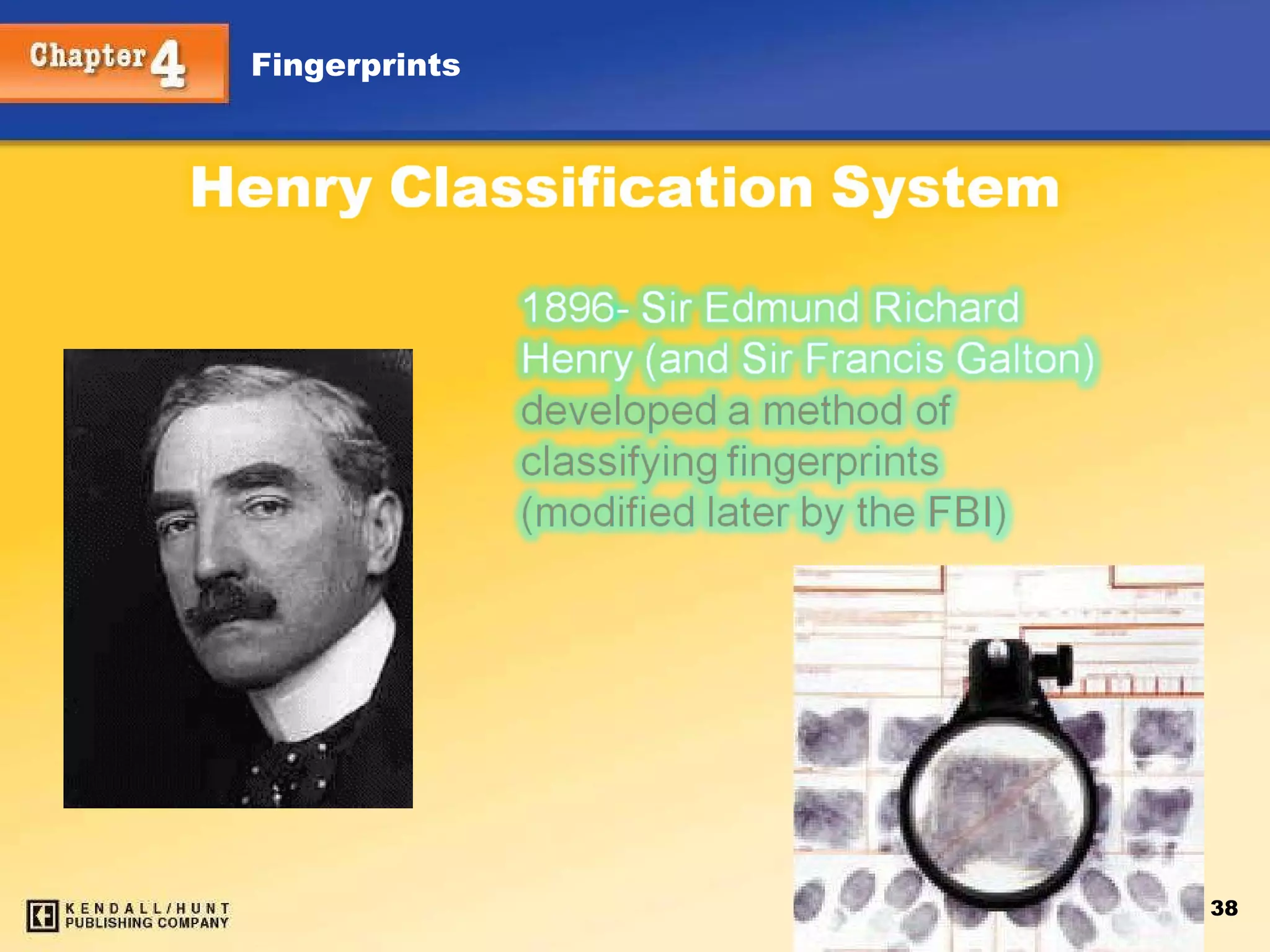
History from 1850 to 1900 William Herschel — required Indians to put their fingerprints on contracts, and used fingerprints as a means of identifying prisoners   Henry Faulds — claimed that fingerprints did not change over time and that they could be classified for identification  Alphonse Bertillon — proposed body measurements as a means of identification; termed  anthropometry Francis Galton — developed a primary classification scheme based on loops, arches, and whorls Edward Richard Henry — in collaboration with Galton, instituted a numerical classification system Juan Vucetich — developed a fingerprint classification system based on Galton’s that is used in Spanish-speaking countries Kendall/Hunt Publishing Company
Terminology IAFIS/AFIS Integrated Automated Fingerprint Identification System Developed in 1999 by FBI and Law Enforcement community Prints and Criminal histories of more than 47 million people  By 2007, 55 million computerized prints Delta Triangular area found in all loop and whorl patterns; ridges go in different directions above and below the triangle Core area found near the center of all loop and whorl patterns Minutiae Tiny, ridge characteristics found between ridge lines or at the end of ridge lines Patent prints Visible prints left on smooth surface when blood, ink or some other liquid comes in contact with hands and is transferred to that surface Plastic Prints Actual identification left in some soft material such as clay, putty, or wax Indented or molded Latent Prints Hidden prints caused by the transfer of oils and other secretions from skin onto surface Must be developed by physical or chemical means Kendall/Hunt Publishing Company
Things a Fingerprint Analyst looks for Core Delta Ridge Pattern Loops, whorls, arches Ridge Characteristics Minutiae  Ridge count (only some types of ridge patterns) Draw a line from the core to the edge of the delta and count lines that the line cuts thru Kendall/Hunt Publishing Company
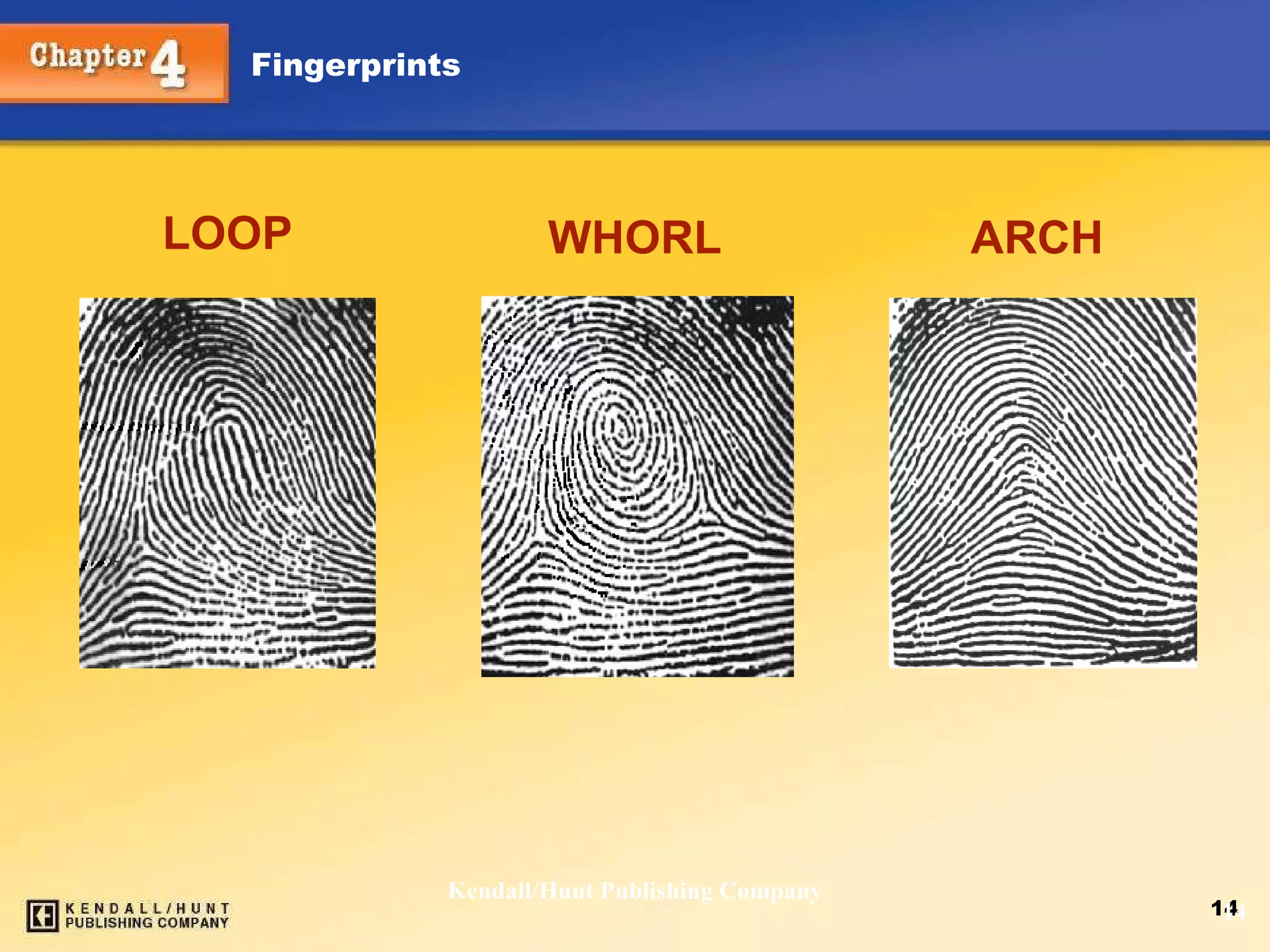
LOOP Kendall/Hunt Publishing Company WHORL ARCH
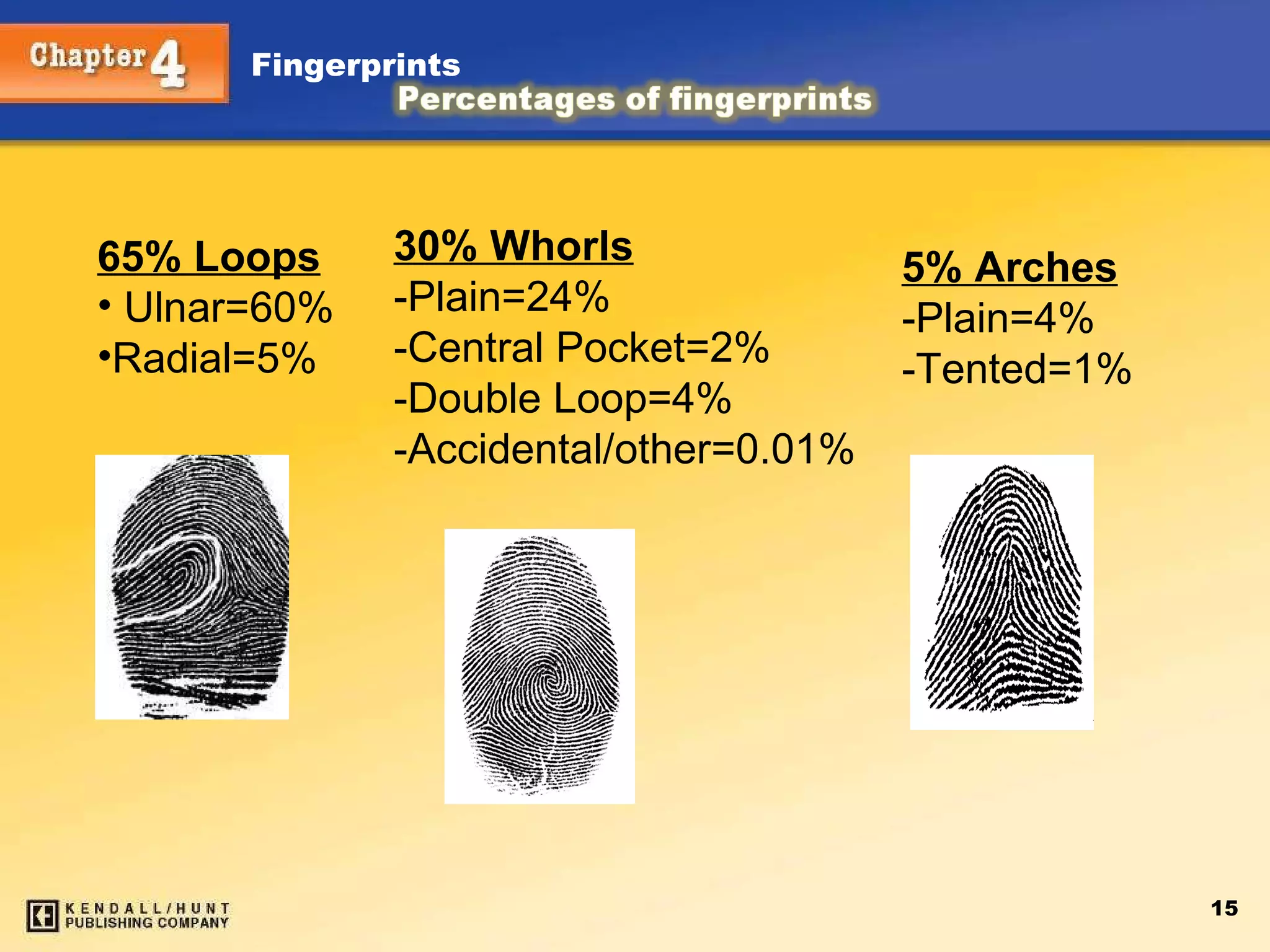
30% Whorls -Plain=24% -Central Pocket=2% -Double Loop=4% -Accidental/other=0.01% 65% Loops Ulnar=60% Radial=5% 5% Arches -Plain=4% -Tented=1%
 
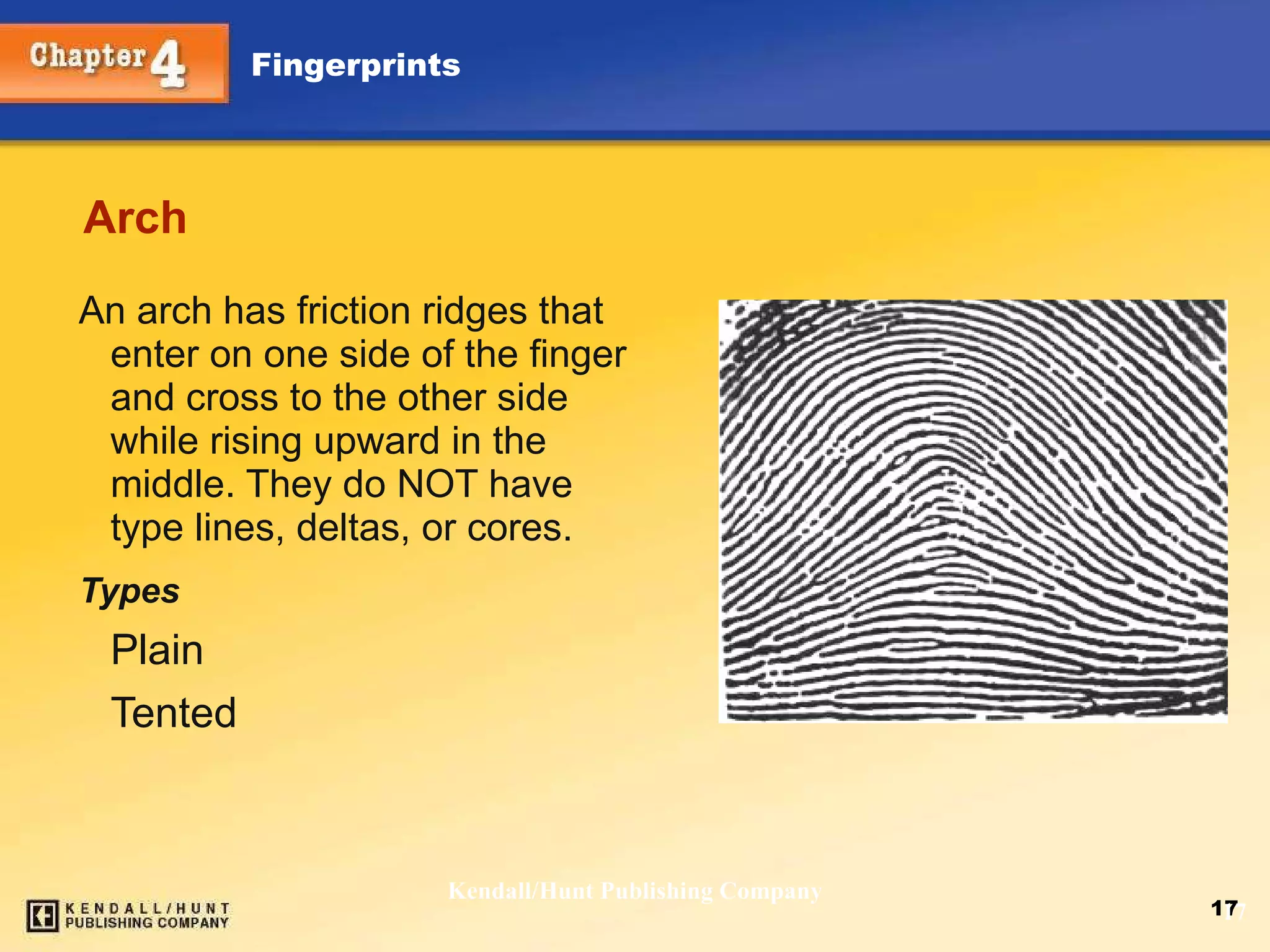
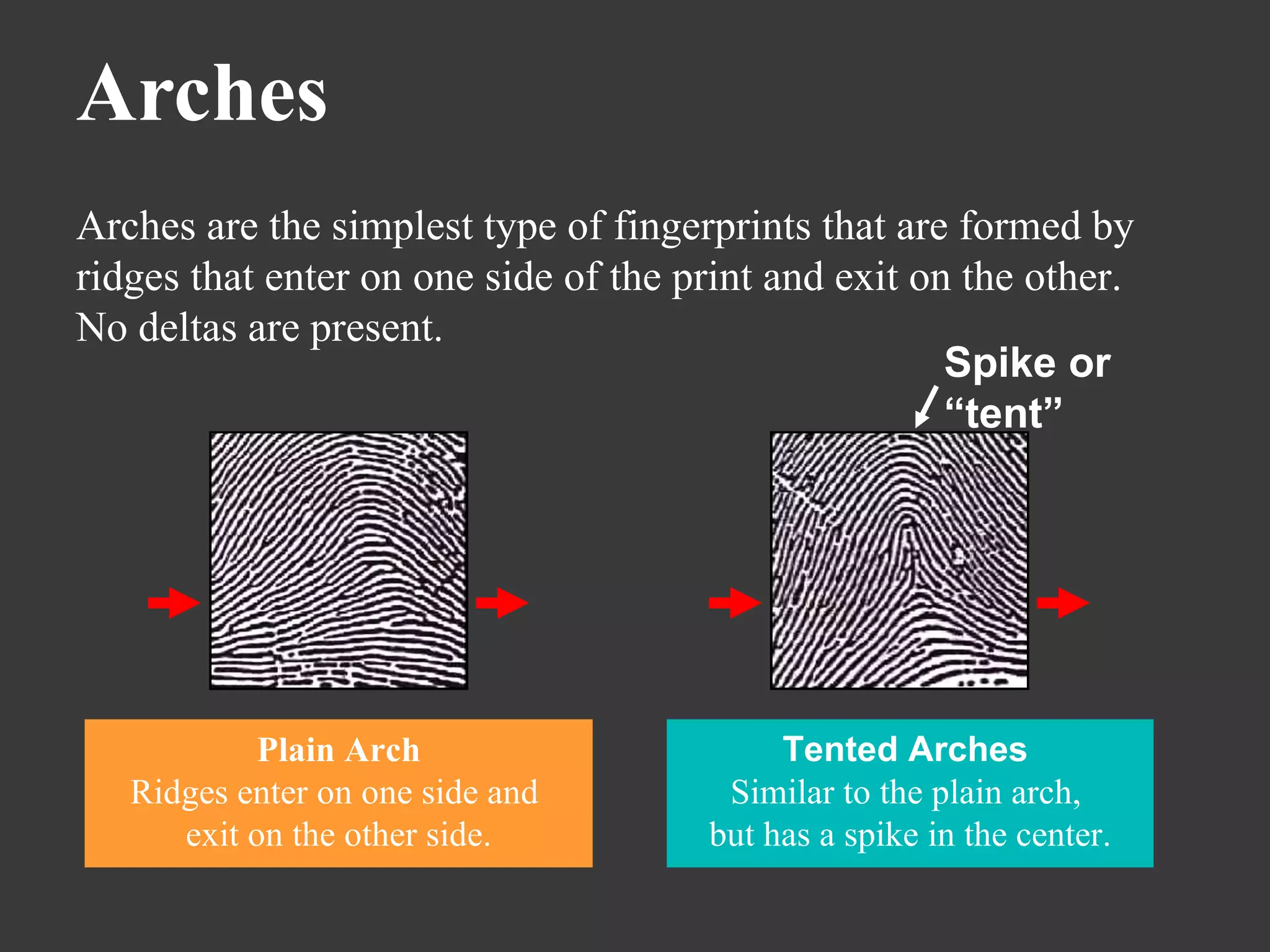
Arch An arch has friction ridges that enter on one side of the finger and cross to the other side while rising upward in the middle. They do NOT have type lines, deltas, or cores. Types Plain Tented Kendall/Hunt Publishing Company
 
 
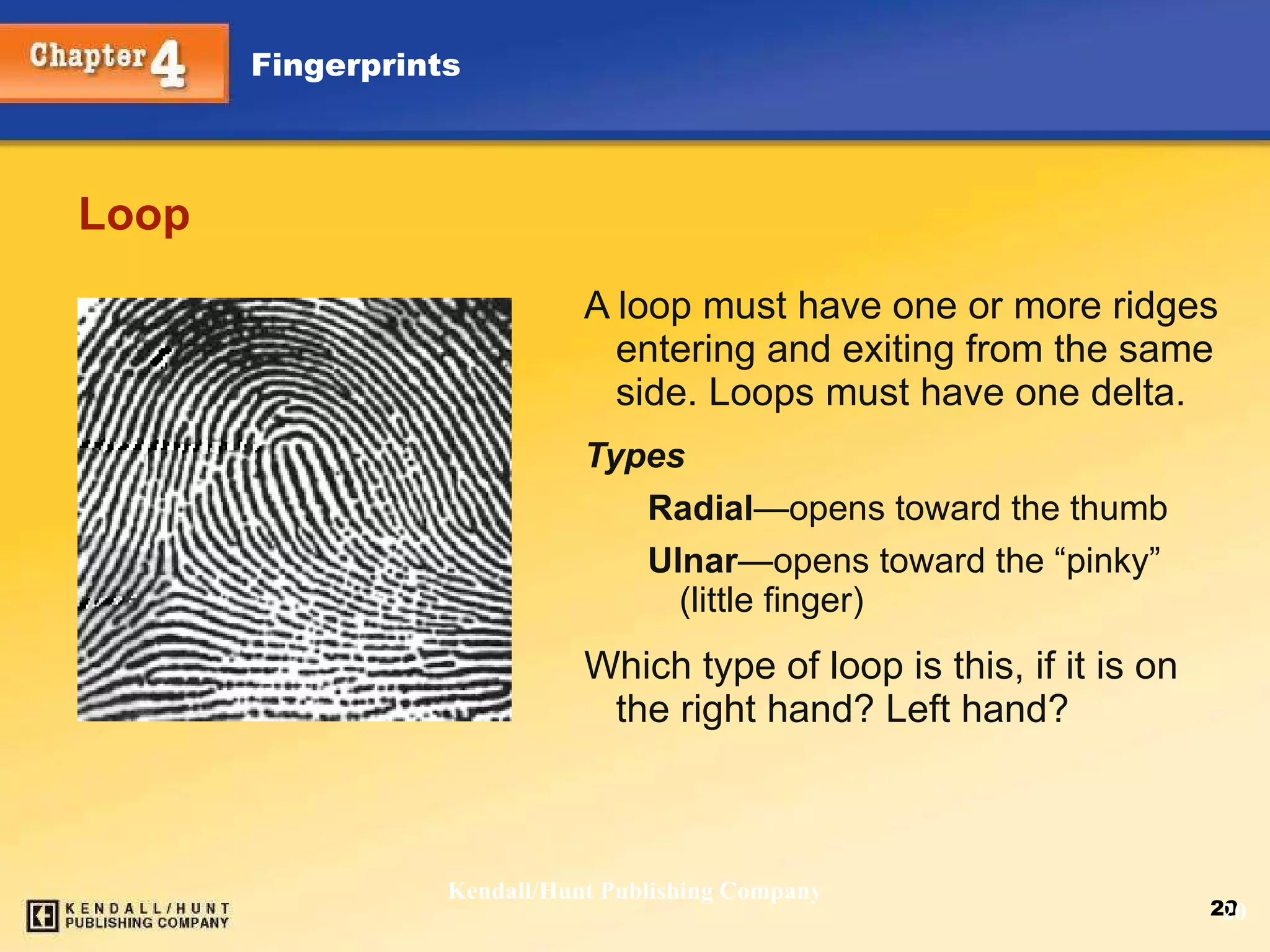
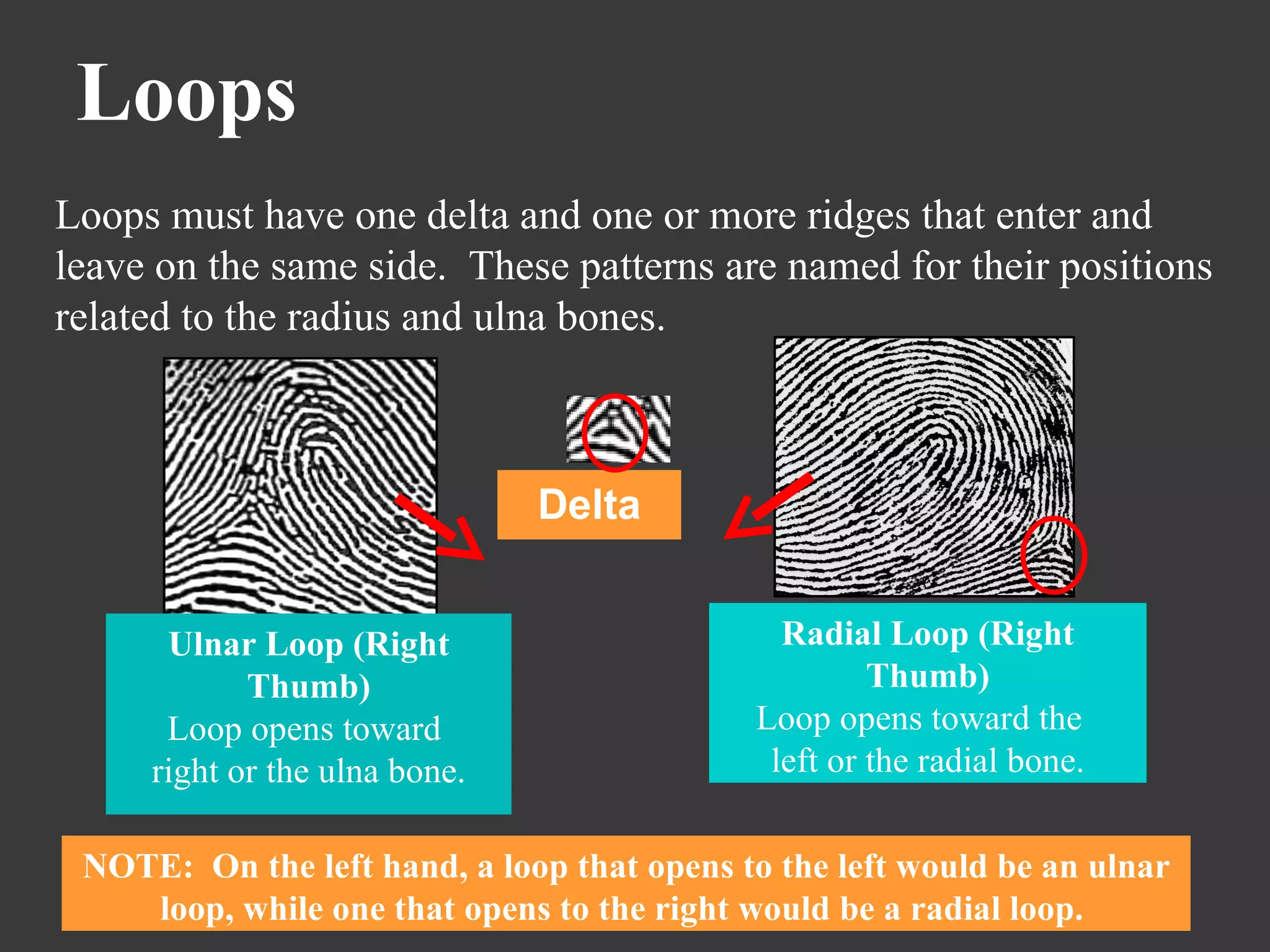
Loop A loop must have one or more ridges entering and exiting from the same side. Loops must have one delta. Types Radial — opens toward the thumb Ulnar — opens toward the “pinky” (little finger) Which type of loop is this, if it is on the right hand? Left hand? Kendall/Hunt Publishing Company
 
 
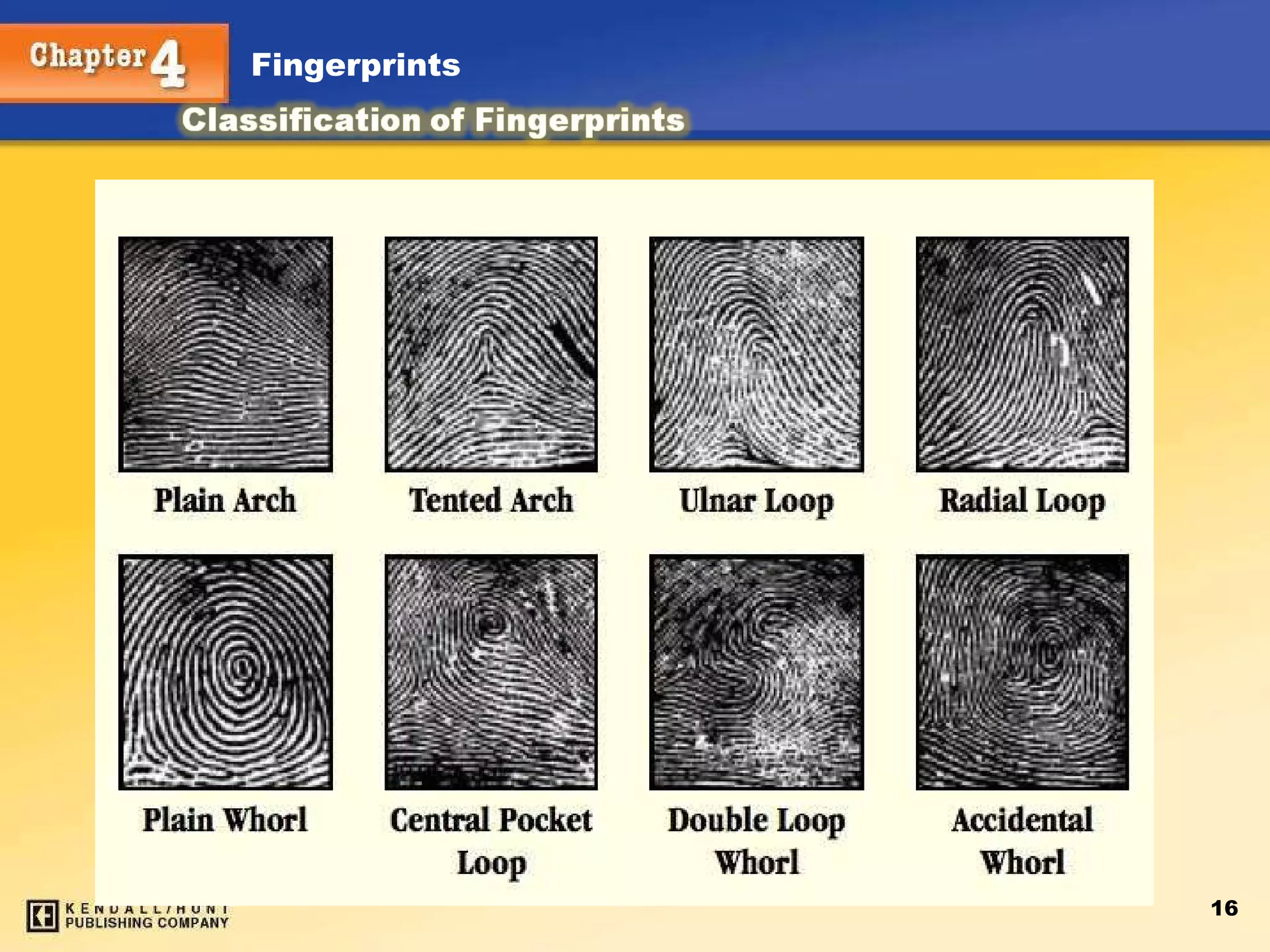
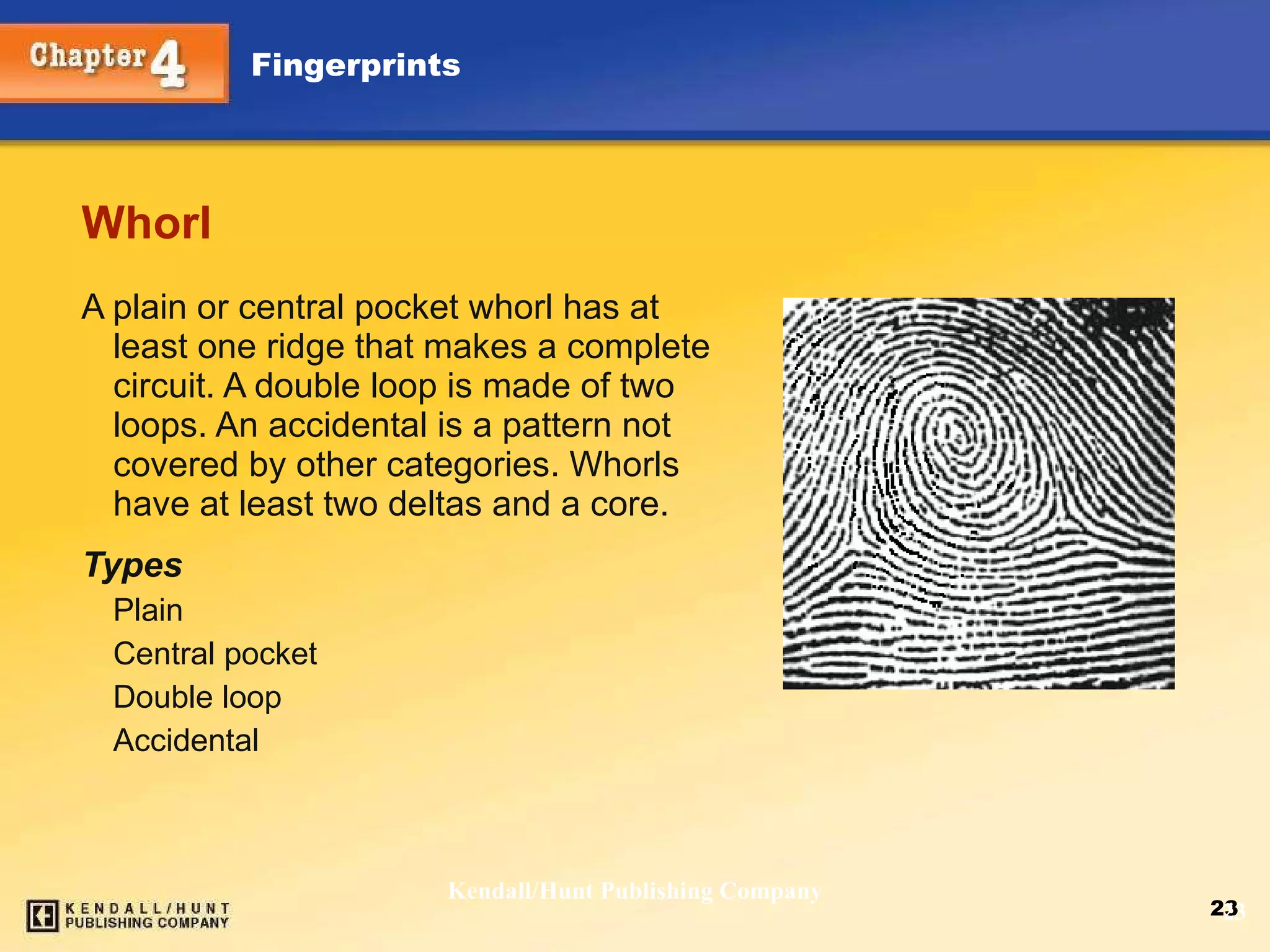
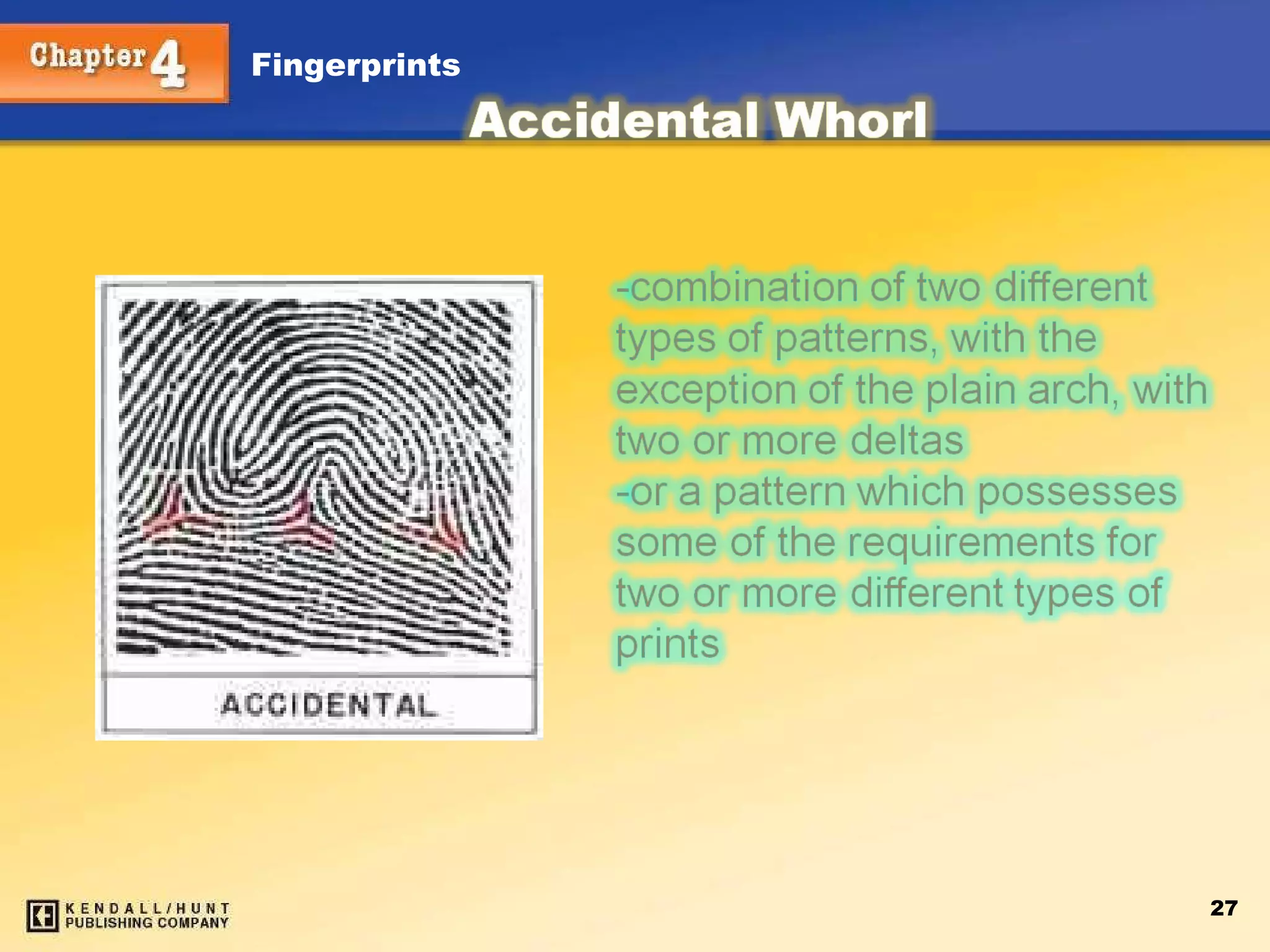
Whorl A plain or central pocket whorl has at least one ridge that makes a complete circuit. A double loop is made of two loops. An accidental is a pattern not covered by other categories. Whorls have at least two deltas and a core. Types Plain Central pocket Double loop Accidental Kendall/Hunt Publishing Company
 
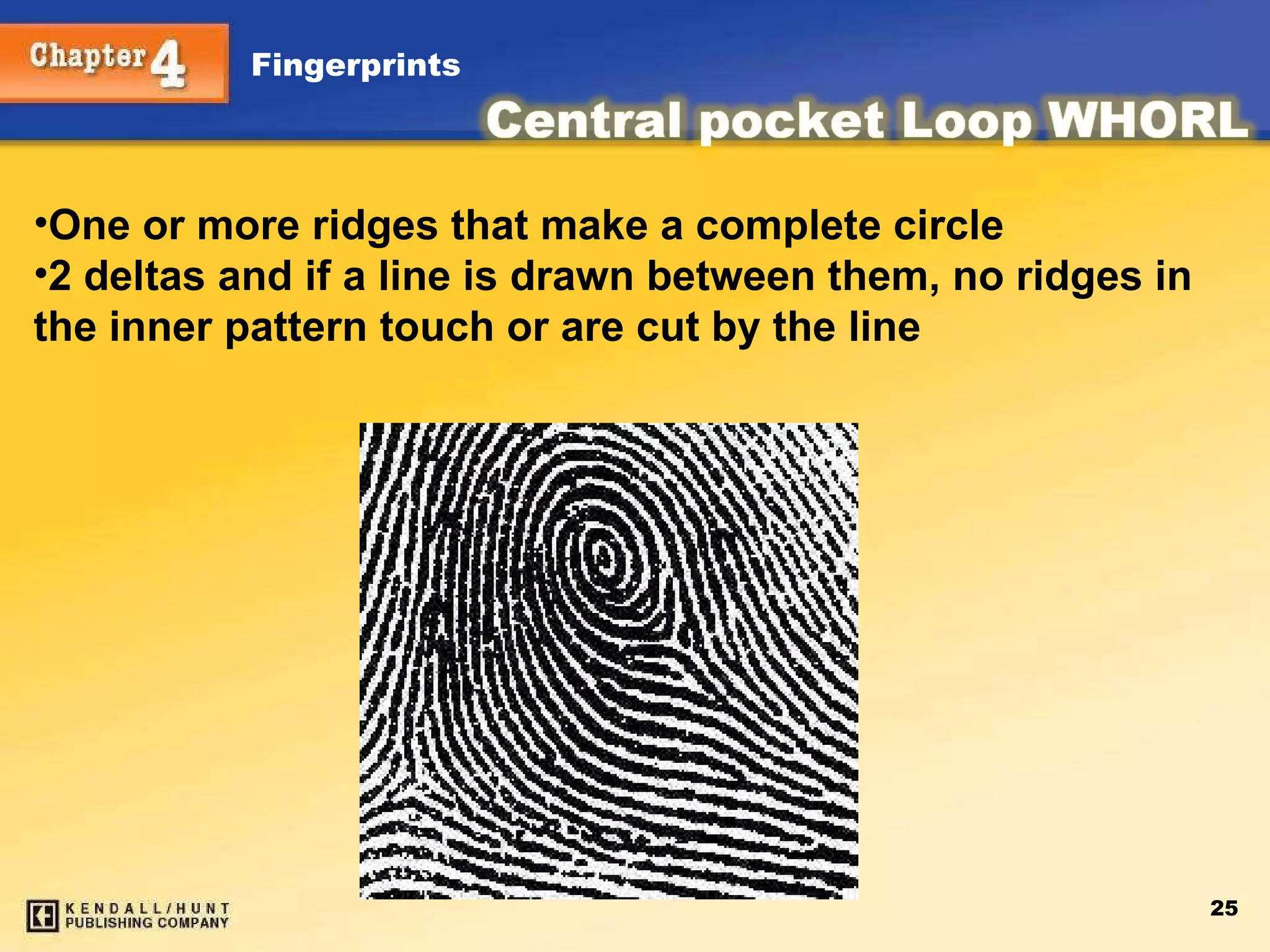
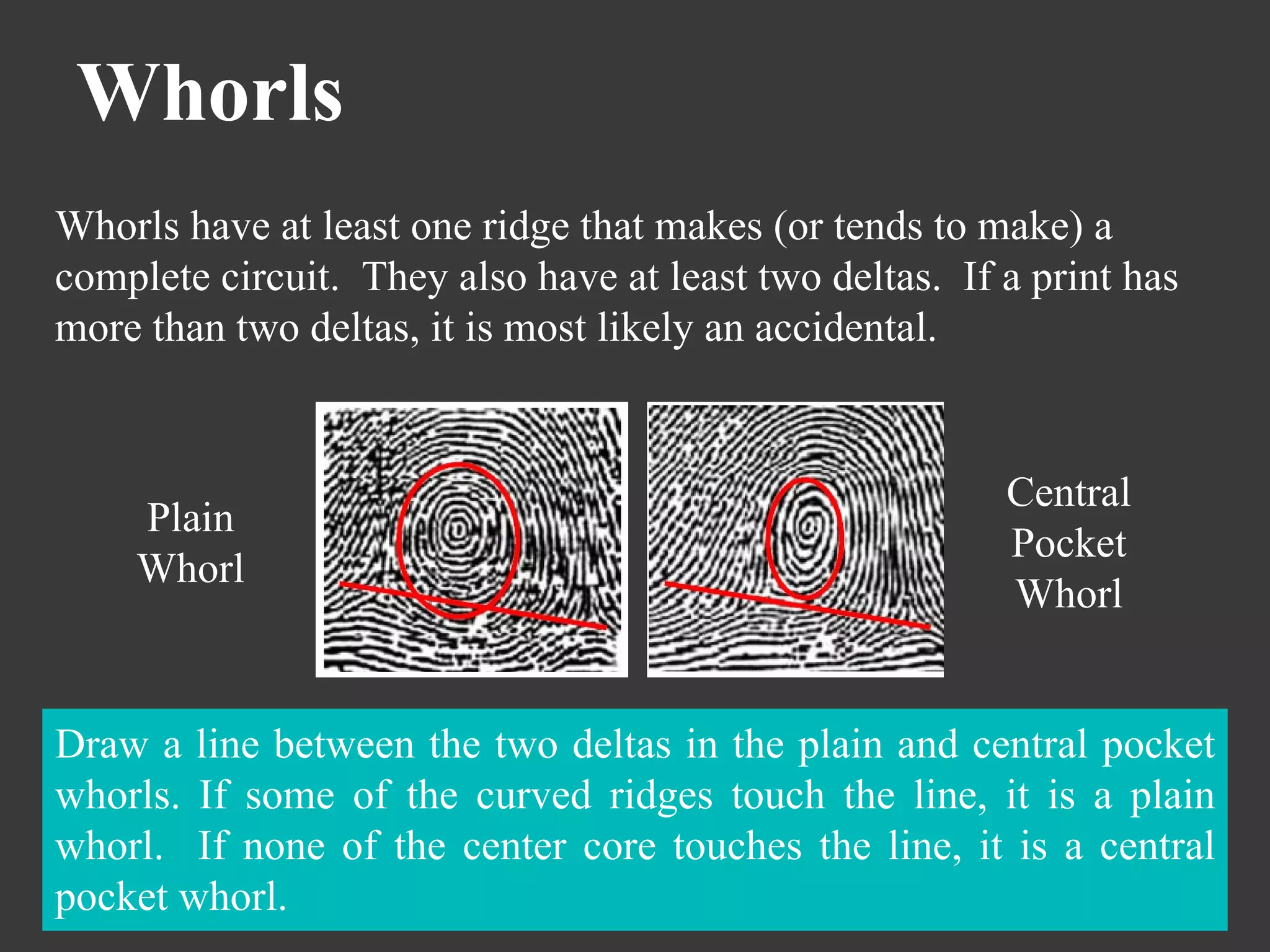
One or more ridges that make a complete circle 2 deltas and if a line is drawn between them, no ridges in the inner pattern touch or are cut by the line
 
 
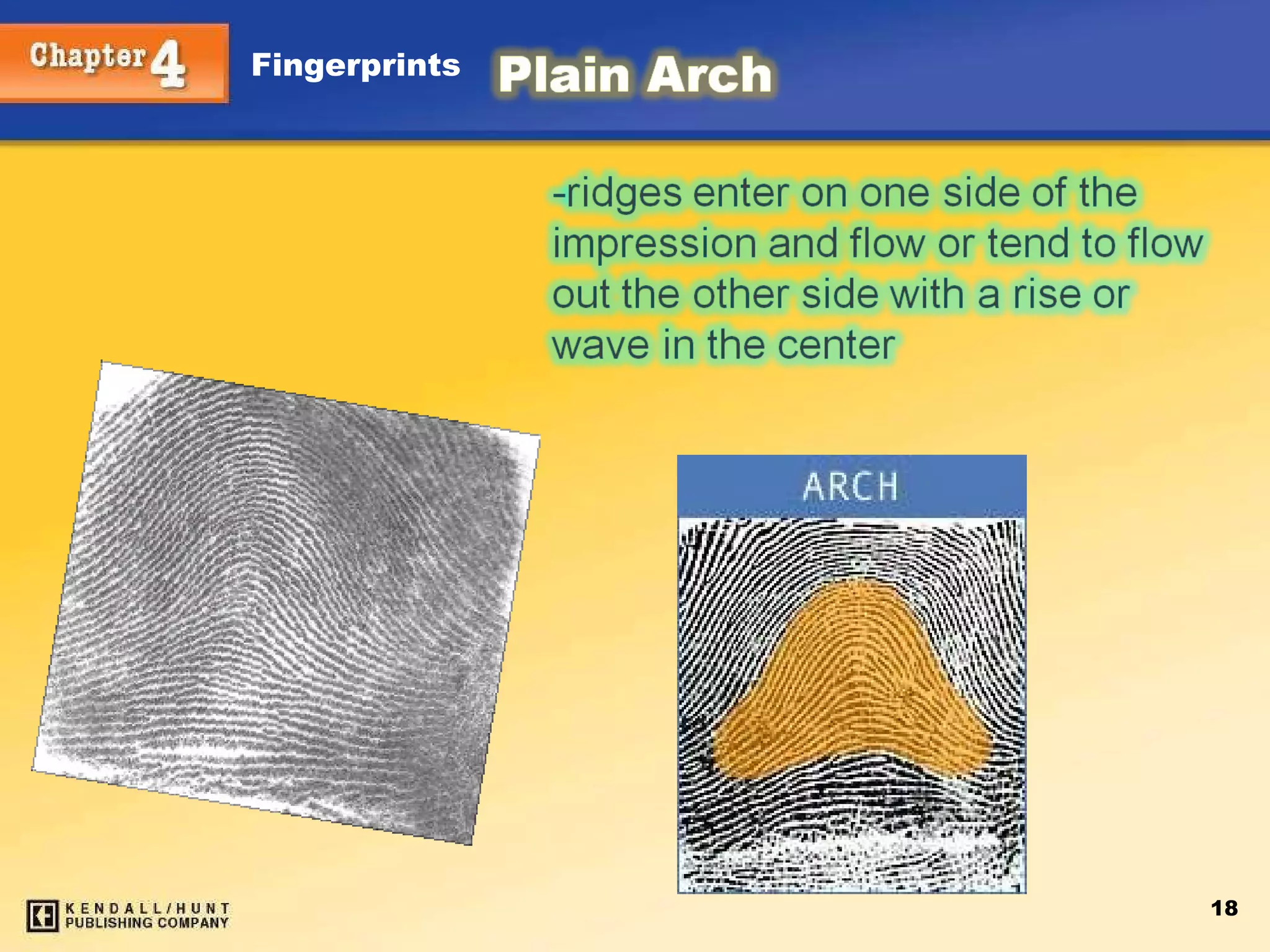
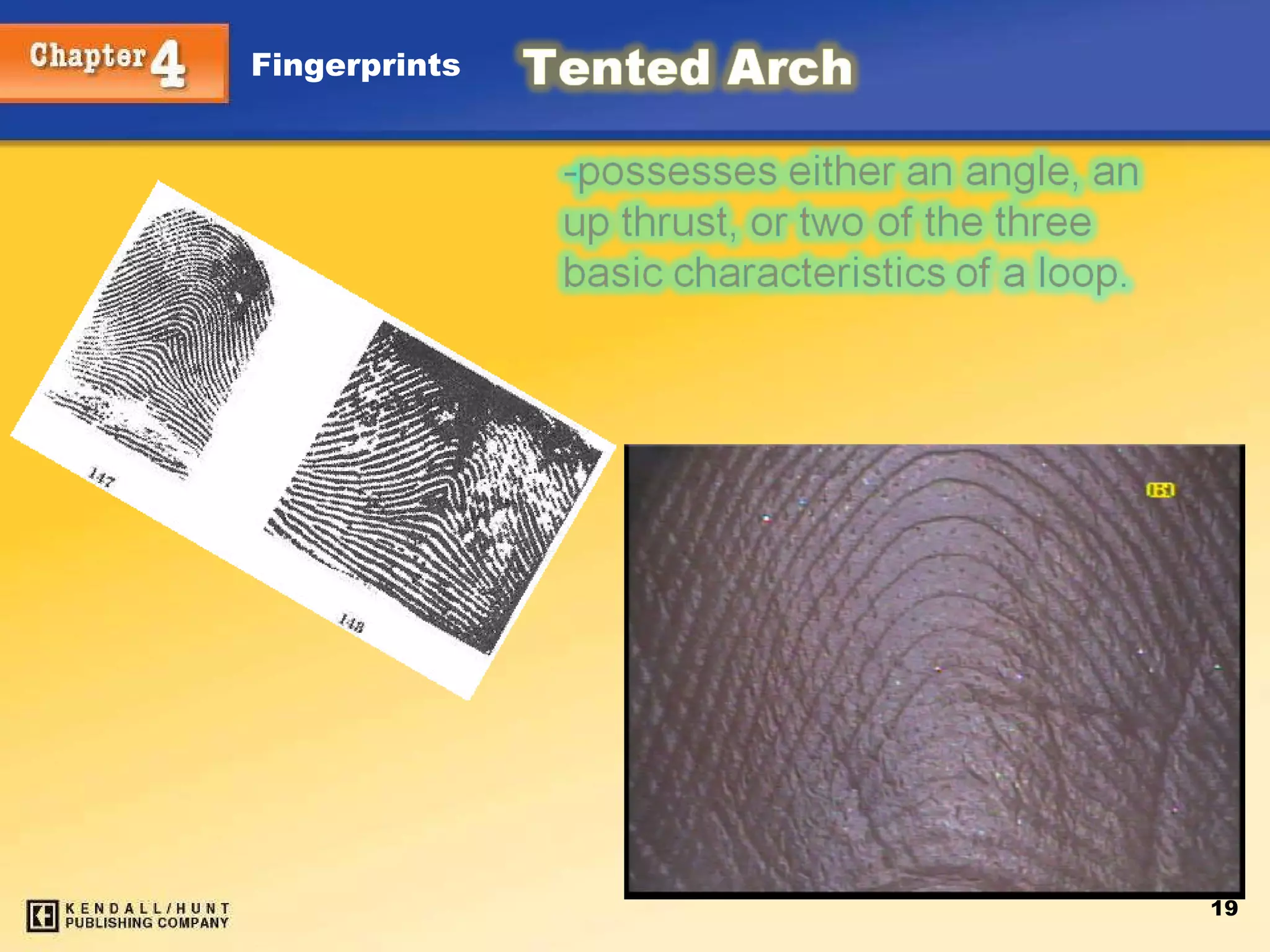
Arches Arches are the simplest type of fingerprints that are formed by ridges that enter on one side of the print and exit on the other.  No deltas are present. Plain Arch Ridges enter on one side and  exit on the other side. Tented Arches   Similar to the plain arch,  but has a spike in the center. Spike or “tent”
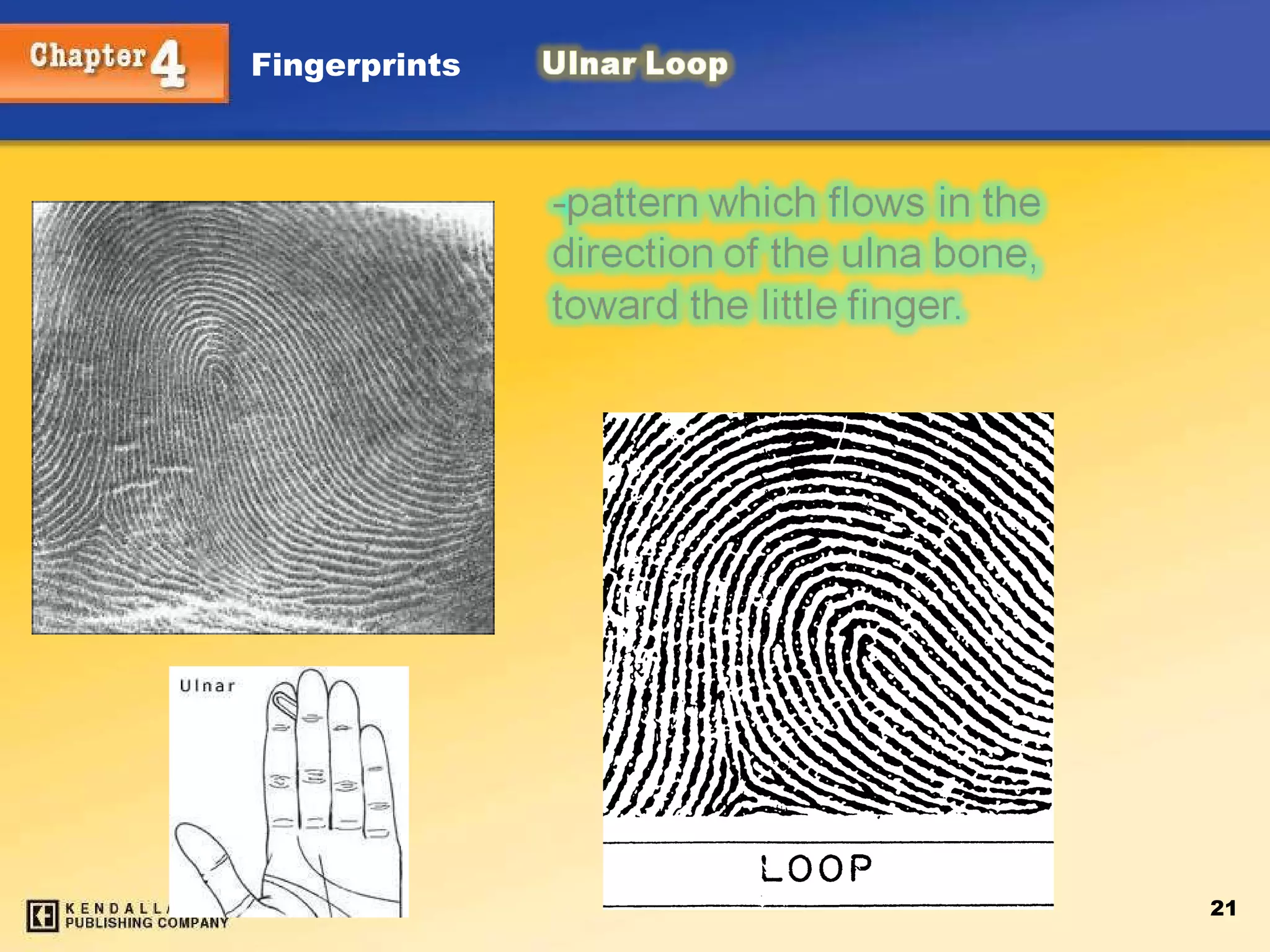
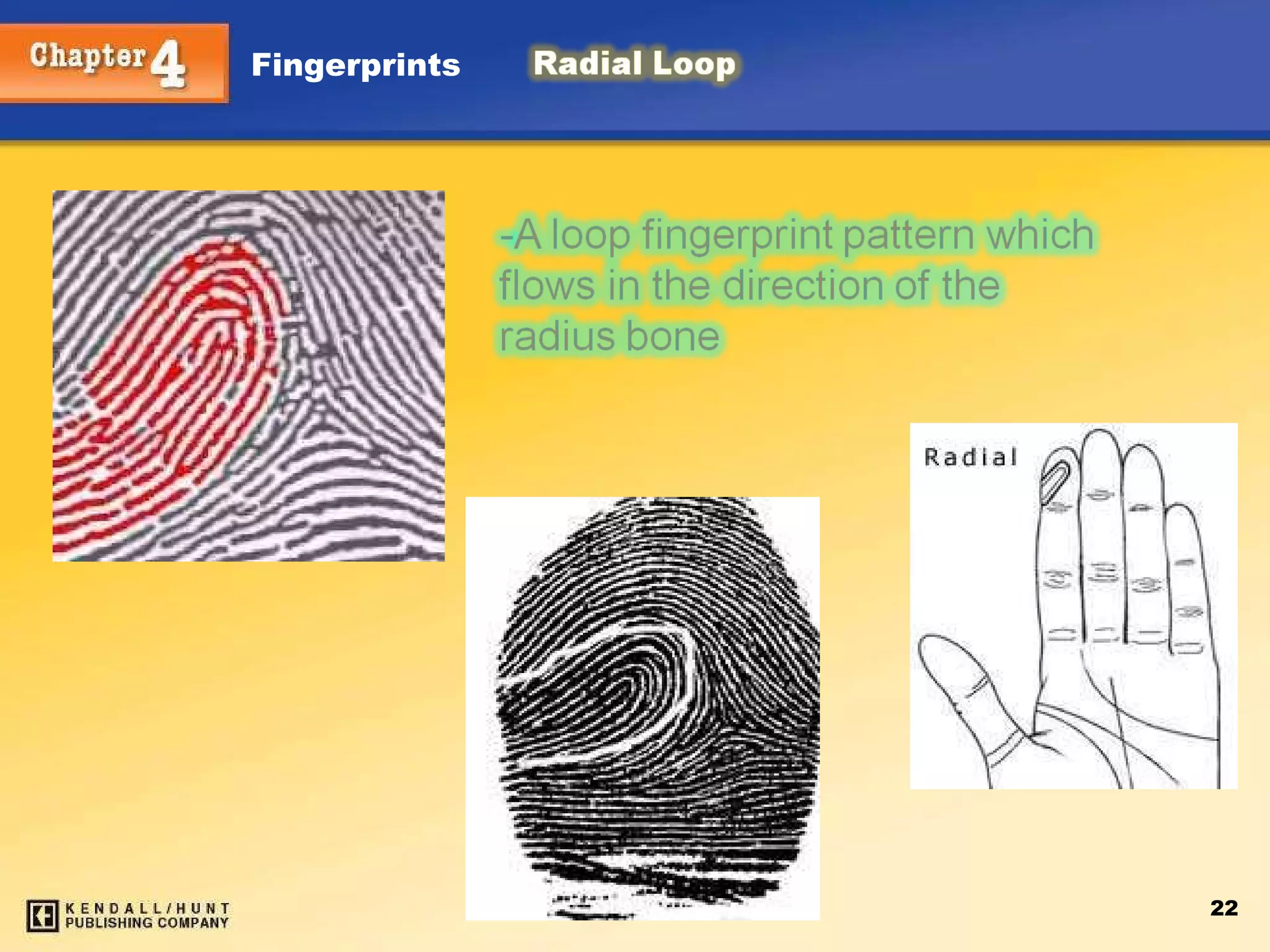
Loops Loops must have one delta and one or more ridges that enter and leave on the same side.  These patterns are named for their positions related to the radius and ulna bones. NOTE:  On the left hand, a loop that opens to the left would be an ulnar loop, while one that opens to the right would be a radial loop.  Delta Ulnar Loop (Right Thumb) Loop opens toward  right or the ulna bone. Radial Loop (Right Thumb) Loop opens toward the  left or the radial bone.
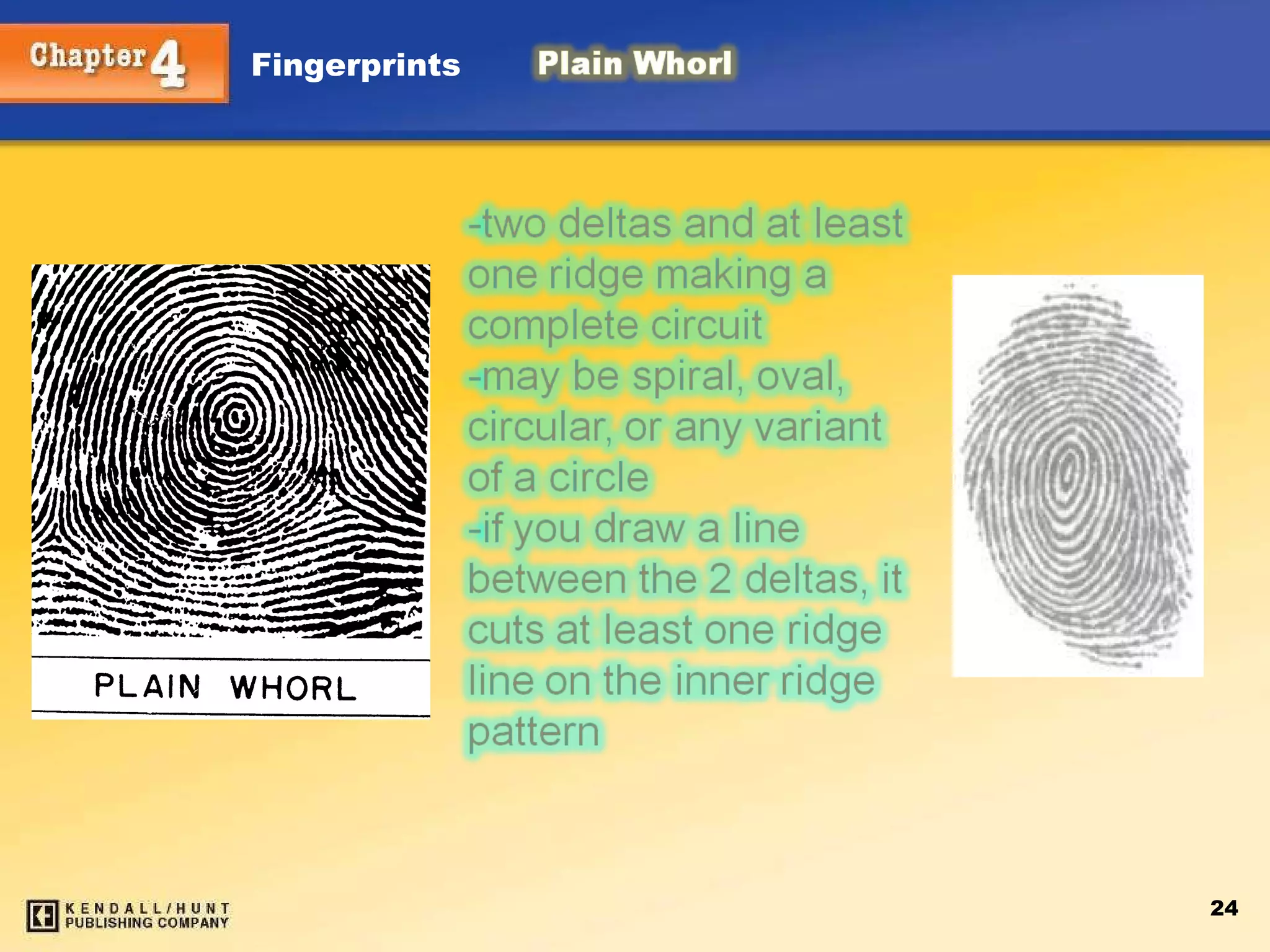
Whorls Whorls have at least one ridge that makes (or tends to make) a complete circuit.  They also have at least two deltas.  If a print has more than two deltas, it is most likely an accidental. Draw a line between the two deltas in the plain and central pocket whorls. If some of the curved ridges touch the line, it is a plain whorl.  If none of the center core touches the line, it is a central pocket whorl.  Plain Whorl Central Pocket Whorl
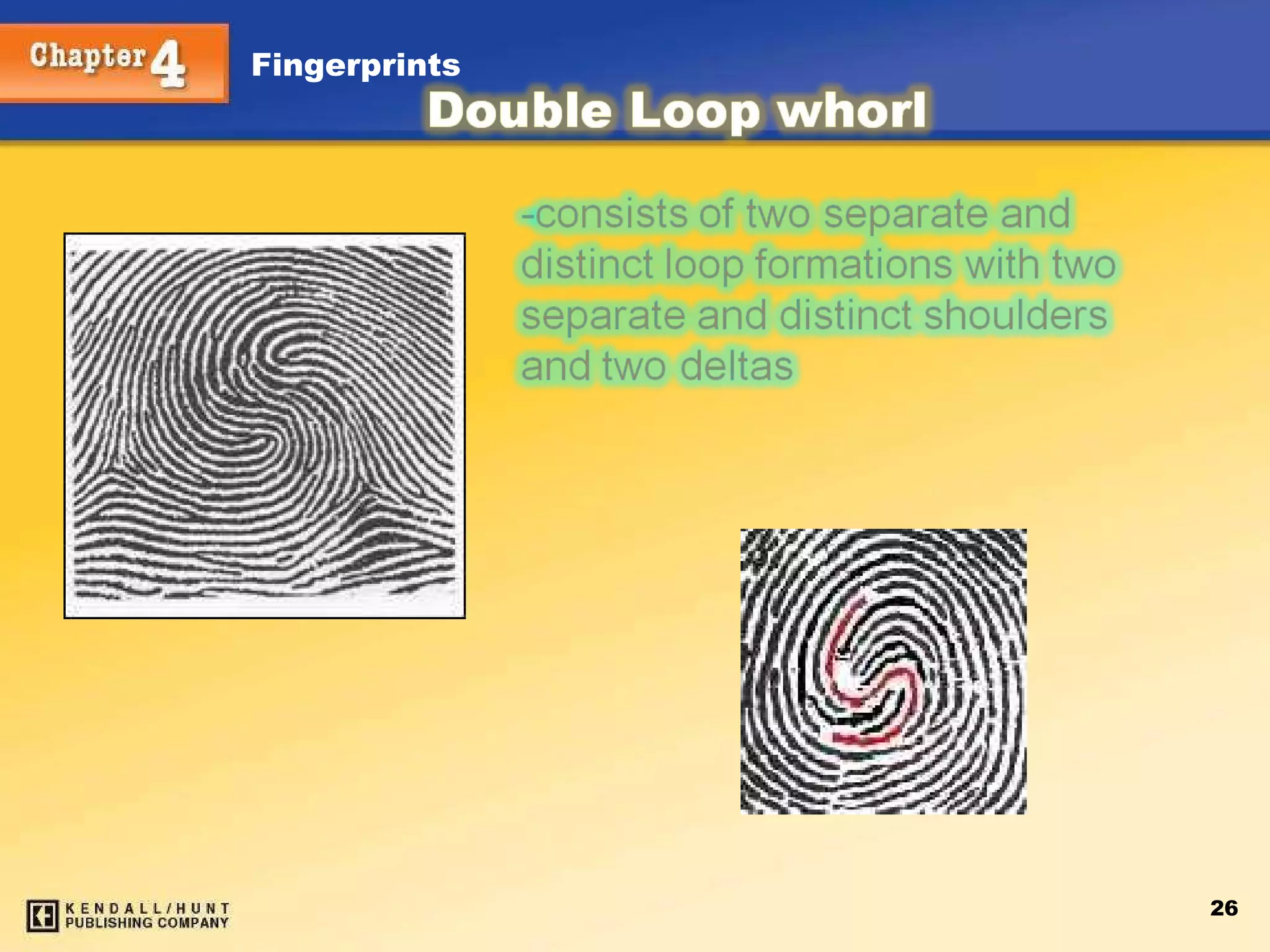
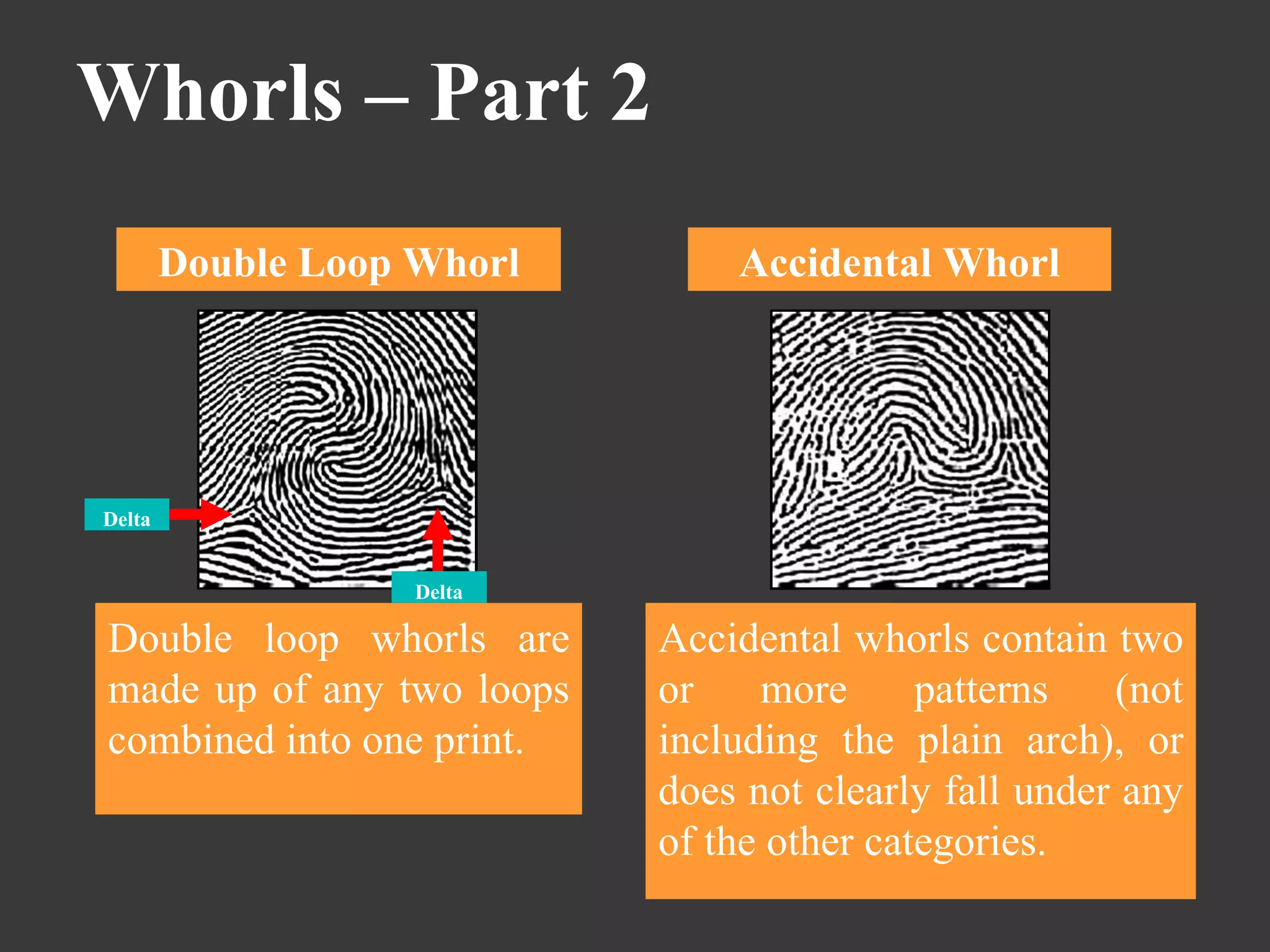
Whorls – Part 2 Accidental Whorl Accidental whorls contain two or more patterns (not including the plain arch), or does not clearly fall under any of the other categories.  Double Loop Whorl Double loop whorls are made up of any two loops combined into one print.  Delta Delta
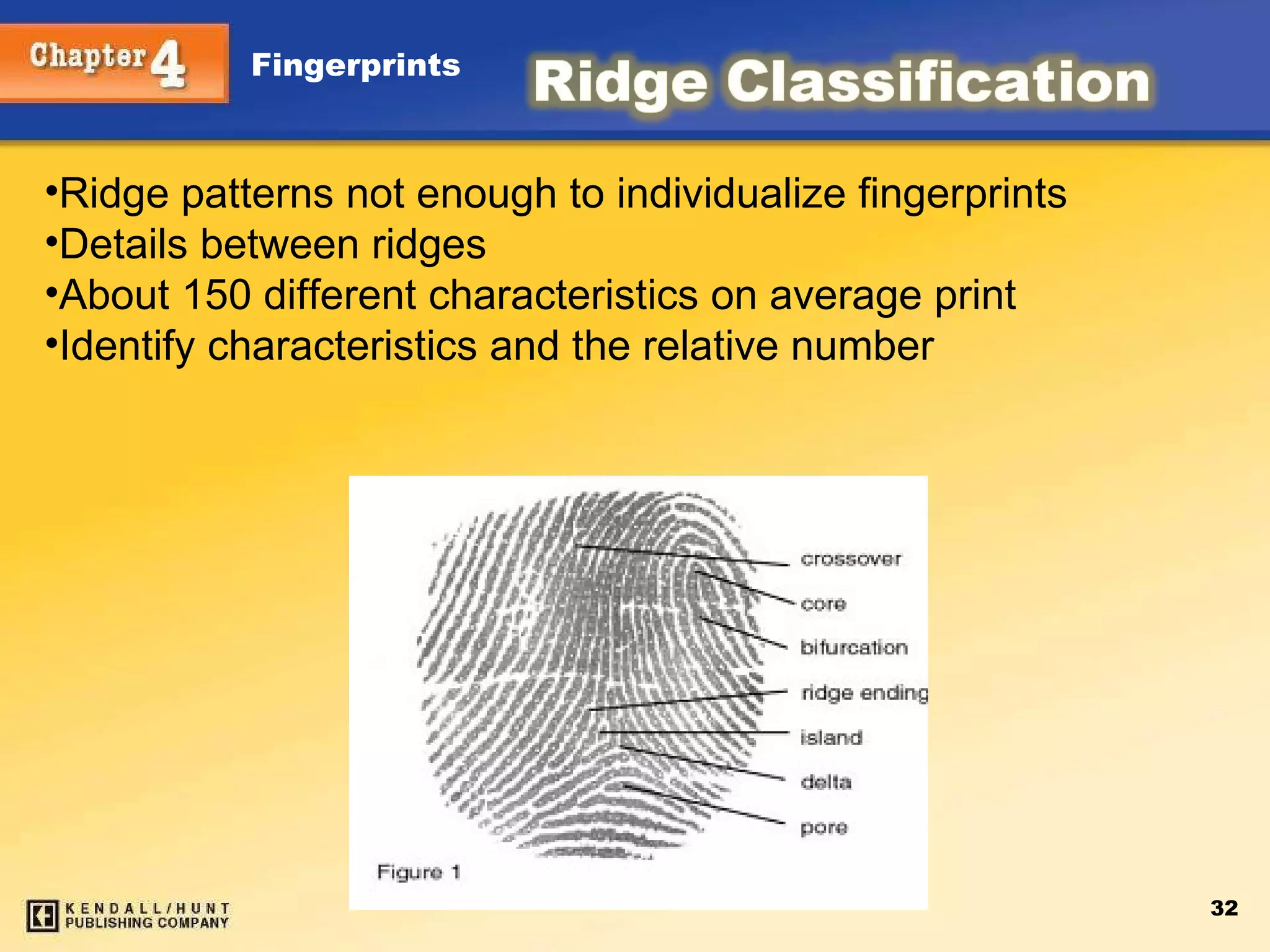
Ridge patterns not enough to individualize fingerprints Details between ridges About 150 different characteristics on average print Identify characteristics and the relative number
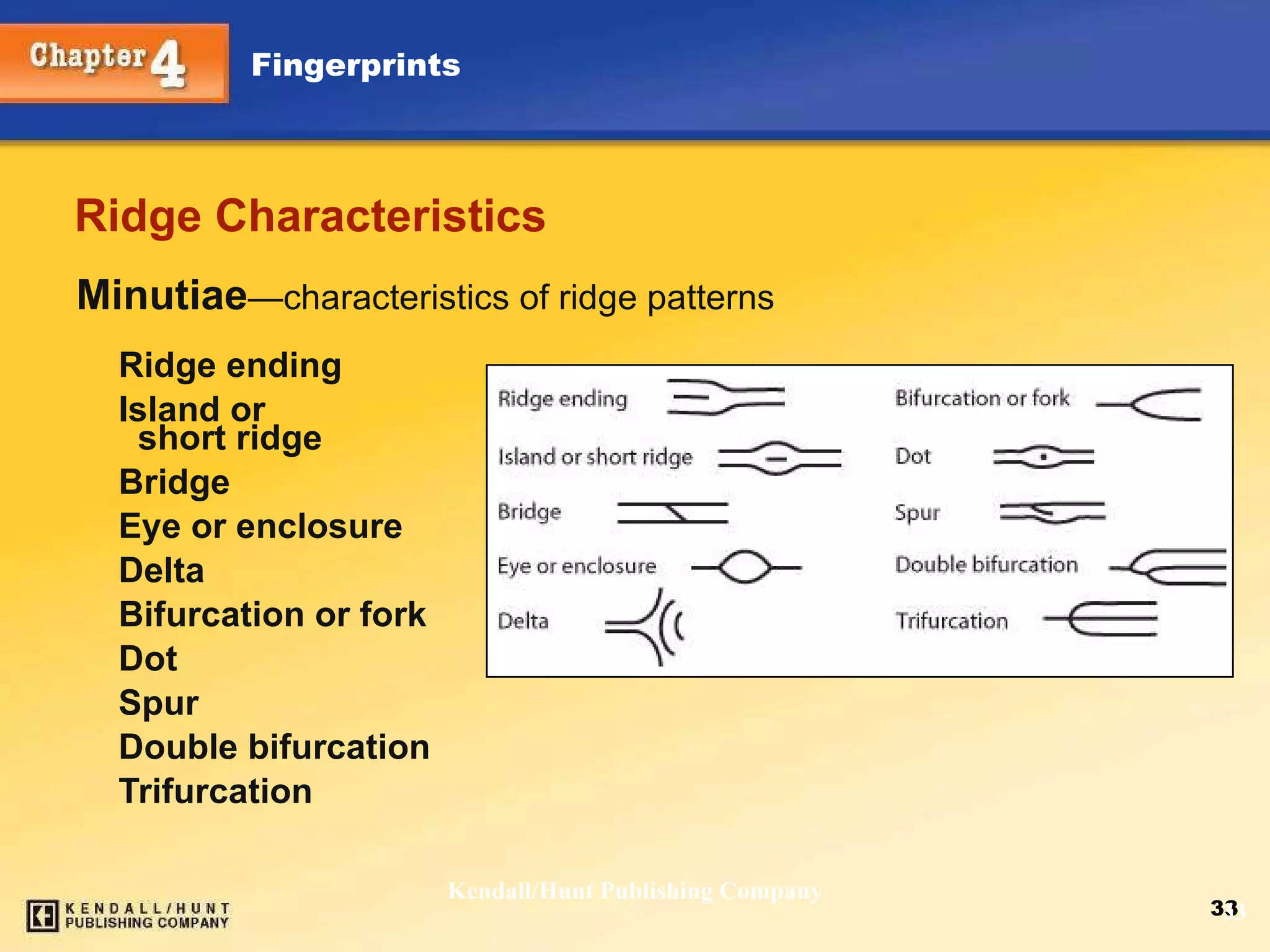
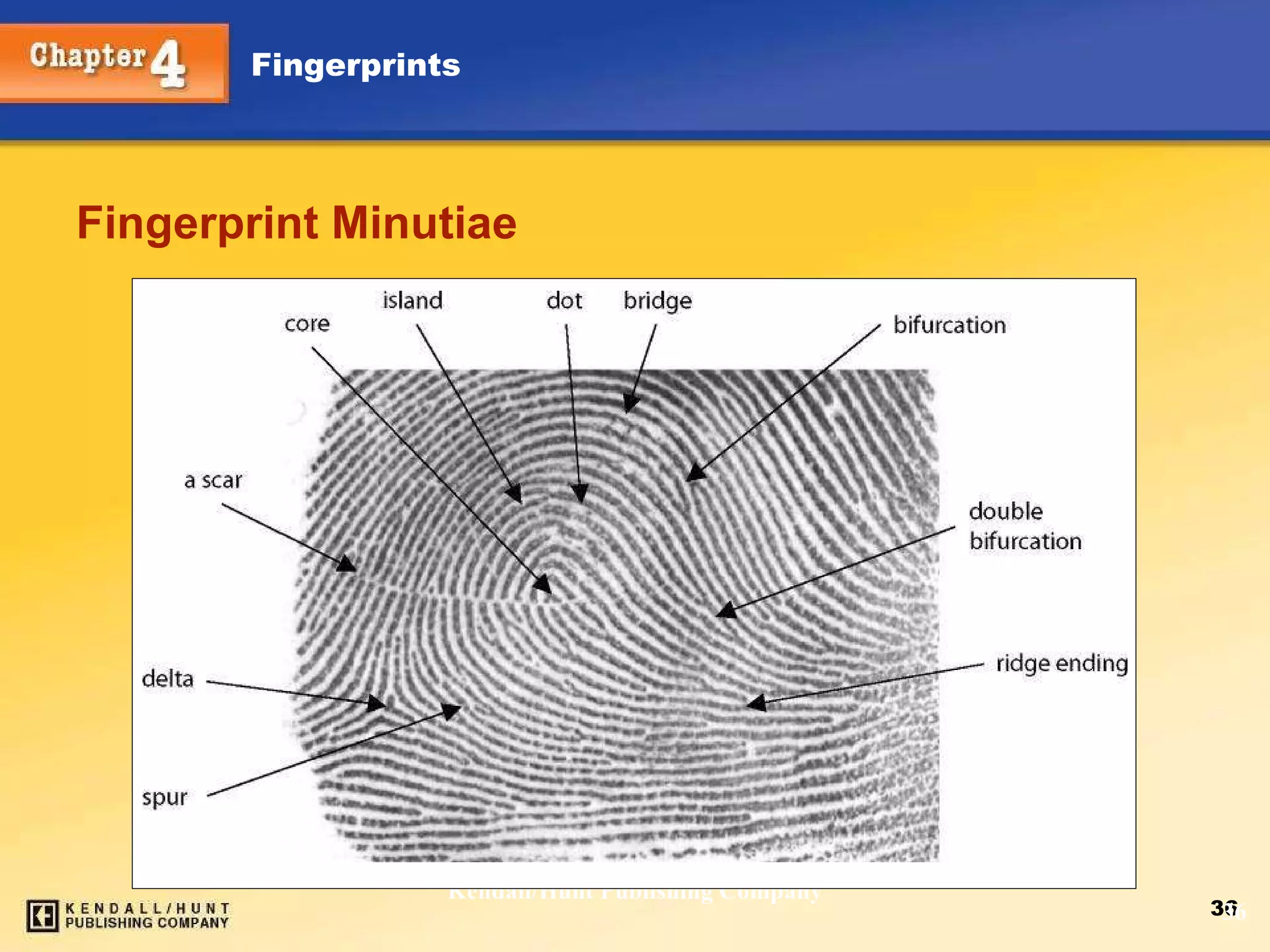
Ridge Characteristics Minutiae — characteristics of ridge patterns Ridge ending Island or  short ridge Bridge Eye or enclosure Delta Bifurcation or fork  Dot Spur Double bifurcation Trifurcation Kendall/Hunt Publishing Company
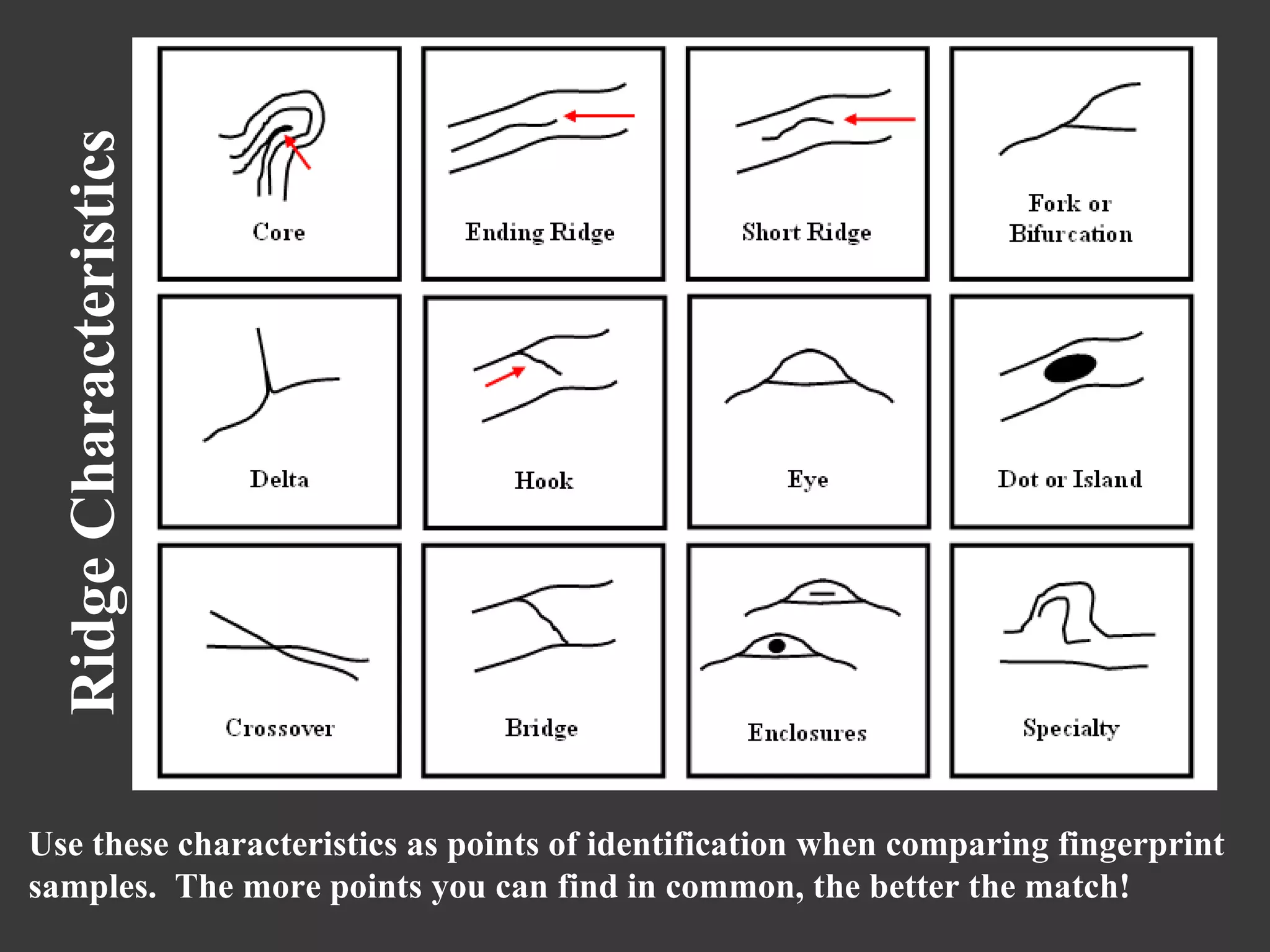
Ridge Characteristics  Use these characteristics as points of identification when comparing fingerprint samples.  The more points you can find in common, the better the match!
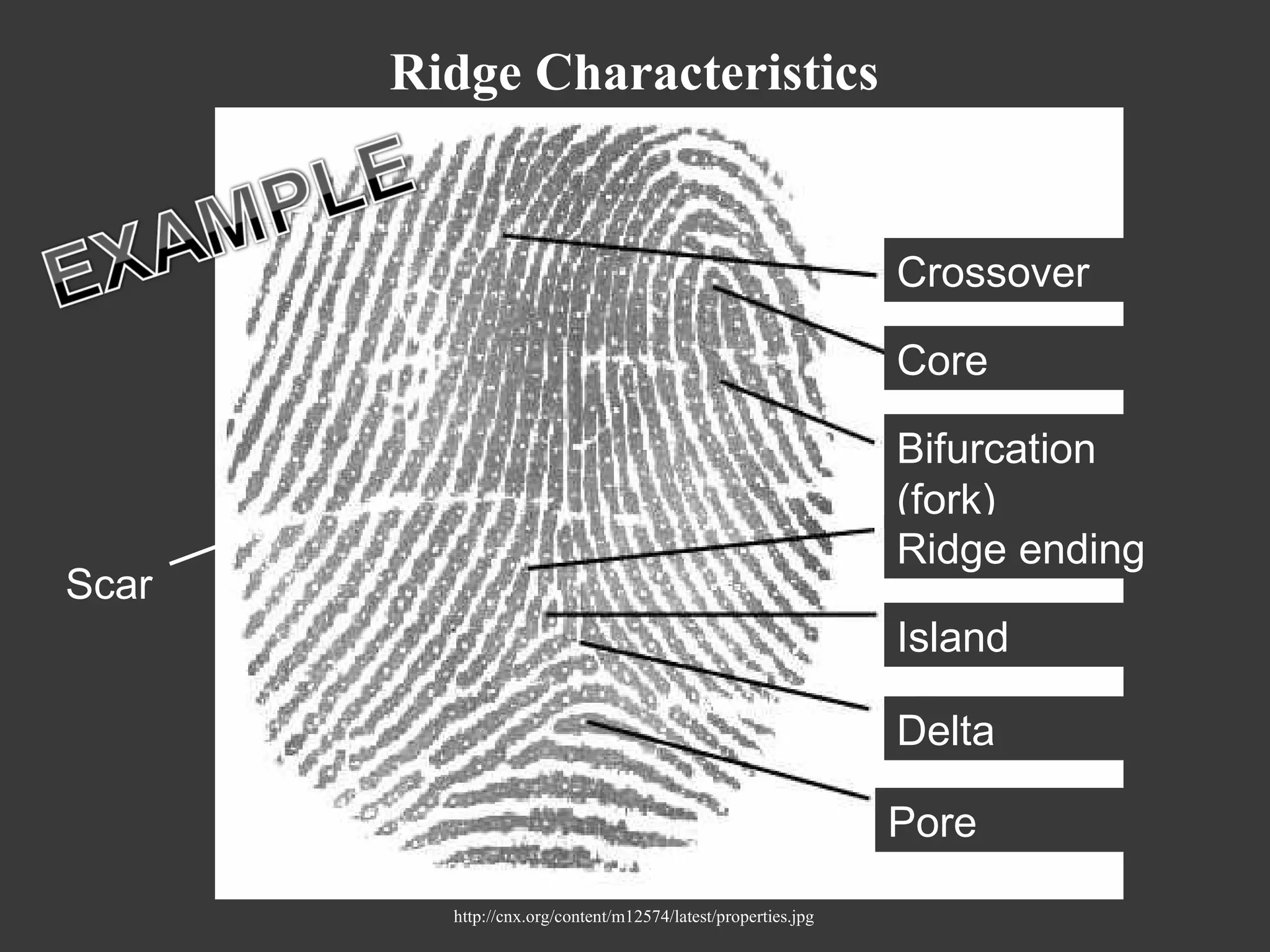
http://cnx.org/content/m12574/latest/properties.jpg Ridge Characteristics Crossover Core Bifurcation (fork) Ridge ending Island Delta Pore Scar
Fingerprint Minutiae Kendall/Hunt Publishing Company
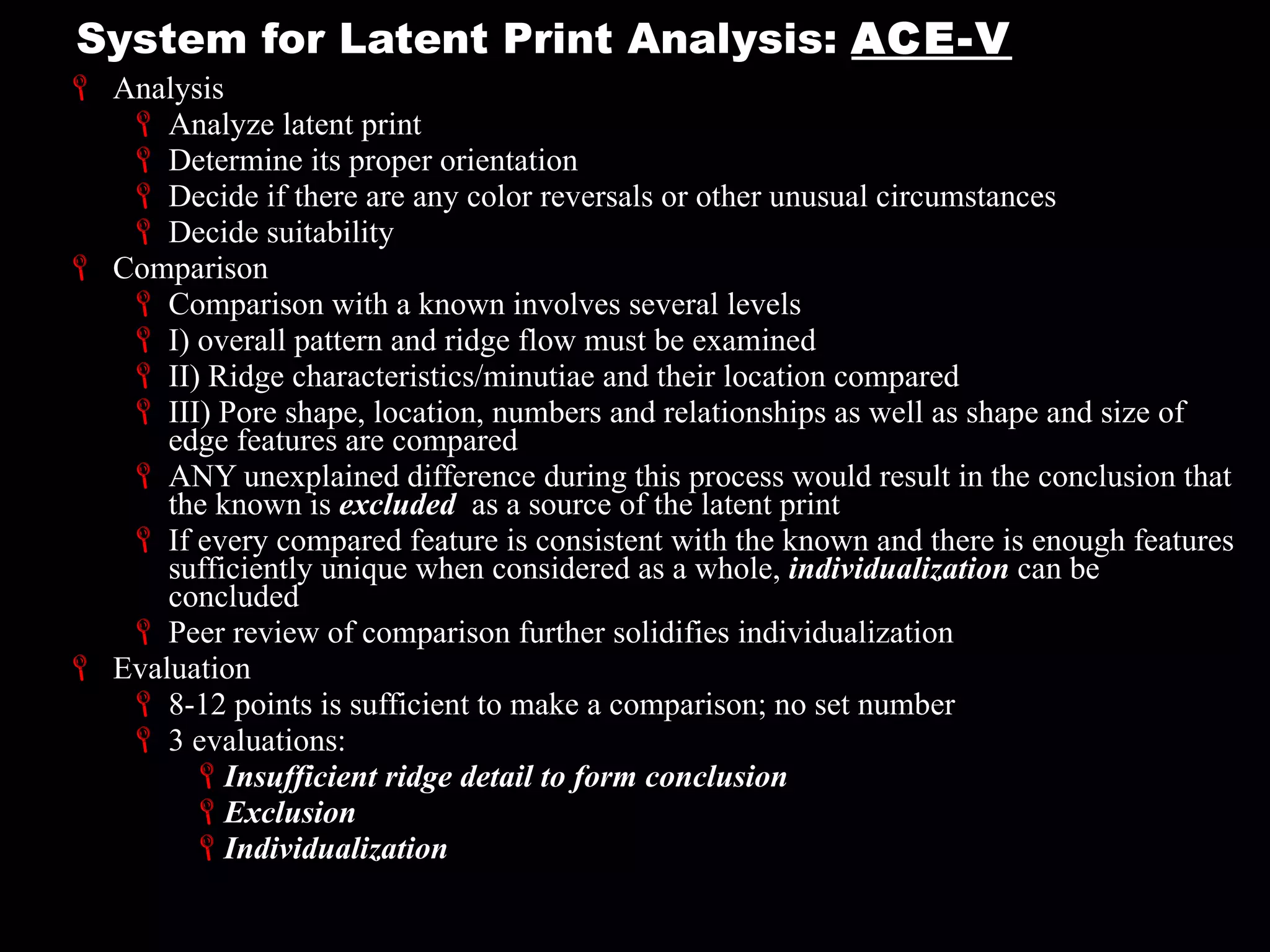
Comparison There are no legal requirements in the United States on the number of points required for a match. Generally, criminal courts will accept 8 to 12 points of similarity. Kendall/Hunt Publishing Company
 
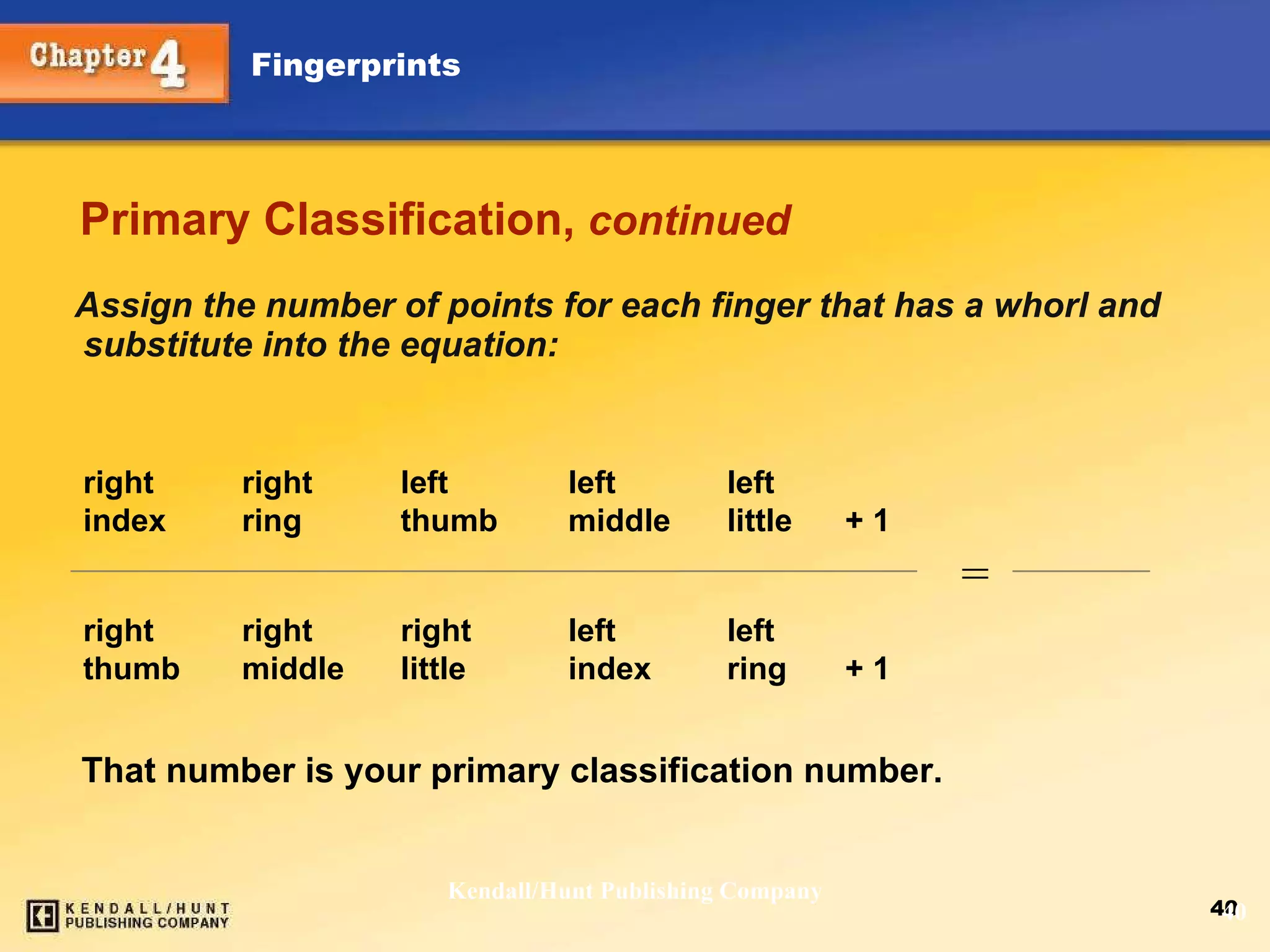
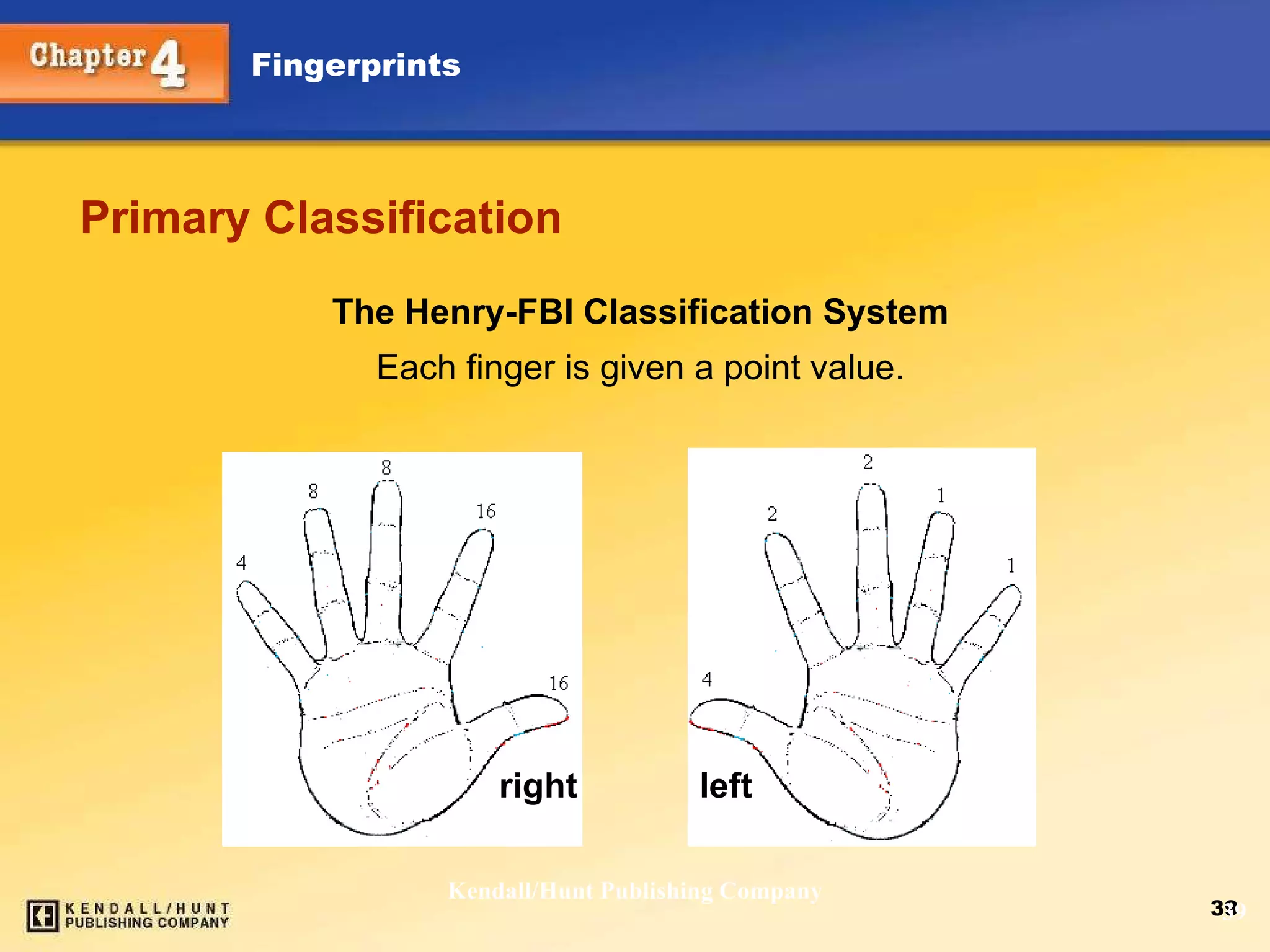
Primary Classification Kendall/Hunt Publishing Company The Henry - FBI Classification System Each finger is given a point value. right left
Primary Classification,  continued Assign the number of points for each finger that has a whorl and substitute into the equation: Kendall/Hunt Publishing Company right right left left left  index ring thumb middle little + 1  right right right left left  thumb middle little index ring + 1 That number is your primary classification number. =
1 – Blow up your  balloon about halfway and twist the end to keep the air from coming out.  Do not tie it off!  2 – Use an ink pad to make a print with all of your fingers and label each one with a permanent marker.  Write your name on the balloon as well.  3 – Blow up the balloon to full size and tie the end.  4 – Analyze the fingerprints to find several ridge structures that we have discussed.  Use a highlighter to mark these structures on your “My Prints” worksheet.  Try It! Think About It! Which ridge structures were most common in your fingerprints? Which ridge structures were most common in your group?  Were there any structures that were not found in any of the fingerprints?
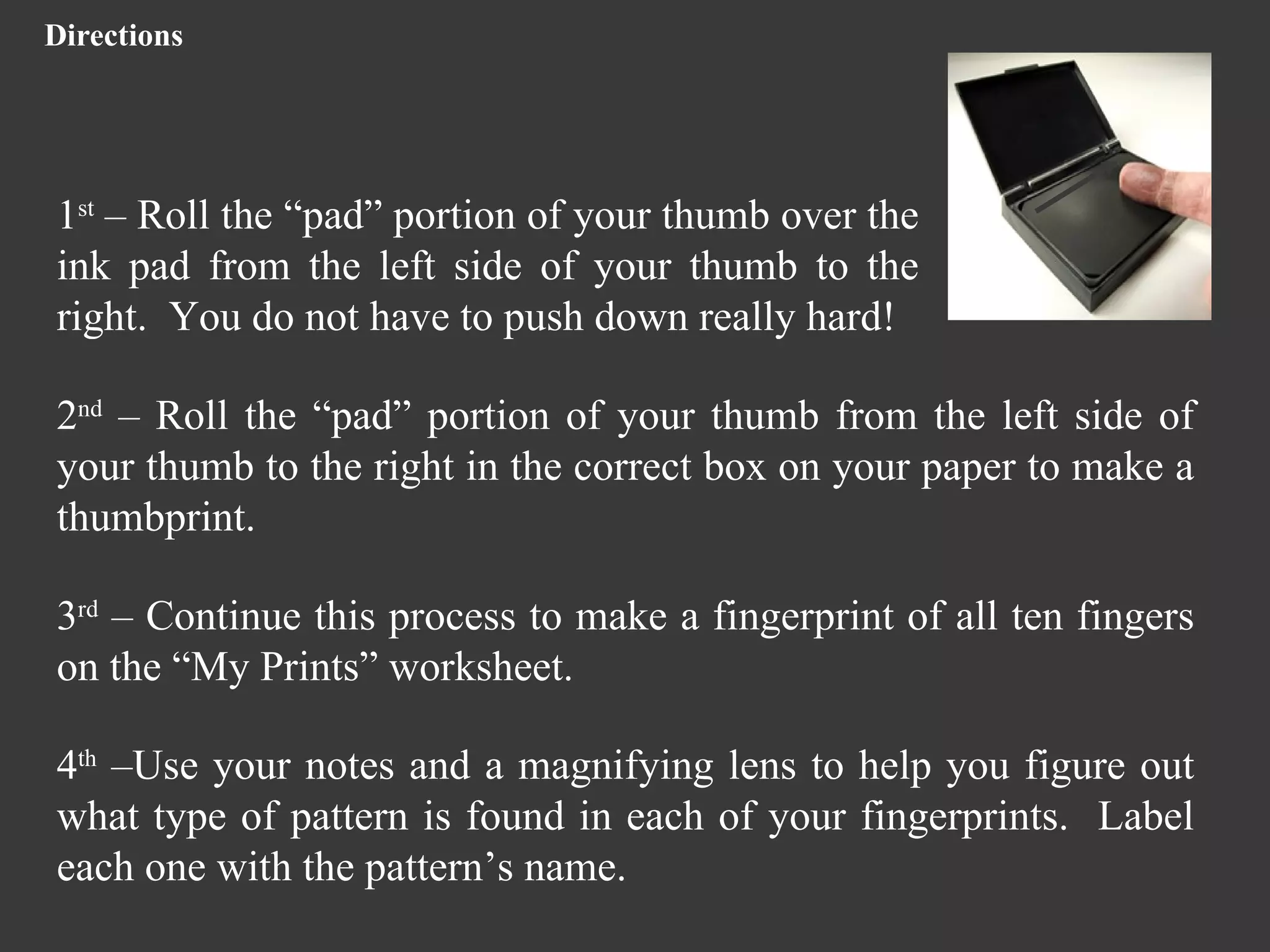
Directions 1 st  – Roll the “pad” portion of your thumb over the ink pad from the left side of your thumb to the right.  You do not have to push down really hard! 2 nd  – Roll the “pad” portion of your thumb from the left side of your thumb to the right in the correct box on your paper to make a thumbprint.  3 rd  – Continue this process to make a fingerprint of all ten fingers on the “My Prints” worksheet. 4 th  –Use your notes and a magnifying lens to help you figure out what type of pattern is found in each of your fingerprints.  Label each one with the pattern’s name.
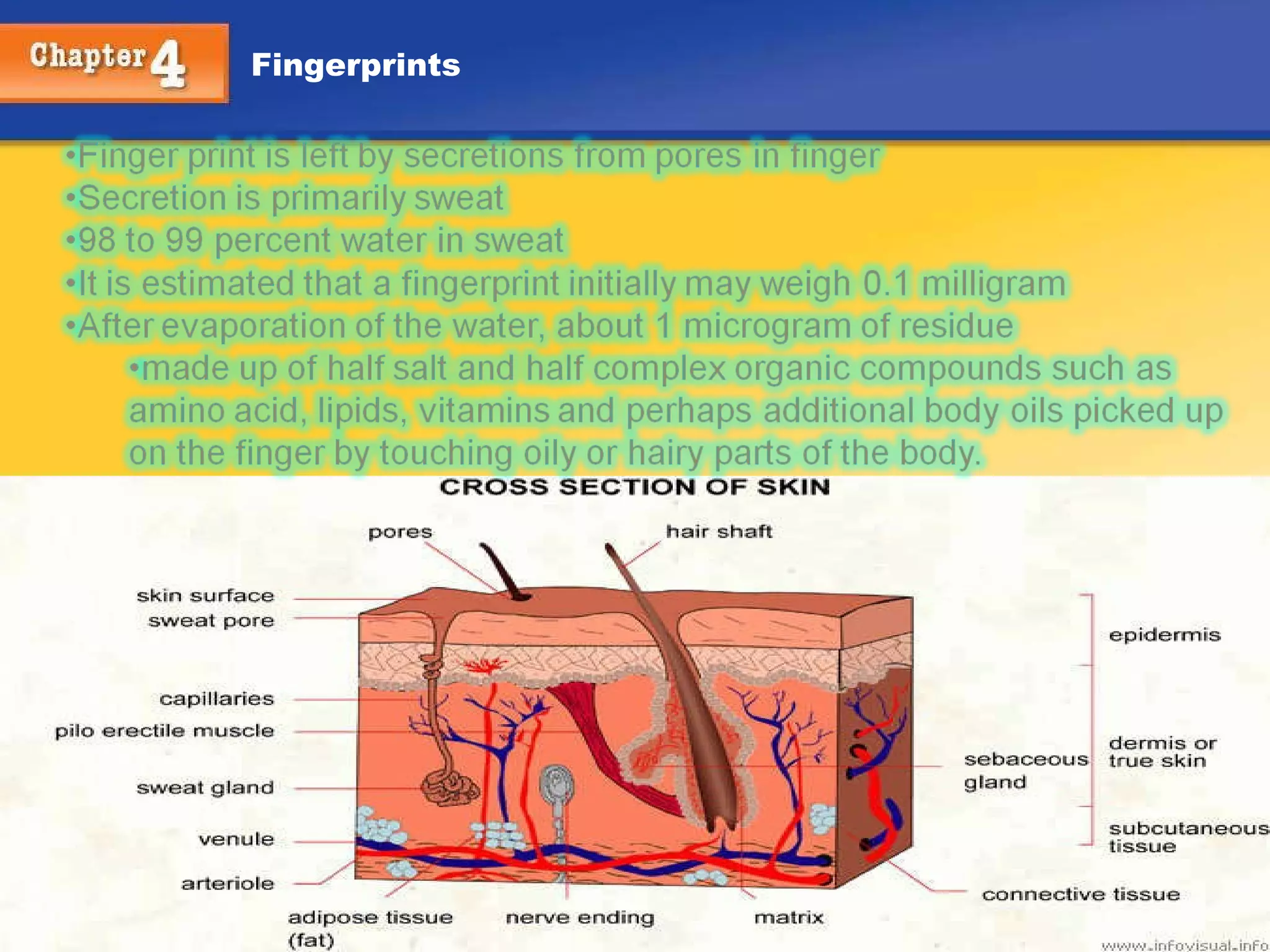
Latent Prints Latent fingerprints are those that are not visible to the naked eye. These prints consist of the natural secretions of human skin and require development for them to become visible. Most secretions come from three glands: Eccrine —secretes  largely water, with both inorganic (ammonia,  chlorides, metal ions, phosphates) and organic (amino acids, lactic  acids, urea, sugars) compounds. Most important for fingerprints. Apocrine — secretes pheromones and other organic materials. Sebaceous — secretes fatty or greasy substances. Kendall/Hunt Publishing Company
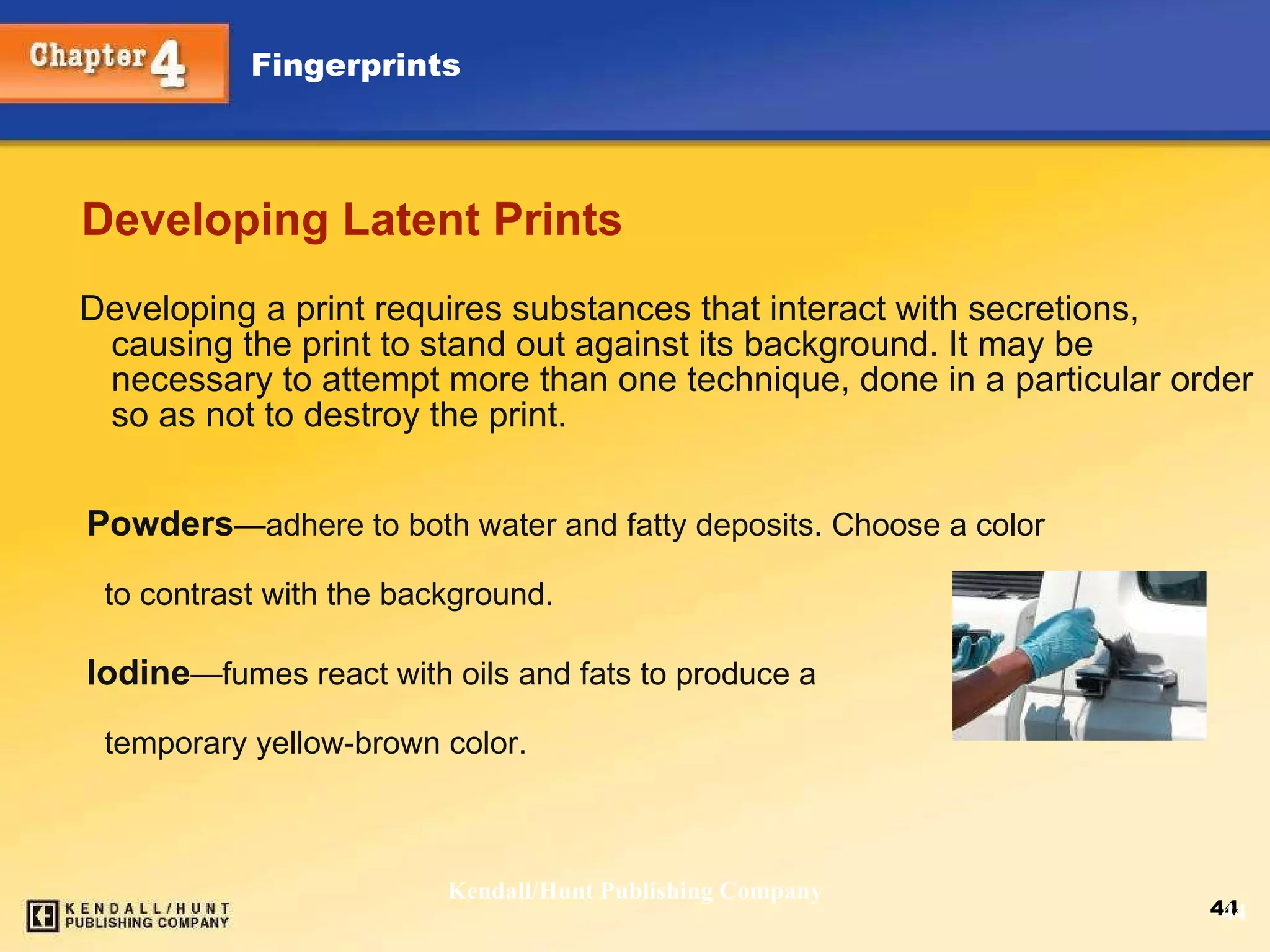
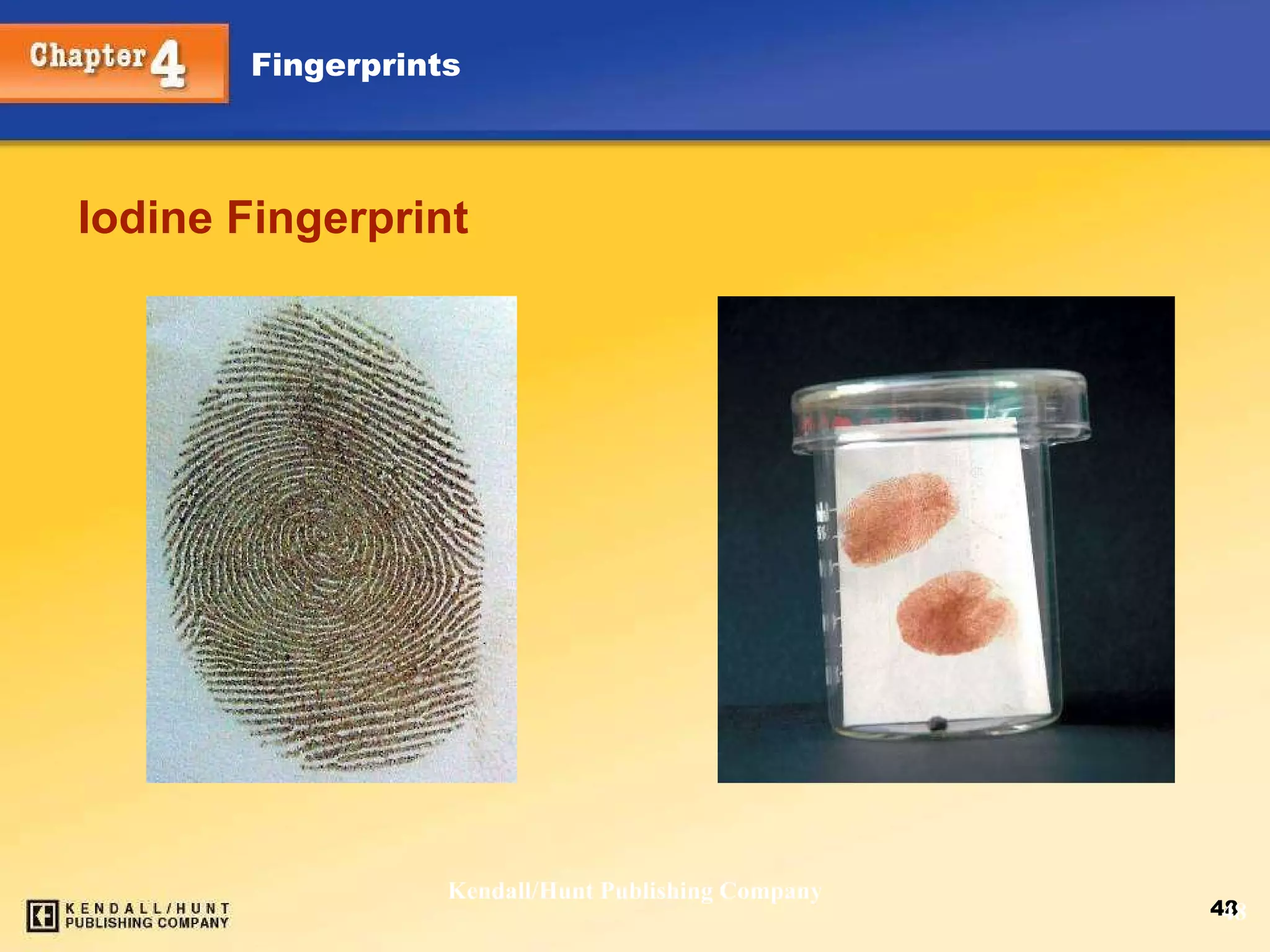
Developing Latent Prints Developing a print requires substances that interact with secretions, causing the print to stand out against its background. It may be necessary to attempt more than one technique, done in a particular order so as not to destroy the print. Kendall/Hunt Publishing Company Powders — adhere to both water and fatty deposits. Choose a color  to contrast with the background. Iodine — fumes react with oils and fats to produce a temporary yellow-brown color.
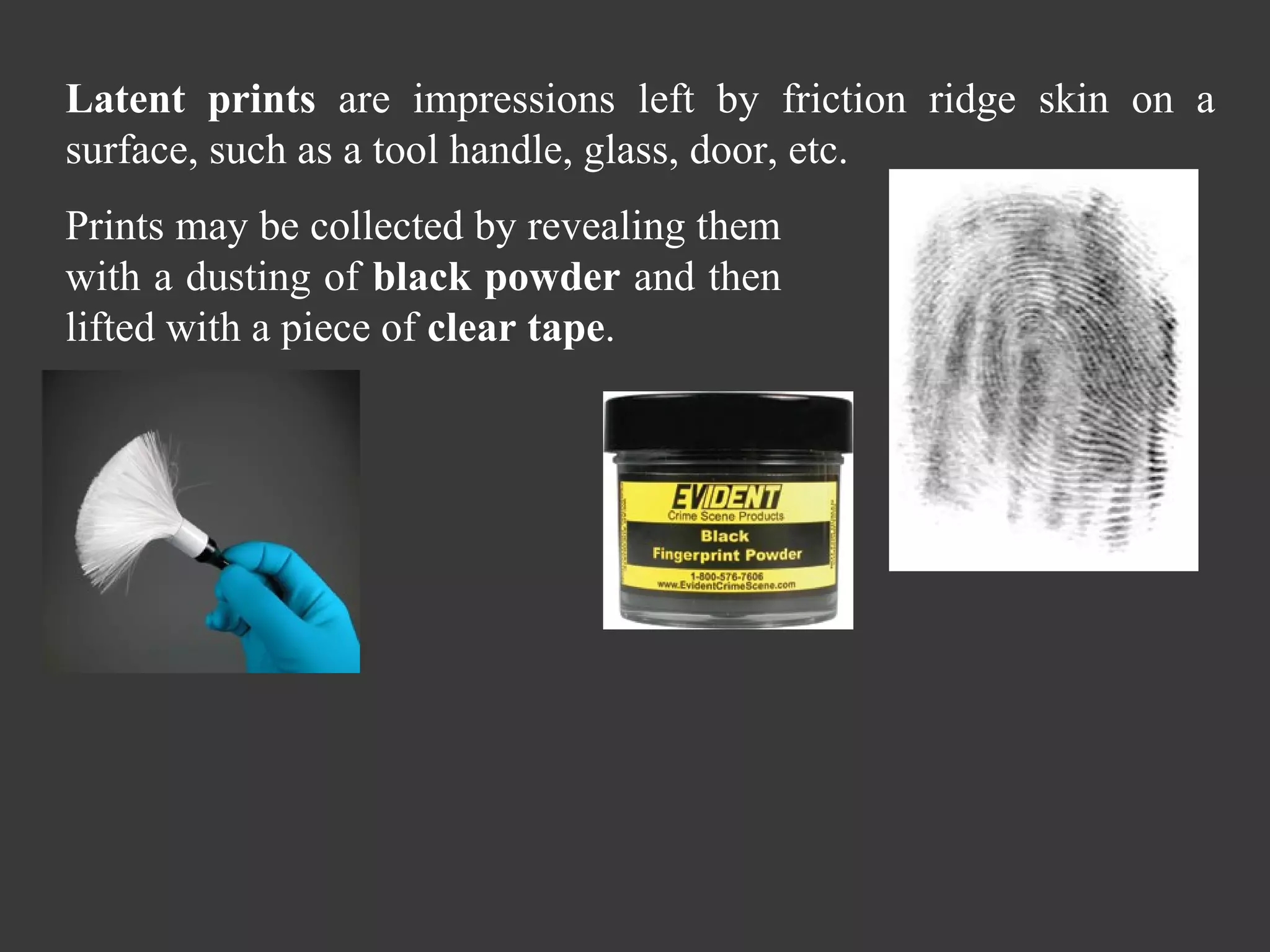
Latent prints  are impressions left by friction ridge skin on a surface, such as a tool handle, glass, door, etc.  Prints may be collected by revealing them with a dusting of  black powder  and then lifted with a piece of  clear tape .
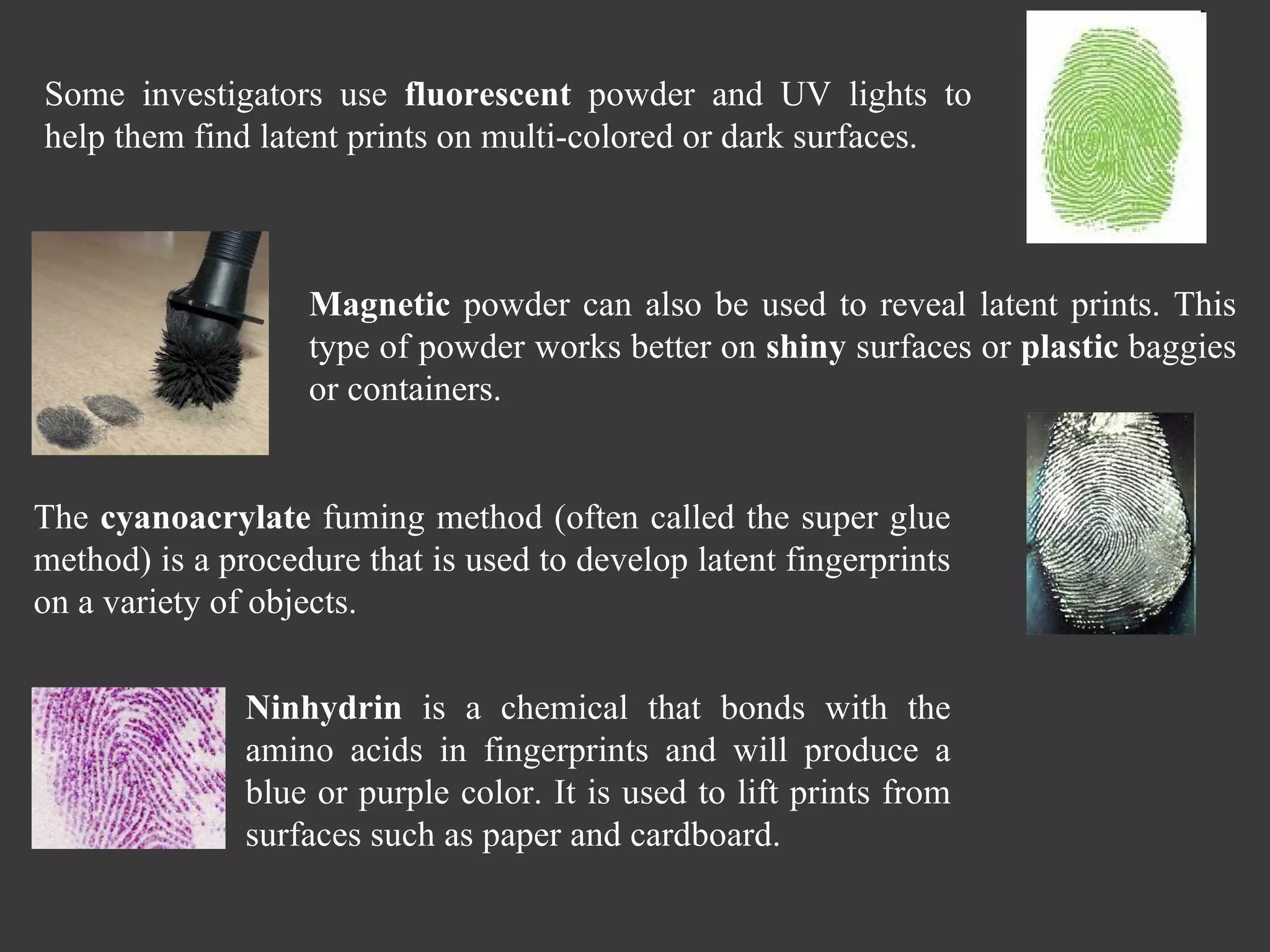
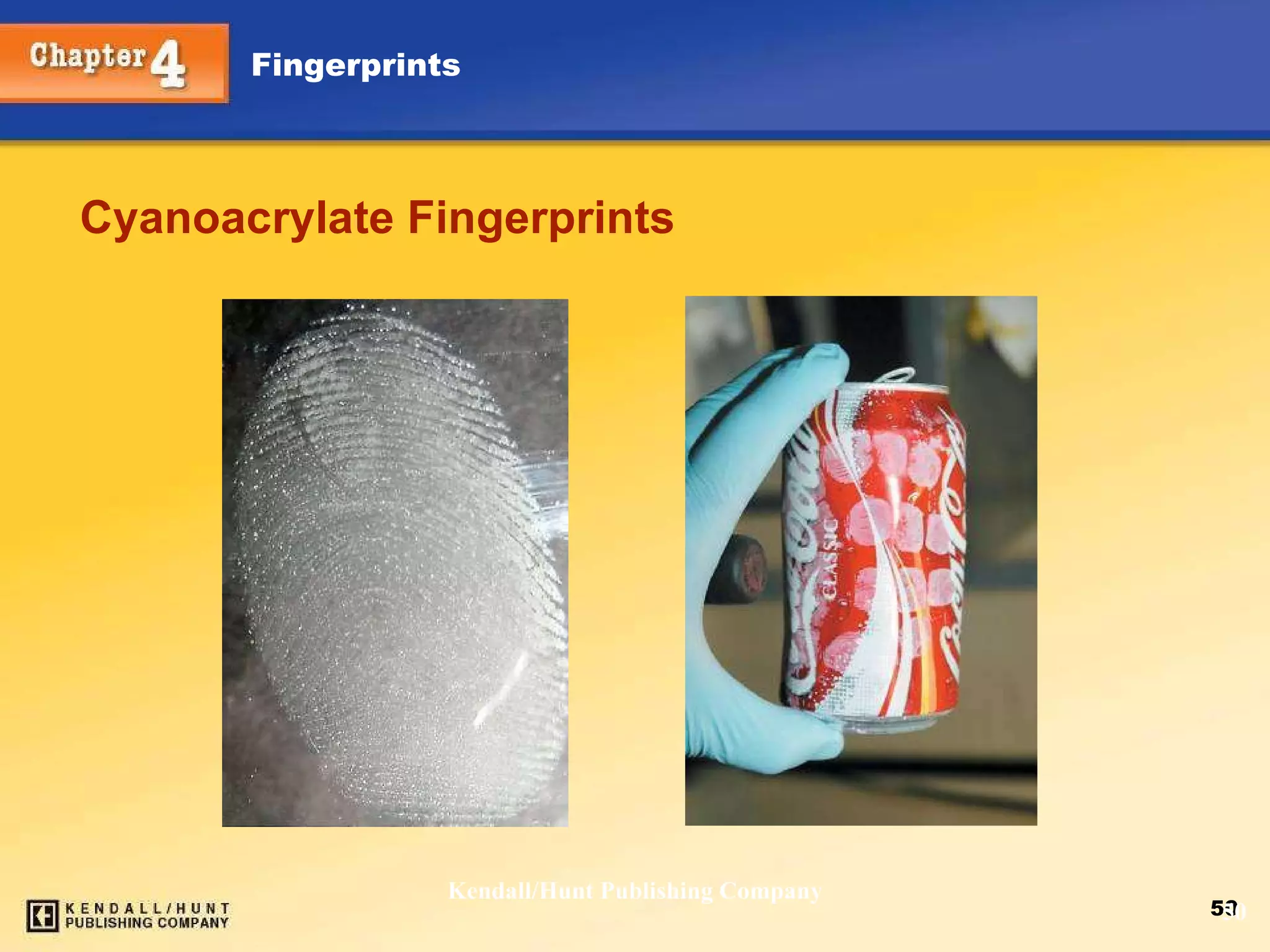
Some investigators use  fluorescent  powder and UV lights to help them find latent prints on multi-colored or dark surfaces. The  cyanoacrylate  fuming method (often called the super glue method) is a procedure that is used to develop latent fingerprints on a variety of objects. Magnetic  powder can also be used to reveal latent prints. This type of powder works better on  shiny  surfaces or  plastic  baggies or containers.  Ninhydrin  is a chemical that bonds with the amino acids in fingerprints and will produce a blue or purple color. It is used to lift prints from surfaces such as paper and cardboard.
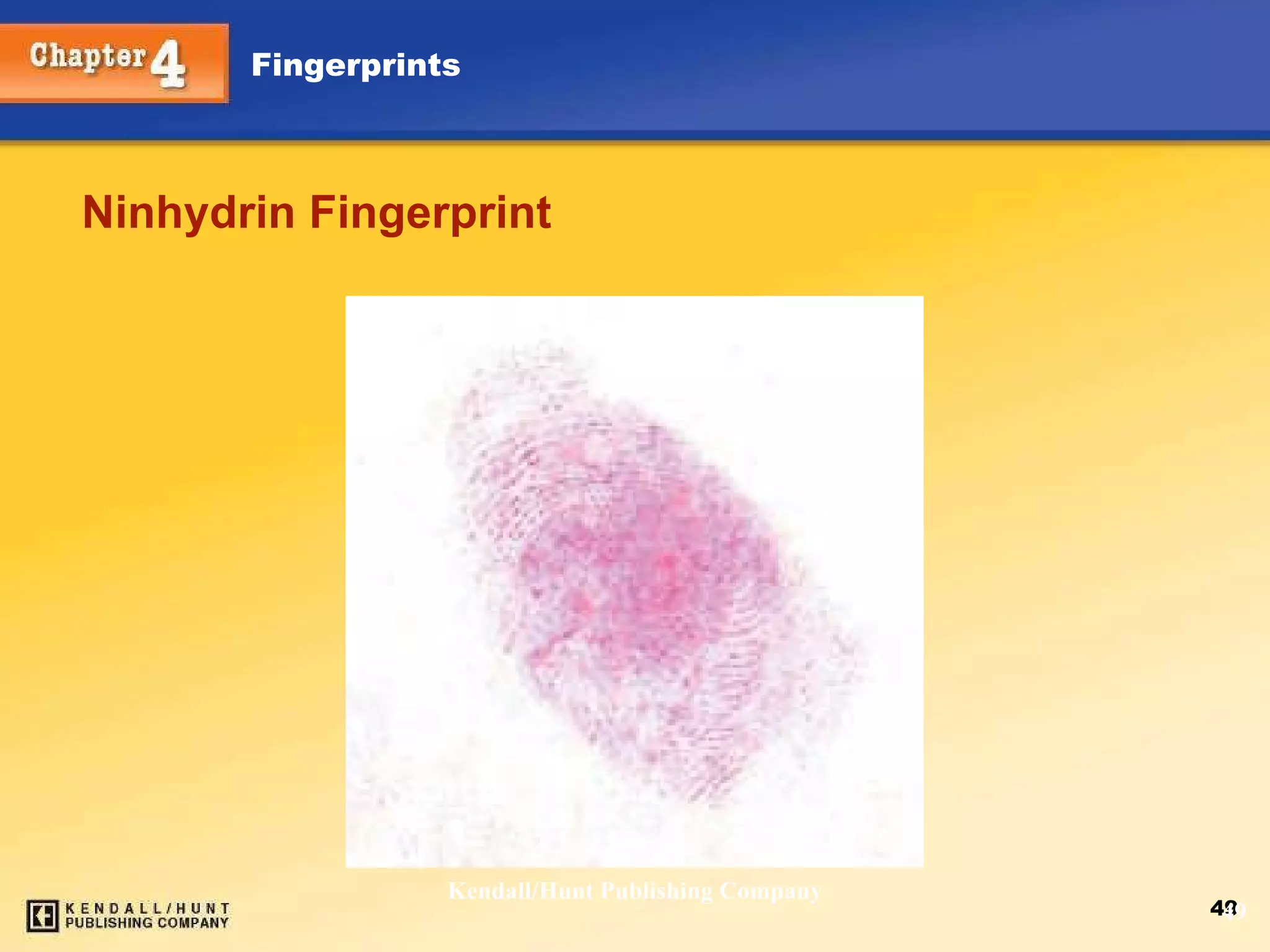
Developing Latent Prints,  continued Ninhydrin — reacts with amino acids to produce a purple color. Silver nitrate — reacts with chloride to form silver chloride, a  material that turns gray when exposed to light. Cyanoacrylate — “superglue” fumes react with water and other  fingerprint constituents to form a hard, whitish deposit . In modern labs and criminal investigations, lasers and alternative light sources are used to view latent fingerprints. These were first used by the FBI in 1978. Since lasers can damage the retina of the eye, special precautions must be taken.  Kendall/Hunt Publishing Company
Iodine Fingerprint Kendall/Hunt Publishing Company
Ninhydrin Fingerprint Kendall/Hunt Publishing Company
Cyanoacrylate Fingerprints Kendall/Hunt Publishing Company
Other Prints Lips — several common patterns Voice — electronic pulses measured on a spectrograph Foot — size of foot and toes; friction ridges on the foot Shoes — can be compared and identified by type of shoe, brand, size, year of purchase, and wear pattern Kendall/Hunt Publishing Company
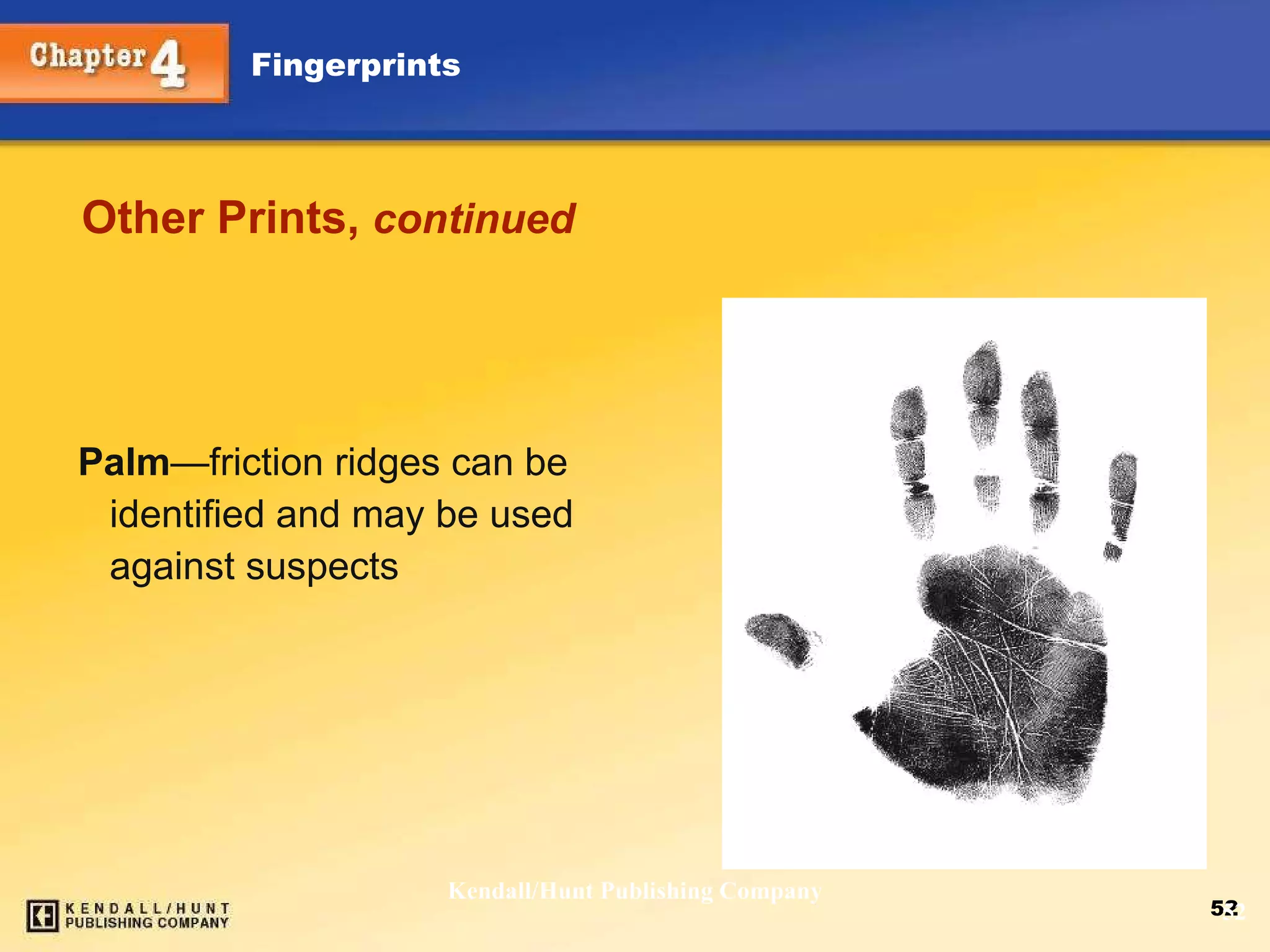
Other Prints,  continued Palm — friction ridges can be identified and may be used against suspects Kendall/Hunt Publishing Company
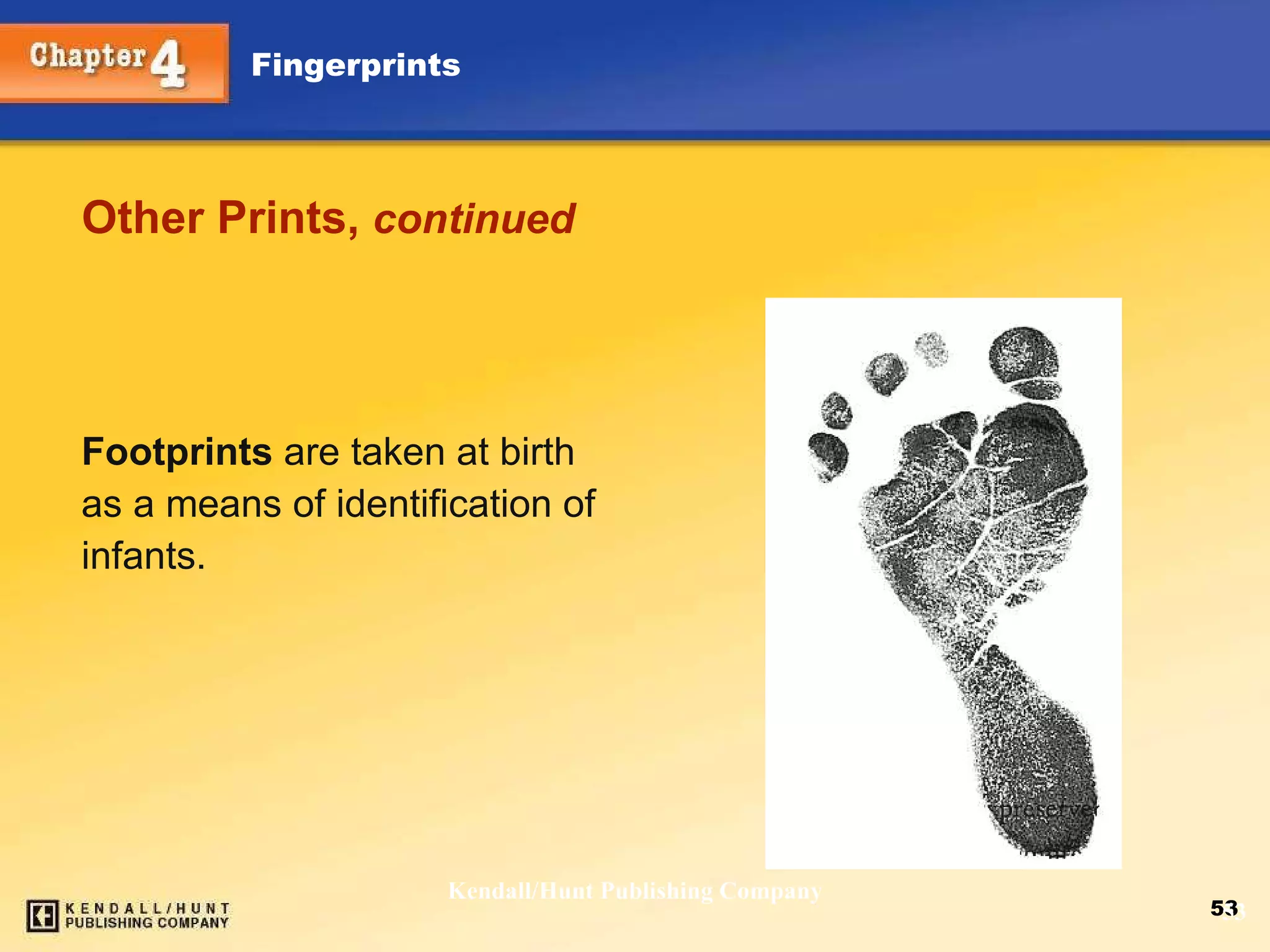
Other Prints,  continued Footprints  are taken at birth as a means of identification of infants. Kendall/Hunt Publishing Company
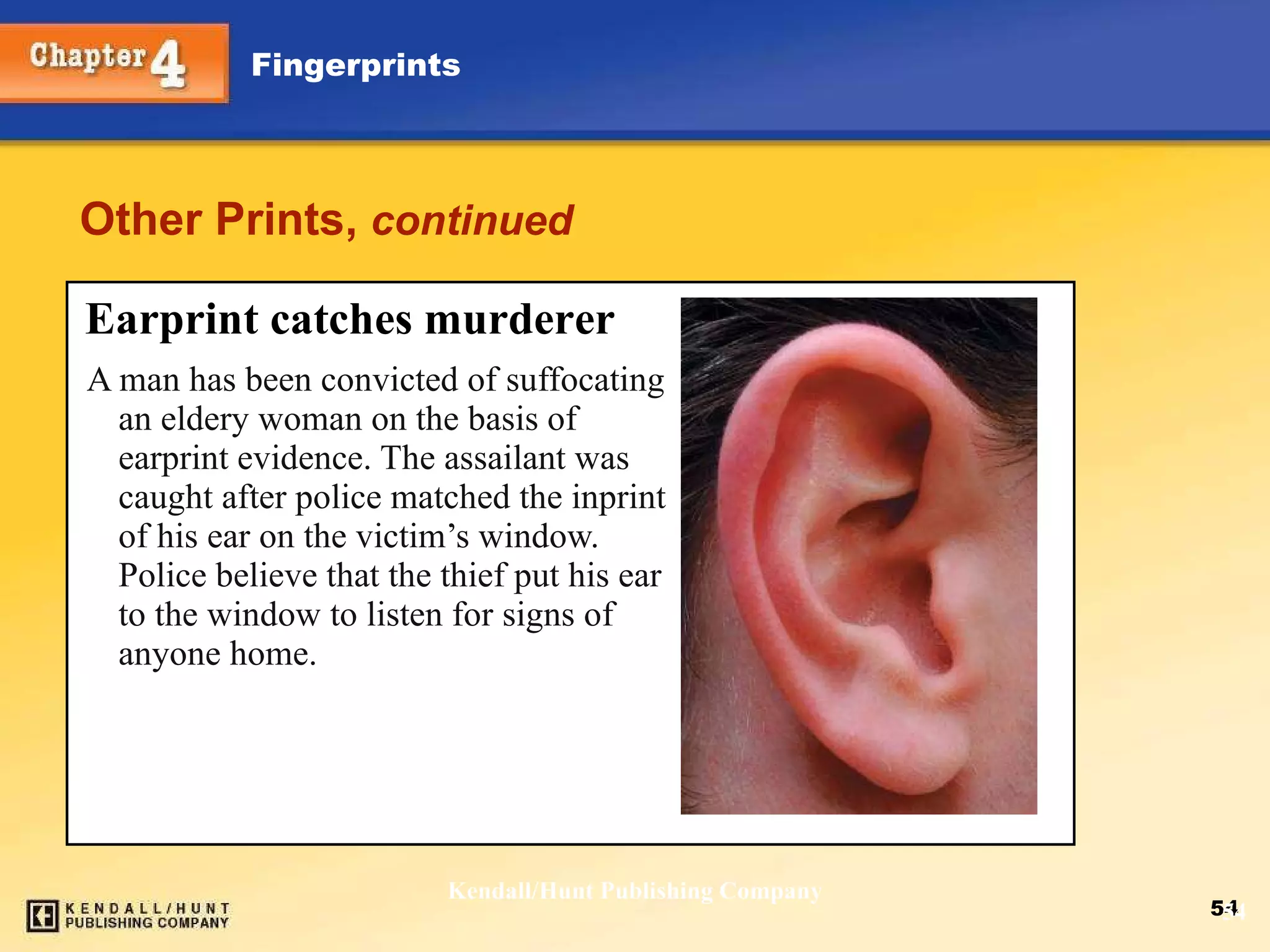
Other Prints,  continued A man has been convicted of suffocating an eldery woman on the basis of earprint evidence. The assailant was caught after police matched the inprint of his ear on the victim’s window. Police believe that the thief put his ear to the window to listen for signs of anyone home. Kendall/Hunt Publishing Company Earprint catches murderer
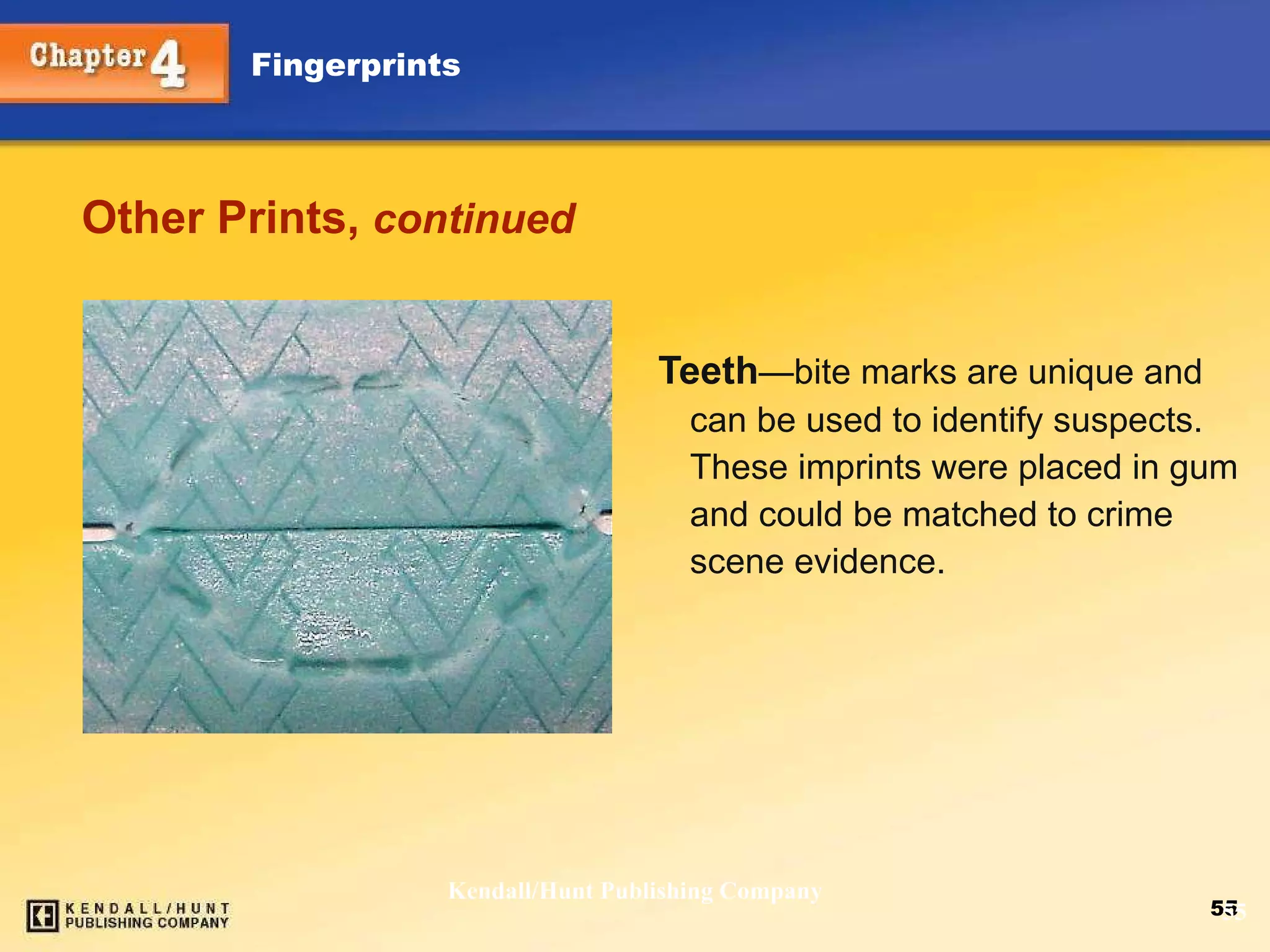
Other Prints,  continued Teeth — bite marks are unique and can be used to identify suspects. These imprints were placed in gum and could be matched to crime scene evidence. Kendall/Hunt Publishing Company
Other Prints,  continued The  blood vessel patterns  in the eye may be unique to individuals. They are used today for various security purposes. Kendall/Hunt Publishing Company
AFIS The Automated Fingerprint Identification System—a computer system for storing and retrieving fingerprints Established in the 1970s, AFIS enables law enforcement  officials to: Search large files for a set of prints taken from an individual Compare a single print, usually a latent print developed from a  crime scene By the 1990s, most large jurisdictions had their own system in place. The problem: A person’s fingerprints may be in one AFIS database but not in others. IAFIS — the FBI’s Integrated Automated Fingerprint Identification System, which is a national database of all 10-print cards from all over the country Kendall/Hunt Publishing Company
Biometrics Use of some type of body metrics for the purpose of identification. (The Bertillon system may actually have been the first biometry system.) Used today in conjunction with AFIS. Examples include retinal or iris patterns, voice recognition, hand geometry. Other functions for biometrics: can be used to control entry or access to computers or other structures; can identify a person for security purposes; can help prevent identity theft or control social services fraud. Kendall/Hunt Publishing Company
Systematic Approaches Least destructive method first Analyze surface the print is on and then determine print development method you will use Porous surfaces: paper, cloth, wood Nonporous surface: glass, metal
Recognition, Collection and  Preservation of Fingerprint Evidence Fingerprints are among the best and most probative of all types of physical evidence Objects believed to have latent prints on their surfaces should be collected intact and submitted to lab’s latent print section for examination If collection of object is improbable or impossible, latent print development needs to be conducted at the scene Tape lift photography Like other evidence, print evidence needs to be carefully documented and Chain of Custody must be pr eserved
Fingerprint Identification relies on 4 Basic Points Friction ridges develop during fetal growth before birth in their definitive form Friction ridges remain unchanged throughout life with the exception of permanent scars The friction ridge patterns and their details are unique and not repeated The ridge patterns vary within certain boundaries, which allows the patterns to be classified
System for Latent Print Analysis:  ACE-V Analysis Analyze latent print Determine its proper orientation Decide if there are any color reversals or other unusual circumstances Decide suitability Comparison Comparison with a known involves several levels I) overall pattern and ridge flow must be examined II) Ridge characteristics/minutiae and their location compared III) Pore shape, location, numbers and relationships as well as shape and size of edge features are compared ANY unexplained difference during this process would result in the conclusion that the known is  excluded  as a source of the latent print If every compared feature is consistent with the known and there is enough features sufficiently unique when considered as a whole,  individualization  can be concluded Peer review of comparison further solidifies individualization  Evaluation 8-12 points is sufficient to make a comparison; no set number 3 evaluations: Insufficient ridge detail to form conclusion Exclusion Individualization
More about Prints For additional information about prints and crime, check out truTV’s Crime Library: www.crimelibrary.com/criminal_mind/forensics/fingerprints/1.html Kendall/Hunt Publishing Company

Finger print revised jan 10

  • 1.
  • 2.
    You will understand:Why fingerprints are individual evidence. Why there may be no fingerprint evidence at a crime scene. How computers have made personal identification easier. Objectives Kendall/Hunt Publishing Company
  • 3.
    You will beable to: Define the three basic properties that allow individual identification by fingerprints. Obtain an inked, readable fingerprint for each finger. Recognize the general ridge patterns (loops, whorls, and arches). Identify friction ridge characteristics and compare two fingerprints with at least ten points of identification. Explain the differences among latent, plastic, and visible fingerprints. Develop latent prints (make them visible) using physical and chemical methods. Objectives, continued Kendall/Hunt Publishing Company
  • 4.
    Recording and classifyingprints Rolling inked prints Loops, whorls, arches, ridge characteristics Primary identification number Kendall/Hunt Publishing Company Lifting prints Black, white, and fluorescent powder Chemicals — ninhydrin, iodine, silver nitrate, cyanoacrylate Other types of prints Palm, lip, teeth, eye, ear, voice, shoeprints, and footprints
  • 5.
  • 6.
    Fundamental Principles ofFingerprints A fingerprint is an individual characteristic. Made of “hills” or ridges and “valleys” or furrows A fingerprint remains unchanged during an individual’s lifetime. A fingerprint cannot be destroyed. Even twins have different fingerprints. Fingerprints have general characteristic ridge patterns that permit them to be systematically classified. Kendall/Hunt Publishing Company
  • 7.
    Patterns form onfingers during early embryo development (10 th week of gestation/pregnancy) Person’s genetic make up plays a role in finger print ridge patterns but it is not the only factor The 2 features of fingerprints most important to their use as a means of personal identification: Every print is unique to an individual Fingerprints do not change during a life time (unless there is extensive damage to the dermal layer) Kendall/Hunt Publishing Company
  • 8.
  • 9.
    History of FingerprintingPresentations Biographical information Date of Birth Place of Birth Residence (if different than birthplace) Education Job/Career Contributions to field of forensic science/study of fingerprints 2 cases they worked on (brief description and relevance) Picture 3 important facts
  • 10.
    Kendall/Hunt Publishing Company1. Nehemiah Grew and Johannes Evangelista Purkinje 2. William Herschel 3. Henry Faulds 4. Alphonse Bertillon 5. Francis Galton 6. Edward Richard Henry 7. Juan Vucetich
  • 11.
    History from 1850to 1900 William Herschel — required Indians to put their fingerprints on contracts, and used fingerprints as a means of identifying prisoners Henry Faulds — claimed that fingerprints did not change over time and that they could be classified for identification Alphonse Bertillon — proposed body measurements as a means of identification; termed anthropometry Francis Galton — developed a primary classification scheme based on loops, arches, and whorls Edward Richard Henry — in collaboration with Galton, instituted a numerical classification system Juan Vucetich — developed a fingerprint classification system based on Galton’s that is used in Spanish-speaking countries Kendall/Hunt Publishing Company
  • 12.
    Terminology IAFIS/AFIS IntegratedAutomated Fingerprint Identification System Developed in 1999 by FBI and Law Enforcement community Prints and Criminal histories of more than 47 million people By 2007, 55 million computerized prints Delta Triangular area found in all loop and whorl patterns; ridges go in different directions above and below the triangle Core area found near the center of all loop and whorl patterns Minutiae Tiny, ridge characteristics found between ridge lines or at the end of ridge lines Patent prints Visible prints left on smooth surface when blood, ink or some other liquid comes in contact with hands and is transferred to that surface Plastic Prints Actual identification left in some soft material such as clay, putty, or wax Indented or molded Latent Prints Hidden prints caused by the transfer of oils and other secretions from skin onto surface Must be developed by physical or chemical means Kendall/Hunt Publishing Company
  • 13.
    Things a FingerprintAnalyst looks for Core Delta Ridge Pattern Loops, whorls, arches Ridge Characteristics Minutiae Ridge count (only some types of ridge patterns) Draw a line from the core to the edge of the delta and count lines that the line cuts thru Kendall/Hunt Publishing Company
  • 14.
    LOOP Kendall/Hunt PublishingCompany WHORL ARCH
  • 15.
    30% Whorls -Plain=24%-Central Pocket=2% -Double Loop=4% -Accidental/other=0.01% 65% Loops Ulnar=60% Radial=5% 5% Arches -Plain=4% -Tented=1%
  • 16.
  • 17.
    Arch An archhas friction ridges that enter on one side of the finger and cross to the other side while rising upward in the middle. They do NOT have type lines, deltas, or cores. Types Plain Tented Kendall/Hunt Publishing Company
  • 18.
  • 19.
  • 20.
    Loop A loopmust have one or more ridges entering and exiting from the same side. Loops must have one delta. Types Radial — opens toward the thumb Ulnar — opens toward the “pinky” (little finger) Which type of loop is this, if it is on the right hand? Left hand? Kendall/Hunt Publishing Company
  • 21.
  • 22.
  • 23.
    Whorl A plainor central pocket whorl has at least one ridge that makes a complete circuit. A double loop is made of two loops. An accidental is a pattern not covered by other categories. Whorls have at least two deltas and a core. Types Plain Central pocket Double loop Accidental Kendall/Hunt Publishing Company
  • 24.
  • 25.
    One or moreridges that make a complete circle 2 deltas and if a line is drawn between them, no ridges in the inner pattern touch or are cut by the line
  • 26.
  • 27.
  • 28.
    Arches Arches arethe simplest type of fingerprints that are formed by ridges that enter on one side of the print and exit on the other. No deltas are present. Plain Arch Ridges enter on one side and exit on the other side. Tented Arches Similar to the plain arch, but has a spike in the center. Spike or “tent”
  • 29.
    Loops Loops musthave one delta and one or more ridges that enter and leave on the same side. These patterns are named for their positions related to the radius and ulna bones. NOTE: On the left hand, a loop that opens to the left would be an ulnar loop, while one that opens to the right would be a radial loop. Delta Ulnar Loop (Right Thumb) Loop opens toward right or the ulna bone. Radial Loop (Right Thumb) Loop opens toward the left or the radial bone.
  • 30.
    Whorls Whorls haveat least one ridge that makes (or tends to make) a complete circuit. They also have at least two deltas. If a print has more than two deltas, it is most likely an accidental. Draw a line between the two deltas in the plain and central pocket whorls. If some of the curved ridges touch the line, it is a plain whorl. If none of the center core touches the line, it is a central pocket whorl. Plain Whorl Central Pocket Whorl
  • 31.
    Whorls – Part2 Accidental Whorl Accidental whorls contain two or more patterns (not including the plain arch), or does not clearly fall under any of the other categories. Double Loop Whorl Double loop whorls are made up of any two loops combined into one print. Delta Delta
  • 32.
    Ridge patterns notenough to individualize fingerprints Details between ridges About 150 different characteristics on average print Identify characteristics and the relative number
  • 33.
    Ridge Characteristics Minutiae— characteristics of ridge patterns Ridge ending Island or short ridge Bridge Eye or enclosure Delta Bifurcation or fork Dot Spur Double bifurcation Trifurcation Kendall/Hunt Publishing Company
  • 34.
    Ridge Characteristics Use these characteristics as points of identification when comparing fingerprint samples. The more points you can find in common, the better the match!
  • 35.
    http://cnx.org/content/m12574/latest/properties.jpg Ridge CharacteristicsCrossover Core Bifurcation (fork) Ridge ending Island Delta Pore Scar
  • 36.
  • 37.
    Comparison There areno legal requirements in the United States on the number of points required for a match. Generally, criminal courts will accept 8 to 12 points of similarity. Kendall/Hunt Publishing Company
  • 38.
  • 39.
    Primary Classification Kendall/HuntPublishing Company The Henry - FBI Classification System Each finger is given a point value. right left
  • 40.
    Primary Classification, continued Assign the number of points for each finger that has a whorl and substitute into the equation: Kendall/Hunt Publishing Company right right left left left index ring thumb middle little + 1 right right right left left thumb middle little index ring + 1 That number is your primary classification number. =
  • 41.
    1 – Blowup your balloon about halfway and twist the end to keep the air from coming out. Do not tie it off! 2 – Use an ink pad to make a print with all of your fingers and label each one with a permanent marker. Write your name on the balloon as well. 3 – Blow up the balloon to full size and tie the end. 4 – Analyze the fingerprints to find several ridge structures that we have discussed. Use a highlighter to mark these structures on your “My Prints” worksheet. Try It! Think About It! Which ridge structures were most common in your fingerprints? Which ridge structures were most common in your group? Were there any structures that were not found in any of the fingerprints?
  • 42.
    Directions 1 st – Roll the “pad” portion of your thumb over the ink pad from the left side of your thumb to the right. You do not have to push down really hard! 2 nd – Roll the “pad” portion of your thumb from the left side of your thumb to the right in the correct box on your paper to make a thumbprint. 3 rd – Continue this process to make a fingerprint of all ten fingers on the “My Prints” worksheet. 4 th –Use your notes and a magnifying lens to help you figure out what type of pattern is found in each of your fingerprints. Label each one with the pattern’s name.
  • 43.
    Latent Prints Latentfingerprints are those that are not visible to the naked eye. These prints consist of the natural secretions of human skin and require development for them to become visible. Most secretions come from three glands: Eccrine —secretes largely water, with both inorganic (ammonia, chlorides, metal ions, phosphates) and organic (amino acids, lactic acids, urea, sugars) compounds. Most important for fingerprints. Apocrine — secretes pheromones and other organic materials. Sebaceous — secretes fatty or greasy substances. Kendall/Hunt Publishing Company
  • 44.
    Developing Latent PrintsDeveloping a print requires substances that interact with secretions, causing the print to stand out against its background. It may be necessary to attempt more than one technique, done in a particular order so as not to destroy the print. Kendall/Hunt Publishing Company Powders — adhere to both water and fatty deposits. Choose a color to contrast with the background. Iodine — fumes react with oils and fats to produce a temporary yellow-brown color.
  • 45.
    Latent prints are impressions left by friction ridge skin on a surface, such as a tool handle, glass, door, etc. Prints may be collected by revealing them with a dusting of black powder and then lifted with a piece of clear tape .
  • 46.
    Some investigators use fluorescent powder and UV lights to help them find latent prints on multi-colored or dark surfaces. The cyanoacrylate fuming method (often called the super glue method) is a procedure that is used to develop latent fingerprints on a variety of objects. Magnetic powder can also be used to reveal latent prints. This type of powder works better on shiny surfaces or plastic baggies or containers. Ninhydrin is a chemical that bonds with the amino acids in fingerprints and will produce a blue or purple color. It is used to lift prints from surfaces such as paper and cardboard.
  • 47.
    Developing Latent Prints, continued Ninhydrin — reacts with amino acids to produce a purple color. Silver nitrate — reacts with chloride to form silver chloride, a material that turns gray when exposed to light. Cyanoacrylate — “superglue” fumes react with water and other fingerprint constituents to form a hard, whitish deposit . In modern labs and criminal investigations, lasers and alternative light sources are used to view latent fingerprints. These were first used by the FBI in 1978. Since lasers can damage the retina of the eye, special precautions must be taken. Kendall/Hunt Publishing Company
  • 48.
  • 49.
  • 50.
  • 51.
    Other Prints Lips— several common patterns Voice — electronic pulses measured on a spectrograph Foot — size of foot and toes; friction ridges on the foot Shoes — can be compared and identified by type of shoe, brand, size, year of purchase, and wear pattern Kendall/Hunt Publishing Company
  • 52.
    Other Prints, continued Palm — friction ridges can be identified and may be used against suspects Kendall/Hunt Publishing Company
  • 53.
    Other Prints, continued Footprints are taken at birth as a means of identification of infants. Kendall/Hunt Publishing Company
  • 54.
    Other Prints, continued A man has been convicted of suffocating an eldery woman on the basis of earprint evidence. The assailant was caught after police matched the inprint of his ear on the victim’s window. Police believe that the thief put his ear to the window to listen for signs of anyone home. Kendall/Hunt Publishing Company Earprint catches murderer
  • 55.
    Other Prints, continued Teeth — bite marks are unique and can be used to identify suspects. These imprints were placed in gum and could be matched to crime scene evidence. Kendall/Hunt Publishing Company
  • 56.
    Other Prints, continued The blood vessel patterns in the eye may be unique to individuals. They are used today for various security purposes. Kendall/Hunt Publishing Company
  • 57.
    AFIS The AutomatedFingerprint Identification System—a computer system for storing and retrieving fingerprints Established in the 1970s, AFIS enables law enforcement officials to: Search large files for a set of prints taken from an individual Compare a single print, usually a latent print developed from a crime scene By the 1990s, most large jurisdictions had their own system in place. The problem: A person’s fingerprints may be in one AFIS database but not in others. IAFIS — the FBI’s Integrated Automated Fingerprint Identification System, which is a national database of all 10-print cards from all over the country Kendall/Hunt Publishing Company
  • 58.
    Biometrics Use ofsome type of body metrics for the purpose of identification. (The Bertillon system may actually have been the first biometry system.) Used today in conjunction with AFIS. Examples include retinal or iris patterns, voice recognition, hand geometry. Other functions for biometrics: can be used to control entry or access to computers or other structures; can identify a person for security purposes; can help prevent identity theft or control social services fraud. Kendall/Hunt Publishing Company
  • 59.
    Systematic Approaches Leastdestructive method first Analyze surface the print is on and then determine print development method you will use Porous surfaces: paper, cloth, wood Nonporous surface: glass, metal
  • 60.
    Recognition, Collection and Preservation of Fingerprint Evidence Fingerprints are among the best and most probative of all types of physical evidence Objects believed to have latent prints on their surfaces should be collected intact and submitted to lab’s latent print section for examination If collection of object is improbable or impossible, latent print development needs to be conducted at the scene Tape lift photography Like other evidence, print evidence needs to be carefully documented and Chain of Custody must be pr eserved
  • 61.
    Fingerprint Identification relieson 4 Basic Points Friction ridges develop during fetal growth before birth in their definitive form Friction ridges remain unchanged throughout life with the exception of permanent scars The friction ridge patterns and their details are unique and not repeated The ridge patterns vary within certain boundaries, which allows the patterns to be classified
  • 62.
    System for LatentPrint Analysis: ACE-V Analysis Analyze latent print Determine its proper orientation Decide if there are any color reversals or other unusual circumstances Decide suitability Comparison Comparison with a known involves several levels I) overall pattern and ridge flow must be examined II) Ridge characteristics/minutiae and their location compared III) Pore shape, location, numbers and relationships as well as shape and size of edge features are compared ANY unexplained difference during this process would result in the conclusion that the known is excluded as a source of the latent print If every compared feature is consistent with the known and there is enough features sufficiently unique when considered as a whole, individualization can be concluded Peer review of comparison further solidifies individualization Evaluation 8-12 points is sufficient to make a comparison; no set number 3 evaluations: Insufficient ridge detail to form conclusion Exclusion Individualization
  • 63.
    More about PrintsFor additional information about prints and crime, check out truTV’s Crime Library: www.crimelibrary.com/criminal_mind/forensics/fingerprints/1.html Kendall/Hunt Publishing Company