POION AND TYPES OF POISON
Department of Forensic
Science
i
Presented By
ANU PRIYA SINGH
PRESENTATION OVERVIEW
1. Abstract
2. History
3. Forensic toxicology
4. Legal implication
5. Characteristic of ideal poison
6. Criminal offence
7. Type of poison
8. Sign and symptom
9. Rout of poison
10. Management of poison
11. most common type of poison in India
12. case study
2
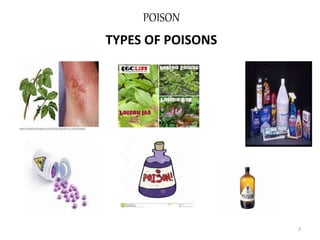
POISON
TYPES OF POISONS
3
POISON
poisons are substances that cause disturbances in organisms,
usually by chemical reaction or other activity on
the molecular scale, when an organism absorbs a sufficient
quantity
4
HISTORY OF POISON
• Throughout human history, intentional application of poison has been used as
a method of murder, suicide etc
• poison has been ingested, as the ancient Athenians, inhaled, as with carbon
monoxide or hydrogen cyanide or injected.
• indian surgeon Sushruta defined the stages of slow poisoning and the
remedies of slow poisoning.
• He also mentions antidotes and the use of traditional substances to counter
the effects of poisoning.
5
FORENSIC TOXICOLOGY
• The first comprehensive work on forensic toxicology was published in
1813 by Mathieu Orifila.
• He was a respected Spanish chemist and the physician who is often given
the distinction of "father of toxicology."
• His work emphasized the need for adequate proof of identification and
the need for quality assurance.
• It also recognized the application of forensic toxicology in pharmaceutical,
clinical, industrial and environmental fields.
• Forensic toxicology is the use of toxicology and other disciplines such as
analytical chemistry, pharmacology and clinical chemistry to aid medical or
legal investigation of death, poisoning, and drug use.
6
LEGAL IMPLICATION OF POISON
• As per Section 284 IPC lays down the punishment for careless handling Of
poisonous substance ,
• while section 299, 302, 304A ,306,309,324, 326, 328 and 498A deal with
offences relating to adminstration of such substance.
• The poison act [12 of 1919] is designed to regulate the importation,Possession ,
and sale of poisons.
7
CHARACTERISTICS OF “IDEAL” POISONS
• It should be odorless, tasteless, and colorless
• It should be readily soluble, preferably in water
• It should have a low-dose lethality
• It should be chemically stable. This makes it easy to store without loss of
potency
• It should be easily obtained
8
CRIMINAL OFFENCE
• It is with intent to kill.
• With intent to cause serious injury
• For stupefying to facilitate a crime e.g robbery or rape
• To throw poison at another poison with intension to injury
9
POISONING
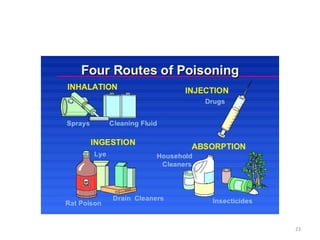
Poisoning occurs when any substance interferes with normal body functions
after it is swallowed, inhaled, injected, or absorbed. The branch of medicine
that deals with the detection and treatment of poisons is known as
toxicology.
10
NATURE OF POISONING IN INDIA
Human poisoning classified as suicidal, Homicidal,and accidental.
These type of poisoning are common in india.
 SUICIDAL POISONING
Poison like potassium cyanide ,hydrocyanic ,opium, barbiturates,
organophosphorus ,organochloro and carbamate insecticides ,oxalic acid,
and oleander,are commonly used for suicidal purpoes.
11
HOMICIDAL PURPOSES
Poisons like arsenic ,antimony ,aconite ,thalium , organophosphorus
,organochloro, and carbamate compounds, oleander, madar, strychnine,
powdered glass, rarely insulin and other drugs ,are used for homicidal
purposes.
 ACCIDENTAL PURPOSES
Accidental poisoning commonly occur due the carelessnes in handling and
storing non poisonous materials with the poisonous materials.A number
of cases of accidental poisoning have been reported from the greater use of
chemicals in industry and for household purposes.
12
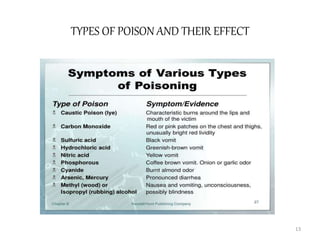
TYPES OF POISON AND THEIR EFFECT
13
CLASSIFICATION OF POISON
• Classification of poison can be done in number of way ,one depending on its
general chemical properties ,other depending on its action on the body and so
on.However,the clasification commonly done is based on the mode of action of
poisons on the body.Accordingly, poison are classified in six groups.
• CORROSIVES
• IRRITANTS
• NEUROTICS
• CARDIAC
• ASPHYXIANTS
• MISCELLANEOUS
14
CORROSIVES
A corrosives poison is a highly active irritant and produces inflammation and
ulceration of the tissues.
• Corrosives poisons consists of :
 STRONG ACIDS
• Such as sulphuric acid,nitric acid,hydrochloric acids; organic acids, such as oxalic
acid,carbolic acids, acetic acids.
 STRONG ALKALIS
• Such as caustic soda caustic potash and carbonates of ammonium, sodium, and
potassium.
15
IRRITANTS
• Irritant poison produce symptoms like pain in the abdomen ,vomiting and
purging.
• The postmortem is indicative of ulceration of the gatrointestional tract.
• The group conists of inorganic, organic, and mechanical substances.
 INORGANIC :
• The inorganic poisons consists of non metallic and metallic poison.
 NON METALLIC POISON:
• Such as phosphorus,chlorine , bromine,iodine ,and boron.
 METALLIC POISONS :
• Such as arsenic, antimony, mercury, lead, copper, thalium,zinc manganese.
16
ORGANIC:
• The organic poisons consists of vegetable and animal poisons.
• The vegetable poisons include castor oil seeds, croton oil, abrus
,Precatorius, ergot, capicum, marking nut, madar, etc.
• The Animal Poison include catharides, snakes, scropians, spider,
poisonous Insects.
MECHANICAL:
• The mechanical subgroup include powdered glass, dried sponge, and
diamond dust.
17
NEUROTICS
• Neurotic poison act mainly on the nervous system. All alkaloidal poisons Fall
into this group,
• the poisonous effect Is due to the absorption ,and Effects even when greatly
diluted with water.
• This group conists of poisons which have specific action on cerebrum, Spinal
cord, and peripheral nerves.
 CEREBRAL:
• The poison mainly act on the cerebral ,they include narcotics like opium and
its alkaloids,
• the inebriant include intoxicant Like alcohol, anaesthetics and sedative like
chloral hydrate, barbiturate ,
• fuel like petroleum, kerosene and insecticide like organophosphorus ,
Compounds such a malathion, parathion, and chloro compounds such as DDT
and endrin:
• while deliriant include dhatura, belladonna, hyoscyamus ,cannabis.
18
 SPINAL:
The poisons acting on the spinal cord include nux vomica and its
Alkaloids,and gelsemium.
 PERIPHERAL:
The poions acting on the peripheral nerves include curare, and
Conium.
CARDIAC
• These are poisons acting on the heart and include digitalis, oleander ,aconite
and tob.
ASPHYXIANTS
• These poions act on lungs and include irrespirable gases, such as coal gas
,carbon monoxide, carbon dioxide, sewar gas,and war gases.
19
MISCELLANEOUS
Poisons having widely different action are put together in this group.It
includes analgesics and antipyretics ,such as aspirin, Phenacetin,
paracetamol ,and quinine ; antithistaminics; tranquiliser such as
chlorpromazine, meprobamate and reserpine; antidepressants, such as
tricylic compounds; stimulants such as amphetamines: and hallucinogens
such as amphetamines; and hallucinogens such as LSD, peyote and
Mescaline.
20
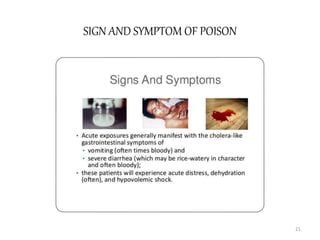
SIGN AND SYMPTOM OF POISON
21
SIGN AND SYMPTOMS OF POISONING
 Low level of consciousnes .
 ALTERED MOOD :lethargic,voilent, or hostile.
 Different breething rate
 Increased or lowered heart rate.
 Dilated or shrunken pupils.
 Change of colour around mouth.
 Cramps.
 Nausea.
 Vomiting
 Diarrhoea
22
23
ROUTES OF ADMINISTRATION
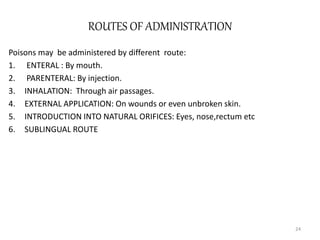
Poisons may be administered by different route:
1. ENTERAL : By mouth.
2. PARENTERAL: By injection.
3. INHALATION: Through air passages.
4. EXTERNAL APPLICATION: On wounds or even unbroken skin.
5. INTRODUCTION INTO NATURAL ORIFICES: Eyes, nose,rectum etc
6. SUBLINGUAL ROUTE
24
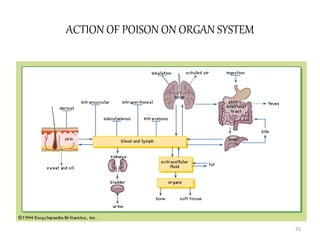
ACTION OF POISON ON ORGAN SYSTEM
25
ACTION OF POISONS
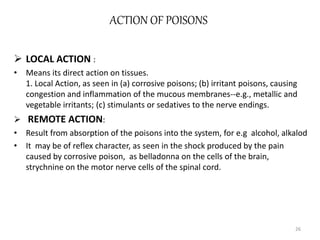
 LOCAL ACTION :
• Means its direct action on tissues.
1. Local Action, as seen in (a) corrosive poisons; (b) irritant poisons, causing
congestion and inflammation of the mucous membranes--e.g., metallic and
vegetable irritants; (c) stimulants or sedatives to the nerve endings.
 REMOTE ACTION:
• Result from absorption of the poisons into the system, for e.g alcohol, alkalod
• It may be of reflex character, as seen in the shock produced by the pain
caused by corrosive poison, as belladonna on the cells of the brain,
strychnine on the motor nerve cells of the spinal cord.
26
27
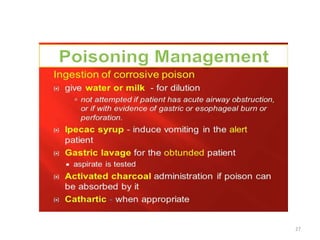
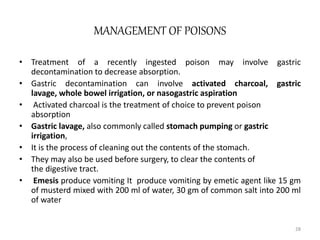
MANAGEMENT OF POISONS
• Treatment of a recently ingested poison may involve gastric
decontamination to decrease absorption.
• Gastric decontamination can involve activated charcoal, gastric
lavage, whole bowel irrigation, or nasogastric aspiration
• Activated charcoal is the treatment of choice to prevent poison
absorption
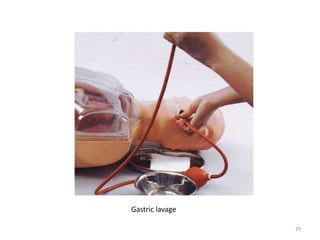
• Gastric lavage, also commonly called stomach pumping or gastric
irrigation,
• It is the process of cleaning out the contents of the stomach.
• They may also be used before surgery, to clear the contents of
the digestive tract.
• Emesis produce vomiting It produce vomiting by emetic agent like 15 gm
of musterd mixed with 200 ml of water, 30 gm of common salt into 200 ml
of water
28
29
Gastric lavage
MOST COMMON TYPE OF POISON USED IN INDIA TO
KILLED PEOPLE
30
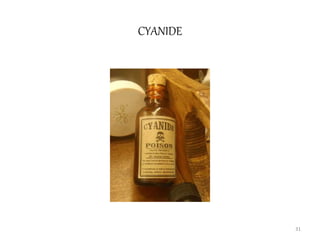
CYANIDE
31
CYANIDE
• it is found in a great variety of substances like fatal dose of cyanide for humans
is 1.5 mg per kilogram of body weight. Secondly, it’s a rapid killer: depending
on the dose, death occurs within 1 to 15 minutes. Also, in its gaseous form –
hydrogen cyanide – it was the agent used by Nazi Germany for mass murders
in gas chambers during the apple seeds, apricot kernel, tobacco smoke,
insecticides, pesticides and the list goes on. Murder in this case can be blamed
on a household accident, such as ingestion of pesticide .
• EFFECTS: Headache, dizziness, fast heart rate, shortness of breath,and
vomiting,cardiac arrest
32
ARSENIC
• Arsenic has been called “The King of Poisons”, for its discreetness and
potency – it was virtually undetectable, so it was very often used either as a
murder weapon or as a mystery story element. But that’s until the Marsh test
came and signalled the presence of this poison in water, food and the like.
However, this king of poisons has taken many famous lives.
EFFECT: If arsenic poisoning occurs over a brief period of time symptoms
may include vomiting, abdominal pain, encephalopathy, and watery diarrhea
that contains blood. Long-term exposure can result in thickening of the skin,
darker skin, abdominal pain, diarrhea, heart disease, numbness, and cancer
33
MERCURY
Mercury poisoning is a type of metal poisoning due to mercury exposure.
Symptoms depend upon the type, dose, method, and duration of
exposure.They may include muscle weakness, poor coordination, numbness in
the hands and feet, skin rashes, anxiety, memory problems, trouble speaking,
trouble hearing, or trouble seeing.High level exposure to methylmercury is
known as Minamata disease. Methylmercury exposure in children may result
in acrodynia (pink's disease) in which the skin becomes pink and peels Long-
term complications may include kidney problems and decreased intelligence.
34
BOTULINUM TOXIN
Botulinum toxin (BTX) is a neurotoxic protein produced by the bacterium
Clostridium botulinum and related species. It prevents the release of the
neurotransmitter acetylcholine from axon endings at the neuromuscular
junction and thus causes flaccid paralysis. Infection with the bacterium
causes the disease botulism. The toxin is also used commercially in
medicine, cosmetics, and research. It involves muscle paralysis, eventually
leading to the paralysis of the respiratory system and, consequently,
death. The bacteria enter the body through open wounds or by ingesting
contaminated food.
35
ACONITE
• Aconite comes from the plant monkshood. Also known as wolfsbane,
aconite leaves only one post-mortem sign, that of asphyxia, as it causes
arrhythmic heart function which leads to suffocation. Poisoning can occur
even after touching the leaves of the plant without wearing gloves as it is
very rapidly and easily absorbed. Because of its untraceable nature it has
been a popular one with the “get away with murder” crowd. Reportedly, it
has a particularly famous casualty.
36
CRIME SCENE MANAGEMENT IN POISON CASES
ROLE OF THE INVESTIGATION OFFICER AND MEDICAL OFFICER
• In cae of death due to poisoning ,it is the duty of the prosecution to prove
the Nature of death , weather the death is homicidal, accidental, or
suicidal Death.
• The articles to be collected in poison cases for analysis normally comprise of
biological articles like viscera consisting of stomach, intestine,kidney,
spleen,lungs, brain, etc.And all the articles from the crime scene like
remnant of poison, the glass and other vessels used by the victim.
• The investigating officer should record the detail about the condition of the
victim and also make arrangement for postmortem in case of death.
PRESEVATION OF EVIDENCES:
A through examination of the scene of death ,source of poison container like
cups,bottle, jars,powder, food material should be done.
37
ANALYTICAL TECHNIUES IN ISOLATION OF POISON
The inorganic poison from tissue ,stomach contents and other material are
isolated by a number of methods and identified by chemical Tests and
instrumental analysis .volatile poison are extracted by Steam distillation
and identified by chemical tests and supplemented By gas
chromatography.The non volatile organic poison are extracted By suitable
solvent and identified by the TLC, GAS CHROMATOGRAPH.
The visceral material including stomach ,intestine with their content Liver,
spleen kidney , blood , urine and other biological fluids are Subjected to
chemical analysis.
38
THANK YOU
39

poison and forensic importance

  • 1.
    POION AND TYPESOF POISON Department of Forensic Science i Presented By ANU PRIYA SINGH
  • 2.
    PRESENTATION OVERVIEW 1. Abstract 2.History 3. Forensic toxicology 4. Legal implication 5. Characteristic of ideal poison 6. Criminal offence 7. Type of poison 8. Sign and symptom 9. Rout of poison 10. Management of poison 11. most common type of poison in India 12. case study 2
  • 3.
  • 4.
    POISON poisons are substancesthat cause disturbances in organisms, usually by chemical reaction or other activity on the molecular scale, when an organism absorbs a sufficient quantity 4
  • 5.
    HISTORY OF POISON •Throughout human history, intentional application of poison has been used as a method of murder, suicide etc • poison has been ingested, as the ancient Athenians, inhaled, as with carbon monoxide or hydrogen cyanide or injected. • indian surgeon Sushruta defined the stages of slow poisoning and the remedies of slow poisoning. • He also mentions antidotes and the use of traditional substances to counter the effects of poisoning. 5
  • 6.
    FORENSIC TOXICOLOGY • Thefirst comprehensive work on forensic toxicology was published in 1813 by Mathieu Orifila. • He was a respected Spanish chemist and the physician who is often given the distinction of "father of toxicology." • His work emphasized the need for adequate proof of identification and the need for quality assurance. • It also recognized the application of forensic toxicology in pharmaceutical, clinical, industrial and environmental fields. • Forensic toxicology is the use of toxicology and other disciplines such as analytical chemistry, pharmacology and clinical chemistry to aid medical or legal investigation of death, poisoning, and drug use. 6
  • 7.
    LEGAL IMPLICATION OFPOISON • As per Section 284 IPC lays down the punishment for careless handling Of poisonous substance , • while section 299, 302, 304A ,306,309,324, 326, 328 and 498A deal with offences relating to adminstration of such substance. • The poison act [12 of 1919] is designed to regulate the importation,Possession , and sale of poisons. 7
  • 8.
    CHARACTERISTICS OF “IDEAL”POISONS • It should be odorless, tasteless, and colorless • It should be readily soluble, preferably in water • It should have a low-dose lethality • It should be chemically stable. This makes it easy to store without loss of potency • It should be easily obtained 8
  • 9.
    CRIMINAL OFFENCE • Itis with intent to kill. • With intent to cause serious injury • For stupefying to facilitate a crime e.g robbery or rape • To throw poison at another poison with intension to injury 9
  • 10.
    POISONING Poisoning occurs whenany substance interferes with normal body functions after it is swallowed, inhaled, injected, or absorbed. The branch of medicine that deals with the detection and treatment of poisons is known as toxicology. 10
  • 11.
    NATURE OF POISONINGIN INDIA Human poisoning classified as suicidal, Homicidal,and accidental. These type of poisoning are common in india.  SUICIDAL POISONING Poison like potassium cyanide ,hydrocyanic ,opium, barbiturates, organophosphorus ,organochloro and carbamate insecticides ,oxalic acid, and oleander,are commonly used for suicidal purpoes. 11
  • 12.
    HOMICIDAL PURPOSES Poisons likearsenic ,antimony ,aconite ,thalium , organophosphorus ,organochloro, and carbamate compounds, oleander, madar, strychnine, powdered glass, rarely insulin and other drugs ,are used for homicidal purposes.  ACCIDENTAL PURPOSES Accidental poisoning commonly occur due the carelessnes in handling and storing non poisonous materials with the poisonous materials.A number of cases of accidental poisoning have been reported from the greater use of chemicals in industry and for household purposes. 12
  • 13.
    TYPES OF POISONAND THEIR EFFECT 13
  • 14.
    CLASSIFICATION OF POISON •Classification of poison can be done in number of way ,one depending on its general chemical properties ,other depending on its action on the body and so on.However,the clasification commonly done is based on the mode of action of poisons on the body.Accordingly, poison are classified in six groups. • CORROSIVES • IRRITANTS • NEUROTICS • CARDIAC • ASPHYXIANTS • MISCELLANEOUS 14
  • 15.
    CORROSIVES A corrosives poisonis a highly active irritant and produces inflammation and ulceration of the tissues. • Corrosives poisons consists of :  STRONG ACIDS • Such as sulphuric acid,nitric acid,hydrochloric acids; organic acids, such as oxalic acid,carbolic acids, acetic acids.  STRONG ALKALIS • Such as caustic soda caustic potash and carbonates of ammonium, sodium, and potassium. 15
  • 16.
    IRRITANTS • Irritant poisonproduce symptoms like pain in the abdomen ,vomiting and purging. • The postmortem is indicative of ulceration of the gatrointestional tract. • The group conists of inorganic, organic, and mechanical substances.  INORGANIC : • The inorganic poisons consists of non metallic and metallic poison.  NON METALLIC POISON: • Such as phosphorus,chlorine , bromine,iodine ,and boron.  METALLIC POISONS : • Such as arsenic, antimony, mercury, lead, copper, thalium,zinc manganese. 16
  • 17.
    ORGANIC: • The organicpoisons consists of vegetable and animal poisons. • The vegetable poisons include castor oil seeds, croton oil, abrus ,Precatorius, ergot, capicum, marking nut, madar, etc. • The Animal Poison include catharides, snakes, scropians, spider, poisonous Insects. MECHANICAL: • The mechanical subgroup include powdered glass, dried sponge, and diamond dust. 17
  • 18.
    NEUROTICS • Neurotic poisonact mainly on the nervous system. All alkaloidal poisons Fall into this group, • the poisonous effect Is due to the absorption ,and Effects even when greatly diluted with water. • This group conists of poisons which have specific action on cerebrum, Spinal cord, and peripheral nerves.  CEREBRAL: • The poison mainly act on the cerebral ,they include narcotics like opium and its alkaloids, • the inebriant include intoxicant Like alcohol, anaesthetics and sedative like chloral hydrate, barbiturate , • fuel like petroleum, kerosene and insecticide like organophosphorus , Compounds such a malathion, parathion, and chloro compounds such as DDT and endrin: • while deliriant include dhatura, belladonna, hyoscyamus ,cannabis. 18
  • 19.
     SPINAL: The poisonsacting on the spinal cord include nux vomica and its Alkaloids,and gelsemium.  PERIPHERAL: The poions acting on the peripheral nerves include curare, and Conium. CARDIAC • These are poisons acting on the heart and include digitalis, oleander ,aconite and tob. ASPHYXIANTS • These poions act on lungs and include irrespirable gases, such as coal gas ,carbon monoxide, carbon dioxide, sewar gas,and war gases. 19
  • 20.
    MISCELLANEOUS Poisons having widelydifferent action are put together in this group.It includes analgesics and antipyretics ,such as aspirin, Phenacetin, paracetamol ,and quinine ; antithistaminics; tranquiliser such as chlorpromazine, meprobamate and reserpine; antidepressants, such as tricylic compounds; stimulants such as amphetamines: and hallucinogens such as amphetamines; and hallucinogens such as LSD, peyote and Mescaline. 20
  • 21.
    SIGN AND SYMPTOMOF POISON 21
  • 22.
    SIGN AND SYMPTOMSOF POISONING  Low level of consciousnes .  ALTERED MOOD :lethargic,voilent, or hostile.  Different breething rate  Increased or lowered heart rate.  Dilated or shrunken pupils.  Change of colour around mouth.  Cramps.  Nausea.  Vomiting  Diarrhoea 22
  • 23.
  • 24.
    ROUTES OF ADMINISTRATION Poisonsmay be administered by different route: 1. ENTERAL : By mouth. 2. PARENTERAL: By injection. 3. INHALATION: Through air passages. 4. EXTERNAL APPLICATION: On wounds or even unbroken skin. 5. INTRODUCTION INTO NATURAL ORIFICES: Eyes, nose,rectum etc 6. SUBLINGUAL ROUTE 24
  • 25.
    ACTION OF POISONON ORGAN SYSTEM 25
  • 26.
    ACTION OF POISONS LOCAL ACTION : • Means its direct action on tissues. 1. Local Action, as seen in (a) corrosive poisons; (b) irritant poisons, causing congestion and inflammation of the mucous membranes--e.g., metallic and vegetable irritants; (c) stimulants or sedatives to the nerve endings.  REMOTE ACTION: • Result from absorption of the poisons into the system, for e.g alcohol, alkalod • It may be of reflex character, as seen in the shock produced by the pain caused by corrosive poison, as belladonna on the cells of the brain, strychnine on the motor nerve cells of the spinal cord. 26
  • 27.
  • 28.
    MANAGEMENT OF POISONS •Treatment of a recently ingested poison may involve gastric decontamination to decrease absorption. • Gastric decontamination can involve activated charcoal, gastric lavage, whole bowel irrigation, or nasogastric aspiration • Activated charcoal is the treatment of choice to prevent poison absorption • Gastric lavage, also commonly called stomach pumping or gastric irrigation, • It is the process of cleaning out the contents of the stomach. • They may also be used before surgery, to clear the contents of the digestive tract. • Emesis produce vomiting It produce vomiting by emetic agent like 15 gm of musterd mixed with 200 ml of water, 30 gm of common salt into 200 ml of water 28
  • 29.
  • 30.
    MOST COMMON TYPEOF POISON USED IN INDIA TO KILLED PEOPLE 30
  • 31.
  • 32.
    CYANIDE • it isfound in a great variety of substances like fatal dose of cyanide for humans is 1.5 mg per kilogram of body weight. Secondly, it’s a rapid killer: depending on the dose, death occurs within 1 to 15 minutes. Also, in its gaseous form – hydrogen cyanide – it was the agent used by Nazi Germany for mass murders in gas chambers during the apple seeds, apricot kernel, tobacco smoke, insecticides, pesticides and the list goes on. Murder in this case can be blamed on a household accident, such as ingestion of pesticide . • EFFECTS: Headache, dizziness, fast heart rate, shortness of breath,and vomiting,cardiac arrest 32
  • 33.
    ARSENIC • Arsenic hasbeen called “The King of Poisons”, for its discreetness and potency – it was virtually undetectable, so it was very often used either as a murder weapon or as a mystery story element. But that’s until the Marsh test came and signalled the presence of this poison in water, food and the like. However, this king of poisons has taken many famous lives. EFFECT: If arsenic poisoning occurs over a brief period of time symptoms may include vomiting, abdominal pain, encephalopathy, and watery diarrhea that contains blood. Long-term exposure can result in thickening of the skin, darker skin, abdominal pain, diarrhea, heart disease, numbness, and cancer 33
  • 34.
    MERCURY Mercury poisoning isa type of metal poisoning due to mercury exposure. Symptoms depend upon the type, dose, method, and duration of exposure.They may include muscle weakness, poor coordination, numbness in the hands and feet, skin rashes, anxiety, memory problems, trouble speaking, trouble hearing, or trouble seeing.High level exposure to methylmercury is known as Minamata disease. Methylmercury exposure in children may result in acrodynia (pink's disease) in which the skin becomes pink and peels Long- term complications may include kidney problems and decreased intelligence. 34
  • 35.
    BOTULINUM TOXIN Botulinum toxin(BTX) is a neurotoxic protein produced by the bacterium Clostridium botulinum and related species. It prevents the release of the neurotransmitter acetylcholine from axon endings at the neuromuscular junction and thus causes flaccid paralysis. Infection with the bacterium causes the disease botulism. The toxin is also used commercially in medicine, cosmetics, and research. It involves muscle paralysis, eventually leading to the paralysis of the respiratory system and, consequently, death. The bacteria enter the body through open wounds or by ingesting contaminated food. 35
  • 36.
    ACONITE • Aconite comesfrom the plant monkshood. Also known as wolfsbane, aconite leaves only one post-mortem sign, that of asphyxia, as it causes arrhythmic heart function which leads to suffocation. Poisoning can occur even after touching the leaves of the plant without wearing gloves as it is very rapidly and easily absorbed. Because of its untraceable nature it has been a popular one with the “get away with murder” crowd. Reportedly, it has a particularly famous casualty. 36
  • 37.
    CRIME SCENE MANAGEMENTIN POISON CASES ROLE OF THE INVESTIGATION OFFICER AND MEDICAL OFFICER • In cae of death due to poisoning ,it is the duty of the prosecution to prove the Nature of death , weather the death is homicidal, accidental, or suicidal Death. • The articles to be collected in poison cases for analysis normally comprise of biological articles like viscera consisting of stomach, intestine,kidney, spleen,lungs, brain, etc.And all the articles from the crime scene like remnant of poison, the glass and other vessels used by the victim. • The investigating officer should record the detail about the condition of the victim and also make arrangement for postmortem in case of death. PRESEVATION OF EVIDENCES: A through examination of the scene of death ,source of poison container like cups,bottle, jars,powder, food material should be done. 37
  • 38.
    ANALYTICAL TECHNIUES INISOLATION OF POISON The inorganic poison from tissue ,stomach contents and other material are isolated by a number of methods and identified by chemical Tests and instrumental analysis .volatile poison are extracted by Steam distillation and identified by chemical tests and supplemented By gas chromatography.The non volatile organic poison are extracted By suitable solvent and identified by the TLC, GAS CHROMATOGRAPH. The visceral material including stomach ,intestine with their content Liver, spleen kidney , blood , urine and other biological fluids are Subjected to chemical analysis. 38
  • 39.