SwapS
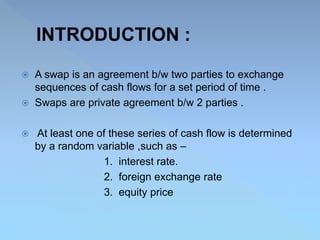
 A swap is an agreement b/w two parties to exchange
sequences of cash flows for a set period of time .
 Swaps are private agreement b/w 2 parties .
 At least one of these series of cash flow is determined
by a random variable ,such as –
1. interest rate.
2. foreign exchange rate
3. equity price
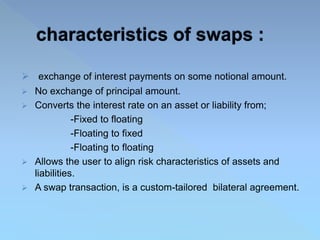
 exchange of interest payments on some notional amount.
 No exchange of principal amount.
 Converts the interest rate on an asset or liability from;
-Fixed to floating
-Floating to fixed
-Floating to floating
 Allows the user to align risk characteristics of assets and
liabilities.
 A swap transaction, is a custom-tailored bilateral agreement.
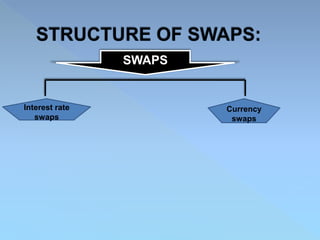
Interest rate
swaps
Currency
swaps
SWAPS
 It is the most commonly practiced & also
called plain vanilla swap .
 Plan vanilla swap are typically n exchange of
floating rate interest obligation for fixed rate
interest obligation .
 Exchange of fixed rate of interest for floating
and & vice versa.
 Denominated in same currency ,on notional
amount.
 Principals are not exchange .
 Based on comparative advantage .
 Used to hedge against adverse movement in
interest rate .
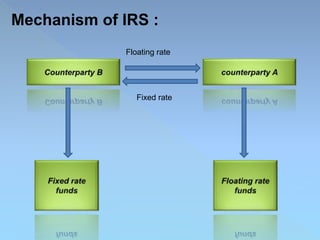
Floating rate
Fixed rate
Mechanism of IRS :
 Hedging :
A hedge is an investment that protects one’s finances
from a risky situation. And is done to minimize chance
that your asset will loose value.
 Speculation :
It involves trading a financial instrument involving high
risk, in expectation of significant returns. The motive is
to take maximum advantage from fluctuations in the
market.
 A financial contract for principal and fixed
rate of interest payment on a loan in one
currency for another currency.
 Currencies are exchanged during the life of
the swap at spot rate prevailing on the date
of the contract.
 A contract between two counterparties .
 Commitment to an exchange of cashflows over
an agreed period.
 One counterparty pays a fixed or floating rate
on principal amount, denominated in one
currency.
 The other counterparty pays a fixed or floating
rate on a (different) principal amount,
denominated in another currency.
 Banks act as intermediaries to eliminate
counterparty risk.
 Currency swap have two main uses:
 To secure cheaper debt (by borrowing at the best
available rate regardless of currency and then swapping
for debt in desired currency using a back-to-back loan)
 To hedge against ( reduce exposure to )
exchange rate fluctuations
 There are two different kinds of swaptions:
- A payer swaption: in this the purchaer has the
right, but not the obligation, to enter into a swap
contract where he becomes the fixed-rate payer
and the floating reciever.
- A receiver swaption Is the opposite; the
purchaser has the option to enter into a swap
contract where he will receive the fixed rate and
pay the floating rate.
Swaps (derivatives)

Swaps (derivatives)

  • 1.
  • 2.
     A swapis an agreement b/w two parties to exchange sequences of cash flows for a set period of time .  Swaps are private agreement b/w 2 parties .  At least one of these series of cash flow is determined by a random variable ,such as – 1. interest rate. 2. foreign exchange rate 3. equity price
  • 3.
     exchange ofinterest payments on some notional amount.  No exchange of principal amount.  Converts the interest rate on an asset or liability from; -Fixed to floating -Floating to fixed -Floating to floating  Allows the user to align risk characteristics of assets and liabilities.  A swap transaction, is a custom-tailored bilateral agreement.
  • 4.
  • 5.
     It isthe most commonly practiced & also called plain vanilla swap .  Plan vanilla swap are typically n exchange of floating rate interest obligation for fixed rate interest obligation .
  • 6.
     Exchange offixed rate of interest for floating and & vice versa.  Denominated in same currency ,on notional amount.  Principals are not exchange .  Based on comparative advantage .  Used to hedge against adverse movement in interest rate .
  • 7.
  • 8.
     Hedging : Ahedge is an investment that protects one’s finances from a risky situation. And is done to minimize chance that your asset will loose value.  Speculation : It involves trading a financial instrument involving high risk, in expectation of significant returns. The motive is to take maximum advantage from fluctuations in the market.
  • 9.
     A financialcontract for principal and fixed rate of interest payment on a loan in one currency for another currency.  Currencies are exchanged during the life of the swap at spot rate prevailing on the date of the contract.
  • 10.
     A contractbetween two counterparties .  Commitment to an exchange of cashflows over an agreed period.  One counterparty pays a fixed or floating rate on principal amount, denominated in one currency.  The other counterparty pays a fixed or floating rate on a (different) principal amount, denominated in another currency.  Banks act as intermediaries to eliminate counterparty risk.
  • 11.
     Currency swaphave two main uses:  To secure cheaper debt (by borrowing at the best available rate regardless of currency and then swapping for debt in desired currency using a back-to-back loan)  To hedge against ( reduce exposure to ) exchange rate fluctuations
  • 12.
     There aretwo different kinds of swaptions: - A payer swaption: in this the purchaer has the right, but not the obligation, to enter into a swap contract where he becomes the fixed-rate payer and the floating reciever. - A receiver swaption Is the opposite; the purchaser has the option to enter into a swap contract where he will receive the fixed rate and pay the floating rate.