
Currency FlowCurrency Flow
& Exchange& Exchange
RateRate
DeterminationDetermination
By :-
Shubham Mittal
2018-20
Kurukshetra
university-usm
Currency Flow
Currency flow is the inflow and outflow of currency
from one country to another country.
Currency flow between countries is generated from
international trade and other major international
transactions. Each of the above transactions is
recorded in the balance of payments and balance of
trade record of each country. Trading balance may
include the flow of currency, goods & services,
economic claims gifts and claims traded by
government.
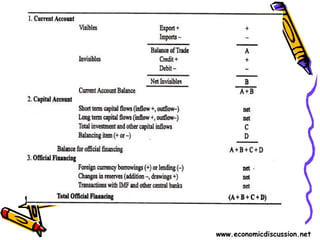
Balance of Payments
According to the RBI, balance of payment is a
statistical statement that shows
1. The transaction in goods, services and income
between an economy and the rest of the world,
2. Changes of ownership and other changes in that
economy’s , special drawing rights (SDRs), and
financial claims on and liabilities to the rest of the
world, and
3. Unrequited transfers or gifts.
By RBI...
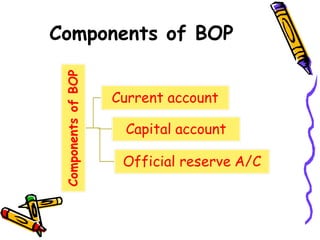
Components of BOP
www.economicdiscussion.net
Exchange rate
determination
Exchange Rate?
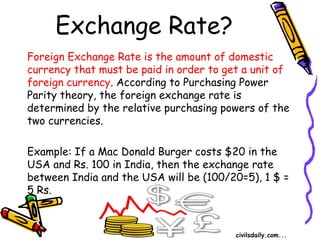
Foreign Exchange Rate is the amount of domestic
currency that must be paid in order to get a unit of
foreign currency. According to Purchasing Power
Parity theory, the foreign exchange rate is
determined by the relative purchasing powers of the
two currencies.
Example: If a Mac Donald Burger costs $20 in the
USA and Rs. 100 in India, then the exchange rate
between India and the USA will be (100/20=5), 1 $ =
5 Rs.
civilsdaily.com...
System of Exchange Rate
1. Fixed Exchange Rate System
• Under this system, there is complete government
intervention in the foreign exchange markets.
• The government or central bank determines the official
exchange rate by linking exchange rate to the price of
gold or major currencies like US dollar.
• If due to any reason, the exchange rate fluctuates,
government intervenes and make sure that equilibrium pre-
determined level is maintained.
2. Floating Exchange Rate System
•Under this system, the market is allowed to determine the
value of exchange rate freely.
•The exchange rate is determined by the forces of demand
and supply.
•If due to any reason exchange rate fluctuates, the
government never intervenes and allows the market to function
and determine the true value of exchange rate.
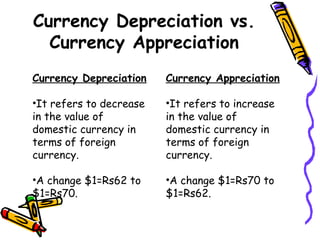
Currency Depreciation vs.
Currency Appreciation
Currency Depreciation
•It refers to decrease
in the value of
domestic currency in
terms of foreign
currency.
•A change $1=Rs62 to
$1=Rs70.
Currency Appreciation
•It refers to increase
in the value of
domestic currency in
terms of foreign
currency.
•A change $1=Rs70 to
$1=Rs62.
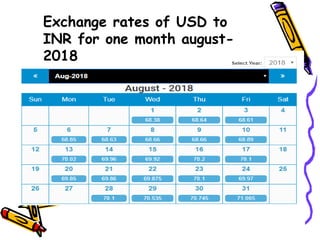
Exchange rates of USD to
INR for one month august-
2018
Exchange Rate Determination?
The rate of exchange being a price of a national
currency in terms of another, is determined in the
foreign exchange market in accordance with the
general principle of the “theory of value” , i.e. by the
interaction of the forces of demand and supply.
Thus the rate of exchange in the foreign exchange
market will be determined by the interaction
between the demand for foreign exchange and the
supply of foreign exchange.
Exchange Rate Equilibrium
The equilibrium rate of exchange is the
rate of exchange at which the par
value of home currency with foreign
currency is maintained at a stable level
over a long period of time, which means
it is neither undervalued nor
overvalued.
Q N
Q
N
FOREIGN CURRENCY SUPPLY &
DEMAND
X
Y
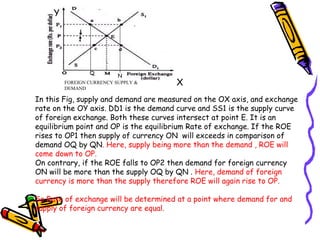
In this Fig, supply and demand are measured on the OX axis, and exchange
rate on the OY axis. DD1 is the demand curve and SS1 is the supply curve
of foreign exchange. Both these curves intersect at point E. It is an
equilibrium point and OP is the equilibrium Rate of exchange. If the ROE
rises to OP1 then supply of currency ON will exceeds in comparison of
demand OQ by QN. Here, supply being more than the demand , ROE will
come down to OP.
On contrary, if the ROE falls to OP2 then demand for foreign currency
ON will be more than the supply OQ by QN . Here, demand of foreign
currency is more than the supply therefore ROE will again rise to OP.
So Rate of exchange will be determined at a point where demand for and
supply of foreign currency are equal.
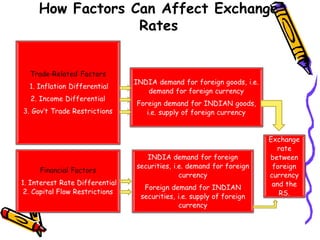
How Factors Can Affect Exchange
Rates
Factors that Influence
Exchange Rates
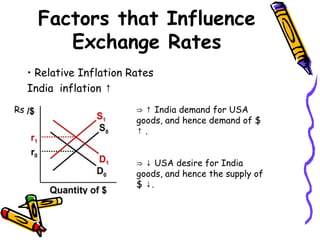
• Relative Inflation Rates
India inflation ↑
Rs ⇒ ↑ India demand for USA
goods, and hence demand of $
.↑
⇒ ↓ USA desire for India
goods, and hence the supply of
$ .↓
Factors that Influence
Exchange Rates
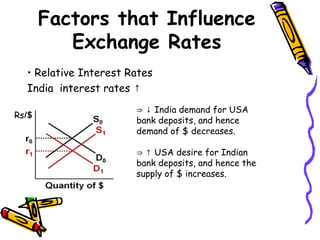
• Relative Interest Rates
India interest rates ↑
Rs
⇒ ↓ India demand for USA
bank deposits, and hence
demand of $ decreases.
⇒ ↑ USA desire for Indian
bank deposits, and hence the
supply of $ increases.
Factors that Influence
Exchange Rates
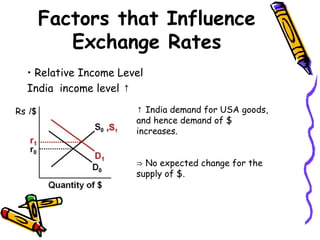
• Relative Income Level
India income level ↑
Rs ↑ India demand for USA goods,
and hence demand of $
increases.
⇒ No expected change for the
supply of $.
Factors that Influence
Exchange Rates
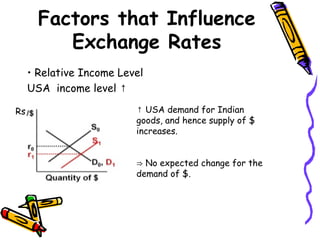
• Relative Income Level
USA income level ↑
Rs ↑ USA demand for Indian
goods, and hence supply of $
increases.
⇒ No expected change for the
demand of $.
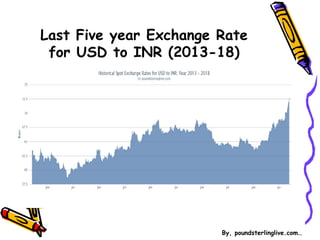
Last Five year Exchange Rate
for USD to INR (2013-18)
By, poundsterlinglive.com…
Currency Flow and Exchange
Rate System Relation
1) Balance of Payments Equilibrium under
the Flexible Exchange Rate System:
Under the Flexible Exchange Rate System, the BOP is in
equilibrium(i.e. the total currency flow is equal to zero)
because any BOP disequilibrium will be automatically
corrected through an adjustment of the exchange rate.
A BOP deficit occurs when domestic money outflows exceeds
money inflows which will lead to a downward pressure on
the exchange rate. Under the Flexible Exchange Rate
System, the resultant depreciation of domestic currency
will lead to an increase in net exports which will correct
the BOP deficit.
2) Balance of Payments Disequilibrium under
the Fixed Exchange Rate System :-
Under the Fixed Exchange Rate System, the BOP is in
disequilibrium(i.e. the total currency flow is not equal to zero)
because any BOP disequilibrium will not be automatically
corrected through an adjustment of the exchange rate.
A BOP deficit occurs when domestic money outflows exceeds
money inflows which will lead to a downward pressure on the
exchange rate. Under the Fixed Exchange Rate System, the
central bank will intervene in the foreign exchange rate by
buying domestic currency and selling foreign currency to
prevent domestic currency from depreciating. Therefore net
exports will not rise and the BOP will remain in deficit.
AnyAny
Queries ?Queries ?

Currency Flow And Exchange Rate Determination

  • 1.
    Currency FlowCurrency Flow &Exchange& Exchange RateRate DeterminationDetermination By :- Shubham Mittal 2018-20 Kurukshetra university-usm
  • 2.
    Currency Flow Currency flowis the inflow and outflow of currency from one country to another country. Currency flow between countries is generated from international trade and other major international transactions. Each of the above transactions is recorded in the balance of payments and balance of trade record of each country. Trading balance may include the flow of currency, goods & services, economic claims gifts and claims traded by government.
  • 3.
    Balance of Payments Accordingto the RBI, balance of payment is a statistical statement that shows 1. The transaction in goods, services and income between an economy and the rest of the world, 2. Changes of ownership and other changes in that economy’s , special drawing rights (SDRs), and financial claims on and liabilities to the rest of the world, and 3. Unrequited transfers or gifts. By RBI...
  • 4.
  • 5.
  • 6.
  • 7.
    Exchange Rate? Foreign ExchangeRate is the amount of domestic currency that must be paid in order to get a unit of foreign currency. According to Purchasing Power Parity theory, the foreign exchange rate is determined by the relative purchasing powers of the two currencies. Example: If a Mac Donald Burger costs $20 in the USA and Rs. 100 in India, then the exchange rate between India and the USA will be (100/20=5), 1 $ = 5 Rs. civilsdaily.com...
  • 8.
    System of ExchangeRate 1. Fixed Exchange Rate System • Under this system, there is complete government intervention in the foreign exchange markets. • The government or central bank determines the official exchange rate by linking exchange rate to the price of gold or major currencies like US dollar. • If due to any reason, the exchange rate fluctuates, government intervenes and make sure that equilibrium pre- determined level is maintained.
  • 9.
    2. Floating ExchangeRate System •Under this system, the market is allowed to determine the value of exchange rate freely. •The exchange rate is determined by the forces of demand and supply. •If due to any reason exchange rate fluctuates, the government never intervenes and allows the market to function and determine the true value of exchange rate.
  • 10.
    Currency Depreciation vs. CurrencyAppreciation Currency Depreciation •It refers to decrease in the value of domestic currency in terms of foreign currency. •A change $1=Rs62 to $1=Rs70. Currency Appreciation •It refers to increase in the value of domestic currency in terms of foreign currency. •A change $1=Rs70 to $1=Rs62.
  • 11.
    Exchange rates ofUSD to INR for one month august- 2018
  • 12.
    Exchange Rate Determination? Therate of exchange being a price of a national currency in terms of another, is determined in the foreign exchange market in accordance with the general principle of the “theory of value” , i.e. by the interaction of the forces of demand and supply. Thus the rate of exchange in the foreign exchange market will be determined by the interaction between the demand for foreign exchange and the supply of foreign exchange.
  • 13.
    Exchange Rate Equilibrium Theequilibrium rate of exchange is the rate of exchange at which the par value of home currency with foreign currency is maintained at a stable level over a long period of time, which means it is neither undervalued nor overvalued.
  • 14.
    Q N Q N FOREIGN CURRENCYSUPPLY & DEMAND X Y In this Fig, supply and demand are measured on the OX axis, and exchange rate on the OY axis. DD1 is the demand curve and SS1 is the supply curve of foreign exchange. Both these curves intersect at point E. It is an equilibrium point and OP is the equilibrium Rate of exchange. If the ROE rises to OP1 then supply of currency ON will exceeds in comparison of demand OQ by QN. Here, supply being more than the demand , ROE will come down to OP. On contrary, if the ROE falls to OP2 then demand for foreign currency ON will be more than the supply OQ by QN . Here, demand of foreign currency is more than the supply therefore ROE will again rise to OP. So Rate of exchange will be determined at a point where demand for and supply of foreign currency are equal.
  • 15.
    How Factors CanAffect Exchange Rates
  • 16.
    Factors that Influence ExchangeRates • Relative Inflation Rates India inflation ↑ Rs ⇒ ↑ India demand for USA goods, and hence demand of $ .↑ ⇒ ↓ USA desire for India goods, and hence the supply of $ .↓
  • 17.
    Factors that Influence ExchangeRates • Relative Interest Rates India interest rates ↑ Rs ⇒ ↓ India demand for USA bank deposits, and hence demand of $ decreases. ⇒ ↑ USA desire for Indian bank deposits, and hence the supply of $ increases.
  • 18.
    Factors that Influence ExchangeRates • Relative Income Level India income level ↑ Rs ↑ India demand for USA goods, and hence demand of $ increases. ⇒ No expected change for the supply of $.
  • 19.
    Factors that Influence ExchangeRates • Relative Income Level USA income level ↑ Rs ↑ USA demand for Indian goods, and hence supply of $ increases. ⇒ No expected change for the demand of $.
  • 20.
    Last Five yearExchange Rate for USD to INR (2013-18) By, poundsterlinglive.com…
  • 21.
    Currency Flow andExchange Rate System Relation 1) Balance of Payments Equilibrium under the Flexible Exchange Rate System: Under the Flexible Exchange Rate System, the BOP is in equilibrium(i.e. the total currency flow is equal to zero) because any BOP disequilibrium will be automatically corrected through an adjustment of the exchange rate. A BOP deficit occurs when domestic money outflows exceeds money inflows which will lead to a downward pressure on the exchange rate. Under the Flexible Exchange Rate System, the resultant depreciation of domestic currency will lead to an increase in net exports which will correct the BOP deficit.
  • 22.
    2) Balance ofPayments Disequilibrium under the Fixed Exchange Rate System :- Under the Fixed Exchange Rate System, the BOP is in disequilibrium(i.e. the total currency flow is not equal to zero) because any BOP disequilibrium will not be automatically corrected through an adjustment of the exchange rate. A BOP deficit occurs when domestic money outflows exceeds money inflows which will lead to a downward pressure on the exchange rate. Under the Fixed Exchange Rate System, the central bank will intervene in the foreign exchange rate by buying domestic currency and selling foreign currency to prevent domestic currency from depreciating. Therefore net exports will not rise and the BOP will remain in deficit.
  • 23.