PERFORMANCE MANAGEMENT
COMPETENCY MANAGEMNT
TALENT MANAGEMENT
Present by:
SONDARVA YAGNESH M
Performance management
Performance management (PM) includes activities which ensure that goals are consistently
being met in an effective and efficient manner.
Performance management can focus on the performance of an organization,
a department, employee, or even the processes to build a product or service, as well as many
other areas.
PM is also known as a process by which organizations align their resources, systems and
employees to strategic objectives and priorities.
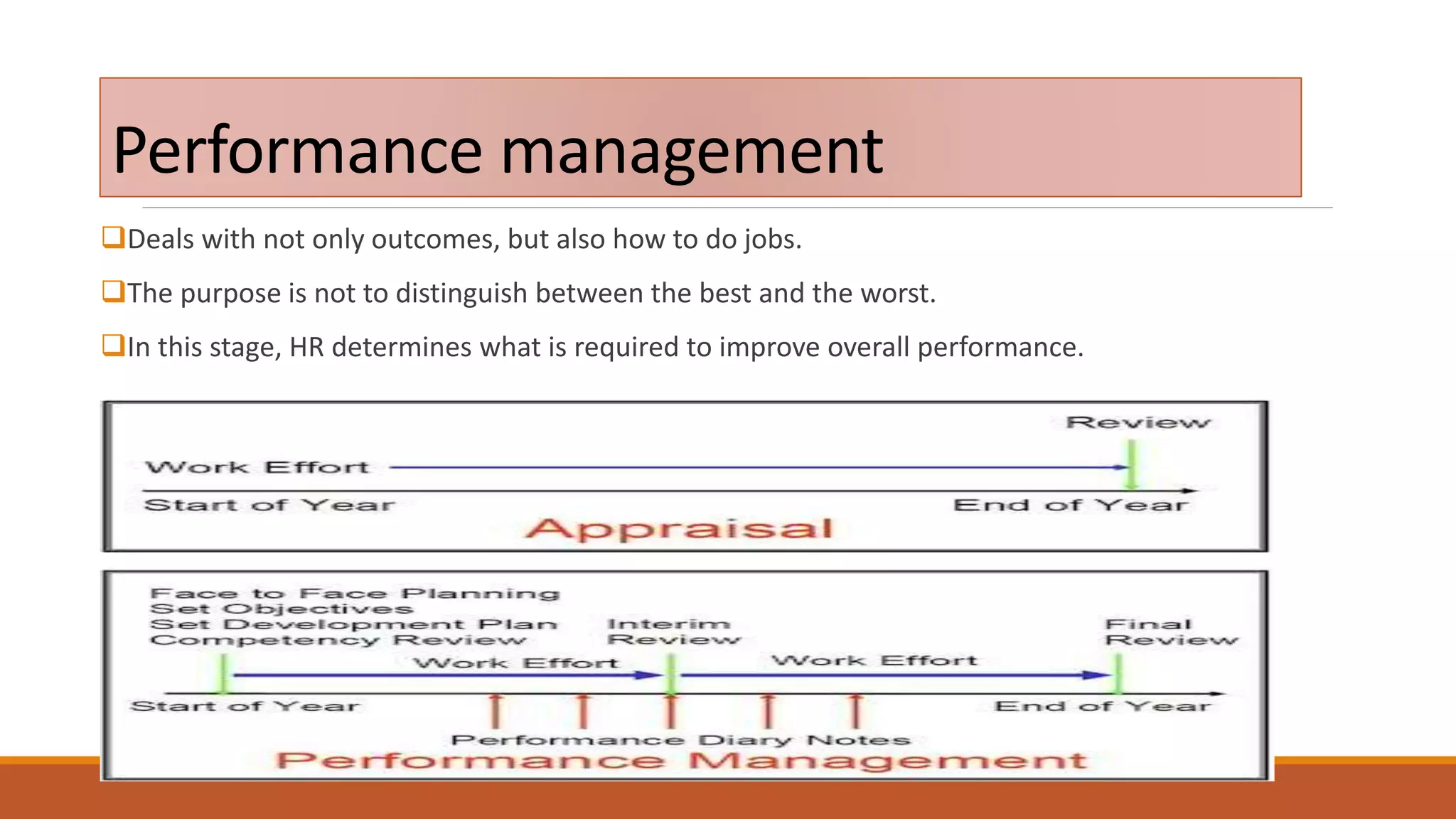
Performance management
Deals with not only outcomes, but also how to do jobs.
The purpose is not to distinguish between the best and the worst.
In this stage, HR determines what is required to improve overall performance.
TALENT
A Talent (or gift, or aptitude) is the skill that someone naturally has to do something that is hard.
It is an ability that someone is born with.
People say they are "born with a talent".
It is a high degree of ability or of aptitude.
Someone who has talent is able to do something without trying as hard as someone who does not have a talent.
Someone who has talent is called talented.
Talented people as rule have many talents, for music, dancing, acting, sports, or other skills, but often only in
single direction or genre, unlike genius.
Even if someone has talent they still have to work very hard if they want to be very good at something.
Some people become quite good at something even if they do not have much talent, but if they are willing to
work very hard at the skill.
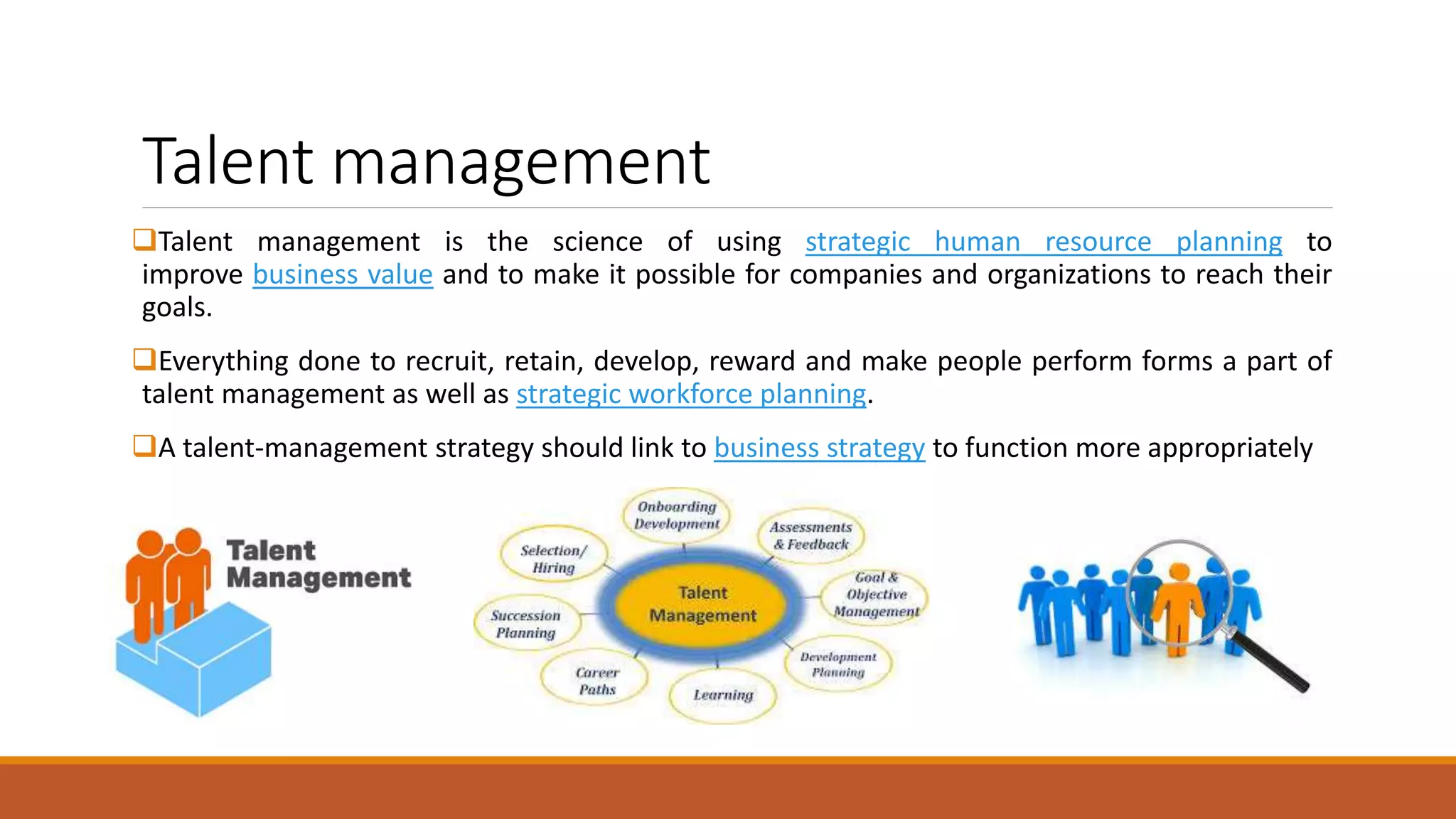
Talent management
Talent management is the science of using strategic human resource planning to
improve business value and to make it possible for companies and organizations to reach their
goals.
Everything done to recruit, retain, develop, reward and make people perform forms a part of
talent management as well as strategic workforce planning.
A talent-management strategy should link to business strategy to function more appropriately
Competence
Competence is the ability of an individual to do a job properly.
A competency is a set of defined behaviors that provide a structured guide enabling the identification,
evaluation and development of the behaviors in individual employees.
The term "competence" first appeared in an article authored by R.W. White in 1959 as a concept for
performance motivation. In 1970,
Some scholars see "competence" as a combination of practical and theoretical knowledge,
cognitive skills, behavior and values used to improve performance; or as the state or quality of being
adequately or well qualified, having the ability to perform a specific role.
For instance, management competency might include systems thinking and emotional intelligence, and
skills in influence and negotiation.
Competency is also used as a more general description of the requirements of human beings in
organizations and communities.
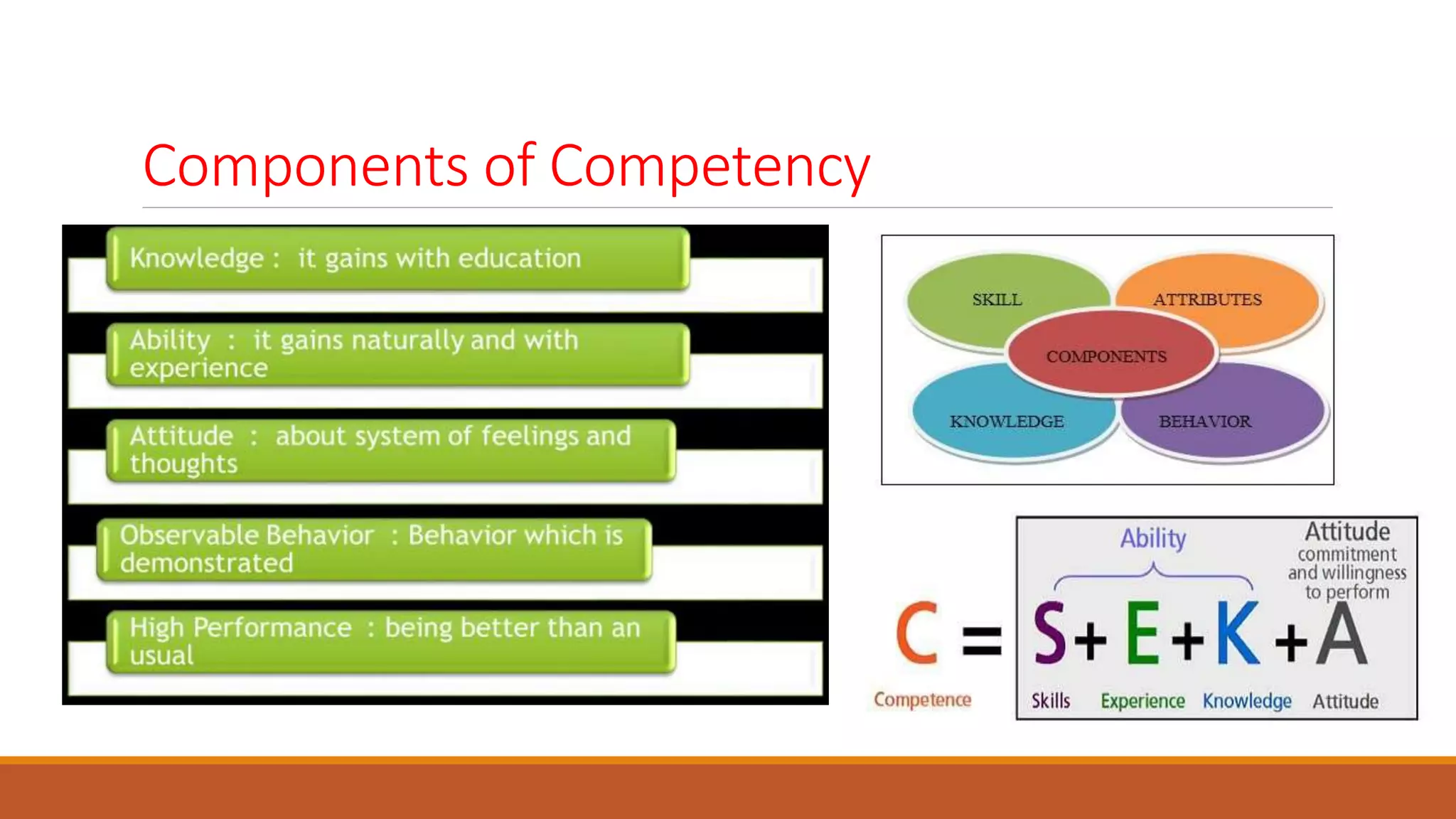
Components of Competency
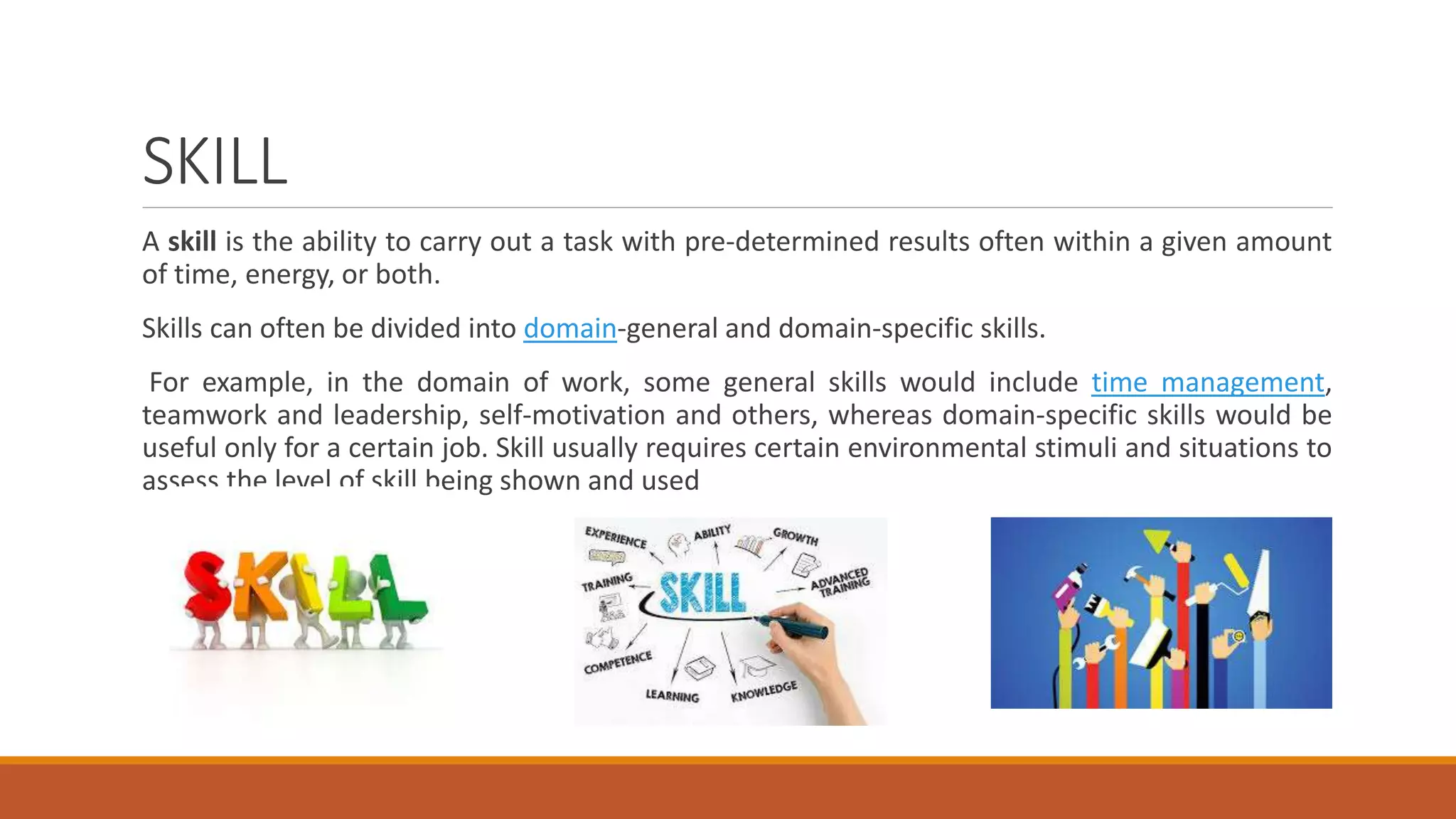
SKILL
A skill is the ability to carry out a task with pre-determined results often within a given amount
of time, energy, or both.
Skills can often be divided into domain-general and domain-specific skills.
For example, in the domain of work, some general skills would include time management,
teamwork and leadership, self-motivation and others, whereas domain-specific skills would be
useful only for a certain job. Skill usually requires certain environmental stimuli and situations to
assess the level of skill being shown and used
Management
Management (or managing) is the administration of an organization, whether it is a business, a
not-for-profit organization, or government body.
Management includes the activities of setting the strategy of an organization and coordinating
the efforts of its employees (or of volunteers) to accomplish its objectives through the
application of available resources, such as financial, natural, technological, and human
resources.
The term "management" may also refer to those people who manage an organization.
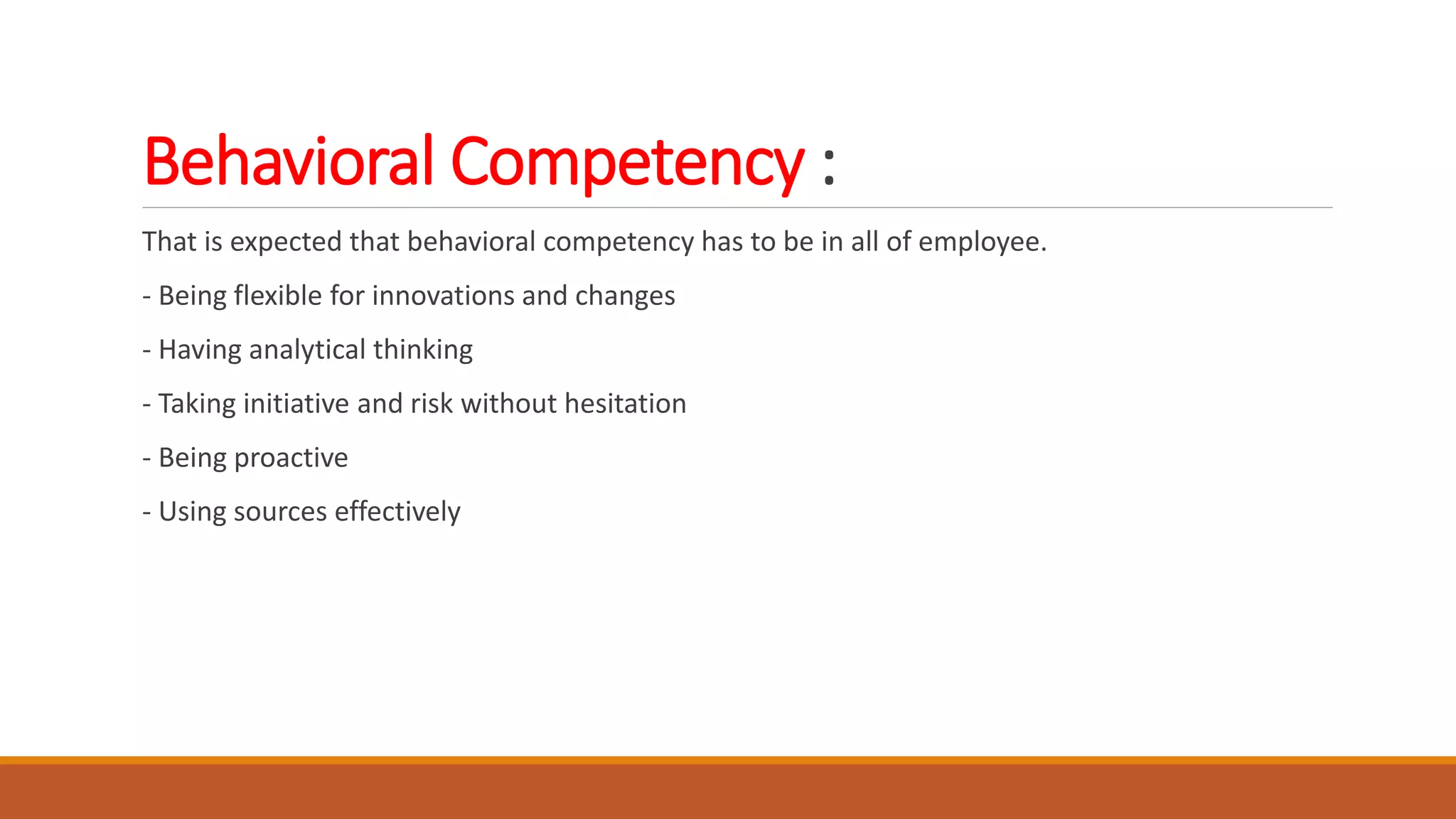
Behavioral Competency :
That is expected that behavioral competency has to be in all of employee.
- Being flexible for innovations and changes
- Having analytical thinking
- Taking initiative and risk without hesitation
- Being proactive
- Using sources effectively
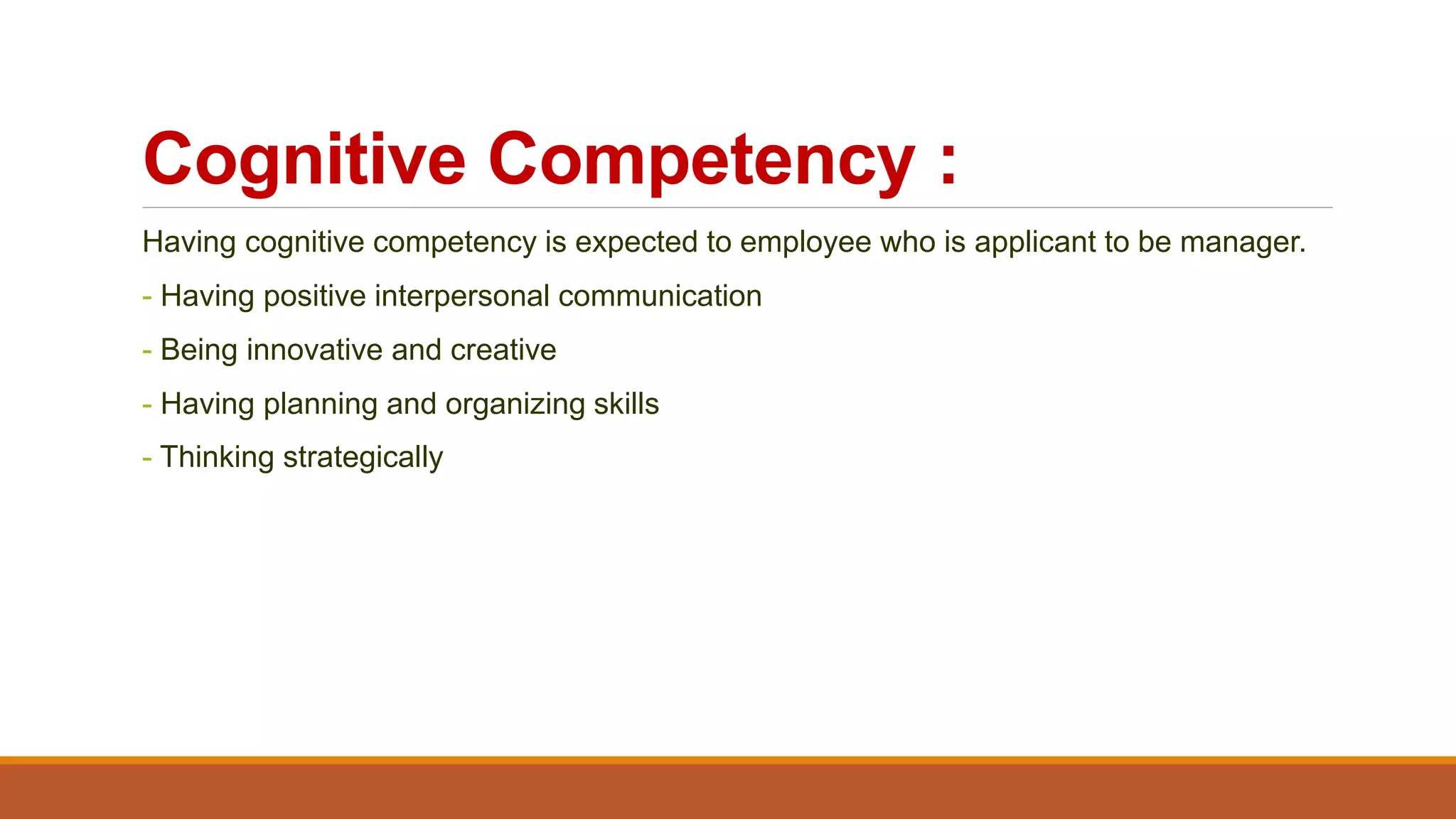
Cognitive Competency :
Having cognitive competency is expected to employee who is applicant to be manager.
- Having positive interpersonal communication
- Being innovative and creative
- Having planning and organizing skills
- Thinking strategically
Technical Competency :
This type is including knowledge, ability and behavior for doing job.
- Marketing knowledge
- Solving customer’s problems and provide assistance
- Development of strategy
- Being convincing
- Review goodsservices quality
Features of Competencies
- Competencies must overlap with strategies
- Competencies must be observable and measurable
- It must focus on behaviors
- It can change depending on company and sector
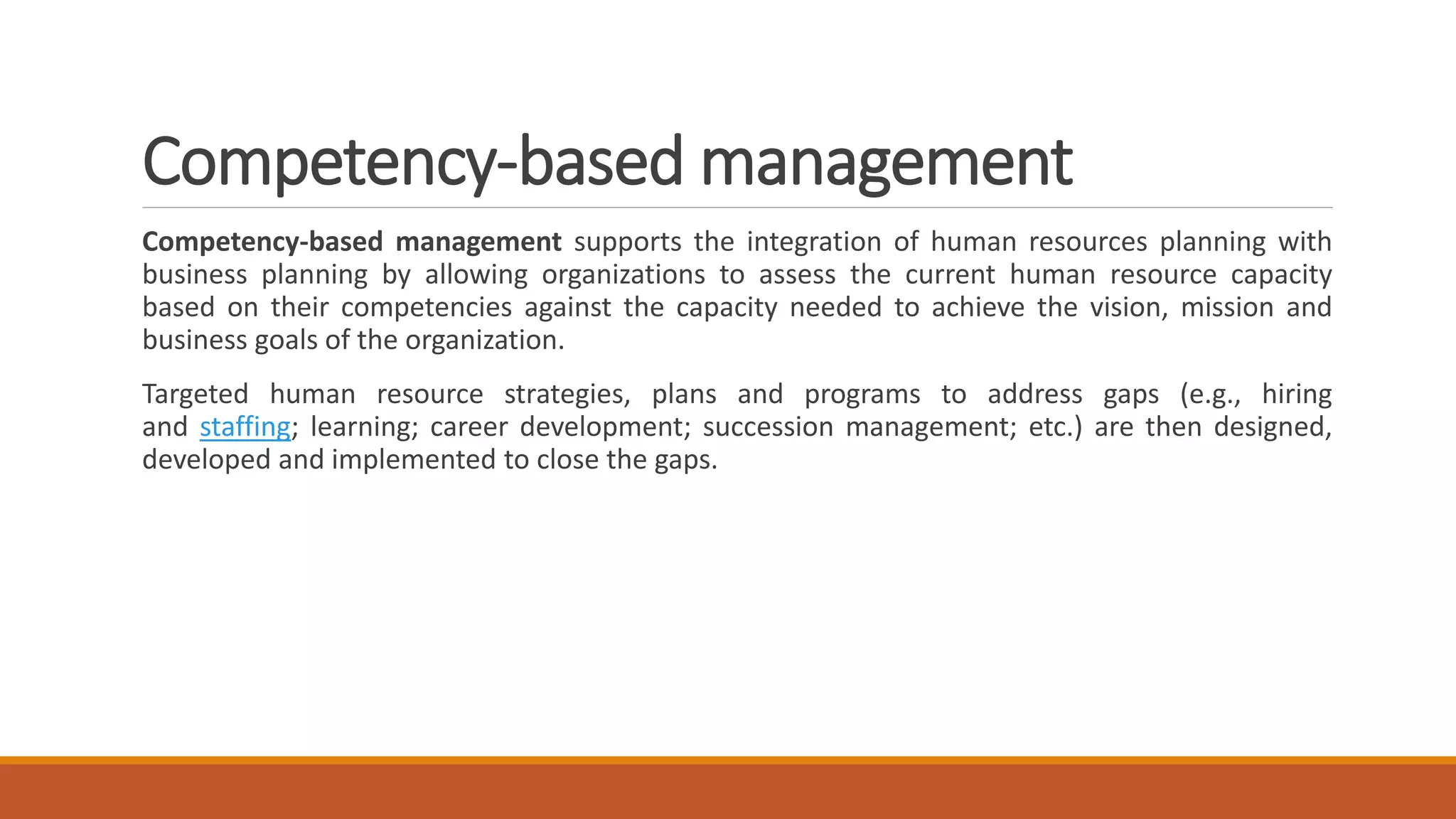
Competency-based management
Competency-based management supports the integration of human resources planning with
business planning by allowing organizations to assess the current human resource capacity
based on their competencies against the capacity needed to achieve the vision, mission and
business goals of the organization.
Targeted human resource strategies, plans and programs to address gaps (e.g., hiring
and staffing; learning; career development; succession management; etc.) are then designed,
developed and implemented to close the gaps.
Competency Modeling
competency model as an overarching representation of multiple success profiles.
We’ll define success profiles as the unique combination of competencies that describe the skill
set of the ideal person for a specific level or key job.”
Proper Model Selection
Questions to consider while developing a Competency Model include:
What level of detail is needed to meet our human capital functions?
How different is our environment from other successful organizations like ours?
To what extent do the competencies of today's employees reflect the competencies
required of tomorrow's employees?
What is our timeframe to accomplish this effort?
What are our resources to invest in this effort?
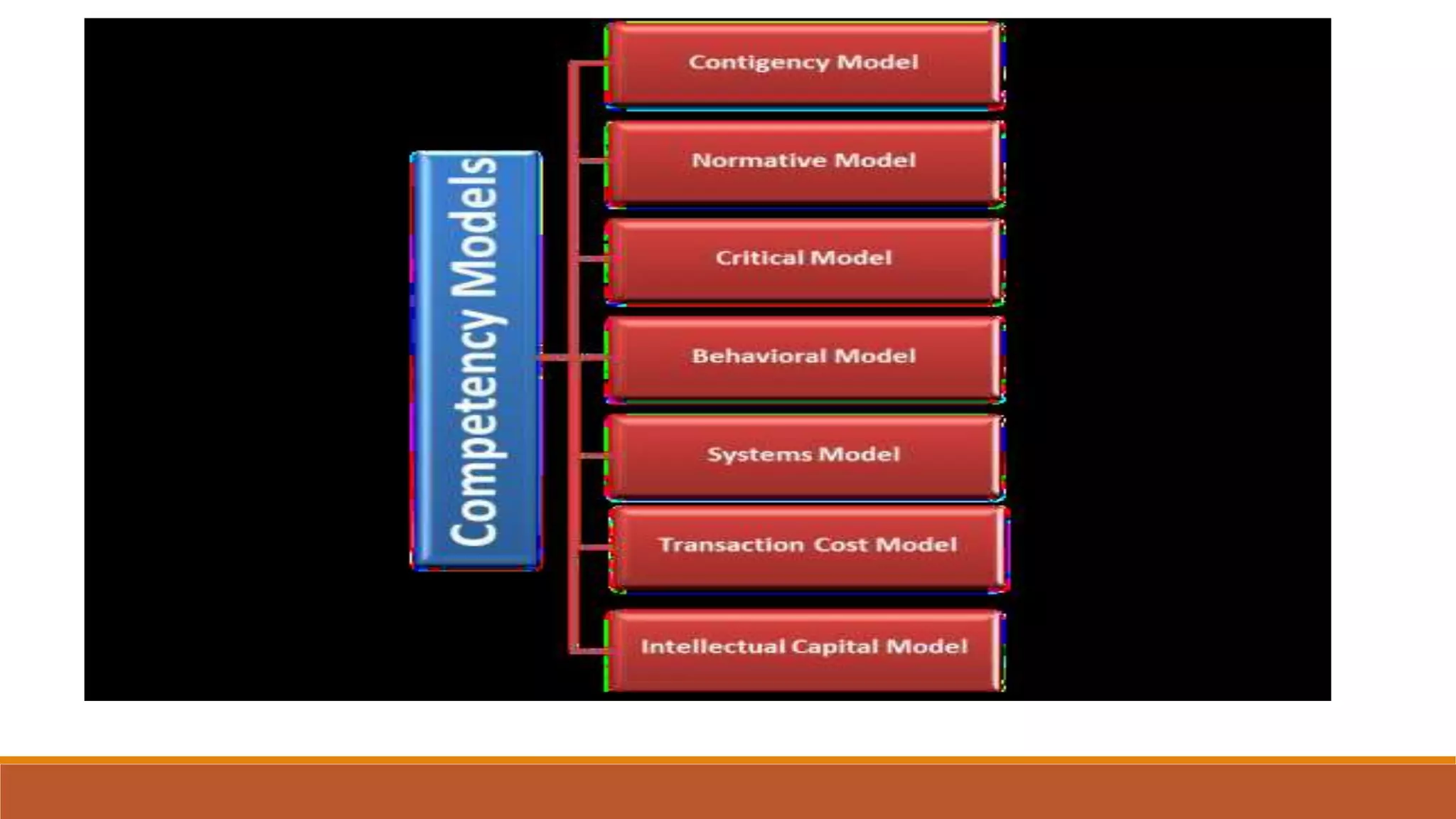
Some of Competency Models
LeBleu and Roger ( flexibility )
McLagan ( less dependence on experts )
Shoonover ( need, simple, compliance with organizational culture )
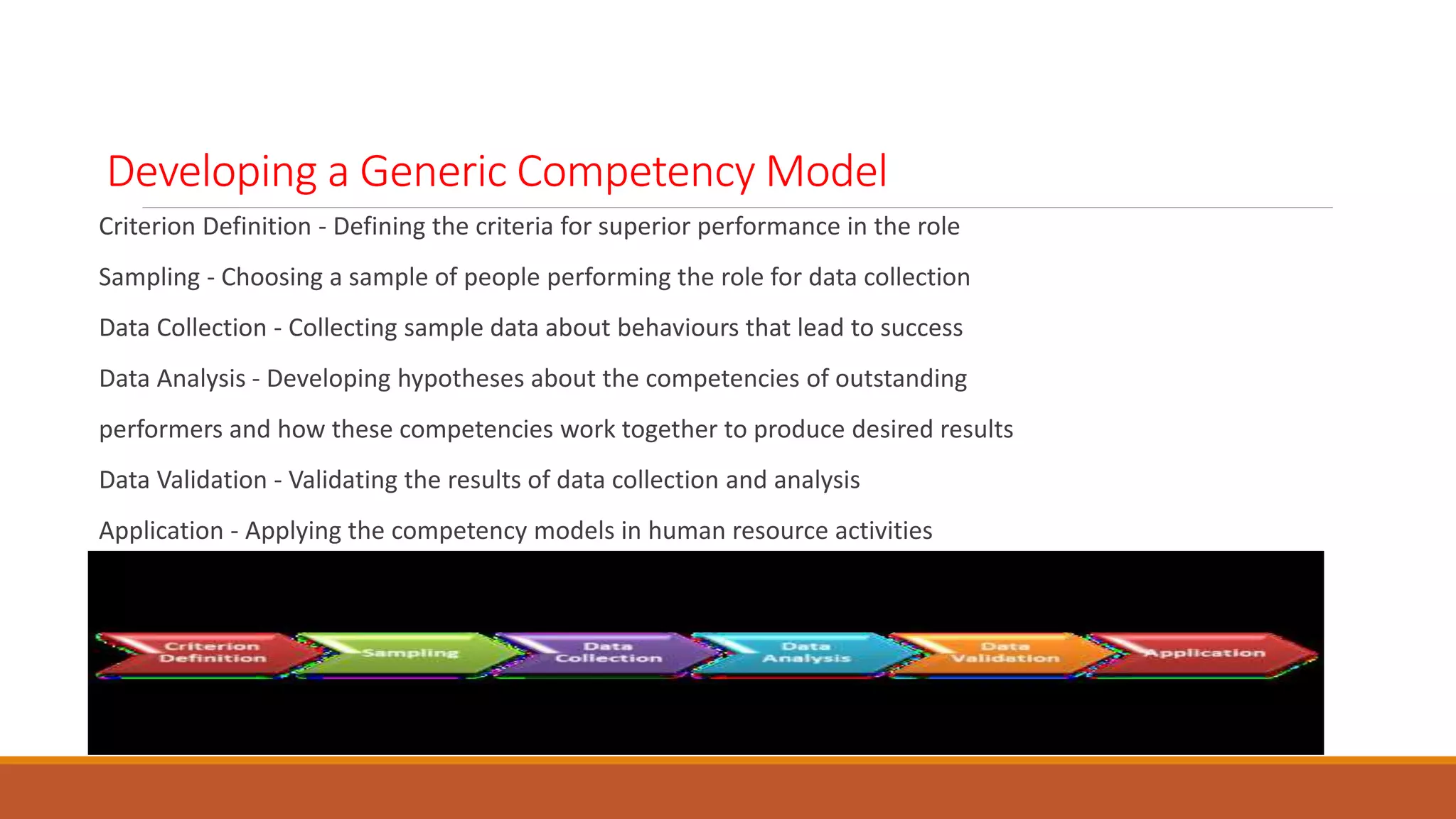
Developing a Generic Competency Model
Criterion Definition - Defining the criteria for superior performance in the role
Sampling - Choosing a sample of people performing the role for data collection
Data Collection - Collecting sample data about behaviours that lead to success
Data Analysis - Developing hypotheses about the competencies of outstanding
performers and how these competencies work together to produce desired results
Data Validation - Validating the results of data collection and analysis
Application - Applying the competency models in human resource activities
Competency Evaluation Methods
Oral and Written Examinations
Practical-Skills Examination
On-the-Job Monitoring
Peer Assessment
360-degree Feedback
Implementations of Competencies
in Human Resources Management
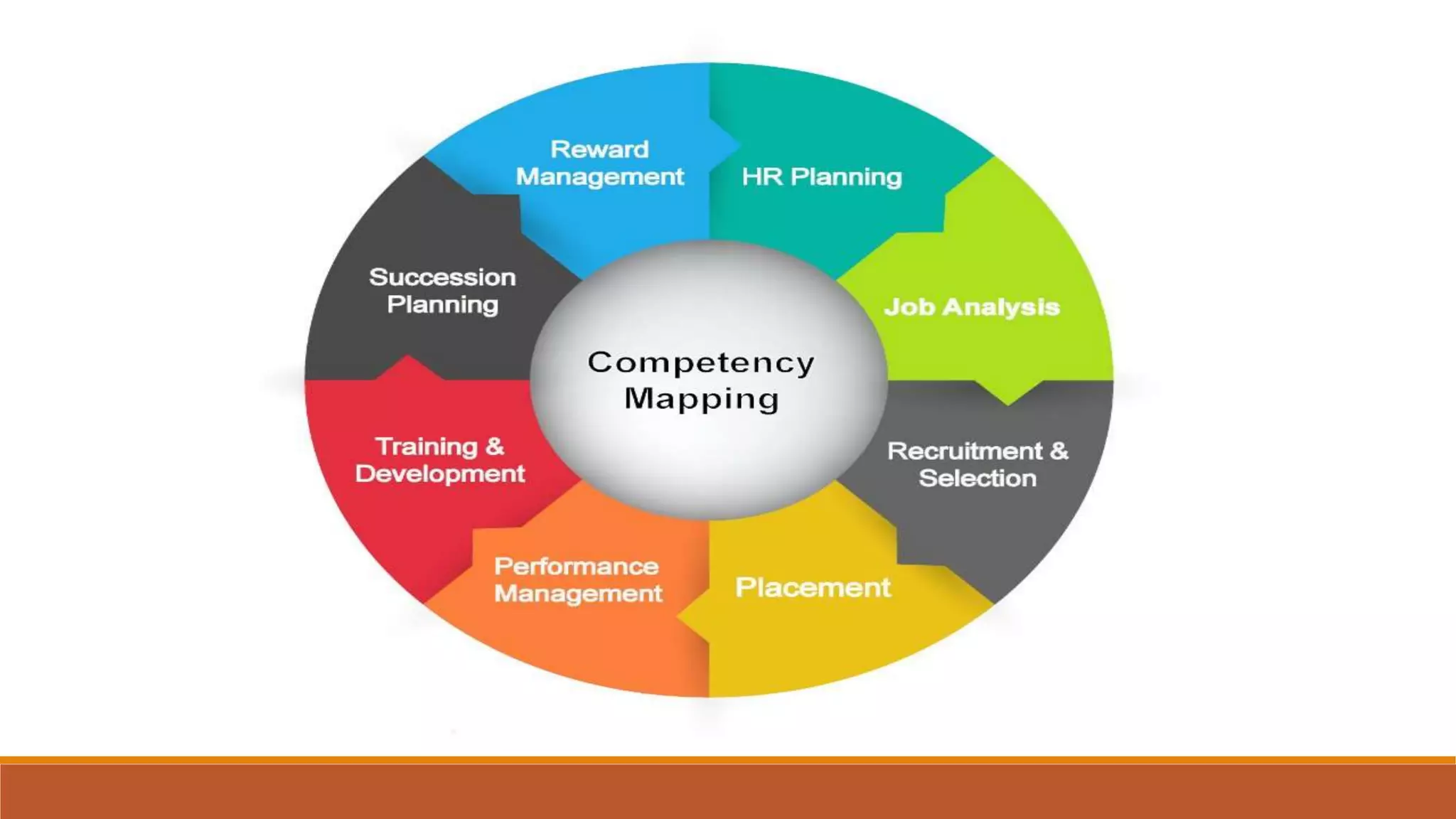
Competency-based Job Analysis
Recruitment
Performance Management
Employee Training
Competency-based Pay
Career Planning
Competency-based Job analysis
Competency-based job analysis is defining of job
in terms of skills, abilities, behaviors and motivations
required.
Recruitment
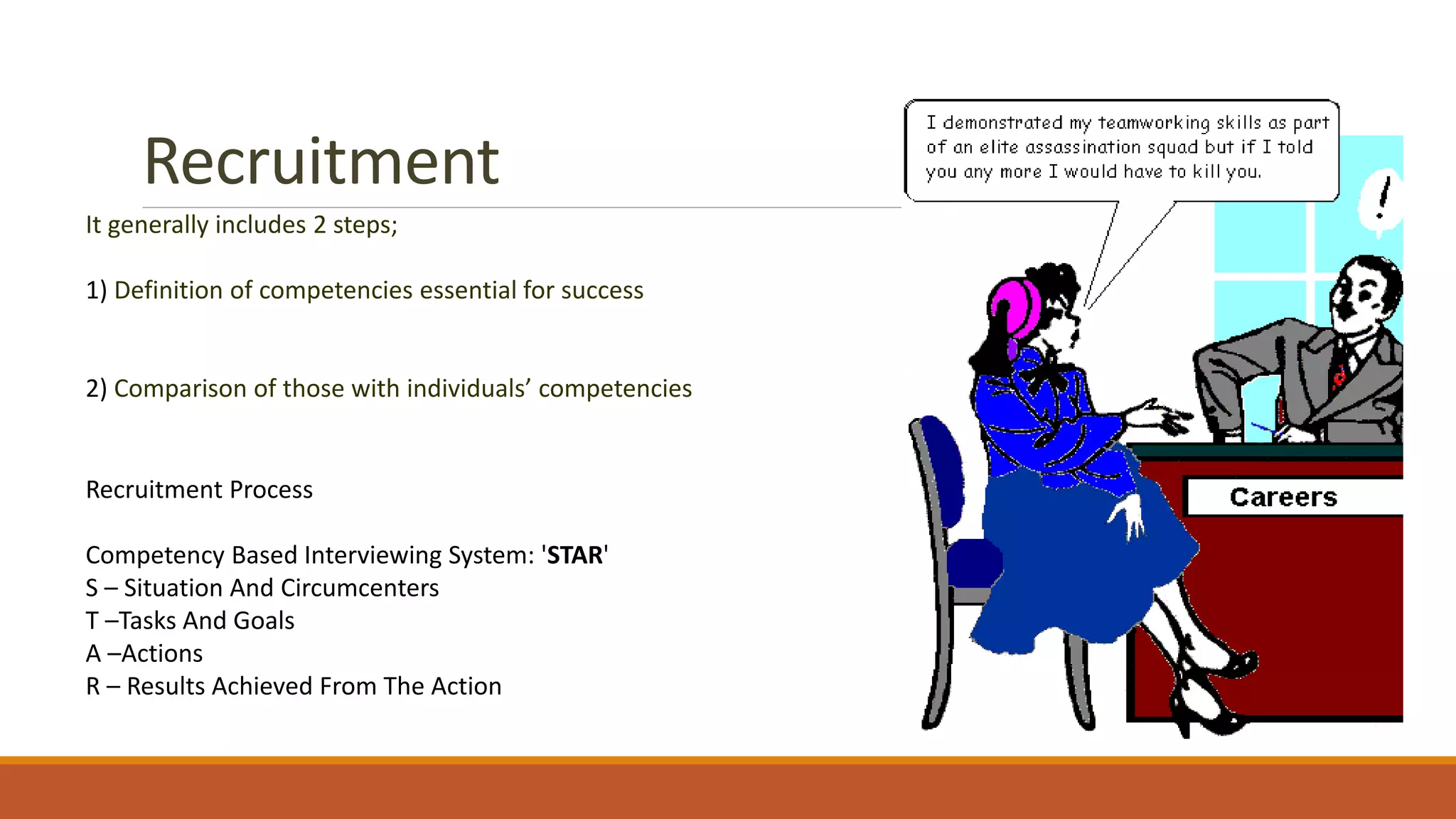
It generally includes 2 steps;
1) Definition of competencies essential for success
2) Comparison of those with individuals’ competencies
Recruitment Process
Competency Based Interviewing System: 'STAR'
S – Situation And Circumcenters
T –Tasks And Goals
A –Actions
R – Results Achieved From The Action
Competency-based Questions
 Give an example of a significant decision you made in your last position.?
Tell me about a time when you had to go above and beyond the call of duty ?
 Give an example of a change you initiated in your organization.?
As a manager, do you direct the project or the people?
Tell us about a time in which you developed an unconventional approach to solve a problem. How did
you develop this new approach? What challenges did you face and how did you address them?
Competence-based training
Competence-based training is another implementation.
Measurable and observable behaviors are tried to develop, and it take places in three stages basically.;
1.Identification of competencies to be developed,
2.The creation of suitable model
3.The implementation of model.
Rewarding
Rewarding the individuals' abilities and behaviors which are critically important to the organization
The primary objective is to maximize employee motivation.
We want to keep our competent employees, and rewarding the success provide employee
retention.
Career Planning
“Career planning assessment results are used to evaluate the degree of fit
between current dimensions/competencies and possible new jobs/roles. New
jobs/roles can be sought as an end in themselves (e.g., for the types of activities or quality of life provided) or
as a development step in a planned career.”
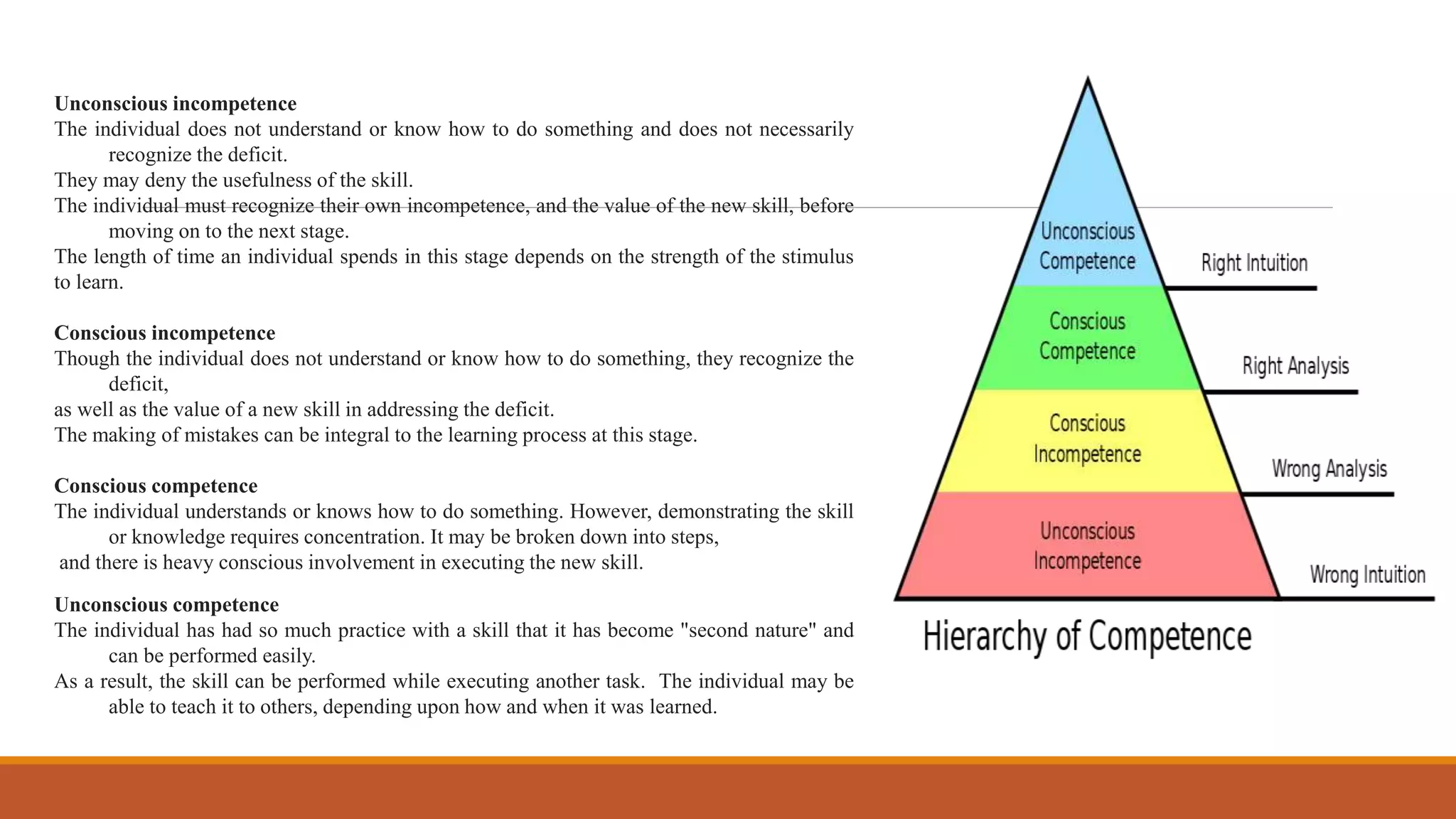
Unconscious incompetence
The individual does not understand or know how to do something and does not necessarily
recognize the deficit.
They may deny the usefulness of the skill.
The individual must recognize their own incompetence, and the value of the new skill, before
moving on to the next stage.
The length of time an individual spends in this stage depends on the strength of the stimulus
to learn.
Conscious incompetence
Though the individual does not understand or know how to do something, they recognize the
deficit,
as well as the value of a new skill in addressing the deficit.
The making of mistakes can be integral to the learning process at this stage.
Conscious competence
The individual understands or knows how to do something. However, demonstrating the skill
or knowledge requires concentration. It may be broken down into steps,
and there is heavy conscious involvement in executing the new skill.
Unconscious competence
The individual has had so much practice with a skill that it has become "second nature" and
can be performed easily.
As a result, the skill can be performed while executing another task. The individual may be
able to teach it to others, depending upon how and when it was learned.
Competency management in extension system in India
How can we manage competency in
extension system of India
Give your suggestions ???
THANK YOU

Competncy management

  • 1.
    PERFORMANCE MANAGEMENT COMPETENCY MANAGEMNT TALENTMANAGEMENT Present by: SONDARVA YAGNESH M
  • 2.
    Performance management Performance management(PM) includes activities which ensure that goals are consistently being met in an effective and efficient manner. Performance management can focus on the performance of an organization, a department, employee, or even the processes to build a product or service, as well as many other areas. PM is also known as a process by which organizations align their resources, systems and employees to strategic objectives and priorities.
  • 3.
    Performance management Deals withnot only outcomes, but also how to do jobs. The purpose is not to distinguish between the best and the worst. In this stage, HR determines what is required to improve overall performance.
  • 4.
    TALENT A Talent (orgift, or aptitude) is the skill that someone naturally has to do something that is hard. It is an ability that someone is born with. People say they are "born with a talent". It is a high degree of ability or of aptitude. Someone who has talent is able to do something without trying as hard as someone who does not have a talent. Someone who has talent is called talented. Talented people as rule have many talents, for music, dancing, acting, sports, or other skills, but often only in single direction or genre, unlike genius. Even if someone has talent they still have to work very hard if they want to be very good at something. Some people become quite good at something even if they do not have much talent, but if they are willing to work very hard at the skill.
  • 5.
    Talent management Talent managementis the science of using strategic human resource planning to improve business value and to make it possible for companies and organizations to reach their goals. Everything done to recruit, retain, develop, reward and make people perform forms a part of talent management as well as strategic workforce planning. A talent-management strategy should link to business strategy to function more appropriately
  • 6.
    Competence Competence is theability of an individual to do a job properly. A competency is a set of defined behaviors that provide a structured guide enabling the identification, evaluation and development of the behaviors in individual employees. The term "competence" first appeared in an article authored by R.W. White in 1959 as a concept for performance motivation. In 1970, Some scholars see "competence" as a combination of practical and theoretical knowledge, cognitive skills, behavior and values used to improve performance; or as the state or quality of being adequately or well qualified, having the ability to perform a specific role. For instance, management competency might include systems thinking and emotional intelligence, and skills in influence and negotiation. Competency is also used as a more general description of the requirements of human beings in organizations and communities.
  • 7.
  • 8.
    SKILL A skill isthe ability to carry out a task with pre-determined results often within a given amount of time, energy, or both. Skills can often be divided into domain-general and domain-specific skills. For example, in the domain of work, some general skills would include time management, teamwork and leadership, self-motivation and others, whereas domain-specific skills would be useful only for a certain job. Skill usually requires certain environmental stimuli and situations to assess the level of skill being shown and used
  • 9.
    Management Management (or managing)is the administration of an organization, whether it is a business, a not-for-profit organization, or government body. Management includes the activities of setting the strategy of an organization and coordinating the efforts of its employees (or of volunteers) to accomplish its objectives through the application of available resources, such as financial, natural, technological, and human resources. The term "management" may also refer to those people who manage an organization.
  • 10.
    Behavioral Competency : Thatis expected that behavioral competency has to be in all of employee. - Being flexible for innovations and changes - Having analytical thinking - Taking initiative and risk without hesitation - Being proactive - Using sources effectively
  • 11.
    Cognitive Competency : Havingcognitive competency is expected to employee who is applicant to be manager. - Having positive interpersonal communication - Being innovative and creative - Having planning and organizing skills - Thinking strategically
  • 12.
    Technical Competency : Thistype is including knowledge, ability and behavior for doing job. - Marketing knowledge - Solving customer’s problems and provide assistance - Development of strategy - Being convincing - Review goodsservices quality
  • 13.
    Features of Competencies -Competencies must overlap with strategies - Competencies must be observable and measurable - It must focus on behaviors - It can change depending on company and sector
  • 14.
    Competency-based management Competency-based managementsupports the integration of human resources planning with business planning by allowing organizations to assess the current human resource capacity based on their competencies against the capacity needed to achieve the vision, mission and business goals of the organization. Targeted human resource strategies, plans and programs to address gaps (e.g., hiring and staffing; learning; career development; succession management; etc.) are then designed, developed and implemented to close the gaps.
  • 18.
    Competency Modeling competency modelas an overarching representation of multiple success profiles. We’ll define success profiles as the unique combination of competencies that describe the skill set of the ideal person for a specific level or key job.”
  • 21.
    Proper Model Selection Questionsto consider while developing a Competency Model include: What level of detail is needed to meet our human capital functions? How different is our environment from other successful organizations like ours? To what extent do the competencies of today's employees reflect the competencies required of tomorrow's employees? What is our timeframe to accomplish this effort? What are our resources to invest in this effort?
  • 22.
    Some of CompetencyModels LeBleu and Roger ( flexibility ) McLagan ( less dependence on experts ) Shoonover ( need, simple, compliance with organizational culture )
  • 23.
    Developing a GenericCompetency Model Criterion Definition - Defining the criteria for superior performance in the role Sampling - Choosing a sample of people performing the role for data collection Data Collection - Collecting sample data about behaviours that lead to success Data Analysis - Developing hypotheses about the competencies of outstanding performers and how these competencies work together to produce desired results Data Validation - Validating the results of data collection and analysis Application - Applying the competency models in human resource activities
  • 25.
    Competency Evaluation Methods Oraland Written Examinations Practical-Skills Examination On-the-Job Monitoring Peer Assessment 360-degree Feedback
  • 26.
    Implementations of Competencies inHuman Resources Management Competency-based Job Analysis Recruitment Performance Management Employee Training Competency-based Pay Career Planning
  • 27.
    Competency-based Job analysis Competency-basedjob analysis is defining of job in terms of skills, abilities, behaviors and motivations required.
  • 28.
    Recruitment It generally includes2 steps; 1) Definition of competencies essential for success 2) Comparison of those with individuals’ competencies Recruitment Process Competency Based Interviewing System: 'STAR' S – Situation And Circumcenters T –Tasks And Goals A –Actions R – Results Achieved From The Action
  • 29.
    Competency-based Questions  Givean example of a significant decision you made in your last position.? Tell me about a time when you had to go above and beyond the call of duty ?  Give an example of a change you initiated in your organization.? As a manager, do you direct the project or the people? Tell us about a time in which you developed an unconventional approach to solve a problem. How did you develop this new approach? What challenges did you face and how did you address them?
  • 30.
    Competence-based training Competence-based trainingis another implementation. Measurable and observable behaviors are tried to develop, and it take places in three stages basically.; 1.Identification of competencies to be developed, 2.The creation of suitable model 3.The implementation of model.
  • 31.
    Rewarding Rewarding the individuals'abilities and behaviors which are critically important to the organization The primary objective is to maximize employee motivation. We want to keep our competent employees, and rewarding the success provide employee retention.
  • 32.
    Career Planning “Career planningassessment results are used to evaluate the degree of fit between current dimensions/competencies and possible new jobs/roles. New jobs/roles can be sought as an end in themselves (e.g., for the types of activities or quality of life provided) or as a development step in a planned career.”
  • 33.
    Unconscious incompetence The individualdoes not understand or know how to do something and does not necessarily recognize the deficit. They may deny the usefulness of the skill. The individual must recognize their own incompetence, and the value of the new skill, before moving on to the next stage. The length of time an individual spends in this stage depends on the strength of the stimulus to learn. Conscious incompetence Though the individual does not understand or know how to do something, they recognize the deficit, as well as the value of a new skill in addressing the deficit. The making of mistakes can be integral to the learning process at this stage. Conscious competence The individual understands or knows how to do something. However, demonstrating the skill or knowledge requires concentration. It may be broken down into steps, and there is heavy conscious involvement in executing the new skill. Unconscious competence The individual has had so much practice with a skill that it has become "second nature" and can be performed easily. As a result, the skill can be performed while executing another task. The individual may be able to teach it to others, depending upon how and when it was learned.
  • 34.
    Competency management inextension system in India How can we manage competency in extension system of India Give your suggestions ???
  • 35.

Editor's Notes