• Characteristics
• Types
• Functions
• Structure
• Major participants
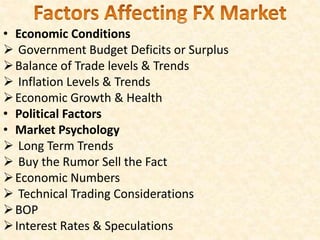
• Factor affecting
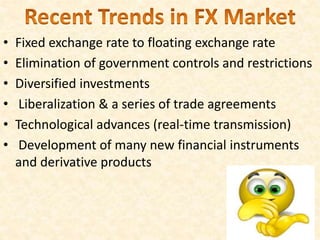
• Recent trends
• The foreign exchange market ( forex, FX, or currency
market) is a global decentralized market for the trading
of currencies.
• This includes all aspects of buying, selling and
exchanging currencies at current or determined prices.
• In terms of volume of trading, it is by far the largest
market in the world
• High liquidity
• Geographical dispersion
• Continuous operation : 24 hours a day except
weekends
• Low margins of relative profit compared with other
markets of fixed income
• The main three types of foreign exchange markets-
 The spot foreign exchange market,
 The forward foreign exchange market
 The future foreign exchange market
• In Spot Market , commodity is bought or sold for an
immediate delivery or delivery in the very near
future.
• The trades in the spot markets are settled on the
spot.
• It is contributing about 37 percent of the total
activity happening in all other types of foreign
exchange markets.
• The price quoted for immediate settlement on a
commodity, a security or a currency is known as The
spot rate or spot price.
• Features
highly paced markets
volatility
quick profits and losses
• Spot Rate value is based on how much buyers are willing
to pay and how much sellers are willing to accept. As a
result, spot rates change frequently and sometimes
dramatically.
• A spot transaction refers to an exchange of currencies at
the prevailing market rate. For most currencies, a spot
transaction consists of a two day settlement period but
for the Canadian dollar (CAD) and Mexican peso (MXN)
a spot transaction is settled in one business day.
• The forward exchange market is a market for
contracts that ensure the future delivery of a
foreign currency at a specified exchange rate.
• The price of a forward contract is known as the forward
rate.
• Forward rates are usually negotiated for delivery one
month, three months, or one year after the date of the
contract's creation. They usually differ from the spot
rate and from each other.
• The nature of forward types of foreign exchange
markets is decentralized, with participants from all over
the world entering into a different types of forex deals
either on a one on one basis or through forex brokers.
• Generally, forward foreign exchange market deals in
cash transactions only.
• The forward markets have no set terms with regard
to the settlement dates and this range from 3 days
to 3 years.
• A buyer & seller agree on an exchange rate for any
date in the future and the transaction occurs on
that date , regardless of what the market rates are
then .
• The forward FoRex currency markets types
comprise of two currency trading instruments-
futures and swaps.
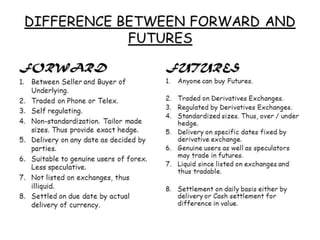
• The first thing is that any one can trade in future
market. It is open to all kind of traders in foreign
exchange market including individual traders.
• This is the difference between the future foreign
exchange market and the spot foreign exchange
market, since spot market is closed to individuals
traders except in case there are deals of high net
worth.
• This are standardize with respect to the quality &
quantity of the underlying asset .
• In a Swap , two parties exchange currencies for a
certain length of time and agree to reverse the
transaction at a later date .
• The buyer and seller are locked into a contract at a
fixed price that cannot be affected by any changes
in the market rates .
• These tools allow the market participants to plan
more safely , since they know in advance what their
FX will cost .
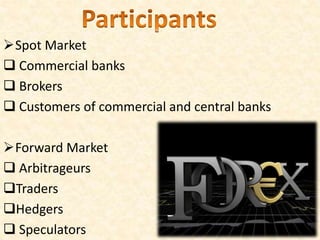
Spot Market
 Commercial banks
 Brokers
 Customers of commercial and central banks
Forward Market
 Arbitrageurs
Traders
Hedgers
 Speculators
 Foreign exchange market performs the following
three functions:
• Transfer Function:
It transfers purchasing power between the
countries involved in the transaction. This function
is performed through credit instruments like bills of
foreign exchange, bank drafts and telephonic
transfers.
• Credit Function:
It provides credit for foreign trade. Bills of
exchange, with maturity period of three months,
are generally used for international payments.
Credit is required for this period in order to enable
the importer to take possession of goods, sell them
and obtain money to pay off the bill.
• Hedging Function:
When exporters and importers enter into an
agreement to sell and buy goods on some future
date at the current prices and exchange rate, it is
called hedging. The purpose of hedging is to avoid
losses that might be caused due to exchange rate
variations in the future.
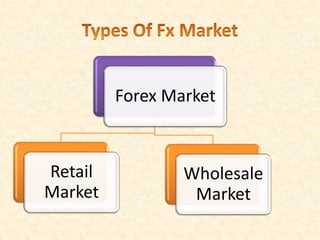
Forex Market
Retail
Market
Wholesale
Market
• Retail forex generally pertain to individual foreign
exchange traders that typically trade currencies in
smaller amounts.
• Such smaller traders will often use technical
analysis-based trading methods, and they generally
trade forex for speculative purposes.
• The exchange of bank notes , bank drafts , currency
, ordinary and traveler’s cheques between private
customers , tourists , banks takes place in retail
market .
• The Retail forex market refers to the currency
trading activities of all the non-institutional traders,
businesses, investors and other organizations.
• Owing largely to the introduction of online trading,
the costs associated with trading foreign currencies
have fallen sharply.
• Many businesses and individual traders have
entered the retail forex market through online
brokers rather than trading through bank desks or
other proprietary trading firms.
• It is also known as Inter-bank Market.
• The interbank market is the top-level foreign exchange
market where banks exchange different currencies.
• The banks can either deal with one another directly, or
through electronic brokering platforms.
• The interbank market is unregulated and decentralized.
There is no specific location or exchange where these
currency transactions take place
• Inter bank market have two parts
 direct market
 indirect market
• Here the banks trade between themselves in order
to remain liquid and meet customer demands for
deposits, withdrawals, and borrowing and for many
different purposes.
• The maximum maturity term of most transactions
in the interbank market is one month, and a
majority of interbank activity is conducted through
the real time gross settlement system (RTGS) where
there is no requirement of collateral.
• In performing overnight transactions, banks use the
main interest rates declared by the central bank of
the nation. This rate is called the federal funds rate
in the US, in the Eurozone it is the main refinancing
rate.In india this is called Call Money Rate.
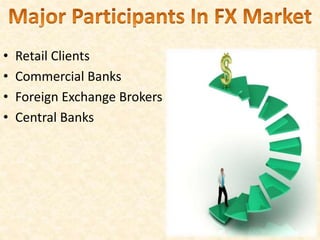
• Retail Clients
• Commercial Banks
• Foreign Exchange Brokers
• Central Banks
• Economic Conditions
 Government Budget Deficits or Surplus
Balance of Trade levels & Trends
 Inflation Levels & Trends
Economic Growth & Health
• Political Factors
• Market Psychology
 Long Term Trends
 Buy the Rumor Sell the Fact
Economic Numbers
 Technical Trading Considerations
BOP
Interest Rates & Speculations
• Fixed exchange rate to floating exchange rate
• Elimination of government controls and restrictions
• Diversified investments
• Liberalization & a series of trade agreements
• Technological advances (real-time transmission)
• Development of many new financial instruments
and derivative products
Global forex market

Global forex market

  • 2.
    • Characteristics • Types •Functions • Structure • Major participants • Factor affecting • Recent trends
  • 3.
    • The foreignexchange market ( forex, FX, or currency market) is a global decentralized market for the trading of currencies. • This includes all aspects of buying, selling and exchanging currencies at current or determined prices. • In terms of volume of trading, it is by far the largest market in the world
  • 4.
    • High liquidity •Geographical dispersion • Continuous operation : 24 hours a day except weekends • Low margins of relative profit compared with other markets of fixed income
  • 5.
    • The mainthree types of foreign exchange markets-  The spot foreign exchange market,  The forward foreign exchange market  The future foreign exchange market
  • 6.
    • In SpotMarket , commodity is bought or sold for an immediate delivery or delivery in the very near future. • The trades in the spot markets are settled on the spot. • It is contributing about 37 percent of the total activity happening in all other types of foreign exchange markets. • The price quoted for immediate settlement on a commodity, a security or a currency is known as The spot rate or spot price.
  • 7.
    • Features highly pacedmarkets volatility quick profits and losses • Spot Rate value is based on how much buyers are willing to pay and how much sellers are willing to accept. As a result, spot rates change frequently and sometimes dramatically. • A spot transaction refers to an exchange of currencies at the prevailing market rate. For most currencies, a spot transaction consists of a two day settlement period but for the Canadian dollar (CAD) and Mexican peso (MXN) a spot transaction is settled in one business day.
  • 8.
    • The forwardexchange market is a market for contracts that ensure the future delivery of a foreign currency at a specified exchange rate. • The price of a forward contract is known as the forward rate. • Forward rates are usually negotiated for delivery one month, three months, or one year after the date of the contract's creation. They usually differ from the spot rate and from each other. • The nature of forward types of foreign exchange markets is decentralized, with participants from all over the world entering into a different types of forex deals either on a one on one basis or through forex brokers.
  • 9.
    • Generally, forwardforeign exchange market deals in cash transactions only. • The forward markets have no set terms with regard to the settlement dates and this range from 3 days to 3 years. • A buyer & seller agree on an exchange rate for any date in the future and the transaction occurs on that date , regardless of what the market rates are then . • The forward FoRex currency markets types comprise of two currency trading instruments- futures and swaps.
  • 10.
    • The firstthing is that any one can trade in future market. It is open to all kind of traders in foreign exchange market including individual traders. • This is the difference between the future foreign exchange market and the spot foreign exchange market, since spot market is closed to individuals traders except in case there are deals of high net worth. • This are standardize with respect to the quality & quantity of the underlying asset .
  • 12.
    • In aSwap , two parties exchange currencies for a certain length of time and agree to reverse the transaction at a later date . • The buyer and seller are locked into a contract at a fixed price that cannot be affected by any changes in the market rates . • These tools allow the market participants to plan more safely , since they know in advance what their FX will cost .
  • 13.
    Spot Market  Commercialbanks  Brokers  Customers of commercial and central banks Forward Market  Arbitrageurs Traders Hedgers  Speculators
  • 14.
     Foreign exchangemarket performs the following three functions: • Transfer Function: It transfers purchasing power between the countries involved in the transaction. This function is performed through credit instruments like bills of foreign exchange, bank drafts and telephonic transfers.
  • 15.
    • Credit Function: Itprovides credit for foreign trade. Bills of exchange, with maturity period of three months, are generally used for international payments. Credit is required for this period in order to enable the importer to take possession of goods, sell them and obtain money to pay off the bill. • Hedging Function: When exporters and importers enter into an agreement to sell and buy goods on some future date at the current prices and exchange rate, it is called hedging. The purpose of hedging is to avoid losses that might be caused due to exchange rate variations in the future.
  • 16.
  • 17.
    • Retail forexgenerally pertain to individual foreign exchange traders that typically trade currencies in smaller amounts. • Such smaller traders will often use technical analysis-based trading methods, and they generally trade forex for speculative purposes. • The exchange of bank notes , bank drafts , currency , ordinary and traveler’s cheques between private customers , tourists , banks takes place in retail market .
  • 18.
    • The Retailforex market refers to the currency trading activities of all the non-institutional traders, businesses, investors and other organizations. • Owing largely to the introduction of online trading, the costs associated with trading foreign currencies have fallen sharply. • Many businesses and individual traders have entered the retail forex market through online brokers rather than trading through bank desks or other proprietary trading firms.
  • 19.
    • It isalso known as Inter-bank Market. • The interbank market is the top-level foreign exchange market where banks exchange different currencies. • The banks can either deal with one another directly, or through electronic brokering platforms. • The interbank market is unregulated and decentralized. There is no specific location or exchange where these currency transactions take place • Inter bank market have two parts  direct market  indirect market
  • 20.
    • Here thebanks trade between themselves in order to remain liquid and meet customer demands for deposits, withdrawals, and borrowing and for many different purposes. • The maximum maturity term of most transactions in the interbank market is one month, and a majority of interbank activity is conducted through the real time gross settlement system (RTGS) where there is no requirement of collateral. • In performing overnight transactions, banks use the main interest rates declared by the central bank of the nation. This rate is called the federal funds rate in the US, in the Eurozone it is the main refinancing rate.In india this is called Call Money Rate.
  • 21.
    • Retail Clients •Commercial Banks • Foreign Exchange Brokers • Central Banks
  • 22.
    • Economic Conditions Government Budget Deficits or Surplus Balance of Trade levels & Trends  Inflation Levels & Trends Economic Growth & Health • Political Factors • Market Psychology  Long Term Trends  Buy the Rumor Sell the Fact Economic Numbers  Technical Trading Considerations BOP Interest Rates & Speculations
  • 23.
    • Fixed exchangerate to floating exchange rate • Elimination of government controls and restrictions • Diversified investments • Liberalization & a series of trade agreements • Technological advances (real-time transmission) • Development of many new financial instruments and derivative products