Dr Catherine B Matheson-Monnet
c.b.matheson@soton.ac.uk
USING FORCE FIELD ANALYSIS AS A
STRUCTURED FOCUS GROUP ACTIVITY
Presentation to Wessex AHSN Learning Lab
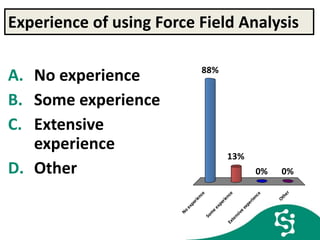
Experience of using Force Field Analysis
A. No experience
B. Some experience
C. Extensive
experience
D. Other
No
experience
Som
e
experienceExtensive
experience
Other
88%
0%0%
13%
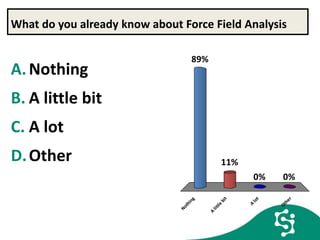
What do you already know about Force Field Analysis
A.Nothing
B. A little bit
C. A lot
D.Other
Nothing
A
little
bit
A
lot
Other
89%
0%0%
11%
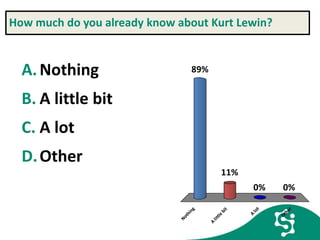
How much do you already know about Kurt Lewin?
A.Nothing
B. A little bit
C. A lot
D.Other
Nothing
A
little
bit
A
lot
Other
89%
0%0%
11%
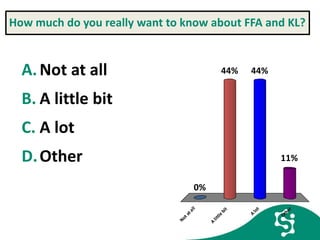
How much do you really want to know about FFA and KL?
A.Not at all
B. A little bit
C. A lot
D.Other
Notatall
A
little
bit
A
lot
Other
0%
11%
44%44%
LEARNING OUTCOMES
1.To define Force Field Analysis [FFA]
2.To explain how I have used FFA in
research and evaluation
3.To undertake a brainstorming and
ranking exercise based on FFA
1. To define Force
Field Analysis [FFA]]
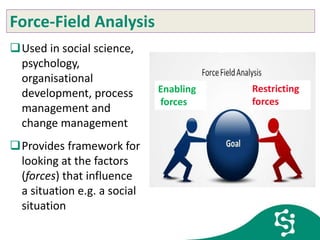
Force-Field Analysis
Used in social science,
psychology,
organisational
development, process
management and
change management
Provides framework for
looking at the factors
(forces) that influence
a situation e.g. a social
situation
Enabling
forces
Restricting
forces
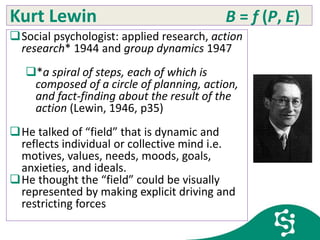
Kurt Lewin B = ƒ (P, E)
Social psychologist: applied research, action
research* 1944 and group dynamics 1947
*a spiral of steps, each of which is
composed of a circle of planning, action,
and fact-finding about the result of the
action (Lewin, 1946, p35)
He talked of “field” that is dynamic and
reflects individual or collective mind i.e.
motives, values, needs, moods, goals,
anxieties, and ideals.
He thought the “field” could be visually
represented by making explicit driving and
restricting forces
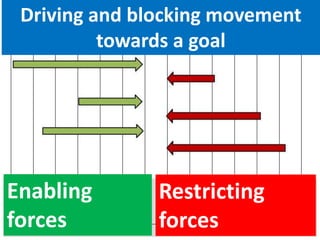
Driving and blocking movement
towards a goal
Enabling
forces
Restricting
forces
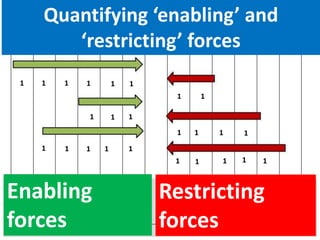
Quantifying ‘enabling’ and
‘restricting’ forces
1
1
11111
1 1
1 1 1 1
1 1 1 1 1
11
11111
Enabling
forces
Restricting
forces
2. To explain how I have
used FFA in research and
evaluation projects
FFA APPROACH FOR RESEARCH AND
EVALUATION OF NEW CARE MODELS
Very flexible and adaptable method
to gather quantitative and qualitative
data suitable for small or larger
groups and short or longer time slots
Used a FFA approach to research and
evaluation to gather collective views re
research questions, interventions or
proposed interventions
Can be done with participants of all
ages and in all contexts
Examples of evaluations using FFA approach
with NPT survey as part of structured focus group
CB Matheson-Monnet (2017) Using the Normalisation Process Theory [NPT] framework to
evaluate a new care model [NCM]: the Happy Healthy at Home [HHH] Enhanced
Recovery at Home [ER@H] Centre for Implementation Science. University of
Southampton. pp40. 11/2017. https://eprints.soton.ac.uk/417685/ See also pp24-
31 Independent evaluation of the Enhanced Recovery and Support at Home Service
https://cdn.southampton.ac.uk/assets/imported/transforms/content-
block/UsefulDownloads_Download/2B42EDD0659F413EBFA4D42FFD6287CB/ERS@
H%20-
%20Evaluation%20Report%20Finalised%2019122017.pdf#_ga=2.50378089.1919947
610.1565023954-1915557494.1486562982
P Darnton, CB Matheson-Monnet, F Campbell and L Beadle L (2018) Evaluation of the
Enhanced Recovery Service at Home [Happy, Healthy at Home and Frimley Health
Foundation Trust], Third NEHF Vanguard Evaluation Symposium: Out of Hospital
Urgent and Integrated Care, 14 March, slides 105-151
https://www.slideshare.net/WessexAHSN/happy-healthy-at-home-evaluation-
symposium-3
CB Matheson-Monnet CB, P Darnton, A Sibley A, J Sladen, T Benson, N Lawford and A Liles
(2018) Evaluation of the Enhanced Recovery Service at Home Service Team [Happy,
Healthy, at Home and Frimley Health Foundation Trust], Poster presentation, First
Implementation Science Research Conference, CLAHRC South London, Kings, College
London, 19 July https://twitter.com/DrCathWessexCIS/status/1019853576838025216
Examples of evaluations using FFA approach
[with NPT survey beforehand] as part of structured focus group
CB Matheson-Monnet (2017) Using the Normalisation Process Theory
[NPT] framework to evaluate a new care model [NCM]: the Happy
Healthy at Home [HHH] Yateley Integrated Care Team [ICTs] Centre
for Implementation Science. University of Southampton. pp27.
07/2017. https://eprints.soton.ac.uk/417686/ See also pp14-19
Yateley ICT Evaluation Report Final v2, pp13-19
http://www.northeasthampshireandfarnhamccg.nhs.uk/documents/n
orth-east-hampshire-and-farnham-vanguard/evaluation
CB Matheson-Monnet (2018) Team Evaluation, in Integrated Care
Teams, Yateley ICT 14 March, Third NEHF Vanguard Evaluation
Symposium: Out of Hospital Urgent and Integrated Care, 14 March,
slides 164-165 https://www.slideshare.net/WessexAHSN/happy-
healthy-at-home-evaluation-symposium-3
Examples of evaluations using FFA approach
[with NPT survey beforehand] as part of structured focus group
CB Matheson-Monnet (2018) Using the Normalisation Process Theory [NPT] to evaluate a New
Care Model: the Happy, Healthy at Home [HHH] Enhanced Integrated Teams [EICTs] in
Farnborough. Centre for Implementation Science. University of Southampton. Wessex AHSN
https://eprints.soton.ac.uk/id/eprint/424113 See also Farnborough ICT Evaluation Report
Final, pp17-27 http://www.northeasthampshireandfarnhamccg.nhs.uk/documents/north-
east-hampshire-and-farnham-vanguard/evaluation
CB Matheson-Monnet (2018) Using the Normalisation Process Theory [NPT] to evaluate a New
Care Model: the Happy, Healthy at Home [HHH] Enhanced Integrated Teams [EICTs] in
Aldershot. Centre for Implementation Science. University of Southampton. Wessex AHSN.
https://eprints.soton.ac.uk/id/eprint/423794 See also Aldershot ICT Evaluation Report Final,
pp18-27 https://www.northeasthampshireandfarnhamccg.nhs.uk/documents/north-east-
hampshire-and-farnham-vanguard/evaluation
CB Matheson-Monnet (2018) Using the Normalisation Process Theory [NPT] to evaluate a New
Care Model: the Happy, Healthy at Home [HHH] Enhanced Integrated Teams [EICTs] in Fleet.
Centre for Implementation Science, University of Southampton. Wessex AHSN
https://eprints.soton.ac.uk/id/eprint/423793 See also Fleet ICT Evaluation Report Final
https://www.northeasthampshireandfarnhamccg.nhs.uk/documents/north-east-hampshire-
and-farnham-vanguard/evaluation pp16-25
Examples of evaluations using FFA approach [with NPT survey
beforehand] as part of structured focus group
CB Matheson-Monnet (2018) Using the NPT framework to evaluate the
Enhanced Integrated Care Teams [EICTs] in Farnborough, Aldershot and
Fleet localities. Southampton: CIS/University of Southampton/Wessex
AHSN. pp 35. 02/2018. https://eprints.soton.ac.uk/id/eprint/423795
CB Matheson-Monnet (2017) Using the Normalisation Process Theory [NPT]
framework to evaluate a new care model [NCM]: the My Life a Full Life
Integrated Local Services [ILS]. Centre for Implementation Science.
University of Southampton. Wessex AHSN pp25. 07/2017.
https://eprints.soton.ac.uk/423793/
CB Matheson-Monnet, CF Brooks, A Argyropoulos and RE Guerrero-Luduena
(2019) Independent evaluation of the piloting of the implementation of
MymHealth [myCOPD, myHeart and myDiabetes] by Dorset CCG. Experience
of Service Users. 03/2019. Poster presentation for BMJ International Forum
on Quality and Safety in Healthcare, Glasgow, Scottish Exhibition Centre,
26-28 March
https://twitter.com/DrCathWessexCIS/status/1111589589662294016
3. To undertake a ‘FFA’ inspired
brainstorming and ranking
exercise about the recent
introduction of CRM [Client
Relationships Management] in
Wessex AHSN FFAFF
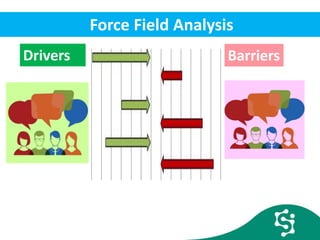
Force Field Analysis
DRIVERS
Driving
forces?
Restricting
forces?
Drivers Barriers
BARRIERS
2. “Post-its” collected and put on board/flipchart
1.Write 2-3 BARRIERS to CRM: one per “post-it”
3. “Post-its” put into categories
4. Allocate your 3 votes to your most important
BARRIER category/categories
See Matheson and Matheson 2009
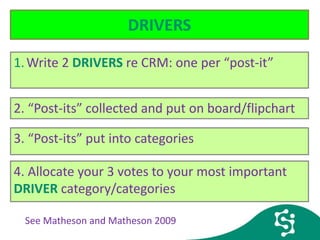
DRIVERS
2. “Post-its” collected and put on board/flipchart
1.Write 2 DRIVERS re CRM: one per “post-it”
3. “Post-its” put into categories
4. Allocate your 3 votes to your most important
DRIVER category/categories
See Matheson and Matheson 2009
Thoughts and feelings about your experience of
FFA brainstorming and ranking exercise?
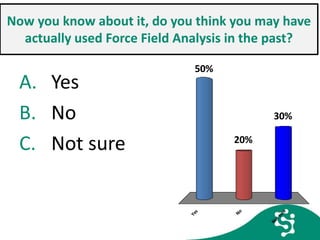
Now you know about it, do you think you may have
actually used Force Field Analysis in the past?
A. Yes
B. No
C. Not sure
Yes
No
Notsure
50%
30%
20%
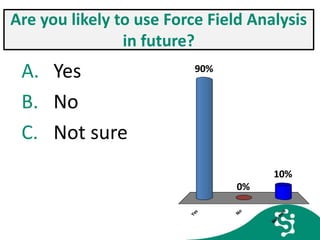
Are you likely to use Force Field Analysis
in future?
A. Yes
B. No
C. Not sure
Yes
No
Notsure
90%
10%
0%
Role Number [%]
Director 1 [25%]
Associate Director 2 [100%]
Senior Programme Managers 2 [40%]
Programme managers 3 [60%]
Assistant Programme managers 2 [100%]
CIS researchers 3 [75%]
Project support administrator 1 [25%]
Total 14 [44%]
 n=10 out of 32 members of staff Wessex AHSN/CIS took part in the brainstorming
and ranking exercise on 1 November 2017 (25 mins)
 n=4 who could not attend completed an electronic survey eliciting the same data as
the brainstorming and ranking exercise (5 mins).
Resultsof ranking drivers and barriers to using CRM[customer
relationshipmanagement] system
LEARNING OUTCOMES
1. I defined Force Field Analysis [FFA]
2. I explained how I have used FFA in
research and evaluation
3. We undertook a FFA inspired
brainstorming and ranking exercise in
relation to the introduction of CRM
Thank you
References
Lewin K (1951) Field Theory in Social Science. New York: Harper and Row
Lewin K (1943) Defining the Field at a Given Time. Psychological Review, 50, 3: 292–
310
Lewin, K. (1946) Action research and minority problems. J Soc. Issues, 2, 4: 34–46
Matheson CB and Matheson D (2013) Evaluation of the East Midlands Healthcare
Workforce Deanery Programme for Educational Supervisors Training [PEST]. Final
Report. Nottingham and Leicester EMHWD. pp50. 01/2013
Matheson CB and Matheson D (2009) Déballage d’idées, catégorisation et
hiérarchisation comme activités structurées en groupe focalisé. Pédagogie
médicale 10, 3, 61-63 http://dx.doi.org/10.1051/pedmed/2008021 and
https://eprints.soton.ac.uk/384175/
Matheson CB (2006) Optimal Cultural Distance: a new conceptual framework about
higher education and young and mature students and potential entrants from
under-represented socio-economic groups. PhD thesis. City University, London. pp
200 https://ethos.bl.uk/OrderDetails.do?uin=uk.bl.ethos.446452
Matheson CB (2000) Facilitating the transition from primary to secondary school.
Report. Northampton Borough Council.pp50

Force field analysis ppt

  • 1.
    Dr Catherine BMatheson-Monnet c.b.matheson@soton.ac.uk USING FORCE FIELD ANALYSIS AS A STRUCTURED FOCUS GROUP ACTIVITY Presentation to Wessex AHSN Learning Lab
  • 2.
    Experience of usingForce Field Analysis A. No experience B. Some experience C. Extensive experience D. Other No experience Som e experienceExtensive experience Other 88% 0%0% 13%
  • 3.
    What do youalready know about Force Field Analysis A.Nothing B. A little bit C. A lot D.Other Nothing A little bit A lot Other 89% 0%0% 11%
  • 4.
    How much doyou already know about Kurt Lewin? A.Nothing B. A little bit C. A lot D.Other Nothing A little bit A lot Other 89% 0%0% 11%
  • 5.
    How much doyou really want to know about FFA and KL? A.Not at all B. A little bit C. A lot D.Other Notatall A little bit A lot Other 0% 11% 44%44%
  • 6.
    LEARNING OUTCOMES 1.To defineForce Field Analysis [FFA] 2.To explain how I have used FFA in research and evaluation 3.To undertake a brainstorming and ranking exercise based on FFA
  • 7.
    1. To defineForce Field Analysis [FFA]]
  • 8.
    Force-Field Analysis Used insocial science, psychology, organisational development, process management and change management Provides framework for looking at the factors (forces) that influence a situation e.g. a social situation Enabling forces Restricting forces
  • 9.
    Kurt Lewin B= ƒ (P, E) Social psychologist: applied research, action research* 1944 and group dynamics 1947 *a spiral of steps, each of which is composed of a circle of planning, action, and fact-finding about the result of the action (Lewin, 1946, p35) He talked of “field” that is dynamic and reflects individual or collective mind i.e. motives, values, needs, moods, goals, anxieties, and ideals. He thought the “field” could be visually represented by making explicit driving and restricting forces
  • 10.
    Driving and blockingmovement towards a goal Enabling forces Restricting forces
  • 11.
    Quantifying ‘enabling’ and ‘restricting’forces 1 1 11111 1 1 1 1 1 1 1 1 1 1 1 11 11111 Enabling forces Restricting forces
  • 12.
    2. To explainhow I have used FFA in research and evaluation projects
  • 13.
    FFA APPROACH FORRESEARCH AND EVALUATION OF NEW CARE MODELS Very flexible and adaptable method to gather quantitative and qualitative data suitable for small or larger groups and short or longer time slots Used a FFA approach to research and evaluation to gather collective views re research questions, interventions or proposed interventions Can be done with participants of all ages and in all contexts
  • 14.
    Examples of evaluationsusing FFA approach with NPT survey as part of structured focus group CB Matheson-Monnet (2017) Using the Normalisation Process Theory [NPT] framework to evaluate a new care model [NCM]: the Happy Healthy at Home [HHH] Enhanced Recovery at Home [ER@H] Centre for Implementation Science. University of Southampton. pp40. 11/2017. https://eprints.soton.ac.uk/417685/ See also pp24- 31 Independent evaluation of the Enhanced Recovery and Support at Home Service https://cdn.southampton.ac.uk/assets/imported/transforms/content- block/UsefulDownloads_Download/2B42EDD0659F413EBFA4D42FFD6287CB/ERS@ H%20- %20Evaluation%20Report%20Finalised%2019122017.pdf#_ga=2.50378089.1919947 610.1565023954-1915557494.1486562982 P Darnton, CB Matheson-Monnet, F Campbell and L Beadle L (2018) Evaluation of the Enhanced Recovery Service at Home [Happy, Healthy at Home and Frimley Health Foundation Trust], Third NEHF Vanguard Evaluation Symposium: Out of Hospital Urgent and Integrated Care, 14 March, slides 105-151 https://www.slideshare.net/WessexAHSN/happy-healthy-at-home-evaluation- symposium-3 CB Matheson-Monnet CB, P Darnton, A Sibley A, J Sladen, T Benson, N Lawford and A Liles (2018) Evaluation of the Enhanced Recovery Service at Home Service Team [Happy, Healthy, at Home and Frimley Health Foundation Trust], Poster presentation, First Implementation Science Research Conference, CLAHRC South London, Kings, College London, 19 July https://twitter.com/DrCathWessexCIS/status/1019853576838025216
  • 15.
    Examples of evaluationsusing FFA approach [with NPT survey beforehand] as part of structured focus group CB Matheson-Monnet (2017) Using the Normalisation Process Theory [NPT] framework to evaluate a new care model [NCM]: the Happy Healthy at Home [HHH] Yateley Integrated Care Team [ICTs] Centre for Implementation Science. University of Southampton. pp27. 07/2017. https://eprints.soton.ac.uk/417686/ See also pp14-19 Yateley ICT Evaluation Report Final v2, pp13-19 http://www.northeasthampshireandfarnhamccg.nhs.uk/documents/n orth-east-hampshire-and-farnham-vanguard/evaluation CB Matheson-Monnet (2018) Team Evaluation, in Integrated Care Teams, Yateley ICT 14 March, Third NEHF Vanguard Evaluation Symposium: Out of Hospital Urgent and Integrated Care, 14 March, slides 164-165 https://www.slideshare.net/WessexAHSN/happy- healthy-at-home-evaluation-symposium-3
  • 16.
    Examples of evaluationsusing FFA approach [with NPT survey beforehand] as part of structured focus group CB Matheson-Monnet (2018) Using the Normalisation Process Theory [NPT] to evaluate a New Care Model: the Happy, Healthy at Home [HHH] Enhanced Integrated Teams [EICTs] in Farnborough. Centre for Implementation Science. University of Southampton. Wessex AHSN https://eprints.soton.ac.uk/id/eprint/424113 See also Farnborough ICT Evaluation Report Final, pp17-27 http://www.northeasthampshireandfarnhamccg.nhs.uk/documents/north- east-hampshire-and-farnham-vanguard/evaluation CB Matheson-Monnet (2018) Using the Normalisation Process Theory [NPT] to evaluate a New Care Model: the Happy, Healthy at Home [HHH] Enhanced Integrated Teams [EICTs] in Aldershot. Centre for Implementation Science. University of Southampton. Wessex AHSN. https://eprints.soton.ac.uk/id/eprint/423794 See also Aldershot ICT Evaluation Report Final, pp18-27 https://www.northeasthampshireandfarnhamccg.nhs.uk/documents/north-east- hampshire-and-farnham-vanguard/evaluation CB Matheson-Monnet (2018) Using the Normalisation Process Theory [NPT] to evaluate a New Care Model: the Happy, Healthy at Home [HHH] Enhanced Integrated Teams [EICTs] in Fleet. Centre for Implementation Science, University of Southampton. Wessex AHSN https://eprints.soton.ac.uk/id/eprint/423793 See also Fleet ICT Evaluation Report Final https://www.northeasthampshireandfarnhamccg.nhs.uk/documents/north-east-hampshire- and-farnham-vanguard/evaluation pp16-25
  • 17.
    Examples of evaluationsusing FFA approach [with NPT survey beforehand] as part of structured focus group CB Matheson-Monnet (2018) Using the NPT framework to evaluate the Enhanced Integrated Care Teams [EICTs] in Farnborough, Aldershot and Fleet localities. Southampton: CIS/University of Southampton/Wessex AHSN. pp 35. 02/2018. https://eprints.soton.ac.uk/id/eprint/423795 CB Matheson-Monnet (2017) Using the Normalisation Process Theory [NPT] framework to evaluate a new care model [NCM]: the My Life a Full Life Integrated Local Services [ILS]. Centre for Implementation Science. University of Southampton. Wessex AHSN pp25. 07/2017. https://eprints.soton.ac.uk/423793/ CB Matheson-Monnet, CF Brooks, A Argyropoulos and RE Guerrero-Luduena (2019) Independent evaluation of the piloting of the implementation of MymHealth [myCOPD, myHeart and myDiabetes] by Dorset CCG. Experience of Service Users. 03/2019. Poster presentation for BMJ International Forum on Quality and Safety in Healthcare, Glasgow, Scottish Exhibition Centre, 26-28 March https://twitter.com/DrCathWessexCIS/status/1111589589662294016
  • 18.
    3. To undertakea ‘FFA’ inspired brainstorming and ranking exercise about the recent introduction of CRM [Client Relationships Management] in Wessex AHSN FFAFF
  • 19.
  • 20.
    BARRIERS 2. “Post-its” collectedand put on board/flipchart 1.Write 2-3 BARRIERS to CRM: one per “post-it” 3. “Post-its” put into categories 4. Allocate your 3 votes to your most important BARRIER category/categories See Matheson and Matheson 2009
  • 21.
    DRIVERS 2. “Post-its” collectedand put on board/flipchart 1.Write 2 DRIVERS re CRM: one per “post-it” 3. “Post-its” put into categories 4. Allocate your 3 votes to your most important DRIVER category/categories See Matheson and Matheson 2009
  • 22.
    Thoughts and feelingsabout your experience of FFA brainstorming and ranking exercise?
  • 23.
    Now you knowabout it, do you think you may have actually used Force Field Analysis in the past? A. Yes B. No C. Not sure Yes No Notsure 50% 30% 20%
  • 24.
    Are you likelyto use Force Field Analysis in future? A. Yes B. No C. Not sure Yes No Notsure 90% 10% 0%
  • 25.
    Role Number [%] Director1 [25%] Associate Director 2 [100%] Senior Programme Managers 2 [40%] Programme managers 3 [60%] Assistant Programme managers 2 [100%] CIS researchers 3 [75%] Project support administrator 1 [25%] Total 14 [44%]  n=10 out of 32 members of staff Wessex AHSN/CIS took part in the brainstorming and ranking exercise on 1 November 2017 (25 mins)  n=4 who could not attend completed an electronic survey eliciting the same data as the brainstorming and ranking exercise (5 mins). Resultsof ranking drivers and barriers to using CRM[customer relationshipmanagement] system
  • 26.
    LEARNING OUTCOMES 1. Idefined Force Field Analysis [FFA] 2. I explained how I have used FFA in research and evaluation 3. We undertook a FFA inspired brainstorming and ranking exercise in relation to the introduction of CRM
  • 27.
  • 28.
    References Lewin K (1951)Field Theory in Social Science. New York: Harper and Row Lewin K (1943) Defining the Field at a Given Time. Psychological Review, 50, 3: 292– 310 Lewin, K. (1946) Action research and minority problems. J Soc. Issues, 2, 4: 34–46 Matheson CB and Matheson D (2013) Evaluation of the East Midlands Healthcare Workforce Deanery Programme for Educational Supervisors Training [PEST]. Final Report. Nottingham and Leicester EMHWD. pp50. 01/2013 Matheson CB and Matheson D (2009) Déballage d’idées, catégorisation et hiérarchisation comme activités structurées en groupe focalisé. Pédagogie médicale 10, 3, 61-63 http://dx.doi.org/10.1051/pedmed/2008021 and https://eprints.soton.ac.uk/384175/ Matheson CB (2006) Optimal Cultural Distance: a new conceptual framework about higher education and young and mature students and potential entrants from under-represented socio-economic groups. PhD thesis. City University, London. pp 200 https://ethos.bl.uk/OrderDetails.do?uin=uk.bl.ethos.446452 Matheson CB (2000) Facilitating the transition from primary to secondary school. Report. Northampton Borough Council.pp50

Editor's Notes

  • #21 Déballage d’idées, catégorisation et hiérarchisation comme activités structurées en groupe focalisé. Pédagogie médicale 10, 3, 61-63
  • #22 Déballage d’idées, catégorisation et hiérarchisation comme activités structurées en groupe focalisé. Pédagogie médicale 10, 3, 61-63