PowerPoint presentation to accompany
Besterfield
Quality Control, 8e
Chapter 12- Management
and Planning Tools
Quality Control
Some Problems (Challenges) !
 Undergraduate Unemployment
 Improve customer experience in a restaurant
 topics for research/project
 expending/relocation business entity
 improve customer experience driving a car
 improving health care system
 What are the consequences of children watching
violent television shows and playing violent video
games?
 ISO Implementation in an organzation
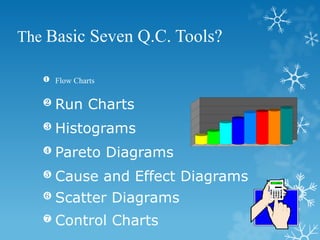
The Basic Seven Q.C. Tools?
 Flow Charts
 Run Charts
 Histograms
 Pareto Diagrams
 Cause and Effect Diagrams
 Scatter Diagrams
 Control Charts
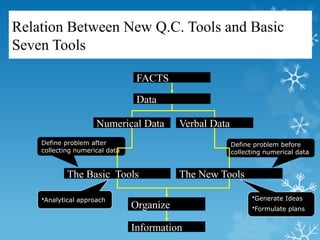
Relation Between New Q.C. Tools and Basic
Seven Tools
FACTS
Data
Numerical Data Verbal Data
Organize
The New Tools
Information
The Basic Tools
•Generate Ideas
•Formulate plans
•Analytical approach
Define problem after
collecting numerical data
Define problem before
collecting numerical data
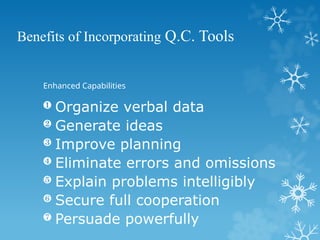
Benefits of Incorporating Q.C. Tools
Enhanced Capabilities
 Generate ideas
 Improve planning
 Eliminate errors and omissions
 Explain problems intelligibly
 Secure full cooperation
 Persuade powerfully
 Organize verbal data
Benefits of Incorporating Q.C. Tools
 Clarify the desired situation
 Prioritize tasks effectively
 Proceed systematically
 Anticipate future events
 Change proactively
 Get things right the first time
 Assess situations from various angles
Benefits of Incorporating Q.C. Tools
Five Objectives of Organizational Reform
which will establish a Culture that:
 Gives importance to planning
 Stresses the importance of the process
 Prioritizes tasks
 Encourages everyone to think
systematically
 Identifies problems
Benefits of Incorporating Q.C. Tools
Unstructured Problem [must be put into solvable form]
Problem is mapped
Problem becomes
obvious to all
Problem is in solvable form
The Seven New Tools
Thoughts are
easily organized
Things go well
People understand
problem
Cooperation is
obtained
Countermeasures
are on target
Problem becomes
obvious to all
Nub of problem
is identified
Problem can be
clearly articulated
Plans are
easily laid
Nothing is
omitted
Source: Nayatani, Y., The Seven New QC Tools (Tokyo, Japan, 3A Corporation, 1984)
Why, Why
Key to finding the root cause of a problem by
focusing on the process rather than on people.
Describes the problem in specific terms and then
ask “why”.
This tool is very beneficial in developing critical
thinking.
It is frequently a quick method of solving
problems.
Management and Planning Tools
These tools are particularly useful in
structuring unstructured ideas, making
strategic plans, organizing and controlling
large and complex projects.
These tools are very effective for teams and,
in some cases, for individuals.
Management and Planning Tools
Subjective information.
Applications of these tools has been proven
useful in process improvement, cost reduction,
policy deployment, and new-product
development.
85% of poor quality is a result of
poor work processes, not of staff
doing a bad job
Processes often “go wrong” at the
point of the “handoff”
Attend to improving the overall
process, not just one part—some of
the most complex processes are
the result of creating a “work
around”
Outline
1.Force Field Analysis
2.Nominal Group Technique
3.Affinity Diagram
4.Interrelationship Diagram
Outline
6. Tree Diagram
7. Matrix Diagram
8. Prioritization Matrices
9. Process Decision Program Chart
10.Activity Network Diagram
Learning Objectives
When you complete this chapter, you should:
 Be able to describe the why, why, forced field, and nominal group techniques.
 Know how to develop and utilize the following tools:
Affinity Diagram
Interrelationship Diagram
Tree Diagram
Matrix Diagram
Learning Objectives-cont’d.
When you complete this chapter, you should:
Know how to develop and utilize the
following tools cont’d.:
Process Decision Program Chart
Activity Network Diagram
Prioritization Matrices
Forced Field Analysis
Identifies the forces and factors that may
influence the problem or goal.
Helps an organization to better understand
promoting or driving and restraining or inhibiting
forces so that the positives can be reinforced and
the negatives reduced or eliminated.
Forced Field Analysis
Steps:
1. Define the objective.
2. Determine criteria for evaluating the
effectiveness of the improvement action.
3. Brainstorm the forces that promote and inhibit
achieving the goal.
Forced Field Analysis
Steps cont’d.:
4.Prioritize the forces from greatest to
least.
5.Take action to strengthen the promoting
forces and weaken the inhibiting forces.
Forced Field Analysis
Benefits:
Determine the positives and negatives of
a situation.
Encourage people to agree and prioritize
the competing forces.
Identify the root causes.
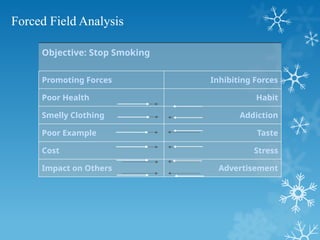
Forced Field Analysis
Objective: Stop Smoking
Promoting Forces Inhibiting Forces
Poor Health Habit
Smelly Clothing Addiction
Poor Example Taste
Cost Stress
Impact on Others Advertisement
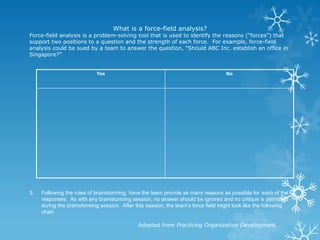
What is a force-field analysis?
Force-field analysis is a problem-solving tool that is used to identify the reasons (“forces”) that
support two positions to a question and the strength of each force. For example, force-field
analysis could be sued by a team to answer the question, “Should ABC Inc. establish an office in
Singapore?”
3. Following the rules of brainstorming, have the team provide as many reasons as possible for each of the
responses. As with any brainstorming session, no answer should be ignored and no critique is permitted
during the brainstorming session. After this session, the team’s force field might look like the following
chart:
Yes No
Adapted from Practicing Organization Development
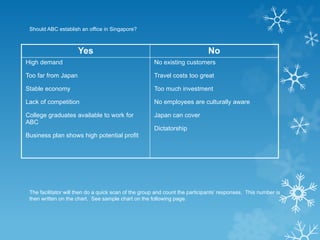
Should ABC establish an office in Singapore?
Yes No
High demand
Too far from Japan
Stable economy
Lack of competition
College graduates available to work for
ABC
Business plan shows high potential profit
No existing customers
Travel costs too great
Too much investment
No employees are culturally aware
Japan can cover
Dictatorship
The facilitator will then do a quick scan of the group and count the participants’ responses. This number is
then written on the chart. See sample chart on the following page.
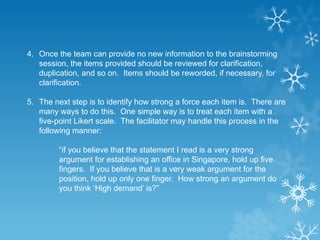
4. Once the team can provide no new information to the brainstorming
session, the items provided should be reviewed for clarification,
duplication, and so on. Items should be reworded, if necessary, for
clarification.
5. The next step is to identify how strong a force each item is. There are
many ways to do this. One simple way is to treat each item with a
five-point Likert scale. The facilitator may handle this process in the
following manner:
“if you believe that the statement I read is a very strong
argument for establishing an office in Singapore, hold up five
fingers. If you believe that is a very weak argument for the
position, hold up only one finger. How strong an argument do
you think ‘High demand’ is?”
Yes No
5 High demand
3 Too far from Japan
4 Stable economy
2 Lack of competition
2 College graduates available to work for ABC
5 Business plan shows high potential profit
1 No existing customers
2 Travel costs too great
5 Too much investment
2 No employees are culturally aware
5 Japan can cover
3 Dictatorship
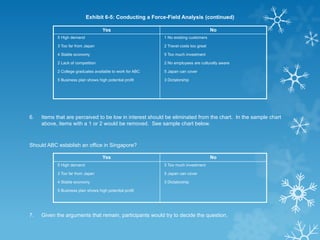
6. Items that are perceived to be low in interest should be eliminated from the chart. In the sample chart
above, items with a 1 or 2 would be removed. See sample chart below.
Should ABC establish an office in Singapore?
Yes No
5 High demand
3 Too far from Japan
4 Stable economy
5 Business plan shows high potential profit
5 Too much investment
5 Japan can cover
3 Dictatorship
7. Given the arguments that remain, participants would try to decide the question.
Exhibit 6-5: Conducting a Force-Field Analysis (continued)
Nominal Group Technique
Provides the issues/ideas input from
everyone on the team and for effective
decisions.
Nominal Group Technique
Steps:
1. Everyone writes on a piece of paper the situation they think
is most important.
2. The papers are collected, and all situations are listed on a flip
chart.
3. Rank the situations (using another paper). Give numerical
values 1…
4. Points for each problem are totaled and the item with the
highest number of points is considered to be the most
important.
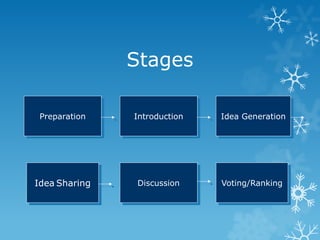
Stages
Introduction
Idea Sharing
Idea Generation
Discussion Voting/Ranking
Preparation
Example of NGT
The faculty at X-University is
concerned that the students are not
getting internships and jobs. A team is
created involving faculty, students, and
recruiters. The goal is to identify the
cause of this problem. After this NGT
process, the faculty will create an action
plan based on the outcome.
Example of NGT
Statement of Problem:
Why aren’t students getting
internships and job offers?
Individual idea generation:
Not enough recruiters come.
Their resumes are weak.
Students are unwilling to
relocate.
Students are
unprepared.
No internships
prevents them
from getting jobs
later on.
The career fair is not
productive.
Everyone wants to stay
in-state.
The job market is slow.
Poor interview skills.
They’re not
networking.
Idea Sharing:
Discussion:
What do you
mean by
“poor
interview
skills?”
Does that
include lack
of training?
Is the career
fair not
productive
because
there are too
many people
or too few?
Can we re-
word that to
say, “There
aren’t job
opportunities
through the
career fair?”
Should
we
combine
“unwilling
ness to
relocate”
with
“students
wanting
to stay in-
state?”
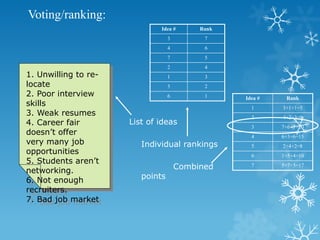
Voting/ranking:
Idea # Rank
3 7
4 6
7 5
2 4
1 3
5 2
6 1
1. Unwilling to re-
locate
2. Poor interview
skills
3. Weak resumes
4. Career fair
doesn’t offer
very many job
opportunities
5. Students aren’t
networking.
6. Not enough
recruiters.
7. Bad job market
Idea # Rank
1 3+1+1=5
2 4+2+3=9
3 7+6+7=20
4 6+3+6=15
5 2+4+2=8
6 1+5+4=10
7 5+7+5=17
List of ideas
Individual rankings
Combined
points
Affinity Diagram
A tool for organizing a large number of
ideas, opinions, and facts relating to a
broad problem or subject area.
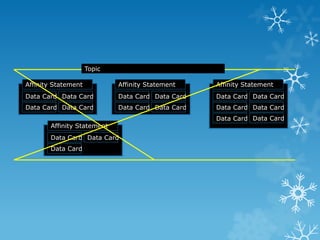
Affinity Diagram
Procedure:
1. State the issue in a full sentence.
2. Brainstorm using short sentences on
self-adhesive notes.
3. Post them for the team to see.
4. Sort ideas into logical groups.
5. Create concise descriptive headings for each
group.
Topic
Affinity Statement
Data Card
Data Card
Data Card
Data Card
Affinity Statement
Data Card
Data Card
Data Card
Data Card
Affinity Statement
Data Card
Data Card
Data Card
Affinity Statement
Data Card
Data Card
Data Card
Data Card
Data Card Data Card
Activity
Innovative product features
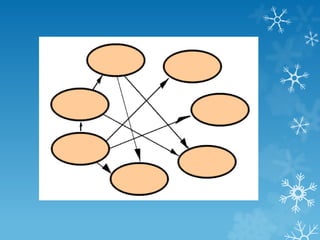
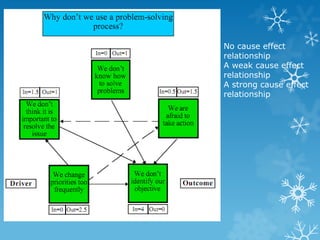
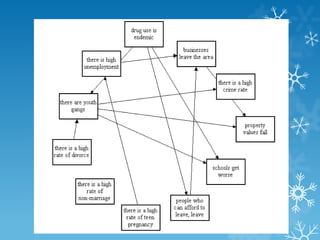
Interrelationship Diagram
Identifies and explores causal relationships
among related concepts or ideas.
It allows the team to classify the cause-and-
effect relationships among all factors so that the
key drivers and outcomes can be used to solve
the problem.
Interrelationship Diagram
Steps:
1. The team should agree on the issue or problem
statement.
2. All of the ideas or issues from other techniques or
from brainstorming should be laid out.
3. Start with the first issue.
4. The second iteration is to compare other issues.
Interrelationship Diagram
Steps cont’d.:
5. The entire diagram should be reviewed and
revised where necessary.
6. The diagram is completed by tallying the
incoming and outgoing arrows and placing
this information below the box.
No cause effect
relationship
A weak cause effect
relationship
A strong cause effect
relationship
Interrelationship Diagram
Benefits:
Allows the team to identify root causes from
subjective data.
Systematically explores cause-and-effect
relationships.
Encourages members to think
multidirectionally.
Develops team harmony and effectiveness.
Tree Diagram
Maps out the paths and tasks necessary to
complete a specific project or reach a specified
goal.
Tree Diagram
Procedure:
1. Choose an action-oriented objective statement from
the interrelationship diagram, affinity diagram,
brainstorming, team mission statement.
2. Using brainstorming, choose the major headings.
3. Generate the next level by analyzing the major
headings. Repeat this question at each level.
Tree Diagram
Benefits:
Encourages team members to think
creatively.
Makes large projects manageable.
Generates a problem-solving
atmosphere.
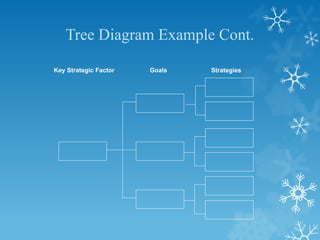
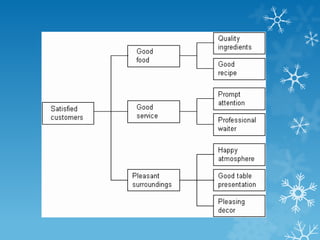
Tree Diagram Example Cont.
Key Strategic Factor Goals Strategies
Matrix Diagram
 Display relationships between ideas, activities or other
dimensions in such a way as to provide logical
connecting points between each item.
 Data are presented in table form and can be objective or
subjective, which can be given symbols with or without
numerical values.
 Identified in 1988 book, Management for Quality
Improvement by Shigeru Mizuno
Matrix Diagram
Procedure:
1. Select the factors affecting a successful
plan.
2. Select the appropriate format (depend on
the number of variables).
3. Determine the relationship symbols.
Matrix Diagram
Benefits:
Encourage the team to think in terms
of relationship, their strength, and
any pattern.
Matrix Diagram Exercise
A restaurant manager wants to
improve customer’s dining
experience!
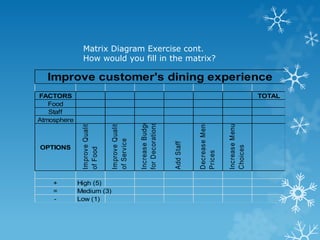
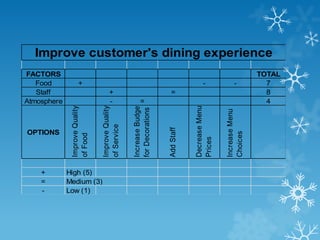
Matrix Diagram Exercise cont.
How would you fill in the matrix?
FACTORS TOTAL
Food
Staff
Atmosphere
OPTIONS
Improve
Quality
of
Food
Improve
Quality
of
Service
Increase
Budget
for
Decorations
Add
Staff
Decrease
Menu
Prices
Increase
Menu
Choices
+ High (5)
=
- Low (1)
Medium (3)
Improve customer's dining experience
FACTORS TOTAL
Food + - - 7
Staff + = 8
Atmosphere - = 4
OPTIONS
Improve
Quality
of
Food
Improve
Quality
of
Service
Increase
Budget
for
Decorations
Add
Staff
Decrease
Menu
Prices
Increase
Menu
Choices
+ High (5)
=
- Low (1)
Medium (3)
Improve customer's dining experience
Prioritization Matrices
Prioritizes issues, tasks, characteristics, based on
weighted criteria using a combination of tree and
matrix diagram techniques.
Once prioritized, effective decision can be made.
Prioritization matrices are designed to reduce the
team’s options rationally before implementation
planning occurs.
Prioritization Matrices
Steps:
1. Construct an L-Shaped matrix combining the
options, which are the lowest-level of detail of
the tree diagram with the criteria.
2. Determine the implementation criteria using the
nominal group technique (NGT) or any other
technique that will satisfactorily weight the
criteria.
Prioritization Matrices
Steps cont’d.:
3. Prioritize the criteria using the NGT. Each team
member weights the criteria so the total weight
equals 1, and the results are totaled for the entire
team.
4. Rank order the options in terms of importance by
each criterion, average the results, and round to
the nearest whole number.
Prioritization Matrices
Steps cont’d.:
5. Compute the option importance score under
each criterion by multiplying the rank by the
criteria weight.
-- refer to handout 1
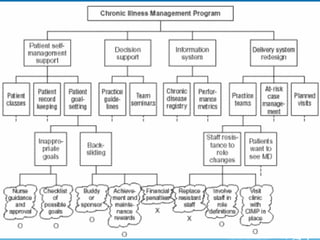
Process Decision Program Chart
The PDPC avoids surprises and identifies possible
countermeasures.
PDPC is a method for mapping out every
conceivable event and contingency that can occur
when moving from a problem statement to possible
solutions.
Process Decision Program Chart
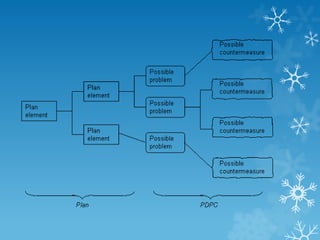
Steps:
1. The team state the objective.
2. That activity is followed by the first level.
3. In some cases a second level of detailed
activities may be used.
4. The team brainstorms to determine what
could go wrong with the conference, and
these are shown as the “what-if” level.
Process Decision Program Chart
Steps cont’d.:
5. The countermeasures are brainstormed and
placed in a balloon in the last level.
6. The last step is to evaluate the countermeasures
and select the optimal ones by placing an O
underneath. Place an X under those that are
rejected.
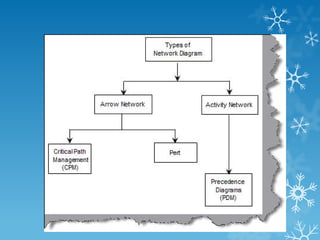
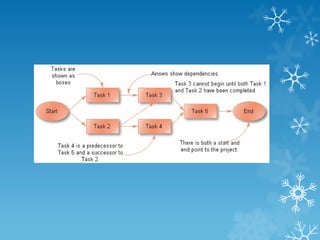
Activity Network Diagram
Program evaluation and review technique
(PERT).
Critical path method (CPM).
Arrow diagram.
Activity on node (AON).
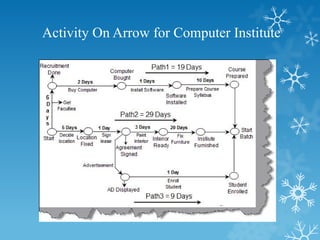
The diagram shows completion times,
simultaneous tasks, and critical activity path.
Activity Network Diagram
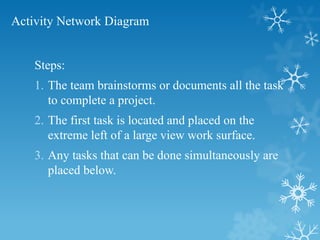
Steps:
1. The team brainstorms or documents all the task
to complete a project.
2. The first task is located and placed on the
extreme left of a large view work surface.
3. Any tasks that can be done simultaneously are
placed below.
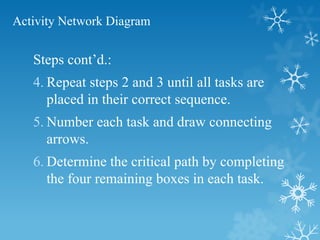
Activity Network Diagram
Steps cont’d.:
4. Repeat steps 2 and 3 until all tasks are
placed in their correct sequence.
5. Number each task and draw connecting
arrows.
6. Determine the critical path by completing
the four remaining boxes in each task.
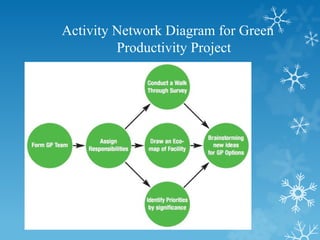
Activity Network Diagram for Green
Productivity Project
Computer Training
Center
Activity On Arrow for Computer Institute
Recommendations to Use Q.C. Tools
Mental Attitudes
- Keen awareness to the actual problem
- Eagerness to solve problem
- Be highly motivated for the challenge
Four Specific Keys
 Understand the problem
 Select the right tool for the job
 Obtain appropriate verbal data
 Interpret analytical results
 Understand the problem
Stage 1 - problem is unclear and not obvious
what exact issue should be addressed
Stage 2 - problem is obvious, but causes unknown
explore causes and single out valid ones
Stage 3 - problem and causes are known
required action is unknown
strategies and plan must be developed
Recommendations to Use Q.C. Tools
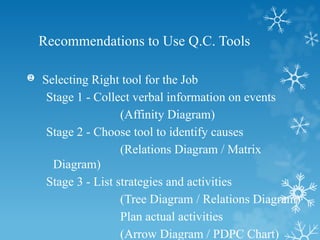
 Selecting Right tool for the Job
Stage 1 - Collect verbal information on events
(Affinity Diagram)
Stage 2 - Choose tool to identify causes
(Relations Diagram / Matrix
Diagram)
Stage 3 - List strategies and activities
(Tree Diagram / Relations Diagram)
Plan actual activities
(Arrow Diagram / PDPC Chart)
Recommendations to Use Q.C. Tools
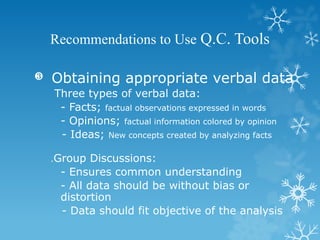
 Obtaining appropriate verbal data
Three types of verbal data:
- Facts; factual observations expressed in words
- Opinions; factual information colored by opinion
- Ideas; New concepts created by analyzing facts
.Group Discussions:
- Ensures common understanding
- All data should be without bias or
distortion
- Data should fit objective of the analysis
Recommendations to Use Q.C. Tools
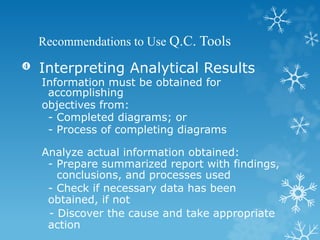
 Interpreting Analytical Results
Information must be obtained for
accomplishing
objectives from:
- Completed diagrams; or
- Process of completing diagrams
Analyze actual information obtained:
- Prepare summarized report with findings,
conclusions, and processes used
- Check if necessary data has been
obtained, if not
- Discover the cause and take appropriate
action
Recommendations to Use Q.C. Tools
Exercises
 The roles of
 Suppliers
 Customers
 Efficiency
 Effectiveness
 Service Industry Innovativeness
 Value-added services and its benefits to the customers
 Management tools to manufacture a product
 Small group (< 5)
 Big group

quality-systems-management_management-tools.pptx

  • 1.
    PowerPoint presentation toaccompany Besterfield Quality Control, 8e Chapter 12- Management and Planning Tools Quality Control
  • 2.
    Some Problems (Challenges)!  Undergraduate Unemployment  Improve customer experience in a restaurant  topics for research/project  expending/relocation business entity  improve customer experience driving a car  improving health care system  What are the consequences of children watching violent television shows and playing violent video games?  ISO Implementation in an organzation
  • 3.
    The Basic SevenQ.C. Tools?  Flow Charts  Run Charts  Histograms  Pareto Diagrams  Cause and Effect Diagrams  Scatter Diagrams  Control Charts
  • 4.
    Relation Between NewQ.C. Tools and Basic Seven Tools FACTS Data Numerical Data Verbal Data Organize The New Tools Information The Basic Tools •Generate Ideas •Formulate plans •Analytical approach Define problem after collecting numerical data Define problem before collecting numerical data
  • 5.
    Benefits of IncorporatingQ.C. Tools Enhanced Capabilities  Generate ideas  Improve planning  Eliminate errors and omissions  Explain problems intelligibly  Secure full cooperation  Persuade powerfully  Organize verbal data
  • 6.
    Benefits of IncorporatingQ.C. Tools  Clarify the desired situation  Prioritize tasks effectively  Proceed systematically  Anticipate future events  Change proactively  Get things right the first time  Assess situations from various angles
  • 7.
    Benefits of IncorporatingQ.C. Tools Five Objectives of Organizational Reform which will establish a Culture that:  Gives importance to planning  Stresses the importance of the process  Prioritizes tasks  Encourages everyone to think systematically  Identifies problems
  • 8.
    Benefits of IncorporatingQ.C. Tools Unstructured Problem [must be put into solvable form] Problem is mapped Problem becomes obvious to all Problem is in solvable form The Seven New Tools Thoughts are easily organized Things go well People understand problem Cooperation is obtained Countermeasures are on target Problem becomes obvious to all Nub of problem is identified Problem can be clearly articulated Plans are easily laid Nothing is omitted Source: Nayatani, Y., The Seven New QC Tools (Tokyo, Japan, 3A Corporation, 1984)
  • 9.
    Why, Why Key tofinding the root cause of a problem by focusing on the process rather than on people. Describes the problem in specific terms and then ask “why”. This tool is very beneficial in developing critical thinking. It is frequently a quick method of solving problems.
  • 10.
    Management and PlanningTools These tools are particularly useful in structuring unstructured ideas, making strategic plans, organizing and controlling large and complex projects. These tools are very effective for teams and, in some cases, for individuals.
  • 11.
    Management and PlanningTools Subjective information. Applications of these tools has been proven useful in process improvement, cost reduction, policy deployment, and new-product development.
  • 12.
    85% of poorquality is a result of poor work processes, not of staff doing a bad job Processes often “go wrong” at the point of the “handoff” Attend to improving the overall process, not just one part—some of the most complex processes are the result of creating a “work around”
  • 13.
    Outline 1.Force Field Analysis 2.NominalGroup Technique 3.Affinity Diagram 4.Interrelationship Diagram
  • 14.
    Outline 6. Tree Diagram 7.Matrix Diagram 8. Prioritization Matrices 9. Process Decision Program Chart 10.Activity Network Diagram
  • 15.
    Learning Objectives When youcomplete this chapter, you should:  Be able to describe the why, why, forced field, and nominal group techniques.  Know how to develop and utilize the following tools: Affinity Diagram Interrelationship Diagram Tree Diagram Matrix Diagram
  • 16.
    Learning Objectives-cont’d. When youcomplete this chapter, you should: Know how to develop and utilize the following tools cont’d.: Process Decision Program Chart Activity Network Diagram Prioritization Matrices
  • 17.
    Forced Field Analysis Identifiesthe forces and factors that may influence the problem or goal. Helps an organization to better understand promoting or driving and restraining or inhibiting forces so that the positives can be reinforced and the negatives reduced or eliminated.
  • 18.
    Forced Field Analysis Steps: 1.Define the objective. 2. Determine criteria for evaluating the effectiveness of the improvement action. 3. Brainstorm the forces that promote and inhibit achieving the goal.
  • 19.
    Forced Field Analysis Stepscont’d.: 4.Prioritize the forces from greatest to least. 5.Take action to strengthen the promoting forces and weaken the inhibiting forces.
  • 20.
    Forced Field Analysis Benefits: Determinethe positives and negatives of a situation. Encourage people to agree and prioritize the competing forces. Identify the root causes.
  • 21.
    Forced Field Analysis Objective:Stop Smoking Promoting Forces Inhibiting Forces Poor Health Habit Smelly Clothing Addiction Poor Example Taste Cost Stress Impact on Others Advertisement
  • 22.
    What is aforce-field analysis? Force-field analysis is a problem-solving tool that is used to identify the reasons (“forces”) that support two positions to a question and the strength of each force. For example, force-field analysis could be sued by a team to answer the question, “Should ABC Inc. establish an office in Singapore?” 3. Following the rules of brainstorming, have the team provide as many reasons as possible for each of the responses. As with any brainstorming session, no answer should be ignored and no critique is permitted during the brainstorming session. After this session, the team’s force field might look like the following chart: Yes No Adapted from Practicing Organization Development
  • 23.
    Should ABC establishan office in Singapore? Yes No High demand Too far from Japan Stable economy Lack of competition College graduates available to work for ABC Business plan shows high potential profit No existing customers Travel costs too great Too much investment No employees are culturally aware Japan can cover Dictatorship The facilitator will then do a quick scan of the group and count the participants’ responses. This number is then written on the chart. See sample chart on the following page.
  • 24.
    4. Once theteam can provide no new information to the brainstorming session, the items provided should be reviewed for clarification, duplication, and so on. Items should be reworded, if necessary, for clarification. 5. The next step is to identify how strong a force each item is. There are many ways to do this. One simple way is to treat each item with a five-point Likert scale. The facilitator may handle this process in the following manner: “if you believe that the statement I read is a very strong argument for establishing an office in Singapore, hold up five fingers. If you believe that is a very weak argument for the position, hold up only one finger. How strong an argument do you think ‘High demand’ is?”
  • 25.
    Yes No 5 Highdemand 3 Too far from Japan 4 Stable economy 2 Lack of competition 2 College graduates available to work for ABC 5 Business plan shows high potential profit 1 No existing customers 2 Travel costs too great 5 Too much investment 2 No employees are culturally aware 5 Japan can cover 3 Dictatorship 6. Items that are perceived to be low in interest should be eliminated from the chart. In the sample chart above, items with a 1 or 2 would be removed. See sample chart below. Should ABC establish an office in Singapore? Yes No 5 High demand 3 Too far from Japan 4 Stable economy 5 Business plan shows high potential profit 5 Too much investment 5 Japan can cover 3 Dictatorship 7. Given the arguments that remain, participants would try to decide the question. Exhibit 6-5: Conducting a Force-Field Analysis (continued)
  • 26.
    Nominal Group Technique Providesthe issues/ideas input from everyone on the team and for effective decisions.
  • 27.
    Nominal Group Technique Steps: 1.Everyone writes on a piece of paper the situation they think is most important. 2. The papers are collected, and all situations are listed on a flip chart. 3. Rank the situations (using another paper). Give numerical values 1… 4. Points for each problem are totaled and the item with the highest number of points is considered to be the most important.
  • 28.
  • 29.
    Example of NGT Thefaculty at X-University is concerned that the students are not getting internships and jobs. A team is created involving faculty, students, and recruiters. The goal is to identify the cause of this problem. After this NGT process, the faculty will create an action plan based on the outcome.
  • 30.
    Example of NGT Statementof Problem: Why aren’t students getting internships and job offers?
  • 31.
    Individual idea generation: Notenough recruiters come. Their resumes are weak. Students are unwilling to relocate. Students are unprepared. No internships prevents them from getting jobs later on. The career fair is not productive. Everyone wants to stay in-state. The job market is slow. Poor interview skills. They’re not networking.
  • 32.
  • 33.
    Discussion: What do you meanby “poor interview skills?” Does that include lack of training? Is the career fair not productive because there are too many people or too few? Can we re- word that to say, “There aren’t job opportunities through the career fair?” Should we combine “unwilling ness to relocate” with “students wanting to stay in- state?”
  • 34.
    Voting/ranking: Idea # Rank 37 4 6 7 5 2 4 1 3 5 2 6 1 1. Unwilling to re- locate 2. Poor interview skills 3. Weak resumes 4. Career fair doesn’t offer very many job opportunities 5. Students aren’t networking. 6. Not enough recruiters. 7. Bad job market Idea # Rank 1 3+1+1=5 2 4+2+3=9 3 7+6+7=20 4 6+3+6=15 5 2+4+2=8 6 1+5+4=10 7 5+7+5=17 List of ideas Individual rankings Combined points
  • 35.
    Affinity Diagram A toolfor organizing a large number of ideas, opinions, and facts relating to a broad problem or subject area.
  • 36.
    Affinity Diagram Procedure: 1. Statethe issue in a full sentence. 2. Brainstorm using short sentences on self-adhesive notes. 3. Post them for the team to see. 4. Sort ideas into logical groups. 5. Create concise descriptive headings for each group.
  • 37.
    Topic Affinity Statement Data Card DataCard Data Card Data Card Affinity Statement Data Card Data Card Data Card Data Card Affinity Statement Data Card Data Card Data Card Affinity Statement Data Card Data Card Data Card Data Card Data Card Data Card
  • 38.
  • 39.
    Interrelationship Diagram Identifies andexplores causal relationships among related concepts or ideas. It allows the team to classify the cause-and- effect relationships among all factors so that the key drivers and outcomes can be used to solve the problem.
  • 41.
    Interrelationship Diagram Steps: 1. Theteam should agree on the issue or problem statement. 2. All of the ideas or issues from other techniques or from brainstorming should be laid out. 3. Start with the first issue. 4. The second iteration is to compare other issues.
  • 42.
    Interrelationship Diagram Steps cont’d.: 5.The entire diagram should be reviewed and revised where necessary. 6. The diagram is completed by tallying the incoming and outgoing arrows and placing this information below the box.
  • 43.
    No cause effect relationship Aweak cause effect relationship A strong cause effect relationship
  • 45.
    Interrelationship Diagram Benefits: Allows theteam to identify root causes from subjective data. Systematically explores cause-and-effect relationships. Encourages members to think multidirectionally. Develops team harmony and effectiveness.
  • 46.
    Tree Diagram Maps outthe paths and tasks necessary to complete a specific project or reach a specified goal.
  • 47.
    Tree Diagram Procedure: 1. Choosean action-oriented objective statement from the interrelationship diagram, affinity diagram, brainstorming, team mission statement. 2. Using brainstorming, choose the major headings. 3. Generate the next level by analyzing the major headings. Repeat this question at each level.
  • 48.
    Tree Diagram Benefits: Encourages teammembers to think creatively. Makes large projects manageable. Generates a problem-solving atmosphere.
  • 49.
    Tree Diagram ExampleCont. Key Strategic Factor Goals Strategies
  • 51.
    Matrix Diagram  Displayrelationships between ideas, activities or other dimensions in such a way as to provide logical connecting points between each item.  Data are presented in table form and can be objective or subjective, which can be given symbols with or without numerical values.  Identified in 1988 book, Management for Quality Improvement by Shigeru Mizuno
  • 52.
    Matrix Diagram Procedure: 1. Selectthe factors affecting a successful plan. 2. Select the appropriate format (depend on the number of variables). 3. Determine the relationship symbols.
  • 53.
    Matrix Diagram Benefits: Encourage theteam to think in terms of relationship, their strength, and any pattern.
  • 54.
    Matrix Diagram Exercise Arestaurant manager wants to improve customer’s dining experience!
  • 55.
    Matrix Diagram Exercisecont. How would you fill in the matrix? FACTORS TOTAL Food Staff Atmosphere OPTIONS Improve Quality of Food Improve Quality of Service Increase Budget for Decorations Add Staff Decrease Menu Prices Increase Menu Choices + High (5) = - Low (1) Medium (3) Improve customer's dining experience
  • 56.
    FACTORS TOTAL Food +- - 7 Staff + = 8 Atmosphere - = 4 OPTIONS Improve Quality of Food Improve Quality of Service Increase Budget for Decorations Add Staff Decrease Menu Prices Increase Menu Choices + High (5) = - Low (1) Medium (3) Improve customer's dining experience
  • 57.
    Prioritization Matrices Prioritizes issues,tasks, characteristics, based on weighted criteria using a combination of tree and matrix diagram techniques. Once prioritized, effective decision can be made. Prioritization matrices are designed to reduce the team’s options rationally before implementation planning occurs.
  • 58.
    Prioritization Matrices Steps: 1. Constructan L-Shaped matrix combining the options, which are the lowest-level of detail of the tree diagram with the criteria. 2. Determine the implementation criteria using the nominal group technique (NGT) or any other technique that will satisfactorily weight the criteria.
  • 59.
    Prioritization Matrices Steps cont’d.: 3.Prioritize the criteria using the NGT. Each team member weights the criteria so the total weight equals 1, and the results are totaled for the entire team. 4. Rank order the options in terms of importance by each criterion, average the results, and round to the nearest whole number.
  • 60.
    Prioritization Matrices Steps cont’d.: 5.Compute the option importance score under each criterion by multiplying the rank by the criteria weight. -- refer to handout 1
  • 61.
    Process Decision ProgramChart The PDPC avoids surprises and identifies possible countermeasures. PDPC is a method for mapping out every conceivable event and contingency that can occur when moving from a problem statement to possible solutions.
  • 63.
    Process Decision ProgramChart Steps: 1. The team state the objective. 2. That activity is followed by the first level. 3. In some cases a second level of detailed activities may be used. 4. The team brainstorms to determine what could go wrong with the conference, and these are shown as the “what-if” level.
  • 64.
    Process Decision ProgramChart Steps cont’d.: 5. The countermeasures are brainstormed and placed in a balloon in the last level. 6. The last step is to evaluate the countermeasures and select the optimal ones by placing an O underneath. Place an X under those that are rejected.
  • 66.
    Activity Network Diagram Programevaluation and review technique (PERT). Critical path method (CPM). Arrow diagram. Activity on node (AON). The diagram shows completion times, simultaneous tasks, and critical activity path.
  • 68.
    Activity Network Diagram Steps: 1.The team brainstorms or documents all the task to complete a project. 2. The first task is located and placed on the extreme left of a large view work surface. 3. Any tasks that can be done simultaneously are placed below.
  • 69.
    Activity Network Diagram Stepscont’d.: 4. Repeat steps 2 and 3 until all tasks are placed in their correct sequence. 5. Number each task and draw connecting arrows. 6. Determine the critical path by completing the four remaining boxes in each task.
  • 70.
    Activity Network Diagramfor Green Productivity Project
  • 72.
  • 73.
    Activity On Arrowfor Computer Institute
  • 74.
    Recommendations to UseQ.C. Tools Mental Attitudes - Keen awareness to the actual problem - Eagerness to solve problem - Be highly motivated for the challenge Four Specific Keys  Understand the problem  Select the right tool for the job  Obtain appropriate verbal data  Interpret analytical results
  • 75.
     Understand theproblem Stage 1 - problem is unclear and not obvious what exact issue should be addressed Stage 2 - problem is obvious, but causes unknown explore causes and single out valid ones Stage 3 - problem and causes are known required action is unknown strategies and plan must be developed Recommendations to Use Q.C. Tools
  • 76.
     Selecting Righttool for the Job Stage 1 - Collect verbal information on events (Affinity Diagram) Stage 2 - Choose tool to identify causes (Relations Diagram / Matrix Diagram) Stage 3 - List strategies and activities (Tree Diagram / Relations Diagram) Plan actual activities (Arrow Diagram / PDPC Chart) Recommendations to Use Q.C. Tools
  • 77.
     Obtaining appropriateverbal data Three types of verbal data: - Facts; factual observations expressed in words - Opinions; factual information colored by opinion - Ideas; New concepts created by analyzing facts .Group Discussions: - Ensures common understanding - All data should be without bias or distortion - Data should fit objective of the analysis Recommendations to Use Q.C. Tools
  • 78.
     Interpreting AnalyticalResults Information must be obtained for accomplishing objectives from: - Completed diagrams; or - Process of completing diagrams Analyze actual information obtained: - Prepare summarized report with findings, conclusions, and processes used - Check if necessary data has been obtained, if not - Discover the cause and take appropriate action Recommendations to Use Q.C. Tools
  • 79.
    Exercises  The rolesof  Suppliers  Customers  Efficiency  Effectiveness  Service Industry Innovativeness  Value-added services and its benefits to the customers  Management tools to manufacture a product  Small group (< 5)  Big group

Editor's Notes

  • #3 Flow Charts - pictorial representation showing all of the steps of a process Run Charts - used to analyze processes according to time or order Histograms - bar graphs with frequency intervals Pareto Diagrams - 80/20 histograms for identifying and prioritizing problems Cause and Effect Diagrams - fishbone diagrams Scatter Diagrams - Identifies the possible relationship between the changes observed in two different sets of variables. Control Charts - used to determine whether a process will produce a product or service with consistent measurable properties
  • #4 This shows how the N7 and the B7 complement each other in solving quality-related problems. Facts -> to Data! Do people provide data in numerical form or verbally? (How do you?) Information - This is the most IMPORTANT GOAL!!! Without the info, there will be no KNOWLEDGE gained which is required for achieving our goal! (Nayatini 4)
  • #5 The N7 are used for promoting Total Quality. The goals for TQM are: Ensuring company fulfills obligations, Securing profits, Developing people (Nayatini 9) The N7 enhance the capabilities of every employee. It has a direct impact on developing the workforce. At the same time, the effectiveness and efficiency is greatly enhanced which results directly on the bottom-line.
  • #6 The N7 will lead to Organizational Reform system-wide. These keys lead to a greater set of skills. The most important being, the ability to be proactive in anticipating future problems. (Nayatini 10)
  • #7 The Organizational Reform establishes a system wide Culture that should result in stimulating people to think for themselves. This culture should result in a workforce that is constantly “Thinking TQM” and being “Creative with TQM”. (Nayatini 10)
  • #8 The N7 are techniques for untangling the intricate relationships among the different variables of a problem. Using the N7 makes it easy to clarify the situation, establish a plan, and get to the root cause of the the problem. It also makes it easier to explain the situation and get “buy-in” with their cooperation. (Nayatini 6)
  • #29 This is an example of how to use NGT. It is a fake scenario, but one when a team might use NGT to problem solve. Once they identify the source of the problem, they could run another round of NGT to brainstorm solutions. Note, however, that this practice is to find the SOURCE of the problem, not the solution. (This is one of the disadvantages of the tool: the scope is limited. You can’t approach multiple ideas at once, which can eliminate synergies.)
  • #30 The facilitator would explain this purpose to the team, and explain the NGT process.
  • #31 Each person on the team will create a list of ideas.
  • #32 The facilitator records the ideas.
  • #33 Ideas are shared in a round robin style, by the facilitator reading cards, or volunteered ideas. The facilitator will decide how to maximize the team members.
  • #34 Given the combined list of ideas, each team member does individual rankings, scoring the 7 ideas from 1-7. Highest score is the best. Each individual’s rankings are totaled, giving the combined points for each idea. (In this example, we use only 3 team members.) The third idea scored the highest number of points (20) so it would be the output of the NGT.
  • #74 For a TQM culture to exist and flourish, the most important factor to consider is mental attitude. This allows for complete awareness to the problem and an eagerness to solve it. The N7 Tools assist in developing the proper mental attitude. These tools will also motivate the group to meet the challenge. To use The N7 Tools skillfully, four specific keys and abilities need to be recognized. (Nayatini 117)
  • #75 When solving a problem using the The N7 Tools it is essential to know which stage of the problem-solving process that you have reached. Which of the tools to use depends on the clarity of the problem. Also can the problem be identified, and if the causes are known and how to eliminate them. There are three stages to the solution of the of a problem. They are: Review each bullet point! (Nayatini 121)
  • #76 Be sure to choose the right tool for the job! When you know which stage you have reached in the problem solving, the goal will become clear and the right tool will present itself. With a Stage 1 problem, collect verbal information and use an Affinity Diagram to structure it. You will be able to identify the problem. With a Stage 2 problem, choose a tool that will enable you to identify its causes. The Relations Diagram is appropriate when complex relationships exist among causes of a single result. The Matrix Diagram is effective when there are many problems or effects and can be related in row/column format. With a Stage 3 problem, some method is needed to list and plan the activities required to solve the problem. A Tree Diagram can develop key points or strategies to achieve an objective. After the activities for solving the problem are identified, a schedule can be devise for carrying them out. An Arrow Diagram should be used for this. The PDPC can be used to develop and modified for the plan. (Nayatini 124)
  • #77 When gathering the verbal data, it is best to use a group setting. It ensures total understanding from all participants. It is also important to distinguish the different types of verbal data. They are: Review each bullet! The goal for gathering verbal data by group discussion should include: (Nayatini 124) Review each bullet!
  • #78 It is essential to obtain the correct information for accomplishing the objectives. When using the N7 Tools, never construct a diagram and leave it that way. Always make some type of record of the findings, conclusions drawn, and the exact process used for constructing the diagram. This is especially true with Affinity Diagrams and Relations Diagrams. Do not forget to check the results of analysis to ensure that you have actually obtained the data you need. If you have not, it is due to insufficient data or unskillful use of the N7 Tools. (Nayatini 126)