Nurturing Potential Assignment 1 Roles and Responsibilities Legislation for the FE Sector  Webinar 2 Analysis of the problem
IILM 3 Webinar 2: Objectives Define a problem Identify four tools for analysing problems List and Discuss three styles of decision making Examine key skills in critical thinking Identify the problem solving process
ILM Webinar 2: The problem is defined  when Everyone who reads your problem statement, including you, understands what will be different when the problem is solved. Your team agrees that it describes the correct problem.
Gathering Information -  Exploration of the Problem
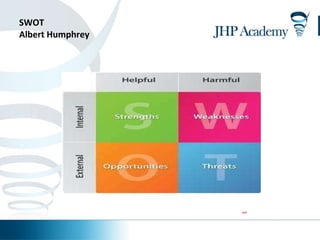
SWOT Albert Humphrey “”
ILM Webinar 2: Threats What threats could harm you? What threats do your weaknesses expose you to? Opportunities What opportunities are available to you? How can you turn your strengths into opportunities? Weaknesses What could you improve? What might others regard as weaknesses? Strengths What do you do well? What do others see as your strengths?
ILM Webinar 2: Your Strengths
ILM Webinar 2: Your Weaknesses
ILM Webinar 2: Your Opportunities
ILM Webinar 2: Your Threats
Fishbone Kaoru Ishikawa   Promoting inclusion of children with special needs in mainstream extended services Access Finance Transport Capacity Attitudes Reliance on voluntary agencies Wheelchair access limited   Bullying Limited number of specially qualified staff Staff work- life balance issues Specialist transport  required Training Need to adjust travel times Need for special equipment & materials Need to train up mainstream staff Unreliable estimates of costs
ILM Webinar 2: Your fishbone Category Cause Effect
Force Field Analysis (Lewin 1951) “”
ILM Webinar 2: Your Problem Negative Forces ( - ) Positive Forces ( + )
Board Storming Alex Osborn Successful outcome requires: no criticism No arguing no negativism no evaluation Large quantities of ideas Record: problems opportunities ideas.
ILM Webinar 2: BOARDSTORM
Three decision making styles   Reflexive Style: Tends to make quick decisions and, as a result, may not take the time to consider and evaluate all possible solutions.  Reflective Style: Takes time to identify, analyse and evaluate as many alternatives to solving a problem situation as possible.  Consistent Style: Based on an appropriate amount of information and evaluation, a decision is made in a reasonable amount of time.
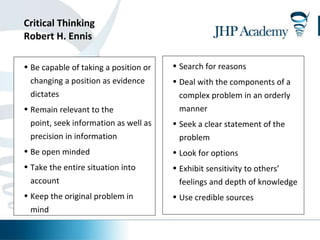
Critical Thinking Robert H. Ennis   Search for reasons Deal with the components of a complex problem in an orderly manner Seek a clear statement of the problem Look for options Exhibit sensitivity to others’ feelings and depth of knowledge Use credible sources  Be capable of taking a position or changing a position as evidence dictates Remain relevant to the point, seek information as well as precision in information  Be open minded Take the entire situation into account Keep the original problem in mind
Task 2 Assessment criteria Information to identify possible solutions to a problem is gathered and interpreted Analysis of the problem Gather and interpret information to identify possible options to solve the problem (min 13 marks required from 25 available) Word count 300-400   M3.01 Solving Problems and Making Decisions Task 2. Analysis of the Problem
ILM 3 Webinar 2 Objectives Define a problem Identify four tools for analysing problems List and Discuss three styles of decision making Examine key skills in critical thinking Identify the problem solving process
Sources  SWOT Analysis http://www.isu.edu/acadaff/swot/index.shtml Fishbone Analysis http://www.skymark.com/resources/leaders/ishikawa.asp Force Field Analysis http://rapidbi.com/created/forcefieldanalysis/ Board Storming http://www.brainstorming.co.uk/tutorials/historyofbrainstorming.html Critical Thinking  http:// faculty.ed.uiuc.edu/rhennis /

Webinar 2 analysis ofthe problem_final

  • 1.
    Nurturing Potential Assignment1 Roles and Responsibilities Legislation for the FE Sector Webinar 2 Analysis of the problem
  • 2.
    IILM 3 Webinar2: Objectives Define a problem Identify four tools for analysing problems List and Discuss three styles of decision making Examine key skills in critical thinking Identify the problem solving process
  • 3.
    ILM Webinar 2:The problem is defined when Everyone who reads your problem statement, including you, understands what will be different when the problem is solved. Your team agrees that it describes the correct problem.
  • 4.
    Gathering Information - Exploration of the Problem
  • 5.
  • 6.
    ILM Webinar 2:Threats What threats could harm you? What threats do your weaknesses expose you to? Opportunities What opportunities are available to you? How can you turn your strengths into opportunities? Weaknesses What could you improve? What might others regard as weaknesses? Strengths What do you do well? What do others see as your strengths?
  • 7.
    ILM Webinar 2:Your Strengths
  • 8.
    ILM Webinar 2:Your Weaknesses
  • 9.
    ILM Webinar 2:Your Opportunities
  • 10.
    ILM Webinar 2:Your Threats
  • 11.
    Fishbone Kaoru Ishikawa Promoting inclusion of children with special needs in mainstream extended services Access Finance Transport Capacity Attitudes Reliance on voluntary agencies Wheelchair access limited Bullying Limited number of specially qualified staff Staff work- life balance issues Specialist transport required Training Need to adjust travel times Need for special equipment & materials Need to train up mainstream staff Unreliable estimates of costs
  • 12.
    ILM Webinar 2:Your fishbone Category Cause Effect
  • 13.
    Force Field Analysis(Lewin 1951) “”
  • 14.
    ILM Webinar 2:Your Problem Negative Forces ( - ) Positive Forces ( + )
  • 15.
    Board Storming AlexOsborn Successful outcome requires: no criticism No arguing no negativism no evaluation Large quantities of ideas Record: problems opportunities ideas.
  • 16.
    ILM Webinar 2:BOARDSTORM
  • 17.
    Three decision makingstyles Reflexive Style: Tends to make quick decisions and, as a result, may not take the time to consider and evaluate all possible solutions. Reflective Style: Takes time to identify, analyse and evaluate as many alternatives to solving a problem situation as possible. Consistent Style: Based on an appropriate amount of information and evaluation, a decision is made in a reasonable amount of time.
  • 18.
    Critical Thinking RobertH. Ennis Search for reasons Deal with the components of a complex problem in an orderly manner Seek a clear statement of the problem Look for options Exhibit sensitivity to others’ feelings and depth of knowledge Use credible sources Be capable of taking a position or changing a position as evidence dictates Remain relevant to the point, seek information as well as precision in information Be open minded Take the entire situation into account Keep the original problem in mind
  • 19.
    Task 2 Assessmentcriteria Information to identify possible solutions to a problem is gathered and interpreted Analysis of the problem Gather and interpret information to identify possible options to solve the problem (min 13 marks required from 25 available) Word count 300-400 M3.01 Solving Problems and Making Decisions Task 2. Analysis of the Problem
  • 20.
    ILM 3 Webinar2 Objectives Define a problem Identify four tools for analysing problems List and Discuss three styles of decision making Examine key skills in critical thinking Identify the problem solving process
  • 21.
    Sources SWOTAnalysis http://www.isu.edu/acadaff/swot/index.shtml Fishbone Analysis http://www.skymark.com/resources/leaders/ishikawa.asp Force Field Analysis http://rapidbi.com/created/forcefieldanalysis/ Board Storming http://www.brainstorming.co.uk/tutorials/historyofbrainstorming.html Critical Thinking http:// faculty.ed.uiuc.edu/rhennis /

Editor's Notes

  • #4 Remind in the first session discussed a problem statement
  • #5 This is the initial activity of decision making in which you think about all of the possibilities related to the problem and the decision.
  • #6 Refer to resources on vle re swot analysis
  • #12 Each of the key factors can then be broken down into subsidiary factors that need to be understood before moving on to solutions in the development phase. The team should be encouraged to brainstorm each main ‘bone of the fish’ in turn. Perhaps each member of the team can take responsibility for facilitating the brainstorming of one main bone. That way it becomes a team-building exercise also.
  • #13 Think of one possible area that may be affecting your problem and why that area is not as it should be
  • #15 Again think of one area and annotate
  • #18 Refer to quiz in VLE
  • #19 Way a person thinks to solve a problem, be open minded,remove emotion,think critically,be logical. Choose 3 that you think are the most important.