GAURAV SAINI
MM-263-2K13
FORCE
FILED
ANALYSIS
CONTENTS
• INTRODUCTION
• CONCEPT BEHIND IT
• LEWIN’S VIEW
• DIAGRAMMATICALLY EXPLAINATION
• STEPS OR PROCESS.
• PURPOSE
• SKILLS REQUIRED
• USES OF THIS MODEL
• CONCLUSION
• REFERENCE
Kurt Lewin [1890 - 1947]
Kurt Lewin was an American
psychologist and having contributedto
science groupdynamics & action
research, but perhaps he is being well
known for developing force field analysis
INTRODUCTION
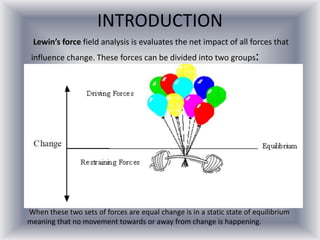
Lewin’s force field analysis is evaluates the net impact of all forces that
influence change. These forces can be divided into two groups:
Driving forces
• Driving forces are all
forces that push for and
promote change. These
change drivers promote
and encourage the
change process. Some
examples of driving
forces are executive
mandate, customer
demands, and increased
efficiency.
Restraining forces
• Restraining forces are
forces that make change
more difficult. These
forces counteract driving
forces and lead to the
avoidance or resistance
of change. Some
examples of restraining
forces are fear, lack of
training, and the lack of
incentives.
When these two sets of forces are equal change is in a static state of equilibrium
meaning that no movement towards or away from change is happening.
Force field analysis is a management technique
developed by Kurt Lewin, a pioneer in the field of
social sciences, for diagnosing situations.
Lewin assumes that in any situation there are both
driving and restraining forces that influence any
change that may occur:
 Driving Forces
 Restraining Forces
 Equilibrium
Lewin’s Three-Step Model of Lewin
Organizational Change
Purpose
•FFA is an analysis technique to identify forces that
either drive or restrain planned change aimed at
solving a problem in an organization.
•It is a creative activity that can be used by needs
analysts as they focus on solutions which will help an
organization make a transformation from the ‘current
(problem) state’ to the ‘desired (solved) state’ as they
identify interventions to improve performance.
FORCE FIELD ANALYSIS can be used to:
Identify the forces
which support
change as well as
those which will
act against it.
Assess the causes of
performance
problems or
inhibitors to
business
opportunities.
Evaluate the relative
strength of forces that
affect alternative
solutions to
performance
problems or business
opportunities.
Help analyze and
prioritize solutions
to problems or
areas needing
improvement
FORCE FIELD
ANALYSIS
Field Force Process is …
Unfreezing--melting away resistance
Change--departure from the status quo
Refreezing--change becomes routine
Force-field analysis focuses our attention on ways of reducing the
hindering forces and encouraging the positive ones.
WHY TO USE?
When to Use It:
It helps team members to view each case as two
sets of off setting factors.
It can be used to study existing problems, or to
anticipate and plan more effectively for
implementing change.
In problem analysis, force-field analysis is
especially helpful in defining more subjective
issues, such as morale, management,
effectiveness, and work climate.
HOW TO USE IT?
Defining the Problem
Defining the Change Objective
Identifying the Driving Forces
Identifying the Restraining Forces
Review and clarify each force or factor
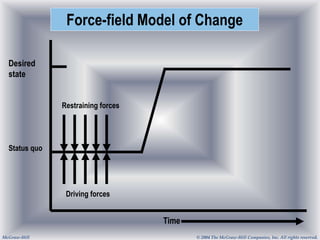
Restraining forces
Driving forces
Status quo
Desired
state
Time
Force-field Model of Change
McGraw-Hill © 2004 The McGraw-Hill Companies, Inc. All rights reserved.
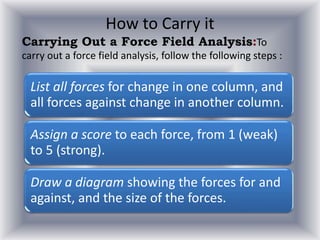
Carrying Out a Force Field Analysis:To
carry out a force field analysis, follow the following steps :
List all forces for change in one column, and
all forces against change in another column.
Assign a score to each force, from 1 (weak)
to 5 (strong).
Draw a diagram showing the forces for and
against, and the size of the forces.
How to Carry it
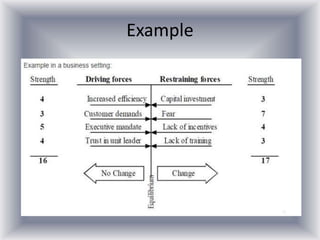
Example
Case study: UPGRADE FACTORY WITH NEW
MANUFACTURING MACHINE
•NOT DADICATED
TEACHERS
•LACK OF
COMMUNICATION
BETWEEN TEACHERS
AND ADMINISTRATORS
•LACK OF MINIMUM
FACILITIES IN SCHOOL
•TEXT BOOKS NOT
RELEVENT
•UNTRAINED TEACHRES
CUSTOMER WANT NEW
PRODUCTS
IMPROVE SPEED OF
PRODUCTION
RAISE VOLUME OF
OUTPUT
MAINTENANACE COST
INCREASING
LOSS OF STAFF OVERTIME
STAFF FRIGHTENED OF
NEW TECHNOLOGY
ENVIRONMENTAL
IMPACT OF NEW
TECHNOLOGY
COST
DISRUPTION
UPGADE FACTORY
WITH NEW
MANUFACTURING
MACHINARY
4
2
3
1
3
3
1
3
1
TOTAL:10 TOTAL: 11
FORCE FOR CHANGE FORCE AGAINST CHANGE
Advantages of Force Field Analysis
Brings into the open factors which will work
for and against the closing of a gap
Identified by a needs analysis.
Helps to recognize circumstances which can and
cannot be changed.
Provides a means to analyze ways to minimize
or eliminate barriers to goal attainment.
The Limitations of Force Field Analysis
Process is subjective and requires collaborative
thinking and agreement
Concerning forces for and against the solution to
a particular problem.
May oversimplify the relationships between
factors that impact a problem.
All aspects of a problem may not be identified.
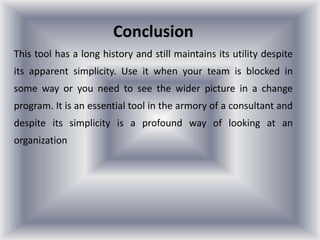
Conclusion
This tool has a long history and still maintains its utility despite
its apparent simplicity. Use it when your team is blocked in
some way or you need to see the wider picture in a change
program. It is an essential tool in the armory of a consultant and
despite its simplicity is a profound way of looking at an
organization
THANK U

FFA Force field analysis for making decision.pptx

  • 1.
  • 2.
    CONTENTS • INTRODUCTION • CONCEPTBEHIND IT • LEWIN’S VIEW • DIAGRAMMATICALLY EXPLAINATION • STEPS OR PROCESS. • PURPOSE • SKILLS REQUIRED • USES OF THIS MODEL • CONCLUSION • REFERENCE
  • 3.
    Kurt Lewin [1890- 1947] Kurt Lewin was an American psychologist and having contributedto science groupdynamics & action research, but perhaps he is being well known for developing force field analysis
  • 4.
    INTRODUCTION Lewin’s force fieldanalysis is evaluates the net impact of all forces that influence change. These forces can be divided into two groups: Driving forces • Driving forces are all forces that push for and promote change. These change drivers promote and encourage the change process. Some examples of driving forces are executive mandate, customer demands, and increased efficiency. Restraining forces • Restraining forces are forces that make change more difficult. These forces counteract driving forces and lead to the avoidance or resistance of change. Some examples of restraining forces are fear, lack of training, and the lack of incentives. When these two sets of forces are equal change is in a static state of equilibrium meaning that no movement towards or away from change is happening.
  • 5.
    Force field analysisis a management technique developed by Kurt Lewin, a pioneer in the field of social sciences, for diagnosing situations. Lewin assumes that in any situation there are both driving and restraining forces that influence any change that may occur:  Driving Forces  Restraining Forces  Equilibrium Lewin’s Three-Step Model of Lewin Organizational Change
  • 6.
    Purpose •FFA is ananalysis technique to identify forces that either drive or restrain planned change aimed at solving a problem in an organization. •It is a creative activity that can be used by needs analysts as they focus on solutions which will help an organization make a transformation from the ‘current (problem) state’ to the ‘desired (solved) state’ as they identify interventions to improve performance.
  • 7.
    FORCE FIELD ANALYSIScan be used to: Identify the forces which support change as well as those which will act against it. Assess the causes of performance problems or inhibitors to business opportunities. Evaluate the relative strength of forces that affect alternative solutions to performance problems or business opportunities. Help analyze and prioritize solutions to problems or areas needing improvement FORCE FIELD ANALYSIS
  • 8.
    Field Force Processis … Unfreezing--melting away resistance Change--departure from the status quo Refreezing--change becomes routine Force-field analysis focuses our attention on ways of reducing the hindering forces and encouraging the positive ones. WHY TO USE?
  • 9.
    When to UseIt: It helps team members to view each case as two sets of off setting factors. It can be used to study existing problems, or to anticipate and plan more effectively for implementing change. In problem analysis, force-field analysis is especially helpful in defining more subjective issues, such as morale, management, effectiveness, and work climate.
  • 10.
    HOW TO USEIT? Defining the Problem Defining the Change Objective Identifying the Driving Forces Identifying the Restraining Forces Review and clarify each force or factor
  • 11.
    Restraining forces Driving forces Statusquo Desired state Time Force-field Model of Change McGraw-Hill © 2004 The McGraw-Hill Companies, Inc. All rights reserved.
  • 12.
    Carrying Out aForce Field Analysis:To carry out a force field analysis, follow the following steps : List all forces for change in one column, and all forces against change in another column. Assign a score to each force, from 1 (weak) to 5 (strong). Draw a diagram showing the forces for and against, and the size of the forces. How to Carry it
  • 13.
  • 14.
    Case study: UPGRADEFACTORY WITH NEW MANUFACTURING MACHINE •NOT DADICATED TEACHERS •LACK OF COMMUNICATION BETWEEN TEACHERS AND ADMINISTRATORS •LACK OF MINIMUM FACILITIES IN SCHOOL •TEXT BOOKS NOT RELEVENT •UNTRAINED TEACHRES CUSTOMER WANT NEW PRODUCTS IMPROVE SPEED OF PRODUCTION RAISE VOLUME OF OUTPUT MAINTENANACE COST INCREASING LOSS OF STAFF OVERTIME STAFF FRIGHTENED OF NEW TECHNOLOGY ENVIRONMENTAL IMPACT OF NEW TECHNOLOGY COST DISRUPTION UPGADE FACTORY WITH NEW MANUFACTURING MACHINARY 4 2 3 1 3 3 1 3 1 TOTAL:10 TOTAL: 11 FORCE FOR CHANGE FORCE AGAINST CHANGE
  • 15.
    Advantages of ForceField Analysis Brings into the open factors which will work for and against the closing of a gap Identified by a needs analysis. Helps to recognize circumstances which can and cannot be changed. Provides a means to analyze ways to minimize or eliminate barriers to goal attainment.
  • 16.
    The Limitations ofForce Field Analysis Process is subjective and requires collaborative thinking and agreement Concerning forces for and against the solution to a particular problem. May oversimplify the relationships between factors that impact a problem. All aspects of a problem may not be identified.
  • 17.
    Conclusion This tool hasa long history and still maintains its utility despite its apparent simplicity. Use it when your team is blocked in some way or you need to see the wider picture in a change program. It is an essential tool in the armory of a consultant and despite its simplicity is a profound way of looking at an organization
  • 18.