Force-field analysis
By
Kurt Lewin
FORCE FIELD ANALYSIS-INTRODUCTION
This is a framework to aid strategic decision making.
It’s a useful tool to help to map out a decision process and weigh up the
reasons for and against, in order to decide the right path for the company.
The main purpose of the technique is to
give managers an insight that will allow them
to strengthen the forces supporting a
decision, and reduce the forces
that oppose it.
The Conceptual Framework
Driving Forces: Factors that promote change (e.g., market demands,
technological advances).
Left side: Driving forces listed with arrows pushing right.
Restraining Forces: Factors resisting change (e.g., employee
resistance, existing processes).
Right side: Restraining forces listed with arrows pushing left.
Equilibrium: The current state maintained by the balance of these
forces.
Center: The "Status Quo" line.
Conducting a force-field analysis
1. Analyse the current situation and the desired situation.
2. List all of the factors driving change towards the desired situation.
3. List all of the constraining factors against change towards the desired
situation.
4. Allocate a numerical score to each force, indicating the scale or significance of
each force: 1 =extremely weak and 10 = extremely strong.
5. Chart the forces on the diagram with driving forces on the left and restraining
forces on the right.
6. Total the scores and establish from this whether the change is really viable. Is
it worth going ahead?
If yes, then the next stage is important.
7.Discuss how the success of the change or proposed decision can be affected
by decreasing thestrength of the restraining forces and increasing the strength of
the driving forces.
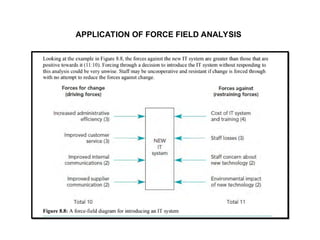
APPLICATION OF FORCE FIELD ANALYSIS
Evaluation of force-field analysis
It has two main limitations as a strategic choice method:
• Unskilled or inexperienced managers could fail to identify all of the relevant
forces involved in the change process.
• The allocation of numerical values to the driving and constraining forces is
rather subjective.
Two managers independently undertaking
the same force-field analysis could arrive
at rather different values for the forces and, consequently,
propose very different decisions
based on their assessments.
Time To Think and Play
SOLUTION

Business studies force field analysis.ppt

  • 1.
  • 2.
    FORCE FIELD ANALYSIS-INTRODUCTION Thisis a framework to aid strategic decision making. It’s a useful tool to help to map out a decision process and weigh up the reasons for and against, in order to decide the right path for the company. The main purpose of the technique is to give managers an insight that will allow them to strengthen the forces supporting a decision, and reduce the forces that oppose it.
  • 3.
    The Conceptual Framework DrivingForces: Factors that promote change (e.g., market demands, technological advances). Left side: Driving forces listed with arrows pushing right. Restraining Forces: Factors resisting change (e.g., employee resistance, existing processes). Right side: Restraining forces listed with arrows pushing left. Equilibrium: The current state maintained by the balance of these forces. Center: The "Status Quo" line.
  • 4.
    Conducting a force-fieldanalysis 1. Analyse the current situation and the desired situation. 2. List all of the factors driving change towards the desired situation. 3. List all of the constraining factors against change towards the desired situation. 4. Allocate a numerical score to each force, indicating the scale or significance of each force: 1 =extremely weak and 10 = extremely strong. 5. Chart the forces on the diagram with driving forces on the left and restraining forces on the right. 6. Total the scores and establish from this whether the change is really viable. Is it worth going ahead? If yes, then the next stage is important. 7.Discuss how the success of the change or proposed decision can be affected by decreasing thestrength of the restraining forces and increasing the strength of the driving forces.
  • 5.
    APPLICATION OF FORCEFIELD ANALYSIS
  • 6.
    Evaluation of force-fieldanalysis It has two main limitations as a strategic choice method: • Unskilled or inexperienced managers could fail to identify all of the relevant forces involved in the change process. • The allocation of numerical values to the driving and constraining forces is rather subjective. Two managers independently undertaking the same force-field analysis could arrive at rather different values for the forces and, consequently, propose very different decisions based on their assessments.
  • 7.
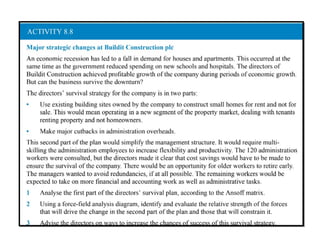
    Time To Thinkand Play
  • 9.