FORCE FIELD ANALYSIS
TIRSO P. SULIGAN
FORCE FIELD ANALYSIS
Force Field Analysis is a useful decision-making technique. It helps
you make a decision by analyzing the forces for and against a
change, and it helps you communicate the reasoning behind your
decision.
You can use it for two purposes: to decide whether to go ahead
with the change; and to increase your chances of success, by
strengthening the forces supporting change and weakening those
against it.
ABOUT THE TOOL
• Force Field Analysis was created by Kurt Lewin in the 1940s. Lewin
originally used the tool in his work as a social psychologist. Today,
however, Force Field Analysis is also used in business, for making
and communicating go/no-go decisions.
• You use the tool by listing all of the factors (forces) for and against
your decision or change. You then score each factor based on its
influence, and add up the scores for and against change to find out
which of these wins.
• You can then look at strengthening the forces that support the
change and managing the forces against the change, so that it's
more successful.
HOW TO USE THE TOOL
1. To carry out a Force Field Analysis, use a blank sheet
of paper or whiteboard.
2. Then describe your plan or proposal for change in a
box in the middle of the paper. List the forces for
change in a column on the left-hand side, and the
forces against change in a column on the right-hand
side.
HOW TO USE THE TOOL
3. As you do this, consider the following questions:
• What organizational/church/business benefit will the change
deliver?
• Who supports the change? Who is against it? Why?
• How easy will it be to make the change? Do you have enough time
and resources to make it work?
• What costs are involved?
• What other processes will be affected by the change?
• What are the risks?
HOW TO USE THE TOOL
4. Next, assign a score to each force, from, say, 1 (weak) to 5 (strong),
and then add up the scores for each column (for and against).
5. For a visual representation of the influence that each force has,
draw arrows around them. Use bigger arrows for the forces that will
have a greater influence on the change, and smaller arrows for forces
that will have less of an influence.
Tip:
It's important to identify as many of the factors that will influence
the change as you can. Where appropriate, involve other people,
such as team members or experts in your organization.
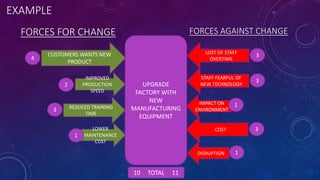
EXAMPLE
UPGRADE
FACTORY WITH
NEW
MANUFACTURING
EQUIPMENT
10 TOTAL 11
CUSTOMERS WANTS NEW
PRODUCT
LOST OF STAFF
OVERTIME
FORCES FOR CHANGE FORCES AGAINST CHANGE
34
IMPROVED
PRODUCTION
SPEED
2
STAFF FEARFUL OF
NEW TECHNOLOGY
3
REDUCED TRAINING
TIME
LOWER
MAINTENANCE
COST
1
3
IMPACT ON
ENVIRONMENT
1
COST 3
DISRUPTION 1
ANALYSIS ON EXAMPLE
• Once you've done your Force Field Analysis, you can use it in two
ways:
• To decide whether or not to move forward with the decision or
change.
• To think about how you can strengthen the forces that support the
change and weaken the forces opposing it, so that the change is
more successful.
ANALYSIS ON EXAMPLE
• If you had to implement the project in the example above, the
analysis might suggest a number of changes that you could make
to the initial plan. For instance, you could:
• Train staff ("Cost" +1) to minimize the fear of technology ("Staff
uncomfortable with new technology" -2).
• Show staff that change is necessary for business survival (new
force that supports the change, +2).
• Show staff that new machines would introduce variety and
interest to their jobs (new
ANALYSIS ON EXAMPLE
• If you had to implement the project in the example above, the
analysis might suggest a number of changes that you could make to
the initial plan. For instance, you could:
• Raise wages to reflect new productivity ("Cost" +1, "Loss of
overtime" -2).
• Install slightly different machines with filters that eliminate
pollution ("Impact on environment" -1).
• These changes would swing the balance from 10:11 (against the
plan), to 13:8 (in favor of the plan).
MORE TIPS
Tip 1:
Some factors – such as those affecting people's health and safety – don't fit
well with this approach. Make sure that you deal with these appropriately,
whatever the outcome of your analysis.
Tip 2:
Bear in mind that while Force Field Analysis helps you understand the impact
of different factors on your decision or change, it can be quite subjective. If
you're making an important decision, use it alongside other decision-making
tools such as Decision Matrix Analysis , Decision Tree Analysis , and
Cost/Benefit Analysis .
Tip 3:
Don't underestimate how much work a Force Field Analysis can involve. There
will be many factors that you'll need to consider for complex decisions and
changes.
KEY POINTS
• Force Field Analysis helps you think about the pressures for and against a
decision or a change. The tool was developed by Kurt Lewin.
• To carry out a Force Field Analysis, describe your plan or proposal in the
middle of a piece of paper or whiteboard. Then list all of the forces for
change in a column on the left-side, and all of the forces against change in a
column on the right-side.
• Score each factor, and add up the scores for each column. You can then
decide whether or not to move forward with the change.
• Alternatively, you can use your analysis to think about how you can
strengthen the forces that support the change and weaken the forces
opposing it, so that the change is more successful.

Force field analysis

  • 1.
  • 2.
    FORCE FIELD ANALYSIS ForceField Analysis is a useful decision-making technique. It helps you make a decision by analyzing the forces for and against a change, and it helps you communicate the reasoning behind your decision. You can use it for two purposes: to decide whether to go ahead with the change; and to increase your chances of success, by strengthening the forces supporting change and weakening those against it.
  • 3.
    ABOUT THE TOOL •Force Field Analysis was created by Kurt Lewin in the 1940s. Lewin originally used the tool in his work as a social psychologist. Today, however, Force Field Analysis is also used in business, for making and communicating go/no-go decisions. • You use the tool by listing all of the factors (forces) for and against your decision or change. You then score each factor based on its influence, and add up the scores for and against change to find out which of these wins. • You can then look at strengthening the forces that support the change and managing the forces against the change, so that it's more successful.
  • 4.
    HOW TO USETHE TOOL 1. To carry out a Force Field Analysis, use a blank sheet of paper or whiteboard. 2. Then describe your plan or proposal for change in a box in the middle of the paper. List the forces for change in a column on the left-hand side, and the forces against change in a column on the right-hand side.
  • 5.
    HOW TO USETHE TOOL 3. As you do this, consider the following questions: • What organizational/church/business benefit will the change deliver? • Who supports the change? Who is against it? Why? • How easy will it be to make the change? Do you have enough time and resources to make it work? • What costs are involved? • What other processes will be affected by the change? • What are the risks?
  • 6.
    HOW TO USETHE TOOL 4. Next, assign a score to each force, from, say, 1 (weak) to 5 (strong), and then add up the scores for each column (for and against). 5. For a visual representation of the influence that each force has, draw arrows around them. Use bigger arrows for the forces that will have a greater influence on the change, and smaller arrows for forces that will have less of an influence. Tip: It's important to identify as many of the factors that will influence the change as you can. Where appropriate, involve other people, such as team members or experts in your organization.
  • 7.
    EXAMPLE UPGRADE FACTORY WITH NEW MANUFACTURING EQUIPMENT 10 TOTAL11 CUSTOMERS WANTS NEW PRODUCT LOST OF STAFF OVERTIME FORCES FOR CHANGE FORCES AGAINST CHANGE 34 IMPROVED PRODUCTION SPEED 2 STAFF FEARFUL OF NEW TECHNOLOGY 3 REDUCED TRAINING TIME LOWER MAINTENANCE COST 1 3 IMPACT ON ENVIRONMENT 1 COST 3 DISRUPTION 1
  • 8.
    ANALYSIS ON EXAMPLE •Once you've done your Force Field Analysis, you can use it in two ways: • To decide whether or not to move forward with the decision or change. • To think about how you can strengthen the forces that support the change and weaken the forces opposing it, so that the change is more successful.
  • 9.
    ANALYSIS ON EXAMPLE •If you had to implement the project in the example above, the analysis might suggest a number of changes that you could make to the initial plan. For instance, you could: • Train staff ("Cost" +1) to minimize the fear of technology ("Staff uncomfortable with new technology" -2). • Show staff that change is necessary for business survival (new force that supports the change, +2). • Show staff that new machines would introduce variety and interest to their jobs (new
  • 10.
    ANALYSIS ON EXAMPLE •If you had to implement the project in the example above, the analysis might suggest a number of changes that you could make to the initial plan. For instance, you could: • Raise wages to reflect new productivity ("Cost" +1, "Loss of overtime" -2). • Install slightly different machines with filters that eliminate pollution ("Impact on environment" -1). • These changes would swing the balance from 10:11 (against the plan), to 13:8 (in favor of the plan).
  • 11.
    MORE TIPS Tip 1: Somefactors – such as those affecting people's health and safety – don't fit well with this approach. Make sure that you deal with these appropriately, whatever the outcome of your analysis. Tip 2: Bear in mind that while Force Field Analysis helps you understand the impact of different factors on your decision or change, it can be quite subjective. If you're making an important decision, use it alongside other decision-making tools such as Decision Matrix Analysis , Decision Tree Analysis , and Cost/Benefit Analysis . Tip 3: Don't underestimate how much work a Force Field Analysis can involve. There will be many factors that you'll need to consider for complex decisions and changes.
  • 12.
    KEY POINTS • ForceField Analysis helps you think about the pressures for and against a decision or a change. The tool was developed by Kurt Lewin. • To carry out a Force Field Analysis, describe your plan or proposal in the middle of a piece of paper or whiteboard. Then list all of the forces for change in a column on the left-side, and all of the forces against change in a column on the right-side. • Score each factor, and add up the scores for each column. You can then decide whether or not to move forward with the change. • Alternatively, you can use your analysis to think about how you can strengthen the forces that support the change and weaken the forces opposing it, so that the change is more successful.