Effecting change in complex contexts -
the promise of Normalization Process
Theory in public sector organisations
Phil Wood, Institute of Education June, 2023
Introduction - Change in the
public sector
Since the late 1980s, shift to New Public Management. Focus on:
- quasi-markets
- accountability systems
- shift to Taylorism and hierarchical structures
- results in tendency for change to to be seen as ‘planned’ and ‘linear’
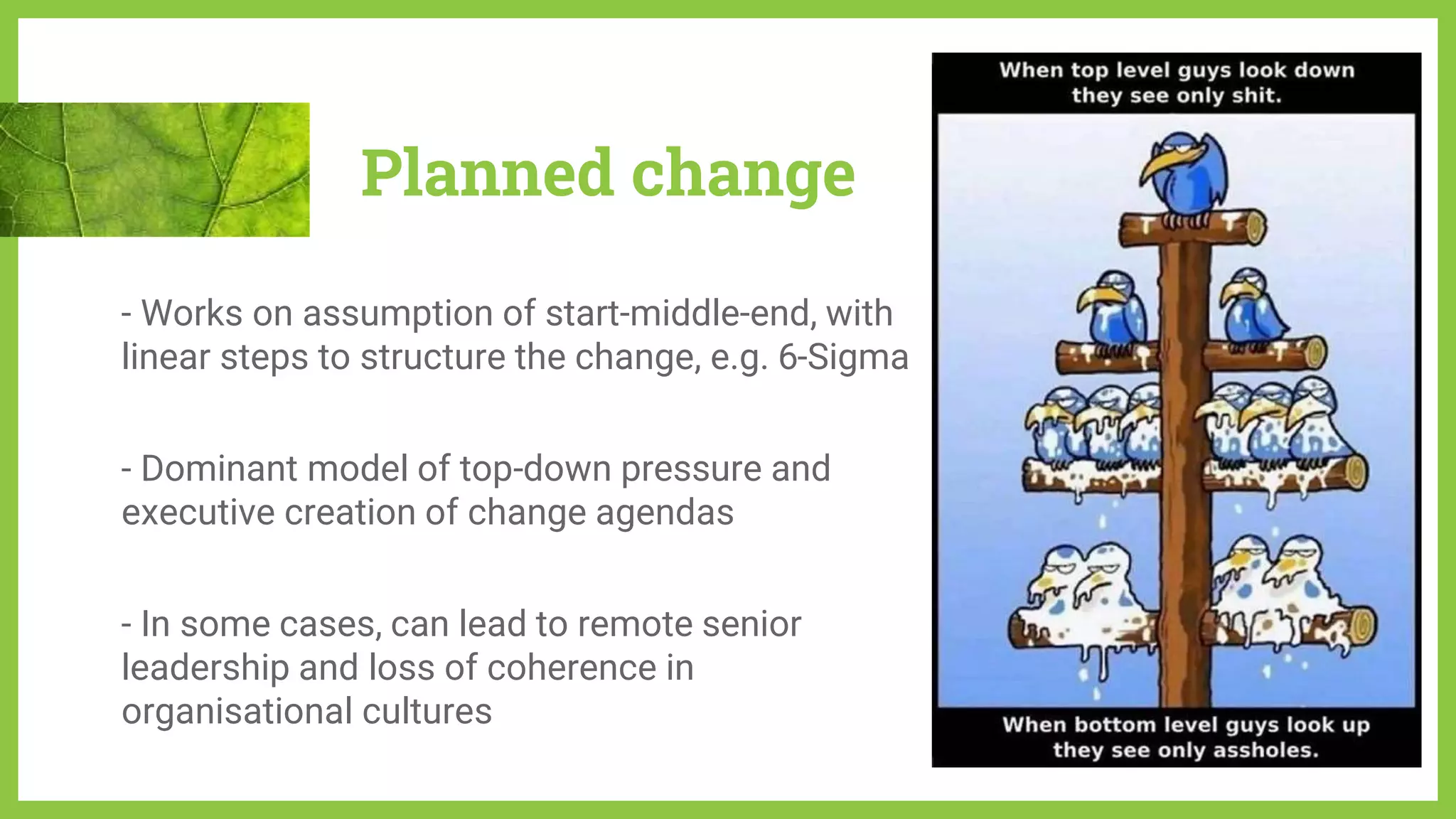
- Works on assumption of start-middle-end, with
linear steps to structure the change, e.g. 6-Sigma
- Dominant model of top-down pressure and
executive creation of change agendas
- In some cases, can lead to remote senior
leadership and loss of coherence in
organisational cultures
Planned change
Cultures of ‘hyper-change’
4
Top-down change led by senior leaders who may each only
have a single change agenda
Change agendas sent ‘down the pipe’ and at the ‘action’ end of
the organisation, intensive change agendas – ‘hyper-change’
Adopt survival techniques – ignoring, repurposing, inventing,
fictional reaction, etc
“
Newton (2003) suggests that where solutions appear to be too simplistic,
teachers can give the illusion of change without real engagement in the process.
This can lead to innovations which exist in strategic plans, which are shown to be
successful in evaluations, and which are recorded in set piece observations but
which are absent in day-to-day practice. I characterize this as a form of ‘zombie
innovation’, where a change process carries on lifeless, sometimes for years, in
the twilight of official documents, plans and quality assurance reports, but never
lives in the normalized practices of the organization
(Wood, 2017: 34)
Normalization Process Theory
Theory developed by May and Finch (2009)
Focuses on three interlocking issues at the core of change
o How are practices brought into action within organizations (implementation)
o How does this practice become part of the everyday practice of individuals
and groups (embedding)
o How are embedded new practices made sustainable in the longer term
(integration)
“
the work that actors do as they engage with some ensemble
of activities (that may include new or changed ways of
thinking, acting and organizing) and by which means it
becomes routinely embedded in the matrices of already
existing, socially patterned, knowledge and practices.
May and Finch (2009: 540)
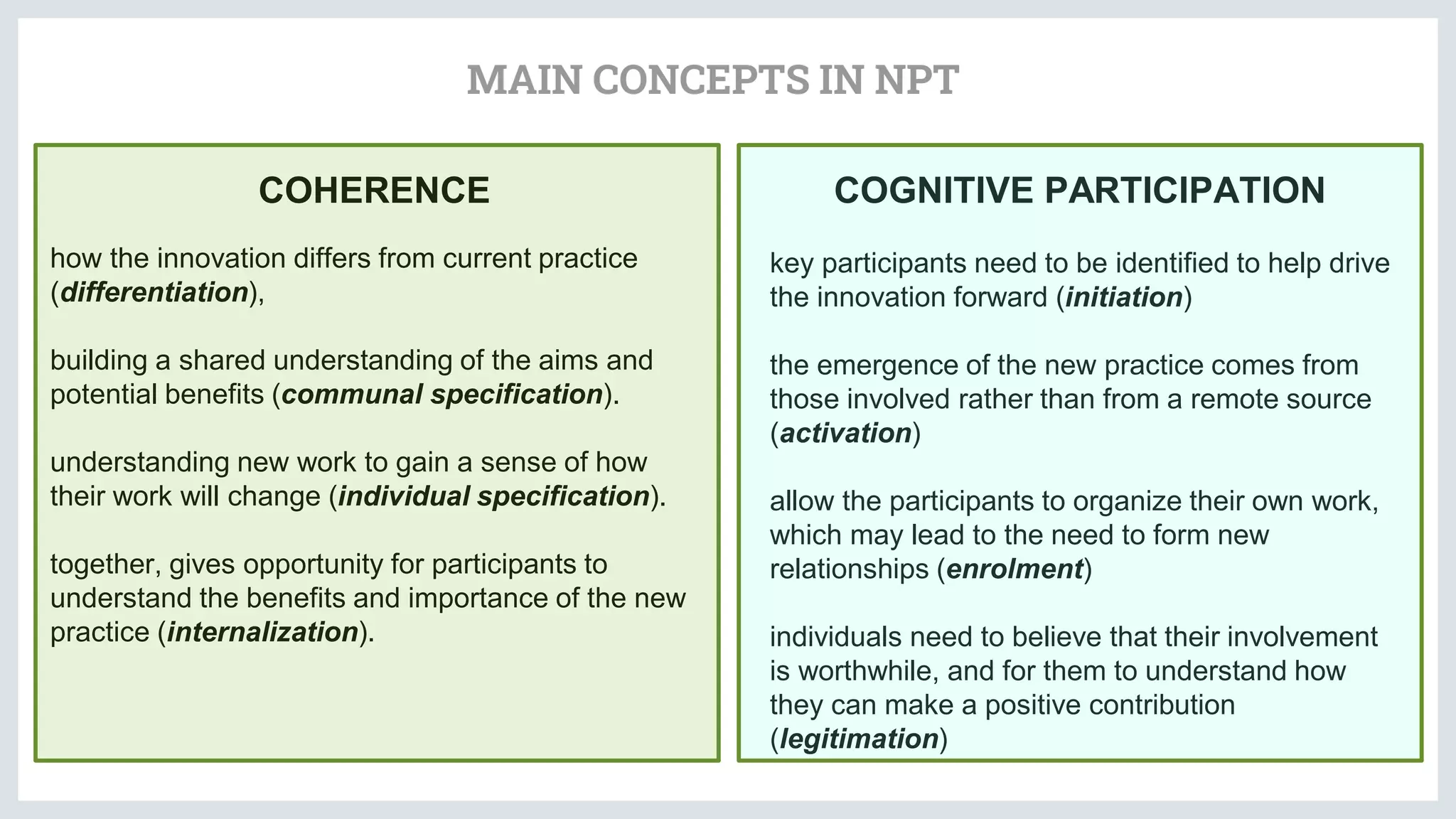
MAIN CONCEPTS IN NPT
COHERENCE
how the innovation differs from current practice
(differentiation),
building a shared understanding of the aims and
potential benefits (communal specification).
understanding new work to gain a sense of how
their work will change (individual specification).
together, gives opportunity for participants to
understand the benefits and importance of the new
practice (internalization).
COGNITIVE PARTICIPATION
key participants need to be identified to help drive
the innovation forward (initiation)
the emergence of the new practice comes from
those involved rather than from a remote source
(activation)
allow the participants to organize their own work,
which may lead to the need to form new
relationships (enrolment)
individuals need to believe that their involvement
is worthwhile, and for them to understand how
they can make a positive contribution
(legitimation)
MAIN CONCEPTS IN NPT
COLLECTIVE ACTION
participants need to build knowledge, accountability
and confidence around the new practice (relational
integration)
interactional work with each other and with any new
procedures and tools (interactional workability)
explicit consideration and allocation of work as the
practice is developed (skills set workability)
resourcing is crucial, in terms of physical resources,
but also time and execution of procedures
(contextual integration)
REFLEXIVE MONITORING
the new practice needs to be communally
evaluated, through both formal channels and the
sharing of less formal experiences (communal
appraisal)
there needs to be an opportunity for individuals to
assess and reflect on the impact of the new
practice on their own work (individual appraisal)
the use of collective and individual appraisal is
the basis for determining how successful and
useful the new practice is within the context
(systematization)
and how it might need to be modified to fit the
particular situation in which it is being embedded
(reconfiguration)
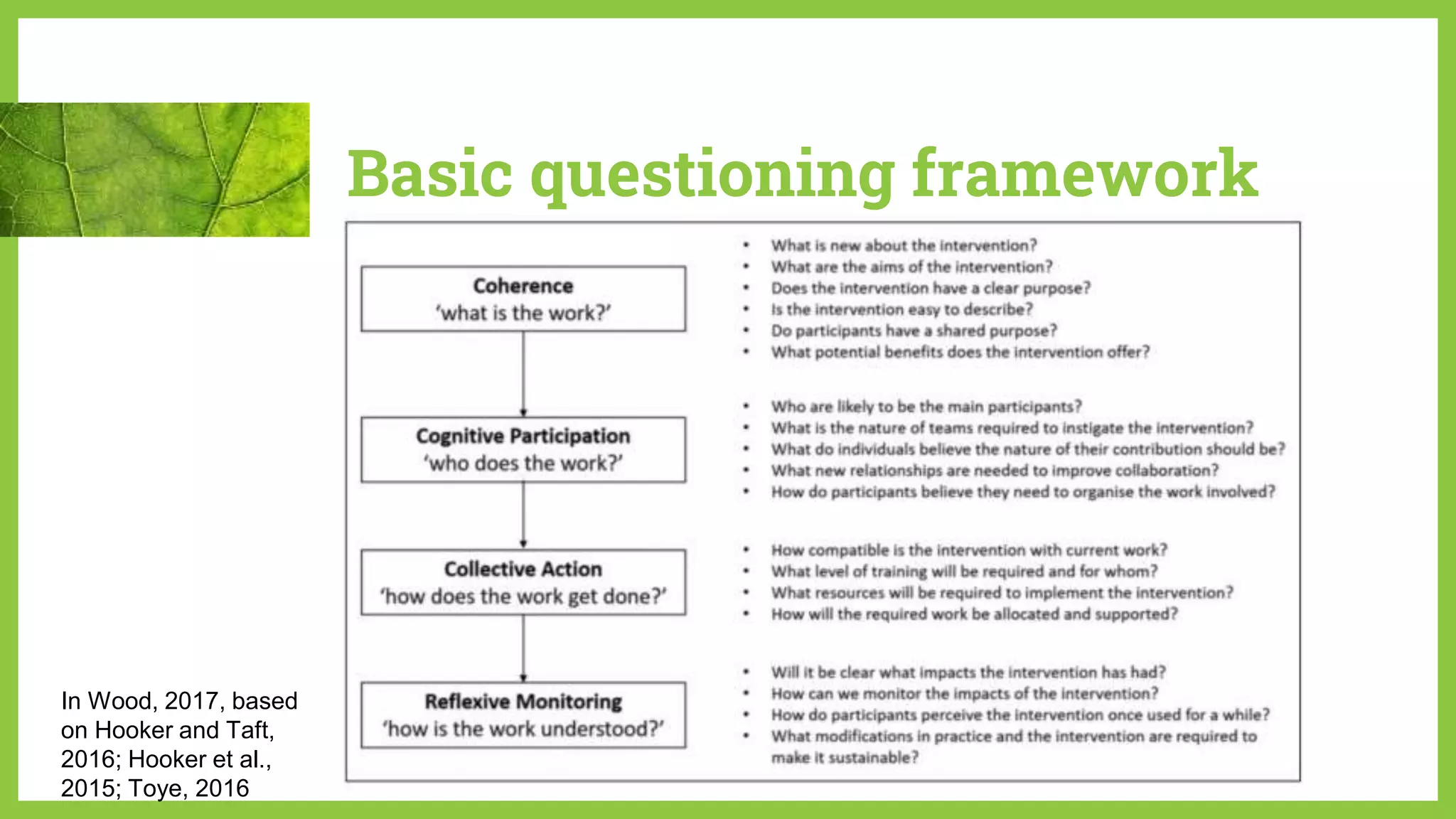
Basic questioning framework
In Wood, 2017, based
on Hooker and Taft,
2016; Hooker et al.,
2015; Toye, 2016
Insights
NPT shifts the focus of change – to the
complex reality
Need for fewer change agendas –
embedding and normalization bringing real
change and exorcizing zombie innovation
and combating hyper-change
Dialogic, collaborative and greater degree of
agency
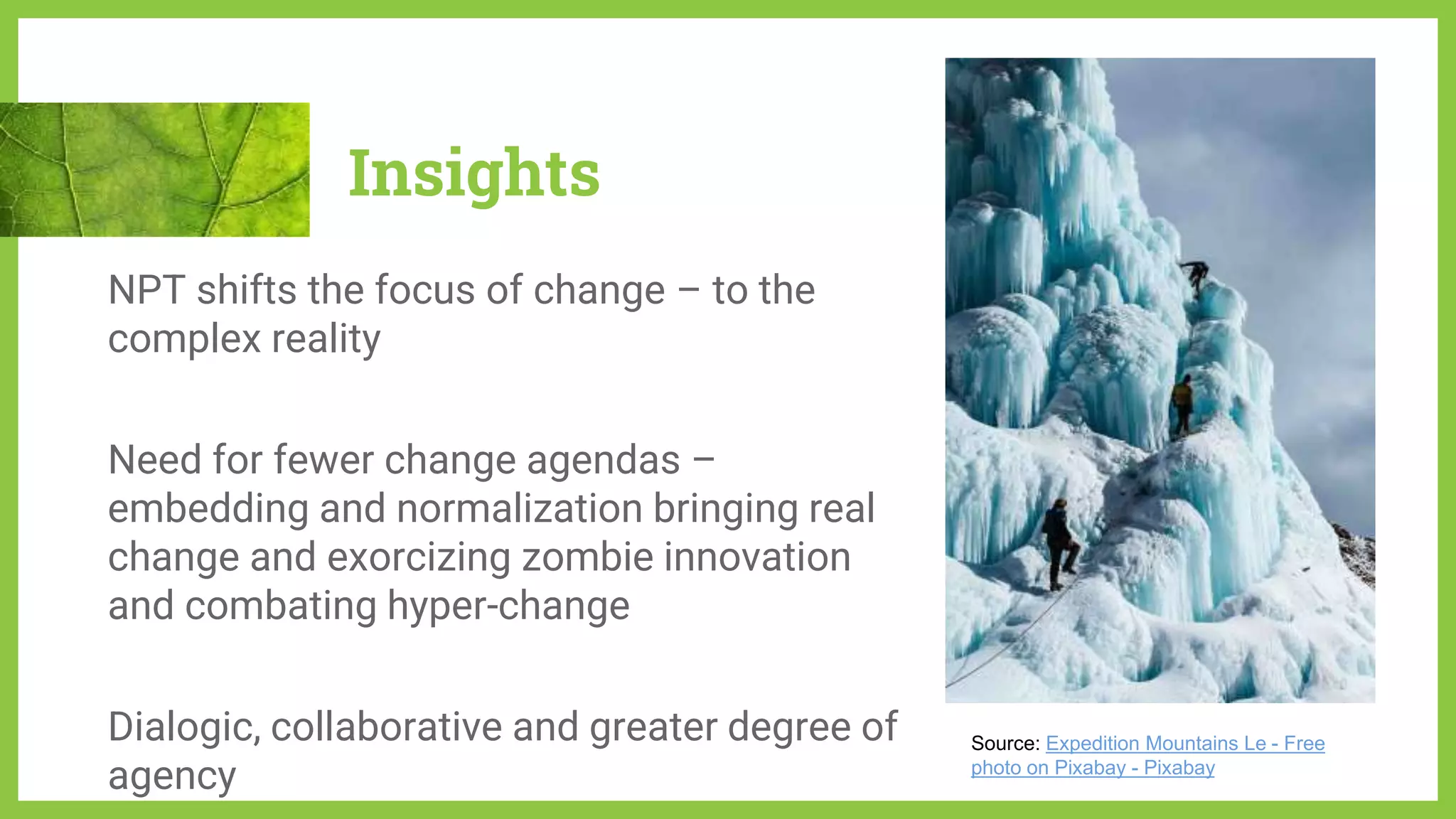
Source: Expedition Mountains Le - Free
photo on Pixabay - Pixabay
References
May C and Finch T (2009) Implementing, embedding, and integrating practices: An outline of
Normalization Process Theory. Sociology 43(3): 535–554.
Hooker L and Taft A (2016) Using theory to design, implement and evaluate sustained nurse domestic
violence screening and supportive care. Journal of Research in Nursing 21(5–6): 432–442.
Hooker L, Small R, Humphreys C, Hegarty K and Taft A (2015) Applying normalization process theory
to understand implementation of a family violence screening and care model in maternal and child
health nursing practice: A mixed method rocess evaluation of a randomised controlled trial.
Implementation Science 10(39), doi: 10.1186/s13012-015-0230-4.
Toye CRA (2016) Normalisation Process Theory and the implementation of Resident Assessment
Instrument–Home Care in Saskatchewan, Canada: A qualitative study. Home Health Care
Management & Practice 28(3): 161–169.
Wood P (2017) Overcoming the problem of embedding change in educational organizations: A
perspective from Normalization Process Theory. Management in Education, 31(1): 33–38.

Change through NPT.pptx

  • 1.
    Effecting change incomplex contexts - the promise of Normalization Process Theory in public sector organisations Phil Wood, Institute of Education June, 2023
  • 2.
    Introduction - Changein the public sector Since the late 1980s, shift to New Public Management. Focus on: - quasi-markets - accountability systems - shift to Taylorism and hierarchical structures - results in tendency for change to to be seen as ‘planned’ and ‘linear’
  • 3.
    - Works onassumption of start-middle-end, with linear steps to structure the change, e.g. 6-Sigma - Dominant model of top-down pressure and executive creation of change agendas - In some cases, can lead to remote senior leadership and loss of coherence in organisational cultures Planned change
  • 4.
    Cultures of ‘hyper-change’ 4 Top-downchange led by senior leaders who may each only have a single change agenda Change agendas sent ‘down the pipe’ and at the ‘action’ end of the organisation, intensive change agendas – ‘hyper-change’ Adopt survival techniques – ignoring, repurposing, inventing, fictional reaction, etc
  • 5.
    “ Newton (2003) suggeststhat where solutions appear to be too simplistic, teachers can give the illusion of change without real engagement in the process. This can lead to innovations which exist in strategic plans, which are shown to be successful in evaluations, and which are recorded in set piece observations but which are absent in day-to-day practice. I characterize this as a form of ‘zombie innovation’, where a change process carries on lifeless, sometimes for years, in the twilight of official documents, plans and quality assurance reports, but never lives in the normalized practices of the organization (Wood, 2017: 34)
  • 6.
    Normalization Process Theory Theorydeveloped by May and Finch (2009) Focuses on three interlocking issues at the core of change o How are practices brought into action within organizations (implementation) o How does this practice become part of the everyday practice of individuals and groups (embedding) o How are embedded new practices made sustainable in the longer term (integration)
  • 7.
    “ the work thatactors do as they engage with some ensemble of activities (that may include new or changed ways of thinking, acting and organizing) and by which means it becomes routinely embedded in the matrices of already existing, socially patterned, knowledge and practices. May and Finch (2009: 540)
  • 8.
    MAIN CONCEPTS INNPT COHERENCE how the innovation differs from current practice (differentiation), building a shared understanding of the aims and potential benefits (communal specification). understanding new work to gain a sense of how their work will change (individual specification). together, gives opportunity for participants to understand the benefits and importance of the new practice (internalization). COGNITIVE PARTICIPATION key participants need to be identified to help drive the innovation forward (initiation) the emergence of the new practice comes from those involved rather than from a remote source (activation) allow the participants to organize their own work, which may lead to the need to form new relationships (enrolment) individuals need to believe that their involvement is worthwhile, and for them to understand how they can make a positive contribution (legitimation)
  • 9.
    MAIN CONCEPTS INNPT COLLECTIVE ACTION participants need to build knowledge, accountability and confidence around the new practice (relational integration) interactional work with each other and with any new procedures and tools (interactional workability) explicit consideration and allocation of work as the practice is developed (skills set workability) resourcing is crucial, in terms of physical resources, but also time and execution of procedures (contextual integration) REFLEXIVE MONITORING the new practice needs to be communally evaluated, through both formal channels and the sharing of less formal experiences (communal appraisal) there needs to be an opportunity for individuals to assess and reflect on the impact of the new practice on their own work (individual appraisal) the use of collective and individual appraisal is the basis for determining how successful and useful the new practice is within the context (systematization) and how it might need to be modified to fit the particular situation in which it is being embedded (reconfiguration)
  • 10.
    Basic questioning framework InWood, 2017, based on Hooker and Taft, 2016; Hooker et al., 2015; Toye, 2016
  • 11.
    Insights NPT shifts thefocus of change – to the complex reality Need for fewer change agendas – embedding and normalization bringing real change and exorcizing zombie innovation and combating hyper-change Dialogic, collaborative and greater degree of agency Source: Expedition Mountains Le - Free photo on Pixabay - Pixabay
  • 12.
    References May C andFinch T (2009) Implementing, embedding, and integrating practices: An outline of Normalization Process Theory. Sociology 43(3): 535–554. Hooker L and Taft A (2016) Using theory to design, implement and evaluate sustained nurse domestic violence screening and supportive care. Journal of Research in Nursing 21(5–6): 432–442. Hooker L, Small R, Humphreys C, Hegarty K and Taft A (2015) Applying normalization process theory to understand implementation of a family violence screening and care model in maternal and child health nursing practice: A mixed method rocess evaluation of a randomised controlled trial. Implementation Science 10(39), doi: 10.1186/s13012-015-0230-4. Toye CRA (2016) Normalisation Process Theory and the implementation of Resident Assessment Instrument–Home Care in Saskatchewan, Canada: A qualitative study. Home Health Care Management & Practice 28(3): 161–169. Wood P (2017) Overcoming the problem of embedding change in educational organizations: A perspective from Normalization Process Theory. Management in Education, 31(1): 33–38.