A PRESENTATION
ON
MANAGEMENT CONCEPTS
& APPLICATIONS
Presented by
Aparna Mishra
FORCE FIELD ANALYSIS
Understanding the Pressures
For and Against Change
In people, groups and organizations
CONTENTS
 Introduction - Force Field theory
 Concept of field
 Use of FFA
 Process of FFA
 Example
 Advantages & Limitations
 Conclusion
FORCE FIELD THEORY
Force field analysis is a management technique developed by
Kurt Lewin a pioneer in the field of social sciences, for diagnosing
situations.
Lewin assumes that in any situation there are both driving and
restraining forces that influence any change that may occur:
Driving forces
Restraining forces
Equilibrium
CONCEPT OF FIELD
 For Kurt Lewin behavior was determined by totality of
an individual’s situation.
 In his field theory, a ‘field’ is defined as ‘the totality of
coexisting facts which are conceived of as mutually
interdependent’.
USE OF FFA
FFA is an analysis technique to identify forces that either
drive or restrain planned change aimed at solving a
problem in an organization. It is a creative activity that
can be used by needs analysts as they focus on solutions
which will help an organization make a transformation
from the ‘current (problem) state’ to the ‘desired (solved)
state’ as they identify interventions to improve
performance.
PROCESS
It helps team members to view each case as two sets of off
setting factors. It can be used to study existing problems, or
to anticipate and plan more effectively for implementing
change. To carry out a force field analysis, follow the
following steps:
 List all forces for change in one column, and all forces
against change in another column.
 Assign a score to each force, from 1 (weak) to 5 (strong).
 Draw a diagram showing the forces for and against, and
the size of the forces.
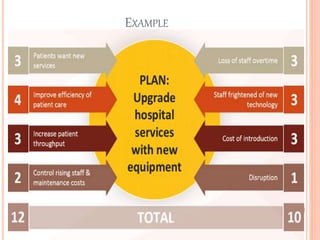
EXAMPLE
ADVANTAGES & LIMITATIONS OF FFA
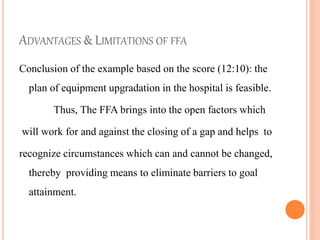
Conclusion of the example based on the score (12:10): the
plan of equipment upgradation in the hospital is feasible.
Thus, The FFA brings into the open factors which
will work for and against the closing of a gap and helps to
recognize circumstances which can and cannot be changed,
thereby providing means to eliminate barriers to goal
attainment.
LIMITATIONS
 May oversimplify the relationships between factors
that impact a problem.
 All aspects of a problem may not be identified.
CONCLUSION
 This technique of managing change has a long history
and still maintains its utility despite its apparent
simplicity. It is beneficial to use when individuals need
to see the wider picture in a change program.
Force field analysis

Force field analysis

  • 1.
    A PRESENTATION ON MANAGEMENT CONCEPTS &APPLICATIONS Presented by Aparna Mishra
  • 2.
    FORCE FIELD ANALYSIS Understandingthe Pressures For and Against Change In people, groups and organizations
  • 3.
    CONTENTS  Introduction -Force Field theory  Concept of field  Use of FFA  Process of FFA  Example  Advantages & Limitations  Conclusion
  • 4.
    FORCE FIELD THEORY Forcefield analysis is a management technique developed by Kurt Lewin a pioneer in the field of social sciences, for diagnosing situations. Lewin assumes that in any situation there are both driving and restraining forces that influence any change that may occur: Driving forces Restraining forces Equilibrium
  • 5.
    CONCEPT OF FIELD For Kurt Lewin behavior was determined by totality of an individual’s situation.  In his field theory, a ‘field’ is defined as ‘the totality of coexisting facts which are conceived of as mutually interdependent’.
  • 6.
    USE OF FFA FFAis an analysis technique to identify forces that either drive or restrain planned change aimed at solving a problem in an organization. It is a creative activity that can be used by needs analysts as they focus on solutions which will help an organization make a transformation from the ‘current (problem) state’ to the ‘desired (solved) state’ as they identify interventions to improve performance.
  • 7.
    PROCESS It helps teammembers to view each case as two sets of off setting factors. It can be used to study existing problems, or to anticipate and plan more effectively for implementing change. To carry out a force field analysis, follow the following steps:  List all forces for change in one column, and all forces against change in another column.  Assign a score to each force, from 1 (weak) to 5 (strong).  Draw a diagram showing the forces for and against, and the size of the forces.
  • 8.
  • 9.
    ADVANTAGES & LIMITATIONSOF FFA Conclusion of the example based on the score (12:10): the plan of equipment upgradation in the hospital is feasible. Thus, The FFA brings into the open factors which will work for and against the closing of a gap and helps to recognize circumstances which can and cannot be changed, thereby providing means to eliminate barriers to goal attainment.
  • 10.
    LIMITATIONS  May oversimplifythe relationships between factors that impact a problem.  All aspects of a problem may not be identified.
  • 11.
    CONCLUSION  This techniqueof managing change has a long history and still maintains its utility despite its apparent simplicity. It is beneficial to use when individuals need to see the wider picture in a change program.