Representing Force
What is a vector?
 QUANTITIES IN SCIENCE

 There are two types of quantities in science:

Scalar quantities.

Vector quantities
 Scalar quantity: It is a quantity which has only
  magnitude. They can be totally described by a
  number and a unit.
  Volume, area, temperature, energy, speed, mass
  , time are all scalar quantities.

 Vector quantity: It is a quantity which has both
  magnitude and direction.
  Force, velocity, acceleration, and displacement
  are vector quantities.
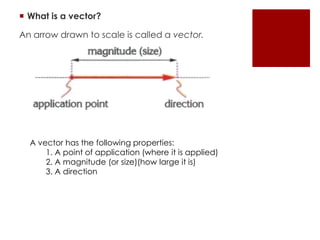
 What is a vector?

An arrow drawn to scale is called a vector.


  A vector has the following properties:
      1. A point of application (where it is applied)
      2. A magnitude (or size)(how large it is)
      3. A direction
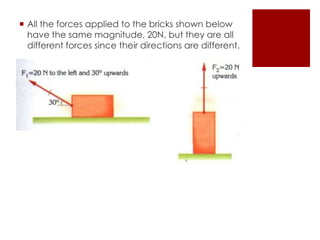
 All the forces applied to the bricks shown below
  have the same magnitude, 20N, but they are all
  different forces since their directions are different.
Example:
 Show the following forces using vectors.

a) A block is pulled to the east with a force of 4 N.

b) A chest is pulled to the southwest with a force of
  3 N.

c) Three forces act on a block to move it, one with
  2 N due north, one with 3 N due east and one
  with 3 N due west.
COMBINING FORCES

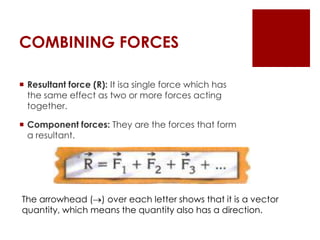
 Resultant force (R): It isa single force which has
  the same effect as two or more forces acting
  together.

 Component forces: They are the forces that form
  a resultant.


The arrowhead ( ) over each letter shows that it is a vector
quantity, which means the quantity also has a direction.
Rule for addition of vectors
(forces):
 Rule for addition of vectors (forces):

1. Add the forces head to tail without changing their magnitude
  and direction

2. Draw a force from the tail of the first to the head of the last.
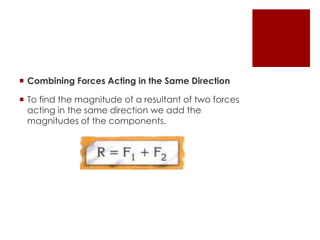
 Combining Forces Acting in the Same Direction

 To find the magnitude of a resultant of two forces
  acting in the same direction we add the
  magnitudes of the components.
 Combining Forces Acting in Opposite Directions

 Let F1 and F2 be forces in opposite directions and
  let F1 be greater than F2. Then the magnitude of
  the resultant is The direction of the resultant force
  is in the direction of the greater force.
Example:
 What will be the net force on the box in the figure
  below, if it is pulled by the two different forces in
  opposite directions?
TURNING EFFECT OF FORCES

 If a force is applied on a body which is
  suspended, hinged or pivoted, the force may
  cause the body to turn.
Moment of force
 The turning effect of the force is called moment.
Conditions for Equilibrium
 There are two conditions for equilibrium:

1. The sum of the forces in one direction must be
  equal to the sum of the forces in the opposite
  direction.
Conditions for Equilibrium
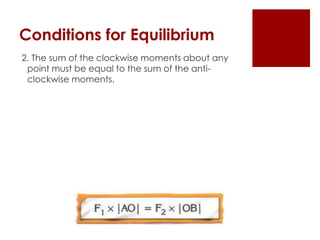
2. The sum of the clockwise moments about any
 point must be equal to the sum of the anti-
 clockwise moments.
Representing force

Representing force

  • 1.
  • 2.
    What is avector?  QUANTITIES IN SCIENCE  There are two types of quantities in science: Scalar quantities. Vector quantities
  • 3.
     Scalar quantity:It is a quantity which has only magnitude. They can be totally described by a number and a unit. Volume, area, temperature, energy, speed, mass , time are all scalar quantities.  Vector quantity: It is a quantity which has both magnitude and direction. Force, velocity, acceleration, and displacement are vector quantities.
  • 4.
     What isa vector? An arrow drawn to scale is called a vector. A vector has the following properties: 1. A point of application (where it is applied) 2. A magnitude (or size)(how large it is) 3. A direction
  • 5.
     All theforces applied to the bricks shown below have the same magnitude, 20N, but they are all different forces since their directions are different.
  • 6.
    Example:  Show thefollowing forces using vectors. a) A block is pulled to the east with a force of 4 N. b) A chest is pulled to the southwest with a force of 3 N. c) Three forces act on a block to move it, one with 2 N due north, one with 3 N due east and one with 3 N due west.
  • 7.
    COMBINING FORCES  Resultantforce (R): It isa single force which has the same effect as two or more forces acting together.  Component forces: They are the forces that form a resultant. The arrowhead ( ) over each letter shows that it is a vector quantity, which means the quantity also has a direction.
  • 8.
    Rule for additionof vectors (forces):  Rule for addition of vectors (forces): 1. Add the forces head to tail without changing their magnitude and direction 2. Draw a force from the tail of the first to the head of the last.
  • 9.
     Combining ForcesActing in the Same Direction  To find the magnitude of a resultant of two forces acting in the same direction we add the magnitudes of the components.
  • 10.
     Combining ForcesActing in Opposite Directions  Let F1 and F2 be forces in opposite directions and let F1 be greater than F2. Then the magnitude of the resultant is The direction of the resultant force is in the direction of the greater force.
  • 11.
    Example:  What willbe the net force on the box in the figure below, if it is pulled by the two different forces in opposite directions?
  • 12.
    TURNING EFFECT OFFORCES  If a force is applied on a body which is suspended, hinged or pivoted, the force may cause the body to turn.
  • 13.
    Moment of force The turning effect of the force is called moment.
  • 14.
    Conditions for Equilibrium There are two conditions for equilibrium: 1. The sum of the forces in one direction must be equal to the sum of the forces in the opposite direction.
  • 15.
    Conditions for Equilibrium 2.The sum of the clockwise moments about any point must be equal to the sum of the anti- clockwise moments.