What is Force?   1) Force is a push or pull 2) Force is the capacity to do work or cause physical change 3) Force= Mass times acceleration (F = ma) 4) A force is that which changes or tends to change the state of rest or motion of a body.
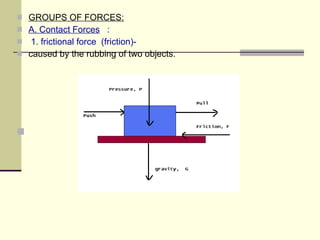
GROUPS OF FORCES: A. Contact Forces   : 1. frictional force  (friction)-   caused by the rubbing of two objects.
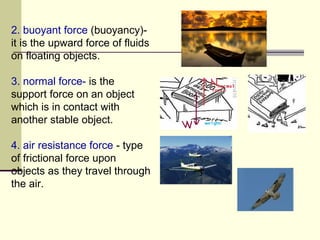
2. buoyant force  (buoyancy)-  it is the upward force of fluids on floating objects. 3. normal force-  is the support force on an object which is in contact with another stable object.   4. air resistance force  - type of frictional force upon objects as they travel through the air.
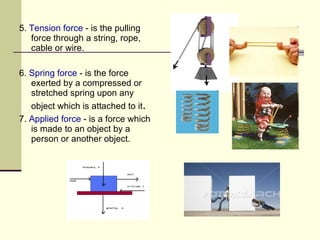
5.  Tension force  - is the pulling force through a string, rope, cable or wire. 6.  Spring force  - is the force exerted by a compressed or stretched spring upon any object which is attached to it . 7.  Applied force  - is a force which is made to an object by a person or another object.
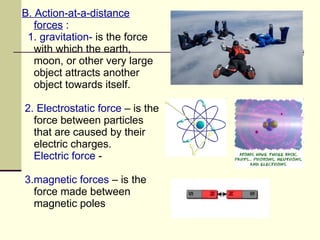
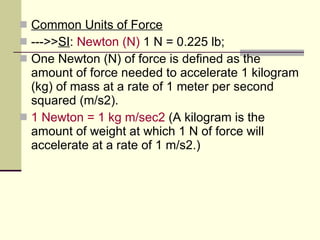
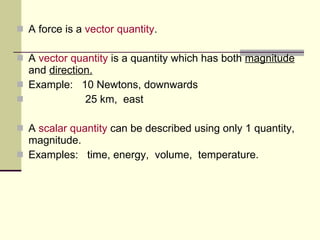
B. Action-at-a-distance forces  : 1. gravitation-  is the force with which the earth, moon, or other very large object attracts another object towards itself.  2. Electrostatic force  – is the force between particles that are caused by their electric charges.  Electric force  -  3.magnetic forces  – is the force made between magnetic poles
Common Units of Force   --->> SI :  Newton (N)  1 N = 0.225 lb;  One Newton (N) of force is defined as the amount of force needed to accelerate 1 kilogram (kg) of mass at a rate of 1 meter per second squared (m/s2). 1 Newton = 1 kg m/sec2  (A kilogram is the amount of weight at which 1 N of force will accelerate at a rate of 1 m/s2.)
A force is a  vector quantity .  A  vector quantity  is a quantity which has both  magnitude  and  direction.   Example:  10 Newtons, downwards 25 km,  east A  scalar quantity  can be described using only 1 quantity, magnitude.  Examples:  time, energy,  volume,  temperature.

What Is Force

  • 1.
    What is Force? 1) Force is a push or pull 2) Force is the capacity to do work or cause physical change 3) Force= Mass times acceleration (F = ma) 4) A force is that which changes or tends to change the state of rest or motion of a body.
  • 2.
    GROUPS OF FORCES:A. Contact Forces : 1. frictional force (friction)- caused by the rubbing of two objects.
  • 3.
    2. buoyant force (buoyancy)- it is the upward force of fluids on floating objects. 3. normal force- is the support force on an object which is in contact with another stable object. 4. air resistance force - type of frictional force upon objects as they travel through the air.
  • 4.
    5. Tensionforce - is the pulling force through a string, rope, cable or wire. 6. Spring force - is the force exerted by a compressed or stretched spring upon any object which is attached to it . 7. Applied force - is a force which is made to an object by a person or another object.
  • 5.
    B. Action-at-a-distance forces : 1. gravitation- is the force with which the earth, moon, or other very large object attracts another object towards itself. 2. Electrostatic force – is the force between particles that are caused by their electric charges. Electric force - 3.magnetic forces – is the force made between magnetic poles
  • 6.
    Common Units ofForce --->> SI : Newton (N) 1 N = 0.225 lb; One Newton (N) of force is defined as the amount of force needed to accelerate 1 kilogram (kg) of mass at a rate of 1 meter per second squared (m/s2). 1 Newton = 1 kg m/sec2 (A kilogram is the amount of weight at which 1 N of force will accelerate at a rate of 1 m/s2.)
  • 7.
    A force isa vector quantity . A vector quantity is a quantity which has both magnitude and direction. Example: 10 Newtons, downwards 25 km, east A scalar quantity can be described using only 1 quantity, magnitude. Examples: time, energy, volume, temperature.