Visual Composition
  By: Anna Rasmussen
Elements of Design:
                         Line
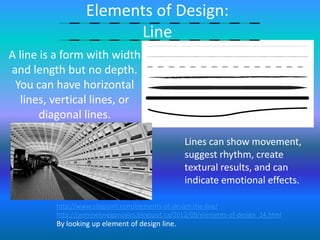
A line is a form with width
and length but no depth.
 You can have horizontal
   lines, vertical lines, or
       diagonal lines.

                                                   Lines can show movement,
                                                   suggest rhythm, create
                                                   textural results, and can
                                                   indicate emotional effects.

          http://www.sitepoint.com/elements-of-design-the-line/
          http://jasminelovegonzales.blogspot.ca/2012/09/elements-of-design_14.html
          By looking up element of design line.
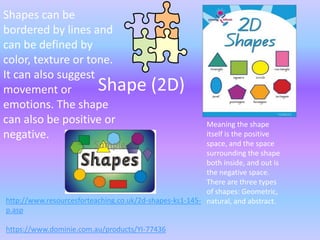
Shapes can be
bordered by lines and
can be defined by
color, texture or tone.
It can also suggest
movement or         Shape                 (2D)
emotions. The shape
can also be positive or                                  Meaning the shape
negative.                                                itself is the positive
                                                         space, and the space
                                                         surrounding the shape
                                                         both inside, and out is
                                                         the negative space.
                                                         There are three types
                                                         of shapes: Geometric,
http://www.resourcesforteaching.co.uk/2d-shapes-ks1-145- natural, and abstract.
p.asp

https://www.dominie.com.au/products/YI-77436
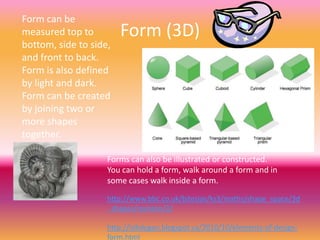
Form can be
measured top to         Form (3D)
bottom, side to side,
and front to back.
Form is also defined
by light and dark.
Form can be created
by joining two or
more shapes
together.

                    Forms can also be illustrated or constructed.
                    You can hold a form, walk around a form and in
                    some cases walk inside a form.

                    http://www.bbc.co.uk/bitesize/ks3/maths/shape_space/3d
                    _shapes/revision/2/

                    http://isikdogan.blogspot.ca/2010/10/elements-of-design-
                    form.html
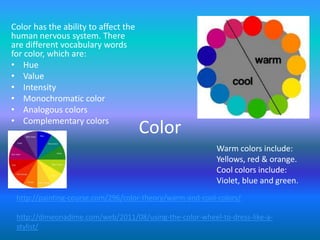
Color has the ability to affect the
human nervous system. There
are different vocabulary words
for color, which are:
• Hue
• Value
• Intensity
• Monochromatic color
• Analogous colors
• Complementary colors
                                      Color
                                                          Warm colors include:
                                                          Yellows, red & orange.
                                                          Cool colors include:
                                                          Violet, blue and green.
 http://painting-course.com/296/color-theory/warm-and-cool-colors/

 http://dimeonadime.com/web/2011/08/using-the-color-wheel-to-dress-like-a-
 stylist/
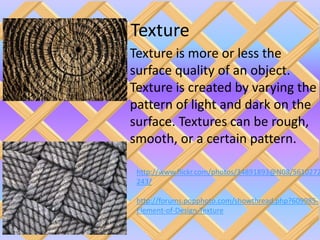
Texture
Texture is more or less the
surface quality of an object.
Texture is created by varying the
pattern of light and dark on the
surface. Textures can be rough,
smooth, or a certain pattern.

 http://www.flickr.com/photos/34891893@N08/5610272
 243/

 http://forums.popphoto.com/showthread.php?609985-
 Element-of-Design-Texture
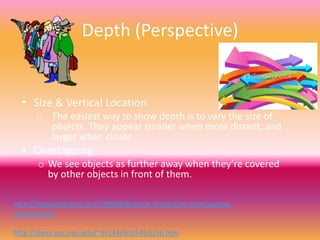
Depth (Perspective)


  • Size & Vertical Location
      o The easiest way to show depth is to vary the size of
        objects. They appear smaller when more distant, and
        larger when closer.
  • Overlapping
       o We see objects as further away when they’re covered
         by other objects in front of them.

http://depositphotos.com/3989808/stock-illustration-Overlapping-
Arrows.html

http://dana.ucc.nau.edu/~dcs34/tetc545/c/sp.htm
Depth (Perspective) Continued…
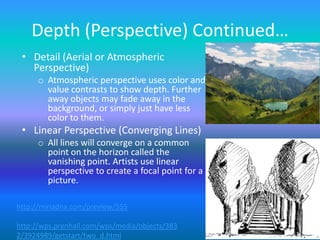
 • Detail (Aerial or Atmospheric
   Perspective)
     o Atmospheric perspective uses color and
       value contrasts to show depth. Further
       away objects may fade away in the
       background, or simply just have less
       color to them.
 • Linear Perspective (Converging Lines)
     o All lines will converge on a common
       point on the horizon called the
       vanishing point. Artists use linear
       perspective to create a focal point for a
       picture.

http://miriadna.com/preview/555

http://wps.prenhall.com/wps/media/objects/383
2/3924989/getstart/two_d.html
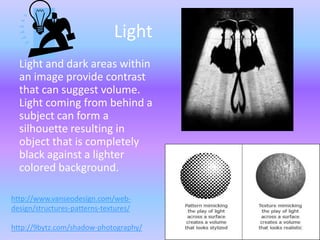
Light
  Light and dark areas within
  an image provide contrast
  that can suggest volume.
  Light coming from behind a
  subject can form a
  silhouette resulting in
  object that is completely
  black against a lighter
  colored background.

http://www.vanseodesign.com/web-
design/structures-patterns-textures/

http://9bytz.com/shadow-photography/
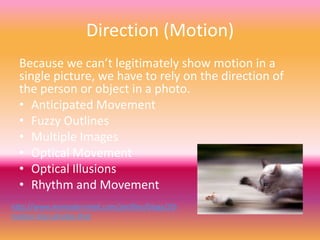
Direction (Motion)
  Because we can’t legitimately show motion in a
  single picture, we have to rely on the direction of
  the person or object in a photo.
  • Anticipated Movement
  • Fuzzy Outlines
  • Multiple Images
  • Optical Movement
  • Optical Illusions
  • Rhythm and Movement
http://www.mymodernmet.com/profiles/blogs/20-
motion-blur-photos-that
Direction (Motion) Continued…
• Anticipated Movement
Live things showed in an unstable position shows that movement is occurring.
• Fuzzy Outlines
When an object moves past us at a very high speed, we see it as blurry, so when a
blurry picture is taken of a moving object, we see it as motion.
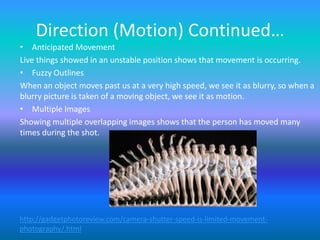
• Multiple Images
Showing multiple overlapping images shows that the person has moved many
times during the shot.


http://gadgetphotoreview.com/camera-shutter-speed-is-limited-movement-
photography/.html
Directions (Motion) Continued…
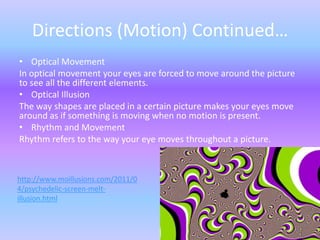
• Optical Movement
In optical movement your eyes are forced to move around the picture
to see all the different elements.
• Optical Illusion
The way shapes are placed in a certain picture makes your eyes move
around as if something is moving when no motion is present.
• Rhythm and Movement
Rhythm refers to the way your eye moves throughout a picture.


http://www.moillusions.com/2011/0
4/psychedelic-screen-melt-
illusion.html
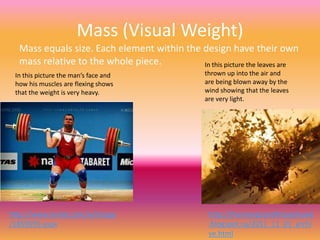
Mass (Visual Weight)
  Mass equals size. Each element within the design have their own
  mass relative to the whole piece.         In this picture the leaves are
 In this picture the man’s face and              thrown up into the air and
 how his muscles are flexing shows               are being blown away by the
 that the weight is very heavy.                  wind showing that the leaves
                                                 are very light.


http://www.mylot.com/w/image                      http://themangoandthejayhawk
/1859059.aspx                                     .blogspot.ca/2011_11_01_archi
                                                  ve.html
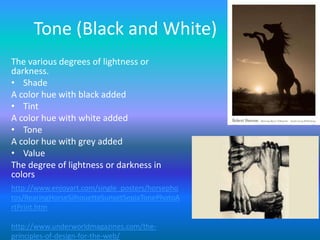
Tone (Black and White)
The various degrees of lightness or
darkness.
• Shade
A color hue with black added
• Tint
A color hue with white added
• Tone
A color hue with grey added
• Value
The degree of lightness or darkness in
colors
http://www.enjoyart.com/single_posters/horsepho
tos/RearingHorseSilhouetteSunsetSepiaTonePhotoA
rtPrint.htm

http://www.underworldmagazines.com/the-
principles-of-design-for-the-web/
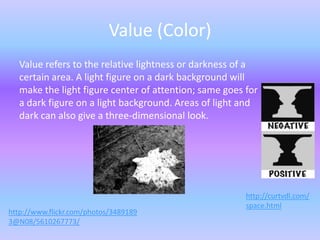
Value (Color)
  Value refers to the relative lightness or darkness of a
  certain area. A light figure on a dark background will
  make the light figure center of attention; same goes for
  a dark figure on a light background. Areas of light and
  dark can also give a three-dimensional look.


                                                       http://curtvdl.com/
                                                       space.html
http://www.flickr.com/photos/3489189
3@N08/5610267773/
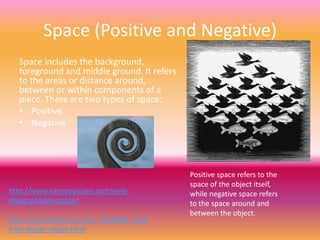
Space (Positive and Negative)
  Space includes the background,
  foreground and middle ground. It refers
  to the areas or distance around,
  between or within components of a
  piece. There are two types of space:
  • Positive
  • Negative


                                            Positive space refers to the
                                            space of the object itself,
http://www.vanseodesign.com/web-            while negative space refers
design/design-space/                        to the space around and
                                            between the object.
http://www.ehow.com/list_7629408_elem
ents-design-shape.html
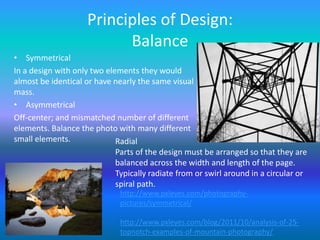
Principles of Design:
                           Balance
• Symmetrical
In a design with only two elements they would
almost be identical or have nearly the same visual
mass.
• Asymmetrical
Off-center; and mismatched number of different
elements. Balance the photo with many different
small elements.              Radial
                             Parts of the design must be arranged so that they are
                             balanced across the width and length of the page.
                             Typically radiate from or swirl around in a circular or
                             spiral path.
                              http://www.pxleyes.com/photography-
                              pictures/symmetrical/

                              http://www.pxleyes.com/blog/2011/10/analysis-of-25-
                              topnotch-examples-of-mountain-photography/
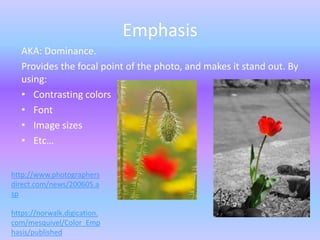
Emphasis
   AKA: Dominance.
   Provides the focal point of the photo, and makes it stand out. By
   using:
   • Contrasting colors
   • Font
   • Image sizes
   • Etc…


http://www.photographers
direct.com/news/200605.a
sp

https://norwalk.digication.
com/mesquivel/Color_Emp
hasis/published
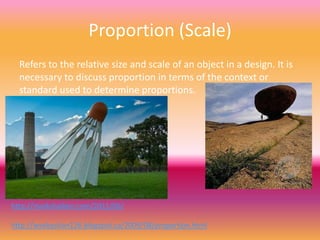
Proportion (Scale)
  Refers to the relative size and scale of an object in a design. It is
  necessary to discuss proportion in terms of the context or
  standard used to determine proportions.


http://markshaiken.com/2011/06/

http://wsebastian126.blogspot.ca/2009/08/proportion.html
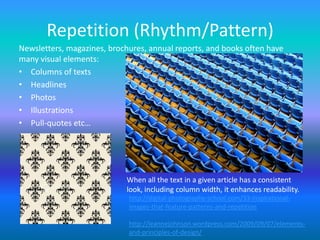
Repetition (Rhythm/Pattern)
Newsletters, magazines, brochures, annual reports, and books often have
many visual elements:
• Columns of texts
• Headlines
• Photos
• Illustrations
• Pull-quotes etc…


                            When all the text in a given article has a consistent
                            look, including column width, it enhances readability.
                             http://digital-photography-school.com/33-inspirational-
                             images-that-feature-patterns-and-repetition

                             http://leannejohnson.wordpress.com/2009/09/07/elements-
                             and-principles-of-design/
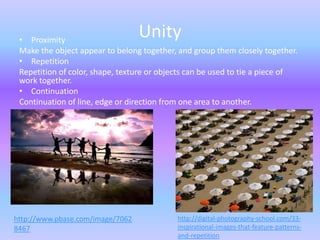
• Proximity
                                  Unity
 Make the object appear to belong together, and group them closely together.
 • Repetition
 Repetition of color, shape, texture or objects can be used to tie a piece of
 work together.
 • Continuation
 Continuation of line, edge or direction from one area to another.


http://www.pbase.com/image/7062             http://digital-photography-school.com/33-
8467                                        inspirational-images-that-feature-patterns-
                                            and-repetition
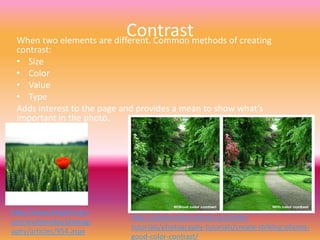
Contrastmethods of creating
 When two elements are different. Common
 contrast:
 • Size
 • Color
 • Value
 • Type
 Adds interest to the page and provides a mean to show what’s
 important in the photo.


http://www.brighthub.c
                            http://photoshoptutorials.ws/other-
om/multimedia/photogr
                            tutorials/photography-tutorials/create-striking-photos-
aphy/articles/954.aspx
                            good-color-contrast/
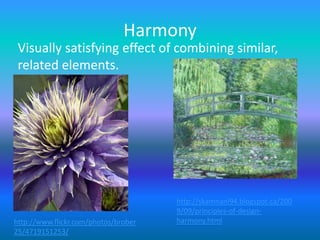
Harmony
 Visually satisfying effect of combining similar,
 related elements.


                                      http://skamnani94.blogspot.ca/200
                                      9/09/principles-of-design-
http://www.flickr.com/photos/brober   harmony.html
25/4719151253/
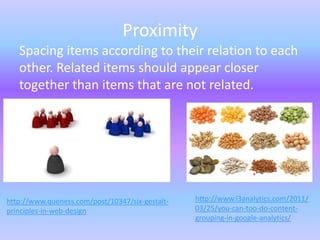
Proximity
   Spacing items according to their relation to each
   other. Related items should appear closer
   together than items that are not related.


http://www.queness.com/post/10347/six-gestalt-   http://www.l3analytics.com/2011/
principles-in-web-design                         03/25/you-can-too-do-content-
                                                 grouping-in-google-analytics/
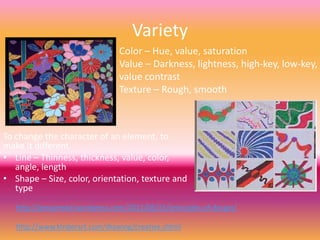
Variety
                                Color – Hue, value, saturation
                                Value – Darkness, lightness, high-key, low-key,
                                value contrast
                                Texture – Rough, smooth


To change the character of an element, to
make it different.
• Line – Thinness, thickness, value, color,
   angle, length
• Shape – Size, color, orientation, texture and
   type
   http://annaereed.wordpress.com/2011/06/15/principles-of-design/

   http://www.kinderart.com/drawing/creative.shtml

Visual Composition Slideshow - Anna Rasmussen

  • 1.
    Visual Composition By: Anna Rasmussen
  • 2.
    Elements of Design: Line A line is a form with width and length but no depth. You can have horizontal lines, vertical lines, or diagonal lines. Lines can show movement, suggest rhythm, create textural results, and can indicate emotional effects. http://www.sitepoint.com/elements-of-design-the-line/ http://jasminelovegonzales.blogspot.ca/2012/09/elements-of-design_14.html By looking up element of design line.
  • 3.
    Shapes can be borderedby lines and can be defined by color, texture or tone. It can also suggest movement or Shape (2D) emotions. The shape can also be positive or Meaning the shape negative. itself is the positive space, and the space surrounding the shape both inside, and out is the negative space. There are three types of shapes: Geometric, http://www.resourcesforteaching.co.uk/2d-shapes-ks1-145- natural, and abstract. p.asp https://www.dominie.com.au/products/YI-77436
  • 4.
    Form can be measuredtop to Form (3D) bottom, side to side, and front to back. Form is also defined by light and dark. Form can be created by joining two or more shapes together. Forms can also be illustrated or constructed. You can hold a form, walk around a form and in some cases walk inside a form. http://www.bbc.co.uk/bitesize/ks3/maths/shape_space/3d _shapes/revision/2/ http://isikdogan.blogspot.ca/2010/10/elements-of-design- form.html
  • 5.
    Color has theability to affect the human nervous system. There are different vocabulary words for color, which are: • Hue • Value • Intensity • Monochromatic color • Analogous colors • Complementary colors Color Warm colors include: Yellows, red & orange. Cool colors include: Violet, blue and green. http://painting-course.com/296/color-theory/warm-and-cool-colors/ http://dimeonadime.com/web/2011/08/using-the-color-wheel-to-dress-like-a- stylist/
  • 6.
    Texture Texture is moreor less the surface quality of an object. Texture is created by varying the pattern of light and dark on the surface. Textures can be rough, smooth, or a certain pattern. http://www.flickr.com/photos/34891893@N08/5610272 243/ http://forums.popphoto.com/showthread.php?609985- Element-of-Design-Texture
  • 7.
    Depth (Perspective) • Size & Vertical Location o The easiest way to show depth is to vary the size of objects. They appear smaller when more distant, and larger when closer. • Overlapping o We see objects as further away when they’re covered by other objects in front of them. http://depositphotos.com/3989808/stock-illustration-Overlapping- Arrows.html http://dana.ucc.nau.edu/~dcs34/tetc545/c/sp.htm
  • 8.
    Depth (Perspective) Continued… • Detail (Aerial or Atmospheric Perspective) o Atmospheric perspective uses color and value contrasts to show depth. Further away objects may fade away in the background, or simply just have less color to them. • Linear Perspective (Converging Lines) o All lines will converge on a common point on the horizon called the vanishing point. Artists use linear perspective to create a focal point for a picture. http://miriadna.com/preview/555 http://wps.prenhall.com/wps/media/objects/383 2/3924989/getstart/two_d.html
  • 9.
    Light Lightand dark areas within an image provide contrast that can suggest volume. Light coming from behind a subject can form a silhouette resulting in object that is completely black against a lighter colored background. http://www.vanseodesign.com/web- design/structures-patterns-textures/ http://9bytz.com/shadow-photography/
  • 10.
    Direction (Motion) Because we can’t legitimately show motion in a single picture, we have to rely on the direction of the person or object in a photo. • Anticipated Movement • Fuzzy Outlines • Multiple Images • Optical Movement • Optical Illusions • Rhythm and Movement http://www.mymodernmet.com/profiles/blogs/20- motion-blur-photos-that
  • 11.
    Direction (Motion) Continued… •Anticipated Movement Live things showed in an unstable position shows that movement is occurring. • Fuzzy Outlines When an object moves past us at a very high speed, we see it as blurry, so when a blurry picture is taken of a moving object, we see it as motion. • Multiple Images Showing multiple overlapping images shows that the person has moved many times during the shot. http://gadgetphotoreview.com/camera-shutter-speed-is-limited-movement- photography/.html
  • 12.
    Directions (Motion) Continued… •Optical Movement In optical movement your eyes are forced to move around the picture to see all the different elements. • Optical Illusion The way shapes are placed in a certain picture makes your eyes move around as if something is moving when no motion is present. • Rhythm and Movement Rhythm refers to the way your eye moves throughout a picture. http://www.moillusions.com/2011/0 4/psychedelic-screen-melt- illusion.html
  • 13.
    Mass (Visual Weight) Mass equals size. Each element within the design have their own mass relative to the whole piece. In this picture the leaves are In this picture the man’s face and thrown up into the air and how his muscles are flexing shows are being blown away by the that the weight is very heavy. wind showing that the leaves are very light. http://www.mylot.com/w/image http://themangoandthejayhawk /1859059.aspx .blogspot.ca/2011_11_01_archi ve.html
  • 14.
    Tone (Black andWhite) The various degrees of lightness or darkness. • Shade A color hue with black added • Tint A color hue with white added • Tone A color hue with grey added • Value The degree of lightness or darkness in colors http://www.enjoyart.com/single_posters/horsepho tos/RearingHorseSilhouetteSunsetSepiaTonePhotoA rtPrint.htm http://www.underworldmagazines.com/the- principles-of-design-for-the-web/
  • 15.
    Value (Color) Value refers to the relative lightness or darkness of a certain area. A light figure on a dark background will make the light figure center of attention; same goes for a dark figure on a light background. Areas of light and dark can also give a three-dimensional look. http://curtvdl.com/ space.html http://www.flickr.com/photos/3489189 3@N08/5610267773/
  • 16.
    Space (Positive andNegative) Space includes the background, foreground and middle ground. It refers to the areas or distance around, between or within components of a piece. There are two types of space: • Positive • Negative Positive space refers to the space of the object itself, http://www.vanseodesign.com/web- while negative space refers design/design-space/ to the space around and between the object. http://www.ehow.com/list_7629408_elem ents-design-shape.html
  • 17.
    Principles of Design: Balance • Symmetrical In a design with only two elements they would almost be identical or have nearly the same visual mass. • Asymmetrical Off-center; and mismatched number of different elements. Balance the photo with many different small elements. Radial Parts of the design must be arranged so that they are balanced across the width and length of the page. Typically radiate from or swirl around in a circular or spiral path. http://www.pxleyes.com/photography- pictures/symmetrical/ http://www.pxleyes.com/blog/2011/10/analysis-of-25- topnotch-examples-of-mountain-photography/
  • 18.
    Emphasis AKA: Dominance. Provides the focal point of the photo, and makes it stand out. By using: • Contrasting colors • Font • Image sizes • Etc… http://www.photographers direct.com/news/200605.a sp https://norwalk.digication. com/mesquivel/Color_Emp hasis/published
  • 19.
    Proportion (Scale) Refers to the relative size and scale of an object in a design. It is necessary to discuss proportion in terms of the context or standard used to determine proportions. http://markshaiken.com/2011/06/ http://wsebastian126.blogspot.ca/2009/08/proportion.html
  • 20.
    Repetition (Rhythm/Pattern) Newsletters, magazines,brochures, annual reports, and books often have many visual elements: • Columns of texts • Headlines • Photos • Illustrations • Pull-quotes etc… When all the text in a given article has a consistent look, including column width, it enhances readability. http://digital-photography-school.com/33-inspirational- images-that-feature-patterns-and-repetition http://leannejohnson.wordpress.com/2009/09/07/elements- and-principles-of-design/
  • 21.
    • Proximity Unity Make the object appear to belong together, and group them closely together. • Repetition Repetition of color, shape, texture or objects can be used to tie a piece of work together. • Continuation Continuation of line, edge or direction from one area to another. http://www.pbase.com/image/7062 http://digital-photography-school.com/33- 8467 inspirational-images-that-feature-patterns- and-repetition
  • 22.
    Contrastmethods of creating When two elements are different. Common contrast: • Size • Color • Value • Type Adds interest to the page and provides a mean to show what’s important in the photo. http://www.brighthub.c http://photoshoptutorials.ws/other- om/multimedia/photogr tutorials/photography-tutorials/create-striking-photos- aphy/articles/954.aspx good-color-contrast/
  • 23.
    Harmony Visually satisfyingeffect of combining similar, related elements. http://skamnani94.blogspot.ca/200 9/09/principles-of-design- http://www.flickr.com/photos/brober harmony.html 25/4719151253/
  • 24.
    Proximity Spacing items according to their relation to each other. Related items should appear closer together than items that are not related. http://www.queness.com/post/10347/six-gestalt- http://www.l3analytics.com/2011/ principles-in-web-design 03/25/you-can-too-do-content- grouping-in-google-analytics/
  • 25.
    Variety Color – Hue, value, saturation Value – Darkness, lightness, high-key, low-key, value contrast Texture – Rough, smooth To change the character of an element, to make it different. • Line – Thinness, thickness, value, color, angle, length • Shape – Size, color, orientation, texture and type http://annaereed.wordpress.com/2011/06/15/principles-of-design/ http://www.kinderart.com/drawing/creative.shtml