Kuliah 3 Teknik PresentasiOleh Coky Fauzi Alficokyfauzialfi.wordpress.comPrinciples of Design

Design is a visual language built on fundamental principles and elements
The elements of design refer to “what” are used.The principles ofdesign refer to “how” they are used.
The Gestalt Theory of Visual Perception
The principles of design are based on the Gestalt Theory of VisualPerception
The Gestalt Theory of VisualPerceptionThe whole is different from the sum of its parts.
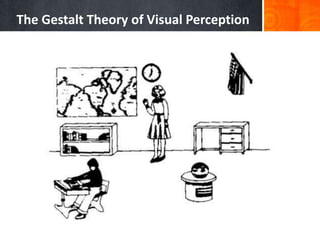
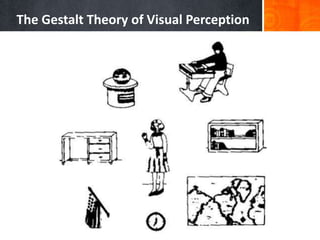
The Gestalt Theory of VisualPerception
Which of those two pictures is easier to remember?
The Gestalt Theory of Visual PerceptionA greater image may be verydifferent from thecomponents
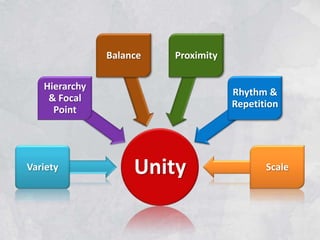
The Principles of Design
Unity or Harmony
To group similar elementsvisually and try to find the relationships that exist between them.
A design that is void of unity isusually chaotic and uncomfortable to view.
Left: Unity. Right: Lack of unity.
Variety
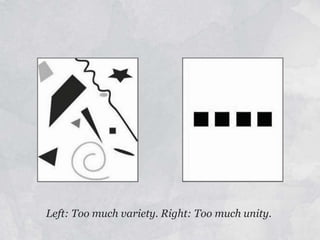
Too much unity is boring. The great design needs adding different elements for visual interest or variety.But too much variety can cause confusion.
Left: Too much variety. Right: Too much unity.
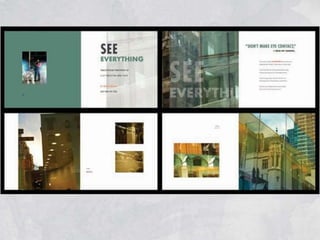
Typography in the same style andsize, and a pastel color palettehelped to unify.But the central image on each isunique, helping to create varietyanddifferentiate one title from thenext.
Hierarchy and Focal Point
Hierarchy is achieved bydetermining dominance oremphasizing one design element overanother
It is important that one element be dominant to give the viewer’s eye a focal point
The most dominantelement is the typography
The photograph is the most dominant element
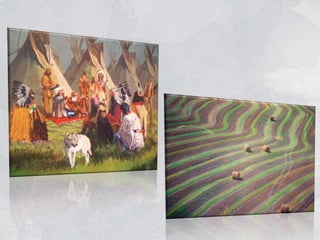
The Indian and horse represent the largest group of shapes
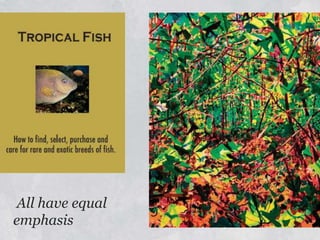
Lack of clear visual hierarchy is the reason many designs fail to attract and hold a viewer’sattention
 All have equal emphasis
Balance
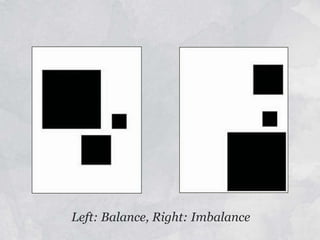
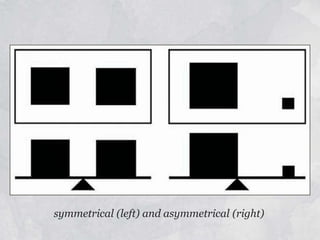
Balance in a design refers to the equal distribution of visual weight in a layout
Left: Balance, Right: Imbalance
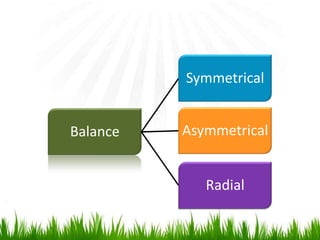
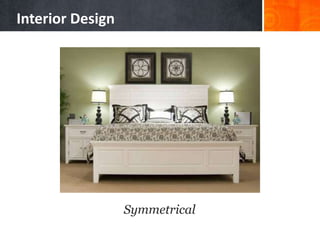
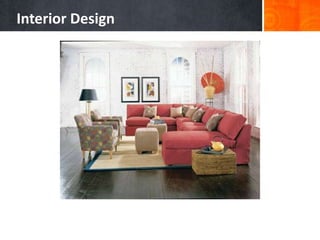
When one side of a design is exactly the same as the other side, it is calledsymmetrical balance or classical balance or formal balance.
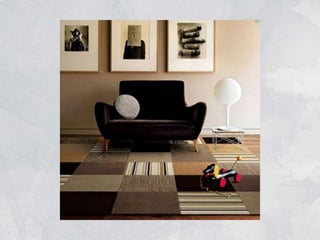
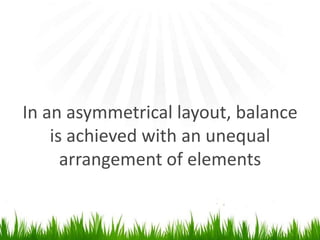
In an asymmetrical layout, balance is achieved with an unequal arrangement of elements
symmetrical (left) and asymmetrical(right)
Interior DesignSymmetrical
Radial balance can be described as balance thatradiates out from a central focal point. This type of balance is commonly used when a dynamic focal point is required.
Radial balance can be either symmetrical or asymmetrical depending on the location of its focal point.
Left: Asymmetrical radial balance. Right: Symmetrical balance.
Proximity
Proximity is a spatial relationship between items.The closer things are to one another, the more they must be related.
Rhythm and Repetition
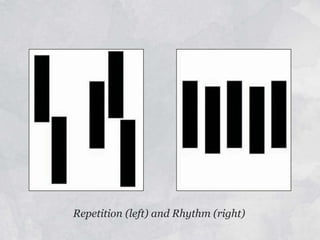
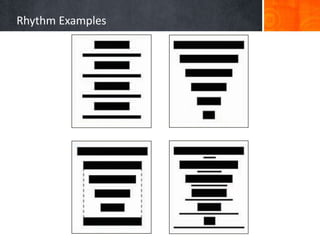
Rhythm is created by repeating exact or slightly different elements in a predictable manner. Itdiffers from repetition in the degree of duplication of elements and a feeling ofpacing.
Repetition (left) and Rhythm (right)
Rhythm Examples
Interior Design
Scale
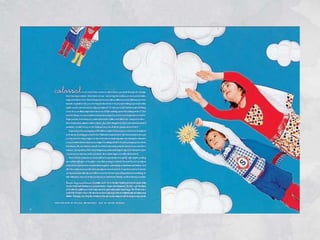
Scale is the size relationships between thevarious elements in a layout and can be used to control emphasis and hierarchy. A sense of perspective, or the illusion of depth, is an aspect ofscale.
Pertanyaan?
Tugas 3: EsaiBuatlah sebuah esai yang menjelaskan tentang proses desain.Deadline: 5 April 2011Send to: coky.fauzi.alfi@gmail.com
Terima Kasih© 2011 cokyfauzialfi.wordpress.com

Principles of Design