Chapter 2:
        Design Basics

         Design basics
Composition=Organization
•  Working with composition helps us to
   understand why certain photographs
   create the impressions they do
•  Two most fundamental types of design
   are contrasts and balance
Contrast
•  Contrast stresses the differences between
   graphic elements
•  The basis for composing an image is contrast
   between tone, color, form, sensations…
•  Johannes Itten created a theory of
   composition based on the idea of contrasts.
many   one
flat


contrasty
delicate/harsh
soft/hard
More Contrast Examples
Strong/Weak
Diagonal/Circular
Large/Small
Large/Small
Still/Moving
Long/Short
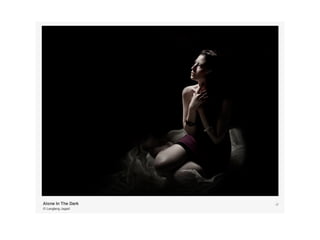
Light/Dark
Sweet/Sour
Gestalt Perception
•  A way of understanding perception
•  The mind goes from recognizing the
   individual parts of a photo to
   understanding the whole scene
•  When the viewer understands the
   image as a whole, it requires less effort
   for them to understand the picture
Gestalt and Kanisza Triangle
•  Gestalt theory of closure
•  Parts of a composition
Suggest a shape and this
Perceived shape helps to
Give structure to the photo
Gestalt
Gestalt Laws
1.  Proximity-the mind groups things according
    to how close they are together
2.  Similarity-items of similar form or content
    are grouped together
3.  Closure-elements arranged together are
    seen to complete a shape
4.  Simplicity-the mind prefers simple visual
    explanations
Gestalt Laws
5.  Common Fate-grouped elements can
    be read as one
6.  Good Continuation-the mind continues
    shape beyond their end
7.  Segregation-in order for an object to
    be seen, it must be distinguishable
    from the background
Gestalt Principles
1.  Emergence-negative space pops out
2.  Reification-the mind fills in an area due to
    inadequate information(like closure)
3.  Multistability-inversion-you can t tell what is
    the subject and what is the background
4.  Invariance-objects can be recognized
    despite orientation
Balance
•  In photography, the mind tries to
   balance things based on the laws of the
   physical world
  –  Gravity, weight, levers…
•  Balance is like a weighing scale, you try
   to even out the weight
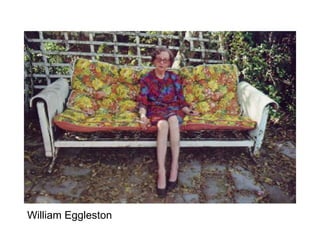
Static Balance/Symmetrical
•  Everything is centered
•  You can place your object in the very
   center or place something on either side
   of the center
static balance
bilateral symmetry
William Eggleston
Dynamic Balance/
          Asymmetrical
•  Opposes forces of nature and creates a
   more dynamic look
•  A large object can be balanced by a
   small one if it is far enough away from
   the center of the frame
imbalance
dynamic balance
Dynamic Tension
•  Using diagonals, rhythm…you can
   create dynamic tension instead of
   balance
•  It keeps the eye moving outward from
   the center of the image
•  Leading Lines
dynamic tension
dynamic tension
Figure and Ground
•  As viewers, we assume, all subjects
   have a setting or background. One
   thing is important while the other is
   secondary
•  You can create an ambiguity as to what
   is figure and what is ground. This adds
   tension.
•  Think about your negative space
figure and ground
Rhythm
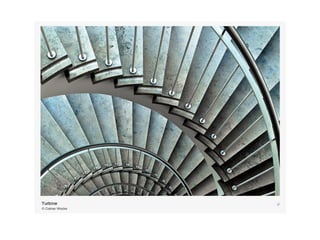
•  Several similar elements or repeating
   elements can create rhythm
•  The viewer will continue the rhythm out
   of the frame
•  Rhythm indicates a directionality
rhythm
dynamic rhythm
Pattern, Texture, Many
•  Like rhythm, pattern in built on repetition, but
   it is not movement based. It is area based
•  Pattern on a large scale takes on the look of
   texture. Texture is a surface quality.
•  Many has more to do with content and the
   surprise of seeing so many of something at
   one time.
many
regular pattern
irregular pattern
breaking pattern
Perspective
•  The appearance of objects in space and
   their relationship to each other and the
   viewer.
•  Photography usually inherently shows
   perspective, so it s more a matter of the
   intensity of the impression of
   perspective
perspective
Linear Perspective
•  This occurs when lines converge.
•  In reality we know that parallel lines
   never cross, but as they get further from
   the camera they appear to move
   towards each other
linear perspective
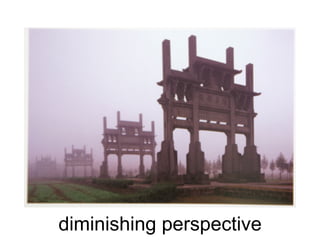
Diminishing Perspective
•  This is a form of linear perspective
•  Objects get successively smaller as
   they move a way from the lens
diminishing perspective
Aerial Perspective
•  Atmospheric haze reduces contrast as
   the scene get further from the camera
•  By not using filters you can maximize
   atmosphere
•  Telephoto lenses show more aerial
   perspective than wide angle because
   they show less of the nearby things that
   are not hazy
aerial perspective
lack of aerial perspective
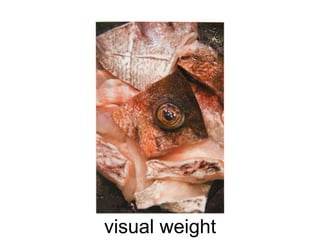
Visual Weight
•  Our eyes focus most on what in the
   frame will give us the most information
  –  Ex: eyes, mouth, hands, writing…
•  Also, things that appeal to our emotions
   draw us
  –  Ex: cuteness, sexuality, horror…
•  We tend to draw conclusions based on
   previous knowledge
visual weight
visual weight
visual weight
visual weight
visual weight
Looking and Interest
•  Our eyes move from point of interest to
   point of interest quickly until we have
   the whole picture in our mind
•  This can be mapped to show how we
   take in images
•  We also look based on what we are
   looking for in the image
intended order
Content, Weak and Strong
•  Content is the subject matter..conctrete
   or abstract
•  Strong content calls for practical
   composition
•  With weaker content you can play more
   with the composition
strong content
James Nachtwey
James Nachtwey
Mainly Form
•  Photo taken with visuals as the focus
Photo Design_Chapter 2_Design Elements

Photo Design_Chapter 2_Design Elements