VISUAL PERCEPTION
- Lopamudra Ghosh
What is Visual Perception?
Visual perception is the ability to see and interpret (analyze
and give meaning to) the visual information that surrounds us.
The process of "taking in" one's environment is referred to as
perception.
or
“ visual perception is the end product of vision”
It can be described as the way the brain interprets what the
eyes see.
Visual perceptual skills include several key
component areas:
• Visual Discrimination: The ability to notice detail differences such as
shape, size, color, or other dimensional aspects.
• Form Constancy (Form Discrimination): The ability to perceive positional
aspect differences and recognize objects when they are in a different
orientation or format.
• Figure Ground (Foreground-Background Differentiation): The ability to
focus on a selected target and screen out or ignore irrelevant images.
• Spatial Relations: The ability to recognize the positioning of objects in
space.
• Visual Closure: The ability to recognize an object, letter or number
without seeing all of the object.
• Visual Sequencing: The ability to see objects in a particular sequential
order.
• Visual Memory: The ability to remember forms (letters) and sequences of
forms (words) and recognize them quickly when seen again.
Gestalt Theory
• The Gestalt Theory originally came about in the 1890’s.
• Gestalt is German for “ Shape/Form/Likeness ”
• There are 3 main Gestalt psychologists:
1. Wertheimer (Is credited as the founder of the movement of Gestalt
Psychology)
2. Wolfgang K öhler
3. Kurt Koffka
• The concept of Gestalts Psychology was originally
foundered by an Austrian psychologist called Christian
Freiherr von Ehrenfels
• The major problem with the Gestalt laws and principles are
that they are mainly descriptive and not explanatory.
Gestalt Theory
The principle can be split into 3 groups
• Figure and Ground
• Similarity, Proximity, Common Fate &
Continuity
• Closure, Area & Symmetry
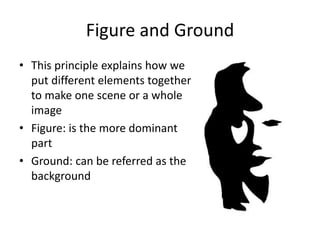
Figure and Ground
• This principle explains how we
put different elements together
to make one scene or a whole
image
• Figure: is the more dominant
part
• Ground: can be referred as the
background
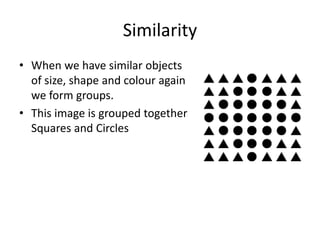
Similarity
• When we have similar objects
of size, shape and colour again
we form groups.
• This image is grouped together
Squares and Circles
Proximity
• When objects which are closer
to each other we tend to
associate them together to
form groups.
• You will see an “U” shape
rather than the design in that
“U”.
• Even Unilever is differently
placed from the “U”.
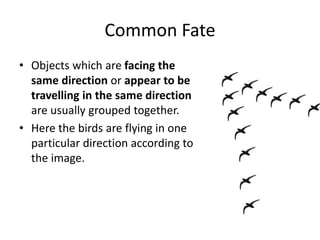
Common Fate
• Objects which are facing the
same direction or appear to be
travelling in the same direction
are usually grouped together.
• Here the birds are flying in one
particular direction according to
the image.
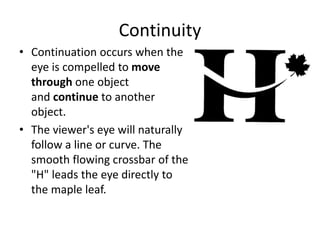
Continuity
• Continuation occurs when the
eye is compelled to move
through one object
and continue to another
object.
• The viewer's eye will naturally
follow a line or curve. The
smooth flowing crossbar of the
"H" leads the eye directly to
the maple leaf.
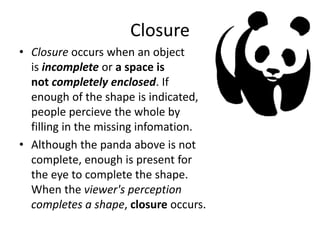
Closure
• Closure occurs when an object
is incomplete or a space is
not completely enclosed. If
enough of the shape is indicated,
people percieve the whole by
filling in the missing infomation.
• Although the panda above is not
complete, enough is present for
the eye to complete the shape.
When the viewer's perception
completes a shape, closure occurs.
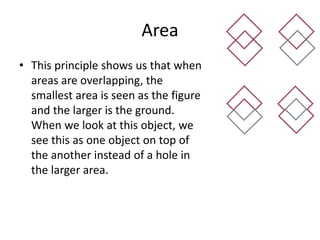
Area
• This principle shows us that when
areas are overlapping, the
smallest area is seen as the figure
and the larger is the ground.
When we look at this object, we
see this as one object on top of
the another instead of a hole in
the larger area.
Symmetry
• Objects which are symmetrical, we
are more likely to group them
together.
• This principle also describes looking
at an image and perceiving it as a
whole figure instead of it’s individual
parts.
Eye Tracking
Eye tracking is an effective tool to study different
aspects of visual perception:
• Understanding eye movements in natural tasks to
see how people coordinate actions in real-life tasks
revealing cognitive/perceptual processes and/or
limitations
• Looking into change blindness, inattentional
blindness, and visual memory
• Exploring navigation and guidance of visual
attention
Eye tracking allows researchers to quantify the dynamics of eye
movements in visual behavior. This is particularly useful for
uncovering patterns and characteristics that are diagnostic of
important states or conditions, such as in traumatic brain injury.
This objective, quantitative information provides a basis for
comparison to normative data, revealing differences that support
particular diagnoses or identification of impairments. Examples
include:
• Saccadic performance, such as latency, over/undershoot, and
suppression
• Fixation stability and drift
• Smooth pursuit, such as alterations of pursuit gain
• Binocularity and vergence, such as strabismus (uncontrolled inward
or outward eye movement) or amblyopia (lazy eye)
• Nystagmus (rapid, uncontrolled eye movements), such as the slope
of the slow phase and amplitude of the fast phase.
Conclusion
Vision is not necessarily what we see but how
our brain interprets the world around us, our
own experiences can shape how we perceive
this world.
And that’s how we Visually Perceive the world
around us.

Visual perception concepts

  • 1.
  • 2.
    What is VisualPerception? Visual perception is the ability to see and interpret (analyze and give meaning to) the visual information that surrounds us. The process of "taking in" one's environment is referred to as perception. or “ visual perception is the end product of vision” It can be described as the way the brain interprets what the eyes see.
  • 3.
    Visual perceptual skillsinclude several key component areas: • Visual Discrimination: The ability to notice detail differences such as shape, size, color, or other dimensional aspects. • Form Constancy (Form Discrimination): The ability to perceive positional aspect differences and recognize objects when they are in a different orientation or format. • Figure Ground (Foreground-Background Differentiation): The ability to focus on a selected target and screen out or ignore irrelevant images. • Spatial Relations: The ability to recognize the positioning of objects in space. • Visual Closure: The ability to recognize an object, letter or number without seeing all of the object. • Visual Sequencing: The ability to see objects in a particular sequential order. • Visual Memory: The ability to remember forms (letters) and sequences of forms (words) and recognize them quickly when seen again.
  • 4.
    Gestalt Theory • TheGestalt Theory originally came about in the 1890’s. • Gestalt is German for “ Shape/Form/Likeness ” • There are 3 main Gestalt psychologists: 1. Wertheimer (Is credited as the founder of the movement of Gestalt Psychology) 2. Wolfgang K öhler 3. Kurt Koffka • The concept of Gestalts Psychology was originally foundered by an Austrian psychologist called Christian Freiherr von Ehrenfels • The major problem with the Gestalt laws and principles are that they are mainly descriptive and not explanatory.
  • 5.
    Gestalt Theory The principlecan be split into 3 groups • Figure and Ground • Similarity, Proximity, Common Fate & Continuity • Closure, Area & Symmetry
  • 6.
    Figure and Ground •This principle explains how we put different elements together to make one scene or a whole image • Figure: is the more dominant part • Ground: can be referred as the background
  • 7.
    Similarity • When wehave similar objects of size, shape and colour again we form groups. • This image is grouped together Squares and Circles
  • 8.
    Proximity • When objectswhich are closer to each other we tend to associate them together to form groups. • You will see an “U” shape rather than the design in that “U”. • Even Unilever is differently placed from the “U”.
  • 9.
    Common Fate • Objectswhich are facing the same direction or appear to be travelling in the same direction are usually grouped together. • Here the birds are flying in one particular direction according to the image.
  • 10.
    Continuity • Continuation occurswhen the eye is compelled to move through one object and continue to another object. • The viewer's eye will naturally follow a line or curve. The smooth flowing crossbar of the "H" leads the eye directly to the maple leaf.
  • 11.
    Closure • Closure occurswhen an object is incomplete or a space is not completely enclosed. If enough of the shape is indicated, people percieve the whole by filling in the missing infomation. • Although the panda above is not complete, enough is present for the eye to complete the shape. When the viewer's perception completes a shape, closure occurs.
  • 12.
    Area • This principleshows us that when areas are overlapping, the smallest area is seen as the figure and the larger is the ground. When we look at this object, we see this as one object on top of the another instead of a hole in the larger area.
  • 13.
    Symmetry • Objects whichare symmetrical, we are more likely to group them together. • This principle also describes looking at an image and perceiving it as a whole figure instead of it’s individual parts.
  • 14.
    Eye Tracking Eye trackingis an effective tool to study different aspects of visual perception: • Understanding eye movements in natural tasks to see how people coordinate actions in real-life tasks revealing cognitive/perceptual processes and/or limitations • Looking into change blindness, inattentional blindness, and visual memory • Exploring navigation and guidance of visual attention
  • 15.
    Eye tracking allowsresearchers to quantify the dynamics of eye movements in visual behavior. This is particularly useful for uncovering patterns and characteristics that are diagnostic of important states or conditions, such as in traumatic brain injury. This objective, quantitative information provides a basis for comparison to normative data, revealing differences that support particular diagnoses or identification of impairments. Examples include: • Saccadic performance, such as latency, over/undershoot, and suppression • Fixation stability and drift • Smooth pursuit, such as alterations of pursuit gain • Binocularity and vergence, such as strabismus (uncontrolled inward or outward eye movement) or amblyopia (lazy eye) • Nystagmus (rapid, uncontrolled eye movements), such as the slope of the slow phase and amplitude of the fast phase.
  • 16.
    Conclusion Vision is notnecessarily what we see but how our brain interprets the world around us, our own experiences can shape how we perceive this world. And that’s how we Visually Perceive the world around us.