56 year old, lady, widowed + 3, Syrian descent presented to ER with speech difficulty, dizziness and general weakness.  3 weeks prior to admission, around the time of family bereavement (mother dying of lymphoma aged 87) began to complain of occipital headache. At the same time multiple complaints - “blurred vision” unable to define accurately - general weakness, unclear history of mild febrile illness - articulation difficulty - peri-oral paraesthesia - left hand paraesthesia - bilateral arm weakness - left leg weakness
Examined in neurology clinic 4 days previously - examination at that time normal - sent for CT ambulatory 2 days prior to admission presented to ER due to worsening of above symptoms - examination normal - treatment commenced with aspirin and patient advised to    continue investigation on ambulatory basis CT performed on day prior to admission normal On day of admission worsening of above symptoms as well as a brief episode of diplopia and difficulty swallowing.
Past History Mild hypothyroidism S/P  R lobectomy for hyperthyroidism Hypercholesterolemia S/P head radiation for tinea capitis On admission receiving aspirin 100mg only
Examination on admission General examination unremarkable Fully conscious and orientated No language deficit Speech mildly dysarthric Cranial nerves in tact Power preserved, reflexes symmetrical, no pyramidal signs, Sensory examination in tact No cerebellar signs Gait in tact
Neurological examination on day following admission Fully conscious and orientated Speech:  - mild cerebellar dysarthria with nasal quality Upgaze nystagmus. Cranial nerves otherwise in tact Tone, power, reflexes symmetrical and in tact No pyramidal signs Sensory examination in tact Mild cerebellar signs bilaterally Gait mildly ataxic
Neurological examination 2 days following admission Fully conscious and orientated PEARLA Skew deviation with no clear cranial nerve lesion Rest of examination as above Psychiatric examination revealed “ normal grief reaction” Treatment with thiamine commenced
Investigations performed which were normal Blood count, biochemistry ESR ( 17 )  LP: - Pressure 17, no cells, TP = 475, OCB –ve Tumour markers AchR Ab’s B1 EBV, CMV – no sign of acute infection  Whole body CT
Other Investigations performed Thyroid USS multinodular goitre left lobe, R lobe absent Thyroid FNAC consistent with benign multinodular goitre Thyroid function VDRL ANA Anti-cardiolipin
MRI at this stage Mass in middle aspect of  lower midbrain / junction with pons - 1cm, round, enhancing - Surrounding hyperintense T2 and FLAIR signal - No major distortion of surrounding structures Additional small foci - non-enhancing, hyperintense T2 and FLAIR - R pons and L frontal white matter
Neurological examination 5 days following admission General deterioration, complains of worsening headache Agitation Decreased co-operation Bilateral gaze paresis “ eyes fixed”
Neurological examination 9 days following admission Deterioration in level of consciousness - Unresponsive to painful stimuli - No eye opening - No vocalisation - Corneal reflexes and Doll’s eyes preserved - not moving arms - spontaneous symmetrical leg movements HEAD CT – revealed hypodense lesion in midbrain Whole body PET: no evidence of lesions outside of brain Treatment with dexamethasone initiated
Neurological examination 12 days following admission Improvement in conscious level Orientated in time and place Moves all 4 limbs symmetrical No pyramidal signs Over following 2 weeks ( until now ) progressive improvement in conscious state and orientation In parallel with above improvement, development of frontal syndrome……….
Neurological examination 1 month following admission ( up to date ) Fully conscious and orientated Minimal co-operation with examination - disinhibited speech - Echolalia - perseveration - hyper-orality - utilisation behaviour
Frontal signs continued….. - Pout  - Grasp bilaterally - PMR absent bilaterally - Paratonia on right side
Neurological examination 1 month following admission continued Cranial nerves - Skew deviation ( R eye above left ) - No voluntary or pursuit eye movements - Doll’s eyes and caloric responses preserved Moves 4 limbs symmetrically  Reflexes slightly brisker on R Chadok on R Sensation grossly in tact Rest of examination limited due to lack of co-operation
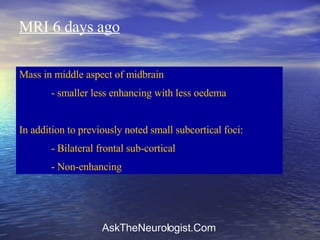
MRI 6 days ago Mass in middle aspect of midbrain - smaller less enhancing with less oedema In addition to previously noted small subcortical foci: - Bilateral frontal sub-cortical - Non-enhancing
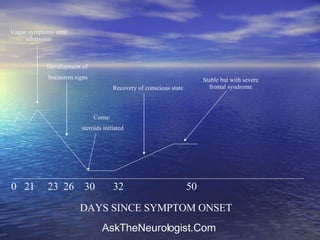
0  21  23  26  30  32  50  Vague symptoms until admission Development of  brainstem signs Coma:  steroids initiated Recovery of conscious state Stable but with severe frontal syndrome DAYS SINCE SYMPTOM ONSET
Summary 56 year old lady Progressive brainstem syndrome with subsequent development of a severe frontal syndrome following improvement of conscious state under steroid treatment
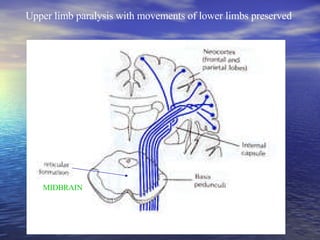
Upper limb paralysis with movements of lower limbs preserved MIDBRAIN
Can MRI findings explain clinical picture? Brainstem syndrome including coma readily explained by lesion in lower midbrain Can frontal syndrome be explained on basis of lesions?
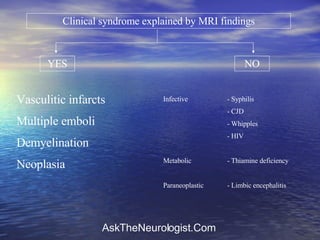
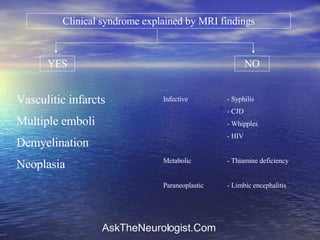
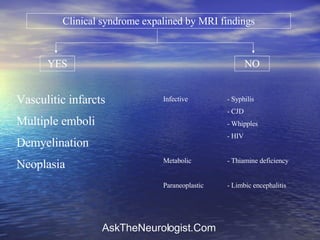
Clinical syndrome explained by MRI findings YES NO Vasculitic infarcts Multiple emboli Demyelination Neoplasia  Infective  - Syphilis - CJD - Whipples - HIV Metabolic - Thiamine deficiency Paraneoplastic - Limbic encephalitis
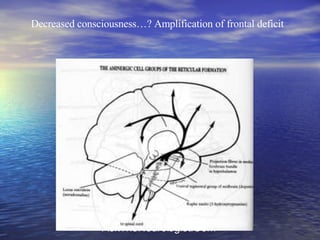
Decreased consciousness…? Amplification of frontal deficit
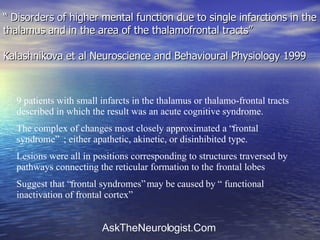
“  Disorders of higher mental function due to single infarctions in the thalamus and in the area of the thalamofrontal tracts” Kalashnikova et al Neuroscience and Behavioural Physiology 1999 9 patients with small infarcts in the thalamus or thalamo-frontal tracts described in which the result was an acute cognitive syndrome. The complex of changes most closely approximated a “ frontal syndrome”  ; either apathetic, akinetic, or disinhibited type. Lesions were all in positions corresponding to structures traversed by pathways connecting the reticular formation to the frontal lobes Suggest that “frontal syndromes” may be caused by “ functional inactivation of frontal cortex”
 
 
Clinical syndrome explained by MRI findings YES NO Vasculitic infarcts Multiple emboli Demyelination Neoplasia  Infective  - Syphilis - CJD - Whipples - HIV Metabolic - Thiamine deficiency Paraneoplastic - Limbic encephalitis
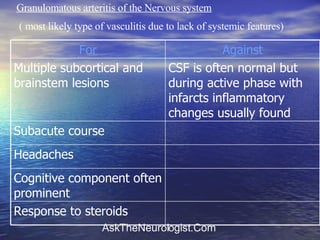
Granulomatous arteritis of the Nervous system ( most likely type of vasculitis due to lack of systemic features) Response to steroids Cognitive component often prominent Headaches Subacute course CSF is often normal but during active phase with infarcts inflammatory changes usually found Multiple subcortical and brainstem lesions Against For
Vasculitis of the nervous system A.Siva, Journal of Neurology, 2001


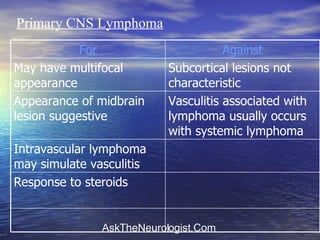
Primary CNS Lymphoma   Response to steroids Intravascular lymphoma may simulate vasculitis Vasculitis associated with lymphoma usually occurs with systemic lymphoma Appearance of midbrain lesion suggestive Subcortical lesions not characteristic May have multifocal appearance  Against For
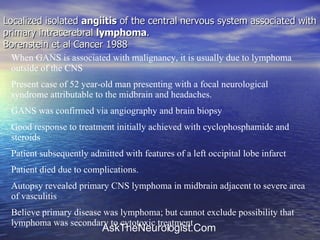
Localized isolated  angiitis  of the central nervous system associated with primary intracerebral  lymphoma .  Borenstein et al Cancer 1988 When GANS is associated with malignancy, it is usually due to lymphoma outside of the CNS Present case of 52 year-old man presenting with a focal neurological syndrome attributable to the midbrain and headaches. GANS was confirmed via angiography and brain biopsy Good response to treatment initially achieved with cyclophosphamide and steroids Patient subsequently admitted with features of a left occipital lobe infarct Patient died due to complications.  Autopsy revealed primary CNS lymphoma in midbrain adjacent to severe area of vasculitis Believe primary disease was lymphoma; but cannot exclude possibility that lymphoma was secondary to cytotoxic treatment
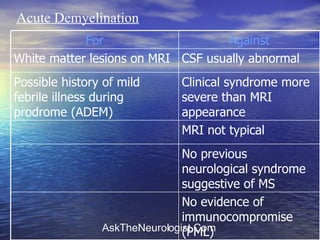
Acute Demyelination   No previous neurological syndrome suggestive of MS No evidence of immunocompromise (PML) MRI not typical Clinical syndrome more severe than MRI appearance Possible history of mild febrile illness during prodrome (ADEM) CSF usually abnormal White matter lesions on MRI Against For
Clinical syndrome expalined by MRI findings YES NO Vasculitic infarcts Multiple emboli Demyelination Neoplasia  Infective  - Syphilis - CJD - Whipples - HIV Metabolic - Thiamine deficiency Paraneoplastic - Limbic encephalitis
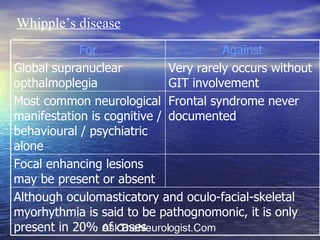
Whipple’s disease Although oculomasticatory and oculo-facial-skeletal myorhythmia is said to be pathognomonic, it is only present in 20% of cases Focal enhancing lesions may be present or absent Frontal syndrome never documented Most common neurological manifestation is cognitive / behavioural / psychiatric alone Very rarely occurs without GIT involvement Global supranuclear opthalmoplegia Against For
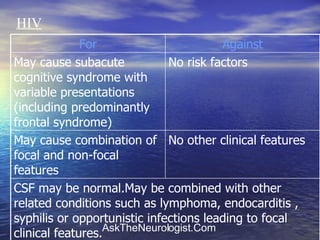
HIV CSF may be normal.May be combined with other related conditions such as lymphoma, endocarditis , syphilis or opportunistic infections leading to focal clinical features.  No other clinical features May cause combination of focal and non-focal features No risk factors May cause subacute cognitive syndrome with variable presentations  (including predominantly frontal syndrome) Against For
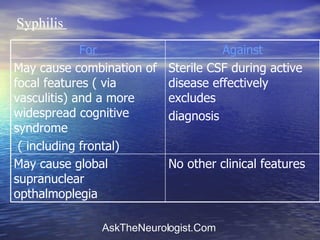
Syphilis  No other clinical features May cause global supranuclear opthalmoplegia Sterile CSF during active disease effectively excludes  diagnosis May cause combination of focal features ( via vasculitis) and a more widespread cognitive syndrome ( including frontal) Against For
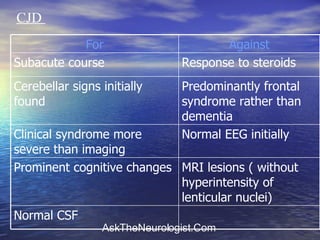
CJD  MRI lesions ( without hyperintensity of lenticular nuclei) Prominent cognitive changes Normal CSF Normal EEG initially Clinical syndrome more severe than imaging Predominantly frontal syndrome rather than dementia Cerebellar signs initially found Response to steroids Subacute course Against For
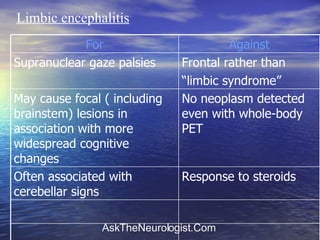
Limbic encephalitis Response to steroids Often associated with cerebellar signs No neoplasm detected even with whole-body PET May cause focal ( including brainstem) lesions in association with more widespread cognitive changes Frontal rather than  “ limbic syndrome” Supranuclear gaze palsies Against For
Resident’s summary of DD
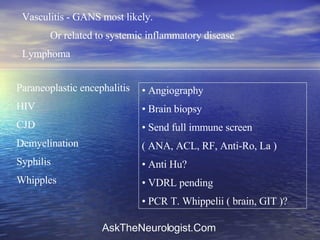
Vasculitis - GANS most likely.  Or related to systemic inflammatory disease Lymphoma Paraneoplastic encephalitis HIV  CJD Demyelination Syphilis  Whipples Angiography Brain biopsy Send full immune screen  ( ANA, ACL, RF, Anti-Ro, La ) Anti Hu? VDRL pending PCR T. Whippelii ( brain, GIT )?
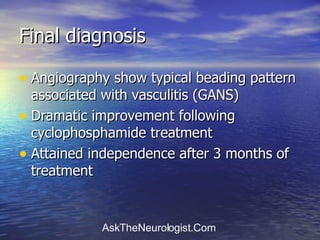
Final diagnosis  Angiography show typical beading pattern associated with vasculitis (GANS) Dramatic improvement following cyclophosphamide treatment Attained independence after 3 months of treatment

Frontal syndrome and mid-brain lesion

  • 1.
    56 year old,lady, widowed + 3, Syrian descent presented to ER with speech difficulty, dizziness and general weakness. 3 weeks prior to admission, around the time of family bereavement (mother dying of lymphoma aged 87) began to complain of occipital headache. At the same time multiple complaints - “blurred vision” unable to define accurately - general weakness, unclear history of mild febrile illness - articulation difficulty - peri-oral paraesthesia - left hand paraesthesia - bilateral arm weakness - left leg weakness
  • 2.
    Examined in neurologyclinic 4 days previously - examination at that time normal - sent for CT ambulatory 2 days prior to admission presented to ER due to worsening of above symptoms - examination normal - treatment commenced with aspirin and patient advised to continue investigation on ambulatory basis CT performed on day prior to admission normal On day of admission worsening of above symptoms as well as a brief episode of diplopia and difficulty swallowing.
  • 3.
    Past History Mildhypothyroidism S/P R lobectomy for hyperthyroidism Hypercholesterolemia S/P head radiation for tinea capitis On admission receiving aspirin 100mg only
  • 4.
    Examination on admissionGeneral examination unremarkable Fully conscious and orientated No language deficit Speech mildly dysarthric Cranial nerves in tact Power preserved, reflexes symmetrical, no pyramidal signs, Sensory examination in tact No cerebellar signs Gait in tact
  • 5.
    Neurological examination onday following admission Fully conscious and orientated Speech: - mild cerebellar dysarthria with nasal quality Upgaze nystagmus. Cranial nerves otherwise in tact Tone, power, reflexes symmetrical and in tact No pyramidal signs Sensory examination in tact Mild cerebellar signs bilaterally Gait mildly ataxic
  • 6.
    Neurological examination 2days following admission Fully conscious and orientated PEARLA Skew deviation with no clear cranial nerve lesion Rest of examination as above Psychiatric examination revealed “ normal grief reaction” Treatment with thiamine commenced
  • 7.
    Investigations performed whichwere normal Blood count, biochemistry ESR ( 17 ) LP: - Pressure 17, no cells, TP = 475, OCB –ve Tumour markers AchR Ab’s B1 EBV, CMV – no sign of acute infection Whole body CT
  • 8.
    Other Investigations performedThyroid USS multinodular goitre left lobe, R lobe absent Thyroid FNAC consistent with benign multinodular goitre Thyroid function VDRL ANA Anti-cardiolipin
  • 9.
    MRI at thisstage Mass in middle aspect of lower midbrain / junction with pons - 1cm, round, enhancing - Surrounding hyperintense T2 and FLAIR signal - No major distortion of surrounding structures Additional small foci - non-enhancing, hyperintense T2 and FLAIR - R pons and L frontal white matter
  • 10.
    Neurological examination 5days following admission General deterioration, complains of worsening headache Agitation Decreased co-operation Bilateral gaze paresis “ eyes fixed”
  • 11.
    Neurological examination 9days following admission Deterioration in level of consciousness - Unresponsive to painful stimuli - No eye opening - No vocalisation - Corneal reflexes and Doll’s eyes preserved - not moving arms - spontaneous symmetrical leg movements HEAD CT – revealed hypodense lesion in midbrain Whole body PET: no evidence of lesions outside of brain Treatment with dexamethasone initiated
  • 12.
    Neurological examination 12days following admission Improvement in conscious level Orientated in time and place Moves all 4 limbs symmetrical No pyramidal signs Over following 2 weeks ( until now ) progressive improvement in conscious state and orientation In parallel with above improvement, development of frontal syndrome……….
  • 13.
    Neurological examination 1month following admission ( up to date ) Fully conscious and orientated Minimal co-operation with examination - disinhibited speech - Echolalia - perseveration - hyper-orality - utilisation behaviour
  • 14.
    Frontal signs continued…..- Pout - Grasp bilaterally - PMR absent bilaterally - Paratonia on right side
  • 15.
    Neurological examination 1month following admission continued Cranial nerves - Skew deviation ( R eye above left ) - No voluntary or pursuit eye movements - Doll’s eyes and caloric responses preserved Moves 4 limbs symmetrically Reflexes slightly brisker on R Chadok on R Sensation grossly in tact Rest of examination limited due to lack of co-operation
  • 16.
    MRI 6 daysago Mass in middle aspect of midbrain - smaller less enhancing with less oedema In addition to previously noted small subcortical foci: - Bilateral frontal sub-cortical - Non-enhancing
  • 17.
    0 21 23 26 30 32 50 Vague symptoms until admission Development of brainstem signs Coma: steroids initiated Recovery of conscious state Stable but with severe frontal syndrome DAYS SINCE SYMPTOM ONSET
  • 18.
    Summary 56 yearold lady Progressive brainstem syndrome with subsequent development of a severe frontal syndrome following improvement of conscious state under steroid treatment
  • 19.
    Upper limb paralysiswith movements of lower limbs preserved MIDBRAIN
  • 20.
    Can MRI findingsexplain clinical picture? Brainstem syndrome including coma readily explained by lesion in lower midbrain Can frontal syndrome be explained on basis of lesions?
  • 21.
    Clinical syndrome explainedby MRI findings YES NO Vasculitic infarcts Multiple emboli Demyelination Neoplasia Infective - Syphilis - CJD - Whipples - HIV Metabolic - Thiamine deficiency Paraneoplastic - Limbic encephalitis
  • 22.
  • 23.
    “ Disordersof higher mental function due to single infarctions in the thalamus and in the area of the thalamofrontal tracts” Kalashnikova et al Neuroscience and Behavioural Physiology 1999 9 patients with small infarcts in the thalamus or thalamo-frontal tracts described in which the result was an acute cognitive syndrome. The complex of changes most closely approximated a “ frontal syndrome” ; either apathetic, akinetic, or disinhibited type. Lesions were all in positions corresponding to structures traversed by pathways connecting the reticular formation to the frontal lobes Suggest that “frontal syndromes” may be caused by “ functional inactivation of frontal cortex”
  • 24.
  • 25.
  • 26.
    Clinical syndrome explainedby MRI findings YES NO Vasculitic infarcts Multiple emboli Demyelination Neoplasia Infective - Syphilis - CJD - Whipples - HIV Metabolic - Thiamine deficiency Paraneoplastic - Limbic encephalitis
  • 27.
    Granulomatous arteritis ofthe Nervous system ( most likely type of vasculitis due to lack of systemic features) Response to steroids Cognitive component often prominent Headaches Subacute course CSF is often normal but during active phase with infarcts inflammatory changes usually found Multiple subcortical and brainstem lesions Against For
  • 28.
    Vasculitis of thenervous system A.Siva, Journal of Neurology, 2001
  • 29.
  • 30.
  • 31.
  • 32.
    Primary CNS Lymphoma Response to steroids Intravascular lymphoma may simulate vasculitis Vasculitis associated with lymphoma usually occurs with systemic lymphoma Appearance of midbrain lesion suggestive Subcortical lesions not characteristic May have multifocal appearance Against For
  • 33.
    Localized isolated angiitis of the central nervous system associated with primary intracerebral lymphoma . Borenstein et al Cancer 1988 When GANS is associated with malignancy, it is usually due to lymphoma outside of the CNS Present case of 52 year-old man presenting with a focal neurological syndrome attributable to the midbrain and headaches. GANS was confirmed via angiography and brain biopsy Good response to treatment initially achieved with cyclophosphamide and steroids Patient subsequently admitted with features of a left occipital lobe infarct Patient died due to complications. Autopsy revealed primary CNS lymphoma in midbrain adjacent to severe area of vasculitis Believe primary disease was lymphoma; but cannot exclude possibility that lymphoma was secondary to cytotoxic treatment
  • 34.
    Acute Demyelination No previous neurological syndrome suggestive of MS No evidence of immunocompromise (PML) MRI not typical Clinical syndrome more severe than MRI appearance Possible history of mild febrile illness during prodrome (ADEM) CSF usually abnormal White matter lesions on MRI Against For
  • 35.
    Clinical syndrome expalinedby MRI findings YES NO Vasculitic infarcts Multiple emboli Demyelination Neoplasia Infective - Syphilis - CJD - Whipples - HIV Metabolic - Thiamine deficiency Paraneoplastic - Limbic encephalitis
  • 36.
    Whipple’s disease Althoughoculomasticatory and oculo-facial-skeletal myorhythmia is said to be pathognomonic, it is only present in 20% of cases Focal enhancing lesions may be present or absent Frontal syndrome never documented Most common neurological manifestation is cognitive / behavioural / psychiatric alone Very rarely occurs without GIT involvement Global supranuclear opthalmoplegia Against For
  • 37.
    HIV CSF maybe normal.May be combined with other related conditions such as lymphoma, endocarditis , syphilis or opportunistic infections leading to focal clinical features. No other clinical features May cause combination of focal and non-focal features No risk factors May cause subacute cognitive syndrome with variable presentations (including predominantly frontal syndrome) Against For
  • 38.
    Syphilis Noother clinical features May cause global supranuclear opthalmoplegia Sterile CSF during active disease effectively excludes diagnosis May cause combination of focal features ( via vasculitis) and a more widespread cognitive syndrome ( including frontal) Against For
  • 39.
    CJD MRIlesions ( without hyperintensity of lenticular nuclei) Prominent cognitive changes Normal CSF Normal EEG initially Clinical syndrome more severe than imaging Predominantly frontal syndrome rather than dementia Cerebellar signs initially found Response to steroids Subacute course Against For
  • 40.
    Limbic encephalitis Responseto steroids Often associated with cerebellar signs No neoplasm detected even with whole-body PET May cause focal ( including brainstem) lesions in association with more widespread cognitive changes Frontal rather than “ limbic syndrome” Supranuclear gaze palsies Against For
  • 41.
  • 42.
    Vasculitis - GANSmost likely. Or related to systemic inflammatory disease Lymphoma Paraneoplastic encephalitis HIV CJD Demyelination Syphilis Whipples Angiography Brain biopsy Send full immune screen ( ANA, ACL, RF, Anti-Ro, La ) Anti Hu? VDRL pending PCR T. Whippelii ( brain, GIT )?
  • 43.
    Final diagnosis Angiography show typical beading pattern associated with vasculitis (GANS) Dramatic improvement following cyclophosphamide treatment Attained independence after 3 months of treatment