Acute Headache An Overview M. Wallin, MD, MPH
Most of the time he seemed to see something shining before him like a light, usually in part of the right eye; at the end of a moment, a violent pain supervened in the right temple, then all of the head and neck, where the head is attached to the spine…vomiting, when it became possible, was able to divert the pain and render it more moderate. Hippocrates
The Burden of Headache > 13,000 tons of aspirin consumed annually worldwide Headaches account for 1-2% of ER visits and up to 4% of visits to physicians Lifetime prevalence for any type of headache > 90% for men & 95% for women 23 million Americans with migraine: 18% women, 6%  men
Acute Headache Topical Outline Primary vs. Secondary Headache Pathophysiology History Physical Exam Laboratory studies & Imaging Differential Diagnosis Case Studies
Primary vs. Secondary Headache Definitions headache the primary manifestation headache a secondary manifestation of an underlying disease process External Stimulus Goals of the clinician make an accurate headache diagnosis provide emergency therapy provide patient with means of long-term care
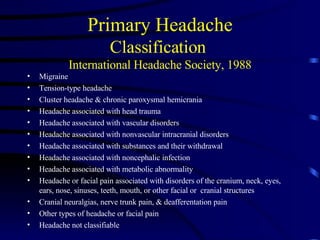
Primary Headache Classification  International Headache Society, 1988 Migraine Tension-type headache Cluster headache & chronic paroxysmal hemicrania Headache associated with head trauma Headache associated with vascular disorders Headache associated with nonvascular intracranial disorders Headache associated with substances and their withdrawal Headache associated with noncephalic infection Headache associated with metabolic abnormality Headache or facial pain associated with disorders of the cranium, neck, eyes, ears, nose, sinuses, teeth, mouth, or other facial or  cranial structures Cranial neuralgias, nerve trunk pain, & deafferentation pain Other types of headache or facial pain Headache not classifiable
Pathophysiology of Headache Specific mechanism of headache is incomplete Genetics (Familial Hemiplegic Migraine) Migraine Generator Final common pathway
History Past history of headaches “ first, worst, different, progressive, persistent” Age of onset > 50 years Headache characteristics P alliative Q uality R egion S everity (0-10) T iming
History  Associated Symptoms Fever/Chills/Nightsweats Nausea/Vomiting Photophobia & Phonophobia Neck pain or stiffness Alterations in level of consciousness Focal neurologic symptoms Family History
Physical Examination General Exam Vital Signs General Appearance  HEENT (Trauma, dentition, sinus/temples)  Neck (ROM, Kernig’s and Brudzinski’s sign) Skin (Rash, bruising, hemorrhages) Lymph Nodes
Physical Examination  Neurologic Exam Mental Status:  LOC, Orientation, Language, mood/thoughts Cranial Nerves I: Not tested unless history suggestive II: Reading VA each eye, VF by confrontation with double simultaneous stimulation, fundoscopy III, IV, VI: Lateral and vertical eye mvts, pupillary light response V: Pinprick and touch sensation on face VII: Close eyes, show teeth VIII: Whispered voice each ear IX, X: Palate lifts in midline, gag present XI: Shrug shoulders XII: Protrude tongue
Physical Examination  Neurologic Exam (cont.) Limbs: Each limb tested separately Tone  Power of main muscle groups (0-5 MRC Scale) Coordination: finger-to-nose, heel-to-shin Tendon reflexes Plantar response  Pinprick and light touch on hands and feet Double simultaneous stimulation on hands and feet Joint position sense in hallux and index finger Vibration sense at ankle and index finger Gait Romberg’s test
Laboratory Studies Blood  CBC Chemistry panel ESR PT/PTT (Consider hypercoagulable profile) TSH ABG (if clinically indicated) Drug screen Urinalysis
Imaging X-rays CXR Cervical Spine X-ray Cranial computed tomography (CT) preferred initial imaging study for acute headache Cranial magnetic resonance imaging (MRI) Magnetic resonance angiography (MRA) Cerebral angiography
Other Studies Lumbar puncture (LP) indicated if acute or chronic meningitis, SAH, pseudotumor cerebri (IIT) or low CSF pressure headache suspected preferable to perform CT before LP Electroencephalogram (EEG) indicated if seizures are suspect
Differential Diagnosis Primary headache Migraine Tension-type headache Cluster headache Indomethacin-responsive headache syndromes Secondary headache
Migraine Headache  IHS Classification Migraine without aura (common migraine) Migraine with aura (classic migraine) Migraine with typical aura Migraine with prolonged aura Familial hemiplegic migraine Basilar migraine Migraine aura w/o headache Migraine with acute onset aura Opthalmoplegic migraine Retinal migraine
Tension-type headache  IHS Classification Episodic Tension-type headache Chronic (Daily) Tension-type headache
Cluster Headache  IHS Classification   5 or more attacks with the following: Severe unilateral supraorbital or temporal pain lasting 15-180 minutes, pain has boring quality One of the following ipsilateral autonomic signs conjunctival injection eyelid edema tearing nasal congestion/rhinorrhea forehead/facial sweating miosis or ptosis   Frequency of attacks qod to 8x/day, occur at similar time of day and often awaken pt from sleep
Indomethacin-Responsive Headache Syndromes Paroxymal Hemicrania Onset second-third decade Females > males (3:1) Unilateral orbit or occipital pain 20 minute attacks, 5 attacks/day on average   Hemicrania Continua Prolonged unilateral headache lasting days-weeks
Secondary Headache DDx Subarachnoid Hemorrhage (SAH) “first or worst headache” physicians consistently misdiagnose SAH pts with the greatest potential tx benefits are most often misdiagnosed early complications develop in patients with an incorrect dx Meningitis associated with fever, neck stiffness, confusion
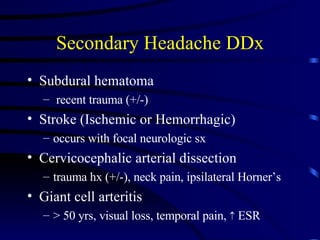
Secondary Headache DDx Subdural hematoma recent trauma (+/-) Stroke (Ischemic or Hemorrhagic) occurs with focal neurologic sx Cervicocephalic arterial dissection trauma hx (+/-), neck pain, ipsilateral Horner’s Giant cell arteritis > 50 yrs, visual loss, temporal pain,    ESR
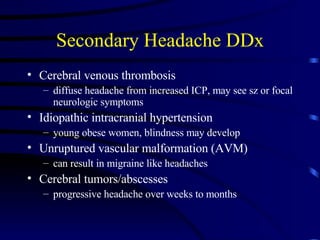
Secondary Headache DDx Cerebral venous thrombosis diffuse headache from increased ICP, may see sz or focal neurologic symptoms Idiopathic intracranial hypertension young obese women, blindness may develop Unruptured vascular malformation (AVM) can result in migraine like headaches Cerebral tumors/abscesses progressive headache over weeks to months
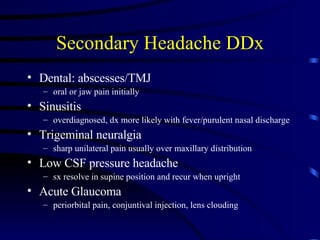
Secondary Headache DDx Dental: abscesses/TMJ oral or jaw pain initially Sinusitis overdiagnosed, dx more likely with fever/purulent nasal discharge Trigeminal neuralgia sharp unilateral pain usually over maxillary distribution Low CSF pressure headache sx resolve in supine position and recur when upright Acute Glaucoma periorbital pain, conjuntival injection, lens clouding
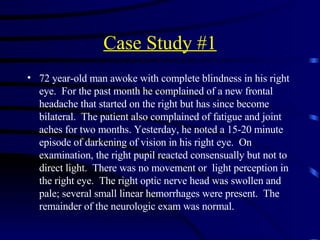
Case Study #1 72 year-old man awoke with complete blindness in his right eye.  For the past month he complained of a new frontal headache that started on the right but has since become bilateral.  The patient also complained of fatigue and joint aches for two months. Yesterday, he noted a 15-20 minute episode of darkening of vision in his right eye.  On examination, the right pupil reacted consensually but not to direct light.  There was no movement or  light perception in the right eye.  The right optic nerve head was swollen and pale; several small linear hemorrhages were present.  The remainder of the neurologic exam was normal.
Case Study #2 18 year-old female presents for an evaluation of episodic headaches that occur four to five times a month.  The headaches started five years ago but have since increased in severity.  Nausea and lightening waves of light are perceived 30 minutes before the onset of the headache. The headache itself in usually on the left side, throbbing in nature and severe.  It lasts 4-6 hours.  Light and sound make the headache worse. Her mother and sister have a history of headaches as well.  While Excedrin and Ibuprofen worked well in the past, they have become less effective in relieving the pain.
Case Study #3 48 year-old male with a history of migraine headaches and squamous cell skin cancer presented with recurrent right frontal-occipital headaches associated with coughing and straining.  The headaches have been present for one month.  He also describes brief spells of flickering lights in his left visual field associated with nausea. The spells occur once or twice a day.  His physical exam is normal.

Acute Headache Mw

  • 1.
    Acute Headache AnOverview M. Wallin, MD, MPH
  • 2.
    Most of thetime he seemed to see something shining before him like a light, usually in part of the right eye; at the end of a moment, a violent pain supervened in the right temple, then all of the head and neck, where the head is attached to the spine…vomiting, when it became possible, was able to divert the pain and render it more moderate. Hippocrates
  • 3.
    The Burden ofHeadache > 13,000 tons of aspirin consumed annually worldwide Headaches account for 1-2% of ER visits and up to 4% of visits to physicians Lifetime prevalence for any type of headache > 90% for men & 95% for women 23 million Americans with migraine: 18% women, 6% men
  • 4.
    Acute Headache TopicalOutline Primary vs. Secondary Headache Pathophysiology History Physical Exam Laboratory studies & Imaging Differential Diagnosis Case Studies
  • 5.
    Primary vs. SecondaryHeadache Definitions headache the primary manifestation headache a secondary manifestation of an underlying disease process External Stimulus Goals of the clinician make an accurate headache diagnosis provide emergency therapy provide patient with means of long-term care
  • 6.
    Primary Headache Classification International Headache Society, 1988 Migraine Tension-type headache Cluster headache & chronic paroxysmal hemicrania Headache associated with head trauma Headache associated with vascular disorders Headache associated with nonvascular intracranial disorders Headache associated with substances and their withdrawal Headache associated with noncephalic infection Headache associated with metabolic abnormality Headache or facial pain associated with disorders of the cranium, neck, eyes, ears, nose, sinuses, teeth, mouth, or other facial or cranial structures Cranial neuralgias, nerve trunk pain, & deafferentation pain Other types of headache or facial pain Headache not classifiable
  • 7.
    Pathophysiology of HeadacheSpecific mechanism of headache is incomplete Genetics (Familial Hemiplegic Migraine) Migraine Generator Final common pathway
  • 8.
    History Past historyof headaches “ first, worst, different, progressive, persistent” Age of onset > 50 years Headache characteristics P alliative Q uality R egion S everity (0-10) T iming
  • 9.
    History AssociatedSymptoms Fever/Chills/Nightsweats Nausea/Vomiting Photophobia & Phonophobia Neck pain or stiffness Alterations in level of consciousness Focal neurologic symptoms Family History
  • 10.
    Physical Examination GeneralExam Vital Signs General Appearance HEENT (Trauma, dentition, sinus/temples) Neck (ROM, Kernig’s and Brudzinski’s sign) Skin (Rash, bruising, hemorrhages) Lymph Nodes
  • 11.
    Physical Examination Neurologic Exam Mental Status: LOC, Orientation, Language, mood/thoughts Cranial Nerves I: Not tested unless history suggestive II: Reading VA each eye, VF by confrontation with double simultaneous stimulation, fundoscopy III, IV, VI: Lateral and vertical eye mvts, pupillary light response V: Pinprick and touch sensation on face VII: Close eyes, show teeth VIII: Whispered voice each ear IX, X: Palate lifts in midline, gag present XI: Shrug shoulders XII: Protrude tongue
  • 12.
    Physical Examination Neurologic Exam (cont.) Limbs: Each limb tested separately Tone Power of main muscle groups (0-5 MRC Scale) Coordination: finger-to-nose, heel-to-shin Tendon reflexes Plantar response Pinprick and light touch on hands and feet Double simultaneous stimulation on hands and feet Joint position sense in hallux and index finger Vibration sense at ankle and index finger Gait Romberg’s test
  • 13.
    Laboratory Studies Blood CBC Chemistry panel ESR PT/PTT (Consider hypercoagulable profile) TSH ABG (if clinically indicated) Drug screen Urinalysis
  • 14.
    Imaging X-rays CXRCervical Spine X-ray Cranial computed tomography (CT) preferred initial imaging study for acute headache Cranial magnetic resonance imaging (MRI) Magnetic resonance angiography (MRA) Cerebral angiography
  • 15.
    Other Studies Lumbarpuncture (LP) indicated if acute or chronic meningitis, SAH, pseudotumor cerebri (IIT) or low CSF pressure headache suspected preferable to perform CT before LP Electroencephalogram (EEG) indicated if seizures are suspect
  • 16.
    Differential Diagnosis Primaryheadache Migraine Tension-type headache Cluster headache Indomethacin-responsive headache syndromes Secondary headache
  • 17.
    Migraine Headache IHS Classification Migraine without aura (common migraine) Migraine with aura (classic migraine) Migraine with typical aura Migraine with prolonged aura Familial hemiplegic migraine Basilar migraine Migraine aura w/o headache Migraine with acute onset aura Opthalmoplegic migraine Retinal migraine
  • 18.
    Tension-type headache IHS Classification Episodic Tension-type headache Chronic (Daily) Tension-type headache
  • 19.
    Cluster Headache IHS Classification 5 or more attacks with the following: Severe unilateral supraorbital or temporal pain lasting 15-180 minutes, pain has boring quality One of the following ipsilateral autonomic signs conjunctival injection eyelid edema tearing nasal congestion/rhinorrhea forehead/facial sweating miosis or ptosis Frequency of attacks qod to 8x/day, occur at similar time of day and often awaken pt from sleep
  • 20.
    Indomethacin-Responsive Headache SyndromesParoxymal Hemicrania Onset second-third decade Females > males (3:1) Unilateral orbit or occipital pain 20 minute attacks, 5 attacks/day on average Hemicrania Continua Prolonged unilateral headache lasting days-weeks
  • 21.
    Secondary Headache DDxSubarachnoid Hemorrhage (SAH) “first or worst headache” physicians consistently misdiagnose SAH pts with the greatest potential tx benefits are most often misdiagnosed early complications develop in patients with an incorrect dx Meningitis associated with fever, neck stiffness, confusion
  • 22.
    Secondary Headache DDxSubdural hematoma recent trauma (+/-) Stroke (Ischemic or Hemorrhagic) occurs with focal neurologic sx Cervicocephalic arterial dissection trauma hx (+/-), neck pain, ipsilateral Horner’s Giant cell arteritis > 50 yrs, visual loss, temporal pain,  ESR
  • 23.
    Secondary Headache DDxCerebral venous thrombosis diffuse headache from increased ICP, may see sz or focal neurologic symptoms Idiopathic intracranial hypertension young obese women, blindness may develop Unruptured vascular malformation (AVM) can result in migraine like headaches Cerebral tumors/abscesses progressive headache over weeks to months
  • 24.
    Secondary Headache DDxDental: abscesses/TMJ oral or jaw pain initially Sinusitis overdiagnosed, dx more likely with fever/purulent nasal discharge Trigeminal neuralgia sharp unilateral pain usually over maxillary distribution Low CSF pressure headache sx resolve in supine position and recur when upright Acute Glaucoma periorbital pain, conjuntival injection, lens clouding
  • 25.
    Case Study #172 year-old man awoke with complete blindness in his right eye. For the past month he complained of a new frontal headache that started on the right but has since become bilateral. The patient also complained of fatigue and joint aches for two months. Yesterday, he noted a 15-20 minute episode of darkening of vision in his right eye. On examination, the right pupil reacted consensually but not to direct light. There was no movement or light perception in the right eye. The right optic nerve head was swollen and pale; several small linear hemorrhages were present. The remainder of the neurologic exam was normal.
  • 26.
    Case Study #218 year-old female presents for an evaluation of episodic headaches that occur four to five times a month. The headaches started five years ago but have since increased in severity. Nausea and lightening waves of light are perceived 30 minutes before the onset of the headache. The headache itself in usually on the left side, throbbing in nature and severe. It lasts 4-6 hours. Light and sound make the headache worse. Her mother and sister have a history of headaches as well. While Excedrin and Ibuprofen worked well in the past, they have become less effective in relieving the pain.
  • 27.
    Case Study #348 year-old male with a history of migraine headaches and squamous cell skin cancer presented with recurrent right frontal-occipital headaches associated with coughing and straining. The headaches have been present for one month. He also describes brief spells of flickering lights in his left visual field associated with nausea. The spells occur once or twice a day. His physical exam is normal.