Epilepsy or Narcolepsy? AskTheNeurologist.Com Author Anon
History 16 year old woman suffering from sleep deprivation on a holiday 4 days into trip Excessively sleepy in day Began “ falling asleep” inappropriately On morning of admission, noticed she had bitten tongue to point of bleeding During day, frequent sleep-attacks
Sleep attacks Sometimes felt tired beforehand Occurred on - talking - walking (fell) Absence of Abnormal movements Tongue biting during LOC Incontinence
Past History Mild asthma Tongue biting since childhood Hypnogogic ? intentional Denies Seizures Cataplexy ( fell, but only after LOC) Sleep paralysis Hypnogogic hallucinations
Examination Signs of tongue-biting on side of tongue Orientated Drowsy Repeatedly falling asleep Neurological examination unremarkable
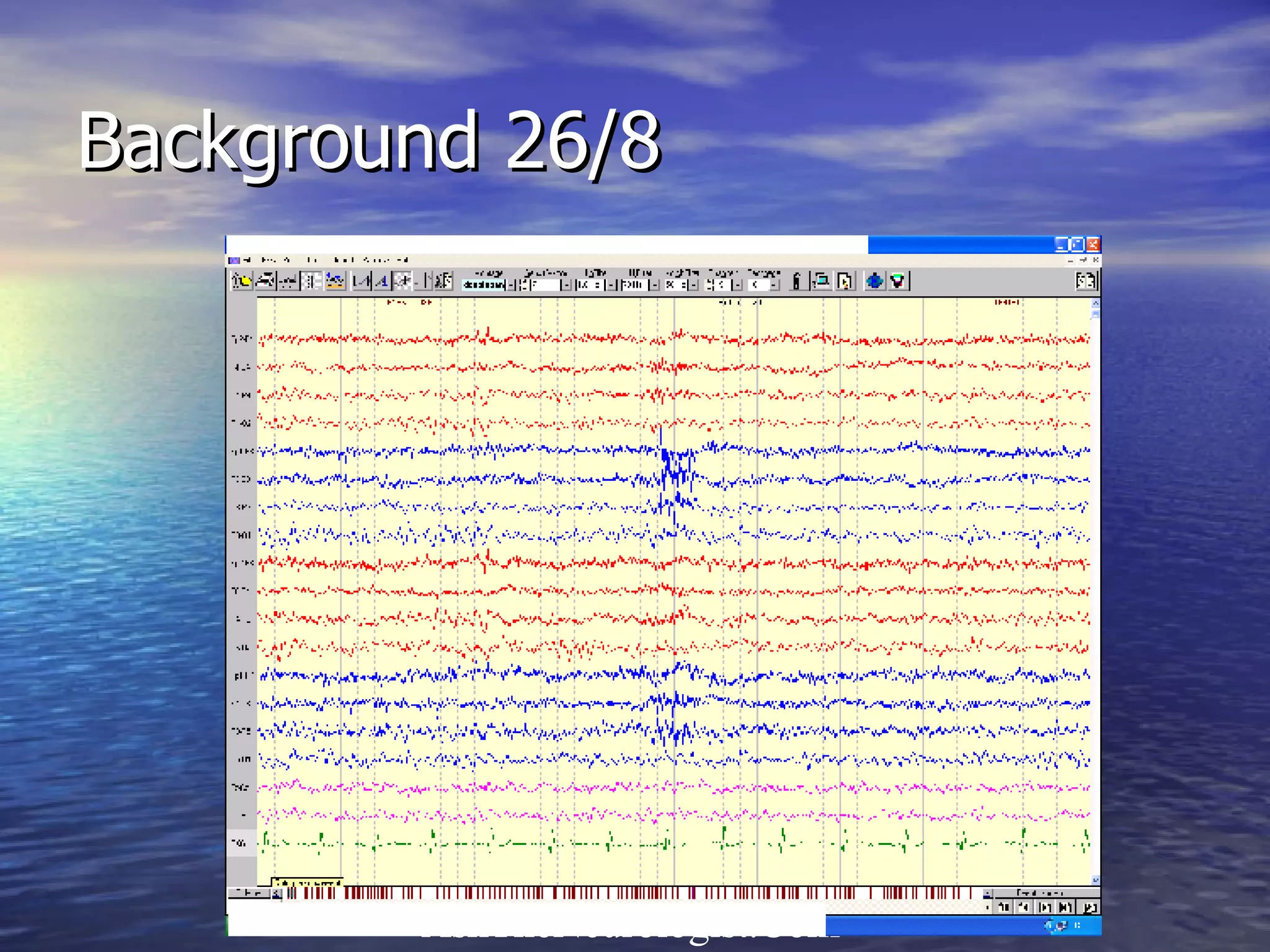
Investigations Blood : - normal ( CBC, Bioch, ESR) Toxic screen negative EEG when drowsy / asleep Synchronous high amplitude activity
Background 26/8
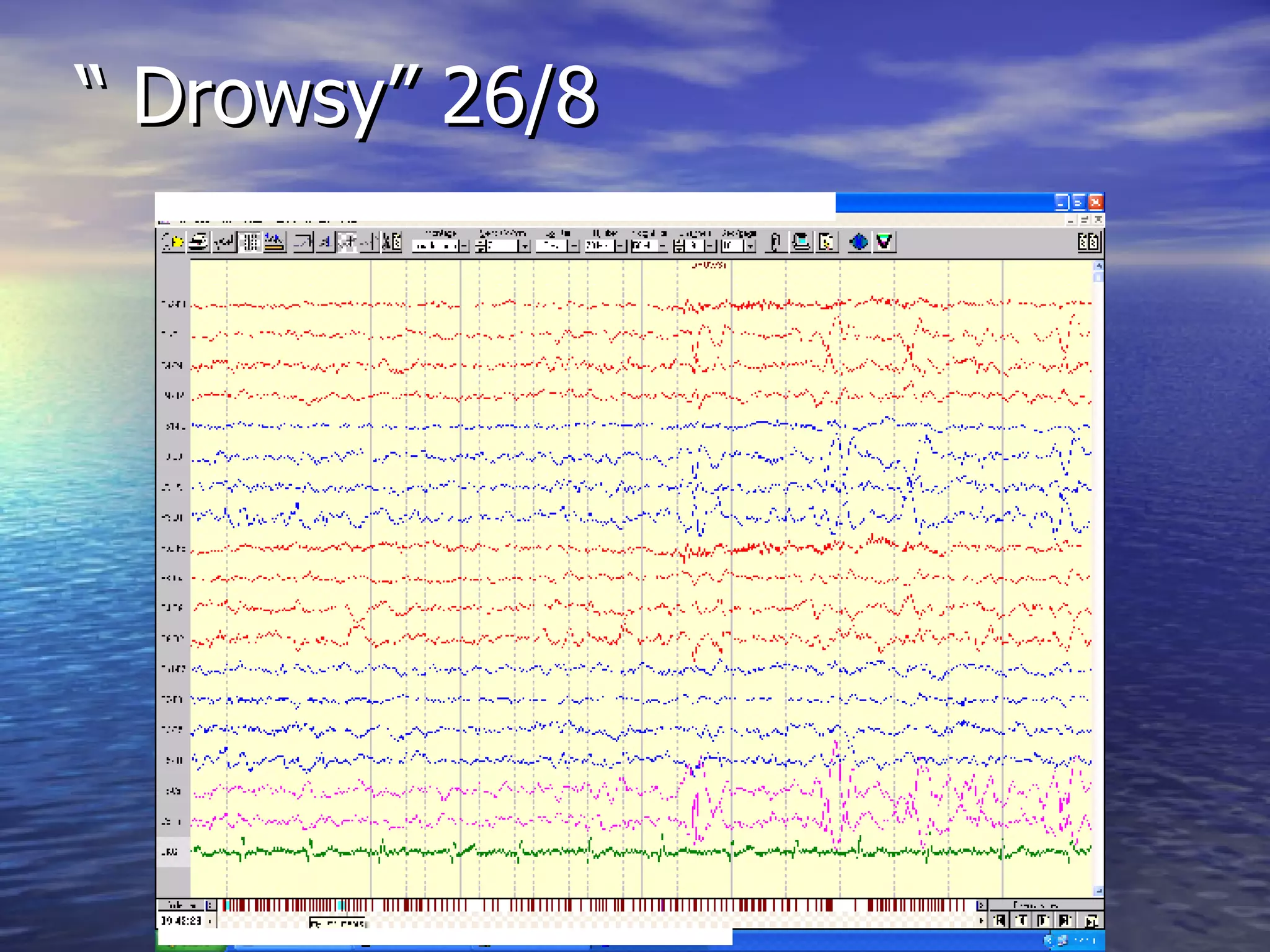
“ Drowsy” 26/8
Impression following EEG Episodes of loss of consciousness and falling Signs of tongue – biting Rhythmic high amplitude activity when drowsy Hospitalised and anti-epilaptic medication commenced
Course Received diazepam drip  and carbamazepine Slept well in hospital Episodes stopped EEG reviewed again
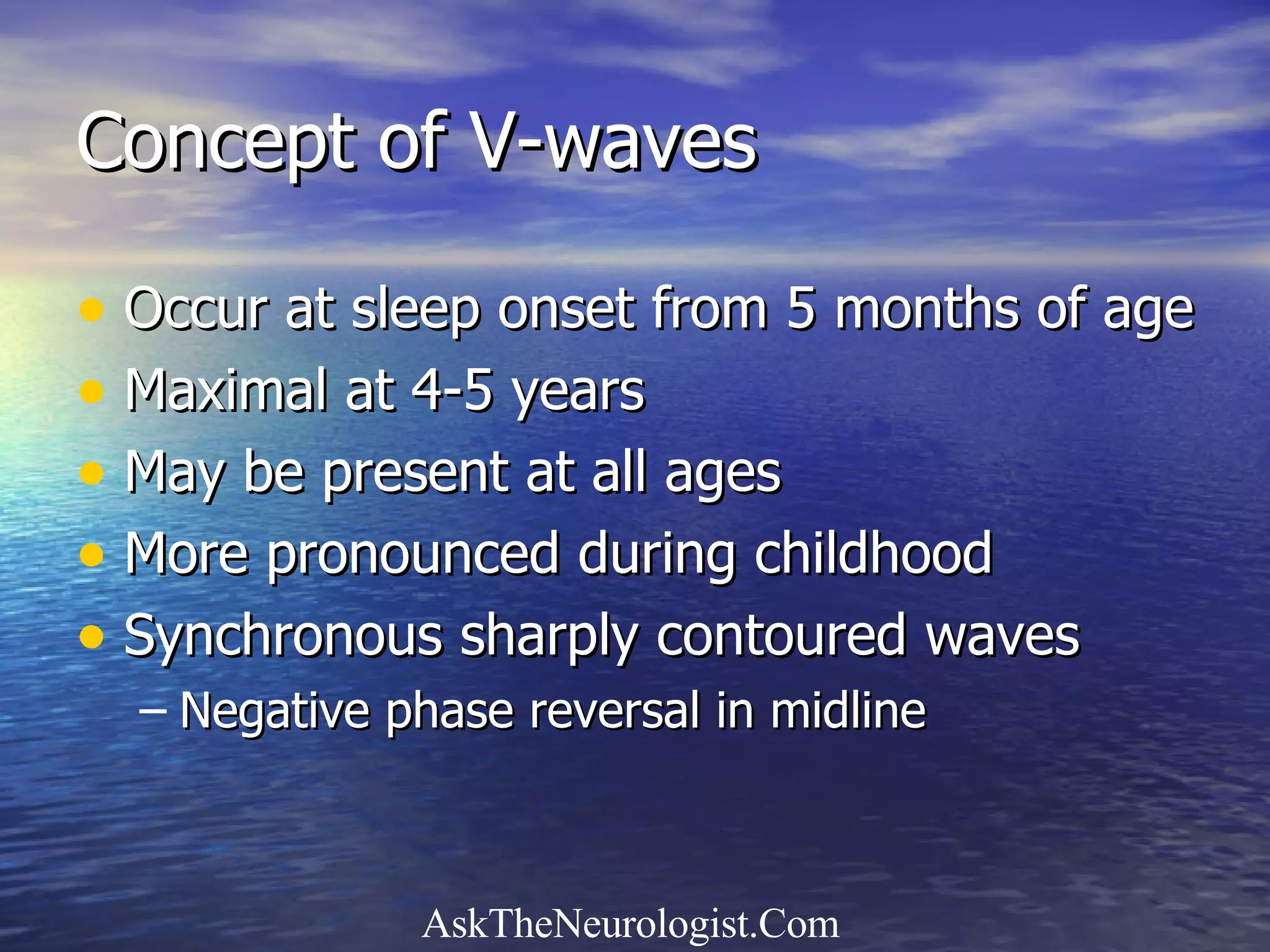
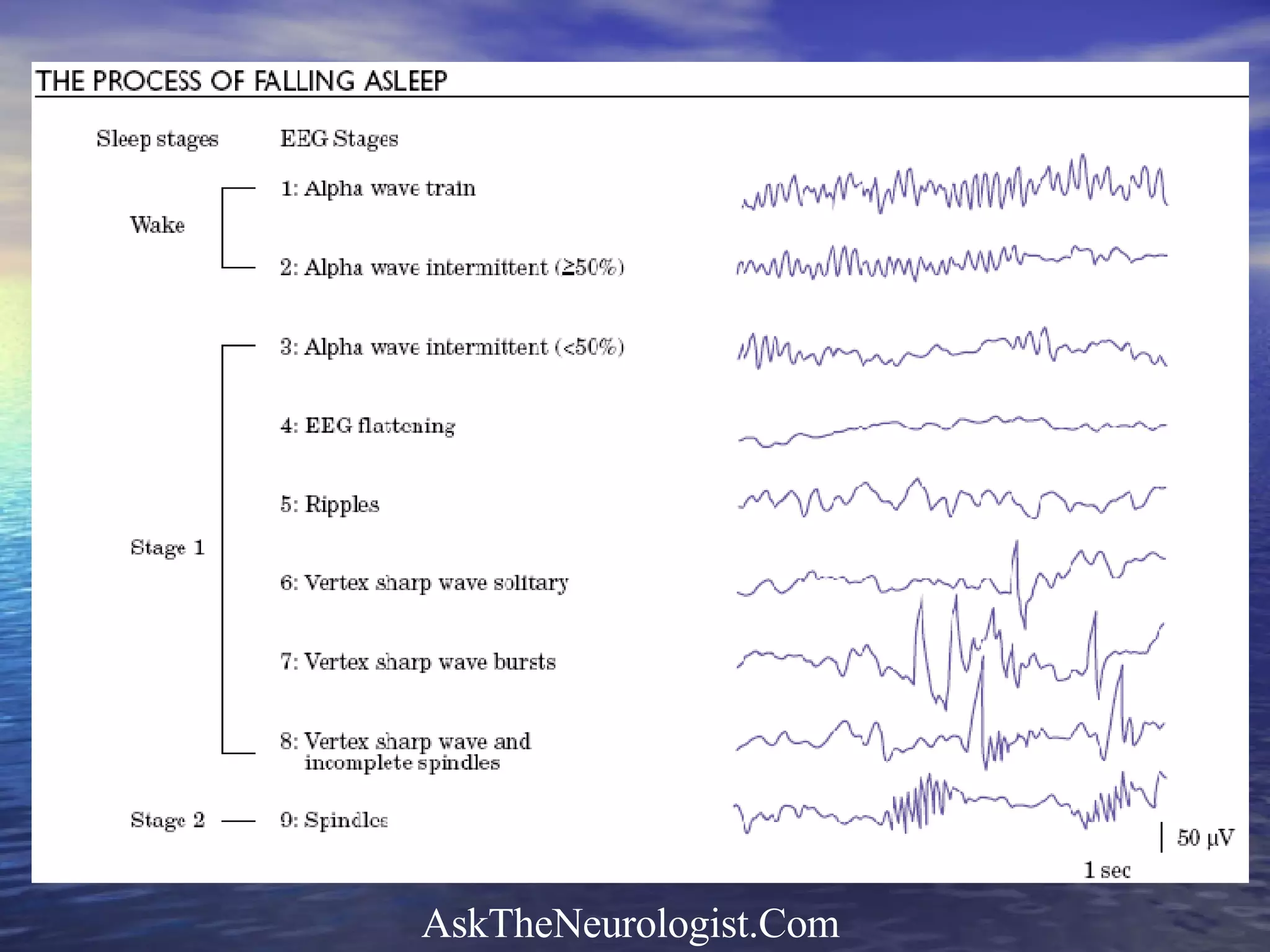
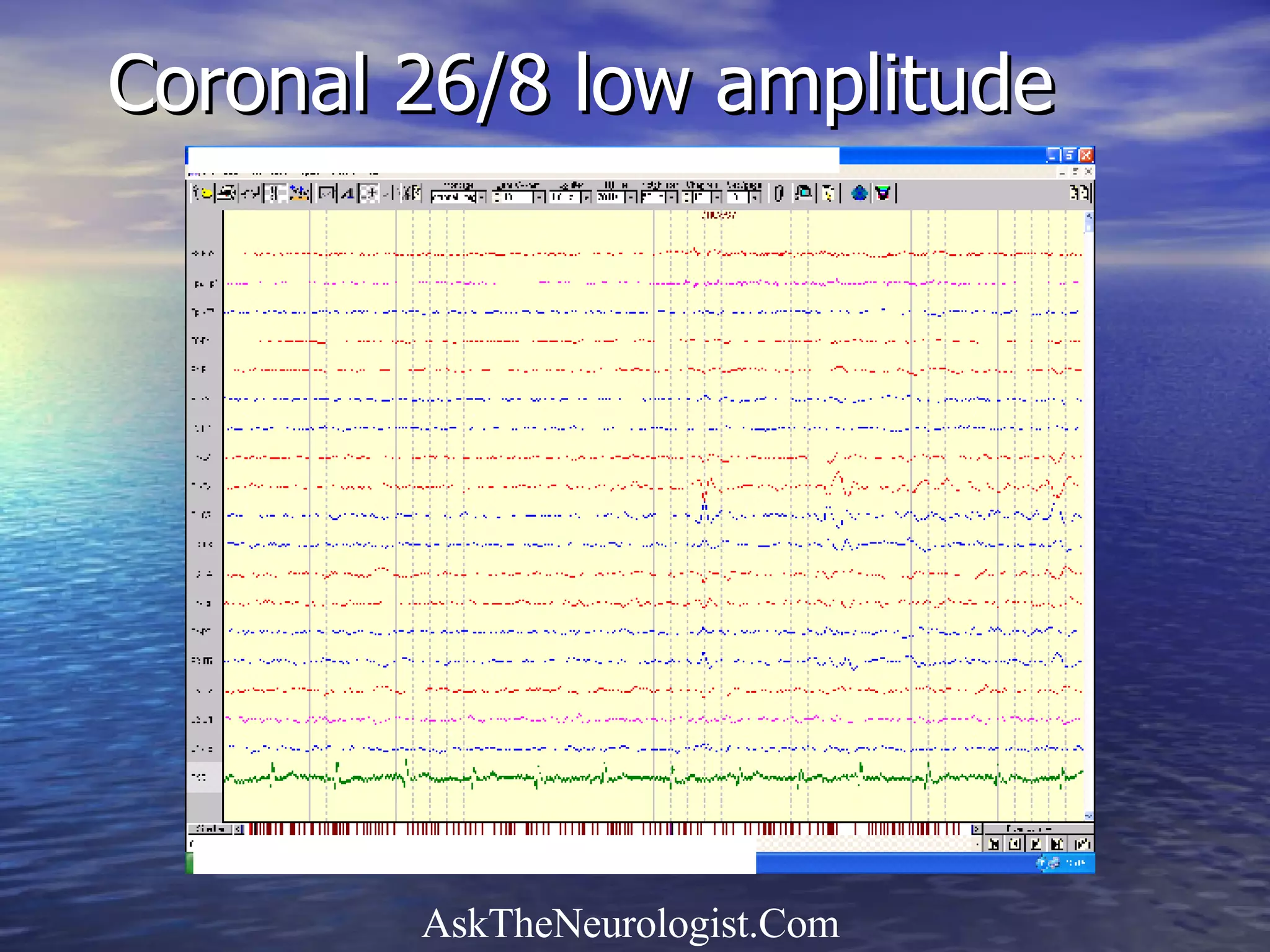
Concept of V-waves Occur at sleep onset from 5 months of age Maximal at 4-5 years May be present at all ages More pronounced during childhood Synchronous sharply contoured waves Negative phase reversal in midline
 
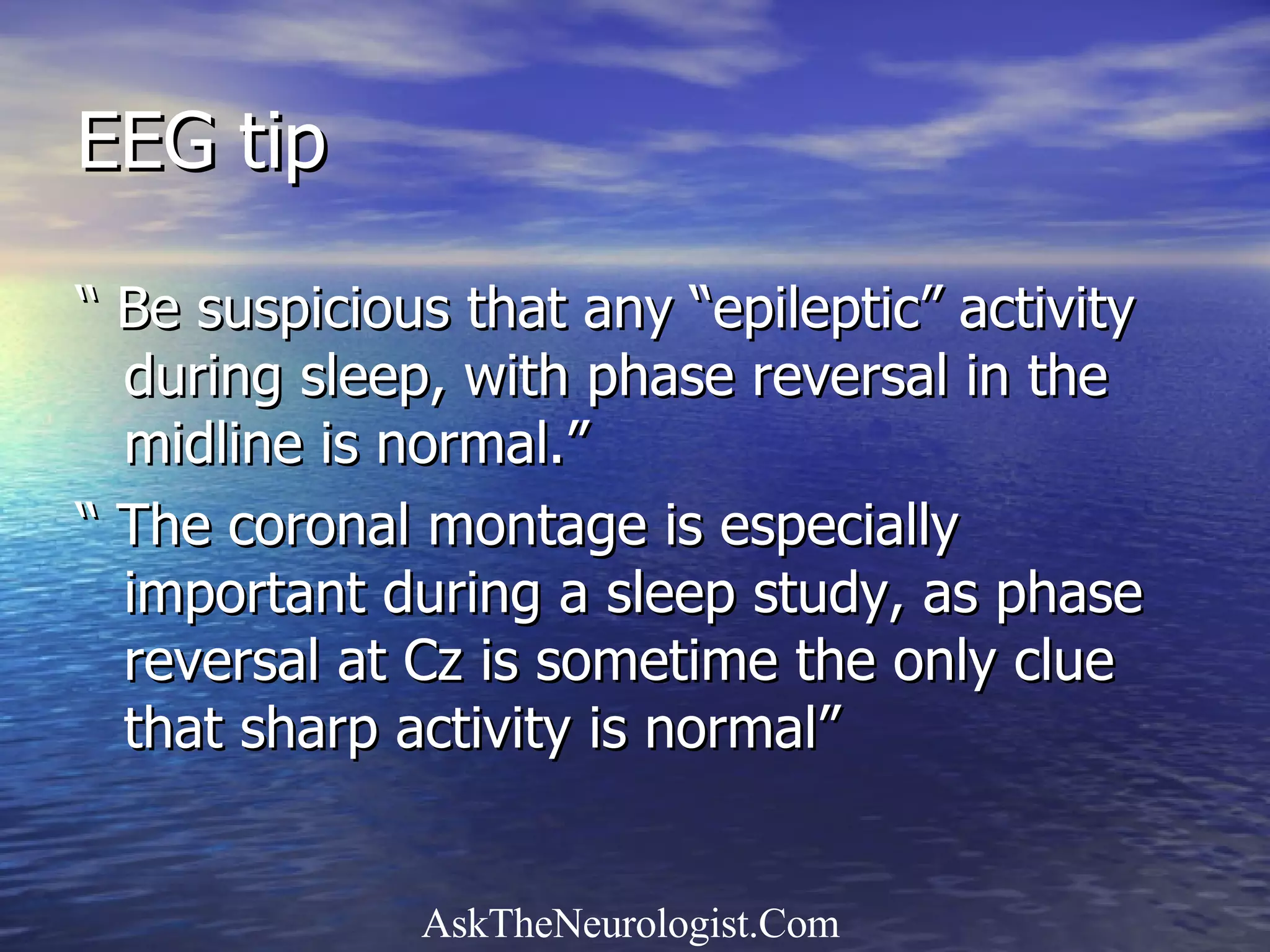
EEG tip “  Be suspicious that any “epileptic” activity during sleep, with phase reversal in the midline is normal.” “  The coronal montage is especially important during a sleep study, as phase reversal at Cz is sometime the only clue that sharp activity is normal”
 
“ Drowsy” 26/8
Coronal 26/8 drowsy
Coronal 26/8 low amplitude
Follow-up EEG 28/8
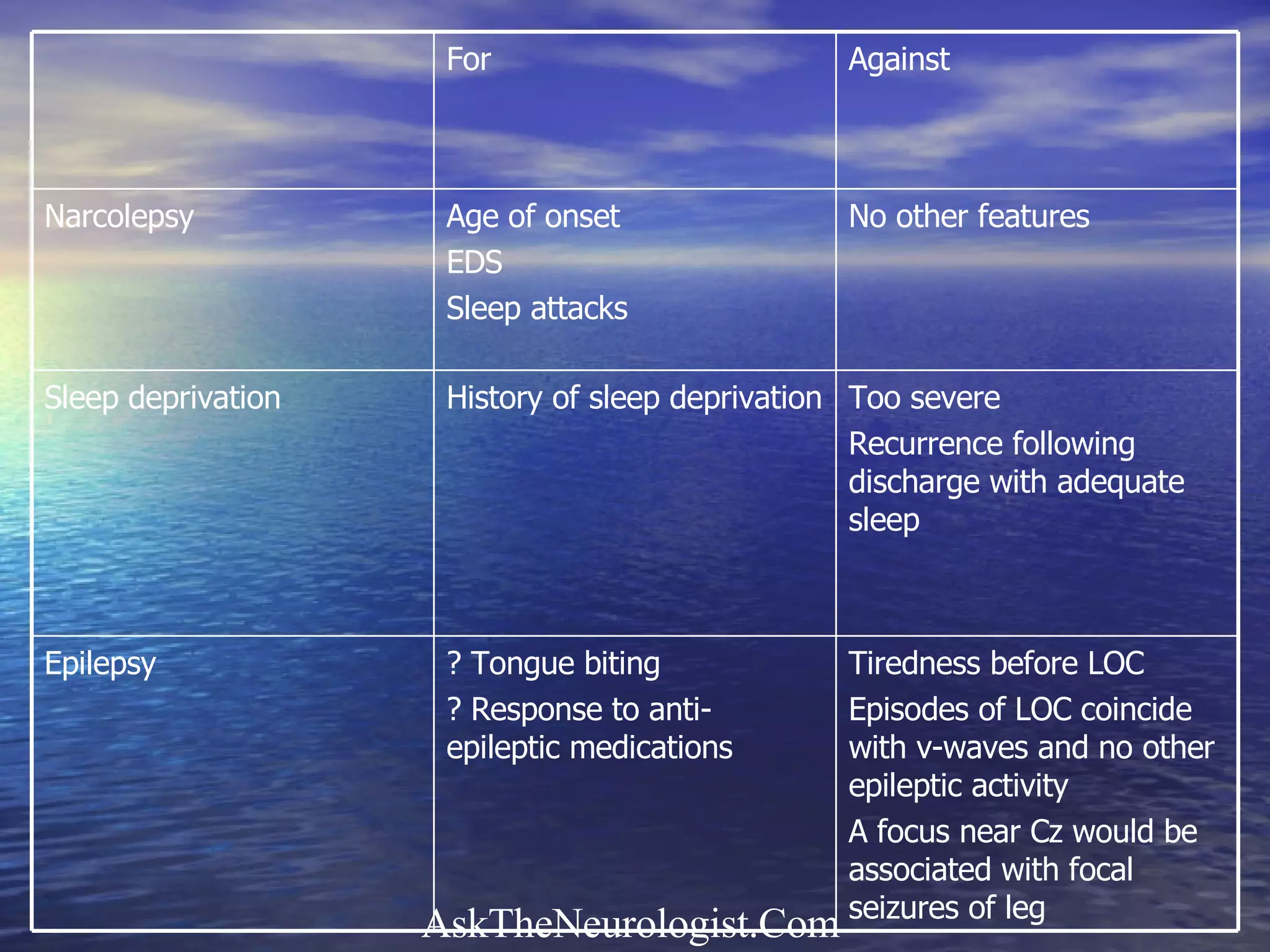
DD Narcolepsy / hypersomnia Sleep deprivation Epilepsy
Tiredness before LOC Episodes of LOC coincide with v-waves and no other epileptic activity A focus near Cz would be associated with focal seizures of leg ? Tongue biting ? Response to anti-epileptic medications Epilepsy Too severe Recurrence following discharge with adequate sleep History of sleep deprivation Sleep deprivation No other features Age of onset EDS Sleep attacks Narcolepsy Against For
 
Excessive daytime sleepiness / hypersomnia “ unintentional naps” Onset in teens / early twenties Sleepiness worst during inactivity Improvement following nap May complain of  Inattention /memory disturbance Diplopia Automatic behaviour
Aspects of REM sleep intrude into wakefulness Cataplexy Hypnagogic hallucinations Sleep paralysis
Hypnagogic hallucinations Dream-like episodes Often frightening Occur during drowsiness or onset of sleep Usually visual May be Tactile Auditory Vestibular (sense of falling)
Sleep paralysis Profound weakness May be at onset of sleep or on waking May cause fear / feeling of choking Is intrusion of ( protective) REM sleep paralysis into wakefulness Sleep paralysis and hypnagogic hallucinations may occur following sleep deprivation
Cataplexy Sudden muscle weakness, no LOC Triggered by intense emotion Laughter Anger Similar concept to sleep paralysis Present in 60% of narcolpetics Usually occurs 3-5 years following onset of sleepiness
Lab. Findings Polysomnography Multiple sleep latency test ( MSLT)
Polysomnography Evaluates sleep quality Excludes other causes of sleepiness: Obstructive Sleep apnea Periodic leg movements REM sleep behaviour disorder
MSLT Performed day after polysomnography Given opportunity to nap 2 hours Narcoleptics fall asleep within 5 minutes Normal = 10-15 minutes Naps often contain REMs (SOREMs)
Diagnosing Narcolepsy Chronic sleepiness  AND Either: - Cataplexy OR: - > 2 SOREMs in MSLT d Idiopathic hypersomnia Chronic sleepiness without either of other criteria
Secondary causes of narcolepsy Posterior hypothalamic lesions Tumour Stroke / AVM Sarcoidosis Paraneoplastic ( anti-Ma) MS
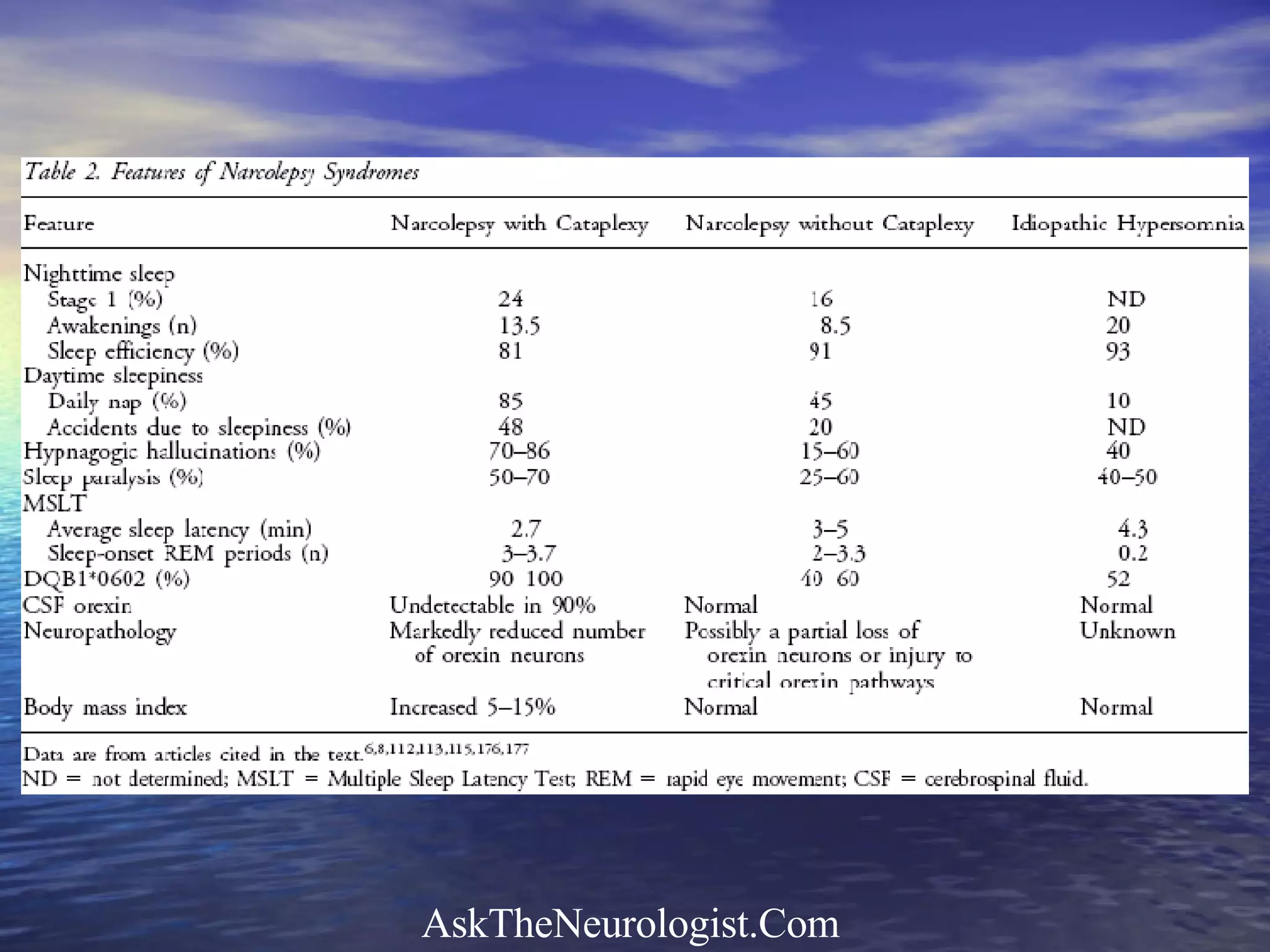
Genetics of narcolepsy 1 / 2000 Usually sporadic HLA DR2, DQ1 ( DQB1 * 0602)
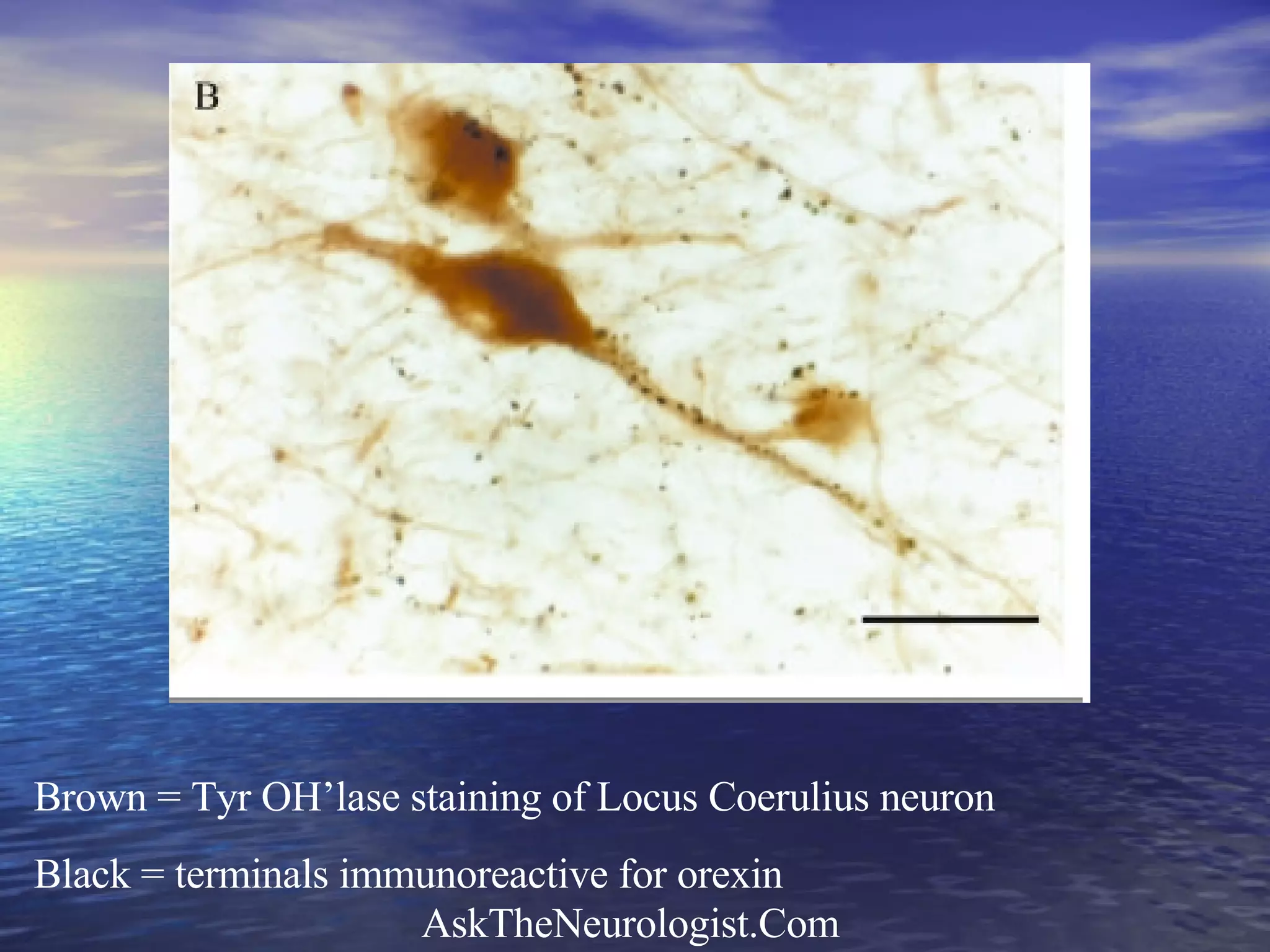
Role of orexin ( hypocretin) Orexin-containing neurons found in posterior and lateral hypothalamus Innervate aminergic annd cholinergic neurons that provoke wakefulness
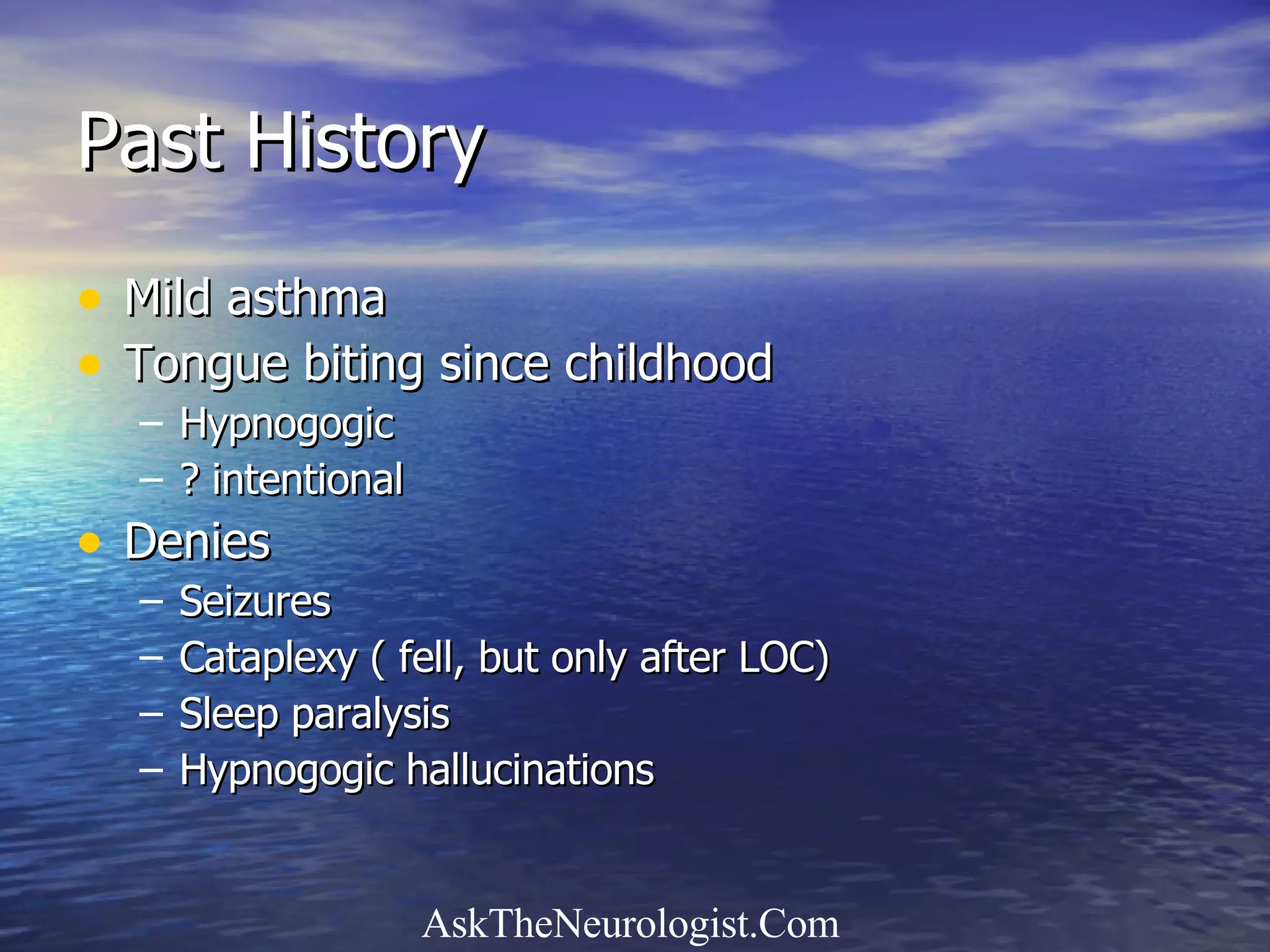
Brown = Tyr OH’lase staining of Locus Coerulius neuron Black = terminals immunoreactive for orexin
Evidence for orexin hypothesis Intraventricular injection of orexin causes wakefulness Knockout mice ( orexin or receptor) have disease resembling narcolepsy Doberman dogs with orexin receptor mutations have narcolepsy and cataplexy Absence of CSF orexin correlates well with cataplexy
 
Cataplexy and Sleep paralysis:-  Intraventricular injection of orexin causes wakefulness Knockout mice ( orexin or receptor) have disease resembling narcolepsy Doberman dogs with orexin receptor mutations have narcolepsy and cataplexy Absence of CSF orexin correlates well with cataplexy
Sleep paralysis = opposite problem i.e. in RBD lose the protective paralysis which is inappropriately active in sleep paralysis and cataplexy.
 
 
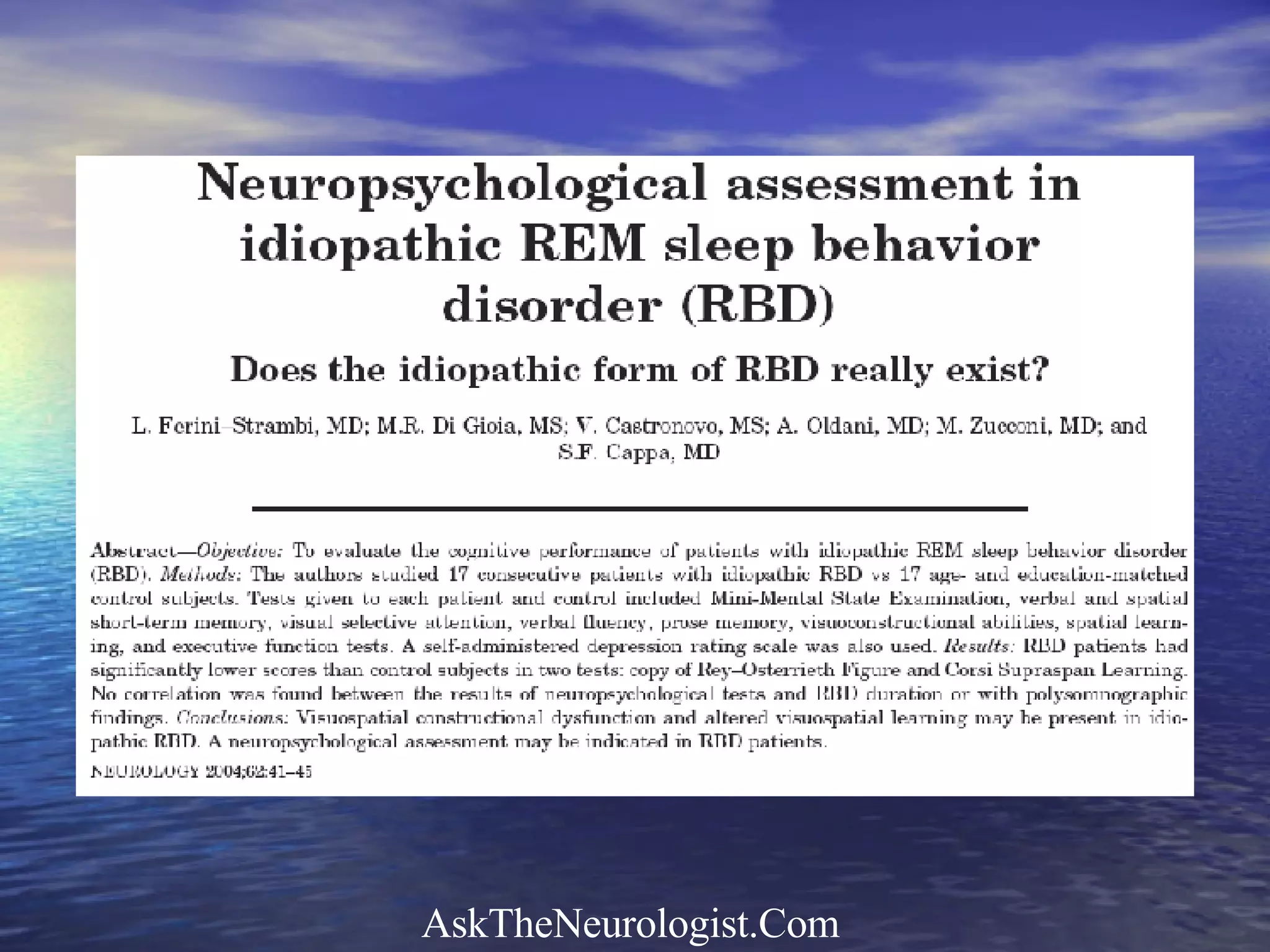
Features of RBD Violent thrashing or yelling accompanied by nightmares during sleep. Behavioral outbursts associated with dream mentation and intermittent loss of the muscle atonia that normally characterizes the REM sleep state.
RBD associations Can be associated with, or even precede, other neurologic disorders, especially parkinsonian states. 38% of patients with isolated RBD developed a parkinsonian disorder at a mean of 3.7 years after the diagnosis of RBD. One-third of patients with (PD) show RBD on polysomnography  Strong association with all synucleinopathies  PD, MSA and DLB RBD with dementia or PD’ism is highly predictive of synucleinopathy at postmortem. Responds to clonazepam, dopaminergic drugs

Epilepsy Vs Narcolepsy

  • 1.
    Epilepsy or Narcolepsy?AskTheNeurologist.Com Author Anon
  • 2.
    History 16 yearold woman suffering from sleep deprivation on a holiday 4 days into trip Excessively sleepy in day Began “ falling asleep” inappropriately On morning of admission, noticed she had bitten tongue to point of bleeding During day, frequent sleep-attacks
  • 3.
    Sleep attacks Sometimesfelt tired beforehand Occurred on - talking - walking (fell) Absence of Abnormal movements Tongue biting during LOC Incontinence
  • 4.
    Past History Mildasthma Tongue biting since childhood Hypnogogic ? intentional Denies Seizures Cataplexy ( fell, but only after LOC) Sleep paralysis Hypnogogic hallucinations
  • 5.
    Examination Signs oftongue-biting on side of tongue Orientated Drowsy Repeatedly falling asleep Neurological examination unremarkable
  • 6.
    Investigations Blood :- normal ( CBC, Bioch, ESR) Toxic screen negative EEG when drowsy / asleep Synchronous high amplitude activity
  • 7.
  • 8.
  • 9.
    Impression following EEGEpisodes of loss of consciousness and falling Signs of tongue – biting Rhythmic high amplitude activity when drowsy Hospitalised and anti-epilaptic medication commenced
  • 10.
    Course Received diazepamdrip and carbamazepine Slept well in hospital Episodes stopped EEG reviewed again
  • 11.
    Concept of V-wavesOccur at sleep onset from 5 months of age Maximal at 4-5 years May be present at all ages More pronounced during childhood Synchronous sharply contoured waves Negative phase reversal in midline
  • 12.
  • 13.
    EEG tip “ Be suspicious that any “epileptic” activity during sleep, with phase reversal in the midline is normal.” “ The coronal montage is especially important during a sleep study, as phase reversal at Cz is sometime the only clue that sharp activity is normal”
  • 14.
  • 15.
  • 16.
  • 17.
  • 18.
  • 19.
    DD Narcolepsy /hypersomnia Sleep deprivation Epilepsy
  • 20.
    Tiredness before LOCEpisodes of LOC coincide with v-waves and no other epileptic activity A focus near Cz would be associated with focal seizures of leg ? Tongue biting ? Response to anti-epileptic medications Epilepsy Too severe Recurrence following discharge with adequate sleep History of sleep deprivation Sleep deprivation No other features Age of onset EDS Sleep attacks Narcolepsy Against For
  • 21.
  • 22.
    Excessive daytime sleepiness/ hypersomnia “ unintentional naps” Onset in teens / early twenties Sleepiness worst during inactivity Improvement following nap May complain of Inattention /memory disturbance Diplopia Automatic behaviour
  • 23.
    Aspects of REMsleep intrude into wakefulness Cataplexy Hypnagogic hallucinations Sleep paralysis
  • 24.
    Hypnagogic hallucinations Dream-likeepisodes Often frightening Occur during drowsiness or onset of sleep Usually visual May be Tactile Auditory Vestibular (sense of falling)
  • 25.
    Sleep paralysis Profoundweakness May be at onset of sleep or on waking May cause fear / feeling of choking Is intrusion of ( protective) REM sleep paralysis into wakefulness Sleep paralysis and hypnagogic hallucinations may occur following sleep deprivation
  • 26.
    Cataplexy Sudden muscleweakness, no LOC Triggered by intense emotion Laughter Anger Similar concept to sleep paralysis Present in 60% of narcolpetics Usually occurs 3-5 years following onset of sleepiness
  • 27.
    Lab. Findings PolysomnographyMultiple sleep latency test ( MSLT)
  • 28.
    Polysomnography Evaluates sleepquality Excludes other causes of sleepiness: Obstructive Sleep apnea Periodic leg movements REM sleep behaviour disorder
  • 29.
    MSLT Performed dayafter polysomnography Given opportunity to nap 2 hours Narcoleptics fall asleep within 5 minutes Normal = 10-15 minutes Naps often contain REMs (SOREMs)
  • 30.
    Diagnosing Narcolepsy Chronicsleepiness AND Either: - Cataplexy OR: - > 2 SOREMs in MSLT d Idiopathic hypersomnia Chronic sleepiness without either of other criteria
  • 31.
    Secondary causes ofnarcolepsy Posterior hypothalamic lesions Tumour Stroke / AVM Sarcoidosis Paraneoplastic ( anti-Ma) MS
  • 32.
    Genetics of narcolepsy1 / 2000 Usually sporadic HLA DR2, DQ1 ( DQB1 * 0602)
  • 33.
    Role of orexin( hypocretin) Orexin-containing neurons found in posterior and lateral hypothalamus Innervate aminergic annd cholinergic neurons that provoke wakefulness
  • 34.
    Brown = TyrOH’lase staining of Locus Coerulius neuron Black = terminals immunoreactive for orexin
  • 35.
    Evidence for orexinhypothesis Intraventricular injection of orexin causes wakefulness Knockout mice ( orexin or receptor) have disease resembling narcolepsy Doberman dogs with orexin receptor mutations have narcolepsy and cataplexy Absence of CSF orexin correlates well with cataplexy
  • 36.
  • 37.
    Cataplexy and Sleepparalysis:- Intraventricular injection of orexin causes wakefulness Knockout mice ( orexin or receptor) have disease resembling narcolepsy Doberman dogs with orexin receptor mutations have narcolepsy and cataplexy Absence of CSF orexin correlates well with cataplexy
  • 38.
    Sleep paralysis =opposite problem i.e. in RBD lose the protective paralysis which is inappropriately active in sleep paralysis and cataplexy.
  • 39.
  • 40.
  • 41.
    Features of RBDViolent thrashing or yelling accompanied by nightmares during sleep. Behavioral outbursts associated with dream mentation and intermittent loss of the muscle atonia that normally characterizes the REM sleep state.
  • 42.
    RBD associations Canbe associated with, or even precede, other neurologic disorders, especially parkinsonian states. 38% of patients with isolated RBD developed a parkinsonian disorder at a mean of 3.7 years after the diagnosis of RBD. One-third of patients with (PD) show RBD on polysomnography Strong association with all synucleinopathies PD, MSA and DLB RBD with dementia or PD’ism is highly predictive of synucleinopathy at postmortem. Responds to clonazepam, dopaminergic drugs