Department of Neurosurgery, University of Michigan Medical School
Thoracic Pedicle ScrewsThoracic Pedicle Screws
Anatomy and TechniqueAnatomy and Technique
Frank La Marca M. D.Frank La Marca M. D.
Department of NeurosurgeryDepartment of Neurosurgery
University of MichiganUniversity of Michigan
Department of Neurosurgery, University of Michigan Medical School
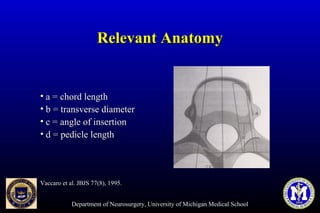
Relevant AnatomyRelevant Anatomy
• a = chord lengtha = chord length
• b = transverse diameterb = transverse diameter
• c = angle of insertionc = angle of insertion
• d = pedicle lengthd = pedicle length
Vaccaro et al. JBJS 77(8), 1995.Vaccaro et al. JBJS 77(8), 1995.
Department of Neurosurgery, University of Michigan Medical School
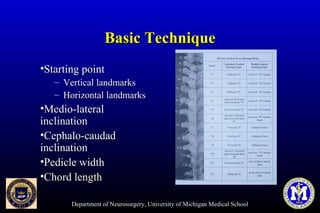
Basic TechniqueBasic Technique
•Starting pointStarting point
– Vertical landmarksVertical landmarks
– Horizontal landmarksHorizontal landmarks
•Medio-lateralMedio-lateral
inclinationinclination
•Cephalo-caudadCephalo-caudad
inclinationinclination
•Pedicle widthPedicle width
•Chord lengthChord length
Department of Neurosurgery, University of Michigan Medical School
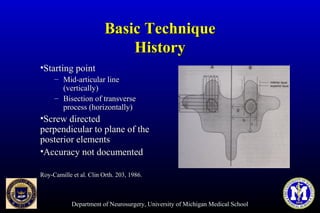
Basic TechniqueBasic Technique
HistoryHistory
•Starting pointStarting point
– Mid-articular lineMid-articular line
(vertically)(vertically)
– Bisection of transverseBisection of transverse
process (horizontally)process (horizontally)
•Screw directedScrew directed
perpendicular to plane of theperpendicular to plane of the
posterior elementsposterior elements
•Accuracy not documentedAccuracy not documented
Roy-Camille et al. Clin Orth. 203, 1986.Roy-Camille et al. Clin Orth. 203, 1986.
Department of Neurosurgery, University of Michigan Medical School
Basic TechniqueBasic Technique
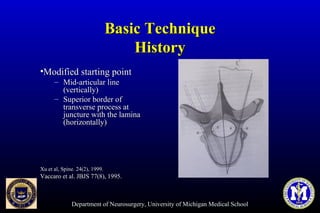
HistoryHistory
•Modified starting pointModified starting point
– Mid-articular lineMid-articular line
(vertically)(vertically)
– Superior border ofSuperior border of
transverse process attransverse process at
juncture with the laminajuncture with the lamina
(horizontally)(horizontally)
Xu et al, Spine. 24(2), 1999.Xu et al, Spine. 24(2), 1999.
Vaccaro et al. JBJS 77(8), 1995.Vaccaro et al. JBJS 77(8), 1995.
Department of Neurosurgery, University of Michigan Medical School
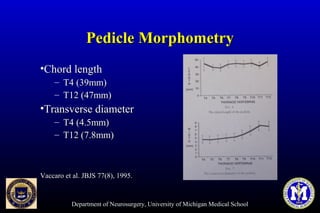
Pedicle MorphometryPedicle Morphometry
•Chord lengthChord length
– T4 (39mm)T4 (39mm)
– T12 (47mm)T12 (47mm)
•Transverse diameterTransverse diameter
– T4 (4.5mm)T4 (4.5mm)
– T12 (7.8mm)T12 (7.8mm)
Vaccaro et al. JBJS 77(8), 1995.Vaccaro et al. JBJS 77(8), 1995.
Department of Neurosurgery, University of Michigan Medical School
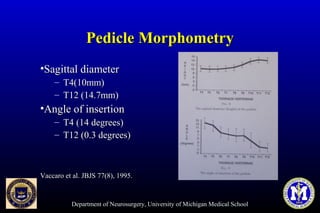
Pedicle MorphometryPedicle Morphometry
•Sagittal diameterSagittal diameter
– T4(10mm)T4(10mm)
– T12 (14.7mm)T12 (14.7mm)
•Angle of insertionAngle of insertion
– T4 (14 degrees)T4 (14 degrees)
– T12 (0.3 degrees)T12 (0.3 degrees)
Vaccaro et al. JBJS 77(8), 1995.Vaccaro et al. JBJS 77(8), 1995.
Department of Neurosurgery, University of Michigan Medical School
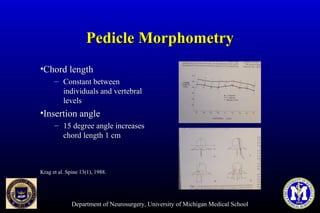
Pedicle MorphometryPedicle Morphometry
•Chord lengthChord length
– Constant betweenConstant between
individuals and vertebralindividuals and vertebral
levelslevels
•Insertion angleInsertion angle
– 15 degree angle increases15 degree angle increases
chord length 1 cmchord length 1 cm
Krag et al. Spine 13(1), 1988.Krag et al. Spine 13(1), 1988.
Department of Neurosurgery, University of Michigan Medical School
Pedicle MorphometryPedicle Morphometry
ScoliosisScoliosis
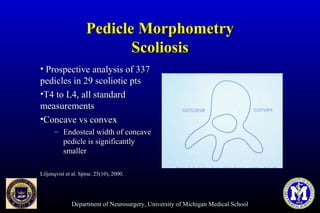
• Prospective analysis of 337Prospective analysis of 337
pedicles in 29 scoliotic ptspedicles in 29 scoliotic pts
•T4 to L4, all standardT4 to L4, all standard
measurementsmeasurements
•Concave vs convexConcave vs convex
– Endosteal width of concaveEndosteal width of concave
pedicle is significantlypedicle is significantly
smallersmaller
Liljenqvist et al. Spine. 25(10), 2000.Liljenqvist et al. Spine. 25(10), 2000.
Department of Neurosurgery, University of Michigan Medical School
Pedicle MorphometryPedicle Morphometry
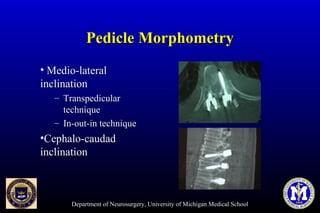
• Medio-lateralMedio-lateral
inclinationinclination
– TranspedicularTranspedicular
techniquetechnique
– In-out-in techniqueIn-out-in technique
•Cephalo-caudadCephalo-caudad
inclinationinclination
Department of Neurosurgery, University of Michigan Medical School
Surrounding StructuresSurrounding Structures
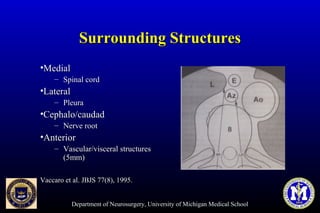
•MedialMedial
– Spinal cordSpinal cord
•LateralLateral
– PleuraPleura
•Cephalo/caudadCephalo/caudad
– Nerve rootNerve root
•AnteriorAnterior
– Vascular/visceral structuresVascular/visceral structures
(5mm)(5mm)
Vaccaro et al. JBJS 77(8), 1995.Vaccaro et al. JBJS 77(8), 1995.
Department of Neurosurgery, University of Michigan Medical School
Thoracic Pedicle ScrewsThoracic Pedicle Screws
Basic Surgical StepsBasic Surgical Steps
1.1. Identify anatomic landmarksIdentify anatomic landmarks
2.2. Access pedicle entry zone … soundAccess pedicle entry zone … sound
pediclepedicle
3.3. TapTap
4.4. Screw placementScrew placement
upper thoracic – 4.5mmupper thoracic – 4.5mm
middle thoracic – 4.5 to 5.5mmmiddle thoracic – 4.5 to 5.5mm
lower thoracic – 5.5 to 6.5mmlower thoracic – 5.5 to 6.5mm
Department of Neurosurgery, University of Michigan Medical School
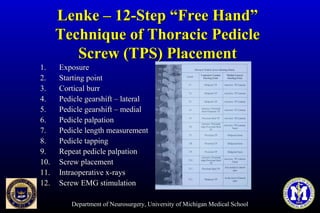
Lenke – 12-Step “Free Hand”Lenke – 12-Step “Free Hand”
Technique of Thoracic PedicleTechnique of Thoracic Pedicle
Screw (TPS) PlacementScrew (TPS) Placement
1.1. ExposureExposure
2.2. Starting pointStarting point
3.3. Cortical burrCortical burr
4.4. Pedicle gearshift – lateralPedicle gearshift – lateral
5.5. Pedicle gearshift – medialPedicle gearshift – medial
6.6. Pedicle palpationPedicle palpation
7.7. Pedicle length measurementPedicle length measurement
8.8. Pedicle tappingPedicle tapping
9.9. Repeat pedicle palpationRepeat pedicle palpation
10.10. Screw placementScrew placement
11.11. Intraoperative x-raysIntraoperative x-rays
12.12. Screw EMG stimulationScrew EMG stimulation
Department of Neurosurgery, University of Michigan Medical School
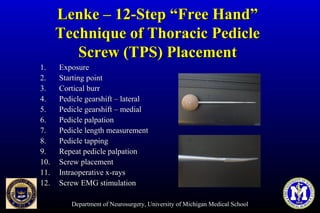
Lenke – 12-Step “Free Hand”Lenke – 12-Step “Free Hand”
Technique of Thoracic PedicleTechnique of Thoracic Pedicle
Screw (TPS) PlacementScrew (TPS) Placement
1.1. ExposureExposure
2.2. Starting pointStarting point
3.3. Cortical burrCortical burr
4.4. Pedicle gearshift – lateralPedicle gearshift – lateral
5.5. Pedicle gearshift – medialPedicle gearshift – medial
6.6. Pedicle palpationPedicle palpation
7.7. Pedicle length measurementPedicle length measurement
8.8. Pedicle tappingPedicle tapping
9.9. Repeat pedicle palpationRepeat pedicle palpation
10.10. Screw placementScrew placement
11.11. Intraoperative x-raysIntraoperative x-rays
12.12. Screw EMG stimulationScrew EMG stimulation
Department of Neurosurgery, University of Michigan Medical School
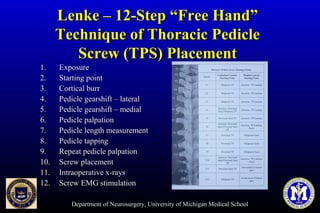
Lenke – 12-Step “Free Hand”Lenke – 12-Step “Free Hand”
Technique of Thoracic PedicleTechnique of Thoracic Pedicle
Screw (TPS) PlacementScrew (TPS) Placement
1.1. ExposureExposure
2.2. Starting pointStarting point
3.3. Cortical burrCortical burr
4.4. Pedicle gearshift – lateralPedicle gearshift – lateral
5.5. Pedicle gearshift – medialPedicle gearshift – medial
6.6. Pedicle palpationPedicle palpation
7.7. Pedicle length measurementPedicle length measurement
8.8. Pedicle tappingPedicle tapping
9.9. Repeat pedicle palpationRepeat pedicle palpation
10.10. Screw placementScrew placement
11.11. Intraoperative x-raysIntraoperative x-rays
12.12. Screw EMG stimulationScrew EMG stimulation
Department of Neurosurgery, University of Michigan Medical School
Pedicle Screw EMGPedicle Screw EMG
StimulationStimulation
Screw levelScrew level Recording MuscleRecording Muscle
T6-T12T6-T12 Rectus abdominusRectus abdominus
L1-L2L1-L2 AdductorsAdductors
L3-L4L3-L4 QuadricepsQuadriceps
L5L5 Tibialis AnteriorTibialis Anterior
S1S1 GastrocnemiusGastrocnemius
Department of Neurosurgery, University of Michigan Medical School
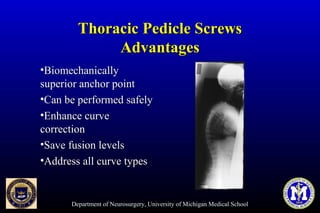
Thoracic Pedicle ScrewsThoracic Pedicle Screws
AdvantagesAdvantages
•BiomechanicallyBiomechanically
superior anchor pointsuperior anchor point
•Can be performed safelyCan be performed safely
•Enhance curveEnhance curve
correctioncorrection
•Save fusion levelsSave fusion levels
•Address all curve typesAddress all curve types
Department of Neurosurgery, University of Michigan Medical School
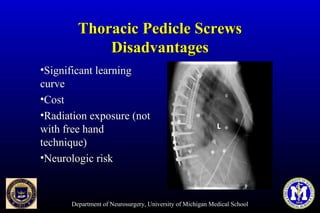
Thoracic Pedicle ScrewsThoracic Pedicle Screws
DisadvantagesDisadvantages
•Significant learningSignificant learning
curvecurve
•CostCost
•Radiation exposure (notRadiation exposure (not
with free handwith free hand
technique)technique)
•Neurologic riskNeurologic risk
Department of Neurosurgery, University of Michigan Medical School
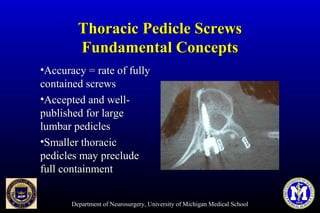
Thoracic Pedicle ScrewsThoracic Pedicle Screws
Fundamental ConceptsFundamental Concepts
•Accuracy = rate of fullyAccuracy = rate of fully
contained screwscontained screws
•Accepted and well-Accepted and well-
published for largepublished for large
lumbar pedicleslumbar pedicles
•Smaller thoracicSmaller thoracic
pedicles may precludepedicles may preclude
full containmentfull containment
Department of Neurosurgery, University of Michigan Medical School
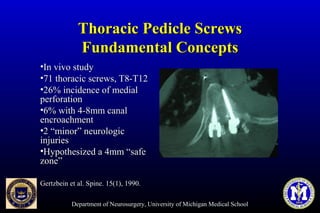
Thoracic Pedicle ScrewsThoracic Pedicle Screws
Fundamental ConceptsFundamental Concepts
•In vivo studyIn vivo study
•71 thoracic screws, T8-T1271 thoracic screws, T8-T12
•26% incidence of medial26% incidence of medial
perforationperforation
•6% with 4-8mm canal6% with 4-8mm canal
encroachmentencroachment
•2 “minor” neurologic2 “minor” neurologic
injuriesinjuries
•Hypothesized a 4mm “safeHypothesized a 4mm “safe
zone”zone”
Gertzbein et al. Spine. 15(1), 1990.Gertzbein et al. Spine. 15(1), 1990.
Department of Neurosurgery, University of Michigan Medical School
Thoracic Pedicle ScrewsThoracic Pedicle Screws
Fundamental ConceptsFundamental Concepts
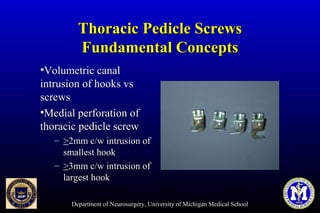
•Volumetric canalVolumetric canal
intrusion of hooks vsintrusion of hooks vs
screwsscrews
•Medial perforation ofMedial perforation of
thoracic pedicle screwthoracic pedicle screw
– >>2mm c/w intrusion of2mm c/w intrusion of
smallest hooksmallest hook
– >>3mm c/w intrusion of3mm c/w intrusion of
largest hooklargest hook
Department of Neurosurgery, University of Michigan Medical School
Thoracic Pedicle ScrewsThoracic Pedicle Screws
Fundamental ConceptsFundamental Concepts
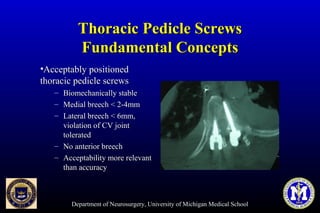
•Acceptably positionedAcceptably positioned
thoracic pedicle screwsthoracic pedicle screws
– Biomechanically stableBiomechanically stable
– Medial breech < 2-4mmMedial breech < 2-4mm
– Lateral breech < 6mm,Lateral breech < 6mm,
violation of CV jointviolation of CV joint
toleratedtolerated
– No anterior breechNo anterior breech
– Acceptability more relevantAcceptability more relevant
than accuracythan accuracy
Department of Neurosurgery, University of Michigan Medical School
Thoracic Pedicle ScrewsThoracic Pedicle Screws
Fundamental ConceptsFundamental Concepts
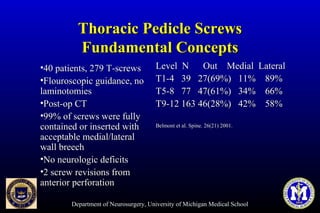
•40 patients, 279 T-screws40 patients, 279 T-screws
•Flouroscopic guidance, noFlouroscopic guidance, no
laminotomieslaminotomies
•Post-op CTPost-op CT
•99% of screws were fully99% of screws were fully
contained or inserted withcontained or inserted with
acceptable medial/lateralacceptable medial/lateral
wall breechwall breech
•No neurologic deficitsNo neurologic deficits
•2 screw revisions from2 screw revisions from
anterior perforationanterior perforation
Level N Out Medial LateralLevel N Out Medial Lateral
T1-4 39 27(69%) 11% 89%T1-4 39 27(69%) 11% 89%
T5-8 77 47(61%) 34% 66%T5-8 77 47(61%) 34% 66%
T9-12 163 46(28%) 42% 58%T9-12 163 46(28%) 42% 58%
Belmont et al. Spine. 26(21) 2001.Belmont et al. Spine. 26(21) 2001.
Department of Neurosurgery, University of Michigan Medical School
Thoracic Pedicle ScrewsThoracic Pedicle Screws
Fundamental ConceptsFundamental Concepts
• 399 T-screws399 T-screws
• Flouroscopic guidance, no laminotomiesFlouroscopic guidance, no laminotomies
• Post-op CTPost-op CT
• Acceptably positioned screwsAcceptably positioned screws
– 98% with coronal plane deformity (curve > 20 degrees)98% with coronal plane deformity (curve > 20 degrees)
– 99% without coronal plane deformity99% without coronal plane deformity
• No neurologic deficitsNo neurologic deficits
Belmont et al. Spine. 27(14), 2002.Belmont et al. Spine. 27(14), 2002.
Department of Neurosurgery, University of Michigan Medical School
ConclusionConclusion
•Understanding of pedicle morphometry is essentialUnderstanding of pedicle morphometry is essential
•Free-hand technique safe and effectiveFree-hand technique safe and effective
•Acceptable vs accuracyAcceptable vs accuracy

Thoracic pedicle screws

  • 1.
    Department of Neurosurgery,University of Michigan Medical School Thoracic Pedicle ScrewsThoracic Pedicle Screws Anatomy and TechniqueAnatomy and Technique Frank La Marca M. D.Frank La Marca M. D. Department of NeurosurgeryDepartment of Neurosurgery University of MichiganUniversity of Michigan
  • 2.
    Department of Neurosurgery,University of Michigan Medical School Relevant AnatomyRelevant Anatomy • a = chord lengtha = chord length • b = transverse diameterb = transverse diameter • c = angle of insertionc = angle of insertion • d = pedicle lengthd = pedicle length Vaccaro et al. JBJS 77(8), 1995.Vaccaro et al. JBJS 77(8), 1995.
  • 3.
    Department of Neurosurgery,University of Michigan Medical School Basic TechniqueBasic Technique •Starting pointStarting point – Vertical landmarksVertical landmarks – Horizontal landmarksHorizontal landmarks •Medio-lateralMedio-lateral inclinationinclination •Cephalo-caudadCephalo-caudad inclinationinclination •Pedicle widthPedicle width •Chord lengthChord length
  • 4.
    Department of Neurosurgery,University of Michigan Medical School Basic TechniqueBasic Technique HistoryHistory •Starting pointStarting point – Mid-articular lineMid-articular line (vertically)(vertically) – Bisection of transverseBisection of transverse process (horizontally)process (horizontally) •Screw directedScrew directed perpendicular to plane of theperpendicular to plane of the posterior elementsposterior elements •Accuracy not documentedAccuracy not documented Roy-Camille et al. Clin Orth. 203, 1986.Roy-Camille et al. Clin Orth. 203, 1986.
  • 5.
    Department of Neurosurgery,University of Michigan Medical School Basic TechniqueBasic Technique HistoryHistory •Modified starting pointModified starting point – Mid-articular lineMid-articular line (vertically)(vertically) – Superior border ofSuperior border of transverse process attransverse process at juncture with the laminajuncture with the lamina (horizontally)(horizontally) Xu et al, Spine. 24(2), 1999.Xu et al, Spine. 24(2), 1999. Vaccaro et al. JBJS 77(8), 1995.Vaccaro et al. JBJS 77(8), 1995.
  • 6.
    Department of Neurosurgery,University of Michigan Medical School Pedicle MorphometryPedicle Morphometry •Chord lengthChord length – T4 (39mm)T4 (39mm) – T12 (47mm)T12 (47mm) •Transverse diameterTransverse diameter – T4 (4.5mm)T4 (4.5mm) – T12 (7.8mm)T12 (7.8mm) Vaccaro et al. JBJS 77(8), 1995.Vaccaro et al. JBJS 77(8), 1995.
  • 7.
    Department of Neurosurgery,University of Michigan Medical School Pedicle MorphometryPedicle Morphometry •Sagittal diameterSagittal diameter – T4(10mm)T4(10mm) – T12 (14.7mm)T12 (14.7mm) •Angle of insertionAngle of insertion – T4 (14 degrees)T4 (14 degrees) – T12 (0.3 degrees)T12 (0.3 degrees) Vaccaro et al. JBJS 77(8), 1995.Vaccaro et al. JBJS 77(8), 1995.
  • 8.
    Department of Neurosurgery,University of Michigan Medical School Pedicle MorphometryPedicle Morphometry •Chord lengthChord length – Constant betweenConstant between individuals and vertebralindividuals and vertebral levelslevels •Insertion angleInsertion angle – 15 degree angle increases15 degree angle increases chord length 1 cmchord length 1 cm Krag et al. Spine 13(1), 1988.Krag et al. Spine 13(1), 1988.
  • 9.
    Department of Neurosurgery,University of Michigan Medical School Pedicle MorphometryPedicle Morphometry ScoliosisScoliosis • Prospective analysis of 337Prospective analysis of 337 pedicles in 29 scoliotic ptspedicles in 29 scoliotic pts •T4 to L4, all standardT4 to L4, all standard measurementsmeasurements •Concave vs convexConcave vs convex – Endosteal width of concaveEndosteal width of concave pedicle is significantlypedicle is significantly smallersmaller Liljenqvist et al. Spine. 25(10), 2000.Liljenqvist et al. Spine. 25(10), 2000.
  • 10.
    Department of Neurosurgery,University of Michigan Medical School Pedicle MorphometryPedicle Morphometry • Medio-lateralMedio-lateral inclinationinclination – TranspedicularTranspedicular techniquetechnique – In-out-in techniqueIn-out-in technique •Cephalo-caudadCephalo-caudad inclinationinclination
  • 11.
    Department of Neurosurgery,University of Michigan Medical School Surrounding StructuresSurrounding Structures •MedialMedial – Spinal cordSpinal cord •LateralLateral – PleuraPleura •Cephalo/caudadCephalo/caudad – Nerve rootNerve root •AnteriorAnterior – Vascular/visceral structuresVascular/visceral structures (5mm)(5mm) Vaccaro et al. JBJS 77(8), 1995.Vaccaro et al. JBJS 77(8), 1995.
  • 12.
    Department of Neurosurgery,University of Michigan Medical School Thoracic Pedicle ScrewsThoracic Pedicle Screws Basic Surgical StepsBasic Surgical Steps 1.1. Identify anatomic landmarksIdentify anatomic landmarks 2.2. Access pedicle entry zone … soundAccess pedicle entry zone … sound pediclepedicle 3.3. TapTap 4.4. Screw placementScrew placement upper thoracic – 4.5mmupper thoracic – 4.5mm middle thoracic – 4.5 to 5.5mmmiddle thoracic – 4.5 to 5.5mm lower thoracic – 5.5 to 6.5mmlower thoracic – 5.5 to 6.5mm
  • 13.
    Department of Neurosurgery,University of Michigan Medical School Lenke – 12-Step “Free Hand”Lenke – 12-Step “Free Hand” Technique of Thoracic PedicleTechnique of Thoracic Pedicle Screw (TPS) PlacementScrew (TPS) Placement 1.1. ExposureExposure 2.2. Starting pointStarting point 3.3. Cortical burrCortical burr 4.4. Pedicle gearshift – lateralPedicle gearshift – lateral 5.5. Pedicle gearshift – medialPedicle gearshift – medial 6.6. Pedicle palpationPedicle palpation 7.7. Pedicle length measurementPedicle length measurement 8.8. Pedicle tappingPedicle tapping 9.9. Repeat pedicle palpationRepeat pedicle palpation 10.10. Screw placementScrew placement 11.11. Intraoperative x-raysIntraoperative x-rays 12.12. Screw EMG stimulationScrew EMG stimulation
  • 14.
    Department of Neurosurgery,University of Michigan Medical School Lenke – 12-Step “Free Hand”Lenke – 12-Step “Free Hand” Technique of Thoracic PedicleTechnique of Thoracic Pedicle Screw (TPS) PlacementScrew (TPS) Placement 1.1. ExposureExposure 2.2. Starting pointStarting point 3.3. Cortical burrCortical burr 4.4. Pedicle gearshift – lateralPedicle gearshift – lateral 5.5. Pedicle gearshift – medialPedicle gearshift – medial 6.6. Pedicle palpationPedicle palpation 7.7. Pedicle length measurementPedicle length measurement 8.8. Pedicle tappingPedicle tapping 9.9. Repeat pedicle palpationRepeat pedicle palpation 10.10. Screw placementScrew placement 11.11. Intraoperative x-raysIntraoperative x-rays 12.12. Screw EMG stimulationScrew EMG stimulation
  • 15.
    Department of Neurosurgery,University of Michigan Medical School Lenke – 12-Step “Free Hand”Lenke – 12-Step “Free Hand” Technique of Thoracic PedicleTechnique of Thoracic Pedicle Screw (TPS) PlacementScrew (TPS) Placement 1.1. ExposureExposure 2.2. Starting pointStarting point 3.3. Cortical burrCortical burr 4.4. Pedicle gearshift – lateralPedicle gearshift – lateral 5.5. Pedicle gearshift – medialPedicle gearshift – medial 6.6. Pedicle palpationPedicle palpation 7.7. Pedicle length measurementPedicle length measurement 8.8. Pedicle tappingPedicle tapping 9.9. Repeat pedicle palpationRepeat pedicle palpation 10.10. Screw placementScrew placement 11.11. Intraoperative x-raysIntraoperative x-rays 12.12. Screw EMG stimulationScrew EMG stimulation
  • 16.
    Department of Neurosurgery,University of Michigan Medical School Pedicle Screw EMGPedicle Screw EMG StimulationStimulation Screw levelScrew level Recording MuscleRecording Muscle T6-T12T6-T12 Rectus abdominusRectus abdominus L1-L2L1-L2 AdductorsAdductors L3-L4L3-L4 QuadricepsQuadriceps L5L5 Tibialis AnteriorTibialis Anterior S1S1 GastrocnemiusGastrocnemius
  • 17.
    Department of Neurosurgery,University of Michigan Medical School Thoracic Pedicle ScrewsThoracic Pedicle Screws AdvantagesAdvantages •BiomechanicallyBiomechanically superior anchor pointsuperior anchor point •Can be performed safelyCan be performed safely •Enhance curveEnhance curve correctioncorrection •Save fusion levelsSave fusion levels •Address all curve typesAddress all curve types
  • 18.
    Department of Neurosurgery,University of Michigan Medical School Thoracic Pedicle ScrewsThoracic Pedicle Screws DisadvantagesDisadvantages •Significant learningSignificant learning curvecurve •CostCost •Radiation exposure (notRadiation exposure (not with free handwith free hand technique)technique) •Neurologic riskNeurologic risk
  • 19.
    Department of Neurosurgery,University of Michigan Medical School Thoracic Pedicle ScrewsThoracic Pedicle Screws Fundamental ConceptsFundamental Concepts •Accuracy = rate of fullyAccuracy = rate of fully contained screwscontained screws •Accepted and well-Accepted and well- published for largepublished for large lumbar pedicleslumbar pedicles •Smaller thoracicSmaller thoracic pedicles may precludepedicles may preclude full containmentfull containment
  • 20.
    Department of Neurosurgery,University of Michigan Medical School Thoracic Pedicle ScrewsThoracic Pedicle Screws Fundamental ConceptsFundamental Concepts •In vivo studyIn vivo study •71 thoracic screws, T8-T1271 thoracic screws, T8-T12 •26% incidence of medial26% incidence of medial perforationperforation •6% with 4-8mm canal6% with 4-8mm canal encroachmentencroachment •2 “minor” neurologic2 “minor” neurologic injuriesinjuries •Hypothesized a 4mm “safeHypothesized a 4mm “safe zone”zone” Gertzbein et al. Spine. 15(1), 1990.Gertzbein et al. Spine. 15(1), 1990.
  • 21.
    Department of Neurosurgery,University of Michigan Medical School Thoracic Pedicle ScrewsThoracic Pedicle Screws Fundamental ConceptsFundamental Concepts •Volumetric canalVolumetric canal intrusion of hooks vsintrusion of hooks vs screwsscrews •Medial perforation ofMedial perforation of thoracic pedicle screwthoracic pedicle screw – >>2mm c/w intrusion of2mm c/w intrusion of smallest hooksmallest hook – >>3mm c/w intrusion of3mm c/w intrusion of largest hooklargest hook
  • 22.
    Department of Neurosurgery,University of Michigan Medical School Thoracic Pedicle ScrewsThoracic Pedicle Screws Fundamental ConceptsFundamental Concepts •Acceptably positionedAcceptably positioned thoracic pedicle screwsthoracic pedicle screws – Biomechanically stableBiomechanically stable – Medial breech < 2-4mmMedial breech < 2-4mm – Lateral breech < 6mm,Lateral breech < 6mm, violation of CV jointviolation of CV joint toleratedtolerated – No anterior breechNo anterior breech – Acceptability more relevantAcceptability more relevant than accuracythan accuracy
  • 23.
    Department of Neurosurgery,University of Michigan Medical School Thoracic Pedicle ScrewsThoracic Pedicle Screws Fundamental ConceptsFundamental Concepts •40 patients, 279 T-screws40 patients, 279 T-screws •Flouroscopic guidance, noFlouroscopic guidance, no laminotomieslaminotomies •Post-op CTPost-op CT •99% of screws were fully99% of screws were fully contained or inserted withcontained or inserted with acceptable medial/lateralacceptable medial/lateral wall breechwall breech •No neurologic deficitsNo neurologic deficits •2 screw revisions from2 screw revisions from anterior perforationanterior perforation Level N Out Medial LateralLevel N Out Medial Lateral T1-4 39 27(69%) 11% 89%T1-4 39 27(69%) 11% 89% T5-8 77 47(61%) 34% 66%T5-8 77 47(61%) 34% 66% T9-12 163 46(28%) 42% 58%T9-12 163 46(28%) 42% 58% Belmont et al. Spine. 26(21) 2001.Belmont et al. Spine. 26(21) 2001.
  • 24.
    Department of Neurosurgery,University of Michigan Medical School Thoracic Pedicle ScrewsThoracic Pedicle Screws Fundamental ConceptsFundamental Concepts • 399 T-screws399 T-screws • Flouroscopic guidance, no laminotomiesFlouroscopic guidance, no laminotomies • Post-op CTPost-op CT • Acceptably positioned screwsAcceptably positioned screws – 98% with coronal plane deformity (curve > 20 degrees)98% with coronal plane deformity (curve > 20 degrees) – 99% without coronal plane deformity99% without coronal plane deformity • No neurologic deficitsNo neurologic deficits Belmont et al. Spine. 27(14), 2002.Belmont et al. Spine. 27(14), 2002.
  • 25.
    Department of Neurosurgery,University of Michigan Medical School ConclusionConclusion •Understanding of pedicle morphometry is essentialUnderstanding of pedicle morphometry is essential •Free-hand technique safe and effectiveFree-hand technique safe and effective •Acceptable vs accuracyAcceptable vs accuracy