DR.HARSH M. PATEL
D.M. NEUROLOGY S.R.
APPROACH TO FOOT DROP
CASE PRESENTATION
70 Years old male, k/c/o DM and HTN since 8 to 10 years presents with
C/c of
weakness of left lower limb since 8 months
thinning of left lower limb since 4 months
HOPI-
Patient was in his usual state of health 8 months back when he developed
weakness of left lower limb which was insidious onset and gradually progressive in
nature. Initially while walking he noticed that he had difficulty in clearing his left foot
off the ground and had occasional episodes of striking of toes on the ground while
walking. Gradually over 1-2 months he noticed that he had difficulty in wearing
chappals in left foot and had to take support of the nearby wall and has to strike the
chappal against the wall to wear chappals. Over next 3-4 months
He started difficulty in gripping chappals and had slippage of chappals
with his knowledge. Also the way in which he walk was changed and
noticed first by his relatives. According to them while walking he lifts his
left leg higher compared to right leg and slaps it on the ground with
slapping noise.
• No h/o s/o similar weakness in the rt. Lower limb
• No h/o s/o proximal weakness such as there was no difficulty in lifting
thigh while climbing stairs. No difficulty in wearing pants. No difficulty
in getting up from squatting position.
• No h/o s/o truncal or neck muscle involvement such as no difficulty in
turning sideways/ getting up and sitting from lying down/ lifting neck
from pillow.
• No history s/o weakness in upper limbs such as removing banayan
overhead/ combing hairs/ pouring water overhead with tumbler while
taking bath. Also no difficulty in tearing chappatis/ buttoning-
unbuttoning of clothes.
Also 4 months after the onset of illness he noticed thinning of left lower
limb which was insidious in onset and progressive in nature.
Initially while wearing socks he noticed that lower portion of left leg got
thinner compared to rt. Leg. Over next 2-3 months he noticed that
posterior portion of left leg also appears thinner and on palpation it was
feeling loose compared to rt. Leg. There was hollowing of inner aspect of
left thigh. On leading question he accepts to have twitching movements
over the left inner thigh.
• No h/o similar thinning in any other part of limb
• No h/o difficulty in appreciation of clothes and hot and cold water over
any part of body
• No h/o dysphagia/ dysarthria /diplopia
• No h/o bowel/ bladder involvement
• No h/o back pain or radicular pain
• No skin rash/ hypopigmented patches.
PAST HISTORY:-
k/c/o D.M. and HTN since 8-10 yrs. ( on regular treatment)
FAMILY HISTORY:-
No sign. Family history
PERSONAL HISTORY:-
• Mixed diet
• Appetite/sleep/bowel/bladder– unaltered
• No addiction
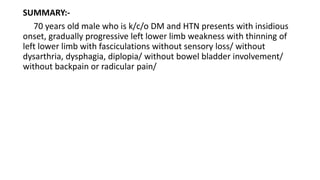
SUMMARY:-
70 years old male who is k/c/o DM and HTN presents with insidious
onset, gradually progressive left lower limb weakness with thinning of
left lower limb with fasciculations without sensory loss/ without
dysarthria, dysphagia, diplopia/ without bowel bladder involvement/
without backpain or radicular pain/
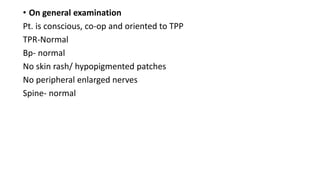
• On general examination
Pt. is conscious, co-op and oriented to TPP
TPR-Normal
Bp- normal
No skin rash/ hypopigmented patches
No peripheral enlarged nerves
Spine- normal
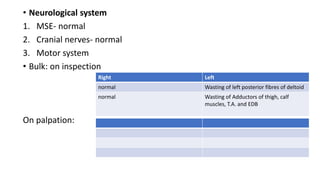
• Neurological system
1. MSE- normal
2. Cranial nerves- normal
3. Motor system
• Bulk: on inspection
On palpation:
Right Left
normal Wasting of left posterior fibres of deltoid
normal Wasting of Adductors of thigh, calf
muscles, T.A. and EDB
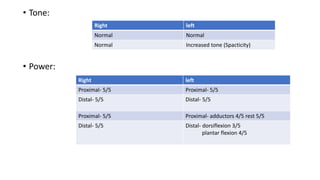
• Tone:
• Power:
Right left
Normal Normal
Normal Increased tone (Spacticity)
Right left
Proximal- 5/5 Proximal- 5/5
Distal- 5/5 Distal- 5/5
Proximal- 5/5 Proximal- adductors 4/5 rest 5/5
Distal- 5/5 Distal- dorsiflexion 3/5
plantar flexion 4/5
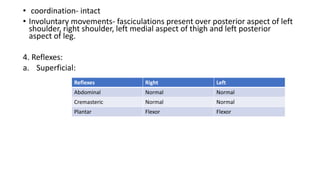
• coordination- intact
• Involuntary movements- fasciculations present over posterior aspect of left
shoulder, right shoulder, left medial aspect of thigh and left posterior
aspect of leg.
4. Reflexes:
a. Superficial:
Reflexes Right Left
Abdominal Normal Normal
Cremasteric Normal Normal
Plantar Flexor Flexor
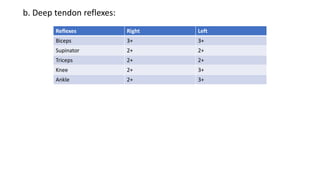
b. Deep tendon reflexes:
Reflexes Right Left
Biceps 3+ 3+
Supinator 2+ 2+
Triceps 2+ 2+
Knee 2+ 3+
Ankle 2+ 3+
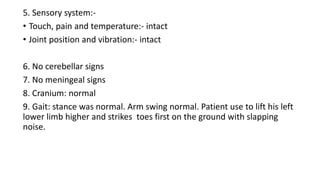
5. Sensory system:-
• Touch, pain and temperature:- intact
• Joint position and vibration:- intact
6. No cerebellar signs
7. No meningeal signs
8. Cranium: normal
9. Gait: stance was normal. Arm swing normal. Patient use to lift his left
lower limb higher and strikes toes first on the ground with slapping
noise.
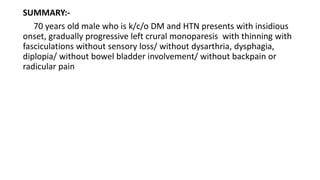
SUMMARY:-
70 years old male who is k/c/o DM and HTN presents with insidious
onset, gradually progressive left crural monoparesis with thinning with
fasciculations without sensory loss/ without dysarthria, dysphagia,
diplopia/ without bowel bladder involvement/ without backpain or
radicular pain
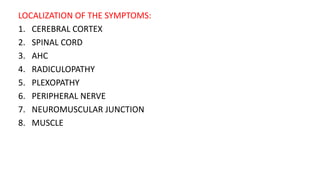
LOCALIZATION OF THE SYMPTOMS:
1. CEREBRAL CORTEX
2. SPINAL CORD
3. AHC
4. RADICULOPATHY
5. PLEXOPATHY
6. PERIPHERAL NERVE
7. NEUROMUSCULAR JUNCTION
8. MUSCLE
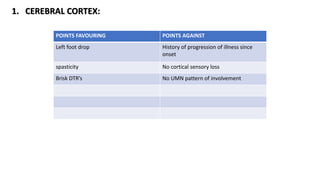
1. CEREBRAL CORTEX:
POINTS FAVOURING POINTS AGAINST
Left foot drop History of progression of illness since
onset
spasticity No cortical sensory loss
Brisk DTR’s No UMN pattern of involvement
2. SPINAL CORD:
POINTS FAVOURING POINTS AGAINST
Left foot drop No sensory loss/sensory level
progressive No bowel /bladder involvement
spasticity No funicular pain
Brisk DTR’s Wasting (can have disuse atrophy)
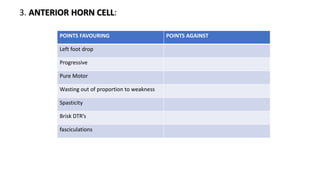
3. ANTERIOR HORN CELL:
POINTS FAVOURING POINTS AGAINST
Left foot drop
Progressive
Pure Motor
Wasting out of proportion to weakness
Spasticity
Brisk DTR’s
fasciculations
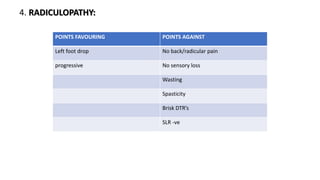
4. RADICULOPATHY:
POINTS FAVOURING POINTS AGAINST
Left foot drop No back/radicular pain
progressive No sensory loss
Wasting
Spasticity
Brisk DTR’s
SLR -ve
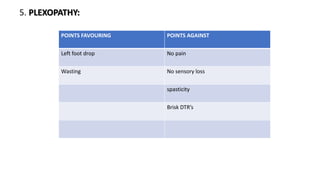
5. PLEXOPATHY:
POINTS FAVOURING POINTS AGAINST
Left foot drop No pain
Wasting No sensory loss
spasticity
Brisk DTR’s
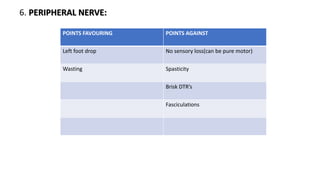
6. PERIPHERAL NERVE:
POINTS FAVOURING POINTS AGAINST
Left foot drop No sensory loss(can be pure motor)
Wasting Spasticity
Brisk DTR’s
Fasciculations
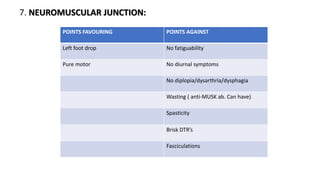
7. NEUROMUSCULAR JUNCTION:
POINTS FAVOURING POINTS AGAINST
Left foot drop No fatiguability
Pure motor No diurnal symptoms
No diplopia/dysarthria/dysphagia
Wasting ( anti-MUSK ab. Can have)
Spasticity
Brisk DTR’s
Fasciculations
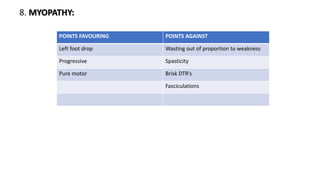
8. MYOPATHY:
POINTS FAVOURING POINTS AGAINST
Left foot drop Wasting out of proportion to weakness
Progressive Spasticity
Pure motor Brisk DTR’s
Fasciculations
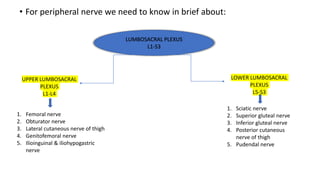
• For peripheral nerve we need to know in brief about:
LUMBOSACRAL PLEXUS
L1-S3
UPPER LUMBOSACRAL
PLEXUS
L1-L4
LOWER LUMBOSACRAL
PLEXUS
L5-S3
1. Femoral nerve
2. Obturator nerve
3. Lateral cutaneous nerve of thigh
4. Genitofemoral nerve
5. Ilioinguinal & iliohypogastric
nerve
1. Sciatic nerve
2. Superior gluteal nerve
3. Inferior gluteal nerve
4. Posterior cutaneous
nerve of thigh
5. Pudendal nerve
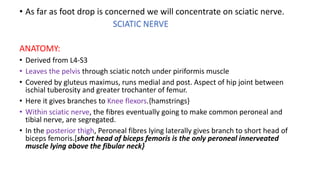
• As far as foot drop is concerned we will concentrate on sciatic nerve.
SCIATIC NERVE
ANATOMY:
• Derived from L4-S3
• Leaves the pelvis through sciatic notch under piriformis muscle
• Covered by gluteus maximus, runs medial and post. Aspect of hip joint between
ischial tuberosity and greater trochanter of femur.
• Here it gives branches to Knee flexors.{hamstrings}
• Within sciatic nerve, the fibres eventually going to make common peroneal and
tibial nerve, are segregated.
• In the posterior thigh, Peroneal fibres lying laterally gives branch to short head of
biceps femoris.[short head of biceps femoris is the only peroneal innerveated
muscle lying above the fibular neck}
• Above the popliteal fossa the sciatic nerve physically bifurcates into
common peroneal nerve and tibial nerve.
• Common peroneal nerve first gives rise to lateral cutaneous nerve of
knee then it winds around fibular neck and then divides into
DEEP PERONEAL NERVE
MOTOR:
• Dorsiflexors of
foot and
toes[TA, EHL,
EDL, EDB]
• Peroneus
tertius
SENSORY:
• First web
space.
SUPERFICIAL PERONEAL NERVE
MOTOR:
• Ankle
evertors{P.L.&
P.B.}
SENSORY:
• Mid and lower
lateral calf.
• Dorsum of foot
and dorsal
medial 3 or 4
toes upto IPJ.
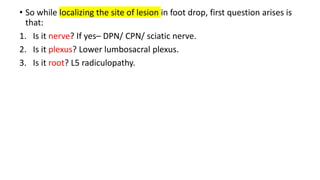
• So while localizing the site of lesion in foot drop, first question arises is
that:
1. Is it nerve? If yes– DPN/ CPN/ sciatic nerve.
2. Is it plexus? Lower lumbosacral plexus.
3. Is it root? L5 radiculopathy.
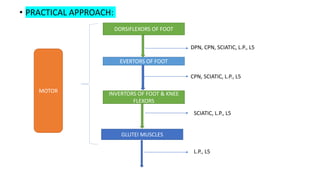
• PRACTICAL APPROACH:
DORSIFLEXORS OF FOOT
EVERTORS OF FOOT
INVERTORS OF FOOT & KNEE
FLEXORS
DPN, CPN, SCIATIC, L.P., L5
CPN, SCIATIC, L.P., L5
GLUTEI MUSCLES
SCIATIC, L.P., L5
L.P., L5
MOTOR
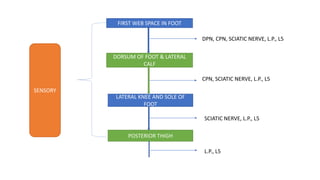
FIRST WEB SPACE IN FOOT
DPN, CPN, SCIATIC NERVE, L.P., L5
DORSUM OF FOOT & LATERAL
CALF
CPN, SCIATIC NERVE, L.P., L5
LATERAL KNEE AND SOLE OF
FOOT
SCIATIC NERVE, L.P., L5
POSTERIOR THIGH
L.P., L5
SENSORY
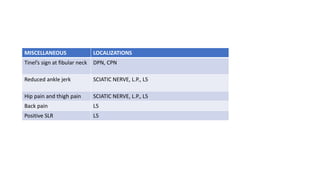
MISCELLANEOUS LOCALIZATIONS
Tinel’s sign at fibular neck DPN, CPN
Reduced ankle jerk SCIATIC NERVE, L.P., L5
Hip pain and thigh pain SCIATIC NERVE, L.P., L5
Back pain L5
Positive SLR L5
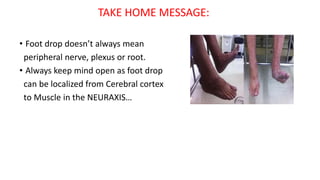
TAKE HOME MESSAGE:
• Foot drop doesn’t always mean
peripheral nerve, plexus or root.
• Always keep mind open as foot drop
can be localized from Cerebral cortex
to Muscle in the NEURAXIS…
.
Approach to foot drop

Approach to foot drop

  • 1.
    DR.HARSH M. PATEL D.M.NEUROLOGY S.R. APPROACH TO FOOT DROP
  • 2.
    CASE PRESENTATION 70 Yearsold male, k/c/o DM and HTN since 8 to 10 years presents with C/c of weakness of left lower limb since 8 months thinning of left lower limb since 4 months HOPI- Patient was in his usual state of health 8 months back when he developed weakness of left lower limb which was insidious onset and gradually progressive in nature. Initially while walking he noticed that he had difficulty in clearing his left foot off the ground and had occasional episodes of striking of toes on the ground while walking. Gradually over 1-2 months he noticed that he had difficulty in wearing chappals in left foot and had to take support of the nearby wall and has to strike the chappal against the wall to wear chappals. Over next 3-4 months
  • 3.
    He started difficultyin gripping chappals and had slippage of chappals with his knowledge. Also the way in which he walk was changed and noticed first by his relatives. According to them while walking he lifts his left leg higher compared to right leg and slaps it on the ground with slapping noise. • No h/o s/o similar weakness in the rt. Lower limb • No h/o s/o proximal weakness such as there was no difficulty in lifting thigh while climbing stairs. No difficulty in wearing pants. No difficulty in getting up from squatting position. • No h/o s/o truncal or neck muscle involvement such as no difficulty in turning sideways/ getting up and sitting from lying down/ lifting neck from pillow. • No history s/o weakness in upper limbs such as removing banayan overhead/ combing hairs/ pouring water overhead with tumbler while taking bath. Also no difficulty in tearing chappatis/ buttoning- unbuttoning of clothes.
  • 4.
    Also 4 monthsafter the onset of illness he noticed thinning of left lower limb which was insidious in onset and progressive in nature. Initially while wearing socks he noticed that lower portion of left leg got thinner compared to rt. Leg. Over next 2-3 months he noticed that posterior portion of left leg also appears thinner and on palpation it was feeling loose compared to rt. Leg. There was hollowing of inner aspect of left thigh. On leading question he accepts to have twitching movements over the left inner thigh. • No h/o similar thinning in any other part of limb • No h/o difficulty in appreciation of clothes and hot and cold water over any part of body • No h/o dysphagia/ dysarthria /diplopia • No h/o bowel/ bladder involvement • No h/o back pain or radicular pain • No skin rash/ hypopigmented patches.
  • 5.
    PAST HISTORY:- k/c/o D.M.and HTN since 8-10 yrs. ( on regular treatment) FAMILY HISTORY:- No sign. Family history PERSONAL HISTORY:- • Mixed diet • Appetite/sleep/bowel/bladder– unaltered • No addiction
  • 6.
    SUMMARY:- 70 years oldmale who is k/c/o DM and HTN presents with insidious onset, gradually progressive left lower limb weakness with thinning of left lower limb with fasciculations without sensory loss/ without dysarthria, dysphagia, diplopia/ without bowel bladder involvement/ without backpain or radicular pain/
  • 7.
    • On generalexamination Pt. is conscious, co-op and oriented to TPP TPR-Normal Bp- normal No skin rash/ hypopigmented patches No peripheral enlarged nerves Spine- normal
  • 8.
    • Neurological system 1.MSE- normal 2. Cranial nerves- normal 3. Motor system • Bulk: on inspection On palpation: Right Left normal Wasting of left posterior fibres of deltoid normal Wasting of Adductors of thigh, calf muscles, T.A. and EDB
  • 9.
    • Tone: • Power: Rightleft Normal Normal Normal Increased tone (Spacticity) Right left Proximal- 5/5 Proximal- 5/5 Distal- 5/5 Distal- 5/5 Proximal- 5/5 Proximal- adductors 4/5 rest 5/5 Distal- 5/5 Distal- dorsiflexion 3/5 plantar flexion 4/5
  • 10.
    • coordination- intact •Involuntary movements- fasciculations present over posterior aspect of left shoulder, right shoulder, left medial aspect of thigh and left posterior aspect of leg. 4. Reflexes: a. Superficial: Reflexes Right Left Abdominal Normal Normal Cremasteric Normal Normal Plantar Flexor Flexor
  • 11.
    b. Deep tendonreflexes: Reflexes Right Left Biceps 3+ 3+ Supinator 2+ 2+ Triceps 2+ 2+ Knee 2+ 3+ Ankle 2+ 3+
  • 12.
    5. Sensory system:- •Touch, pain and temperature:- intact • Joint position and vibration:- intact 6. No cerebellar signs 7. No meningeal signs 8. Cranium: normal 9. Gait: stance was normal. Arm swing normal. Patient use to lift his left lower limb higher and strikes toes first on the ground with slapping noise.
  • 13.
    SUMMARY:- 70 years oldmale who is k/c/o DM and HTN presents with insidious onset, gradually progressive left crural monoparesis with thinning with fasciculations without sensory loss/ without dysarthria, dysphagia, diplopia/ without bowel bladder involvement/ without backpain or radicular pain
  • 14.
    LOCALIZATION OF THESYMPTOMS: 1. CEREBRAL CORTEX 2. SPINAL CORD 3. AHC 4. RADICULOPATHY 5. PLEXOPATHY 6. PERIPHERAL NERVE 7. NEUROMUSCULAR JUNCTION 8. MUSCLE
  • 15.
    1. CEREBRAL CORTEX: POINTSFAVOURING POINTS AGAINST Left foot drop History of progression of illness since onset spasticity No cortical sensory loss Brisk DTR’s No UMN pattern of involvement
  • 16.
    2. SPINAL CORD: POINTSFAVOURING POINTS AGAINST Left foot drop No sensory loss/sensory level progressive No bowel /bladder involvement spasticity No funicular pain Brisk DTR’s Wasting (can have disuse atrophy)
  • 17.
    3. ANTERIOR HORNCELL: POINTS FAVOURING POINTS AGAINST Left foot drop Progressive Pure Motor Wasting out of proportion to weakness Spasticity Brisk DTR’s fasciculations
  • 18.
    4. RADICULOPATHY: POINTS FAVOURINGPOINTS AGAINST Left foot drop No back/radicular pain progressive No sensory loss Wasting Spasticity Brisk DTR’s SLR -ve
  • 19.
    5. PLEXOPATHY: POINTS FAVOURINGPOINTS AGAINST Left foot drop No pain Wasting No sensory loss spasticity Brisk DTR’s
  • 20.
    6. PERIPHERAL NERVE: POINTSFAVOURING POINTS AGAINST Left foot drop No sensory loss(can be pure motor) Wasting Spasticity Brisk DTR’s Fasciculations
  • 21.
    7. NEUROMUSCULAR JUNCTION: POINTSFAVOURING POINTS AGAINST Left foot drop No fatiguability Pure motor No diurnal symptoms No diplopia/dysarthria/dysphagia Wasting ( anti-MUSK ab. Can have) Spasticity Brisk DTR’s Fasciculations
  • 22.
    8. MYOPATHY: POINTS FAVOURINGPOINTS AGAINST Left foot drop Wasting out of proportion to weakness Progressive Spasticity Pure motor Brisk DTR’s Fasciculations
  • 23.
    • For peripheralnerve we need to know in brief about: LUMBOSACRAL PLEXUS L1-S3 UPPER LUMBOSACRAL PLEXUS L1-L4 LOWER LUMBOSACRAL PLEXUS L5-S3 1. Femoral nerve 2. Obturator nerve 3. Lateral cutaneous nerve of thigh 4. Genitofemoral nerve 5. Ilioinguinal & iliohypogastric nerve 1. Sciatic nerve 2. Superior gluteal nerve 3. Inferior gluteal nerve 4. Posterior cutaneous nerve of thigh 5. Pudendal nerve
  • 24.
    • As faras foot drop is concerned we will concentrate on sciatic nerve. SCIATIC NERVE ANATOMY: • Derived from L4-S3 • Leaves the pelvis through sciatic notch under piriformis muscle • Covered by gluteus maximus, runs medial and post. Aspect of hip joint between ischial tuberosity and greater trochanter of femur. • Here it gives branches to Knee flexors.{hamstrings} • Within sciatic nerve, the fibres eventually going to make common peroneal and tibial nerve, are segregated. • In the posterior thigh, Peroneal fibres lying laterally gives branch to short head of biceps femoris.[short head of biceps femoris is the only peroneal innerveated muscle lying above the fibular neck}
  • 25.
    • Above thepopliteal fossa the sciatic nerve physically bifurcates into common peroneal nerve and tibial nerve. • Common peroneal nerve first gives rise to lateral cutaneous nerve of knee then it winds around fibular neck and then divides into DEEP PERONEAL NERVE MOTOR: • Dorsiflexors of foot and toes[TA, EHL, EDL, EDB] • Peroneus tertius SENSORY: • First web space. SUPERFICIAL PERONEAL NERVE MOTOR: • Ankle evertors{P.L.& P.B.} SENSORY: • Mid and lower lateral calf. • Dorsum of foot and dorsal medial 3 or 4 toes upto IPJ.
  • 26.
    • So whilelocalizing the site of lesion in foot drop, first question arises is that: 1. Is it nerve? If yes– DPN/ CPN/ sciatic nerve. 2. Is it plexus? Lower lumbosacral plexus. 3. Is it root? L5 radiculopathy.
  • 27.
    • PRACTICAL APPROACH: DORSIFLEXORSOF FOOT EVERTORS OF FOOT INVERTORS OF FOOT & KNEE FLEXORS DPN, CPN, SCIATIC, L.P., L5 CPN, SCIATIC, L.P., L5 GLUTEI MUSCLES SCIATIC, L.P., L5 L.P., L5 MOTOR
  • 28.
    FIRST WEB SPACEIN FOOT DPN, CPN, SCIATIC NERVE, L.P., L5 DORSUM OF FOOT & LATERAL CALF CPN, SCIATIC NERVE, L.P., L5 LATERAL KNEE AND SOLE OF FOOT SCIATIC NERVE, L.P., L5 POSTERIOR THIGH L.P., L5 SENSORY
  • 29.
    MISCELLANEOUS LOCALIZATIONS Tinel’s signat fibular neck DPN, CPN Reduced ankle jerk SCIATIC NERVE, L.P., L5 Hip pain and thigh pain SCIATIC NERVE, L.P., L5 Back pain L5 Positive SLR L5
  • 30.
    TAKE HOME MESSAGE: •Foot drop doesn’t always mean peripheral nerve, plexus or root. • Always keep mind open as foot drop can be localized from Cerebral cortex to Muscle in the NEURAXIS…
  • 31.