Rotator Cuff Tendinopathy
Mr Puneet Monga
Consultant Orthopaedic Shoulder Surgeon
Wrightington Hospital
Terminology
• Tendonitis / Tendinitis
• Tendinoses
• Tendinopathy
What’s the correct term to use ?
Terminology
• Tendonitis / Tendinitis - Inflammation of the
tendon (rare)- Inappropriate terminology.
• Tendinoses- Degenerative condition-
Tendon damage at cellular level.
• Tendinopathy - Disease of the tendon
What’s the function of the
Rotator Cuff?
Function of a Tendon
Force Transmission from Muscle to bone
The Rotator Cuff
Image Courtesy- www.patient.info
Function of the RC
• Rotation of the humerus w.r.t Scapula
• Compresses the head into the glenoid-
dynamic stability
• Force coupling - Deltoid / Lattisimus / Pec
Major
What’s the Aetiology of RC
Tendinopathy
Causation of Rotator Cuff Tendinopathy
• Extrinsic factors
• Intrinsic factors
Acromial shapes
Bigliani, L. U.; Morrison, D. S.; and April, E. W.: The morphology of the acromion and its relationship to
rotator cuff tears. Orthop. Trans.,10: 228, 1986.10228  1986  
Higher proportion of RC
tears seen in Curved and
Hooked Acromions
Image courtesy- Shoulderdoc.co.uk
Sub-acromial Wringer
Coronal Plane Patho-anatomy
AbductionNeutral Position
Repetitive Micro-trauma from external impingement
Sagittal - oblique Plane Pathoanatomy
Sub-Acromial volume
Subacromial Decompression
Sub-Acromial volume
Extrinsic Theory doesn’t explain it all
• RCT- Bursectomy vs Bursectomy + acromioplasty- No Difference
• Articular surface tendon damage more common
• No direct relation between acromial shape and impingement
symptoms
Lewis J. Subacromial impingement syndrome: a musculoskeletal condition or a clinical illusion? Physical Therapy Reviews. 16(5):388-98. 2011
Let’s understand the normal
tendon structure and healing….
Normal Tendon
Normal Cuff Tendon =
Collagen (Type I predominantly)
Elastin
Glycosaminoglycan
Proteoglycans
Water
Image Courtesy:
www.ouhsc.edu
Injured tendon- Usual repair
Total Collagen decreases
Increased gene expression of Type I,VI, IX and III
Decreased Type II expression.
Repair and replacement of normal collagen
Andrew Carr, Paul Harvie Chapter;Tendon Injuries pp 101-118 Rotator Cuff Tendinopathy.
In Tendon Injuries. Maffulli et al Springer, 2005.
Normal Healing
Repetitive loading
Micro tearsHealing
Cellular Repair
Compensated Overuse
Excessive loading
Healing
Cellular Repair
So, what goes wrong in
tendinopathy?
Tendinopathy
• Excessive remodelling in response to
tendon damage during tendon repair
• Aberrant “quality” Collagen
“Stiffer Extracellular matrix”
Normal
Tendinopathy-
Disorganised matrix
Cellular clumping
Is Tendon Structure Associated with symptoms in Chronic Achilles TEndinopathy?
An update on pain mechanisms– Written by Robert-Jan deVos,The Netherlands,Aspetar Sports Medicine Journal 2017
Tendinopathy
Repetitive loadingProne to
damage
Can we blame our genes ?
Role of genetics
Possible link with “ank” mutation
(This is seen in association with Progressive form of arthritis)
Gene codes for a protein which transports Pyrophosphate out of
the cells…..so a defective gene leads to high concentration of PPi.
Increased Calcium deposition
Andrew Carr, Paul Harvie Chapter;Tendon Injuries pp 101-118 Rotator Cuff Tendinopathy.
In Tendon Injuries. Maffulli et al Springer, 2005.
Ok, what about the tendon
blood supply?
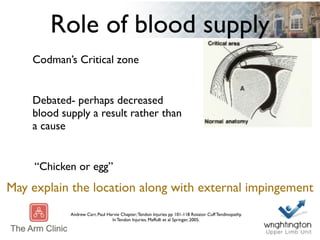
Role of blood supply
Codman’s Critical zone
Debated- perhaps decreased
blood supply a result rather than
a cause
“Chicken or egg”
May explain the location along with external impingement
Andrew Carr, Paul Harvie Chapter;Tendon Injuries pp 101-118 Rotator Cuff Tendinopathy.
In Tendon Injuries. Maffulli et al Springer, 2005.
What’s the progression of Cuff
tendinopathy ?
Unified Continuum Theory
• Why do some partial tears progress to Full
• Why do some small tears progress to large
• Why do only 4% massive tears develop
Cuff tear arthritis
• Presence of Cuff tear without impingement
/ vice versa
Discontinuous and multifactorial model
Andrew Carr, Paul Harvie Chapter;Tendon Injuries pp 101-118 Rotator Cuff Tendinopathy.
In Tendon Injuries. Maffulli et al Springer, 2005.
Making a Diagnosis
Rotator Cuff Tendinopathy (and
tears) may be asymptomatic
Using a Cluster approach recommended
• History
• Look Feel Move + Special Tests
• Investigations
Making a Diagnosis
Positive Special Test = Diagnosis!
History and physical examination provide little
guidance on diagnosis of rotator cuff tears.
Jain NB, Yamaguchi K. Evid Based Med.
2014 Jun;19(3):108.
Role of Investigations
• Ultrasound - Good for soft tissues & dynamic
• Xray- Good screening tool for Bone / joint
• CT- Good for bone
• MRI- Good for soft tissues and cross sectional
Management
First line Management
• Activity Modification
• Analgesia
• Physiotherapy- Posture, motor control,
stretching, strengthening, Manual therapy-
6 weeks
Physiotherapy
Principles
• Pain relief
• Maintaining Range of movement
• Progressive Strengthening
When would I expect
physiotherapy to work?
Positive Predictors
(1) Patient expectation of ‘complete recovery’ compared to a
‘slight improvement’ as ‘a result of physiotherapy treatment’,
(2) Lower pain severity specifically at rest,
(3) The absence of a previous major operation (shoulder
surgery excluded),
(4) The absence of pain in the opposite upper quadrant and
(5) Change in pain or range of shoulder elevation with manual
facilitation of the scapula during elevation of the arm.
Cortisone Injection in Cuff
Tendinopathy
Is Tendinopathy inflammatory?
• No
• Biopsies- No inflammatory cells
• Degenerative changes
Sports Med. 1999 Jun;27(6):393-408.Histopathology of common tendinopathies.
Update and implications for clinical management. Khan KM1, Cook JL, Bonar F,
Harcourt P,Astrom M.
1. Pragmatic reason
Neer’s Test - LA component Cross confirms the
diagnosis
So,Why inject?
And,…. what about bursitis ?
Is Bursitis inflammatory?
• Yes
• Presence of Inflammatory mediators in
Bursal biopsies
• Inflammatory mediators reduced following
NSAIDs or cortisone injection
Arch Orthop Trauma Surg. 1992;111(6):336-40. Inflammation of the subacromial bursa in chronic shoulder pain. Santavirta S1, KonttinenYT,Antti-Poika I, Nordström D
J Shoulder Elbow Surg. 2005 Jan-Feb;14(1 Suppl S):84S-89S.The molecular pathophysiology of subacromial bursitis in rotator cuff disease. Blaine TA1, KimYS,Voloshin I, Chen D, Murakami K, Chang SS,
Winchester R, Lee FY, O'keefe RJ, Bigliani LU.
J Orthop Res. 2006 Aug;24(8):1756-64. Stromal cell-derived factor 1 (SDF-1, CXCL12) is increased in subacromial bursitis and downregulated by steroid and nonsteroidal anti-inflammatory agents.
KimYS1, Bigliani LU, Fujisawa M, Murakami K, Chang SS, Lee HJ, Lee FY, Blaine TA.
Current Practice
Sub-acromial Steroid Injection
Usually 1
BOA/ BESS commissioning guide
Indications for Surgery
Failure of First line treatment
Symptoms lasting more than 6 months
Notable Exception
Acute Rotator Cuff Tears
Early surgery has better outcomes
Duncan NS, Booker SJ, Gooding BW, Geoghegan J, Wallace WA, Manning PA Surgery within 6 months of an acute rotator cuff tear significantly improves
outcome. J Shoulder Elbow Surg. 2015 Dec;24(12):1876-80.
Setup
• Patient Position - Beach chair / lateral
• Arm holder - traction vs mechanical
• Kit- Coblation/ shaver/ pump
Portals
Outcomes
20 year follow up 80% satisfied- 14% revision
Arthroscopy. 2015 Oct 24. pii: S0749-8063(15)00704-5. doi: 10.1016/j.arthro.2015.08.026. [Epub ahead of print]
Patients With Impingement Syndrome With and Without Rotator Cuff
Tears Do Well 20 Years After Arthroscopic Subacromial Decompression.
Jaeger M1, Berndt T2, Rühmann O2, Lerch S2.
Key Points
• Both Extrinsic and Intrinsic factors play a role
• Tendinopathy is degenerative not inflammatory
• ASD when first line treatment fails
• Reliable outcomes in carefully selected patients
Comments and questions?

Rotator Cuff Tendinopathy

  • 1.
    Rotator Cuff Tendinopathy MrPuneet Monga Consultant Orthopaedic Shoulder Surgeon Wrightington Hospital
  • 2.
    Terminology • Tendonitis /Tendinitis • Tendinoses • Tendinopathy
  • 3.
    What’s the correctterm to use ?
  • 4.
    Terminology • Tendonitis /Tendinitis - Inflammation of the tendon (rare)- Inappropriate terminology. • Tendinoses- Degenerative condition- Tendon damage at cellular level. • Tendinopathy - Disease of the tendon
  • 5.
    What’s the functionof the Rotator Cuff?
  • 6.
    Function of aTendon Force Transmission from Muscle to bone
  • 7.
    The Rotator Cuff ImageCourtesy- www.patient.info
  • 8.
    Function of theRC • Rotation of the humerus w.r.t Scapula • Compresses the head into the glenoid- dynamic stability • Force coupling - Deltoid / Lattisimus / Pec Major
  • 9.
    What’s the Aetiologyof RC Tendinopathy
  • 10.
    Causation of RotatorCuff Tendinopathy • Extrinsic factors • Intrinsic factors
  • 11.
    Acromial shapes Bigliani, L.U.; Morrison, D. S.; and April, E. W.: The morphology of the acromion and its relationship to rotator cuff tears. Orthop. Trans.,10: 228, 1986.10228  1986   Higher proportion of RC tears seen in Curved and Hooked Acromions Image courtesy- Shoulderdoc.co.uk
  • 12.
  • 13.
    Coronal Plane Patho-anatomy AbductionNeutralPosition Repetitive Micro-trauma from external impingement
  • 14.
    Sagittal - obliquePlane Pathoanatomy Sub-Acromial volume
  • 15.
  • 16.
    Extrinsic Theory doesn’texplain it all • RCT- Bursectomy vs Bursectomy + acromioplasty- No Difference • Articular surface tendon damage more common • No direct relation between acromial shape and impingement symptoms Lewis J. Subacromial impingement syndrome: a musculoskeletal condition or a clinical illusion? Physical Therapy Reviews. 16(5):388-98. 2011
  • 17.
    Let’s understand thenormal tendon structure and healing….
  • 18.
    Normal Tendon Normal CuffTendon = Collagen (Type I predominantly) Elastin Glycosaminoglycan Proteoglycans Water Image Courtesy: www.ouhsc.edu
  • 19.
    Injured tendon- Usualrepair Total Collagen decreases Increased gene expression of Type I,VI, IX and III Decreased Type II expression. Repair and replacement of normal collagen Andrew Carr, Paul Harvie Chapter;Tendon Injuries pp 101-118 Rotator Cuff Tendinopathy. In Tendon Injuries. Maffulli et al Springer, 2005.
  • 20.
    Normal Healing Repetitive loading MicrotearsHealing Cellular Repair
  • 21.
  • 22.
    So, what goeswrong in tendinopathy?
  • 23.
    Tendinopathy • Excessive remodellingin response to tendon damage during tendon repair • Aberrant “quality” Collagen “Stiffer Extracellular matrix”
  • 24.
    Normal Tendinopathy- Disorganised matrix Cellular clumping IsTendon Structure Associated with symptoms in Chronic Achilles TEndinopathy? An update on pain mechanisms– Written by Robert-Jan deVos,The Netherlands,Aspetar Sports Medicine Journal 2017
  • 25.
  • 26.
    Can we blameour genes ?
  • 27.
    Role of genetics Possiblelink with “ank” mutation (This is seen in association with Progressive form of arthritis) Gene codes for a protein which transports Pyrophosphate out of the cells…..so a defective gene leads to high concentration of PPi. Increased Calcium deposition Andrew Carr, Paul Harvie Chapter;Tendon Injuries pp 101-118 Rotator Cuff Tendinopathy. In Tendon Injuries. Maffulli et al Springer, 2005.
  • 28.
    Ok, what aboutthe tendon blood supply?
  • 29.
    Role of bloodsupply Codman’s Critical zone Debated- perhaps decreased blood supply a result rather than a cause “Chicken or egg” May explain the location along with external impingement Andrew Carr, Paul Harvie Chapter;Tendon Injuries pp 101-118 Rotator Cuff Tendinopathy. In Tendon Injuries. Maffulli et al Springer, 2005.
  • 30.
    What’s the progressionof Cuff tendinopathy ?
  • 31.
  • 32.
    • Why dosome partial tears progress to Full • Why do some small tears progress to large • Why do only 4% massive tears develop Cuff tear arthritis • Presence of Cuff tear without impingement / vice versa
  • 33.
    Discontinuous and multifactorialmodel Andrew Carr, Paul Harvie Chapter;Tendon Injuries pp 101-118 Rotator Cuff Tendinopathy. In Tendon Injuries. Maffulli et al Springer, 2005.
  • 34.
  • 35.
    Rotator Cuff Tendinopathy(and tears) may be asymptomatic
  • 36.
    Using a Clusterapproach recommended • History • Look Feel Move + Special Tests • Investigations Making a Diagnosis
  • 37.
  • 38.
    History and physicalexamination provide little guidance on diagnosis of rotator cuff tears. Jain NB, Yamaguchi K. Evid Based Med. 2014 Jun;19(3):108.
  • 39.
    Role of Investigations •Ultrasound - Good for soft tissues & dynamic • Xray- Good screening tool for Bone / joint • CT- Good for bone • MRI- Good for soft tissues and cross sectional
  • 40.
  • 41.
    First line Management •Activity Modification • Analgesia • Physiotherapy- Posture, motor control, stretching, strengthening, Manual therapy- 6 weeks
  • 42.
    Physiotherapy Principles • Pain relief •Maintaining Range of movement • Progressive Strengthening
  • 43.
    When would Iexpect physiotherapy to work?
  • 44.
    Positive Predictors (1) Patientexpectation of ‘complete recovery’ compared to a ‘slight improvement’ as ‘a result of physiotherapy treatment’, (2) Lower pain severity specifically at rest, (3) The absence of a previous major operation (shoulder surgery excluded), (4) The absence of pain in the opposite upper quadrant and (5) Change in pain or range of shoulder elevation with manual facilitation of the scapula during elevation of the arm.
  • 45.
    Cortisone Injection inCuff Tendinopathy
  • 46.
    Is Tendinopathy inflammatory? •No • Biopsies- No inflammatory cells • Degenerative changes Sports Med. 1999 Jun;27(6):393-408.Histopathology of common tendinopathies. Update and implications for clinical management. Khan KM1, Cook JL, Bonar F, Harcourt P,Astrom M.
  • 47.
    1. Pragmatic reason Neer’sTest - LA component Cross confirms the diagnosis So,Why inject?
  • 48.
  • 49.
    Is Bursitis inflammatory? •Yes • Presence of Inflammatory mediators in Bursal biopsies • Inflammatory mediators reduced following NSAIDs or cortisone injection Arch Orthop Trauma Surg. 1992;111(6):336-40. Inflammation of the subacromial bursa in chronic shoulder pain. Santavirta S1, KonttinenYT,Antti-Poika I, Nordström D J Shoulder Elbow Surg. 2005 Jan-Feb;14(1 Suppl S):84S-89S.The molecular pathophysiology of subacromial bursitis in rotator cuff disease. Blaine TA1, KimYS,Voloshin I, Chen D, Murakami K, Chang SS, Winchester R, Lee FY, O'keefe RJ, Bigliani LU. J Orthop Res. 2006 Aug;24(8):1756-64. Stromal cell-derived factor 1 (SDF-1, CXCL12) is increased in subacromial bursitis and downregulated by steroid and nonsteroidal anti-inflammatory agents. KimYS1, Bigliani LU, Fujisawa M, Murakami K, Chang SS, Lee HJ, Lee FY, Blaine TA.
  • 50.
    Current Practice Sub-acromial SteroidInjection Usually 1 BOA/ BESS commissioning guide
  • 51.
    Indications for Surgery Failureof First line treatment Symptoms lasting more than 6 months
  • 52.
    Notable Exception Acute RotatorCuff Tears Early surgery has better outcomes Duncan NS, Booker SJ, Gooding BW, Geoghegan J, Wallace WA, Manning PA Surgery within 6 months of an acute rotator cuff tear significantly improves outcome. J Shoulder Elbow Surg. 2015 Dec;24(12):1876-80.
  • 53.
    Setup • Patient Position- Beach chair / lateral • Arm holder - traction vs mechanical • Kit- Coblation/ shaver/ pump
  • 54.
  • 56.
    Outcomes 20 year followup 80% satisfied- 14% revision Arthroscopy. 2015 Oct 24. pii: S0749-8063(15)00704-5. doi: 10.1016/j.arthro.2015.08.026. [Epub ahead of print] Patients With Impingement Syndrome With and Without Rotator Cuff Tears Do Well 20 Years After Arthroscopic Subacromial Decompression. Jaeger M1, Berndt T2, Rühmann O2, Lerch S2.
  • 57.
    Key Points • BothExtrinsic and Intrinsic factors play a role • Tendinopathy is degenerative not inflammatory • ASD when first line treatment fails • Reliable outcomes in carefully selected patients
  • 58.