QUALITY ASSURANCEFOOD SAFETY AND QUALITY
MICROBIOLOGICAL SAFETY OF FOODAT THE SOURCE,ControlPRODUCT DESIGN AND PROCESS CONTROLAPPLICATION OF GOOD HYGENIC PRACTICESDuring productionProcessing,labellingHandling,distribution ,storage   Sale ,preparation ,use  The above in conjunction with HACCP  system
APPLICATIONTo the complete food chainProduction on the farm through to the consumer
FOOD SAFETY TOOLS REQUIREDGMPGHPHACCPMICROBIOLOGICAL RISK ASSESSMENTQUALITY MANAGEMENT:ISO SeriesTQMImplemented Worlwide
IMPORTANT INTERNATIONAL MEETINGSGATT-General agreement on Tarriffs and TradeUnder WTOSPS agreement-Agreement on The Application of Sanitary and Phytosanitary MeasuresTBT-Agreement to technical Barriers to tradeFor free movement on international borders,means established for protecting human health is scientifically justified.spsstandards,codes,guidelines based on Codex alimentarius.
5-step Management of food in international tradeConduct a risk assessmentEstablish food safety objectives-maximum level of hazard acceptable for human consumptionAchievable food safety objectives-HACCP can be involvedEstablish Microbiological CriteriaEstablish acceptance procedure for the food at the port of entry.-food testing,phlevel,moisture content etc.
QUALITY MANAGEMENT SYSTEMQUALITYAnticipating,conforming and exceeding customer requirements.ISO:9000”the totality of characteristics of a product or service that bears on its ability to satisfy stated or implied needs”ISO:9000:2000”the degree to which a set of inherent characteristics fulfils requirement”
QUALITY ASSURANCEA prevention based system which improves product and service quality and increases productivity by placing the emphasis on product and process design.At source-it prevents emergence of non-conforming products or services.At design stage only quality is created,not on the control stage.
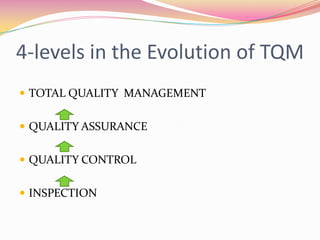
4-levels in the Evolution of TQMTOTAL QUALITY  MANAGEMENTQUALITY ASSURANCEQUALITY CONTROLINSPECTION
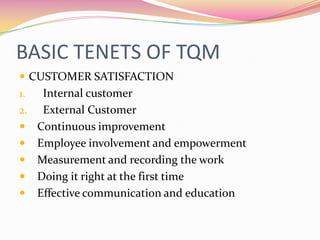
BASIC TENETS OF TQMCUSTOMER SATISFACTION Internal customer  External CustomerContinuous improvementEmployee involvement and empowermentMeasurement and recording the workDoing it right at the first timeEffective communication and education
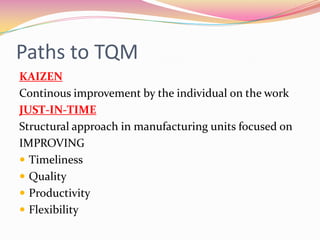
Paths to TQMKAIZENContinous improvement by the individual on the workJUST-IN-TIMEStructural approach in manufacturing units focused onIMPROVINGTimelinessQualityProductivityFlexibility
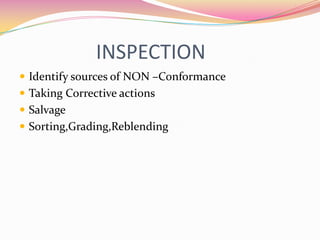
                INSPECTIONIdentify sources of NON –ConformanceTaking Corrective actionsSalvageSorting,Grading,Reblending
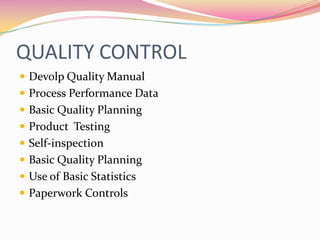
QUALITY CONTROLDevolp Quality ManualProcess Performance DataBasic Quality PlanningProduct  TestingSelf-inspectionBasic Quality PlanningUse of Basic StatisticsPaperwork Controls
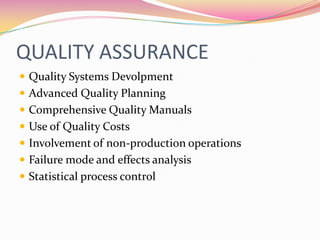
QUALITY ASSURANCEQuality Systems DevolpmentAdvanced Quality PlanningComprehensive Quality ManualsUse of Quality CostsInvolvement of non-production operationsFailure mode and effects analysisStatistical process control
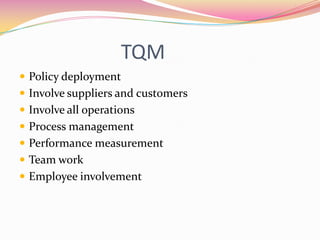
                     TQMPolicy deploymentInvolve suppliers and customersInvolve all operationsProcess managementPerformance measurementTeam workEmployee involvement
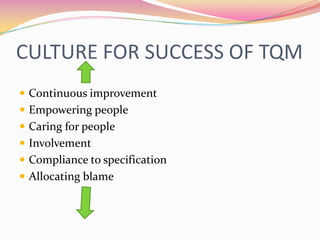
CULTURE FOR SUCCESS OF TQMContinuous improvementEmpowering peopleCaring for peopleInvolvementCompliance to specificationAllocating blame

FOOD SAFETY NOTES-QUALITY ASSURANCE

  • 1.
  • 2.
    MICROBIOLOGICAL SAFETY OFFOODAT THE SOURCE,ControlPRODUCT DESIGN AND PROCESS CONTROLAPPLICATION OF GOOD HYGENIC PRACTICESDuring productionProcessing,labellingHandling,distribution ,storage Sale ,preparation ,use The above in conjunction with HACCP system
  • 3.
    APPLICATIONTo the completefood chainProduction on the farm through to the consumer
  • 4.
    FOOD SAFETY TOOLSREQUIREDGMPGHPHACCPMICROBIOLOGICAL RISK ASSESSMENTQUALITY MANAGEMENT:ISO SeriesTQMImplemented Worlwide
  • 5.
    IMPORTANT INTERNATIONAL MEETINGSGATT-Generalagreement on Tarriffs and TradeUnder WTOSPS agreement-Agreement on The Application of Sanitary and Phytosanitary MeasuresTBT-Agreement to technical Barriers to tradeFor free movement on international borders,means established for protecting human health is scientifically justified.spsstandards,codes,guidelines based on Codex alimentarius.
  • 6.
    5-step Management offood in international tradeConduct a risk assessmentEstablish food safety objectives-maximum level of hazard acceptable for human consumptionAchievable food safety objectives-HACCP can be involvedEstablish Microbiological CriteriaEstablish acceptance procedure for the food at the port of entry.-food testing,phlevel,moisture content etc.
  • 7.
    QUALITY MANAGEMENT SYSTEMQUALITYAnticipating,conformingand exceeding customer requirements.ISO:9000”the totality of characteristics of a product or service that bears on its ability to satisfy stated or implied needs”ISO:9000:2000”the degree to which a set of inherent characteristics fulfils requirement”
  • 8.
    QUALITY ASSURANCEA preventionbased system which improves product and service quality and increases productivity by placing the emphasis on product and process design.At source-it prevents emergence of non-conforming products or services.At design stage only quality is created,not on the control stage.
  • 9.
    4-levels in theEvolution of TQMTOTAL QUALITY MANAGEMENTQUALITY ASSURANCEQUALITY CONTROLINSPECTION
  • 10.
    BASIC TENETS OFTQMCUSTOMER SATISFACTION Internal customer External CustomerContinuous improvementEmployee involvement and empowermentMeasurement and recording the workDoing it right at the first timeEffective communication and education
  • 11.
    Paths to TQMKAIZENContinousimprovement by the individual on the workJUST-IN-TIMEStructural approach in manufacturing units focused onIMPROVINGTimelinessQualityProductivityFlexibility
  • 12.
    INSPECTIONIdentify sources of NON –ConformanceTaking Corrective actionsSalvageSorting,Grading,Reblending
  • 13.
    QUALITY CONTROLDevolp QualityManualProcess Performance DataBasic Quality PlanningProduct TestingSelf-inspectionBasic Quality PlanningUse of Basic StatisticsPaperwork Controls
  • 14.
    QUALITY ASSURANCEQuality SystemsDevolpmentAdvanced Quality PlanningComprehensive Quality ManualsUse of Quality CostsInvolvement of non-production operationsFailure mode and effects analysisStatistical process control
  • 15.
    TQMPolicy deploymentInvolve suppliers and customersInvolve all operationsProcess managementPerformance measurementTeam workEmployee involvement
  • 16.
    CULTURE FOR SUCCESSOF TQMContinuous improvementEmpowering peopleCaring for peopleInvolvementCompliance to specificationAllocating blame