TQM (Total Quality Management)
Total Quality Management (TQM) is a theory of management based on the
principles of quality assurance. It consists of the integration of all functions and
processes within an organization in order to achieve continuous improvement of
quality of goods and services.
Objectives of TQM
1. Total client satisfaction through quality products and services.
2. Continuous improvements to processes, systems, people, suppliers, partners,
products, and services.
Importance of TQM in Food Industry
 continuously improving products .
 services to meet or possibly exceed the needs and expectations of the customer.
 Strengthened competitive position.
 Enhanced market image.
 Increase customer loyalty and retention.
 Increased job security.
Total Quality Management Principles:
The 8 Primary Elements of TQM
1. Customer-focused
2. Total employee involvement
3. Process-centered
4. Integrated system
5. Strategic and systematic approach
6. Continual improvement
7. Fact-based decision making
8. Communications
Obstacles encountered during the implementation of Total Quality Management
(TQM)
 Lack of company-wide definition of quality
 Lack of strategic plan for change
 Lack of customer focus
 Poor intra-organizational communication
 Lack of employee empowerment
 The view of quality as a quick fix rather than a long-term process
 Emphasis on short-term financial results
 Presence of internal politics and turf issues
 Lack of strong motivation
 Lack of time to devote to quality initiatives
 Lack of leadership
Total Quality Management tools used in Problem Solving and Process
Improvement
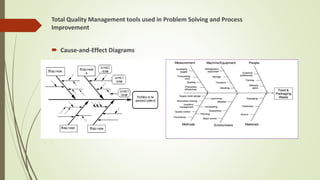
 Cause-and-Effect Diagrams
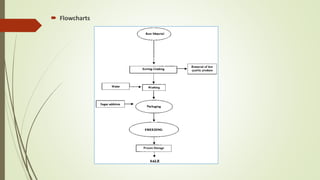
 Flowcharts
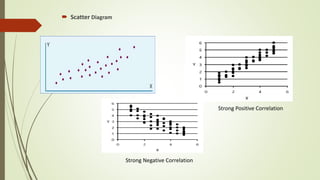
 Scatter Diagram
Strong Positive Correlation
Strong Negative Correlation
Weak Positive Correlation
Weak Negative Correlation
Complex Correlation No Correlation
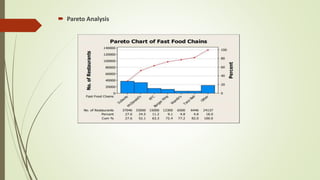
 Pareto Analysis
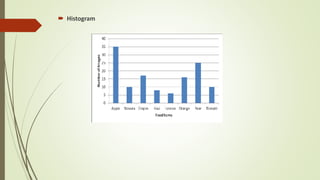
 Histogram
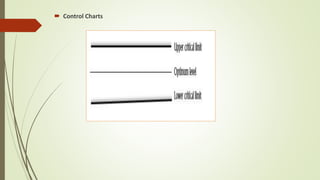
 Control Charts
Conclusion
Food safety is a growing global concern not only because of its continuing
importance for public health but also because of its impact on international trade.
The application of total quality management (TQM) provides the best possible care
by continuously improving products and services to meet or possibly exceed the
needs and expectations of the customer. The TQM approach is useful for companies
in terms of improving their business performance.
Thank You

Tqm (total quality management)

  • 1.
    TQM (Total QualityManagement) Total Quality Management (TQM) is a theory of management based on the principles of quality assurance. It consists of the integration of all functions and processes within an organization in order to achieve continuous improvement of quality of goods and services. Objectives of TQM 1. Total client satisfaction through quality products and services. 2. Continuous improvements to processes, systems, people, suppliers, partners, products, and services.
  • 2.
    Importance of TQMin Food Industry  continuously improving products .  services to meet or possibly exceed the needs and expectations of the customer.  Strengthened competitive position.  Enhanced market image.  Increase customer loyalty and retention.  Increased job security.
  • 3.
    Total Quality ManagementPrinciples: The 8 Primary Elements of TQM 1. Customer-focused 2. Total employee involvement 3. Process-centered 4. Integrated system 5. Strategic and systematic approach 6. Continual improvement 7. Fact-based decision making 8. Communications
  • 4.
    Obstacles encountered duringthe implementation of Total Quality Management (TQM)  Lack of company-wide definition of quality  Lack of strategic plan for change  Lack of customer focus  Poor intra-organizational communication  Lack of employee empowerment  The view of quality as a quick fix rather than a long-term process  Emphasis on short-term financial results  Presence of internal politics and turf issues  Lack of strong motivation  Lack of time to devote to quality initiatives  Lack of leadership
  • 5.
    Total Quality Managementtools used in Problem Solving and Process Improvement  Cause-and-Effect Diagrams
  • 6.
  • 7.
     Scatter Diagram StrongPositive Correlation Strong Negative Correlation
  • 8.
    Weak Positive Correlation WeakNegative Correlation Complex Correlation No Correlation
  • 9.
  • 10.
  • 11.
  • 12.
    Conclusion Food safety isa growing global concern not only because of its continuing importance for public health but also because of its impact on international trade. The application of total quality management (TQM) provides the best possible care by continuously improving products and services to meet or possibly exceed the needs and expectations of the customer. The TQM approach is useful for companies in terms of improving their business performance.
  • 13.