Food Safety Standards and
certifications
Sayed Mohammad Naim KHALID
Technical Advisor at AARDO/CAARDO/SADA-O
April 2013
Kabul, Afghanistan
Contents
1. Food safety vs. Safe food
2. Certification
3. GFSI
4. Codex Alimentarius
5. Safe Quality Food (SQF)
6. British Retail Consortium (BRC)
7. International Food Safety (IFS)
8. ISO 22000
9. HACCP
10. Global GAP
2
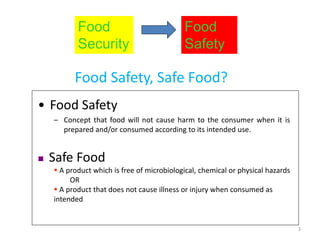
Food
Security
Food
Safety
Food Safety, Safe Food?
• Food Safety
– Concept that food will not cause harm to the consumer when it is
prepared and/or consumed according to its intended use.
 Safe Food
 A product which is free of microbiological, chemical or physical hazards
OR
 A product that does not cause illness or injury when consumed as
intended
3
Why Food Safety?
• Some of the reasons for concern about food
safety?
Changes in food habits
Food handling practices
Changing products, processes etc.
Globalization of trade in food
4
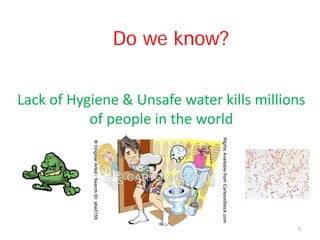
Lack of Hygiene & Unsafe water kills millions
of people in the world
Do we know?
5
What is Certification?
• It is a procedure for verifying that products
conform to certain standards, either
mandatory/compulsory or voluntarily.
• In the case of organic products, it is primarily
the acknowledgement that such products have
been produced according to the applicable
organic production standards.
6
Basic types of certification
• Mandatory or Compulsory (public)
When products are sold to mainstream domestic market or
exported, national governments & exporting countries normally
require standards & certification as part of food safety
regulations (e.g., MRLs on pesticides use,Product Traceability).
• Voluntary (private)
Decision to adhere to standards & apply for certification is
mainly a decision of the producing group for environmental,
social, cultural, food safety purposes.
7
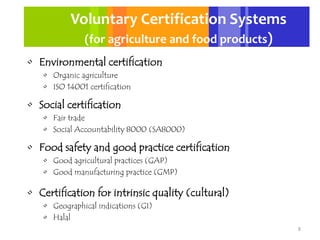
Voluntary Certification Systems
(for agriculture and food products)
• Environmental certification
• Organic agriculture
• ISO 14001 certification
• Social certification
• Fair trade
• Social Accountability 8000 (SA8000)
• Food safety and good practice certification
• Good agricultural practices (GAP)
• Good manufacturing practice (GMP)
• Certification for intrinsic quality (cultural)
• Geographical indications (GI)
• Halal
8
Global Food Safety Initiative
(GFSI)
Food retailers from around the world agreed to a
common goal and strategy.
 The Goal: Continuous improvement in food safety
management systems to ensure confidence in the
delivery of safe food to consumers
 The Strategy: GFSI launched in 2000
 GFSI is managed by CIES – The Food Business
Forum an international organization of food
businesses
9
GFSI Guidance Document
 Standard = Key Elements
 HACCP-Based Standards
 Food Safety Management System
 Best Practices
 Regulatory requirements
 Operation of certification process
 Accreditation
 Certification
 Auditing
10
Codex Alimentarius
• In Latin, Codex = Law, Alimentarius = Food
• Hence, it is a “Food Law Commisson”
• Set up by WHO & FAO in 1962:
– World Health Organization
– Food and Agricultural Organization
• Aim:
– To protect health of consumers worldwide
– To guide food industry in defining standards
– Promote harmonization of standards and facilitate
international trade
– Standards for labelling, nutritional labelling, and HACCP
guidelines drawn in 1981, 1983, and 1993 respectively
11
Codex Alimentarius
• A Statutory Regulatory Body under Ministry of Health & Family
Welfare, Government of India
• Constituted on 5 Sep 2008
• Mandate of laying down science based standards for articles of
food and to regulate their manufacture, storage, distribution,
sale and import to ensure availability of safe and wholesome
food for human consumption.
12
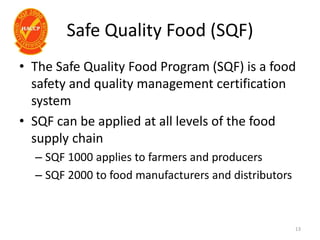
Safe Quality Food (SQF)
• The Safe Quality Food Program (SQF) is a food
safety and quality management certification
system
• SQF can be applied at all levels of the food
supply chain
– SQF 1000 applies to farmers and producers
– SQF 2000 to food manufacturers and distributors
13
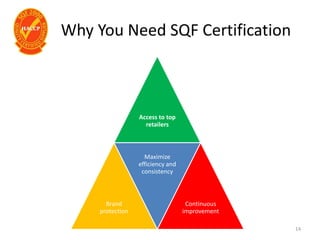
Why You Need SQF Certification
Access to top
retailers
Brand
protection
Maximize
efficiency and
consistency
Continuous
improvement
14
British Retail Consortium (BRC)
• The British Retail Consortium (or BRC) is one
of the leading trade associations in the UK
• They represent all forms of retailers from
small, independently owned stores, to big
chain stores and department stores.
• This standard is used as the benchmark for
food safety management.
15
BRC Global Standards
• The retailers, food producers, importers, caterers,
ingredient suppliers and the food service industry
can all benefit greatly from this standard.
• It is well known for its global standards in four
areas, producing much literature on these topics:
– Food safety
– Consumer products
– Packaging and packaging materials
– Storage and distribution
16
Benefits
• Enhances your food safety and food safety
management system
• Shows your commitment to producing safe food
• Achieves recognition and acceptance from the UK
retailer community
• Increases your customers product safety and
quality confidence
• Reduces the number of supplier
audits/assessments
17
International Food Safety (IFS)
• German and French food trade associations
created IFS.
• Benefits of the standard include enhanced
transparency along the food chain and a reduced
number of customer audits resulting in cost
savings.
• Certification to IFS by an independent third-party,
helps suppliers demonstrate to retailers that their
product safety, quality and legal obligations are
fulfilled.
18
Benefits
• commitment to supplying a safe quality food
product
• Enhances product assurance
• Minimizing product liability risks and recalls
• reduce both internal and external audit costs by
using one uniform standard
• raise your company's reputation, brand and
image
• Continuous improvement through ongoing
surveillance and corrective actions.
19
ISO 22000:2005
• ISO 22000 is an international standard ensures:
– worldwide safe food supply chains and
– provide a framework of internationally harmonised
requirements for the global approach that is needed.
• It implement the Codex Alimentarius HACCP
• Used by from farm to fork (all chain members)
• The standard can also be implemented solely for
the benefits it provides without certification of
conformity.
20
Benefits
 Applies to all organizations in the global food supply chain.
 System approach, rather than product approach.
 Resource optimization ? internally and along the food chain.
 All control measures subjected to hazard analysis.
 Improved documentation.
 Dynamic communication
 A systematic and proactive approach to identification of food
safety hazards and development and implementation of
control measures.
21
HACCP
• Hazard Analysis Critical Control Point
• History: Pillsbury and NASA. Well Aged.
• 2 Functions: Systematic Approach
• Define & Characterize Hazards,
• Identify Critical Control Points (CCP’s)
22
Benefits
• Enables you to demonstrate a commitment to food
safety
• Conveys a degree of confidence required by
consumers, retailers and buyers in the food industry
• Provides buyers, consumers, government
enforcement and trade agencies with justified
assurance that control systems are in place to assure
the safe production of food
• Regular assessments help to continually monitor
food safety system
23
Global GAP
• Developed in 1997 in EU under the title Europe GAP
• designed to reassure consumers about how food is
produced on the farm by :
– minimizing detrimental environmental impacts of farming
operations,
– reducing the use of chemical inputs and ensuring a responsible
approach to worker health and safety as well as
– animal welfare.
• GLOBAL GAP is a private sector body that sets voluntary
standards for the certification of agricultural products
around the globe.
• It is an equal partnership of agricultural producers and
retailers
24
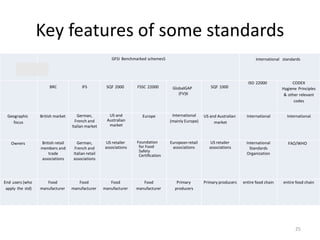
Key features of some standards
GFSI Benchmarked schemes5 International standards
BRC IFS SQF 2000 FSSC 22000 GlobalGAP
(FV)6
SQF 1000
ISO 22000 CODEX
Hygiene Principles
& other relevant
codes
Geographic
focus
British market German,
French and
Italian market
US and
Australian
market
Europe International
(mainly Europe)
US and Australian
market
International International
Owners British retail
members and
trade
associations
German,
French and
Italian retail
associations
US retailer
associations
Foundation
for Food
Safety
Certification
European retail
associations
US retailer
associations
International
Standards
Organization
FAO/WHO
End users (who
apply the std)
Food
manufacturer
Food
manufacturer
Food
manufacturer
Food
manufacturer
Primary
producers
Primary producers entire food chain entire food chain
25
Thank you!
26

Food safety standards and certifications

  • 1.
    Food Safety Standardsand certifications Sayed Mohammad Naim KHALID Technical Advisor at AARDO/CAARDO/SADA-O April 2013 Kabul, Afghanistan
  • 2.
    Contents 1. Food safetyvs. Safe food 2. Certification 3. GFSI 4. Codex Alimentarius 5. Safe Quality Food (SQF) 6. British Retail Consortium (BRC) 7. International Food Safety (IFS) 8. ISO 22000 9. HACCP 10. Global GAP 2
  • 3.
    Food Security Food Safety Food Safety, SafeFood? • Food Safety – Concept that food will not cause harm to the consumer when it is prepared and/or consumed according to its intended use.  Safe Food  A product which is free of microbiological, chemical or physical hazards OR  A product that does not cause illness or injury when consumed as intended 3
  • 4.
    Why Food Safety? •Some of the reasons for concern about food safety? Changes in food habits Food handling practices Changing products, processes etc. Globalization of trade in food 4
  • 5.
    Lack of Hygiene& Unsafe water kills millions of people in the world Do we know? 5
  • 6.
    What is Certification? •It is a procedure for verifying that products conform to certain standards, either mandatory/compulsory or voluntarily. • In the case of organic products, it is primarily the acknowledgement that such products have been produced according to the applicable organic production standards. 6
  • 7.
    Basic types ofcertification • Mandatory or Compulsory (public) When products are sold to mainstream domestic market or exported, national governments & exporting countries normally require standards & certification as part of food safety regulations (e.g., MRLs on pesticides use,Product Traceability). • Voluntary (private) Decision to adhere to standards & apply for certification is mainly a decision of the producing group for environmental, social, cultural, food safety purposes. 7
  • 8.
    Voluntary Certification Systems (foragriculture and food products) • Environmental certification • Organic agriculture • ISO 14001 certification • Social certification • Fair trade • Social Accountability 8000 (SA8000) • Food safety and good practice certification • Good agricultural practices (GAP) • Good manufacturing practice (GMP) • Certification for intrinsic quality (cultural) • Geographical indications (GI) • Halal 8
  • 9.
    Global Food SafetyInitiative (GFSI) Food retailers from around the world agreed to a common goal and strategy.  The Goal: Continuous improvement in food safety management systems to ensure confidence in the delivery of safe food to consumers  The Strategy: GFSI launched in 2000  GFSI is managed by CIES – The Food Business Forum an international organization of food businesses 9
  • 10.
    GFSI Guidance Document Standard = Key Elements  HACCP-Based Standards  Food Safety Management System  Best Practices  Regulatory requirements  Operation of certification process  Accreditation  Certification  Auditing 10
  • 11.
    Codex Alimentarius • InLatin, Codex = Law, Alimentarius = Food • Hence, it is a “Food Law Commisson” • Set up by WHO & FAO in 1962: – World Health Organization – Food and Agricultural Organization • Aim: – To protect health of consumers worldwide – To guide food industry in defining standards – Promote harmonization of standards and facilitate international trade – Standards for labelling, nutritional labelling, and HACCP guidelines drawn in 1981, 1983, and 1993 respectively 11
  • 12.
    Codex Alimentarius • AStatutory Regulatory Body under Ministry of Health & Family Welfare, Government of India • Constituted on 5 Sep 2008 • Mandate of laying down science based standards for articles of food and to regulate their manufacture, storage, distribution, sale and import to ensure availability of safe and wholesome food for human consumption. 12
  • 13.
    Safe Quality Food(SQF) • The Safe Quality Food Program (SQF) is a food safety and quality management certification system • SQF can be applied at all levels of the food supply chain – SQF 1000 applies to farmers and producers – SQF 2000 to food manufacturers and distributors 13
  • 14.
    Why You NeedSQF Certification Access to top retailers Brand protection Maximize efficiency and consistency Continuous improvement 14
  • 15.
    British Retail Consortium(BRC) • The British Retail Consortium (or BRC) is one of the leading trade associations in the UK • They represent all forms of retailers from small, independently owned stores, to big chain stores and department stores. • This standard is used as the benchmark for food safety management. 15
  • 16.
    BRC Global Standards •The retailers, food producers, importers, caterers, ingredient suppliers and the food service industry can all benefit greatly from this standard. • It is well known for its global standards in four areas, producing much literature on these topics: – Food safety – Consumer products – Packaging and packaging materials – Storage and distribution 16
  • 17.
    Benefits • Enhances yourfood safety and food safety management system • Shows your commitment to producing safe food • Achieves recognition and acceptance from the UK retailer community • Increases your customers product safety and quality confidence • Reduces the number of supplier audits/assessments 17
  • 18.
    International Food Safety(IFS) • German and French food trade associations created IFS. • Benefits of the standard include enhanced transparency along the food chain and a reduced number of customer audits resulting in cost savings. • Certification to IFS by an independent third-party, helps suppliers demonstrate to retailers that their product safety, quality and legal obligations are fulfilled. 18
  • 19.
    Benefits • commitment tosupplying a safe quality food product • Enhances product assurance • Minimizing product liability risks and recalls • reduce both internal and external audit costs by using one uniform standard • raise your company's reputation, brand and image • Continuous improvement through ongoing surveillance and corrective actions. 19
  • 20.
    ISO 22000:2005 • ISO22000 is an international standard ensures: – worldwide safe food supply chains and – provide a framework of internationally harmonised requirements for the global approach that is needed. • It implement the Codex Alimentarius HACCP • Used by from farm to fork (all chain members) • The standard can also be implemented solely for the benefits it provides without certification of conformity. 20
  • 21.
    Benefits  Applies toall organizations in the global food supply chain.  System approach, rather than product approach.  Resource optimization ? internally and along the food chain.  All control measures subjected to hazard analysis.  Improved documentation.  Dynamic communication  A systematic and proactive approach to identification of food safety hazards and development and implementation of control measures. 21
  • 22.
    HACCP • Hazard AnalysisCritical Control Point • History: Pillsbury and NASA. Well Aged. • 2 Functions: Systematic Approach • Define & Characterize Hazards, • Identify Critical Control Points (CCP’s) 22
  • 23.
    Benefits • Enables youto demonstrate a commitment to food safety • Conveys a degree of confidence required by consumers, retailers and buyers in the food industry • Provides buyers, consumers, government enforcement and trade agencies with justified assurance that control systems are in place to assure the safe production of food • Regular assessments help to continually monitor food safety system 23
  • 24.
    Global GAP • Developedin 1997 in EU under the title Europe GAP • designed to reassure consumers about how food is produced on the farm by : – minimizing detrimental environmental impacts of farming operations, – reducing the use of chemical inputs and ensuring a responsible approach to worker health and safety as well as – animal welfare. • GLOBAL GAP is a private sector body that sets voluntary standards for the certification of agricultural products around the globe. • It is an equal partnership of agricultural producers and retailers 24
  • 25.
    Key features ofsome standards GFSI Benchmarked schemes5 International standards BRC IFS SQF 2000 FSSC 22000 GlobalGAP (FV)6 SQF 1000 ISO 22000 CODEX Hygiene Principles & other relevant codes Geographic focus British market German, French and Italian market US and Australian market Europe International (mainly Europe) US and Australian market International International Owners British retail members and trade associations German, French and Italian retail associations US retailer associations Foundation for Food Safety Certification European retail associations US retailer associations International Standards Organization FAO/WHO End users (who apply the std) Food manufacturer Food manufacturer Food manufacturer Food manufacturer Primary producers Primary producers entire food chain entire food chain 25
  • 26.