MODULE 2
Quality management
 Survival of the fittest
 Todays market quality is the watch word for any manufacture.
 If prescribed quality is absent in the product, it will not be accepted by the
customer.
 ISO – international standards organization
 A single standard for operations and management of quality assurance.
 TQM- total quality Management
QUALITY
 Degree of excellence.
 Quality is fitness for use.
 Quality is conformance to requirements or specification.
 Quality is what customer says it is.
 Quality is defect free production through prevention rather than
detection.
 Quality is the totality of features and characteristic of product in
satisfying customer needs and expectations on a continues basis in
fact to delight the customer.
DIMNESIONS OR REQUIREMENTS OF QUALITY
1. Suitability
2. Durability
3. Dependability
4. Safe workability
5. Affordability
6. Applicability
7. Value for money
QUALITY PLANNING
 It is the process of establishing quality objectives and
developing means for meeting those objectives.
 Planning quality of service or production which give
customer satisfaction.
 The steps involved are
1. Identification of customer
2. Discovering customer needs
3. Translate customer needs into suppliers language.
4. Develop product that meet customers needs.
5. Optimize product design
6. Develop the process
Objectives of quality planning
 To produce the quality and services which meet the customer
needs.
 To define quality standards and prepare product specifications
 To prepare guidelines on various elements affecting quality.
 To establish quality objectives and developing plans for
achieving these objectives.
 To have quality assurance system in every functional group of
the organization.
 To evaluate product design with a view to improve quality and
reduce quality costs.
 To develop quality control techniques.
 To develop a basis for TQM culture.
 To create an excellent operating culture in the organization
Process of quality planning
1. Identification of customers
2. Discovering customer needs
3. Translate customer need into suppliers language.
4. Develop the product according to customer needs
5. Optimize product design
6. Develop the process
7. Transfer to operations
 Three prong approach to quality planning
1. Product planning
 Evaluation of the range, mix , specification and pricing of
existing and new products in relation to present and future
market requirements and competition.
2. Managerial and operational planning
1. Preparing organization structure
2. Preparing organizational procedure.
3. Preparing process
4. Preparation of resources needed to implement quality
management
3. Preparation of quality plan and making provision for
quality improvement.(Documentation)
Quality management system
 It is as defined as a management system to direct and control an
organization with regard to quality.
 A system to establish quality policy and quality objectives and to
achieve those objectives.
CONCEPT AND ROLE OF ISO 9000
 ISO stands for International organization for standardization,
is founded in 1946
 With the objective of promotion and development of
international standards and related activities, including
conformity assessments such as testing, inspection, laboratory
accreditation, certification and quality assessments for
facilitating international exchange of goods and service.
 ISO 9000 is a family of standards for quality management
systems.
 ISO HQ is at Geneva
 India is a member of ISO
 In 1987, ISO released the ISO 9000 series of standards.
 Its equivalent Standards in the Indian context is the Bureau of
Indian standards (BIS) 14000 series.
 ISO is a published document outlining the
specification ,features, characteristics and requirements
to be met by every operation, fictional Ares ,procedure
and every where in an organization.
 It explains the guide lines for excellent operating culture
in the organization.
 It ensures safety to personnel who will use the product or
service.
 It promotes interchangeability of products as well as its
constituent parts.
 ISO 9000 is a family of standards for quality management
systems, maintained by ISO.
 ISO 9000 applied in sectors like engineering, process
sectors, education sector, automotive sector and software
sector.
ELEMENTS OF ISO 9000
1. Management responsibility. 11. control of non conformity product
2. Quality systems 12. corrective action
3. Control review 13.Handling,storage , packaging and delivery
4. Design control 14. quality records
5. Document control 15. international quality audits
6. Purchasing 16.training
7. Product identification and traceability 17. servicing
8. Process control
9. Inspection and testing
10. Inspection, measuring and test equipment's
STEPS FOR INSTALATION OF ISO 9000
1. Preparatory steps
2. Implementation steps
3. Registration and certification steps
1. Preparatory steps
1. Quality awareness training
2. Task force should be established at three levels to prepare necessary
quality documents.
1. Top management group : Quality policy/ Quality manual
2. Department heads : Quality procedure
3. Junior level executives : Work instructions / drawings.
3. Analyze the existing practices and procedures and the corrective
actions or procedures to be implemented.
4. Quality policies, procedures, quality records, work instructions, test
and of calibration records should be documented in a systematic and
orderly manner.
5. Design and develop standard procedure of manufacturing.
2. IMPLIMENTATION STEP
 Implementing the documented quality systems into
practice in the organization.
 Quality system should be internally audited and evaluated
on regular basis, to determine whether these are effective
in achieving stated quality objectives.
 A third party audit is carried out by an independent body
to establish the extend to which an organization meets the
requirements of an applicable standards.
 Normal, third part is sure a certification of registration.
 Conduct pre registration
3. Registration and certification step
 Apply for registration
 Certification body will conduct an adequacy audit and
compliance audit.
 The certification body will issue a certificate.
BENEFITS OF ISO 9000
 ISO 9000 provides a competitive edge in the domestic
and global markets.
 It provides a climate for consistent improvement in
quality.
 It reduces wastage and repairs – enhancing profits in
turn.
 It maintains streamlined records.
 It maintains streamlined material handling and storage.
 It changes the attitude of workers.
 It gives international recognition.
 Increasing number of customers
QUALITY AUDIT
 It is defined as “ A systematic and independent
examination, to determine whether quality objectives are
as per the plans, and whether these plans are
implemented effectively in achieving quality objectives,
with the maintenance of quality standards”
OBJECTIVES OF QUALITY AUDIT
1. To study the quality of the existing systems and find out
the non conformity with the quality systems.
2. To suggest the corrections to be done in different areas
and operations.
3. To propose and implement methods as per ISO standards.
4. To evaluate a supplier before entering contract with him.
5. To suggest best procedure and practices.
6. To reduce the loss of money due to duplication of
activities, high repairs, high scraps and so on.
TYPES OF AUDIT
 Adequacy audit : Documentation review
 Compliance audit : Implementation or effectiveness audit.
 System audit : It evaluates the quality aspects of various
systems in the organization.
 Product audit : It evaluates or examines the acceptance
level of finished products made by the inspection and
testing department.
 First party audit : Internal audit.
 Second party audit : Conducted by parties having an
interest in the organization.
 Third party audit : Conducted by independent external
organization.
TOTAL QUALITY MANAGEMENT
 TQM is a cost effective system for integrating continuous
quality improvement efforts of people at all levels in an
organization, to deliver products and services which ensure
customer satisfaction.
 TQM means quality in every aspect of company’s operation.
 TQM involves effective decision making, problem solving,
quality planning, quality implementation and quality
improvement strategies of all departments.
 TQM involves consideration of all major areas of production
activities as engineering design development, sales ,
marketing, information system, purchasing services,
distribution etc.
 TQM aims at zero defects and customer satisfaction
with increased profits.
 TQM involves due consideration of the following:
1. An internal environment conductive to quality
improvement at all levels.
2. The commitment of management on optimizing
systems/methods and training of workers.
3. Component consultancy guidance.
4. Availability of facilities for continuing education of
the staff.
FEATURES OF TQM
 Customer –focused
 The customer determines the level of quality
 Integrating customer needs into the design process improves the
quality
 Total employee involvement
 All employees participate in working towards common goals.
 Quality system
 A critical part of the quality management is the strategic and
systematic approach to achieving an organizations vision , mission
and goals.
 Continuous improvement
 A large aspect of TQM is continuous improvement.
TEN MANTHRAS OF TQM
 Quality is through continuous involvement and
effort.
 Quality involves hard work and devotion.
 Quality is everybody's work.
 Quality begins cleanliness of work piece.
 Take care of quality and quality will take care
everything
 Make it right for first time and time
 Quality is achieved through team work.
 Document is dependable, but not memory
 Quality begins with education.
 Quality used to evaluate product and services.
LINK BETWEEN ISO 9000 AND TQM
 TQM is a mechanism to change the culture of the
company to achieve its goals.
 ISO certification facilitates this change. Thus ISO may be
called as subset of TQM.
 ISO 9000 is and is just beginning a quality management
system and is just beginning of TQM process.
 TQM= ISO 9000+ Total involvement + Focus on
customers+ Continuous improvement management
commitment and involvement.
VISION, MISSION AND QUALITY POLICY
 Vision : it can be described as desired future
position of company.
 E.g.; within next 5 year, company will take one fourth
of the market.
 Mission : it describes company's objectives and
approaches to reach its goals.
 By expanding production of dress we will achieve the
one fourth of the market.
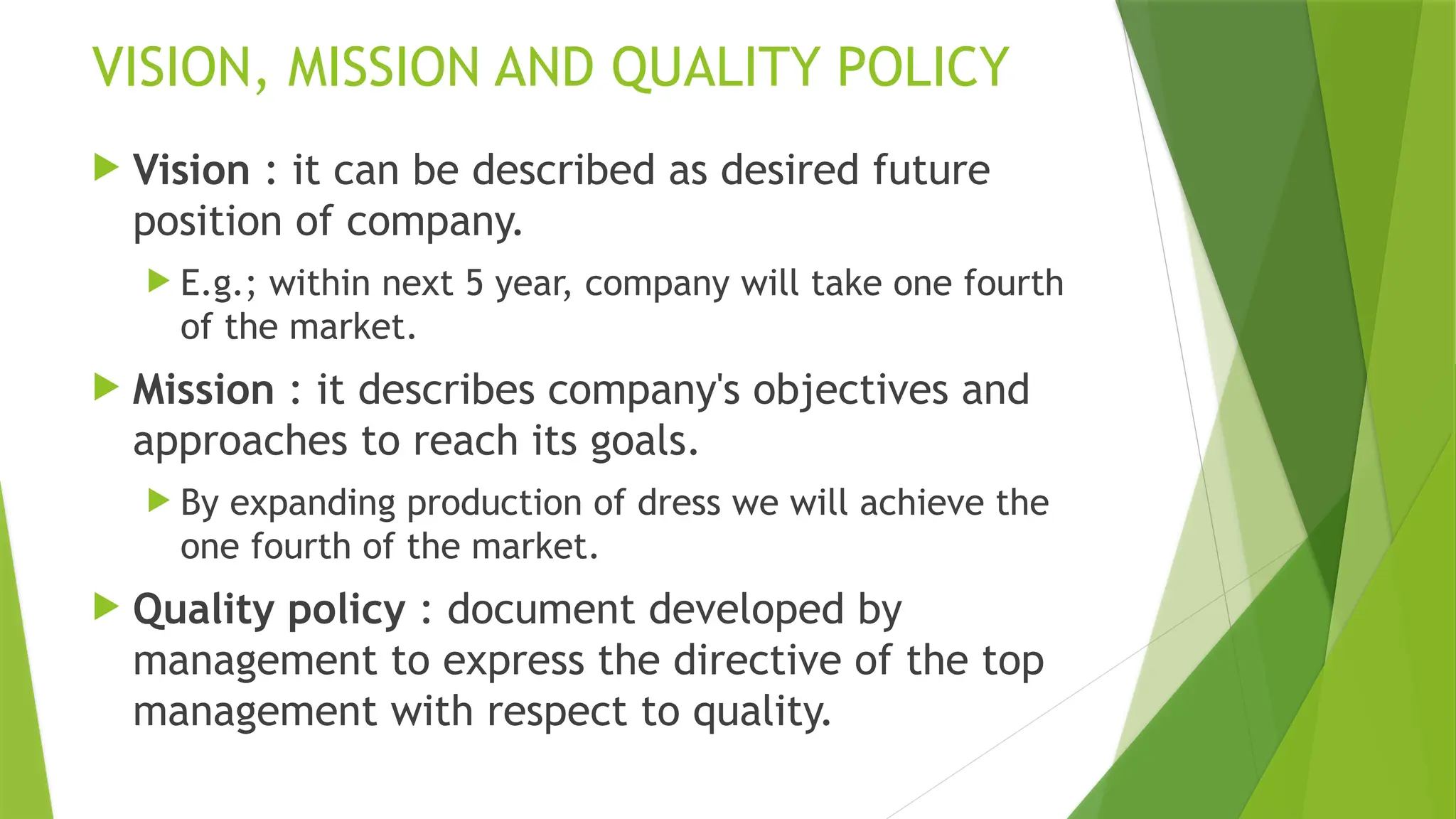
 Quality policy : document developed by
management to express the directive of the top
management with respect to quality.
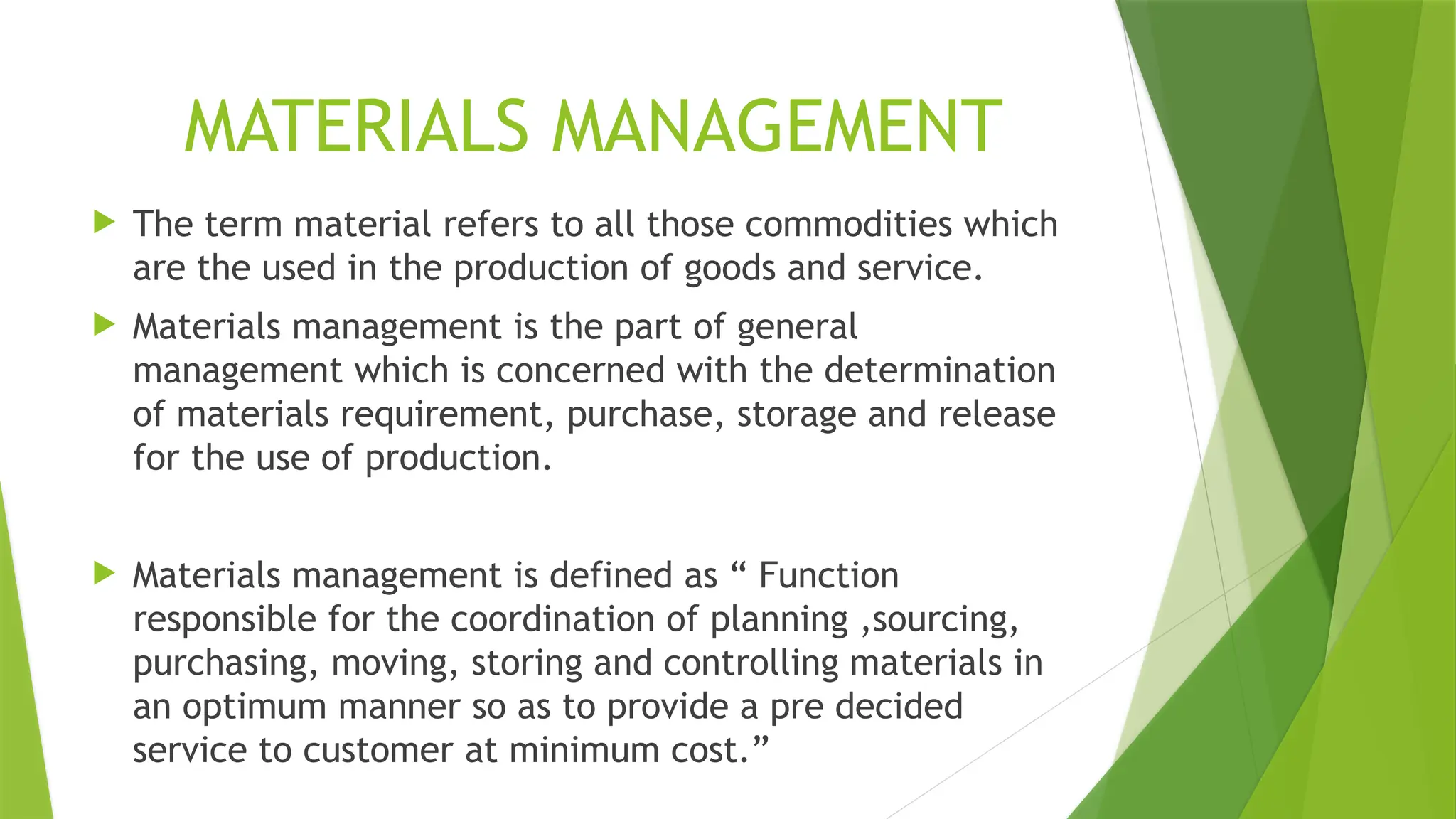
MATERIALS MANAGEMENT
 The term material refers to all those commodities which
are the used in the production of goods and service.
 Materials management is the part of general
management which is concerned with the determination
of materials requirement, purchase, storage and release
for the use of production.
 Materials management is defined as “ Function
responsible for the coordination of planning ,sourcing,
purchasing, moving, storing and controlling materials in
an optimum manner so as to provide a pre decided
service to customer at minimum cost.”
Functions of material management
 Material planning
 Procurement or purchasing of material.
 Receiving and warehousing.
 Storage and store administration
 Inventory control
 External transportation and internal
transportation.
 Disposal of scrap, surplus and obsolete
materials.
PURCHASE DEPARTMENT
 In any industry before starting the process of
production, the prime requirements is to procure
raw materials, machinery and tools that go into
the production and other materials require for the
maintenance work.
 Maximum savings in purchase results more profits.
 Small industries – Superintendent
 Large industries – Purchase department
Objectives of purchasing department
1. To maintain regular flow of materials.
2. To purchase at a competitive price the right
quality, in right quantity and at a right time from
right source.
3. To ensure higher productivity.
4. To ensure the production of a better quality
production at a competitive cost.
5. To act for standardization, variety reduction and
value analysis.
6. To ensure a better margin of profit.
Functions of purchasing department
1. Maintain records of available and reliable suppliers and prices of
materials.
2. To prepare and update list of materials required by different
departments of the organization within a specified span of time.
3. Place and follow up purchase orders.
4. Maintain records of all purchases.
5. To make sure through inspection that right kind of material has been
purchased.
6. To check , if the material has been purchased at the right time and
economical rates.
7. To prepare purchasing budget.
8. To ensure that prompt payments are made to the suppliers in the
interest of good public relations.
Methods of purchasing techniques
1. Purchasing by requirements.
2. Purchasing for a specific future period.
3. Market purchasing.
4. Speculative purchasing.
5. Contact purchasing
6. Central purchase organization
7. Through directorate general of suppliers and
disposal.
1. Purchasing by requirements
 The required quantity of materials for any particular
job are purchased, when the job is in hand.
 This method is suitable for the industries , having less
working capital.
Advantages Disadvantages
The market fluctuations will
not affect as costing is based
on the market rates.
The selling price will be
higher.
Small storage space will be
required.
Profits are limited since the
orders are for small
quantities.
Less inventory carrying cost Sudden demands cant be
met.
Bargaining cannot be had due
to the small amount
involved.
2. Purchasing for a specific future period
 The materials are purchased in bulk for specific
future period to maintain the flow of production
 The standard items which are in regular use are
purchased by this method.
Advantages Disadvantages
As the order is received,
production can at once be
started
This cannot be adopted for
large scale industries.
The market fluctuations will
not affect to a small size.
The involved working capital
will be less.
Less storage space is
needed.
Cost analysis is easier
3. Market purchasing
When the raw materials are available at low
price , they are purchased in bulk quantities ,
to get greater margin of profit in finished
goods.
This is suitable in case of goods involving major
fluctuations.
Advantages Disadvantages
As purchasing is done in lot,
distribution cost is less.
Large space is required
Production will be
continues.
If the market topples, there
is big loss.
Bargaining power will be
more due to bulk purchase.
Capital requirement is
more.
4. Speculative purchasing
 The are made note according to requirement, but they
are made with a view that there will be a greater
demand for the product in future.
 Purchase are made in excess of actual requirements.
 This is not a scientific method.
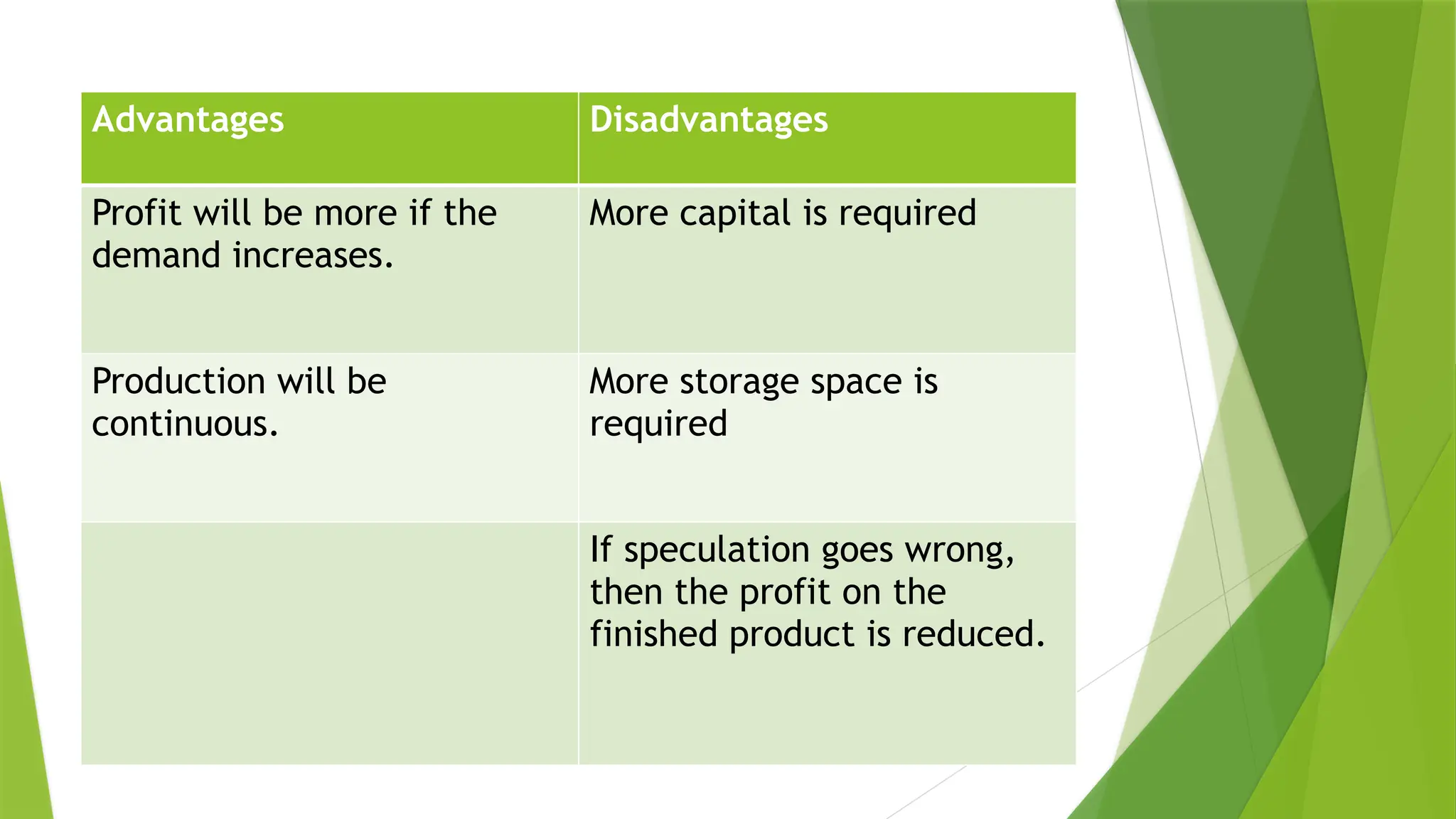
Advantages Disadvantages
Profit will be more if the
demand increases.
More capital is required
Production will be
continuous.
More storage space is
required
If speculation goes wrong,
then the profit on the
finished product is reduced.
5. Contract purchasing
 Contracts are given to suppliers for large amounts of
future requirements, for certain period, subject to
review and cancellation with an appropriate period of
notice.
 While calling quotations, the approximate quantity and
time etc. are specified.
Advantages Disadvantages
It avoids necessity for keeping
stocks
The supply may not be regular , as
it is out of control of production
department.
The purchase is not affected by
market fluctuations and supply
ensured.
Normally during the period of
contract ,there is no change in
price rate.
The purchase department is
relieved from the routine work.
6. Central purchase organization
 Central purchase organization makes the direct
dealings with the manufactures and distributes the
material to section wise stores.
Advantages Disadvantages
A strict control and check is possible.
There fore there will be a little chance
of malpractice.
There may be a delay in getting
materials from the central store to the
sectional stores.
It can have direct dealings with the
manufacture can get things as per
specification.
When the central store makes a
purchase, it is on large scale , naturally
it can obtain a good bargain.
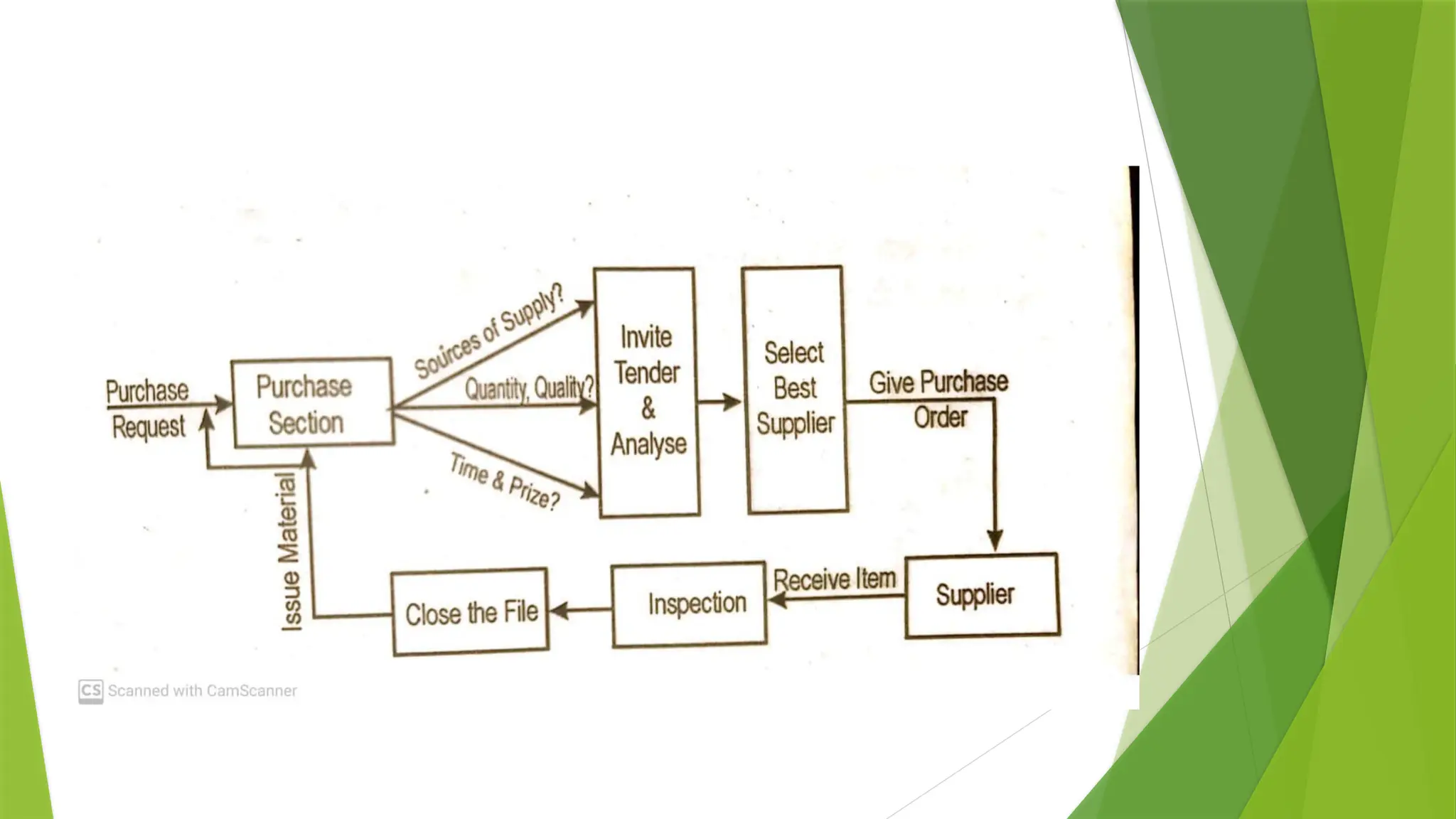
Purchase procedure
1. Purchase requisition.
2. Selection of possible source of supply.
3. Determining the time, price, quality and quantity.
4. Making request for quotation.
5. Receipt and analysis of quotations.
6. Selection of right source of supply.
7. Placing purchase order.
8. Following up and expediting of the order.
9. Inspection
10.Checking and approving venders invoices for payment.
11.Closing completed records.
12.Maintenance of records and files.
1. Purchase requisition
 The various department of organization communicate
their requirements for various items to purchase
department through requisition form.
 It includes
 What is the material required
 Quantity required
 Date by which material needed
 Place of delivery
 Name of suggested supplier.
2. Selection of possible source of supply.
 The process consists of selecting a fair number of
suppliers through authorized representatives,
catalogues, advertisements, trade journals etc.
 The criterion for ultimate choice of a vendor is also
based on the following factor
 Reliability of supply
 Assurance of timely delivery of goods.
 Other considerations like after sales service, attitude towards
goods rejected by purchaser,
 Technical assistance in and after installation.
3. Determining the Time, Price , Quantity
 When the item is required
 What is the approximate price?
 How many quantity is required
 Product quality required.
4. Request, Receipt and analysis of quotations
 Request for quotation is made on prescribed quotation form.
 After receiving all the quotations a comparative statement is
prepared.
 Quotation or tender is an enquiry to know whether the suppler
can supply the desired material by the specified rate under
specified conditions and if yes then at what rate.
 Single tender : tender with whom they are already in contract
and rates are fixed by mutual acceptance.
 Close tender : the tenders are invited from limited firms, hence
also called limited tender.
 Open tender : all the interested firms can apply for the tender.
 Earnest money deposit
 When a group of persons submits the tender they have
to submit some amount called Earnest money deposit
(EMD).
 It may be some lump sum amount or may be some
percentage of the total contract value.
 It was introduced to check the seriousness of the
tenderer.
 The EMD amount will be return back to unsuccessful .
 For the successful tenderer it will be return back after
completing the project or submitting security deposit.
5. Selection of right source of supply and placing purchasing order
 After selecting the right vendor a purchase order is send to him which
is the supplier authority for delivery of materials.
 Once purchase order accepted, establish a contract for delivery.
 Following up and expediting the purchase
order.
 Verification of suppliers invoice for
payments
 Closing completed order and maintenance
of records.
INVENTORY
 It is a detailed list of movable goods such as raw
materials, materials in process, finished products,
general supplies and equipment's, which are
necessary to manufacture a product and to
maintain the equipment and machinery in good
working order.
 The quantity and value of every items is also
mentioned in the list.
INVENTORY CONTROL
 Techniques of maintaining inventories at
appropriate level is known as inventory control.
 Scientific method of finding out how much stock
should be maintained in order to meet the
production demands and able to provide right
type material at right time in right quantities.
INVENTORY CONTROL TECHNIQUES
1. ABC analysis or selective control analysis
2. Economic order quantity (EOQ) model
3. System of reordering
ECONOMIC ORDER QUANTITY
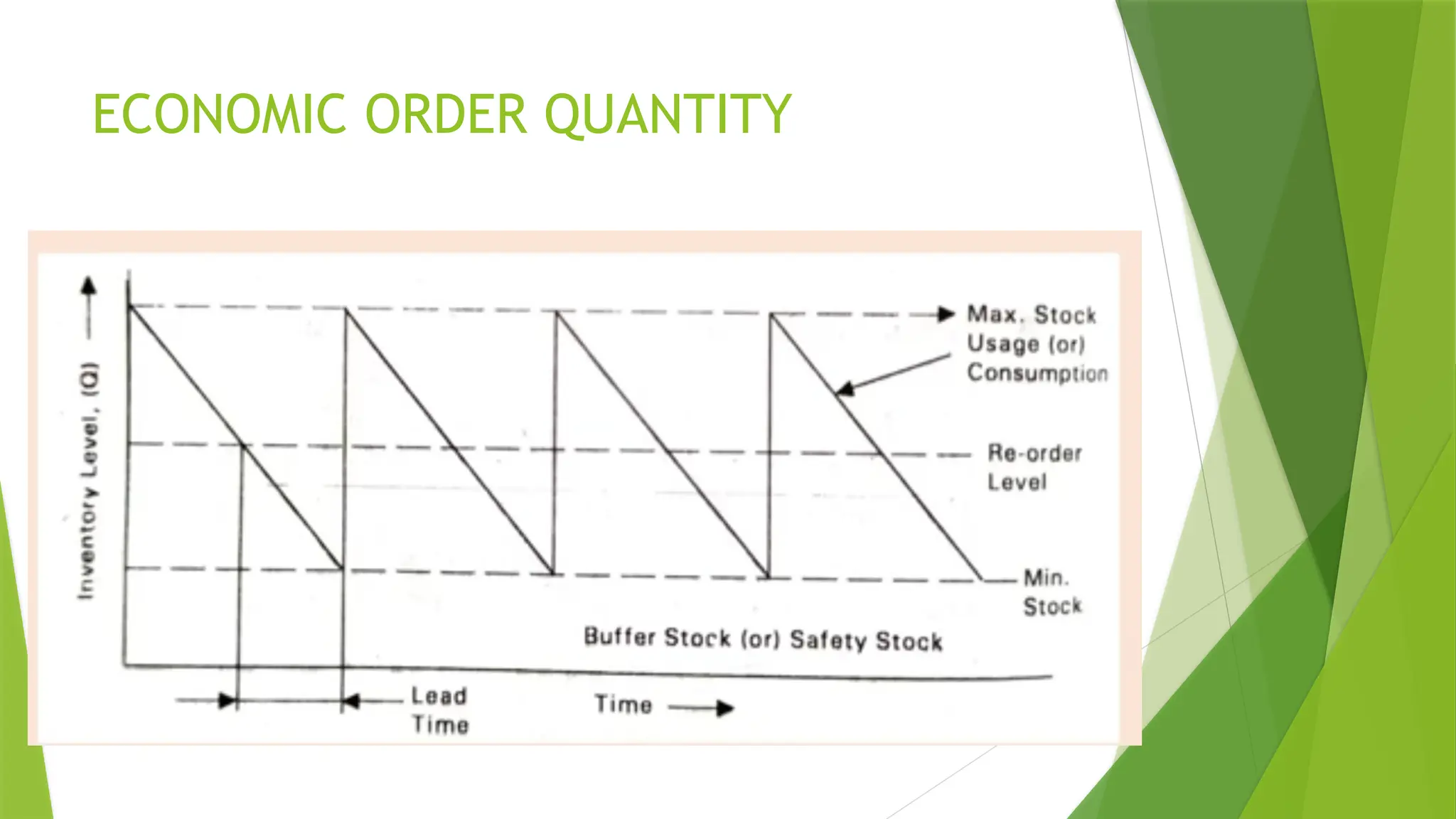
 Maximum stock
 Minimum stock
 Standard order : it is the difference between
maximum and minimum quantity.
 Reorder point : the level of material, at which a
new order for the requirement of EOQ is placed.
 Lead time : it is the time taken by the material
after placing the order and receiving the material.
 Buffer stock : it is the stock which is not usually
consumed in normal circumstances.
 Cycle time : it is the time between two successive
order.
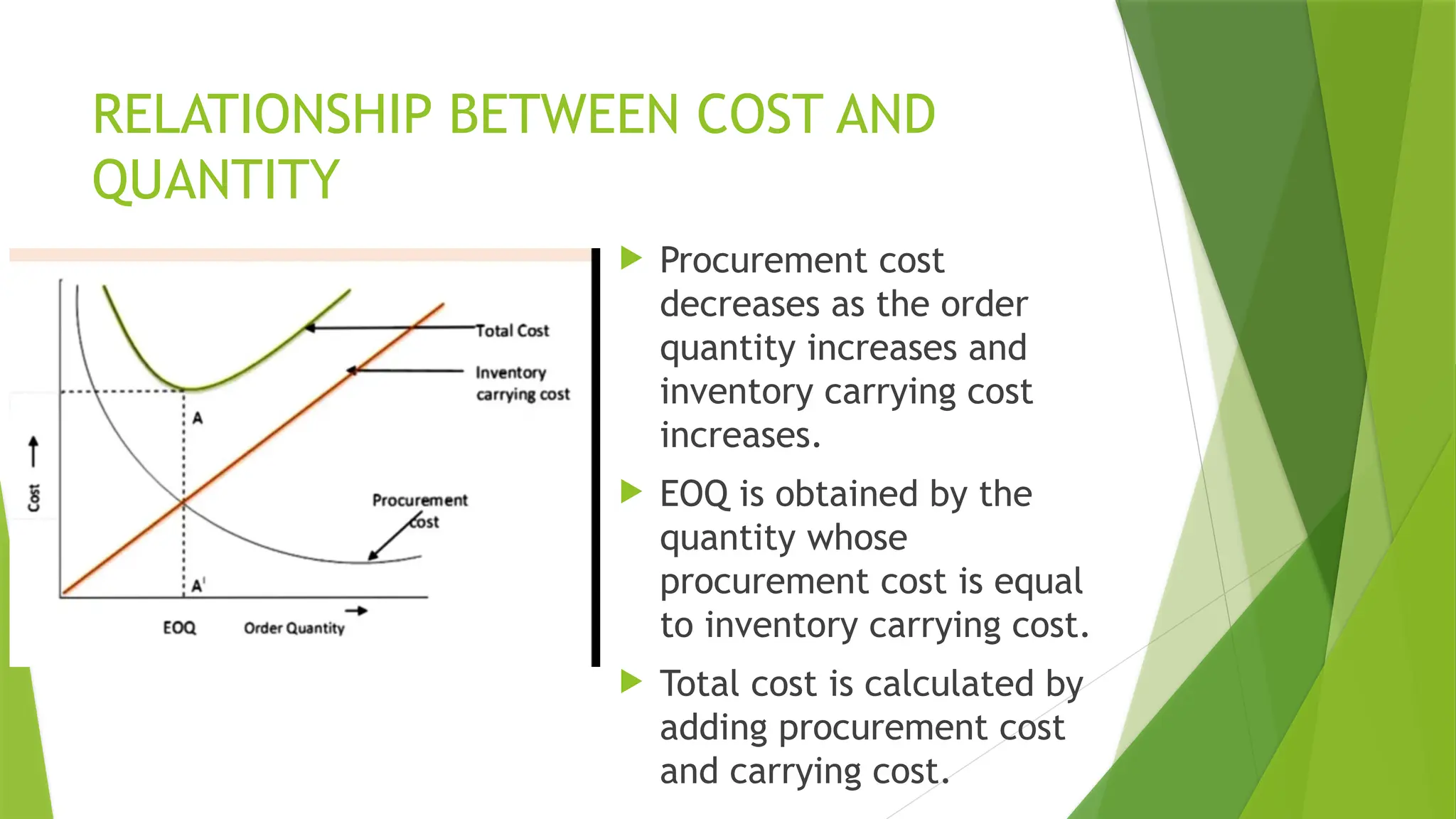
 The economic order quantity depends on two types of cost
 Procurement cost
 Inventory carrying cost
RELATIONSHIP BETWEEN COST AND
QUANTITY
 Procurement cost
decreases as the order
quantity increases and
inventory carrying cost
increases.
 EOQ is obtained by the
quantity whose
procurement cost is equal
to inventory carrying cost.
 Total cost is calculated by
adding procurement cost
and carrying cost.
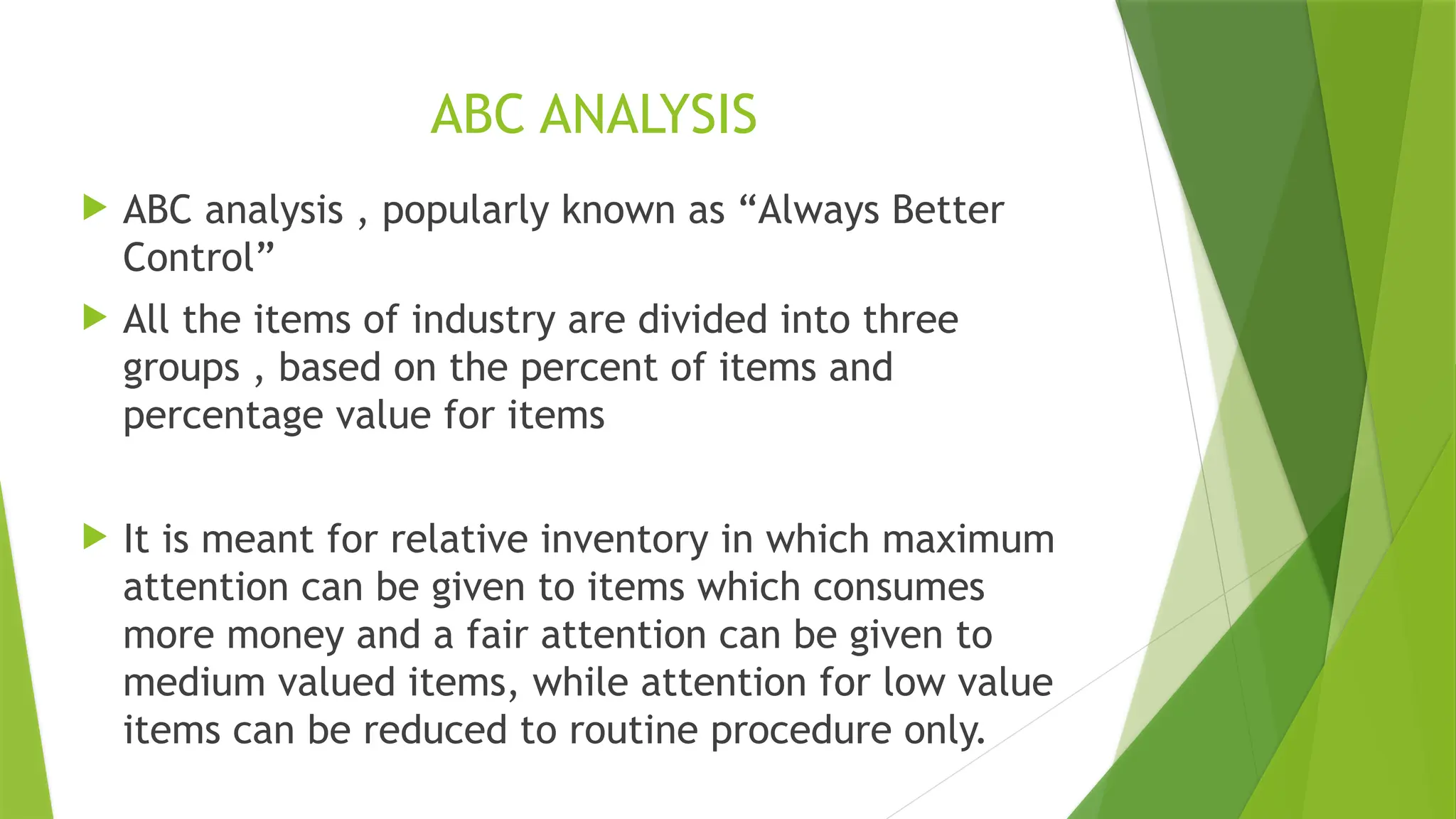
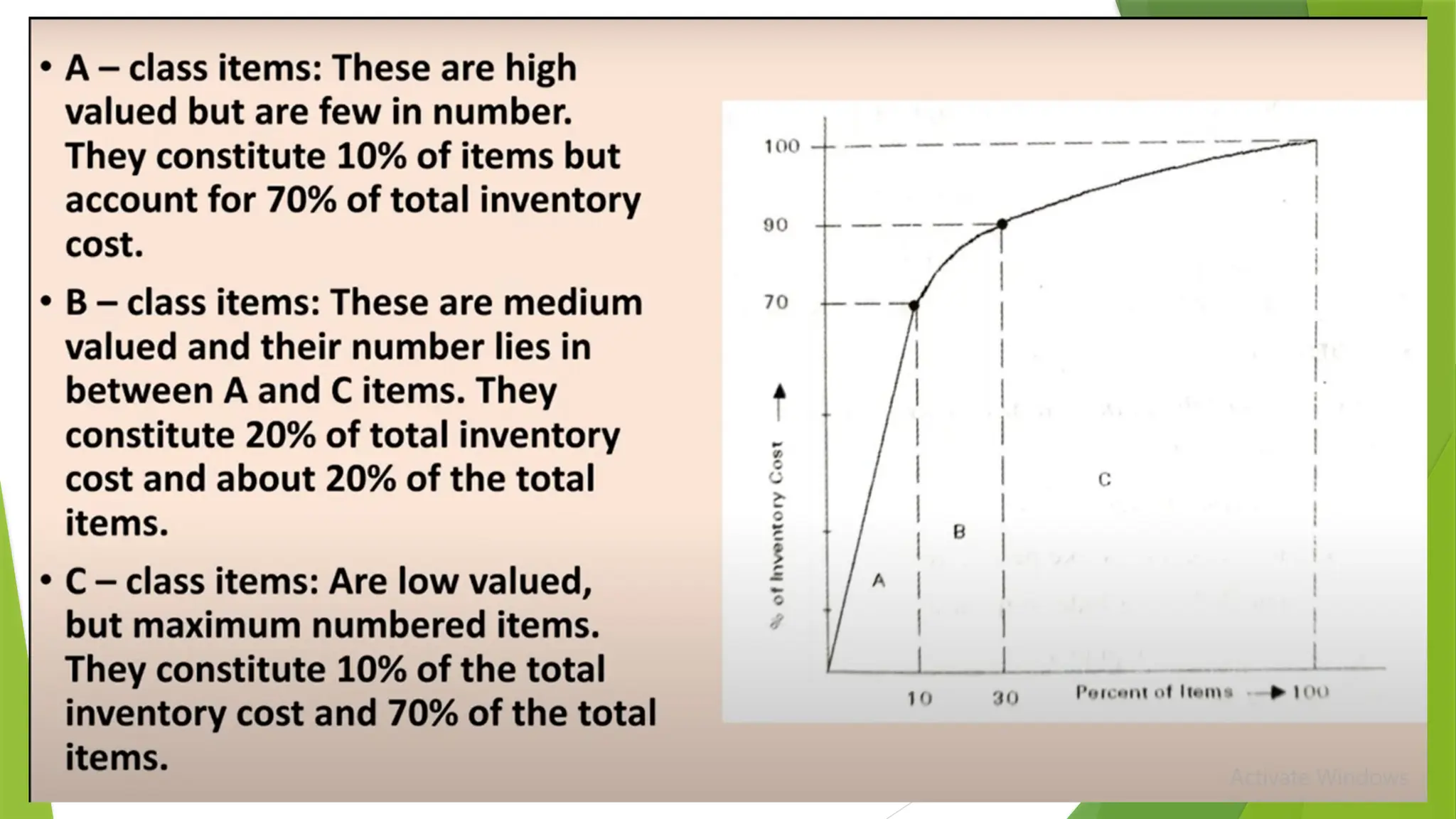
ABC ANALYSIS
 ABC analysis , popularly known as “Always Better
Control”
 All the items of industry are divided into three
groups , based on the percent of items and
percentage value for items
 It is meant for relative inventory in which maximum
attention can be given to items which consumes
more money and a fair attention can be given to
medium valued items, while attention for low value
items can be reduced to routine procedure only.
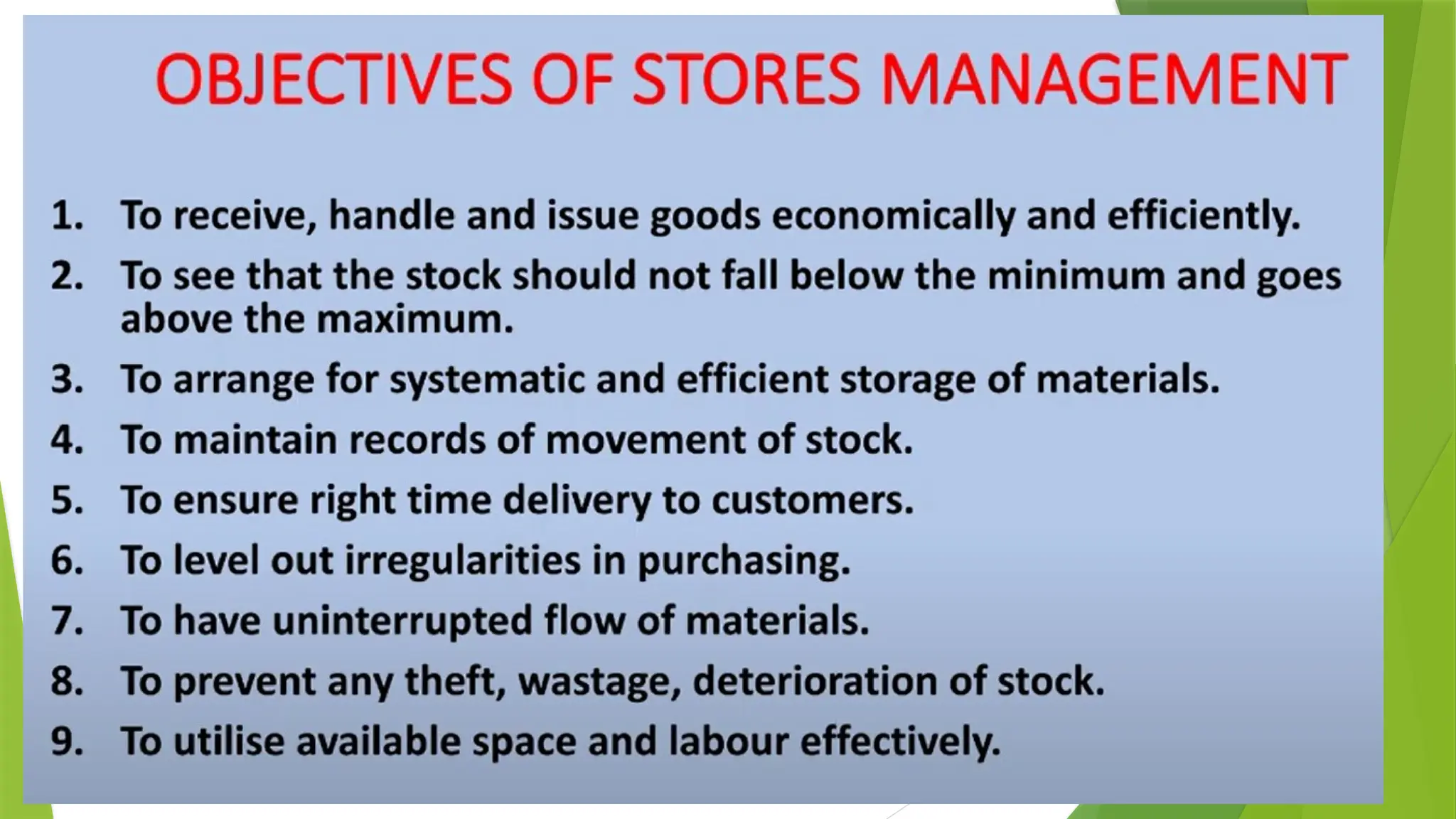
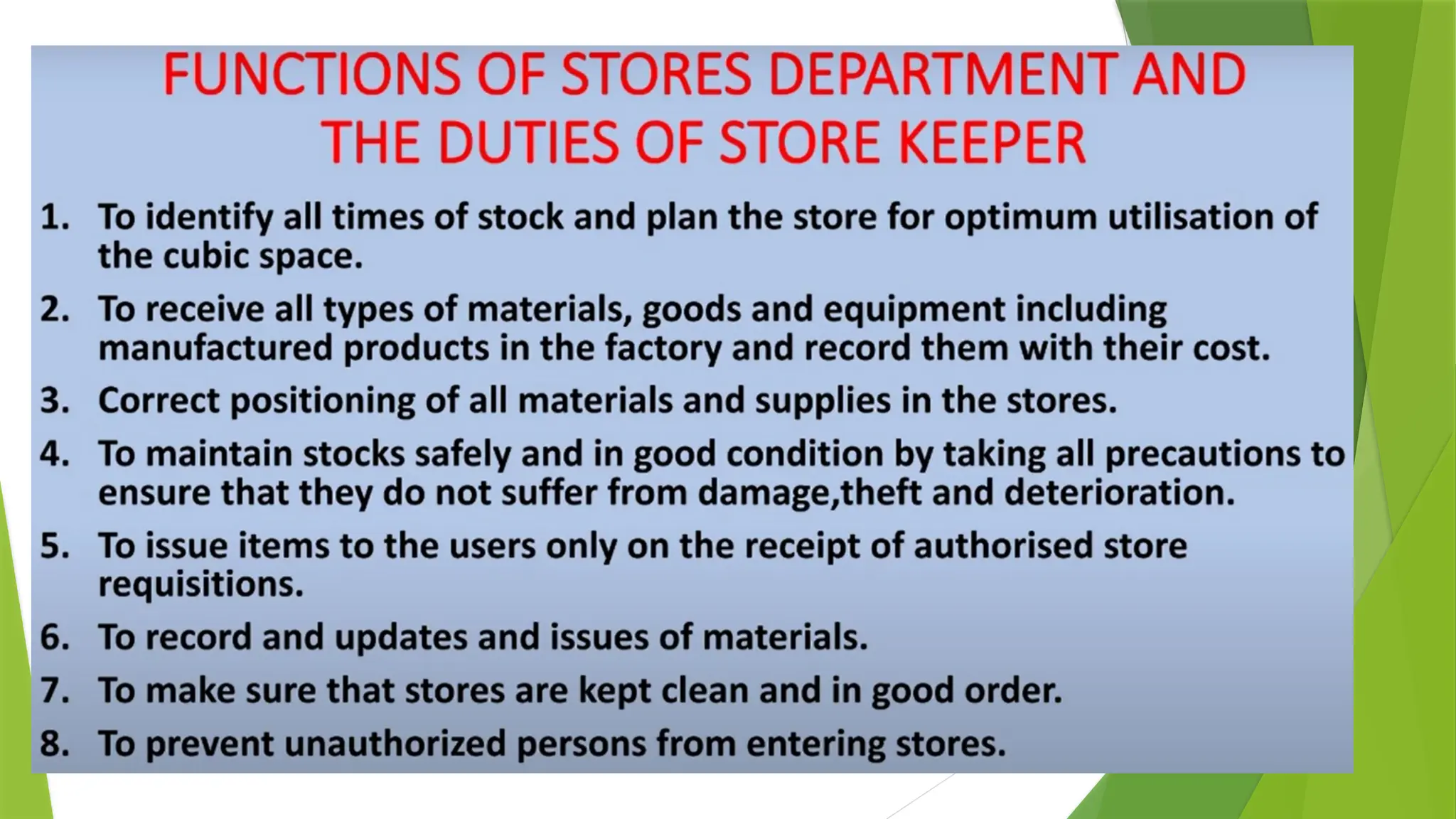
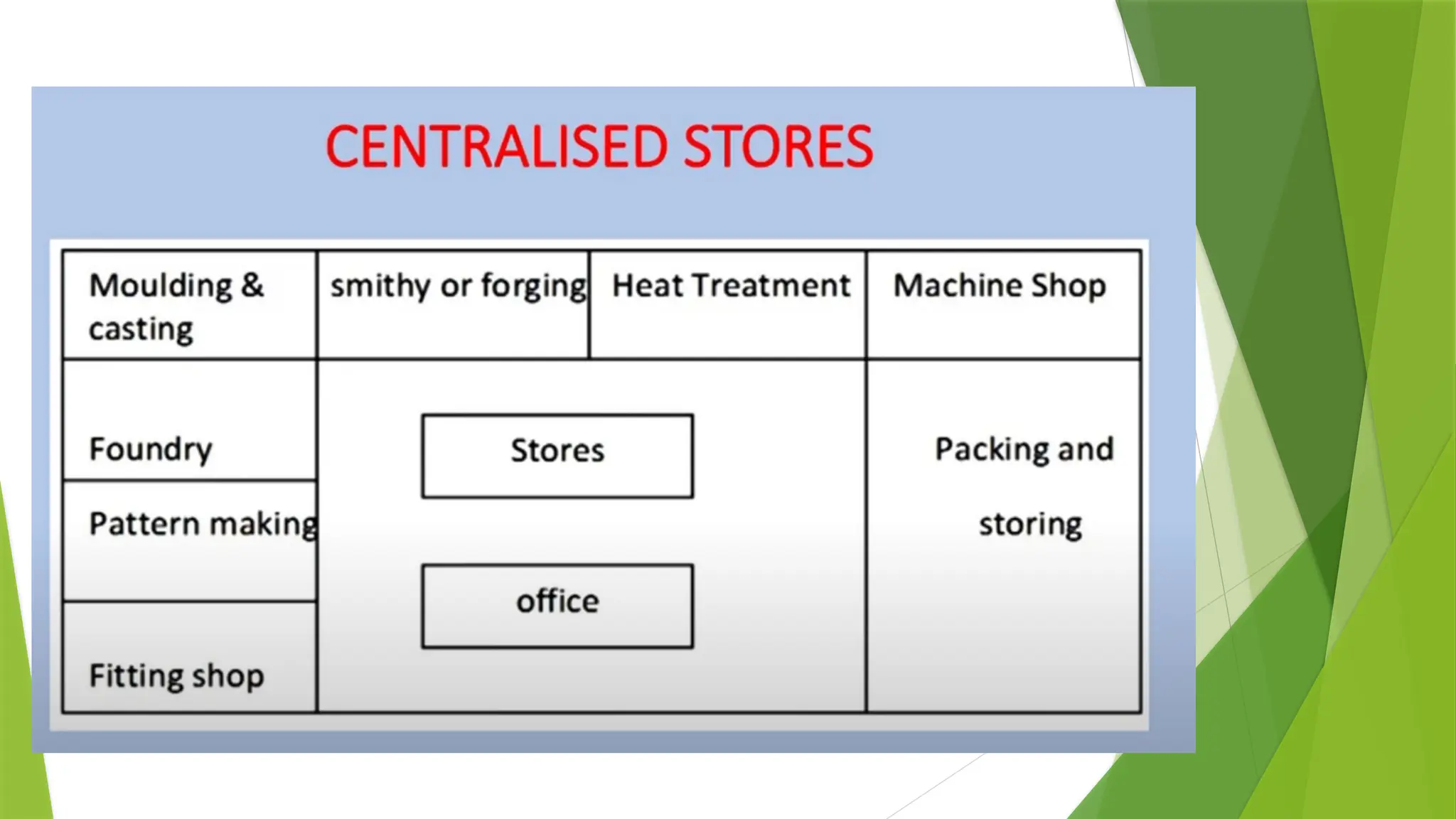
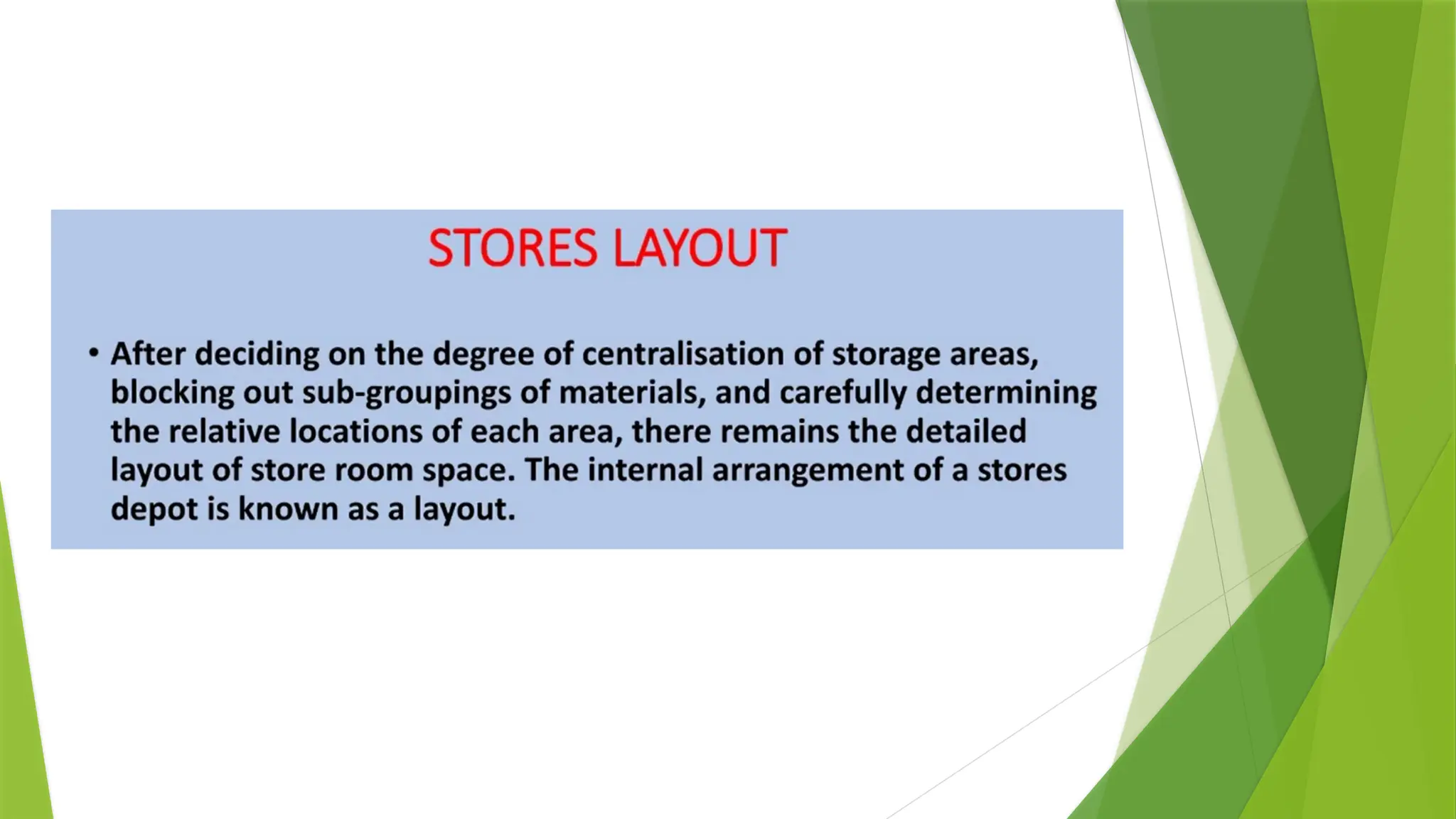
STORE MANAGEMENT
THANK YOU

MODULE 2.pptxvbbbnnffgdrfzzxxdfgghjjjjjj

  • 1.
  • 2.
    Quality management  Survivalof the fittest  Todays market quality is the watch word for any manufacture.  If prescribed quality is absent in the product, it will not be accepted by the customer.  ISO – international standards organization  A single standard for operations and management of quality assurance.  TQM- total quality Management
  • 3.
    QUALITY  Degree ofexcellence.  Quality is fitness for use.  Quality is conformance to requirements or specification.  Quality is what customer says it is.  Quality is defect free production through prevention rather than detection.  Quality is the totality of features and characteristic of product in satisfying customer needs and expectations on a continues basis in fact to delight the customer.
  • 4.
    DIMNESIONS OR REQUIREMENTSOF QUALITY 1. Suitability 2. Durability 3. Dependability 4. Safe workability 5. Affordability 6. Applicability 7. Value for money
  • 5.
    QUALITY PLANNING  Itis the process of establishing quality objectives and developing means for meeting those objectives.  Planning quality of service or production which give customer satisfaction.  The steps involved are 1. Identification of customer 2. Discovering customer needs 3. Translate customer needs into suppliers language. 4. Develop product that meet customers needs. 5. Optimize product design 6. Develop the process
  • 6.
    Objectives of qualityplanning  To produce the quality and services which meet the customer needs.  To define quality standards and prepare product specifications  To prepare guidelines on various elements affecting quality.  To establish quality objectives and developing plans for achieving these objectives.  To have quality assurance system in every functional group of the organization.  To evaluate product design with a view to improve quality and reduce quality costs.  To develop quality control techniques.  To develop a basis for TQM culture.  To create an excellent operating culture in the organization
  • 7.
    Process of qualityplanning 1. Identification of customers 2. Discovering customer needs 3. Translate customer need into suppliers language. 4. Develop the product according to customer needs 5. Optimize product design 6. Develop the process 7. Transfer to operations
  • 8.
     Three prongapproach to quality planning 1. Product planning  Evaluation of the range, mix , specification and pricing of existing and new products in relation to present and future market requirements and competition. 2. Managerial and operational planning 1. Preparing organization structure 2. Preparing organizational procedure. 3. Preparing process 4. Preparation of resources needed to implement quality management 3. Preparation of quality plan and making provision for quality improvement.(Documentation)
  • 9.
    Quality management system It is as defined as a management system to direct and control an organization with regard to quality.  A system to establish quality policy and quality objectives and to achieve those objectives.
  • 10.
    CONCEPT AND ROLEOF ISO 9000  ISO stands for International organization for standardization, is founded in 1946  With the objective of promotion and development of international standards and related activities, including conformity assessments such as testing, inspection, laboratory accreditation, certification and quality assessments for facilitating international exchange of goods and service.  ISO 9000 is a family of standards for quality management systems.  ISO HQ is at Geneva  India is a member of ISO  In 1987, ISO released the ISO 9000 series of standards.  Its equivalent Standards in the Indian context is the Bureau of Indian standards (BIS) 14000 series.
  • 11.
     ISO isa published document outlining the specification ,features, characteristics and requirements to be met by every operation, fictional Ares ,procedure and every where in an organization.  It explains the guide lines for excellent operating culture in the organization.  It ensures safety to personnel who will use the product or service.  It promotes interchangeability of products as well as its constituent parts.  ISO 9000 is a family of standards for quality management systems, maintained by ISO.  ISO 9000 applied in sectors like engineering, process sectors, education sector, automotive sector and software sector.
  • 12.
    ELEMENTS OF ISO9000 1. Management responsibility. 11. control of non conformity product 2. Quality systems 12. corrective action 3. Control review 13.Handling,storage , packaging and delivery 4. Design control 14. quality records 5. Document control 15. international quality audits 6. Purchasing 16.training 7. Product identification and traceability 17. servicing 8. Process control 9. Inspection and testing 10. Inspection, measuring and test equipment's
  • 13.
    STEPS FOR INSTALATIONOF ISO 9000 1. Preparatory steps 2. Implementation steps 3. Registration and certification steps
  • 14.
    1. Preparatory steps 1.Quality awareness training 2. Task force should be established at three levels to prepare necessary quality documents. 1. Top management group : Quality policy/ Quality manual 2. Department heads : Quality procedure 3. Junior level executives : Work instructions / drawings. 3. Analyze the existing practices and procedures and the corrective actions or procedures to be implemented. 4. Quality policies, procedures, quality records, work instructions, test and of calibration records should be documented in a systematic and orderly manner. 5. Design and develop standard procedure of manufacturing.
  • 15.
    2. IMPLIMENTATION STEP Implementing the documented quality systems into practice in the organization.  Quality system should be internally audited and evaluated on regular basis, to determine whether these are effective in achieving stated quality objectives.  A third party audit is carried out by an independent body to establish the extend to which an organization meets the requirements of an applicable standards.  Normal, third part is sure a certification of registration.  Conduct pre registration
  • 16.
    3. Registration andcertification step  Apply for registration  Certification body will conduct an adequacy audit and compliance audit.  The certification body will issue a certificate.
  • 17.
    BENEFITS OF ISO9000  ISO 9000 provides a competitive edge in the domestic and global markets.  It provides a climate for consistent improvement in quality.  It reduces wastage and repairs – enhancing profits in turn.  It maintains streamlined records.  It maintains streamlined material handling and storage.  It changes the attitude of workers.  It gives international recognition.  Increasing number of customers
  • 18.
    QUALITY AUDIT  Itis defined as “ A systematic and independent examination, to determine whether quality objectives are as per the plans, and whether these plans are implemented effectively in achieving quality objectives, with the maintenance of quality standards”
  • 19.
    OBJECTIVES OF QUALITYAUDIT 1. To study the quality of the existing systems and find out the non conformity with the quality systems. 2. To suggest the corrections to be done in different areas and operations. 3. To propose and implement methods as per ISO standards. 4. To evaluate a supplier before entering contract with him. 5. To suggest best procedure and practices. 6. To reduce the loss of money due to duplication of activities, high repairs, high scraps and so on.
  • 20.
    TYPES OF AUDIT Adequacy audit : Documentation review  Compliance audit : Implementation or effectiveness audit.  System audit : It evaluates the quality aspects of various systems in the organization.  Product audit : It evaluates or examines the acceptance level of finished products made by the inspection and testing department.  First party audit : Internal audit.  Second party audit : Conducted by parties having an interest in the organization.  Third party audit : Conducted by independent external organization.
  • 21.
    TOTAL QUALITY MANAGEMENT TQM is a cost effective system for integrating continuous quality improvement efforts of people at all levels in an organization, to deliver products and services which ensure customer satisfaction.  TQM means quality in every aspect of company’s operation.  TQM involves effective decision making, problem solving, quality planning, quality implementation and quality improvement strategies of all departments.  TQM involves consideration of all major areas of production activities as engineering design development, sales , marketing, information system, purchasing services, distribution etc.
  • 22.
     TQM aimsat zero defects and customer satisfaction with increased profits.  TQM involves due consideration of the following: 1. An internal environment conductive to quality improvement at all levels. 2. The commitment of management on optimizing systems/methods and training of workers. 3. Component consultancy guidance. 4. Availability of facilities for continuing education of the staff.
  • 23.
    FEATURES OF TQM Customer –focused  The customer determines the level of quality  Integrating customer needs into the design process improves the quality  Total employee involvement  All employees participate in working towards common goals.  Quality system  A critical part of the quality management is the strategic and systematic approach to achieving an organizations vision , mission and goals.  Continuous improvement  A large aspect of TQM is continuous improvement.
  • 24.
    TEN MANTHRAS OFTQM  Quality is through continuous involvement and effort.  Quality involves hard work and devotion.  Quality is everybody's work.  Quality begins cleanliness of work piece.  Take care of quality and quality will take care everything  Make it right for first time and time  Quality is achieved through team work.  Document is dependable, but not memory  Quality begins with education.  Quality used to evaluate product and services.
  • 25.
    LINK BETWEEN ISO9000 AND TQM  TQM is a mechanism to change the culture of the company to achieve its goals.  ISO certification facilitates this change. Thus ISO may be called as subset of TQM.  ISO 9000 is and is just beginning a quality management system and is just beginning of TQM process.  TQM= ISO 9000+ Total involvement + Focus on customers+ Continuous improvement management commitment and involvement.
  • 26.
    VISION, MISSION ANDQUALITY POLICY  Vision : it can be described as desired future position of company.  E.g.; within next 5 year, company will take one fourth of the market.  Mission : it describes company's objectives and approaches to reach its goals.  By expanding production of dress we will achieve the one fourth of the market.  Quality policy : document developed by management to express the directive of the top management with respect to quality.
  • 27.
    MATERIALS MANAGEMENT  Theterm material refers to all those commodities which are the used in the production of goods and service.  Materials management is the part of general management which is concerned with the determination of materials requirement, purchase, storage and release for the use of production.  Materials management is defined as “ Function responsible for the coordination of planning ,sourcing, purchasing, moving, storing and controlling materials in an optimum manner so as to provide a pre decided service to customer at minimum cost.”
  • 28.
    Functions of materialmanagement  Material planning  Procurement or purchasing of material.  Receiving and warehousing.  Storage and store administration  Inventory control  External transportation and internal transportation.  Disposal of scrap, surplus and obsolete materials.
  • 29.
    PURCHASE DEPARTMENT  Inany industry before starting the process of production, the prime requirements is to procure raw materials, machinery and tools that go into the production and other materials require for the maintenance work.  Maximum savings in purchase results more profits.  Small industries – Superintendent  Large industries – Purchase department
  • 30.
    Objectives of purchasingdepartment 1. To maintain regular flow of materials. 2. To purchase at a competitive price the right quality, in right quantity and at a right time from right source. 3. To ensure higher productivity. 4. To ensure the production of a better quality production at a competitive cost. 5. To act for standardization, variety reduction and value analysis. 6. To ensure a better margin of profit.
  • 31.
    Functions of purchasingdepartment 1. Maintain records of available and reliable suppliers and prices of materials. 2. To prepare and update list of materials required by different departments of the organization within a specified span of time. 3. Place and follow up purchase orders. 4. Maintain records of all purchases. 5. To make sure through inspection that right kind of material has been purchased. 6. To check , if the material has been purchased at the right time and economical rates. 7. To prepare purchasing budget. 8. To ensure that prompt payments are made to the suppliers in the interest of good public relations.
  • 32.
    Methods of purchasingtechniques 1. Purchasing by requirements. 2. Purchasing for a specific future period. 3. Market purchasing. 4. Speculative purchasing. 5. Contact purchasing 6. Central purchase organization 7. Through directorate general of suppliers and disposal.
  • 33.
    1. Purchasing byrequirements  The required quantity of materials for any particular job are purchased, when the job is in hand.  This method is suitable for the industries , having less working capital.
  • 34.
    Advantages Disadvantages The marketfluctuations will not affect as costing is based on the market rates. The selling price will be higher. Small storage space will be required. Profits are limited since the orders are for small quantities. Less inventory carrying cost Sudden demands cant be met. Bargaining cannot be had due to the small amount involved.
  • 35.
    2. Purchasing fora specific future period  The materials are purchased in bulk for specific future period to maintain the flow of production  The standard items which are in regular use are purchased by this method.
  • 36.
    Advantages Disadvantages As theorder is received, production can at once be started This cannot be adopted for large scale industries. The market fluctuations will not affect to a small size. The involved working capital will be less. Less storage space is needed. Cost analysis is easier
  • 37.
    3. Market purchasing Whenthe raw materials are available at low price , they are purchased in bulk quantities , to get greater margin of profit in finished goods. This is suitable in case of goods involving major fluctuations.
  • 38.
    Advantages Disadvantages As purchasingis done in lot, distribution cost is less. Large space is required Production will be continues. If the market topples, there is big loss. Bargaining power will be more due to bulk purchase. Capital requirement is more.
  • 39.
    4. Speculative purchasing The are made note according to requirement, but they are made with a view that there will be a greater demand for the product in future.  Purchase are made in excess of actual requirements.  This is not a scientific method.
  • 40.
    Advantages Disadvantages Profit willbe more if the demand increases. More capital is required Production will be continuous. More storage space is required If speculation goes wrong, then the profit on the finished product is reduced.
  • 41.
    5. Contract purchasing Contracts are given to suppliers for large amounts of future requirements, for certain period, subject to review and cancellation with an appropriate period of notice.  While calling quotations, the approximate quantity and time etc. are specified.
  • 42.
    Advantages Disadvantages It avoidsnecessity for keeping stocks The supply may not be regular , as it is out of control of production department. The purchase is not affected by market fluctuations and supply ensured. Normally during the period of contract ,there is no change in price rate. The purchase department is relieved from the routine work.
  • 43.
    6. Central purchaseorganization  Central purchase organization makes the direct dealings with the manufactures and distributes the material to section wise stores.
  • 44.
    Advantages Disadvantages A strictcontrol and check is possible. There fore there will be a little chance of malpractice. There may be a delay in getting materials from the central store to the sectional stores. It can have direct dealings with the manufacture can get things as per specification. When the central store makes a purchase, it is on large scale , naturally it can obtain a good bargain.
  • 45.
    Purchase procedure 1. Purchaserequisition. 2. Selection of possible source of supply. 3. Determining the time, price, quality and quantity. 4. Making request for quotation. 5. Receipt and analysis of quotations. 6. Selection of right source of supply. 7. Placing purchase order. 8. Following up and expediting of the order. 9. Inspection 10.Checking and approving venders invoices for payment. 11.Closing completed records. 12.Maintenance of records and files.
  • 47.
    1. Purchase requisition The various department of organization communicate their requirements for various items to purchase department through requisition form.  It includes  What is the material required  Quantity required  Date by which material needed  Place of delivery  Name of suggested supplier.
  • 48.
    2. Selection ofpossible source of supply.  The process consists of selecting a fair number of suppliers through authorized representatives, catalogues, advertisements, trade journals etc.  The criterion for ultimate choice of a vendor is also based on the following factor  Reliability of supply  Assurance of timely delivery of goods.  Other considerations like after sales service, attitude towards goods rejected by purchaser,  Technical assistance in and after installation.
  • 49.
    3. Determining theTime, Price , Quantity  When the item is required  What is the approximate price?  How many quantity is required  Product quality required.
  • 50.
    4. Request, Receiptand analysis of quotations  Request for quotation is made on prescribed quotation form.  After receiving all the quotations a comparative statement is prepared.  Quotation or tender is an enquiry to know whether the suppler can supply the desired material by the specified rate under specified conditions and if yes then at what rate.  Single tender : tender with whom they are already in contract and rates are fixed by mutual acceptance.  Close tender : the tenders are invited from limited firms, hence also called limited tender.  Open tender : all the interested firms can apply for the tender.
  • 51.
     Earnest moneydeposit  When a group of persons submits the tender they have to submit some amount called Earnest money deposit (EMD).  It may be some lump sum amount or may be some percentage of the total contract value.  It was introduced to check the seriousness of the tenderer.  The EMD amount will be return back to unsuccessful .  For the successful tenderer it will be return back after completing the project or submitting security deposit.
  • 52.
    5. Selection ofright source of supply and placing purchasing order  After selecting the right vendor a purchase order is send to him which is the supplier authority for delivery of materials.  Once purchase order accepted, establish a contract for delivery.
  • 53.
     Following upand expediting the purchase order.  Verification of suppliers invoice for payments  Closing completed order and maintenance of records.
  • 54.
    INVENTORY  It isa detailed list of movable goods such as raw materials, materials in process, finished products, general supplies and equipment's, which are necessary to manufacture a product and to maintain the equipment and machinery in good working order.  The quantity and value of every items is also mentioned in the list.
  • 55.
    INVENTORY CONTROL  Techniquesof maintaining inventories at appropriate level is known as inventory control.  Scientific method of finding out how much stock should be maintained in order to meet the production demands and able to provide right type material at right time in right quantities.
  • 56.
    INVENTORY CONTROL TECHNIQUES 1.ABC analysis or selective control analysis 2. Economic order quantity (EOQ) model 3. System of reordering
  • 57.
  • 58.
     Maximum stock Minimum stock  Standard order : it is the difference between maximum and minimum quantity.  Reorder point : the level of material, at which a new order for the requirement of EOQ is placed.  Lead time : it is the time taken by the material after placing the order and receiving the material.  Buffer stock : it is the stock which is not usually consumed in normal circumstances.  Cycle time : it is the time between two successive order.
  • 59.
     The economicorder quantity depends on two types of cost  Procurement cost  Inventory carrying cost
  • 60.
    RELATIONSHIP BETWEEN COSTAND QUANTITY  Procurement cost decreases as the order quantity increases and inventory carrying cost increases.  EOQ is obtained by the quantity whose procurement cost is equal to inventory carrying cost.  Total cost is calculated by adding procurement cost and carrying cost.
  • 63.
    ABC ANALYSIS  ABCanalysis , popularly known as “Always Better Control”  All the items of industry are divided into three groups , based on the percent of items and percentage value for items  It is meant for relative inventory in which maximum attention can be given to items which consumes more money and a fair attention can be given to medium valued items, while attention for low value items can be reduced to routine procedure only.
  • 65.
  • 74.