baking flours yeast eggs proofing baking ovens wheat
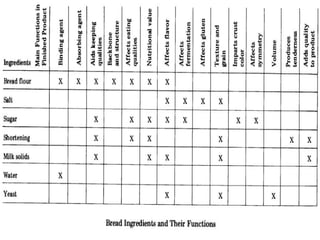
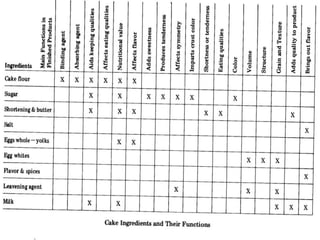
Flour Finely ground meal of wheat The quality of flour has direct implications  on the final product Backbone structure of baked goods Acts as a Binding and Absorbing agent Effects the keeping quality of the product Adds to the nutritional value of the product
Wheat Essential grain used for bread making Has the right combination of Glutenin and Gliadin With water forms gluten , which retains the gas produced by the yeast The two primary types of wheat are HARD & SOFT WHEAT Hard wheat contains a high proportion of gluten  Hence very good for breads and related products Soft wheat generally contains less gluten Hence used for delicate baked goods  The three basic soft flours are – cake flour, pastry flour  & cookie flour
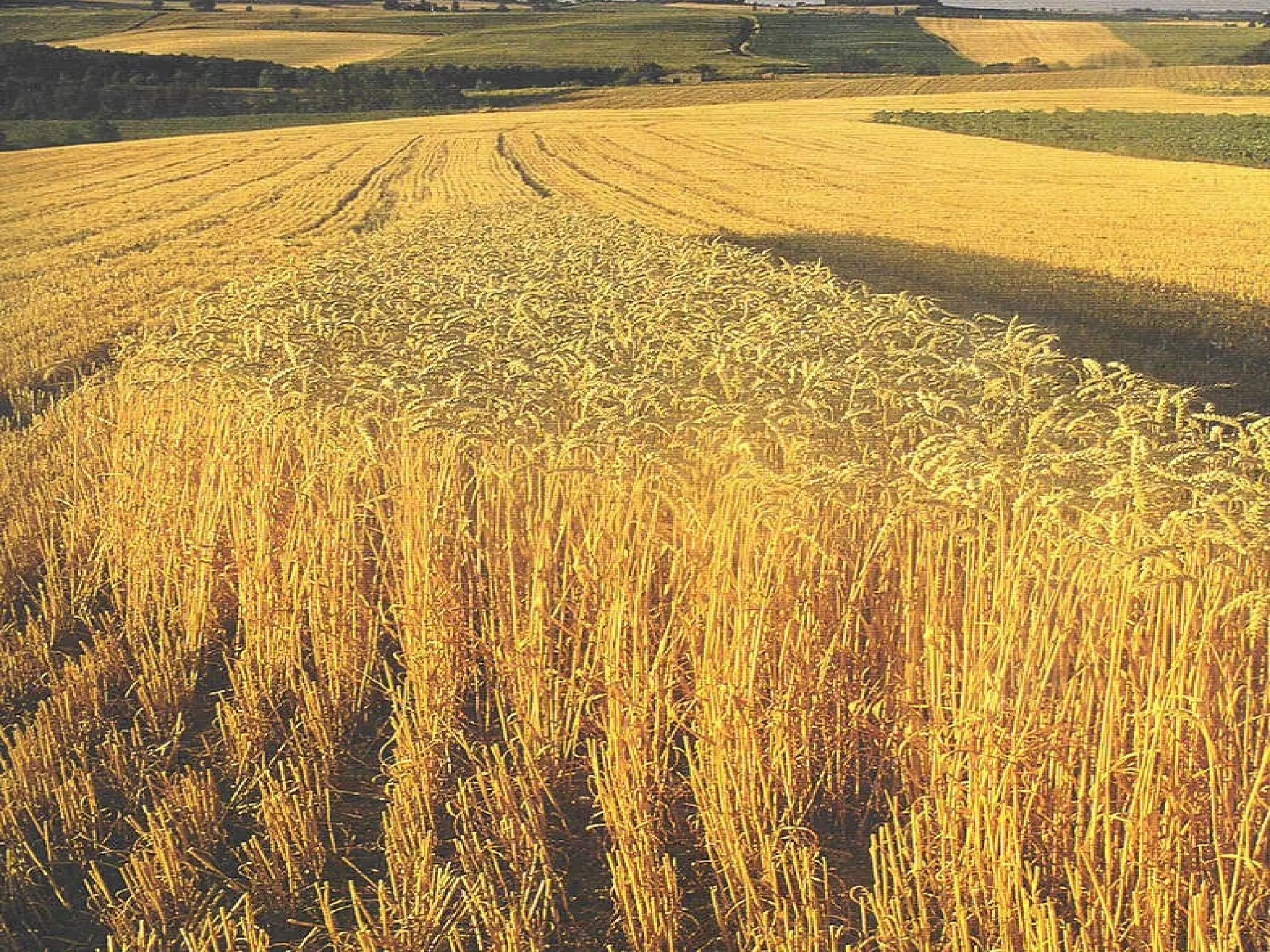
From Sowing to Milling Wheat belongs to the grass family – Triticum Bread wheat – Triticum Aestivum – used in baking Pasta wheat – Triticum Durum – mainly for pasta making Science and research has developed many useful varieties Grows very well in temperate climates Except for the water, salt and optional yeast wheat has all Varies from pale gold to ochre or a reddish brown
The wheat grain The tiny fruit comprises of The Husk The Bran – the cellulose envelope Flour Kernel – creamy white starch and natural protein gluten The Germ – the plant embryo –Vitamin B&E, minerals,  fatty acids etc.,
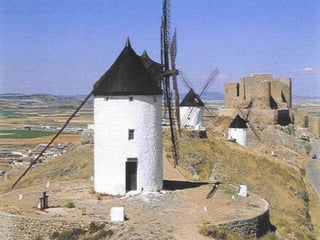
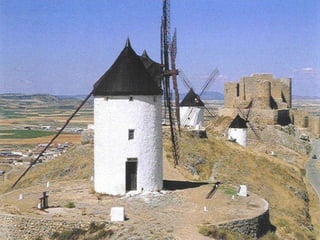
Milling of  Wheat Wind mills the traditional way Beauce region of France – “bread basket of France” The grain – quality / humidity / protein content etc… Trial milling  done in sample sizes The grain is stored in huge/ immense  “Silos” The  grist  is cleaned meticulously in series of machines Brushed/ magnetic field / washed thoroughly in fresh water  Let to settle in silos in the moisture
Milling of  Wheat 46- 48 hours in the silo – moisture of 15 percent Traditional millstone – grinding.  The stone grinds the germ too.shelf life    flavour   Modern roller milling effective and efficient The rollers separate the germ too - shelf life    flavour   Different sets of grinding / sifting with diff. grades of sieves Pnuematic ducts / fractional milling Final sifting – through a silk screen
Milling of  Wheat For whole wheat flour  –  the entire bran &germ milled For White flour  –  the large particles of bran are extracted in the coarse sifters/ sieve Bleaching / enhancing / additives Tests  Grading Bagging / stamps  Dispatch What ever the the flour quality …. -you need a good baker to produce good bread  
 
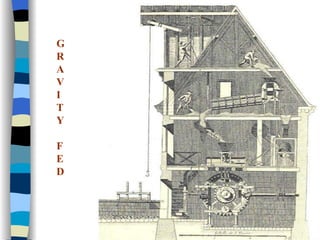
GRAVITY FED
 
EGGS Eggs are natural emulsifying agents  –  they form smooth batters Creaming / beating produces gas to be trapped In turn helps in leavening Application of heat coagulates the proteins and forms the structure the framework for bread is formed The fat in the egg yolks have a shortening effect  –  E.g..Sponge cakes and yeast products Egg white and the structure in meringues and sponges They add colour, add volume, give structure to the products Improve grain and texture
EGGS Shelled eggs Frozen eggs  - They save time and labor - They avoid wastage through spoilage / breakage - The quality is of uniform nature and hence the products - They can be egg yolk & white separate or combinations Freshness of eggs a very important factor The containers and cleanliness for whipping eggs Bring eggs to room temperature for better results
SALT Brings out the desired flavour Controls yeast action.> salt content retards yeast action Also prevents objectionable bacteria  - and  wild yeast types to develop Helps to strengthen the gluten and in turns holds co2 better It improves the texture and grain of the baked products
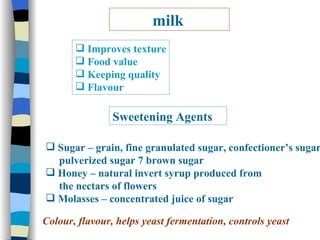
milk Improves texture Food value Keeping quality  Flavour Sweetening Agents Sugar – grain, fine granulated sugar, confectioner’s sugar,  pulverized sugar 7 brown sugar Honey – natural invert syrup produced from  the nectars of flowers  Molasses – concentrated juice of sugar Colour, flavour, helps yeast fermentation, controls yeast
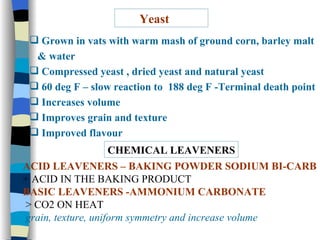
Yeast Grown in vats with warm mash of ground corn, barley malt  & water  Compressed yeast , dried yeast and natural yeast 60 deg F – slow reaction to  188 deg F -Terminal death point Increases volume Improves grain and texture Improved flavour CHEMICAL LEAVENERS ACID LEAVENERS – BAKING POWDER SODIUM BI-CARB + ACID IN THE BAKING PRODUCT BASIC LEAVENERS -AMMONIUM CARBONATE > CO2 ON HEAT grain, texture, uniform symmetry and increase volume
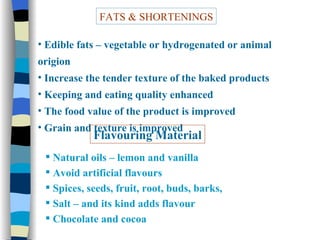
FATS & SHORTENINGS Edible fats – vegetable or hydrogenated or animal origion Increase the tender texture of the baked products Keeping and eating quality enhanced The food value of the product is improved Grain and texture is improved Flavouring Material Natural oils – lemon and vanilla Avoid artificial flavours Spices, seeds, fruit, root, buds, barks,  Salt – and its kind adds flavour Chocolate and cocoa
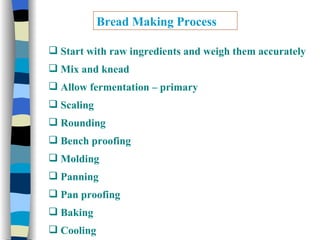
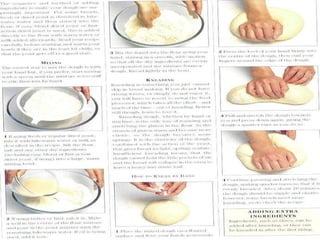
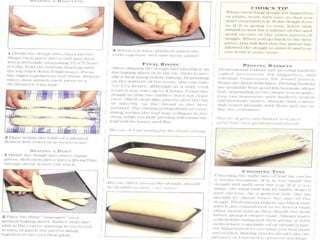
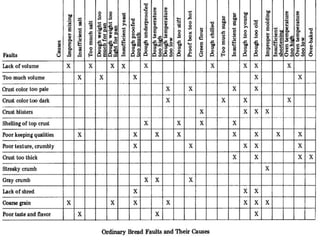
Bread Making Process Start with raw ingredients and weigh them accurately Mix and knead  Allow fermentation – primary  Scaling Rounding Bench proofing Molding Panning Pan proofing Baking  Cooling
Dough Mixing Uniform mixture of ingredients all along the dough To develop gluten to promote the elasticity of the dough Also to distribute the yeast cells uniformly so that receive uniform nutrition and also proof evenly SPONGE DOUGH METHOD: Partial dough is made a s base starter and the rest of the  Ingredients mixed in later STRAIGHT DOUGH METHOD: All ingredients mixed in together
FREMENTATION The most favourable temp 80 – 82 deg F The length of the fermentation depends on the yeast,  temperature of the dough and the surroundings Young dough – indicates under proofed Old dough – indicates over proofed The punching of the dough helps in relaxing the gluten  and equalises the temperature of the dough Best indication – punch when double the size
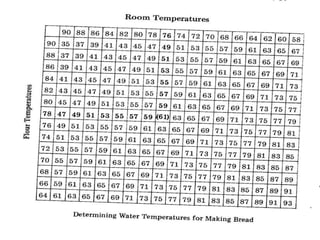
Controlling Dough Temperature Very important to moderate the  dough temperature The ingredients temperature Machine friction Heat due to fermentation process Water Temperature chart
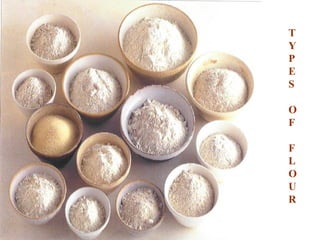
TYPES  OF  FLOUR


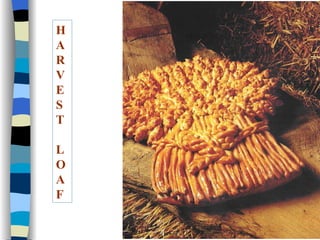
HARVE S T  LOAF
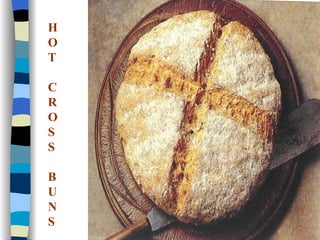
HOT CROSS  BUNS
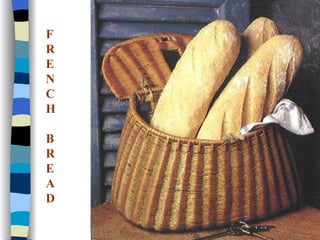
FRENCH BREAD
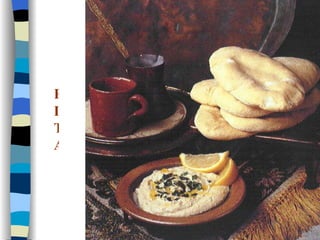
PITA


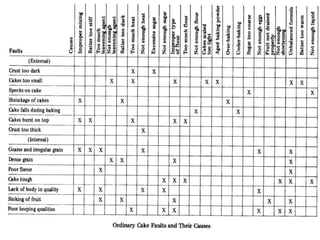
Cakes Methods of making Cake batters : Creaming Method   - sugar / butter flavours and spices/ egg /  milk + water / sifted flour with the baking powder Two stage method   -  All dry ingredients + fat + milk mix. … 2 nd  stage add the remaining milk and mix at a slow speed  Sponge or foaming  -  Eggs and sugar to around 100 deg F/ beat until the required consistency is reached / Fold in flour  uniformly
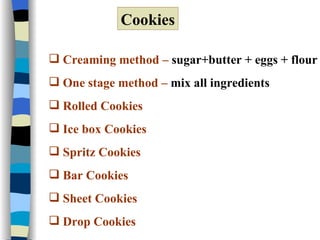
Cookies Creaming method –  sugar+butter + eggs + flour One stage method –  mix all ingredients  Rolled Cookies Ice box Cookies Spritz Cookies Bar Cookies Sheet Cookies Drop Cookies


Baking

  • 1.
  • 2.
    baking flours yeasteggs proofing baking ovens wheat
  • 3.
    Flour Finely groundmeal of wheat The quality of flour has direct implications on the final product Backbone structure of baked goods Acts as a Binding and Absorbing agent Effects the keeping quality of the product Adds to the nutritional value of the product
  • 4.
    Wheat Essential grainused for bread making Has the right combination of Glutenin and Gliadin With water forms gluten , which retains the gas produced by the yeast The two primary types of wheat are HARD & SOFT WHEAT Hard wheat contains a high proportion of gluten Hence very good for breads and related products Soft wheat generally contains less gluten Hence used for delicate baked goods The three basic soft flours are – cake flour, pastry flour & cookie flour
  • 5.
    From Sowing toMilling Wheat belongs to the grass family – Triticum Bread wheat – Triticum Aestivum – used in baking Pasta wheat – Triticum Durum – mainly for pasta making Science and research has developed many useful varieties Grows very well in temperate climates Except for the water, salt and optional yeast wheat has all Varies from pale gold to ochre or a reddish brown
  • 6.
    The wheat grainThe tiny fruit comprises of The Husk The Bran – the cellulose envelope Flour Kernel – creamy white starch and natural protein gluten The Germ – the plant embryo –Vitamin B&E, minerals, fatty acids etc.,
  • 7.
    Milling of Wheat Wind mills the traditional way Beauce region of France – “bread basket of France” The grain – quality / humidity / protein content etc… Trial milling done in sample sizes The grain is stored in huge/ immense “Silos” The grist is cleaned meticulously in series of machines Brushed/ magnetic field / washed thoroughly in fresh water Let to settle in silos in the moisture
  • 8.
    Milling of Wheat 46- 48 hours in the silo – moisture of 15 percent Traditional millstone – grinding. The stone grinds the germ too.shelf life  flavour  Modern roller milling effective and efficient The rollers separate the germ too - shelf life  flavour  Different sets of grinding / sifting with diff. grades of sieves Pnuematic ducts / fractional milling Final sifting – through a silk screen
  • 9.
    Milling of Wheat For whole wheat flour – the entire bran &germ milled For White flour – the large particles of bran are extracted in the coarse sifters/ sieve Bleaching / enhancing / additives Tests Grading Bagging / stamps Dispatch What ever the the flour quality …. -you need a good baker to produce good bread 
  • 10.
  • 11.
  • 12.
  • 13.
    EGGS Eggs arenatural emulsifying agents – they form smooth batters Creaming / beating produces gas to be trapped In turn helps in leavening Application of heat coagulates the proteins and forms the structure the framework for bread is formed The fat in the egg yolks have a shortening effect – E.g..Sponge cakes and yeast products Egg white and the structure in meringues and sponges They add colour, add volume, give structure to the products Improve grain and texture
  • 14.
    EGGS Shelled eggsFrozen eggs - They save time and labor - They avoid wastage through spoilage / breakage - The quality is of uniform nature and hence the products - They can be egg yolk & white separate or combinations Freshness of eggs a very important factor The containers and cleanliness for whipping eggs Bring eggs to room temperature for better results
  • 15.
    SALT Brings outthe desired flavour Controls yeast action.> salt content retards yeast action Also prevents objectionable bacteria - and wild yeast types to develop Helps to strengthen the gluten and in turns holds co2 better It improves the texture and grain of the baked products
  • 16.
    milk Improves textureFood value Keeping quality Flavour Sweetening Agents Sugar – grain, fine granulated sugar, confectioner’s sugar, pulverized sugar 7 brown sugar Honey – natural invert syrup produced from the nectars of flowers Molasses – concentrated juice of sugar Colour, flavour, helps yeast fermentation, controls yeast
  • 17.
    Yeast Grown invats with warm mash of ground corn, barley malt & water Compressed yeast , dried yeast and natural yeast 60 deg F – slow reaction to 188 deg F -Terminal death point Increases volume Improves grain and texture Improved flavour CHEMICAL LEAVENERS ACID LEAVENERS – BAKING POWDER SODIUM BI-CARB + ACID IN THE BAKING PRODUCT BASIC LEAVENERS -AMMONIUM CARBONATE > CO2 ON HEAT grain, texture, uniform symmetry and increase volume
  • 18.
    FATS & SHORTENINGSEdible fats – vegetable or hydrogenated or animal origion Increase the tender texture of the baked products Keeping and eating quality enhanced The food value of the product is improved Grain and texture is improved Flavouring Material Natural oils – lemon and vanilla Avoid artificial flavours Spices, seeds, fruit, root, buds, barks, Salt – and its kind adds flavour Chocolate and cocoa
  • 19.
    Bread Making ProcessStart with raw ingredients and weigh them accurately Mix and knead Allow fermentation – primary Scaling Rounding Bench proofing Molding Panning Pan proofing Baking Cooling
  • 20.
    Dough Mixing Uniformmixture of ingredients all along the dough To develop gluten to promote the elasticity of the dough Also to distribute the yeast cells uniformly so that receive uniform nutrition and also proof evenly SPONGE DOUGH METHOD: Partial dough is made a s base starter and the rest of the Ingredients mixed in later STRAIGHT DOUGH METHOD: All ingredients mixed in together
  • 21.
    FREMENTATION The mostfavourable temp 80 – 82 deg F The length of the fermentation depends on the yeast, temperature of the dough and the surroundings Young dough – indicates under proofed Old dough – indicates over proofed The punching of the dough helps in relaxing the gluten and equalises the temperature of the dough Best indication – punch when double the size
  • 22.
    Controlling Dough TemperatureVery important to moderate the dough temperature The ingredients temperature Machine friction Heat due to fermentation process Water Temperature chart
  • 23.
    TYPES OF FLOUR
  • 24.
  • 25.
  • 26.
  • 27.
  • 28.
    HARVE S T LOAF
  • 29.
  • 30.
  • 31.
  • 32.
  • 33.
  • 34.
  • 35.
    Cakes Methods ofmaking Cake batters : Creaming Method - sugar / butter flavours and spices/ egg / milk + water / sifted flour with the baking powder Two stage method - All dry ingredients + fat + milk mix. … 2 nd stage add the remaining milk and mix at a slow speed Sponge or foaming - Eggs and sugar to around 100 deg F/ beat until the required consistency is reached / Fold in flour uniformly
  • 36.
    Cookies Creaming method– sugar+butter + eggs + flour One stage method – mix all ingredients Rolled Cookies Ice box Cookies Spritz Cookies Bar Cookies Sheet Cookies Drop Cookies
  • 37.
  • 38.
  • 39.
  • 40.