HAZARD ANALYSIS
CRITICAL CONTROL
POINT (HACCP)
Allwyn Vyas. G
HACCP System
 Hazard Analysis Critical Control Point
(HACCP)
 Food safety management system.
 It Identifies, Evaluate and Controls Hazards
which are Significant for Food Safety
throughout the food supply.
GUIDELINES FOR APPLICATION OF HACCP
PRINCIPLES
 Prerequisite Programs
 Facilities
 Supplier Control
 Specifications
 Production Equipment
 Cleaning and Sanitation
 Personal Hygiene
 Training
 Chemical Control
 Receiving, Storage and Shipping
 Traceability and Recall
 Pest Control
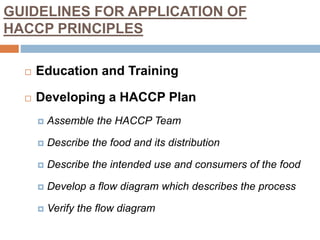
GUIDELINES FOR APPLICATION OF
HACCP PRINCIPLES
 Education and Training
 Developing a HACCP Plan
 Assemble the HACCP Team
 Describe the food and its distribution
 Describe the intended use and consumers of the food
 Develop a flow diagram which describes the process
 Verify the flow diagram
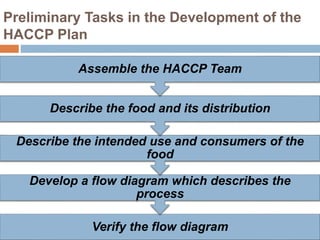
Preliminary Tasks in the Development of the
HACCP Plan
Verify the flow diagram
Develop a flow diagram which describes the
process
Describe the intended use and consumers of the
food
Describe the food and its distribution
Assemble the HACCP Team
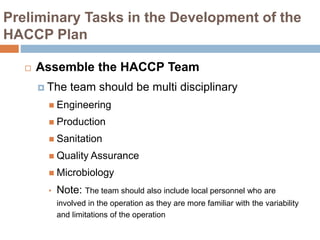
Preliminary Tasks in the Development of the
HACCP Plan
 Assemble the HACCP Team
 The team should be multi disciplinary
 Engineering
 Production
 Sanitation
 Quality Assurance
 Microbiology
• Note: The team should also include local personnel who are
involved in the operation as they are more familiar with the variability
and limitations of the operation
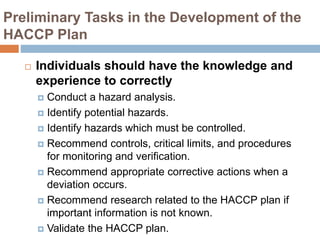
Preliminary Tasks in the Development of the
HACCP Plan
 Individuals should have the knowledge and
experience to correctly
 Conduct a hazard analysis.
 Identify potential hazards.
 Identify hazards which must be controlled.
 Recommend controls, critical limits, and procedures
for monitoring and verification.
 Recommend appropriate corrective actions when a
deviation occurs.
 Recommend research related to the HACCP plan if
important information is not known.
 Validate the HACCP plan.
Preliminary Tasks in the Development of the
HACCP Plan
 Describe the food and its distribution
 The HACCP team first describes the food.
 General description of the food, ingredients, and
processing methods.
 Distribution of the food (whether the food is to be
distributed frozen, refrigerated, or at ambient
temperature.)
 Describe the intended use and consumers of
the food
 Describe the normal expected use of the food.

 The intended consumers may be the general public or
a particular segment of the population.
Preliminary Tasks in the Development of the
HACCP Plan
 Develop a flow diagram which describes the
process
 Clear, simple outline of the steps involved in the
process.
 Flow diagram must cover all the steps in the process
which are directly under the control of the
establishment.
 The flow diagram should be simple that everyone in
Preliminary Tasks in the Development of the
HACCP Plan
 Verify the flow diagram
 Perform an on-site review of the operation to verify
the accuracy and completeness of the flow diagram.
 Modifications should be made to the flow diagram as
necessary and documented.
 After these five preliminary tasks have been completed, the
seven principles of HACCP are applied
PRINCIPLES OF HACCP
1. Conduct Hazard Analysis.
2. Determine the Critical Control Points
(CCPs).
3. Establish Control Limits (CLs).
4. Establish Monitoring Systems.
5. Establish Corrective Actions.
6. Establish Verification Procedures.
PRINCIPLES OF HACCP
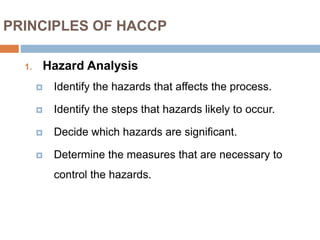
1. Hazard Analysis
 Identify the hazards that affects the process.
 Identify the steps that hazards likely to occur.
 Decide which hazards are significant.
 Determine the measures that are necessary to
control the hazards.
PRINCIPLES OF HACCP
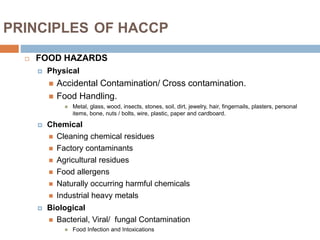
 FOOD HAZARDS
 Physical
 Accidental Contamination/ Cross contamination.
 Food Handling.
 Metal, glass, wood, insects, stones, soil, dirt, jewelry, hair, fingernails, plasters, personal
items, bone, nuts / bolts, wire, plastic, paper and cardboard.
 Chemical
 Cleaning chemical residues
 Factory contaminants
 Agricultural residues
 Food allergens
 Naturally occurring harmful chemicals
 Industrial heavy metals
 Biological
 Bacterial, Viral/ fungal Contamination
 Food Infection and Intoxications
PRINCIPLES OF HACCP
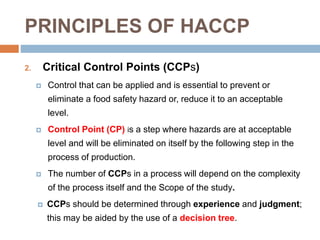
2. Critical Control Points (CCPs)
 Control that can be applied and is essential to prevent or
eliminate a food safety hazard or, reduce it to an acceptable
level.
 Control Point (CP) is a step where hazards are at acceptable
level and will be eliminated on itself by the following step in the
process of production.
 The number of CCPs in a process will depend on the complexity
of the process itself and the Scope of the study.
 CCPs should be determined through experience and judgment;
this may be aided by the use of a decision tree.
PRINCIPLES Of HACCP
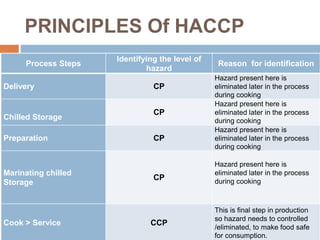
Process Steps
Identifying the level of
hazard
Reason for identification
Delivery CP
Hazard present here is
eliminated later in the process
during cooking
Chilled Storage
CP
Hazard present here is
eliminated later in the process
during cooking
Preparation CP
Hazard present here is
eliminated later in the process
during cooking
Marinating chilled
Storage
CP
Hazard present here is
eliminated later in the process
during cooking
Cook > Service CCP
This is final step in production
so hazard needs to controlled
/eliminated, to make food safe
for consumption.
PRINCIPLES Of HACCP
3. CRITICAL LIMIT
 A critical limit is the maximum or minimum value for the control
measure at a CCP to prevent, eliminate, or reduce the hazard to
an acceptable level.
 It separates acceptable (safe) product from unacceptable
(unsafe) product.
 Critical limits should be for the control measure and not the
hazard. They should be:
 Measureable.
 Observable.
 Able to monitor in “real time” (quickly)
 Some critical limits are defined in:
 Legislation.
 Industry guidelines and codes of practice.
PRINCIPLES Of HACCP
 Others can be determined from:
 Collection of experimental data during trials
 Advice from specialists with expert knowledge
 Criteria often used to set a critical limit include measurements
of:
 Temperature
 Time
 Moisture level
 pH (level of acidity)
 Aw (level of water available to support the growth of a hazard such as
bacteria)
 Chemical analyses
 Available chlorine
 Subjective data
 e.g. visual observations/assessments.
PRINCIPLES Of HACCP
4. MONITORING SYSTEM
 The monitoring system describes the methods by which the
business is able to confirm that all CCPs are operating within
the defined critical limit.
 Monitoring actions must be able to detect a loss of control at
the CCP and provide rapid results. This should be in time to
allow corrective action to be taken, to regain control of the
process whilst the product is still under your control.
 Generally microbiological testing is not considered to be
suitable as a monitoring activity because the results are not
quick, even with the most rapid methods results are not instant.
PRINCIPLES Of HACCP
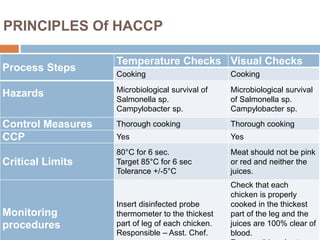
Process Steps
Temperature Checks Visual Checks
Cooking Cooking
Hazards Microbiological survival of
Salmonella sp.
Campylobacter sp.
Microbiological survival
of Salmonella sp.
Campylobacter sp.
Control Measures Thorough cooking Thorough cooking
CCP Yes Yes
Critical Limits
80°C for 6 sec.
Target 85°C for 6 sec
Tolerance +/-5°C
Meat should not be pink
or red and neither the
juices.
Monitoring
procedures
Insert disinfected probe
thermometer to the thickest
part of leg of each chicken.
Responsible – Asst. Chef.
Check that each
chicken is properly
cooked in the thickest
part of the leg and the
juices are 100% clear of
blood.
PRINCIPLES OF HACCP
5. CORRECTIVE ACTIONS
 Decide What to do when a CCP is breached
 Actions taken again to make food safe and to get the
process back under control. immediate actions taken
if processes fail to achieve food safety.
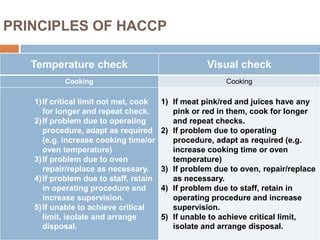
PRINCIPLES OF HACCP
Temperature check Visual check
Cooking Cooking
1)If critical limit not met, cook
for longer and repeat check.
2)If problem due to operating
procedure, adapt as required
(e.g. increase cooking time/or
oven temperature)
3)If problem due to oven
repair/replace as necessary.
4)If problem due to staff, retain
in operating procedure and
increase supervision.
5)If unable to achieve critical
limit, isolate and arrange
disposal.
1) If meat pink/red and juices have any
pink or red in them, cook for longer
and repeat checks.
2) If problem due to operating
procedure, adapt as required (e.g.
increase cooking time or oven
temperature)
3) If problem due to oven, repair/replace
as necessary.
4) If problem due to staff, retain in
operating procedure and increase
supervision.
5) If unable to achieve critical limit,
isolate and arrange disposal.
PRINCIPLES OF HACCP
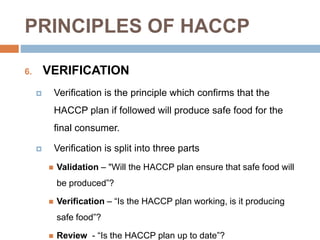
6. VERIFICATION
 Verification is the principle which confirms that the
HACCP plan if followed will produce safe food for the
final consumer.
 Verification is split into three parts
 Validation – "Will the HACCP plan ensure that safe food will
be produced”?
 Verification – “Is the HACCP plan working, is it producing
safe food”?
 Review - “Is the HACCP plan up to date”?
PRINCIPLES OF HACCP
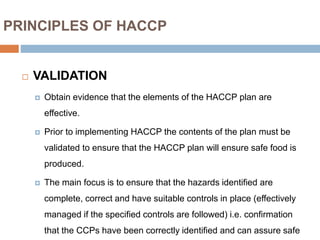
 VALIDATION
 Obtain evidence that the elements of the HACCP plan are
effective.
 Prior to implementing HACCP the contents of the plan must be
validated to ensure that the HACCP plan will ensure safe food is
produced.
 The main focus is to ensure that the hazards identified are
complete, correct and have suitable controls in place (effectively
managed if the specified controls are followed) i.e. confirmation
that the CCPs have been correctly identified and can assure safe
PRINCIPLES OF HACCP
 Validation activities could include:
 Challenge testing the equipment / machinery
 Experimental trials e.g. thermal evaluations on the equipment either at
high temperatures or low temperatures
 Mathematical modeling
 Other areas where information can be obtained to support a
validation study include:
 Document review
 Legislation – confirm that the HACCP plan meets legal requirements,
with regard to food safety.
 Codes of practices
 Accepted good practice
PRINCIPLES OF HACCP
 VERIFICATION ACTIVITIES
 The application of methods, procedures, tests and other evaluations, in
addition to monitoring to determine ongoing compliance with the HACCP
plan.
 Depending on the type of product and scale of business
verification activities may include:
 Internal audits.
 External audits on suppliers.
 Undertaking chemical or microbiological sampling and examinations.
 Evaluating customer feedback analysis including complaints.
 Undertaking raw material or end product testing.
 Analysis and confirmation that the controls, monitoring and corrective
actions are being properly applied.
 Analysis of deviation from the critical limits.
 Ensuring that the prerequisites are under control.
 Ensuring that the personnel carrying out the verification activities have
the appropriate qualifications, training and experience i.e. they are
competent to undertake the verification activity.
PRINCIPLES OF HACCP
 REVIEW
 Your HACCP plan should be up-to-date at all times
and reflect any change. A change is anything in the
HACCP plan that is different to when the study was
last carried out.
 A review should be both scheduled and triggered.
 Triggered, prior to a change
 There should be factors built into the plan that would initiate
(trigger) a review.
PRINCIPLES OF HACCP
 Things that should be Reviewed
 Changes in raw materials or product formulation
 Introduction of new product
 Change raw materials supplier
 Change in processing system
 Change in layout or environment
 Modification to process equipment or new equipment
 Failures in system e.g. corrective action or product recall
 Anticipated change in customer or consumer
 Any report from the market place that indicates a health or
spoilage risk associated with the product
 Emergence of a new food borne pathogen (e.g bacteria
that can cause illness) with public health significance or
other health issue
PRINCIPLES OF HACCP
7. DOCUMENTATION
 Efficient and accurate record-keeping is essential to the
application of a HACCP system.
 In the unfortunate event of a food safety incident that is
connected to your products you may have to show that you have
taken all reasonable precautions to produce food safely.
 Demonstrating that the principles of HACCP have been correctly
applied as required by law and that documentation and records
are kept, may provide evidence of due diligence in the event of
legal action.
PRINCIPLES OF HACCP
 Documentation and record-keeping should be:
 Appropriate to the nature and size of the operation –
your local environmental health practitioner will be
able to guide you on this requirement.
 Sufficient to assist the business to verify that the
HACCP controls are in place and being maintained.
PRINCIPLES OF HACCP
 What to consider regarding documentation
 What records need to be kept?
 How are they to be stored – e.g. hard copy, electronic?
 Where are the documents to be stored?
 How long are the records to be retained for ? (what is an
appropriate time, think about the shelf-life of the product
and possibly how the product may be misused)
 Who is responsible for the records?
 Who needs frequent access to the records?
PRINCIPLES OF HACCP
 Examples of documentation
 The HACCP plan
 List of hazards and details of the hazard analysis
 CCP determination
 Critical limit determination
 Training needs analysis
 Procedures – e.g. standard operating procedures,
corrective action procedure
 Work Instructions
PRINCIPLES OF HACCP
 Examples of records
 CCP monitoring activities
 Deviations and associated corrective actions
 Verification procedures performed
 Modification to the HACCP plan
 Training undertaken
 Daily records (glass and brittle plastic check)
 Visual inspection reports
 Team meeting records
 Processing records
Bon Appétit
THANKYOU

Hazard analysis critical control point (haccp)

  • 1.
  • 2.
    HACCP System  HazardAnalysis Critical Control Point (HACCP)  Food safety management system.  It Identifies, Evaluate and Controls Hazards which are Significant for Food Safety throughout the food supply.
  • 3.
    GUIDELINES FOR APPLICATIONOF HACCP PRINCIPLES  Prerequisite Programs  Facilities  Supplier Control  Specifications  Production Equipment  Cleaning and Sanitation  Personal Hygiene  Training  Chemical Control  Receiving, Storage and Shipping  Traceability and Recall  Pest Control
  • 4.
    GUIDELINES FOR APPLICATIONOF HACCP PRINCIPLES  Education and Training  Developing a HACCP Plan  Assemble the HACCP Team  Describe the food and its distribution  Describe the intended use and consumers of the food  Develop a flow diagram which describes the process  Verify the flow diagram
  • 5.
    Preliminary Tasks inthe Development of the HACCP Plan Verify the flow diagram Develop a flow diagram which describes the process Describe the intended use and consumers of the food Describe the food and its distribution Assemble the HACCP Team
  • 6.
    Preliminary Tasks inthe Development of the HACCP Plan  Assemble the HACCP Team  The team should be multi disciplinary  Engineering  Production  Sanitation  Quality Assurance  Microbiology • Note: The team should also include local personnel who are involved in the operation as they are more familiar with the variability and limitations of the operation
  • 7.
    Preliminary Tasks inthe Development of the HACCP Plan  Individuals should have the knowledge and experience to correctly  Conduct a hazard analysis.  Identify potential hazards.  Identify hazards which must be controlled.  Recommend controls, critical limits, and procedures for monitoring and verification.  Recommend appropriate corrective actions when a deviation occurs.  Recommend research related to the HACCP plan if important information is not known.  Validate the HACCP plan.
  • 8.
    Preliminary Tasks inthe Development of the HACCP Plan  Describe the food and its distribution  The HACCP team first describes the food.  General description of the food, ingredients, and processing methods.  Distribution of the food (whether the food is to be distributed frozen, refrigerated, or at ambient temperature.)  Describe the intended use and consumers of the food  Describe the normal expected use of the food.  The intended consumers may be the general public or a particular segment of the population.
  • 9.
    Preliminary Tasks inthe Development of the HACCP Plan  Develop a flow diagram which describes the process  Clear, simple outline of the steps involved in the process.  Flow diagram must cover all the steps in the process which are directly under the control of the establishment.  The flow diagram should be simple that everyone in
  • 10.
    Preliminary Tasks inthe Development of the HACCP Plan  Verify the flow diagram  Perform an on-site review of the operation to verify the accuracy and completeness of the flow diagram.  Modifications should be made to the flow diagram as necessary and documented.  After these five preliminary tasks have been completed, the seven principles of HACCP are applied
  • 11.
    PRINCIPLES OF HACCP 1.Conduct Hazard Analysis. 2. Determine the Critical Control Points (CCPs). 3. Establish Control Limits (CLs). 4. Establish Monitoring Systems. 5. Establish Corrective Actions. 6. Establish Verification Procedures.
  • 12.
    PRINCIPLES OF HACCP 1.Hazard Analysis  Identify the hazards that affects the process.  Identify the steps that hazards likely to occur.  Decide which hazards are significant.  Determine the measures that are necessary to control the hazards.
  • 13.
    PRINCIPLES OF HACCP FOOD HAZARDS  Physical  Accidental Contamination/ Cross contamination.  Food Handling.  Metal, glass, wood, insects, stones, soil, dirt, jewelry, hair, fingernails, plasters, personal items, bone, nuts / bolts, wire, plastic, paper and cardboard.  Chemical  Cleaning chemical residues  Factory contaminants  Agricultural residues  Food allergens  Naturally occurring harmful chemicals  Industrial heavy metals  Biological  Bacterial, Viral/ fungal Contamination  Food Infection and Intoxications
  • 14.
    PRINCIPLES OF HACCP 2.Critical Control Points (CCPs)  Control that can be applied and is essential to prevent or eliminate a food safety hazard or, reduce it to an acceptable level.  Control Point (CP) is a step where hazards are at acceptable level and will be eliminated on itself by the following step in the process of production.  The number of CCPs in a process will depend on the complexity of the process itself and the Scope of the study.  CCPs should be determined through experience and judgment; this may be aided by the use of a decision tree.
  • 15.
    PRINCIPLES Of HACCP ProcessSteps Identifying the level of hazard Reason for identification Delivery CP Hazard present here is eliminated later in the process during cooking Chilled Storage CP Hazard present here is eliminated later in the process during cooking Preparation CP Hazard present here is eliminated later in the process during cooking Marinating chilled Storage CP Hazard present here is eliminated later in the process during cooking Cook > Service CCP This is final step in production so hazard needs to controlled /eliminated, to make food safe for consumption.
  • 16.
    PRINCIPLES Of HACCP 3.CRITICAL LIMIT  A critical limit is the maximum or minimum value for the control measure at a CCP to prevent, eliminate, or reduce the hazard to an acceptable level.  It separates acceptable (safe) product from unacceptable (unsafe) product.  Critical limits should be for the control measure and not the hazard. They should be:  Measureable.  Observable.  Able to monitor in “real time” (quickly)  Some critical limits are defined in:  Legislation.  Industry guidelines and codes of practice.
  • 17.
    PRINCIPLES Of HACCP Others can be determined from:  Collection of experimental data during trials  Advice from specialists with expert knowledge  Criteria often used to set a critical limit include measurements of:  Temperature  Time  Moisture level  pH (level of acidity)  Aw (level of water available to support the growth of a hazard such as bacteria)  Chemical analyses  Available chlorine  Subjective data  e.g. visual observations/assessments.
  • 18.
    PRINCIPLES Of HACCP 4.MONITORING SYSTEM  The monitoring system describes the methods by which the business is able to confirm that all CCPs are operating within the defined critical limit.  Monitoring actions must be able to detect a loss of control at the CCP and provide rapid results. This should be in time to allow corrective action to be taken, to regain control of the process whilst the product is still under your control.  Generally microbiological testing is not considered to be suitable as a monitoring activity because the results are not quick, even with the most rapid methods results are not instant.
  • 19.
    PRINCIPLES Of HACCP ProcessSteps Temperature Checks Visual Checks Cooking Cooking Hazards Microbiological survival of Salmonella sp. Campylobacter sp. Microbiological survival of Salmonella sp. Campylobacter sp. Control Measures Thorough cooking Thorough cooking CCP Yes Yes Critical Limits 80°C for 6 sec. Target 85°C for 6 sec Tolerance +/-5°C Meat should not be pink or red and neither the juices. Monitoring procedures Insert disinfected probe thermometer to the thickest part of leg of each chicken. Responsible – Asst. Chef. Check that each chicken is properly cooked in the thickest part of the leg and the juices are 100% clear of blood.
  • 20.
    PRINCIPLES OF HACCP 5.CORRECTIVE ACTIONS  Decide What to do when a CCP is breached  Actions taken again to make food safe and to get the process back under control. immediate actions taken if processes fail to achieve food safety.
  • 21.
    PRINCIPLES OF HACCP Temperaturecheck Visual check Cooking Cooking 1)If critical limit not met, cook for longer and repeat check. 2)If problem due to operating procedure, adapt as required (e.g. increase cooking time/or oven temperature) 3)If problem due to oven repair/replace as necessary. 4)If problem due to staff, retain in operating procedure and increase supervision. 5)If unable to achieve critical limit, isolate and arrange disposal. 1) If meat pink/red and juices have any pink or red in them, cook for longer and repeat checks. 2) If problem due to operating procedure, adapt as required (e.g. increase cooking time or oven temperature) 3) If problem due to oven, repair/replace as necessary. 4) If problem due to staff, retain in operating procedure and increase supervision. 5) If unable to achieve critical limit, isolate and arrange disposal.
  • 22.
    PRINCIPLES OF HACCP 6.VERIFICATION  Verification is the principle which confirms that the HACCP plan if followed will produce safe food for the final consumer.  Verification is split into three parts  Validation – "Will the HACCP plan ensure that safe food will be produced”?  Verification – “Is the HACCP plan working, is it producing safe food”?  Review - “Is the HACCP plan up to date”?
  • 23.
    PRINCIPLES OF HACCP VALIDATION  Obtain evidence that the elements of the HACCP plan are effective.  Prior to implementing HACCP the contents of the plan must be validated to ensure that the HACCP plan will ensure safe food is produced.  The main focus is to ensure that the hazards identified are complete, correct and have suitable controls in place (effectively managed if the specified controls are followed) i.e. confirmation that the CCPs have been correctly identified and can assure safe
  • 24.
    PRINCIPLES OF HACCP Validation activities could include:  Challenge testing the equipment / machinery  Experimental trials e.g. thermal evaluations on the equipment either at high temperatures or low temperatures  Mathematical modeling  Other areas where information can be obtained to support a validation study include:  Document review  Legislation – confirm that the HACCP plan meets legal requirements, with regard to food safety.  Codes of practices  Accepted good practice
  • 25.
    PRINCIPLES OF HACCP VERIFICATION ACTIVITIES  The application of methods, procedures, tests and other evaluations, in addition to monitoring to determine ongoing compliance with the HACCP plan.  Depending on the type of product and scale of business verification activities may include:  Internal audits.  External audits on suppliers.  Undertaking chemical or microbiological sampling and examinations.  Evaluating customer feedback analysis including complaints.  Undertaking raw material or end product testing.  Analysis and confirmation that the controls, monitoring and corrective actions are being properly applied.  Analysis of deviation from the critical limits.  Ensuring that the prerequisites are under control.  Ensuring that the personnel carrying out the verification activities have the appropriate qualifications, training and experience i.e. they are competent to undertake the verification activity.
  • 26.
    PRINCIPLES OF HACCP REVIEW  Your HACCP plan should be up-to-date at all times and reflect any change. A change is anything in the HACCP plan that is different to when the study was last carried out.  A review should be both scheduled and triggered.  Triggered, prior to a change  There should be factors built into the plan that would initiate (trigger) a review.
  • 27.
    PRINCIPLES OF HACCP Things that should be Reviewed  Changes in raw materials or product formulation  Introduction of new product  Change raw materials supplier  Change in processing system  Change in layout or environment  Modification to process equipment or new equipment  Failures in system e.g. corrective action or product recall  Anticipated change in customer or consumer  Any report from the market place that indicates a health or spoilage risk associated with the product  Emergence of a new food borne pathogen (e.g bacteria that can cause illness) with public health significance or other health issue
  • 28.
    PRINCIPLES OF HACCP 7.DOCUMENTATION  Efficient and accurate record-keeping is essential to the application of a HACCP system.  In the unfortunate event of a food safety incident that is connected to your products you may have to show that you have taken all reasonable precautions to produce food safely.  Demonstrating that the principles of HACCP have been correctly applied as required by law and that documentation and records are kept, may provide evidence of due diligence in the event of legal action.
  • 29.
    PRINCIPLES OF HACCP Documentation and record-keeping should be:  Appropriate to the nature and size of the operation – your local environmental health practitioner will be able to guide you on this requirement.  Sufficient to assist the business to verify that the HACCP controls are in place and being maintained.
  • 30.
    PRINCIPLES OF HACCP What to consider regarding documentation  What records need to be kept?  How are they to be stored – e.g. hard copy, electronic?  Where are the documents to be stored?  How long are the records to be retained for ? (what is an appropriate time, think about the shelf-life of the product and possibly how the product may be misused)  Who is responsible for the records?  Who needs frequent access to the records?
  • 31.
    PRINCIPLES OF HACCP Examples of documentation  The HACCP plan  List of hazards and details of the hazard analysis  CCP determination  Critical limit determination  Training needs analysis  Procedures – e.g. standard operating procedures, corrective action procedure  Work Instructions
  • 32.
    PRINCIPLES OF HACCP Examples of records  CCP monitoring activities  Deviations and associated corrective actions  Verification procedures performed  Modification to the HACCP plan  Training undertaken  Daily records (glass and brittle plastic check)  Visual inspection reports  Team meeting records  Processing records
  • 33.