Microbiology of meat
 Meat is easily spoiled by microorganisms
because it contains a lot of nutrient, growth
factors etc. the pH for meat is the range of 5.6-
7.4.
 Microorganism for soil, water and manure
make up the dominant flora of meat. During
slaughter, the external surface of the animal
may contaminate the meat by direct contact
through the above sources and equipment,
personnel and slaughtering area.
 Bacteria generally found in meat:
a) Pathogenic microorganism
eg: Brucella, Salmonella, Streptococcus,
Mycobacterium tuberculosis, Clostridium
b) Spoilage microorganisms
eg: Achromobacter, Pseudomonas, Bacillus
and Staphylococcus
c) Molds
eg: Aspergillus, Mucor, Penicillium
Factors affecting the spoilage of meat
a. Water content
b. Redox potential
c. pH value
d. temperature
a) water content
 Meat has high water content with dissolved
substances such as glycogen, lactic acids and
amino acids.
 All these substance can cause microbial
growth which can lead to early spoilage.
b) Redox potential
 Has a big influence on microbes.
 Tissue respiration continues after death and uses
up oxygen present and produce CO2 .
 Finally oxygen tension will fall (Eh negative).
 The inner side of meat becomes anaerobic;
together with the production of lactic acids.
 The bulk of meat becomes anaerobic except on
the surface. At the surface, aerobic flora and
inside meat, anaerobic flora predominates. But,
these microorganisms do not grow readily at low
temperature, therefore little growth may be
observed.
c) pH value
 pH value of the meat is between 5.5-7.4.
Acidic pH (5.5) not suitable for growth of many
types of microorganisms.
 pH of meat depends on amount of lactic acid
produced by glycolysis in muscle after death.
 The more acid produced the lower the pH. But,
the amount of acid depends on the amount of
glycogen in the muscle at death.
i. If animal is exercised before slaughter, the
glycogen is low, little lactic acid produced and
the pH of carcass is relatively high. Muscle will
be dry and firm in texture and dark in color (DFD
condition).
ii. If non-exercised animal is stimulated before
slaughter such as stress, glycogen will rapidly
turn to lactic acid and low pH is approached
before tissue has time to cool. This cause
denaturation of some, muscle protein. Meat will
become pale, soft and exudative (PSE
condition).
 The type and spoilage of meat is determined by:
 Initial numbers present
 pH value of meat – if pH > 6.0, amino acid is
attacked. Microorganisms can grow fast. Meat will
putrefy mainly due to Pseudomonas and
Aeromonas type.
 Two types of spoilage: Aerobic condition
Anaerobic condition
 Aerobic condition
a) Surface slime
b) Colour change
c) Off flavors and odours
d) Rancidity
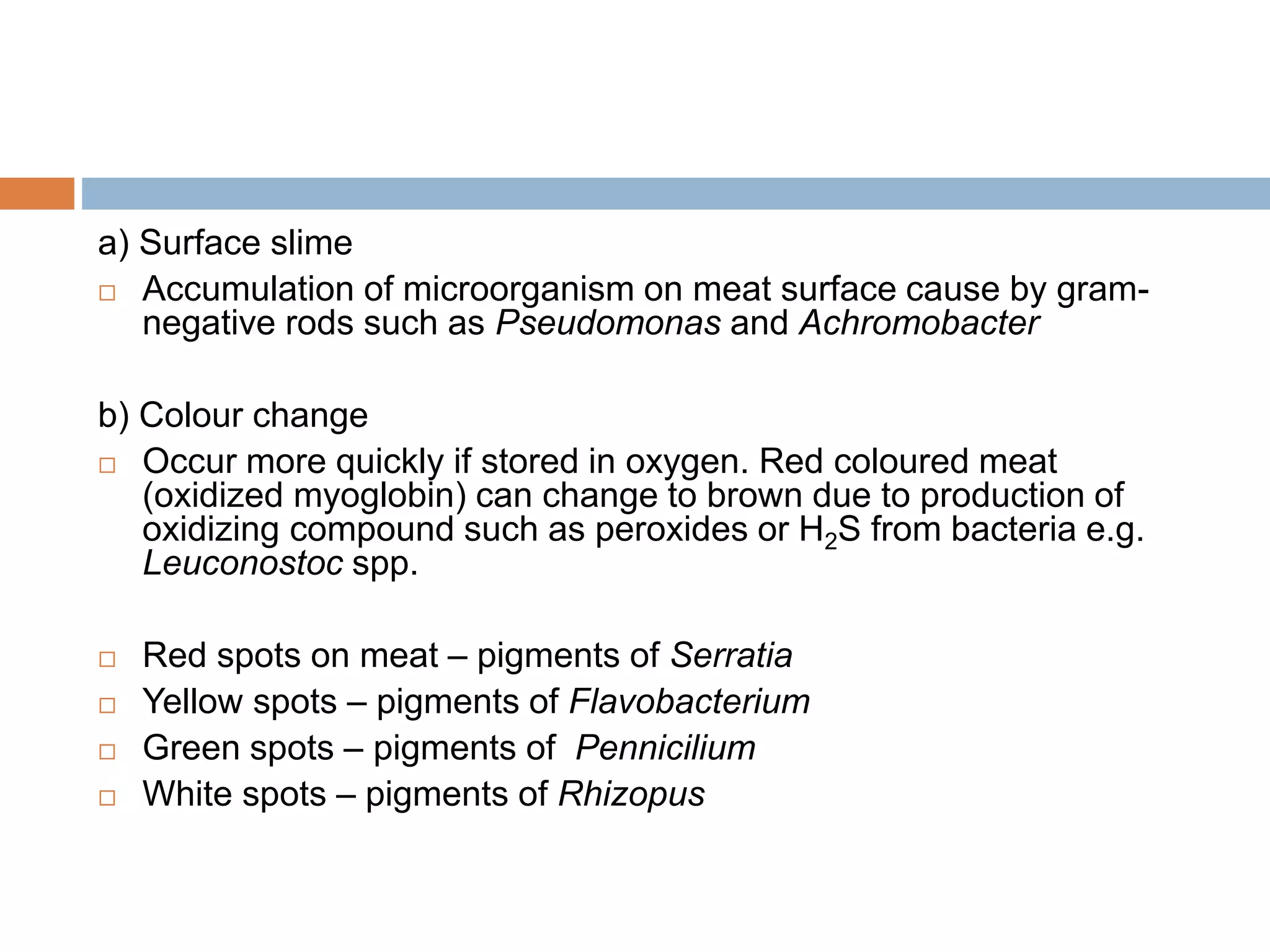
a) Surface slime
 Accumulation of microorganism on meat surface cause by gram-
negative rods such as Pseudomonas and Achromobacter
b) Colour change
 Occur more quickly if stored in oxygen. Red coloured meat
(oxidized myoglobin) can change to brown due to production of
oxidizing compound such as peroxides or H2S from bacteria e.g.
Leuconostoc spp.
 Red spots on meat – pigments of Serratia
 Yellow spots – pigments of Flavobacterium
 Green spots – pigments of Pennicilium
 White spots – pigments of Rhizopus
c) Off flavors and odours
 Due to formation of fatty acids on the meat
surface such as formic, butyric and propionic acid.
 It can also due to production of compounds such
as amines, ammonia caused by degradation of
amino acid by proteolytic bacteria such as
Pseudomonas spp whereas Actinomycetes will
give an earthy odour.
d) Rancidity
 Caused by some lipolytic bacteria and molds
Anaerobic condition
a) Putrefaction
Breakdown of protein with the formation of foul smelling compounds
such as mercaptans, H2S, indol, amines and others. This occurs inside
the meat such as Proteus, Clostridium and Bacillus
b) Souring
Can be microbial and biochemical. Microbial souring is due to the
formation of fatty acids and lactic acids, with no putrefaction. E.g.
Clostridium, Bacillus
 The souring results from the utilization of lactose and other sugars and the
production of acids.
 Normally occur underneath the casing of meat products.
Microbiology of Milk
 Milk and its product contain a large amount of nutrient.
Excellent media for growth of spoilage microorganisms.
 Before milking, milk is sterile. As soon as it comes out of the
udder, it becomes contaminated. Contamination comes from
milking utensils, air, personnel etc.
 The number of microorganisms present depends on how the
milk is handled. Aseptic handling is important in reducing
contamination.
 Milk collected should be immediately put in tank, then put in
cold storage, pasteurize and refrigerate. Make sure aseptic
condition after pasteurization otherwise post pasteurization
contamination can be occur.
 Examples of microflora in milk:
 Pathogenic – Campylobacter fetus, Listeria
monocytogenes, Clostridium perfringens
 Spoilage – Pseudomonas spp, Aeromonas spp.,
Streptococci, Acinetobacter and Flavobacterium,
Listeria monocytogenes, Acinetobacter
 Preservation is commonly done by pasteurization
and sterilization.
Composition of Milk
 Water
 Protein
 Fat
 Carbohydrate
 Ash
 Protein---Related to milk spoilage
 Casein—alpha and beta
 Whey--- Serum , albumin, immunoglobulins, alpha-lactalbumin
 Carbohydrate
 Lactose
 Small amount of glucose
Milk spoilage
 Milk is an excellent media for microbial growth. If the
preservation methods are inadequate, different type of
spoilage can occur.
1) Souring of milk
2) Gas production
3) Proteolysis
4) Ropiness
5) Alkali production
6) Colour change
1)Souring of milk
 Milk considered spoilt if it curdles or sours. This is
due to the formation of acid caused by lactic acid
bacteria.
2) Gas production
 During fermentation, acid and gas produced,
formation of foam on surface can be seen. If too
much gas, it cause stormy fermentation. The gas
ripped the curd apart, which produces gas.
Example: Clostridium, Bacillus, yeast and
heterofermentative lactic acid bacteria.
3) Proteolysis
 Hydrolysis of milk protein with the production of peptides causing bitter flavor.
Proteolysis can occur if:
 Milk store at low temperature
 When acid forming bacteria are destroyed due to heating, leaving only the
proteolytic ones (no competition)
 Types of proteolysis can be divided into 4 categories:
 Acid proteolysis-acid production occurs together with proteolysis.
 Sweet curdling-early stage curdling caused by rennin like enzymes produced by
bacteria.
 Slow proteolysis-caused by endoenzymes of bacteria which undergo autolysis.
Important in cheese making and maturation.
 Residual proteolysis-caused by heat stable proteinases.
 Proteolytic microorganisms are: Micrococcus, Proteus and Pseudomonas spp.
4) Ropiness
 There are two types of bacterial ropiness:
a) Surface – slimy material on surface of food.
Develop best at refrigeration temperature.
 Examples: Alcaligenes viscolactis
b) Throughout – the whole milk becomes ropy.
Caused by Alcaligenes spp. and Strep. Lactis.
These microorganisms reproduce within capsule
and form long chain.
 Ropiness can be reduced if acidity is increased.
Acid usually produced at mesophilic temperature.
5) Alkali production
 Due to formation of ammonia from urea,
carbonates or organic acids. Caused by
Pseud. fluorescens, Pseud. trifolil, Alcaligenes
faecalis, Alcaligenes viscolactis
6) Colour change
 May be due to surface growth of pigmented
microorganisms.
Microbiology of fruits and
vegetables
 25% of fruits and vegetables are spoilt before
harvesting because of infection and disease.
 Spoilage after harvesting is due to
mishandling, over-ripening etc. Skin becomes
soft, makes it easier to be infected by
microorganisms.
Fruits
Fruits are covered with skin/shell for:
a) Natural protection from microbial infection.
b) Minimize moisture loss to environment.
c) Stabilize enzymatic changes.
 Healthy fresh fruits are free from microorganisms.
Once skin is broken e.g. insect sting, it will become
infected especially if put in place where sanitary
condition is not satisfactory.
 The kind of microorganisms in fruits depend on various
factors:
a) Characteristics of fruit – soft ones more prone to infection.
b) Nutrient content – sugar and acid.
c) Climatic condition.
 Bacteria do not play important role in fruit spoilage due to
acidity of fruits.
 Mold spoilage usually more significant.
 Yeast usually initiate spoilage then later taken over by molds.
Spoilage by yeast is not extensive.
Spoilage of fruits:
 Blue mold rot: Penicillium expansum
 Black mold spoilage: Aspergillus spp
 Green mold spoilage: Cladosporium spp.
 Bacteria soft rot: Xanthomonas, Erwinia and
Pseudomonas
Vegetables
 Vegetables are easily spoilt, just like fruits.
 Examples: 40%tomatoes are already spoilt before
consumption.
 Through genetic engineering, new hybrid of tomato is
produced to reduce spoilage. Example: flav sav tomato.
 Vegetable contain more available water and less
carbohydrate or fat content compared to fruits. High pH and
the less acidic content are favoured by bacteria.
Spoilage of vegetables:
 Bacteria soft rot – the vegetables part
becomes soft and moist. These bacteria
produce pectinase which can hydrolyze pectin
such as in tomato, garlic, celery etc.
 Mold spoilage to vegetables:
 Grey mold rot – Botrytis spp.
 Sour rot – cause formation of acid. Geotricum
candidum.

Microbiology of meat

  • 1.
    Microbiology of meat Meat is easily spoiled by microorganisms because it contains a lot of nutrient, growth factors etc. the pH for meat is the range of 5.6- 7.4.  Microorganism for soil, water and manure make up the dominant flora of meat. During slaughter, the external surface of the animal may contaminate the meat by direct contact through the above sources and equipment, personnel and slaughtering area.
  • 2.
     Bacteria generallyfound in meat: a) Pathogenic microorganism eg: Brucella, Salmonella, Streptococcus, Mycobacterium tuberculosis, Clostridium b) Spoilage microorganisms eg: Achromobacter, Pseudomonas, Bacillus and Staphylococcus c) Molds eg: Aspergillus, Mucor, Penicillium
  • 3.
    Factors affecting thespoilage of meat a. Water content b. Redox potential c. pH value d. temperature
  • 4.
    a) water content Meat has high water content with dissolved substances such as glycogen, lactic acids and amino acids.  All these substance can cause microbial growth which can lead to early spoilage.
  • 5.
    b) Redox potential Has a big influence on microbes.  Tissue respiration continues after death and uses up oxygen present and produce CO2 .  Finally oxygen tension will fall (Eh negative).  The inner side of meat becomes anaerobic; together with the production of lactic acids.  The bulk of meat becomes anaerobic except on the surface. At the surface, aerobic flora and inside meat, anaerobic flora predominates. But, these microorganisms do not grow readily at low temperature, therefore little growth may be observed.
  • 6.
    c) pH value pH value of the meat is between 5.5-7.4. Acidic pH (5.5) not suitable for growth of many types of microorganisms.  pH of meat depends on amount of lactic acid produced by glycolysis in muscle after death.  The more acid produced the lower the pH. But, the amount of acid depends on the amount of glycogen in the muscle at death.
  • 7.
    i. If animalis exercised before slaughter, the glycogen is low, little lactic acid produced and the pH of carcass is relatively high. Muscle will be dry and firm in texture and dark in color (DFD condition). ii. If non-exercised animal is stimulated before slaughter such as stress, glycogen will rapidly turn to lactic acid and low pH is approached before tissue has time to cool. This cause denaturation of some, muscle protein. Meat will become pale, soft and exudative (PSE condition).
  • 8.
     The typeand spoilage of meat is determined by:  Initial numbers present  pH value of meat – if pH > 6.0, amino acid is attacked. Microorganisms can grow fast. Meat will putrefy mainly due to Pseudomonas and Aeromonas type.  Two types of spoilage: Aerobic condition Anaerobic condition
  • 9.
     Aerobic condition a)Surface slime b) Colour change c) Off flavors and odours d) Rancidity
  • 10.
    a) Surface slime Accumulation of microorganism on meat surface cause by gram- negative rods such as Pseudomonas and Achromobacter b) Colour change  Occur more quickly if stored in oxygen. Red coloured meat (oxidized myoglobin) can change to brown due to production of oxidizing compound such as peroxides or H2S from bacteria e.g. Leuconostoc spp.  Red spots on meat – pigments of Serratia  Yellow spots – pigments of Flavobacterium  Green spots – pigments of Pennicilium  White spots – pigments of Rhizopus
  • 11.
    c) Off flavorsand odours  Due to formation of fatty acids on the meat surface such as formic, butyric and propionic acid.  It can also due to production of compounds such as amines, ammonia caused by degradation of amino acid by proteolytic bacteria such as Pseudomonas spp whereas Actinomycetes will give an earthy odour. d) Rancidity  Caused by some lipolytic bacteria and molds
  • 12.
    Anaerobic condition a) Putrefaction Breakdownof protein with the formation of foul smelling compounds such as mercaptans, H2S, indol, amines and others. This occurs inside the meat such as Proteus, Clostridium and Bacillus b) Souring Can be microbial and biochemical. Microbial souring is due to the formation of fatty acids and lactic acids, with no putrefaction. E.g. Clostridium, Bacillus  The souring results from the utilization of lactose and other sugars and the production of acids.  Normally occur underneath the casing of meat products.
  • 13.
    Microbiology of Milk Milk and its product contain a large amount of nutrient. Excellent media for growth of spoilage microorganisms.  Before milking, milk is sterile. As soon as it comes out of the udder, it becomes contaminated. Contamination comes from milking utensils, air, personnel etc.  The number of microorganisms present depends on how the milk is handled. Aseptic handling is important in reducing contamination.  Milk collected should be immediately put in tank, then put in cold storage, pasteurize and refrigerate. Make sure aseptic condition after pasteurization otherwise post pasteurization contamination can be occur.
  • 14.
     Examples ofmicroflora in milk:  Pathogenic – Campylobacter fetus, Listeria monocytogenes, Clostridium perfringens  Spoilage – Pseudomonas spp, Aeromonas spp., Streptococci, Acinetobacter and Flavobacterium, Listeria monocytogenes, Acinetobacter  Preservation is commonly done by pasteurization and sterilization.
  • 15.
    Composition of Milk Water  Protein  Fat  Carbohydrate  Ash  Protein---Related to milk spoilage  Casein—alpha and beta  Whey--- Serum , albumin, immunoglobulins, alpha-lactalbumin  Carbohydrate  Lactose  Small amount of glucose
  • 16.
    Milk spoilage  Milkis an excellent media for microbial growth. If the preservation methods are inadequate, different type of spoilage can occur. 1) Souring of milk 2) Gas production 3) Proteolysis 4) Ropiness 5) Alkali production 6) Colour change
  • 17.
    1)Souring of milk Milk considered spoilt if it curdles or sours. This is due to the formation of acid caused by lactic acid bacteria. 2) Gas production  During fermentation, acid and gas produced, formation of foam on surface can be seen. If too much gas, it cause stormy fermentation. The gas ripped the curd apart, which produces gas. Example: Clostridium, Bacillus, yeast and heterofermentative lactic acid bacteria.
  • 18.
    3) Proteolysis  Hydrolysisof milk protein with the production of peptides causing bitter flavor. Proteolysis can occur if:  Milk store at low temperature  When acid forming bacteria are destroyed due to heating, leaving only the proteolytic ones (no competition)  Types of proteolysis can be divided into 4 categories:  Acid proteolysis-acid production occurs together with proteolysis.  Sweet curdling-early stage curdling caused by rennin like enzymes produced by bacteria.  Slow proteolysis-caused by endoenzymes of bacteria which undergo autolysis. Important in cheese making and maturation.  Residual proteolysis-caused by heat stable proteinases.  Proteolytic microorganisms are: Micrococcus, Proteus and Pseudomonas spp.
  • 19.
    4) Ropiness  Thereare two types of bacterial ropiness: a) Surface – slimy material on surface of food. Develop best at refrigeration temperature.  Examples: Alcaligenes viscolactis b) Throughout – the whole milk becomes ropy. Caused by Alcaligenes spp. and Strep. Lactis. These microorganisms reproduce within capsule and form long chain.  Ropiness can be reduced if acidity is increased. Acid usually produced at mesophilic temperature.
  • 20.
    5) Alkali production Due to formation of ammonia from urea, carbonates or organic acids. Caused by Pseud. fluorescens, Pseud. trifolil, Alcaligenes faecalis, Alcaligenes viscolactis 6) Colour change  May be due to surface growth of pigmented microorganisms.
  • 21.
    Microbiology of fruitsand vegetables  25% of fruits and vegetables are spoilt before harvesting because of infection and disease.  Spoilage after harvesting is due to mishandling, over-ripening etc. Skin becomes soft, makes it easier to be infected by microorganisms.
  • 22.
    Fruits Fruits are coveredwith skin/shell for: a) Natural protection from microbial infection. b) Minimize moisture loss to environment. c) Stabilize enzymatic changes.  Healthy fresh fruits are free from microorganisms. Once skin is broken e.g. insect sting, it will become infected especially if put in place where sanitary condition is not satisfactory.
  • 23.
     The kindof microorganisms in fruits depend on various factors: a) Characteristics of fruit – soft ones more prone to infection. b) Nutrient content – sugar and acid. c) Climatic condition.  Bacteria do not play important role in fruit spoilage due to acidity of fruits.  Mold spoilage usually more significant.  Yeast usually initiate spoilage then later taken over by molds. Spoilage by yeast is not extensive.
  • 24.
    Spoilage of fruits: Blue mold rot: Penicillium expansum  Black mold spoilage: Aspergillus spp  Green mold spoilage: Cladosporium spp.  Bacteria soft rot: Xanthomonas, Erwinia and Pseudomonas
  • 25.
    Vegetables  Vegetables areeasily spoilt, just like fruits.  Examples: 40%tomatoes are already spoilt before consumption.  Through genetic engineering, new hybrid of tomato is produced to reduce spoilage. Example: flav sav tomato.  Vegetable contain more available water and less carbohydrate or fat content compared to fruits. High pH and the less acidic content are favoured by bacteria.
  • 26.
    Spoilage of vegetables: Bacteria soft rot – the vegetables part becomes soft and moist. These bacteria produce pectinase which can hydrolyze pectin such as in tomato, garlic, celery etc.  Mold spoilage to vegetables:  Grey mold rot – Botrytis spp.  Sour rot – cause formation of acid. Geotricum candidum.