APPLIED MICROBIOLOGY
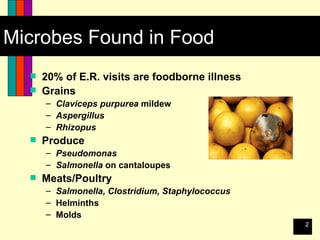
Microbes Found in Food 20% of E.R. visits are foodborne illness  Grains Claviceps purpurea  mildew Aspergillus Rhizopus Produce Pseudomonas   Salmonella  on cantaloupes Meats/Poultry Salmonella, Clostridium, Staphylococcus Helminths Molds
Microbes Found in Food (cont.) Fish/Shellfish Vibrio cholerae, V. parahemolyticus Salmonella Milk Staphylococcus aureus  (milk handling) Pseudomonas Mycobacterium bovis
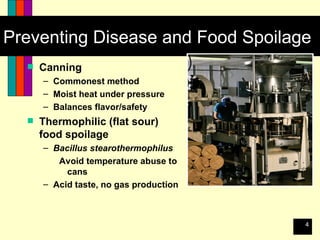
Preventing Disease and Food Spoilage Canning Commonest method Moist heat under pressure Balances flavor/safety Thermophilic (flat sour) food spoilage Bacillus stearothermophilus   Avoid temperature abuse to cans Acid taste, no gas production
Canning Mesophilic food spoilage Improper cooking Flaws in cans Gas often seen Botulism is a risk in canned meats Home canners need to follow USDA guidelines
Food preservation (cont.) Refrigeration/ Freezing Frig. – few days only – bacteriostatic Freezing – also bacteriostatic Softer textures due to ice crystals May enhance thawed food spoilage Drying Removal of 90% or more of moisture Microbes may not be killed Osmotic control with salt/sugar adds bacteriocidal effects
Preventing Disease and Food Spoilage Irradiation Safe but expensive X-rays,  γ -rays Public education is needed Chemical Preservatives Organic acids Ozone Ethylene oxide for dried foods
Pasteurization Destroys vegetative pathogens High Temperature Short Time (HTST) 72 o C, 15 secs Low Temperature Long Time 70 o C, 30 mins Ultra High Temperature (UHT) 88 o C, 3 secs Refrigeration not needed
Microbes as Food Fungi Yeast supplements Limited tolerance by humans Algae Chlorella Shortened food chain Some disease risks from sewage growth Bacteria Spirulina 65% protein South America
Microbes in Food Production Bread Saccharomyces cerevisiae Carbon dioxide bubbles create leavening
Cheese manufacture Add rennin to milk (curd) Add  Lactobacillus  bacteria (anaerobic acid fermenters) Immature cheese – cottage cheese Allow ripening (aging) to decrease water, increase flavor Classified by consistency Very hard – Parmesan, Romano Hard – Cheddar, Swiss Semi-hard – Stilton, Danish Blue Soft – Camembert, Brie
Cheese production Dairy/Cheese
Alcoholic Beverages — Beer Beer/Ales Starch from rice, wheat, barley Malting of grains,  Hop addition Yeast  Saccharomyces cerevisiae Alcohol is filtered, pasteurized (diluted)
Alcoholic Beverages — Wine Wine Monosaccharides from fruit juice Yeast added after sulfites/pasteurization Filtration, clarification, wood aging Spirits Alcoholic mash is “distilled” to boil off alcohol Fruit or grains may be used
Industrial Fermentation Valuable commodities Acetone/ glycerol Vitamins Antibiotics, vaccines Monoclonal Ab,  human insulin (Humulin) Metabolic Processes are modified for commercial production by Altered nutrition/ environment Citric acid from molds in iron free media Altered gene regulation Overproducers of penicillin Recombinant genes Humulin from bacteria
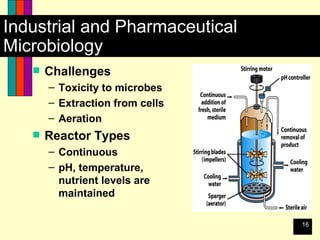
Industrial and Pharmaceutical Microbiology Challenges Toxicity to microbes Extraction from cells Aeration Reactor Types Continuous pH, temperature, nutrient levels are maintained

APPLIED MICROBIOLOGY

  • 1.
  • 2.
    Microbes Found inFood 20% of E.R. visits are foodborne illness Grains Claviceps purpurea mildew Aspergillus Rhizopus Produce Pseudomonas Salmonella on cantaloupes Meats/Poultry Salmonella, Clostridium, Staphylococcus Helminths Molds
  • 3.
    Microbes Found inFood (cont.) Fish/Shellfish Vibrio cholerae, V. parahemolyticus Salmonella Milk Staphylococcus aureus (milk handling) Pseudomonas Mycobacterium bovis
  • 4.
    Preventing Disease andFood Spoilage Canning Commonest method Moist heat under pressure Balances flavor/safety Thermophilic (flat sour) food spoilage Bacillus stearothermophilus Avoid temperature abuse to cans Acid taste, no gas production
  • 5.
    Canning Mesophilic foodspoilage Improper cooking Flaws in cans Gas often seen Botulism is a risk in canned meats Home canners need to follow USDA guidelines
  • 6.
    Food preservation (cont.)Refrigeration/ Freezing Frig. – few days only – bacteriostatic Freezing – also bacteriostatic Softer textures due to ice crystals May enhance thawed food spoilage Drying Removal of 90% or more of moisture Microbes may not be killed Osmotic control with salt/sugar adds bacteriocidal effects
  • 7.
    Preventing Disease andFood Spoilage Irradiation Safe but expensive X-rays, γ -rays Public education is needed Chemical Preservatives Organic acids Ozone Ethylene oxide for dried foods
  • 8.
    Pasteurization Destroys vegetativepathogens High Temperature Short Time (HTST) 72 o C, 15 secs Low Temperature Long Time 70 o C, 30 mins Ultra High Temperature (UHT) 88 o C, 3 secs Refrigeration not needed
  • 9.
    Microbes as FoodFungi Yeast supplements Limited tolerance by humans Algae Chlorella Shortened food chain Some disease risks from sewage growth Bacteria Spirulina 65% protein South America
  • 10.
    Microbes in FoodProduction Bread Saccharomyces cerevisiae Carbon dioxide bubbles create leavening
  • 11.
    Cheese manufacture Addrennin to milk (curd) Add Lactobacillus bacteria (anaerobic acid fermenters) Immature cheese – cottage cheese Allow ripening (aging) to decrease water, increase flavor Classified by consistency Very hard – Parmesan, Romano Hard – Cheddar, Swiss Semi-hard – Stilton, Danish Blue Soft – Camembert, Brie
  • 12.
  • 13.
    Alcoholic Beverages —Beer Beer/Ales Starch from rice, wheat, barley Malting of grains, Hop addition Yeast Saccharomyces cerevisiae Alcohol is filtered, pasteurized (diluted)
  • 14.
    Alcoholic Beverages —Wine Wine Monosaccharides from fruit juice Yeast added after sulfites/pasteurization Filtration, clarification, wood aging Spirits Alcoholic mash is “distilled” to boil off alcohol Fruit or grains may be used
  • 15.
    Industrial Fermentation Valuablecommodities Acetone/ glycerol Vitamins Antibiotics, vaccines Monoclonal Ab, human insulin (Humulin) Metabolic Processes are modified for commercial production by Altered nutrition/ environment Citric acid from molds in iron free media Altered gene regulation Overproducers of penicillin Recombinant genes Humulin from bacteria
  • 16.
    Industrial and PharmaceuticalMicrobiology Challenges Toxicity to microbes Extraction from cells Aeration Reactor Types Continuous pH, temperature, nutrient levels are maintained