 
Food for Life 
Year 9 
N Gibellini 
1
http://lgfl.skoool.ccoo..uukk//kkeeyyssttaaggee44..aassppxx??iidd==885500 
2
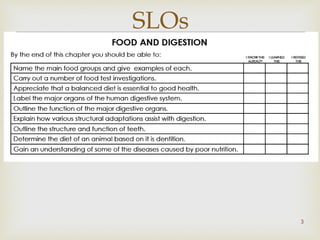
SLOs 
 
3
Introduction 
 
 http://lgfl.skoool.co.uk/content/keystage3/biology/pc/learningsteps/ http://www.bbc.co.uk/learningzone/clips/a-well-balanced- http://e-learningforkids.org/Courses/EN/S0702/launch.html 
4
SLO 
 
Appreciate that a balanced diet is 
essential for good health 
5
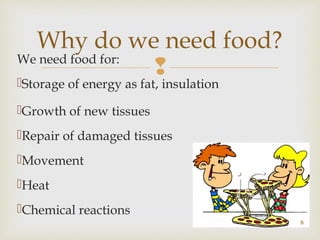
Why do we need food? 
We need food for:  
Storage of energy as fat, insulation 
Growth of new tissues 
Repair of damaged tissues 
Movement 
Heat 
Chemical reactions 
6
Eat Healthy Kids! 
 
7
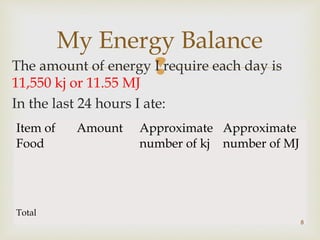
My Energy Balance 
The amount of energy I require each day is 
11,550 kj or 11.55 MJ 
In the last 24 hours I ate: 
Item of 
Food 
Amount Approximate 
number of kj 
Approximate 
number of MJ 
Total 
8
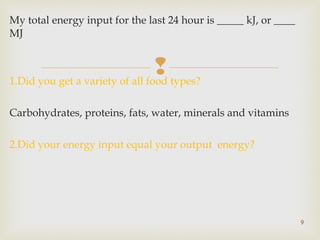
My total energy input for the last 24 hour is _____ kJ, or ____ 
MJ 
 
1.Did you get a variety of all food types? 
Carbohydrates, proteins, fats, water, minerals and vitamins 
2.Did your energy input equal your output energy? 
9
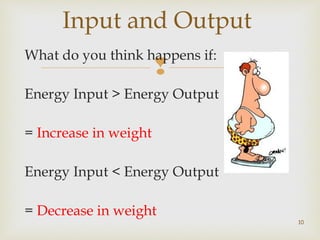
Input and Output 
 What do you think happens if: 
Energy Input > Energy Output 
= Increase in weight 
Energy Input < Energy Output 
= Decrease in weight 
10
 
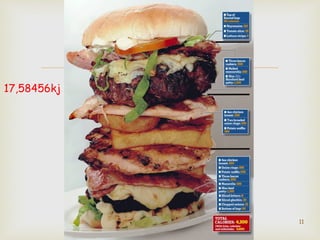
17,58456kj 
11
 
12
Success Criteria 
  In order to stay healthy our diets should be what? 
 Balance of protein, fats and oils and carbohydrates 
 Contain all food types 
 What happens if we do not maintain a healthy diet? 
 Become obese, lack of energy, brittle bones, diabetes 
 Memory loss, malnutrition, 
 How can you tell if you have a healthy diet? 
 Active, clear eyes, reddish gums, focused, strong pink 
fingernails, flexible skin, shiny hair 
 How can you tell if you have an unhealthy diet? 
 Unfocused, difficulty concentrating, limp hair that 
breaks off, brittle fingernails, dull complexion 
13
SLO 
 
Name the main food groups 
and give examples of each 
14
Dietary Intake 
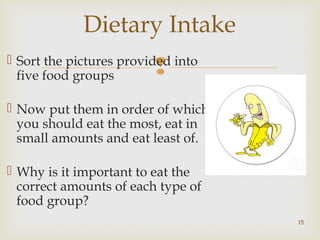
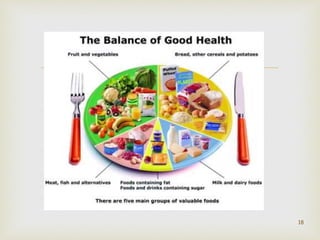
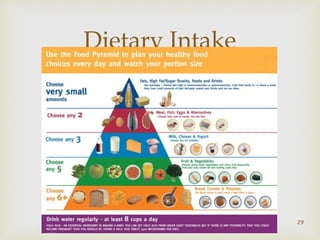
 Sort the pictures provided into 
five food groups 
 Now put them in order of which 
you should eat the most, eat in 
small amounts and eat least of. 
 Why is it important to eat the 
correct amounts of each type of 
food group? 
15
 
16
Food Groups 
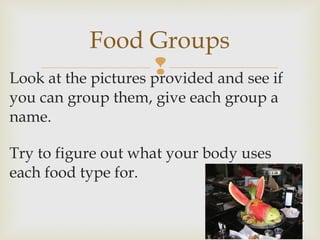
Look at the pictures provided and see if 
you can group them, give each group a 
name. 
Try to figure out what your body uses 
each food type for. 
17
 
18
 
 http://e-learningforkids.org/Courses/EN/S0703/launch.html 
19
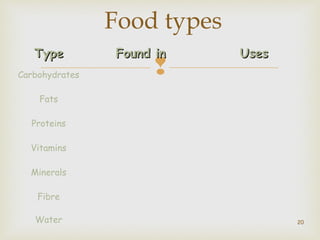
Food types 
TTyyppee FFoouunndd iinn UUsseess 
 
Carbohydrates 
Fats 
Proteins 
Vitamins 
Minerals 
Fibre 
Water 20
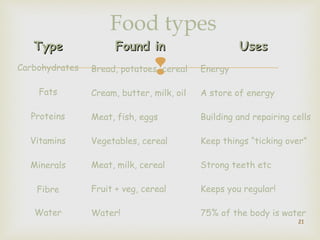
Food types 
TTyyppee FFoouunndd iinn UUsseess 
 
Carbohydrates 
Fats 
Proteins 
Vitamins 
Minerals 
Fibre 
Water 
Bread, potatoes, cereal 
Cream, butter, milk, oil 
Meat, fish, eggs 
Vegetables, cereal 
Meat, milk, cereal 
Fruit + veg, cereal 
Water! 
Energy 
A store of energy 
Building and repairing cells 
Keep things “ticking over” 
Strong teeth etc 
Keeps you regular! 
75% of the body is water 
21
Sort the Food into 
Groups 
 
22
Flush the Food 
 
23
 
 http://lgfl.skoool.co.uk/content/keystage4/biology/pc/modules/24
Important Substances 
Our bodies require certain other substances in 
order to stay healthy: 
 
Iron: used in blood to carry oxygen need for 
respiration which makes energy! (green vege, 
red meat) 
Fibre: keeps intestines clean, helps move the 
food through the intestines (cereals) 
Calcium: helps strengthen our bones (diary 
products) 
Water: helps in metabolic process and keep 
cells alive 
25
Important Substances 
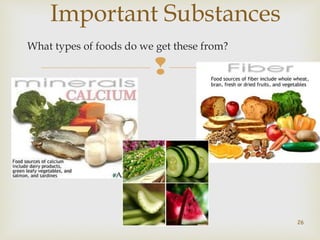
What types of foods do we get these from? 
 
26
Success Criteria 
 
1. Write a definition of the following words: diet, 
nutrition 
2. List the types of foods which contain lots of the 
following 
Carbohydrates, proteins, fats, vitamins 
3. State what each of the above substances do in the 
body. 
4. Complete Scipad page 149-150 and 154-155 
27
SLO 
 
 Gain an understanding of some of 
the diseases caused by poor diet 
28
Dietary Intake 
 
29
Modern diets and health problems 
 
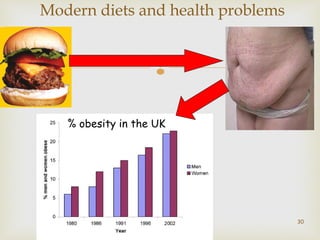
% obesity in the UK 
30
Dietary Problems 
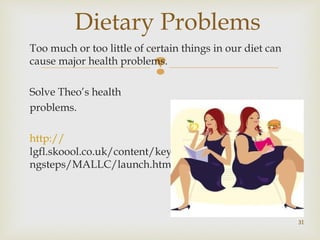
Too much or too little of certain things in our diet can 
cause major health problems. 
 
Solve Theo’s health 
problems. 
http:// 
lgfl.skoool.co.uk/content/keystage3/biology/pc/learni 
ngsteps/MALLC/launch.html 
31
Dietary Problems 
 
Research two of the following dietary problems. 
Obesity, Anorexia, Bulimia, Malnutrition, Anemia, 
Goiter, bowel cancer, diabetes, heart disease, 
dehydration, 
You need to find out: 
What causes the problem 
What effects does the problem cause 
How can the problem be cured? 
32
Dietary Problems 
 
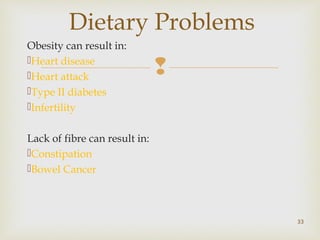
Obesity can result in: 
Heart disease 
Heart attack 
Type II diabetes 
Infertility 
Lack of fibre can result in: 
Constipation 
Bowel Cancer 
33
Tasks 
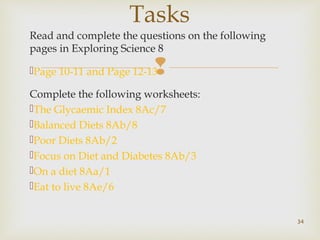
Read and complete the questions on the following 
pages in Exploring Science 8 
Page 10-11 and Page 12-13 
 
Complete the following worksheets: 
The Glycaemic Index 8Ac/7 
Balanced Diets 8Ab/8 
Poor Diets 8Ab/2 
Focus on Diet and Diabetes 8Ab/3 
On a diet 8Aa/1 
Eat to live 8Ae/6 
34
Poor diets 
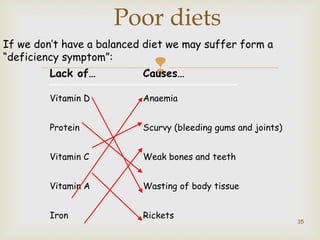
If we don’t have a balanced diet we may suffer form a 
“deficiency symptom”: 
 
Lack of… Causes… 
Vitamin D 
Protein 
Vitamin C 
Vitamin A 
Iron 
Calcium 
Anaemia 
Scurvy (bleeding gums and joints) 
Weak bones and teeth 
Wasting of body tissue 
Rickets 
Poor night vision 
35
Success Criteria 
Explain what a balanced diet is. 
 1. Write a definition of the following words: diet, 
nutrition, energy input, energy out put, food 
pyramid, calcium, fibre, water, 
2. What type of food substance is calcium? 
3. Why is fibre important in the diet? 
4. What makes up the missing mass in most foods? 
5. Complete Scipad page 156 
36
Success Criteria 
Explain what a balanced diet is. 
 
1. Bob has become very overweigh in the last few years. 
He used to play a lot of sports and go to the gym 
everyday, but he injured his knee and cannot play sports 
anymore and he has stopped going to the gym. 
 Bob still eats the same about of food as he did before 
his knee injury. Suggest two reasons why he might 
be overweight now. 
 Suggest two health problems the Bob could have as a 
result of becoming overweight. 
 Suggest two ways in which Bob might lose mass. 
37
SLO 
 
Carry out a number of food test 
investigations 
38
Food Tests 
 
 http://lgfl.skoool.co.uk/content/keystage3/biology 
/pc/learningsteps/FOTLC/launch.html 
 Complete scipad pages 151-153 
39
 
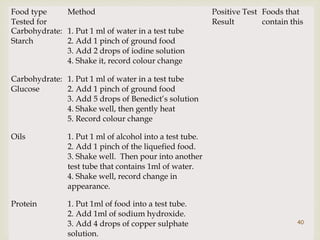
Food type 
Tested for 
Method Positive Test 
Result 
Foods that 
contain this 
Carbohydrate: 
Starch 
1. Put 1 ml of water in a test tube 
2. Add 1 pinch of ground food 
3. Add 2 drops of iodine solution 
4. Shake it, record colour change 
Carbohydrate: 
Glucose 
1. Put 1 ml of water in a test tube 
2. Add 1 pinch of ground food 
3. Add 5 drops of Benedict’s solution 
4. Shake well, then gently heat 
5. Record colour change 
Oils 1. Put 1 ml of alcohol into a test tube. 
2. Add 1 pinch of the liquefied food. 
3. Shake well. Then pour into another 
test tube that contains 1ml of water. 
4. Shake well, record change in 
appearance. 
Protein 1. Put 1ml of food into a test tube. 
2. Add 1ml of sodium hydroxide. 
3. Add 4 drops of copper sulphate 
solution. 
4. Shake well and record colour 
40
Food tests 1 
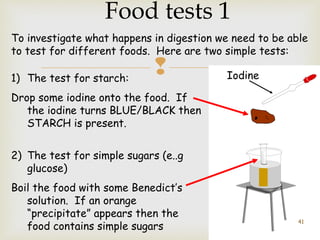
To investigate what happens in digestion we need to be able 
to test for different foods. Here are two simple tests: 
 
1) The test for starch: 
Drop some iodine onto the food. If 
the iodine turns BLUE/BLACK then 
STARCH is present. 
2) The test for simple sugars (e..g 
glucose) 
Boil the food with some Benedict’s 
solution. If an orange 
“precipitate” appears then the 
food contains simple sugars 
Iodine 
41
Food tests 2 
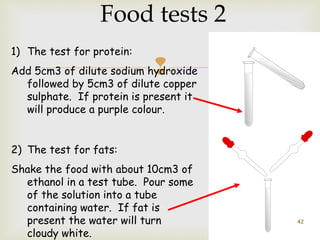
1) The test for protein: 
Add 5cm3 of dilute sodium hydroxide 
 
followed by 5cm3 of dilute copper 
sulphate. If protein is present it 
will produce a purple colour. 
2) The test for fats: 
Shake the food with about 10cm3 of 
ethanol in a test tube. Pour some 
of the solution into a tube 
containing water. If fat is 
present the water will turn 
cloudy white. 
42
Success Criteria 
 
1.Draw a labelled diagram to show how to test 
for protein, starch, sugar and fats 
2.Give the positive results expected for foods 
that contain starch, protein, sugar and fat. 
3.Complete Scipad pages 149-154 
43
SLO 
 
Label the major organs of the 
digestive system 
Outline the main function of the 
digestive organs 
44
Before 
 
 Draw an outline of a body 
 Draw and label the following organs 
 List any organs you don’t know on the side of 
the poster 
Heart, lungs, kidneys , bladder, oesophagus, 
trachea, stomach, liver, gall bladder, large 
intestine, small intestine, pancreas, appendix, 
ureter, urethra, diaphragm, eyes, bile duct, 
larynx 
45
Nutrition 
 
46
Nutrition 
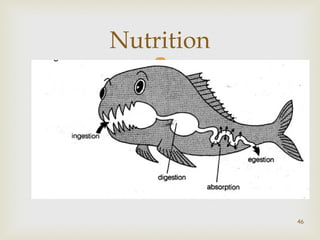
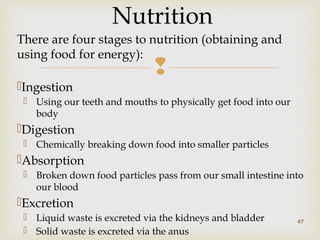
There are four stages to nutrition (obtaining and 
using food for energy): 
 
Ingestion 
 Using our teeth and mouths to physically get food into our 
body 
Digestion 
 Chemically breaking down food into smaller particles 
Absorption 
 Broken down food particles pass from our small intestine into 
our blood 
Excretion 
 Liquid waste is excreted via the kidneys and bladder 
 Solid waste is excreted via the anus 
47
 
48
 
49
Digestion 
What is digestion?  
Turns food into a form that your body 
can use 
Why do we need to digest food? 
Food particles are to large to fit through 
cell membranes and be absorbed and 
passed around the blood stream 
50
 Once you have ingested your food with your teeth, 
enzymes then digest it. 
 Digestion means to break particles. These smaller particles  
down into simpler smaller 
can then pass 
through the cell membrane of the intestines. 
 Digestion first takes place in your mouth where an 
enzyme called amylase (found in your saliva) breaks 
down starch into smaller particles. 
 Digestion is a chemical process that takes place in 
the mouth, stomach and small intestine. 
51
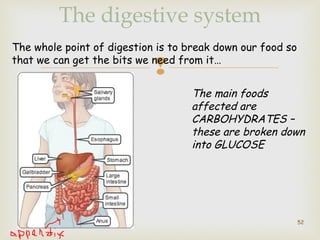
The digestive system 
The whole point of digestion is to break down our food so 
that we can get the bits we need from it… 
 
The main foods 
affected are 
CARBOHYDRATES – 
these are broken down 
into GLUCOSE 
52
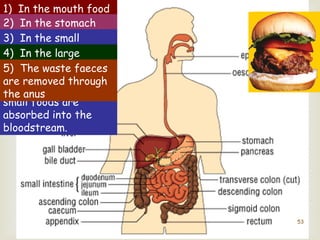
Digestion 
 
1) In the mouth food 
is mechanically 
broked down by the 
teeth and chemically 
broken down by 
enzymes in saliva 
2) In the stomach 
food is chemically 
broked down by 
enzymes and acid is 
produced to kill 
bacteria and help the 
enzymes work 
3) In the small 
4) intestine In the enzymes 
large 
intestine 5) complete The waste excess 
the 
faeces 
digestion are water removed is absorbed 
process through 
and 
into glucose the anus 
the and blood 
other 
small foods are 
absorbed into the 
bloodstream. 
53
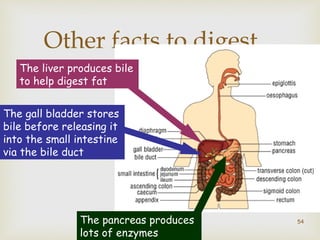
Other facts to digest... 
 
The liver produces bile 
to help digest fat 
The gall bladder stores 
bile before releasing it 
into the small intestine 
via the bile duct 
The pancreas produces 
lots of enzymes 
54
Label the Digestive 
System 
 
 http://www.neok12.com/diagram/Digestive-System- 
01.htm 
 http://nature.ca/discover/exm/blddgstvsystm/index_e. 
cfm 
 http://www.purposegames.com/game/1918 
 http://e-learningforkids. 
org/Courses/Liquid_Animation/Body_P 
arts/Digestive_System/index.html 
55
 
56
 
57
 
58
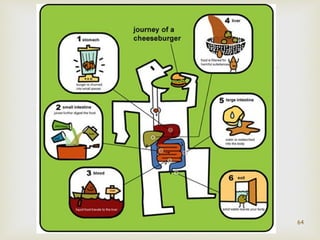
Function of Organs 
Mouth – Chemical break down – amylase 
- Physical break down – teeth 
Gullet/Oesphagus – moves food to stomach 
Stomach – stores food and digestion begins 
Small intestine – digestion continues and nutrients 
are absorbed 
Large Intestine – water is absorbed and feaces are 
compacted 
Anus – wastes are excreted. 
59
 
60
 
61
Rat Dissection 
 Animated Rat dissection [www.keepvid.com].mp4 
 Complete Scipad 157-158, 
62
Success Criteria 
 Draw a flow diagram of the digestive system 
 Where is food first acted on Mouth – saliva contains enzyme  
by enzymes? 
amylase 
 Where are proteins first digested? 
Stomach – protease breaks down proteins 
 Where are carbohydrates first digested? 
Mouth – amylase digests carbohydrates 
 What happens to food in the stomach? 
Broken down and mixed and bacteria killed 
 Why do we need teeth? How do they help with 
digestion? 
Breaks food into smaller parts so can be swallowed and 
so enzymes can act on it quickly 
 What else occurs in the mouth that aids digestion? 
Chemical breakdown, moistening of food 
63
 
64
SLO 
 
Explain how various structural 
adaptations aid digestion 
65
 
66
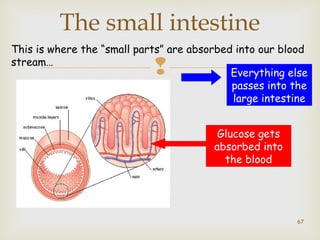
The small intestine 
This is where the “small parts” are absorbed into our blood 
stream… 
 
Everything else 
passes into the 
large intestine 
Glucose gets 
absorbed into 
the blood 
67
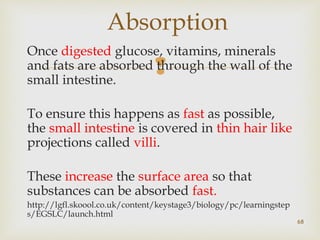
Absorption 
Once digested glucose, vitamins, minerals 
and fats are absorbed  
through the wall of the 
small intestine. 
To ensure this happens as fast as possible, 
the small intestine is covered in thin hair like 
projections called villi. 
These increase the surface area so that 
substances can be absorbed fast. 
http://lgfl.skoool.co.uk/content/keystage3/biology/pc/learningstep 
s/EGSLC/launch.html 
68
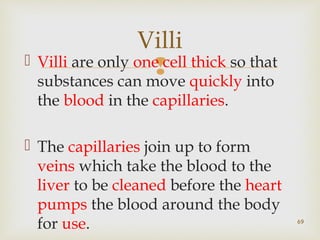
Villi 
 Villi are only one cell thick so that 
substances can move quickly into 
the blood in the capillaries. 
 The capillaries join up to form 
veins which take the blood to the 
liver to be cleaned before the heart 
pumps the blood around the body 
for use. 
69
Success Criteria 
1. Write a definition of the following words: 
absorption, surface area, villi, artery, vein, small 
intestine, large intestine, villus, capillary, 
pressure 
2. Where are most substances absorbed into the blood? 
3. Where are water and minerals absorbed into the blood? 
4. Complete scipad 163-167 
70
Label Race 
 
 http://www.purposegames.com/game/label-the-hearts-parts- 
quiz 
 http://www.neok12.com/diagram/Circulatory-System- 
01.htm 
 http://www.neok12.com/diagram/Digestive-System- 
01.htm 
 http://www.neok12.com/diagram/Photosynthesis- 
01.htm 
71
SLO 
 
 Outline the structure and 
function of teeth 
72
Teeth 
 
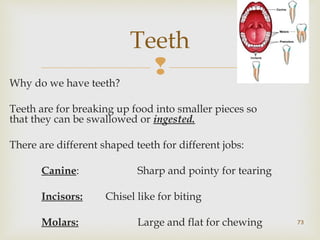
Why do we have teeth? 
Teeth are for breaking up food into smaller pieces so 
that they can be swallowed or ingested. 
There are different shaped teeth for different jobs: 
Canine: Sharp and pointy for tearing 
Incisors: Chisel like for biting 
Molars: Large and flat for chewing 
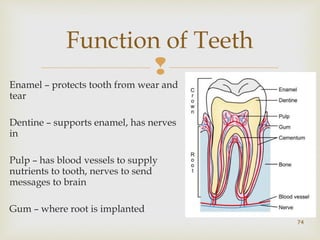
73
 
Enamel – protects tooth from wear and 
tear 
Dentine – supports enamel, has nerves 
in 
Pulp – has blood vessels to supply 
nutrients to tooth, nerves to send 
messages to brain 
Gum – where root is implanted 
74 
Function of Teeth
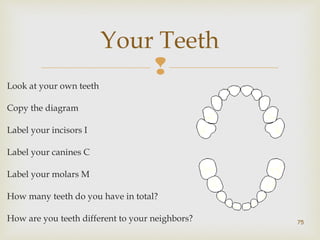
Your Teeth 
 
Look at your own teeth 
Copy the diagram 
Label your incisors I 
Label your canines C 
Label your molars M 
How many teeth do you have in total? 
How are you teeth different to your neighbors? 
75
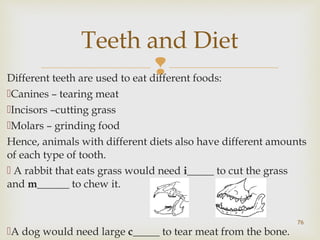
Teeth and Diet 
 Different teeth are used to eat different foods: 
Canines – tearing meat 
Incisors –cutting grass 
Molars – grinding food 
Hence, animals with different diets also have different amounts 
of each type of tooth. 
 A rabbit that eats grass would need i_____ to cut the grass 
and m______ to chew it. 
A dog would need large c_____ to tear meat from the bone. 
76
 
Name the different kinds of teeth and give their 
function 
What kind of teeth do carnivores, omnivores and 
herbivores need most of? 
77 
Success Criteria

Food and Digestion Year 9

  • 1.
     Food forLife Year 9 N Gibellini 1
  • 2.
  • 3.
  • 4.
    Introduction  http://lgfl.skoool.co.uk/content/keystage3/biology/pc/learningsteps/ http://www.bbc.co.uk/learningzone/clips/a-well-balanced- http://e-learningforkids.org/Courses/EN/S0702/launch.html 4
  • 5.
    SLO  Appreciatethat a balanced diet is essential for good health 5
  • 6.
    Why do weneed food? We need food for:  Storage of energy as fat, insulation Growth of new tissues Repair of damaged tissues Movement Heat Chemical reactions 6
  • 7.
  • 8.
    My Energy Balance The amount of energy I require each day is 11,550 kj or 11.55 MJ In the last 24 hours I ate: Item of Food Amount Approximate number of kj Approximate number of MJ Total 8
  • 9.
    My total energyinput for the last 24 hour is _____ kJ, or ____ MJ  1.Did you get a variety of all food types? Carbohydrates, proteins, fats, water, minerals and vitamins 2.Did your energy input equal your output energy? 9
  • 10.
    Input and Output  What do you think happens if: Energy Input > Energy Output = Increase in weight Energy Input < Energy Output = Decrease in weight 10
  • 11.
  • 12.
  • 13.
    Success Criteria  In order to stay healthy our diets should be what?  Balance of protein, fats and oils and carbohydrates  Contain all food types  What happens if we do not maintain a healthy diet?  Become obese, lack of energy, brittle bones, diabetes  Memory loss, malnutrition,  How can you tell if you have a healthy diet?  Active, clear eyes, reddish gums, focused, strong pink fingernails, flexible skin, shiny hair  How can you tell if you have an unhealthy diet?  Unfocused, difficulty concentrating, limp hair that breaks off, brittle fingernails, dull complexion 13
  • 14.
    SLO  Namethe main food groups and give examples of each 14
  • 15.
    Dietary Intake Sort the pictures provided into five food groups  Now put them in order of which you should eat the most, eat in small amounts and eat least of.  Why is it important to eat the correct amounts of each type of food group? 15
  • 16.
  • 17.
    Food Groups Lookat the pictures provided and see if you can group them, give each group a name. Try to figure out what your body uses each food type for. 17
  • 18.
  • 19.
  • 20.
    Food types TTyyppeeFFoouunndd iinn UUsseess  Carbohydrates Fats Proteins Vitamins Minerals Fibre Water 20
  • 21.
    Food types TTyyppeeFFoouunndd iinn UUsseess  Carbohydrates Fats Proteins Vitamins Minerals Fibre Water Bread, potatoes, cereal Cream, butter, milk, oil Meat, fish, eggs Vegetables, cereal Meat, milk, cereal Fruit + veg, cereal Water! Energy A store of energy Building and repairing cells Keep things “ticking over” Strong teeth etc Keeps you regular! 75% of the body is water 21
  • 22.
    Sort the Foodinto Groups  22
  • 23.
  • 24.
  • 25.
    Important Substances Ourbodies require certain other substances in order to stay healthy:  Iron: used in blood to carry oxygen need for respiration which makes energy! (green vege, red meat) Fibre: keeps intestines clean, helps move the food through the intestines (cereals) Calcium: helps strengthen our bones (diary products) Water: helps in metabolic process and keep cells alive 25
  • 26.
    Important Substances Whattypes of foods do we get these from?  26
  • 27.
    Success Criteria  1. Write a definition of the following words: diet, nutrition 2. List the types of foods which contain lots of the following Carbohydrates, proteins, fats, vitamins 3. State what each of the above substances do in the body. 4. Complete Scipad page 149-150 and 154-155 27
  • 28.
    SLO  Gain an understanding of some of the diseases caused by poor diet 28
  • 29.
  • 30.
    Modern diets andhealth problems  % obesity in the UK 30
  • 31.
    Dietary Problems Toomuch or too little of certain things in our diet can cause major health problems.  Solve Theo’s health problems. http:// lgfl.skoool.co.uk/content/keystage3/biology/pc/learni ngsteps/MALLC/launch.html 31
  • 32.
    Dietary Problems  Research two of the following dietary problems. Obesity, Anorexia, Bulimia, Malnutrition, Anemia, Goiter, bowel cancer, diabetes, heart disease, dehydration, You need to find out: What causes the problem What effects does the problem cause How can the problem be cured? 32
  • 33.
    Dietary Problems  Obesity can result in: Heart disease Heart attack Type II diabetes Infertility Lack of fibre can result in: Constipation Bowel Cancer 33
  • 34.
    Tasks Read andcomplete the questions on the following pages in Exploring Science 8 Page 10-11 and Page 12-13  Complete the following worksheets: The Glycaemic Index 8Ac/7 Balanced Diets 8Ab/8 Poor Diets 8Ab/2 Focus on Diet and Diabetes 8Ab/3 On a diet 8Aa/1 Eat to live 8Ae/6 34
  • 35.
    Poor diets Ifwe don’t have a balanced diet we may suffer form a “deficiency symptom”:  Lack of… Causes… Vitamin D Protein Vitamin C Vitamin A Iron Calcium Anaemia Scurvy (bleeding gums and joints) Weak bones and teeth Wasting of body tissue Rickets Poor night vision 35
  • 36.
    Success Criteria Explainwhat a balanced diet is.  1. Write a definition of the following words: diet, nutrition, energy input, energy out put, food pyramid, calcium, fibre, water, 2. What type of food substance is calcium? 3. Why is fibre important in the diet? 4. What makes up the missing mass in most foods? 5. Complete Scipad page 156 36
  • 37.
    Success Criteria Explainwhat a balanced diet is.  1. Bob has become very overweigh in the last few years. He used to play a lot of sports and go to the gym everyday, but he injured his knee and cannot play sports anymore and he has stopped going to the gym.  Bob still eats the same about of food as he did before his knee injury. Suggest two reasons why he might be overweight now.  Suggest two health problems the Bob could have as a result of becoming overweight.  Suggest two ways in which Bob might lose mass. 37
  • 38.
    SLO  Carryout a number of food test investigations 38
  • 39.
    Food Tests   http://lgfl.skoool.co.uk/content/keystage3/biology /pc/learningsteps/FOTLC/launch.html  Complete scipad pages 151-153 39
  • 40.
     Food type Tested for Method Positive Test Result Foods that contain this Carbohydrate: Starch 1. Put 1 ml of water in a test tube 2. Add 1 pinch of ground food 3. Add 2 drops of iodine solution 4. Shake it, record colour change Carbohydrate: Glucose 1. Put 1 ml of water in a test tube 2. Add 1 pinch of ground food 3. Add 5 drops of Benedict’s solution 4. Shake well, then gently heat 5. Record colour change Oils 1. Put 1 ml of alcohol into a test tube. 2. Add 1 pinch of the liquefied food. 3. Shake well. Then pour into another test tube that contains 1ml of water. 4. Shake well, record change in appearance. Protein 1. Put 1ml of food into a test tube. 2. Add 1ml of sodium hydroxide. 3. Add 4 drops of copper sulphate solution. 4. Shake well and record colour 40
  • 41.
    Food tests 1 To investigate what happens in digestion we need to be able to test for different foods. Here are two simple tests:  1) The test for starch: Drop some iodine onto the food. If the iodine turns BLUE/BLACK then STARCH is present. 2) The test for simple sugars (e..g glucose) Boil the food with some Benedict’s solution. If an orange “precipitate” appears then the food contains simple sugars Iodine 41
  • 42.
    Food tests 2 1) The test for protein: Add 5cm3 of dilute sodium hydroxide  followed by 5cm3 of dilute copper sulphate. If protein is present it will produce a purple colour. 2) The test for fats: Shake the food with about 10cm3 of ethanol in a test tube. Pour some of the solution into a tube containing water. If fat is present the water will turn cloudy white. 42
  • 43.
    Success Criteria  1.Draw a labelled diagram to show how to test for protein, starch, sugar and fats 2.Give the positive results expected for foods that contain starch, protein, sugar and fat. 3.Complete Scipad pages 149-154 43
  • 44.
    SLO  Labelthe major organs of the digestive system Outline the main function of the digestive organs 44
  • 45.
    Before  Draw an outline of a body  Draw and label the following organs  List any organs you don’t know on the side of the poster Heart, lungs, kidneys , bladder, oesophagus, trachea, stomach, liver, gall bladder, large intestine, small intestine, pancreas, appendix, ureter, urethra, diaphragm, eyes, bile duct, larynx 45
  • 46.
  • 47.
    Nutrition There arefour stages to nutrition (obtaining and using food for energy):  Ingestion  Using our teeth and mouths to physically get food into our body Digestion  Chemically breaking down food into smaller particles Absorption  Broken down food particles pass from our small intestine into our blood Excretion  Liquid waste is excreted via the kidneys and bladder  Solid waste is excreted via the anus 47
  • 48.
  • 49.
  • 50.
    Digestion What isdigestion?  Turns food into a form that your body can use Why do we need to digest food? Food particles are to large to fit through cell membranes and be absorbed and passed around the blood stream 50
  • 51.
     Once youhave ingested your food with your teeth, enzymes then digest it.  Digestion means to break particles. These smaller particles  down into simpler smaller can then pass through the cell membrane of the intestines.  Digestion first takes place in your mouth where an enzyme called amylase (found in your saliva) breaks down starch into smaller particles.  Digestion is a chemical process that takes place in the mouth, stomach and small intestine. 51
  • 52.
    The digestive system The whole point of digestion is to break down our food so that we can get the bits we need from it…  The main foods affected are CARBOHYDRATES – these are broken down into GLUCOSE 52
  • 53.
    Digestion  1)In the mouth food is mechanically broked down by the teeth and chemically broken down by enzymes in saliva 2) In the stomach food is chemically broked down by enzymes and acid is produced to kill bacteria and help the enzymes work 3) In the small 4) intestine In the enzymes large intestine 5) complete The waste excess the faeces digestion are water removed is absorbed process through and into glucose the anus the and blood other small foods are absorbed into the bloodstream. 53
  • 54.
    Other facts todigest...  The liver produces bile to help digest fat The gall bladder stores bile before releasing it into the small intestine via the bile duct The pancreas produces lots of enzymes 54
  • 55.
    Label the Digestive System   http://www.neok12.com/diagram/Digestive-System- 01.htm  http://nature.ca/discover/exm/blddgstvsystm/index_e. cfm  http://www.purposegames.com/game/1918  http://e-learningforkids. org/Courses/Liquid_Animation/Body_P arts/Digestive_System/index.html 55
  • 56.
  • 57.
  • 58.
  • 59.
    Function of Organs Mouth – Chemical break down – amylase - Physical break down – teeth Gullet/Oesphagus – moves food to stomach Stomach – stores food and digestion begins Small intestine – digestion continues and nutrients are absorbed Large Intestine – water is absorbed and feaces are compacted Anus – wastes are excreted. 59
  • 60.
  • 61.
  • 62.
    Rat Dissection Animated Rat dissection [www.keepvid.com].mp4  Complete Scipad 157-158, 62
  • 63.
    Success Criteria Draw a flow diagram of the digestive system  Where is food first acted on Mouth – saliva contains enzyme  by enzymes? amylase  Where are proteins first digested? Stomach – protease breaks down proteins  Where are carbohydrates first digested? Mouth – amylase digests carbohydrates  What happens to food in the stomach? Broken down and mixed and bacteria killed  Why do we need teeth? How do they help with digestion? Breaks food into smaller parts so can be swallowed and so enzymes can act on it quickly  What else occurs in the mouth that aids digestion? Chemical breakdown, moistening of food 63
  • 64.
  • 65.
    SLO  Explainhow various structural adaptations aid digestion 65
  • 66.
  • 67.
    The small intestine This is where the “small parts” are absorbed into our blood stream…  Everything else passes into the large intestine Glucose gets absorbed into the blood 67
  • 68.
    Absorption Once digestedglucose, vitamins, minerals and fats are absorbed  through the wall of the small intestine. To ensure this happens as fast as possible, the small intestine is covered in thin hair like projections called villi. These increase the surface area so that substances can be absorbed fast. http://lgfl.skoool.co.uk/content/keystage3/biology/pc/learningstep s/EGSLC/launch.html 68
  • 69.
    Villi  Villiare only one cell thick so that substances can move quickly into the blood in the capillaries.  The capillaries join up to form veins which take the blood to the liver to be cleaned before the heart pumps the blood around the body for use. 69
  • 70.
    Success Criteria 1.Write a definition of the following words: absorption, surface area, villi, artery, vein, small intestine, large intestine, villus, capillary, pressure 2. Where are most substances absorbed into the blood? 3. Where are water and minerals absorbed into the blood? 4. Complete scipad 163-167 70
  • 71.
    Label Race   http://www.purposegames.com/game/label-the-hearts-parts- quiz  http://www.neok12.com/diagram/Circulatory-System- 01.htm  http://www.neok12.com/diagram/Digestive-System- 01.htm  http://www.neok12.com/diagram/Photosynthesis- 01.htm 71
  • 72.
    SLO  Outline the structure and function of teeth 72
  • 73.
    Teeth  Whydo we have teeth? Teeth are for breaking up food into smaller pieces so that they can be swallowed or ingested. There are different shaped teeth for different jobs: Canine: Sharp and pointy for tearing Incisors: Chisel like for biting Molars: Large and flat for chewing 73
  • 74.
     Enamel –protects tooth from wear and tear Dentine – supports enamel, has nerves in Pulp – has blood vessels to supply nutrients to tooth, nerves to send messages to brain Gum – where root is implanted 74 Function of Teeth
  • 75.
    Your Teeth  Look at your own teeth Copy the diagram Label your incisors I Label your canines C Label your molars M How many teeth do you have in total? How are you teeth different to your neighbors? 75
  • 76.
    Teeth and Diet  Different teeth are used to eat different foods: Canines – tearing meat Incisors –cutting grass Molars – grinding food Hence, animals with different diets also have different amounts of each type of tooth.  A rabbit that eats grass would need i_____ to cut the grass and m______ to chew it. A dog would need large c_____ to tear meat from the bone. 76
  • 77.
     Name thedifferent kinds of teeth and give their function What kind of teeth do carnivores, omnivores and herbivores need most of? 77 Success Criteria

Editor's Notes

  • #16 http://www.dailymail.co.uk/femail/food/article-1351147/The-burger-laden-days-calories--actual-size.html
  • #69 http://lgfl.skoool.co.uk/content/keystage3/biology/pc/learningsteps/EGSLC/launch.html
  • #71 2. amaylase, 3. Starch is too big a molecule to fit through membranes so it have to be broken down into sugar which can then pass through the membrane into the blood stream. Pressure keeps the villi up and open to increase surface area.