NUTRITIONAL
BIOCHEMISTRY (BCH 309)
OUTLINES;
•FOOD NUTRIENT
• NUTRITIVE VALUE OF
FOODS
• ENERGY VALUES OF
FOOD AND ENERGY
EXPNDITURE BY
MAMMALS
• ETIOLOGY OF
MALNUTRITIO
11/29/201
7
BY
DR ODESANMI E.O
2.
NUTRITION
Nutrition isthe science of food and its relationship
to health.
Nutrition refers to nourishment that sustains life.
Pike and Brown, 1984 defined it as “the science that
interprets the relationship of food to the functioning
of living organism.
11/29/201
7
2
3.
FOOD NUTRIENTS
Foodnutrients are chemical constituents in the
food we eat that are essential for life and must be
supplied to the body in suitable amount. They
provide the energy needed for the metabolic
processes in the body.
The six essential food nutrients are: proteins, fats,
carbohydrate, vitamins, minerals and water.
classified into macronutrients
The essential food nutrients may be
further
and
micronutrients.
11/29/201
7
3
4.
MACRONUTRIENTS
11/29/201
7
4
Macronutrients arerequired in relatively large
amounts to fuel the body and are also required
for growth and maintenance of the body.
carbohydrates
proteins
fats
5.
MICRONUTRIENTS
Micronutrients, asopposed to
macronutrients are made up of
vitamins andminerals which are required
insmall quantities to ensure normal
metabolism, growth and physical well-being.
Minerals: these comprise microminerals or trace
elements (Fe, Cu, F, Zn, I, Se, Mn, Mo, Cr, Co and B)
and macrominerals (Na, Mg, K, Ca, P, S and Cl)
vitamins (A, B, C, D, E, K)
11/29/201
7
5
6.
CARBOHYDRATES
Carbohydrates Cx (H2O) y / (CH2O) n are made up of
carbon, hydrogen and oxygen and are burned
during metabolism to produce energy. This group
is a major energy source to the body.
Carbohydrates are present in the form of sugars,
starch (polymers of sugars) and fiber (Non-Starch
Polysaccharide- NSP).
In the diet of poor people, especially in the tropics,
up to 85% of the energy may come from this source.
On the other hand, in the diet of the rich people in
many countries the proportion may be as low as
40%.
11/29/201
7
6
7.
CARBOHYDRATES
Carbohydrates arecomponents of body substances
needed for the regulation of body processes.
Heparin, which prevents blood from clotting,
contains carbohydrate.
Ribose, another carbohydrate is part of
Deoxyribonucleic acid (DNA) and ribonucleic acid
RNA), the substance that carry the hereditary
factors in the cell.
11/29/201
7
7
8.
CARBOHYDRATES
Other naturally
occurringinterest in foods
include –
carbohydrates
of
glucose, fructose (monosaccharides- are
simplest form of carbohydrate and cannot be
hydrolyzed further.)
sucrose, maltose and lactose (disaccharides)
and
starch (polysaccharide).
11/29/201
7
8
9.
DIGESTION AND ABSORPTIONOF
CARBOHYDRATES
The digestion of carbohydrates begins in the
mouth by amylase produced by the salivary
glands. No carbohydrate digestion takes place in
the stomach. Digestion occurs mainly in the
small intestine through the action of pancreatic
and intestinal juices:
Amylase
Lactase
Sucrase
Maltase
11/29/201
7
9
10.
The twohormones, which control the
metabolism of carbohydrates, are insulin and
glucagon
Insulin is secreted by the beta cells of the islets
of
Langerhans
glucagon is secreted by the alpha cells of
the islets of langerhans
11/29/201
7
10
11.
FUNCTIONS OF CARBOHYDRATES
Major
energy
providing nutrient in the diet. It
provides 4kcal/g
The dietary fiber/non-digestible carbohydrate help in
various ways.
Different starches are used as thickening agents e.g.
corn flour
Pentoses are components of DNA and RNA.
11/29/201
7
11
12.
FOOD SOURCES
Sugarsare found naturally in fruits, milk, honey
and the sap of certain trees.
Starch is found in: grains (rice, corn/maize, wheat,
millet, oats), roots and tubers (potatoes, cassava,
yams and certain fruits (breadfruit,
banana/plantain, water chestnut).
Foods containing fiber are: wholegrain cereals,
starchy roots, fruits, most vegetables, beans, peas
and other legumes
11/29/201
7
12
13.
LIPIDS
Lipids consistof a broad group of compounds
that are generally soluble in organic solvents but
insoluble in water.
They are major components of adipose tissue,
and together with proteins and carbohydrates,
they constitute the principal structural
components of all living cells.
Fatty acids in lipids can be grouped into
unsaturated fatty acids (including
monounsaturated and polyunsaturated) and
saturated fatty acids.
11/29/201
7
13
14.
LIPIDS
Sources ofmonounsaturated fats are: canola
oil; peanut oil; olive oil; avocados; nuts, such as
almonds, hazelnuts and pecans; and seeds such as
pumpkin and sesame seeds.
Sources of polyunsaturated fats are: sunflower
oil; corn oil; soybean oil; flaxseed oil; walnuts,
flaxseeds; and fish. Fatty fishes, including salmon,
trout, mackerel, herring, sardines,
11/29/201
7
14
15.
DIGESTION OF LIPIDS
Inthe mouth
Enzyme – lingual lipase
End products – diglycerides
In the stomach
Enzyme – Gastric lipase
End products – Fatty acids, glycerol, diglycerides
and monoglycerides
In small intestine
Enzyme – Pancreatic lipase
End products – monoglycerides, fatty acids,
glycerol
11/29/201
7
15
16.
FUNCTIONS OF LIPIDS
Help in absorption of fat-soluble vitamins.
Essential fatty acids (EFA) are important for
the
function and structure of body cell membranes.
MUFAs and PUFAs have beneficial effects such as
lowering risk of coronary heart disease, cancer, cataract,
and other inflammatory disorders.
act as an insulator and padding for vital organs.
11/29/201
7
16
17.
PROTEINS
PROTEINS aremade up of ‘building blocks’ called
amino acids, composed basically of carbon, hydrogen,
oxygen and nitrogen (amino group).
Protein Digestion
Digestion of protein starts from the stomach and finally
completes in the small intestine.
The proteolytic enzymes have the power to attack native
proteins and must be secreted in an inactive form to
prevent damage to the tissues where they are formed.
Proteins on hydrolysis break down to polypeptides
and finally into amino acids.
11/29/201
7
17
18.
PROTEINS
11/29/201
7
Proteolytic enzymes
Pepsinogen
Trypsinogen
Chemotrypsinogen
Functions of proteins
1.Required for general growth, maintenance & repair of body
tissues.
2. It serves as an energy source, It provides 4kcal/g
3.Required for the supply of the essential amino acids which
cannot be synthesized by the body
4.Required to build new tissue, particularly during the rapid
growth period of infancy and early childhood,
during18 pregnancy and nursing, and after infections or
injuries.
19.
WATER
Water isthe most abundant and surely the most
frequently overlooked component in food.
It is estimated that over 35% of our total water
intake comes from the moisture in the food we
consume.
The water content of food varies, it may be as low as
0% in vegetable oils and as high as 99% in some
vegetables and fruit.
Water by itself is free of calories and plain water
does not contain nutritive substance, but it may be
an ingredient itself in food.
11/29/201
7
19
20.
MICRONUTRIENTS
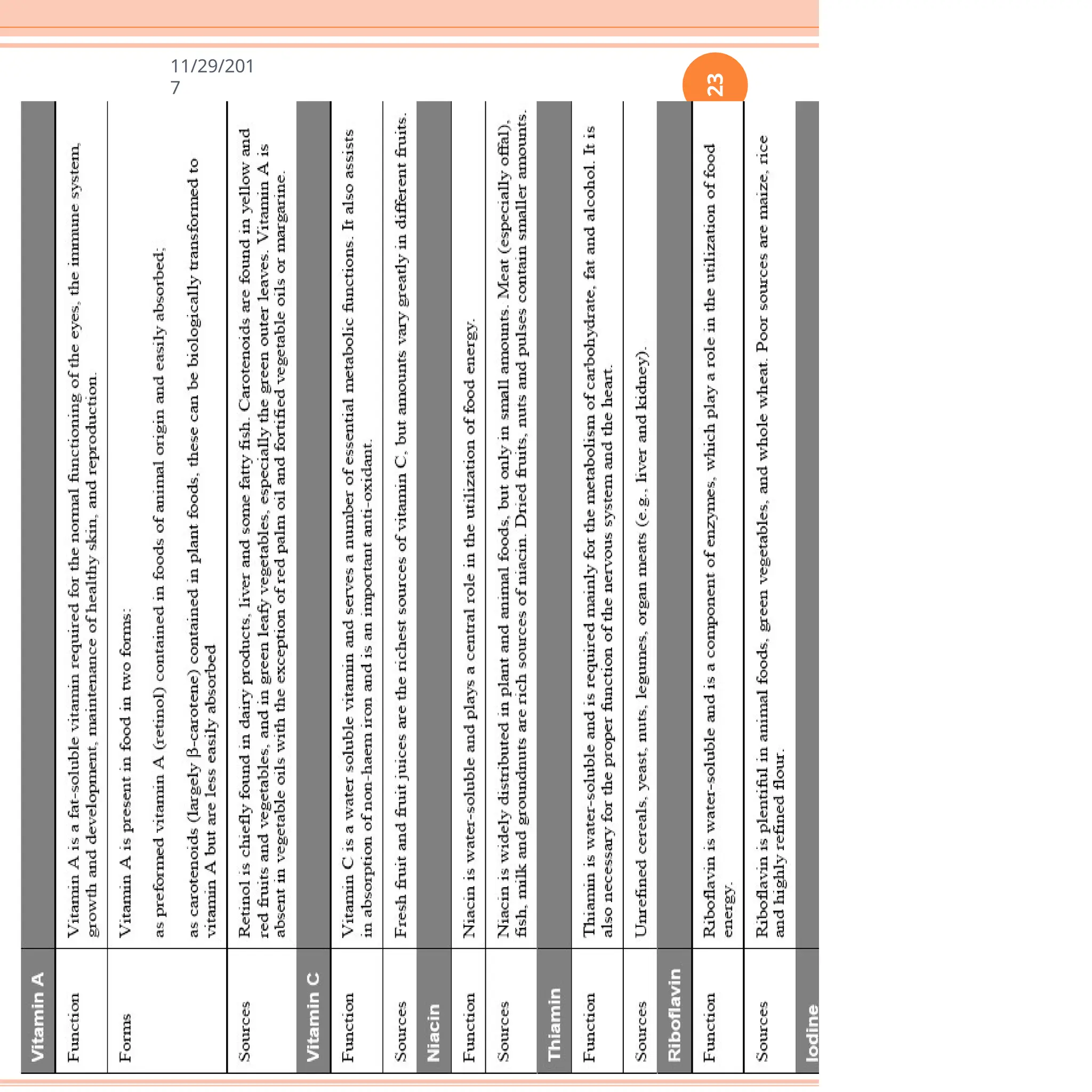
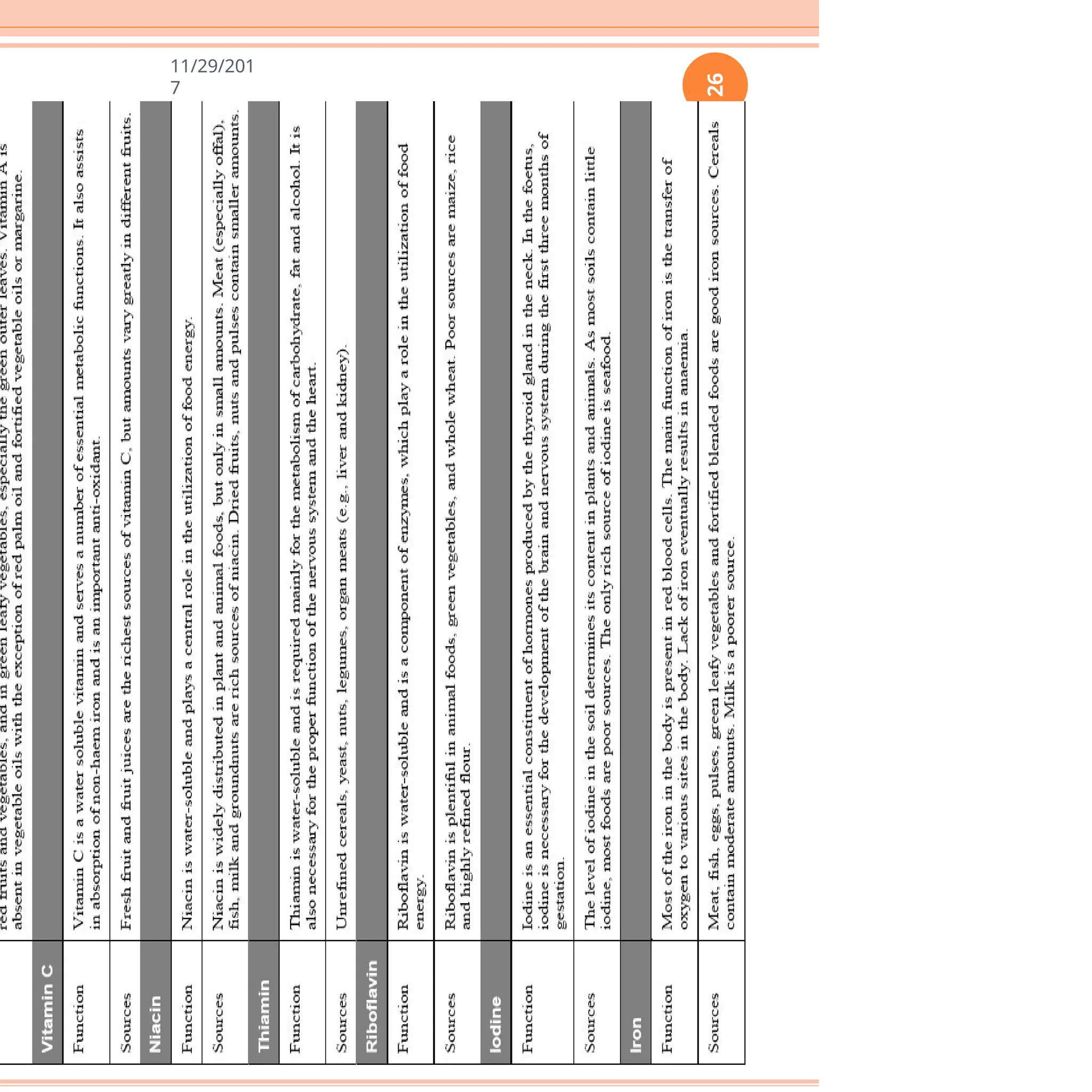
Vitamins: aredefined as organic compounds, other
than any of the amino acids, fatty acids and
carbohydrates that are necessary in small amounts in
the diet of higher animals for growth, maintenance of
health and reproduction.
13 essential vitamins:
Vitamin A (Retinol)
Vitamin B1 (Thiamine)
Vitamin B2 (Riboflavin)
Vitamin B6 (pyridoxine)
11/29/201
7
20
21.
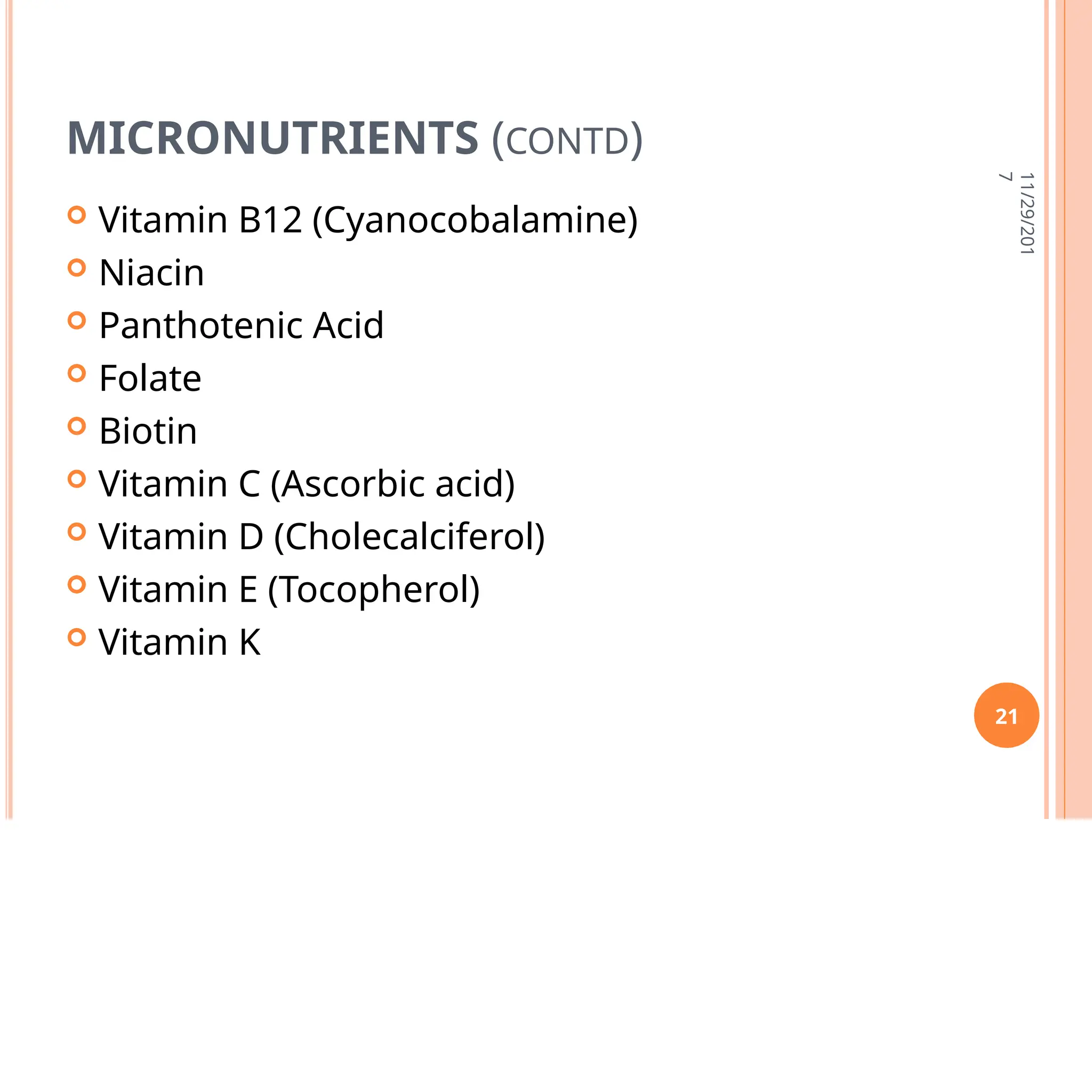
MICRONUTRIENTS (CONTD)
VitaminB12 (Cyanocobalamine)
Niacin
Panthotenic Acid
Folate
Biotin
Vitamin C (Ascorbic acid)
Vitamin D (Cholecalciferol)
Vitamin E (Tocopherol)
Vitamin K
11/29/201
7
21
22.
FUNCTIONS OF VITAMINS:
promote growth
promote reproduction
promote health & vigor
promote nervous activity
promote normal appetite
promote resistance to
infection.
promote digestion
11/29/201
7
22
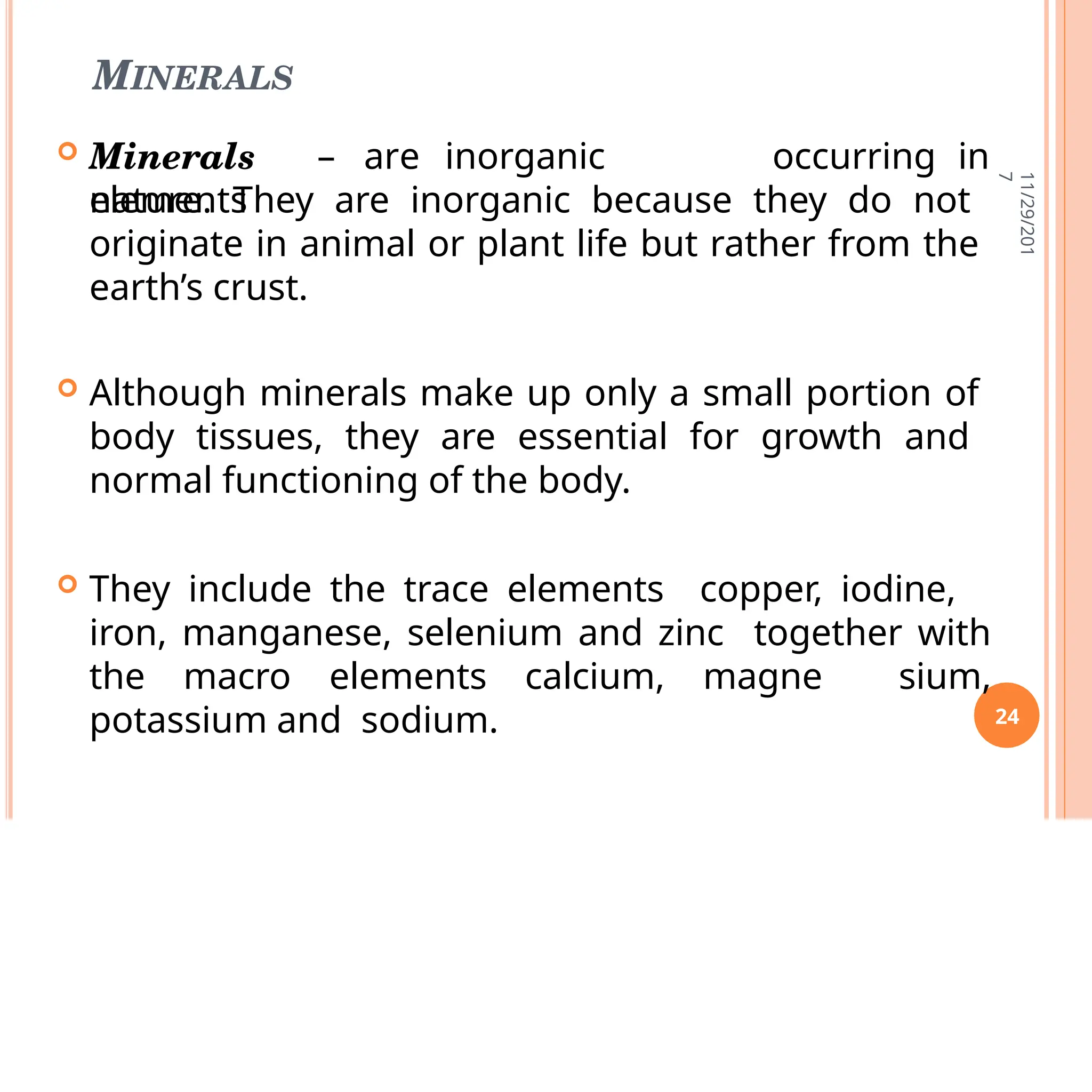
MINERALS
Minerals –are inorganic
elements
occurring in
nature. They are inorganic because they do not
originate in animal or plant life but rather from the
earth’s crust.
Although minerals make up only a small portion of
body tissues, they are essential for growth and
normal functioning of the body.
They include the trace elements copper, iodine,
iron, manganese, selenium and zinc together with
the macro elements calcium, magne sium,
potassium and sodium.
11/29/201
7
24
25.
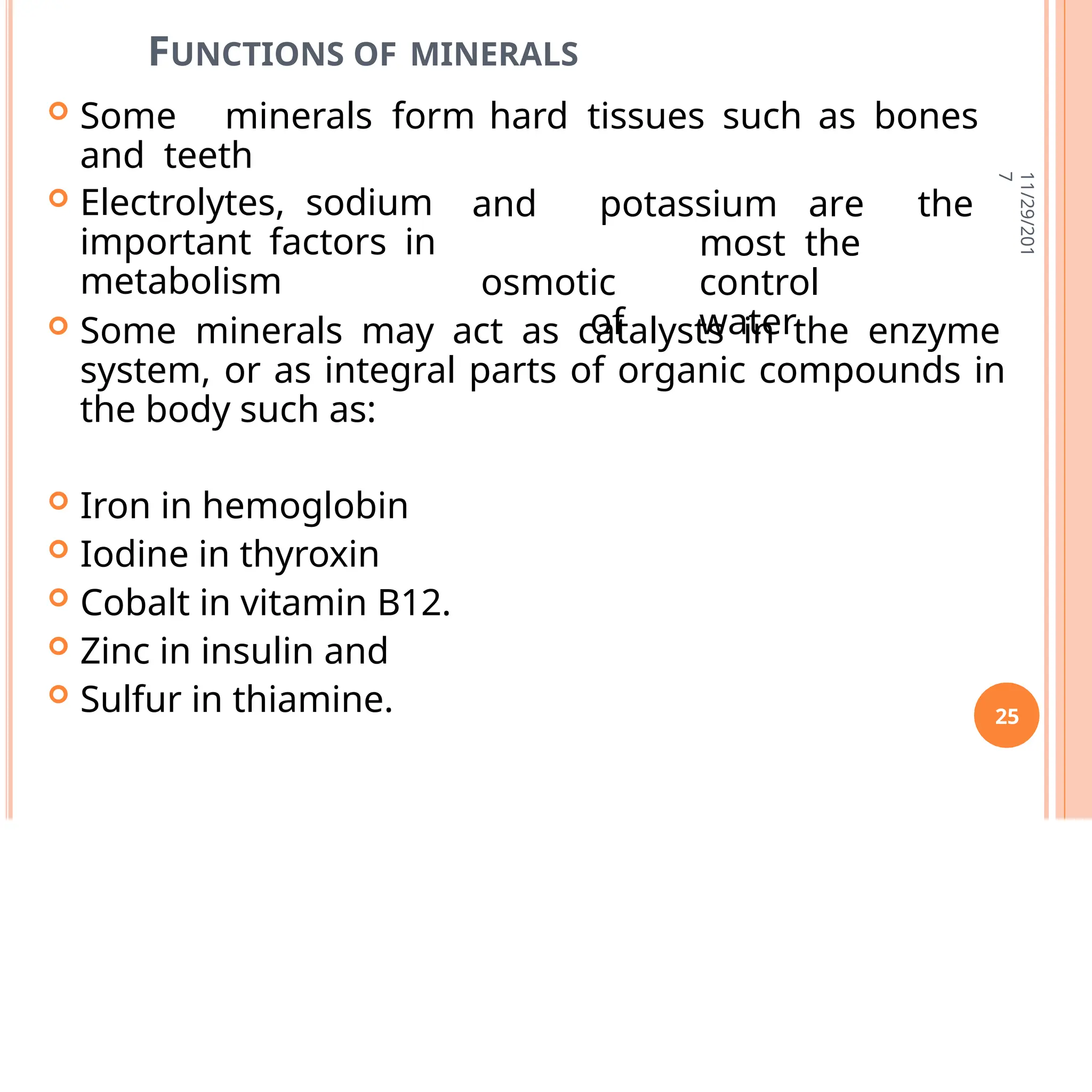
FUNCTIONS OF MINERALS
Some minerals form hard tissues such as bones
and teeth
Electrolytes, sodium
important factors in
metabolism
and potassium are the
most the
osmotic control
of water
Some minerals may act as catalysts in the enzyme
system, or as integral parts of organic compounds in
the body such as:
Iron in hemoglobin
Iodine in thyroxin
Cobalt in vitamin B12.
Zinc in insulin and
Sulfur in thiamine.
11/29/201
7
25